
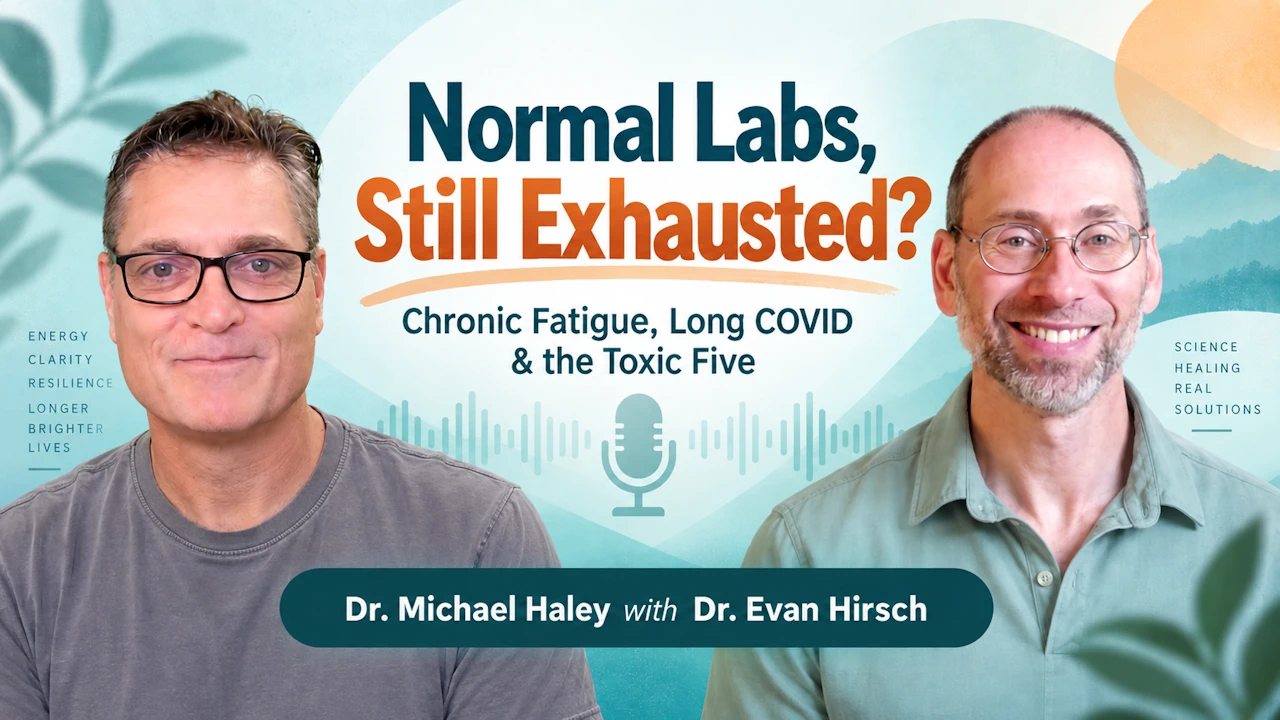
Why can someone feel profoundly exhausted even when routine blood work does not provide a clear explanation? In this episode of The Dr. Haley Show, Dr. Michael Haley talks with Evan H. Hirsch, MD, known as the EnergyMD, about chronic fatigue syndrome (ME/CFS), Long COVID, post-exertional malaise, environmental exposures, nervous-system regulation, and the four-step process Dr. Hirsch uses in his work.
Dr. Hirsch also explains the framework he calls the “Toxic Five”—heavy metals, chemicals, mold, infections, and nervous-system dysfunction or trauma—and why he believes some people remain symptomatic even after standard testing appears normal. The conversation explores where his approach overlaps with functional medicine, where it goes beyond it, and how he uses symptoms, clinical history, treatment response, and selected laboratory testing to guide care.
“Chronic fatigue, you never get back to baseline no matter how much you sleep.”
Evan H. Hirsch, MD
Watch the Interview
Listen to the Podcast
Resources
- Dr. Evan Hirsch / EnergyMD Method: energymdmethod.com
- Fix Your Fatigue Masterclass: fixyourfatigue.com
- Book — Fix Your Fatigue: Book information and access
- EnergyMD Podcast: EnergyMD Podcast episodes
- Watch on YouTube: https://www.youtube.com/watch?v=OL5s38lMXQ0
Quick Takeaway
Dr. Evan Hirsch’s central message is that persistent fatigue may require looking beyond a diagnosis or a single laboratory result. Drawing from his own five-year experience with chronic fatigue, he describes a clinical approach that considers nutritional and hormonal deficiencies, environmental exposures, infections, and nervous-system regulation.
His “Toxic Five” framework—heavy metals, chemicals, mold, infections, and nervous-system dysfunction or trauma—is his clinical model for understanding possible contributors to chronic fatigue and Long COVID. In this conversation, Dr. Haley also challenges him on the limits of testing, how treatment reactions should be interpreted, and how patients can think about progress over time.
ENJOYING THIS CONVERSATION?
Get the Next Episode in Your Inbox
Get notified when a new episode of The Dr. Haley Show is published, plus occasional highlights and resources worth exploring.
By subscribing, you agree to receive email from The Dr. Haley Show. Unsubscribe anytime.
Episode Timestamps
- 00:00 — What chronic fatigue really feels like
- 00:49 — Normal labs but still exhausted?
- 03:18 — How Dr. Hirsch found his specialty
- 05:17 — Functional vs. conventional medicine
- 10:40 — Dr. Hirsch’s own chronic fatigue story
- 13:10 — What is chronic fatigue syndrome / ME/CFS?
- 15:51 — Long COVID vs. chronic fatigue
- 17:59 — Can spike protein be measured?
- 20:12 — Nicotine, spike protein, and Long COVID
- 24:46 — Why do some people develop Long COVID?
- 28:01 — The “Toxic Five” explained
- 29:11 — Why Dr. Hirsch questions some lab testing
- 32:10 — Can response to treatment reveal a cause?
- 33:29 — Treatment reaction or adverse reaction?
- 36:42 — The four-step EnergyMD Method
- 37:51 — Step 2: Replace deficiencies
- 40:11 — Step 3: “Open the exit pathways”
- 40:45 — Step 4: Address toxicities and infections
- 42:10 — Nervous-system retraining
- 47:14 — What surprised Dr. Hirsch most
- 50:47 — Keep asking “why”
- 53:03 — Can everyone recover?
- 54:45 — Measuring progress
- 57:10 — Where to learn more
Episode Summary
Dr. Evan Hirsch shares how his own five-year experience with chronic fatigue changed the direction of his medical career. Already practicing functional medicine, he says he eventually began studying environmental medicine, chronic infections, mold, heavy metals, chemicals, and nervous-system retraining after the approaches he had previously used were not enough to restore his own energy.
The discussion begins by defining chronic fatigue as more than ordinary tiredness. Dr. Hirsch describes fatigue that is not relieved by rest and discusses other commonly associated symptoms, including post-exertional malaise, brain fog, body pain, sleep problems, and orthostatic symptoms. He then compares chronic fatigue syndrome (ME/CFS) with Long COVID and explains why he believes the two conditions can share underlying contributors.
A major part of the interview focuses on Dr. Hirsch’s “Toxic Five” framework and his view that laboratory testing can sometimes miss clinically meaningful problems. He explains why he now relies heavily on a patient’s history, symptoms, response to treatment, and selected testing rather than laboratory results alone. Dr. Haley presses him on an important question: how can someone distinguish a beneficial treatment reaction from a sign that a treatment is simply causing harm?
Dr. Hirsch also walks through his four-step EnergyMD Method: identify possible causes, replace deficiencies, support what he calls the body’s “exit pathways,” and then address toxicities, infections, and nervous-system dysfunction over time. The conversation closes with nervous-system retraining, mindset, breathwork, vagal practices, recovery expectations, and how Dr. Hirsch tracks improvement in people dealing with long-term fatigue.
Key Takeaways
- Chronic fatigue is different from ordinary tiredness. Dr. Hirsch describes it as fatigue that does not return to baseline with normal rest and sleep, often accompanied by post-exertional malaise, brain fog, pain, and sleep disturbance.
- ME/CFS and Long COVID can look very similar. In the interview, Dr. Hirsch discusses overlapping symptoms while also describing Long COVID as a condition that follows SARS-CoV-2 infection or, in his clinical framework, symptoms he associates with spike-protein exposure.
- The “Toxic Five” is Dr. Hirsch’s clinical framework. He groups potential contributors into heavy metals, chemicals, mold, infections, and nervous-system dysfunction or trauma.
- Dr. Hirsch is skeptical of relying on laboratory testing alone. He explains that some tests may be negative even when he remains clinically suspicious of a particular contributor, and he sometimes uses symptoms and treatment response as additional information.
- His four-step process is sequential. It begins with identifying possible causes, then replacing deficiencies, supporting elimination pathways, and finally addressing the Toxic Five over a longer period of time.
- Nervous-system regulation is a major part of his approach. Dr. Hirsch discusses gratitude, visualization, changing limiting beliefs, breathwork, humming, gargling, vagal practices, and other methods intended to support parasympathetic activity.
- Recovery may be slow and should be tracked. Dr. Hirsch tells patients to expect improvement over many months rather than days or weeks and says he monitors energy and symptom scores over time.
Note: Several ideas discussed in this episode—including Dr. Hirsch’s views on the Toxic Five, spike protein, detoxification, treatment without confirmatory testing, and interpretation of treatment reactions—reflect his clinical framework and opinions. This conversation is educational and is not a substitute for individualized medical diagnosis or treatment.
Medical Disclaimer
This podcast and article are provided for educational and informational purposes only and do not constitute medical advice. The experiences and opinions discussed are those of the speakers and should not replace diagnosis or treatment from a qualified healthcare professional. Do not begin, discontinue, or change any medication, supplement, diet, or treatment based solely on this episode.
Full Transcript
The transcript has been lightly formatted for readability. Because it was created from the recorded conversation, it may contain minor transcription errors.
Read the Full Transcript
00:00 it’s really a tiredness that’s not relieved by rest. That’s really a definition of chronic fatigue. You know, when you have acute fatigue, you exert yourself.
00:09 Once you rest enough, then you get back to your baseline, right?
00:13 So chronic fatigue, you never get back to baseline no matter how much you sleep.
00:22 You are listening to the Dr. Haley Show, the podcast dedicated to helping you optimize your health. Each episode there will be an interview or a message to help you discover better health. We will be featuring health radicals on the show to bring new ideas to the table, as well as doubling down on key fundamentals to support you living your best life.
00:43 Your host is no other than the founder of Haley Nutrition Dr. Michael Haley.
00:49 This is the Dr Haley Show podcast I’m Dr Michael Haley, your show host. And today, well, what if being exhausted all the time isn’t simply just a lack of sleep or getting older or something, you just have to learn to live with? And what if normal blood work doesn’t necessarily mean that nothing is wrong? Millions of people describe persistent fatigue, brain fog, exercise intolerance, poor sleep, and other symptoms that can dramatically change their lives.
01:23 For some, those symptoms follow Covid. Others receive a diagnosis of chronic fatigue syndrome, while many more spend years going from doctor to doctor without finding a solution. My guest today believes that we’re often looking at chronic fatigue from the wrong direction. Dr Hirsch, also known as the energy MD, is author of Fix Your Fatigue and a physician specializing in chronic fatigue.
01:55 Also, myalgic encephalomyelitis and chronic fatigue syndrome and long Covid. After experiencing a five year battle with chronic fatigue himself. In fact, I hear that he was seeing patients and secretly napping under his desk. But after this five year battle, he well, kind of figured things out and he came up with a four step process that looks at both deficiencies in the body and what he calls the toxic five.
02:26 Today I want to find out what that four step process is and what the toxic five are, how strong the evidence is behind them. Why conventional testing may sometimes fail patients. What role exercise should and shouldn’t play in recovery? And perhaps more importantly, if someone listening feels like they’ve tried everything and they’re still exhausted, what should they do next?
02:53 Dr Hirsch, welcome to Dr Haley show. You know, I am wondering because I have my reasons for becoming a physician. For me, I wanted to be able to raise the dead. And it sounds like you’re kind of doing that when you went to school to be a doctor. First of all, why did you want to be a doctor?
03:12 And did you ever think that this would be your specialty?
03:18 Let’s answer the second part of that first. Yeah. I had no clue that, you know, they say that, you know, oftentimes, you know,
03:25 by your illness kind of leads the way. And so, you know, the fact that I had chronic fatigue syndrome forced me into a place where I had to find solutions. But, you know,
03:35 when I was already practicing functional medicine, and I could help 90% of the people walking through the door with lifestyle and diet and replacing the deficiencies and really help people feel better.
03:47 there’s a subset of the population. And I became one of them where functional medicine isn’t enough. Natural medicine is not enough. Right. And so
03:55 I had to go into environmental medicine. I had to learn about heavy metals and chemicals and molds and infections and nervous system dysfunction and I had to apply them to my own life in order to be able to get better.
04:08 And then so the answer first part is that, you know, I was good at science and I wanted to help people. That’s the simple reason why I kind of got into medicine. I also didn’t know anything else growing up in new Jersey in the 80s. Like never met a chiropractor, never met a naturopath It was kind of like conventional medicine or bust.
04:33 I mean, I ended up majoring in history and minoring in neuroscience and going to medical school, so I had other interests. But then once I was in medical school and I was, you know, I was more holistically minded and I was asking lots of questions that my, my professors could not answer. That really made me continue my search.
04:53 And then I found American Holistic Medical Association and all these other things too. But but yeah, that became that became my story. And then when I got sick, I just had to get better. And that became my mission. Wow. Do you find that a lot of medical doctors are now finding their way into functional medicine, as opposed to their standard mainstream medicine that they’ve been doing for years?
05:16 Well,
05:17 I think, yes, I think a lot of practitioners are becoming there’s a lot more awareness. You know, most conventional doctors now when you say functional medicine, they’re like, oh, I’ve heard of that as opposed to previously, you know, two decades ago when they were like, I’ve never heard of that. It doesn’t exist.
05:35 it’s not a thing. And now with research, you can actually take a look. It’s no longer an excuse to say there’s no research behind that because at your fingertips you can go ahead and look using AI and some of the latest technologies. And you can find research on all of the stuff that we do from a natural and functional medicine lens.
05:56 Yeah. I want to dig into this a little bit more before talking about your book and chronic fatigue and those things, because I’m going to read a definition and I’ve read this before on my podcast, but I just looked it up again just so I nailed it and get it right. And it’s on the cancer.gov website. This isn’t something that’s you’re going to, you know, see on a well I don’t know one of those woo woo kind of doctors.
06:21 Right. People that things that used to be frowned upon and myself being a chiropractor you know certainly
06:27 I’ve received some abuse for my thoughts. And I used to think chiropractors were the best kind of doctors. I eventually switched and said, no functional medicine doctors. Some are medical doctors, some are chiropractors, some are, you know, osteopaths.
06:43 So I’m looking at this definition right now mainstream medicine at cancer.gov
06:48 And it says a system in which medical doctors and other healthcare professionals such as nurses, pharmacists and therapists treat symptoms and diseases using drugs, radiation or surgery, also called allopathic medicine, biomedicine, conventional medicine, orthodox medicine and Western medicine. How would you say that definition differs from what functional medicine doctors do? So I would say that functional medicine is more of a look at underlying imbalances and looking at the biochemistry oftentimes.
07:32 Now, the challenge that I have with functional medicine is that
07:36 it gives some lip service into environmental medicine. Invite the environmental causes. Interestingly enough, I thought what you were going to read to me off of that site is that 80% of cancer is environmental and 20% is genetic, because that’s what the research shows.
07:52 But I digress. But in terms of functional medicine. So, you know, sometimes you’ll have functional medicine providers who will step into doing something with heavy metals or something with mold, or maybe something with Lyme disease. But most of the time they won’t, because they can help 90% of the people who walk through the door just with replacing deficiencies.
08:17 So I really had to go outside. I saw a bunch of functional medicine providers when I was sick, and
08:22 they weren’t able to help me, and I was like, what’s going on here? And then I learned about environmental medicine. And so then I learned about heavy metals and chemicals and molds. And then I had to do specific training in Lyme and Epstein-Barr virus.
08:36 And then I had to do specific trainings in nervous system retraining and limbic system retraining and,
08:42 neurological lock and nervous system dysfunction. So I think that it takes, you know, what I feel like I’m practicing now is really beyond functional medicine, because I had to fill in a bunch of gaps that I didn’t get from it. But functional medicine is definitely better than conventional medicine because you are looking at the underlying root causes.
09:00 Yeah. And I think it’s something that chooses to identify a cause. Meaning I’ve kind of practice thinking there’s always a cause. As a chiropractor, I don’t think your back pain is because you bent over wrong and lifted up a heavy box. I think there’s a lot more that goes into it. And maybe you did that without being in proper shape, and maybe you didn’t use proper technique, and maybe at the same time you were sick, or you’re mentally stressed and going through something seriously emotional that’s affecting your body’s natural ability to do things properly.
09:33 You know, there’s always more going on than my back hurts or
09:38 I got this bug, and it’s just it’s getting me. Well, something else is probably going on. Why did it get you? Did cancer just get you, or do you have a say in
09:48 preventing it to some extent. Genetics play a role, but do you have a say in your environment?
09:53 You have a say in all of these things. So I think functional
09:57 medicine is really exploring those things instead of just saying, okay, what are your symptoms? You know, your temperature, is high let’s bring it down.
10:05 your blood pressure is high. Your sugar levels are high. Let’s lower them. I think medicine has a wonderful place in using
10:14 medications, drugs to buy time until
10:18 We figure out what the cause is, get rid of it, and hopefully eventually get our patients off those medications if possible. Yeah. So I think that’s the real big difference right I agree. And you know, for acute medicine I give the example of, you know, if you break your leg you don’t want to come see me. You go to the emergency room, right.
10:39 Like,
10:40 you know, you get into a car accident, God forbid, you know, like that’s where you want to go. Conventional medicine does some things very well. And other things like chronic disease. Not so well. Yeah, yeah. Well, tell me about your experience with the chronic fatigue. What caused it in your life and what happened? Yeah, I had all of the toxic five.
11:01 I mean, that’s the short of it. But, you know, I came out of residency and I started my own practice, did my first functional medicine training in 2007. And then around 2010, I realized that my energy was starting to go down and starting to get worse. You know, I did have a, you know, stress in my practice. I had 4000ft² of office space in ten employees and very successful functional medicine practice.
11:25 But it was stressful. So there was mental and emotional stress around that.
11:29 I had married my wife in 2006, and we had a new child in 2008. So those things, you know, I had some stress with that as well. But,
11:39 when I went through the process of after I’d been napping underneath my desk, what felt like the millionth day in a row, I was like, okay, I know if I can find all of the causes, much like you said, then I can.
11:51 I can fix this. And, you know, it’s never just one thing. Everybody’s hoping, oh, it’s my thyroid. Oh it’s Epstein-Barr. Oh it’s MTHFR Right. And so I was like, okay, well let’s figure out what all the causes are and then let’s address them. And so that’s what I did. Now some of what I learned along the way also, which is kind of heresy or heretical to say, is that I found that laboratory testing was imperfect.
12:16 You know, I would do laboratory tests. It wouldn’t show I would have a particular cause, and then I wouldn’t address it. I wouldn’t get better. And I saw this with a lot of my clients until finally I was like, let me go ahead and address it, and then I would get better, you know, I’d get significantly better. And so,
12:32 going through this process definitely really has showed me that laboratory testing are very much imperfect.
12:40 And we can kind of talk a little bit more about that I know you’ve had people talking about how imperfect the PCR testing is and whatnot,
12:47 and how important it is to make sure that we’re addressing all of the underlying causes. Because really, the recipe for success, as I found it, is you have to address all of the underlying causes that somebody has, not just the causes that show up on a laboratory test, and then you have to match it up with a treatment that actually works to resolve that particular cause.
13:05 And then you need really great support to guide you through any bumps along the way.
13:10 I would imagine some people are listening to this and saying, okay, this is woo woo because we’re talking about toxins and detoxification and, you know, these various things. But then again, if you step back and look at, well, what is chronic fatigue, there really isn’t necessarily a test for chronic fatigue.
13:31 And oh, here’s your diagnosis. It’s you know, you took this blood test and you have chronic fatigue. Help us understand who this podcast is for. What is chronic fatigue. How is it diagnosed? How is it different from long Covid or any of these other syndromes that fibromyalgia, you know, that don’t necessarily have a way of testing and saying, this is what you have?
14:02 Yeah. So I would say for people listening to this, you know, if you have or you know, somebody you love or you know, who has exhaustion, you know, where they really can’t function on a day to day basis without caffeine, without napping. They have a hard time going out in the evening, going out on weekends,
14:20 traveling because they’re so tired.
14:22 You know, it’s really a tiredness that’s not relieved by rest. That’s really a definition of chronic fatigue. You know, when you have acute fatigue, you exert yourself. You’re either exercising or traveling or you’re, you know, pulling an all-nighter or something like that. Once you rest enough, then you get back to your baseline, right? You know, like after finals week, you go home, you sleep for a couple of weeks, and then you’re back to baseline.
14:47 Right. So chronic fatigue, you never get back to baseline no matter how much you sleep. And so that’s really the tiredness that’s not relieved by rest. Most of the time people have post exertional malaise, which means that you exert yourself and you feel worse. They oftentimes have brain fog. So just fuzzy thinking can’t get their head around what they’re trying to say.
15:10 Cognitive dysfunction, body pain, sleep issues, and the combination of all of those symptoms that I just mentioned. If you’ve had those for longer than six months, that is diagnosable for chronic fatigue syndrome. Now what does that diagnose get you? Not much gives you a label. It doesn’t tell you what your causes are. So that’s a big takeaway from this talk.
15:34 Hopefully that like your goal is to figure out the causes you have, not what diagnosis you have. Right? Because the only way to really reverse your diagnosis or the symptoms you have is by getting rid of your causes. So that’s the diagnosis of chronic fatigue syndrome. And that’s what I’ve been specializing in for the last decade.
15:51 now let’s talk about some of the testing then. How do blood tests fall short and what other testing is there? Well, can I first go into the long Covid just real quick. Oh, please. So then the difference between chronic fatigue syndrome and long Covid is that long Covid obviously happened starting in 2020. We’re basically you get a vaccine or you get a virus around that time since 2020, and then you felt worse afterwards.
16:22 Now for some people, they felt worse immediately afterwards and the symptoms persisted. For other people, they had the initial cold or whatever, and then their symptoms went away. And then they came back a month later or a couple of months later. Now with Covid, you can have or long Covid, you can have over 250 different symptoms, right? For some people, they were having heart attacks at 20 years of age, right.
16:46 Like that bills cornerback, Hamlin or whatever his name is. Right. And for other people, they’re having the symptoms that I just described of, you know, unrefreshing sleep and chronic fatigue and post-exertional malaise, maybe POTS, you know, orthostatic tachycardia syndrome, where you go from a sitting to a standing position, your blood pressure drops and your heart rate increases, right? And you have to spend most of your time in bed. So, you know, you can have, like I said, a lot of different symptoms associated with long COVID
17:15 So
17:16 they look different in terms of their presentation, but they’re very similar in terms of addressing the underlying causes because they both have the toxic five. With long Covid they have the spike protein as well. And what’s really interesting to see is that, you know, if you got Covid or you got
17:33 the
17:34 Covid vaccine and you ended up with subsequent symptoms, if you go after the spike protein, for some people, that helps.
17:41 But for the majority of people it doesn’t. You know, and the question is always why? And it’s because of the toxic five, these underlying root causes. So we can get more into that and get. Now you want me to answer your question about testing? No, actually I want to go another way now because in my head I’m hearing you say talk about the spike protein.
17:59 Is there a way of measuring that? How much spike protein someone has? Well there is there are antibodies that you can test for to see how reactive your immune system is to the spike protein. Now the challenge is, is that when you have long Covid or chronic fatigue syndrome, your immune system is dysfunctional. So then you’re asking a dysfunctional immune system to give you an accurate test result, which really doesn’t happen.
18:23 So sometimes it can be helpful where it’s like, oh yeah, your body’s reacting a lot to the spike protein. You probably have long Covid, but most of the people that I work with, they know, like when there was a trigger, they may not have tested positive for Covid, they may not have known exactly what it was. But they’re like, ever since around this time, something ended up happening.
18:44 And whether it’s Covid or not, it really doesn’t matter to me because we address Covid now and spike protein with everybody who comes through our program, because everybody who’s got chronic fatigue syndrome, they all have been affected by spike protein as well. They’re actually a lot more likely to be to get long Covid in addition. And they all have felt worse since 2020.
19:04 Right.
19:04 so we address all of it in the programs. And answer your question. Yes, I want to dig a little deeper, though.
19:10 you enjoying the show thus far? One of the many health secrets that we have covered on the show is all around aloe vera. Specifically drinking raw aloe vera. Our aloe vera has helped our customers effectively heal their gut, increase their intestine health, lower inflammation in the body, eliminate and or decrease acid reflux, have glowing skin and hair, and so much more.
19:35 Now, as a frequent member of our audience, you will be exposed to exclusive specials and coupon codes for the awesome products manufactured by Haley Nutrition. That’s right, for simply being awesome and tuning in. You can get a mini discount to help you optimize and better your health. To see how we can help and support you on your health journey.
19:56 Tune in to the episodes and listen for coupon codes that you can use at haleynutrition.com. Before you make your orders of raw aloe vera. Once again, it’s www.haleynutrition.com. Now back to the show.
20:12 How do we address the spike protein. Is it kind of like literally detoxifying the body from the spike protein or so. Yeah, there’s a couple of different ways. So one way is to kick the spike protein off of the Ace2 receptor.
20:26 So we do want to extricate it remove it from the body. And so one of the ways is to kick it off of that receptor. And there are a couple of different ways of doing it. The way that I like to do it is utilizing nicotine. So nicotine patches, very low dose have been shown in some surveys and
20:44 some new studies to be helpful for not only kicking the spike protein off the receptor sites, but they’ll also stimulate the mitochondria so they can increase some energy.
20:54 And then they can also stimulate parasympathetic nervous system, which is basically your rest, your digest and your healing aspect. Now when you’re sick, you’re in your sympathetic nervous system, which is fight, flight or freeze. And we really want to get more into our parasympathetic. So interestingly enough, the receptors for the parasympathetic nervous system are acetylcholine receptors. And nicotine binds preferentially to the acetylcholine receptor, which basically means that the acetylcholine receptor prefers nicotine than it does acetylcholine.
21:29 So very interesting. Interesting. Yeah. And then the dosing that we’re using is very low. So
21:33 the likelihood of dependance on nicotine you know, which is from the Earth, which is very much a spiritual medicine in so many different parts of the world. But it is the dependency likelihood of dependency is incredibly low. In fact, research studies have found that if you’re using 7mg or 14mg, that it’s pretty much non-existent in terms of the dependency.
21:57 Too bad it’s not caffeine instead of nicotine, because then most people would be cured already.
22:04 I personally I haven’t had nicotine in years, so I don’t know. But caffeine. I got some probably in my green tea right here.
22:12 Is there clinical evidence or is there a science to show that we’re getting rid of the spike protein? Which is it in terms of getting rid of it? I would say no. But in terms of in terms of before and after,
22:26 we have
22:26 some studies, you know, we don’t have a ton of placebo controlled studies, but we do have a lot of before and after studies, which are definitely data.
22:35 And then you know, my job is to take whatever data is available that might work and then apply it to my population and see what happens. Right. So there’s a number of things
22:46 that we’re seeing besides that, You know, we’re also seeing utilizing fibrinolytic enzymes to kind of, like, digest the spike protein in the body, things like nattokinase or serrapeptase or lumbrokinase.
22:59 And then
22:59 been some studies to show utilizing things like bromelain and quercetin and curcumin can also be very helpful. Now, some of those are kind of, like, more natural anti-inflammatories. But what’s interesting is that you can do all of those things to be, like, directed at the spike protein and maybe get a little bit better, but the majority of people that I see, they all plateau.
23:22 And it’s because the immune system and the nervous system are not functioning correctly because you have toxins and infections and nervous system dysfunction or trauma that has built up in the body over time. That is not allowing the body to get rid of the spike protein and all the consequences of it. So that’s kind of like why we take like, this full approach of detoxing the body of all of these things over 12 months.
23:46 Okay. I think I’m understanding a little bit more. Meaning the nicotine is somehow blocking the receptors competing for the spike protein, which might be buying time as we’re getting the body to naturally cleanse itself of spike protein. Yeah. That’s good. Okay, okay. And I’m guessing it’s accurate that we probably all have some amount of spike protein, whether you were vaccinated or not.
24:14 Chances are some people have more spike protein than others, based on maybe how many vaccines they may have gotten or how many times they have been exposed to Covid even.
24:24 Yeah. I mean, essentially 99% of the world’s population supposedly has Covid at this point in time. So, I mean, and with the stats being that 20 to 40% of people who get Covid progress to long Covid, we’re talking about a billion people on the planet who potentially have long Covid symptoms.
24:46 Now, for a lot of people, it’s just, okay, I got these symptoms since 2020 and I go to the doctor
24:52 and it’s no different than if you got them in 2015. Because it’s just a new symptom for somebody. They’re not thinking that potentially it could be Covid related because it’s over 250 different symptoms. So if all of a sudden now you have a new diagnosis of rheumatoid arthritis, or Hashimoto’s or
25:10 heart issues, you know, there’s a significant uptick in cancers since 2020, a significant uptick in memory issues and neurologic issues.
25:21 Right. So more Alzheimer’s, etc., you know, so I definitely saw this, you know, even in my own parents where they got vaccinated. And pretty soon thereafter, all of a sudden, my mom gets Alzheimer’s.
25:32 my dad, who’s a PhD in organic chemistry, like, you know, having a hard time managing his finances, you know, so, you know, a lot of this stuff unfortunately hits very close to home for me.
25:43 And I think a lot of people, if they actually go back and look at the chronology, they’ll see that there were significant issues potentially in their health since 2020. Very interesting. Did Covid cause the body to accumulate more of the toxic five or to stop cleansing from the toxic five? How is the Covid causing the chronic fatigue in the sense that you know well, getting rid of the toxic five is somehow the cure.
26:12 There must be a correlation between what happened to their toxin levels. Yeah, yeah. And so for the you know, so 20 to 40% of people end up with long Covid. What about those other people? Why didn’t they get it right. And so the toxic five set the stage. So you already had heavy metals chemicals, molds, infections, nervous system dysfunction in your body.
26:35 You’re ready had them in your body. And so they’ve been building up over time. You know, there’s studies to show that over 300 different chemicals are found in babies, cord blood in the placenta. And this study was done like a decade or two ago. So like we come out of the womb already with all this crap in our bodies, and then we get exposed to other things,
26:55 eat non-organic food and you’re eating pesticides and herbicides, insecticides and glyphosate.
27:00 Right. And then you live in a place that has water damage. Half of all the buildings in the world have water damage, and most of those have molds. So then you’re being exposed to mold and then you get mercury fillings in your mouth. I’m basically telling you my story. You get mercury fillings in your mouth. Every time you bite down, you release mercury vapor.
27:18 You eat a bunch of tuna fish growing up, you know, the bigger the fish, the more mercury there is in that fish, right? So then that
27:25 continues to accumulate. You have difficult relationships, go through medical school, residency. You don’t sleep that much, right? You know, and so all of a sudden it’s like this ticking time bomb, this imperfectly perfect storm, and then all you need is some sort of something to a straw to break the camel’s back, so to speak.
27:44 Right. And then that’s where that’s where Covid comes into play, is that the spike protein becomes that straw. And so that’s why you can’t just for some people they can just
27:54 reverse it by taking some things for the spike protein. But for the majority of people they do need to address all of the toxic five. Okay.
28:01 What are the toxic five?
28:03 So the heavy metals, chemicals, molds, infections, including the spike protein and nervous system dysfunction or trauma.
28:15 And so those are basically the known toxins and infections and nervous system dysfunction that causes that that are in the research, 99% of all the causes
28:27 of chronic fatigue syndrome and long Covid and most of the autoimmune conditions out there as well. So if you look up, you know, I recently had somebody who I was talking to who was interested in my program, who had neuropathies, significant neuropathies.
28:42 And so I said, well, I recently put together this paper on how the toxic five contributes to neuropathies, and there’s over 30 different papers indicating that this is in fact, the case. And so once again, it’s looking at the causes. Which of the toxic five can we measure and track our progress on. That’s a great question. So the heavy metals and the chemicals and the molds can all be done by urinary testing.
29:11 The infections can be done on blood testing. More so than urine testing though urine testing is also an option. But I’ve been fooled. You know, I don’t actually do much testing anymore. And the reason why is because I’ve been fooled.
29:30 and what I mean by that is that I have done tests before on people, and it comes back negative and it shows that somebody does not have something.
29:37 Let’s say they don’t have mold. And so then we don’t treat mold. And then 12 months later scratching my head, being like, okay, well why aren’t you getting better? We’ve addressed all the causes that I have found so far. And then I’m like, you know what? Let’s just treat you for mold because you’re highly suspicious for mold, given your symptoms.
29:54 And then all of a sudden, six months later, they’re doing wonderfully well. And so that happened enough times with a number of these causes where I’m like, I don’t want to be limited. I don’t want to be tricked anymore by these laboratory tests. And so what I do is what I found is that everybody has all the toxic five.
30:13 It’s just a question about how much they have. And so what we do is we go through the process of removing all of the toxic five. And then if at some point and then people get better, and then at some point I say, hey, do you want to run these tests now to see how much is left? And they’re like, my energy is in 8 or 9 out of ten.
30:33 I can live my life. I don’t really care how much I have left in my body, right. So they can do it if they want to. But the challenge is, is that when you do it initially, when like with these urine tests, they’re really tests of excretion. They’re testing how well you get rid of the crap out of your body.
30:49 Not if you have it in your body. Right. So then if it doesn’t show up, you don’t get treated for it and you don’t get better, okay. And I think when you’re saying everyone has the five throughout history. This is nothing new. It’s just something that we’re, you know, like we all have cancer cells. I think that’s what you’re kind of referring to.
31:07 Some people are within a normal level of infection in their body, which our bodies always fighting off, or mold exposure, because mold truly is everywhere and we even eat it. So it would make sense that everyone has it to some extent. And I would imagine what you’re saying is, rather than test for it, treat for it, because there’s no harm in treating for it.
31:36 Correct? Yeah. You’re going to save time, energy and money by just going ahead and treating it because then you’re not missing it. You know, like how many of these people have been looking for five, ten, 15, 20 years to resolve their symptoms. And they go to this doctor and they find they have heavy metals and they treat it and but then they don’t get help for the next 6 to 12 months.
31:56 And they’re like, okay, I got to move on. Then they go to this person who’s like, okay, we found molds and same thing happens, right? So it’s taking all of these years for them to find all of their causes instead of just being like, let’s just go ahead and address all of them. Now,
32:10 one of the diagnostic tools that a lot of people don’t realize is that we can really tell which causes you have based on your reaction to treatment.
32:19 So we’re using majority tinctures in the program. So everything I do is natural. Even though I’m an MD, I practice online as a health coach so I can help people across state lines and national lines. And so when we’re using these tinctures, which are herbs and whatnot and quite potent, you increase by a drop and you feel worse, it means you’re pulling out heavy metals or chemicals, if that’s what that tincture does, or you’re killing an infection.
32:45 And so and the herbs do double and triple duty. So I can say, okay, well, the likelihood is that, you know, this is addressing a virus. Do I know exactly which one it is? Is it Epstein-Barr? Is it HHV-6? Is it a cytomegalovirus? Probably not, and I don’t care. You know, but the reality is, if you’re reacting to it, you’re killing something
33:03 And the body is like, okay. And it’s something that needs to be addressed because it’s going to make certain symptoms you have worse. And those symptoms, when you address them with the right dose, get better. Okay. A little bit of a challenging question. Probably not for you though. How do you know that it’s a reaction to getting better, as opposed to a reaction that this is something that’s bad for me?
33:29 That’s a good question. So generally
33:31 at that point in the program, we’re going to know what people’s sensitivities are. And it’s very rare when somebody reacts to an herb unless they react to other herbs. And so we start off we have this four step process that we take people through. In step three. We’re giving them pretty benign herbs that we ramp up on that we use to open up exit pathways.
33:55 So we’re opening up pathways in the liver and the kidney and the lymph and the neural lymph and the gallbladder and the intestines, all of these things in which
34:02 the pathways you use to get crap out of your body. And so, you know, if somebody is already reacting to some of those, then I know that, number one, they’re very congested.
34:12 Or number two, they’re actually reacting to herbs. But even people who have mast cell activation syndrome, which right now are like the most sensitive people on the planet, they can still a lot of them can still tolerate a lot of this. And we, you know, if they’re really sensitive to the oral stuff, we put it on their hands and they apply it topically and they absorb about 20% of it.
34:32 So
34:32 there are ways to discern,
34:34 and putting it in the structure.
34:36 and increasing by a drop at a time, I can really determine because I’ve been doing this also for a decade. I can tell like how why somebody reacting. Yeah it’s interesting and I’m understanding more and more because, you know, essentially you’re talking about opening up basic detoxification pathways.
34:53 And how could that possibly be harmful. And quite frankly, it’s kind of what I do in a sense. Maybe not to your extent, where I’m not using tinctures, but coaching people on proper diet and want to get people that are with chronic diarrhea to get more normal people with constipation to get more normal, let’s get them back to the center.
35:16 And how do we do that? So it makes sense. Well, now when that’s working better your body is detoxifying. It’s eliminating better more like it’s supposed to. You seem to be taking it a few steps further, addressing it almost medicinally with tinctures. Yeah. And we do you know, we do some of those other components as well. But generally when people come to see me, they’ve already tried a bunch of that stuff, you know, so they have their diet is already paleo.
35:48 they’ve taken all the supplements. They’ve seen multiple functional medicine practitioners. Right. And so then that’s kind of like why we’re starting kind of at that later stage. But yeah, there’s a lot of people, majority of people I would say do that work with you and they get better.
36:03 How much of your four step process is given away in the book? A lot of it, yeah. I mean, the challenge with the book is that it’s from 2017. So it’s, you know, nine years old and my protocols have changed a lot.
36:17 and it needs to be updated and I just haven’t had a chance to do it.
36:20 So it’s definitely a good opening or kind of like shares a lot of information with folks. But you know, my latest masterclass provides more information than that. And then people can learn more about it.
36:33 but it is a good introduction if somebody is interested in that. All right. Could you give us some of the a little more of the four step process here?
36:42 Sure. Yeah. So the first step is to make sure that you’re identifying and addressing all of the causes you have, not just the causes that you found on laboratory tests. So for all the people that I work with, they we’re going to address the toxic five. And then if you have fatigue and post exertional malaise we’re going to or Pots.
37:02 We’re going to address adrenals in mitochondrial function. We’re going to make sure that we’re working on lifestyle habits. So are you getting enough good food, good water, good movement, good sleep. And then what is your mindset. And then in terms of and then there are questions about okay well individualizing it and personalizing it. What is your thyroid look like based on your symptoms.
37:29 And those would be ones that we want to look at labs. What about vitamins. All of these part of the first step. Yeah yeah. What about vitamin D. What about B12. What about sex hormones. So those are all kind of like what we’re
37:45 we’re looking at as part of like step one. What are the causes you have.
37:51 So people fill out a form when they join the program. And I provide them with a plan within seven days. And so then the second step is to replace the deficiencies. So this process is all about getting to step forward and removing the toxic five. Like those are the really underlying root causes. The reason why you have deficiencies in hormones and vitamins and minerals is because of the toxic five.
38:17 Yes, there are potentially some genetic components, but it is going to be the stressors mental, emotional, and physical environmental stressors in your body that end up causing the deficiencies in the vitamins, minerals and hormones. Right? So but we do want to replace those in order to make you more resilient, more robust, decrease inflammation, give you a win, right?
38:40 Take your energy for maybe a four out of ten. If ten is ideal, up to a five out of ten and less crashes just makes your life easier. You can change your diet if that’s the case, if you need to, because you have a little bit more energy. So that’s in step two. We replace. Are you measuring the deficiencies or is this again using your experience and clinical expertise to recognize what people might be deficient in some of them, you know, so interestingly enough, you know, in medical school I learned that 90% of a diagnosis is based on history and symptoms, 10% is physical exam and labs.
39:14 Right. So the same is true, I can tell based on somebody’s symptoms. Like do they have low thyroid. But I do like to see some thyroid labs. I do like to see vitamin D, B12, iron generally. Even if you see a conventional doctor you’re going to get all those. So, you know, most of the people come to me with those.
39:33 If not, I can always have them get those labs from a local lab. So that’s step one. Any questions on that? No, no, that was great.
39:44 Thank you for tuning in to the Doctor Haley Show podcast When you’re shopping at haleynutrition.com during the month of September 2026 use the coupon code ***** that’s ***** for $20 off your order valued at $200 or more That coupon code reset Thanks again and enjoy the rest of this podcast
40:11 So then step two we’re replacing those deficiencies that we just talked about the vitamins and minerals, the hormones etc. to make you more resilient. Step three we’re opening up the exit pathways the liver, the kidney, the lymph, the neural lymph, the gallbladder, the intestines.
40:27 Some of this is done through like doing self lymph massage, skin brushing and some of it is using tinctures. I never thought I’d hear a medical doctor talk about skin brushing. It’s great. I do it every day.
40:45 And then we get into step four where really the money’s at. So it’s kind of like, you know, 1 to 2 months in step two, 1 to 2 months, and step three. And then step four is like month for and beyond. You know, where it really is just a tincture of time. Hahaha. Pun intended. Where, you know, it just takes it’s just about how long is it going to take to remove the toxins and the infections out of your body and to retrain your
41:12 your nervous system.
41:13 So we have a nervous system retraining program in our program, you know, where we do a top down and a bottom up approach that we can kind of get into. But, you know, what I found is that incorporating that in with all of the
41:28 process of removing the toxins and infections out of the body is really kind of like where the money’s at.
41:32 That’s really the 99%, addressing 99% of what was causing it. But we want to detoxify people at a rate that they can tolerate, so that they don’t end up in bed, right? They don’t get hit with a sledgehammer and then they have, like, a whole bunch of die-off, right? So we want you to have die-off, but we want you to have just an itty-bitty little amount
41:52 Right. So we can see it. You can let me know. I can respond within two business days, and you can pivot and you can keep moving forward. So and because you’re going to spend that time in the in step four, removing the toxins and infections and retrain your nervous system for the next 6 to 12 months.
42:10 One that has me really curious as a chiropractor now is the retraining the nervous system. What is that? Yeah. So this is looking at nervous system retraining practices to put your body more into parasympathetic. So there are some standalone programs like the Gupta Program or the DNRS or Primal Trust, where they’re basically limbic system or amygdala system retraining programs. Like, part of getting well is feeling safe, feeling loved, and feeling enough, right?
42:44 And if you do not feel those things, you are a lot more likely to end up in this situation with these conditions. And so what we do, the top down approach is working on the mindset. So changing your thoughts and your beliefs in order to change your physiology and change your nervous system. So we start off with gratitude and then we go into envisioning your ideal health and your ideal life.
43:10 You know, the brain doesn’t know the difference between imagination and reality, which is why horror films make our hearts pump harder and faster, right? Like so. If you envision your ideal life, you know this is a little bit woo woo. But spiritually, you know, like
43:26 your body and the universe will really conspire to kind of create that, you know, and there is research behind that.
43:33 the next step is looking at any sort of limiting beliefs you have and flipping them into empowering beliefs or affirmations. And then the last step of that is looking at any sort of questions that you’re asking yourself, disempowering questions and flipping them into empowering questions.
43:51 How many people are asking themselves, why is this happening to me? Why does my life suck, right? Like the brain is a goal achieving machine. If you ask it a bad question, it’s going to go ahead and it’s going to find data to support and answer to that question that really isn’t going to serve you. So a better question is how can I love myself more today?
44:12 Right. That’s a really powerful question. And then your brain is going to go out and find ways that you can love yourself more today. Right. And then that is going to change the way that you live your life.
44:23 that’s the top down approach. And then the bottom up is changing your physiology to change your nervous system.
44:29 And so this is breathwork. This is humming. This is gargling. This is vagal toning. This is you know vagal. Practices essentially stimulating the vagus nerve cranial nerve number five, which is like a direct path into supporting your parasympathetic nervous system. I don’t think I’m oversimplifying it, but maybe I am. When we’re in a sympathetic state, our digestion is pretty much shut down.
44:57 It’s not working like it’s supposed to. And that is our elimination pathways, right? And for those of us that are stuck in this sympathetic overload, that might be one of the main problems causing your symptoms. Absolutely. Yeah. And it’s and it’s really unfortunate when it progresses to something like gastroparesis where you end up with then a neuropathy of the gut.
45:23 So, you know, the gut has its own nervous system, and as I know you know, I’m just telling everybody else. You know, you have this enteric nervous system, and if you basically have a neuropathy, or basically like a paralysis of the nervous system there, you know, you’re not going to have your peristalsis. Your gut’s not going to move the way it’s supposed to
45:41 You’re not going to release
45:42 different juices that are supposed to be released along the way. Right. So you’re absolutely right. It’s so important. And that’s why, you know, we talk about,
45:50 sitting and relaxing when you’re eating, you know, like don’t eat it on the run. Don’t shove it in your mouth like chew every bite 20 to 50 times like all of these things puts you into your parasympathetic right?
46:02 Yeah, I’ve tried that. But by the time I get to the 50th chew, there’s nothing left, which is the way it’s supposed to be. That’s probably why they say 50 times, up to 50 times, you know, in the scriptures. And I think it’s a proverb, it says something along the lines of a joyful heart is like a good medicine or a good cure bringing I don’t know if it says something like being bringing healing to the bones, but a poor spirit dries up the bones.
46:29 Our mental is definitely connected, and it was written about thousands of years ago in the in the Hebrew scriptures, in Proverbs. I do believe we need to spend more time understanding that component of our health, because nowadays, as things are going faster and faster and faster, right? We’re just clogging our brains and we’re more sympathetic than ever before.
46:57 We need to relax, take a breath. So everything that you’re saying, the breathwork, it’s all making sense for me. On how this would affect detoxifying and regaining our life. Regaining energy.
47:14 Interesting. What’s something that you’ve learned in this that completely shocked you, that you would have never believed when you were first in medical school? Well, I think it’s the not testing bit that it really it took a couple of years for me to wrap my head around and be like, okay.
47:32 Am I really going to step into this? And it’s like, this is I, you know. I saw it as the when I, when I started to see it in practice and I was like, wow, this really is going to help a lot more people. You have to step into this. Even though my brain is like, I want to see the data, it also made it so much more simple for people, you know, like how many people order the test kit and then it just sits there on the kitchen table just as a daily reminder of like, you’re supposed to get this lab done, right?
48:02 And then you send it off and then you get takes a month to get the labs back, and then you start something, and then it takes a couple of months to see if it’s going to work. Right. And then you have to retest again. So yeah, that’s that was probably one of the biggest things. And you know what I you know I mean I’m just so far worlds away from what I learned in medical school, you know, and just having this causal approach versus, you know, a lab based approach and matching up a laboratory test with a diagnosis and then matching up a medication with a diagnosis.
48:35 Right. It’s just it’s just worlds away when there’s a problem. There’s this little conflicting thing as a doctor, because we have a standard of practice that we’re supposed to adhere to. And for me, as a chiropractor, taking x rays is a standard of practice. But X-rays don’t show function. I guess you could do, you know, flexion extension studies, but now you’re taking a whole bunch of extra x rays, or you can do some kind of, you know, motion x ray type thing.
49:06 But it’s a lot of diagnosis and really a lot of these people, if we just give them the treatment they get, well, we already know what we’re going to do anyway before seeing the test results. And you develop this art and it’s unexplainable other than, you know, someone walks into your office and you see them and you already know what’s wrong with them, and that can’t be explained other than it’s an art based on the years of practice and it’s been developed and it’s fine tuned.
49:34 So I completely get what you’re saying. And I wouldn’t waste time and effort on testing. That probably isn’t going to give me the answers I need anyway. So and I think it’s important to remember that the definition of evidence based medicine, one of the criteria is the experience of a clinician. Right. So some one criteria is research. So like does it have research behind it in order to determine if this is valid treatment.
50:03 And then the second one is what is the experience of the clinician. So it’s exactly what you’re speaking to. You know like if you have seen this time and time again and you know, when this is walking towards you, what it is, if you’re tapped into your intuition and you know, and stuff comes to you and you implement it and people get better, like that really is the goal.
50:26 and that’s why experience is so important. And working with a clinician who resonates with you, who is going to be open
50:35 is so important. Yeah. Probably need to throw in a disclaimer here, because we’re not giving anyone permission to not adhere to the standards of medicine, not medical advice.
50:47 This is good. I’ve kept you already nearly an hour. What do you wish I asked you that we haven’t covered? Gosh, I mean, I think we’ve been around the block, talked about the four step process. We talked about the toxic five.
51:04 I think that I would just really encourage people to make sure that they,
51:08 just don’t stop asking why, you know, because what you’re looking for is the why under the why?
51:13 Under the why, right? Like, if you go to see your provider and, and you’re like, I’m tired and they’re like, your thyroid is low. And then you take some thyroid and it helps for a little bit, but then you plateau. It’s kind of like, all right, well why is my thyroid low or what are the other causes underneath.
51:29 why am I still fatigued. Right. Because your digestion isn’t working well. Why isn’t your digestion working right. Exactly what are all why? Why exactly what are all the potential causes? And then let’s make sure that we’re addressing them, or we’re assessing for them or determining that. Because if you feel for people listening to this, oftentimes they feel disenchanted with the system and they feel like they’re never going to get better.
51:52 But the reality is, is that you are going to get better. You just sometimes you have to kiss a lot of frogs to meet a prince, right? So you have to you have to figure out, you know, you go from, you know, the next provider is the right provider. You don’t have to. A lot of people get into paralysis analysis or analysis paralysis.
52:11 You know, where they’re like, oh my gosh. Is this the right next provider for me? What, am I going to make a wrong decision? You’re not going to make a wrong decision. You just need to see who resonates with you, who makes sense. You go and work with that provider for 6 to 12 months. You know, at that point you’ve kind of exhausted all of their skills.
52:27 If you’re still not better, then you see who the next person is, right? And eventually you will get there. You know, like, we’ve got the internet, you know, there’s all this. Just continue to get educated without having it rule your life. Make sure you’re focused on the mindset work. Do the nervous system retaining. It’s like the cheapest thing out there that get so many people better.
52:46 So like there’s just so much possibility out there and so much hope for those who are struggling right now. Yeah, I love the whole mindset things with the breathing and all the exercises that you can do for that, that are so good for your mind and how that affects your body.
53:03 You kind of said you’re going to get better and I believe everyone can do some people not. And if so, why? yeah, I think, you know, in my experience sometimes people quit early, you know, like our programs 12 months. But I tell people it takes at least 12 months to get better. Like, should we have an 18 month or a 24 month
53:24 program so that people have the right expectations because that 12 months, they’re like, oh man, I’m so disappointed.
53:30 I’m not 100% better. It’s like, well, how much better are you there? Like I’m 40% or 60% better. It’d be like, okay, I told you it was going to take at least 12 months. And they’re like, oh yeah, that’s right. But you know, like the program’s 12 months. So then that’s my expectation, right? So I think some of it is expectation or you know, if people aren’t better at six months, it’s like you haven’t detoxified, you haven’t moved anything from your body.
53:53 You’re not going to feel better. I tell people the magic usually happens around month 9 or 10 when people start to notice an improvement, and that’s when a bunch of the toxins and infections start coming out in significant quantities. But it just takes time. So, you know, when I can’t get people better, it’s either that I’m missing a cause, which is definitely possible.
54:13 I’m looking at over 30 plus different causes and addressing 99% of them, but there’s still potential causes that I might miss that we haven’t found yet in the literature. So maybe I’m missing a cause because I’m not perfect, and maybe it’s maybe it’s just because it takes more time. Because for some people, you know, if you’ve got 20 years of exposure to Mercury, because you worked in a salmon factory in Alaska or something like that, or you’ve been eating lead paint for the last 20 years, like it’s going to take a while to get that stuff out of your body.
54:45 And so it’s really just a matter of time, though, when you’re addressing 99% of the causes, it’s really just a matter of time. Do you use functional capacity evaluations to kind of measure people’s progress when you came here, you where this score and now you’re at this score? Yeah. The main one that I use is an energy level out of ten.
55:07 So that’s the main one that we’re asking people. But we also ask them to kind of track
55:11 their symptoms as they move through the program. We have a spreadsheet in which they’re tracking them as they move through. And so it’s all either out of five or out of ten so that we can see how they’re progressing. Because people forget, you know,
55:24 the human condition,
55:24 is one of an adaptation and forgetting, kind of like where we were six months ago, where people are like, oh yeah, I forgot that my energy was a three out of ten, and now it’s a six or a seven out of ten.
55:36 So even though I’m complaining because I don’t have enough energy, I have to remember that that’s where I came from. Yeah. Where are you on that ten scale? I’m a good eight, nine out of ten, you know. Is anyone at tear ten. Yeah, that’s a good question. I mean, I don’t really give tens, but I mean, I couldn’t run a I couldn’t run a marathon.
56:00 Right now I’m, I do yoga practices twice a day. I do my breathwork, you know, I’m gluten free, dairy free, sugar free. You know, for the most part, you know, so I’m kind of like doing all the things. And I have a very busy life. So, you know, I’m not prioritizing,
56:21 exercise to that degree. And I also don’t think that marathon running is actually the best thing for us, but I digress.
56:28 Yeah. What was your energy level before you had chronic fatigue? It’s like a three out of ten. I mean, before I had chronic fatigue. Oh no. Before I had chronic fatigue. It was I mean, we got to go back to before medical school, right? Because medical school was really hard and residency was really hard, like not sleeping. And so my barometer, I would probably say that it was.
56:53 So then I’m in college and then I’m still not, you know, not prioritizing sleep, you know, and having like way too much fun. And so I guess high school, you know, I was probably, you know, a 9 or 10 out of ten,
57:10 Then take down to a three and now to an eight nine-ish exactly. Yeah. Okay. So change is definitely possible. Absolutely. Where should people go to find out more? So best next step is to go to fixyourfatigue.com
57:28 That’s where you can watch my latest masterclass, where I go into more depth about some of what we talked about today. And then you can get the opportunity to apply for a free call with me, an hour long call where I’ll do an assessment to determine whether or not we’re a good fit to work together. So this is just for people who are interested to see if we’re a good fit to work together.
57:45 I don’t want to work with you if you’re not a good fit. You know, I only want people who I can take
57:50 to be my next testimonial, right? If I don’t think I can help you, I’ll send you someplace else. Right. So, Yeah. That’s good, that’s good. I’ll have a link in the description.
58:03 So people, whatever platform you’re finding this on, look in the description to find a link to that website. And Dr Hirsch, thank you so much. This has been informative. I learned a lot. So thank you. Thanks so much for having me on.
58:18 I hope you enjoyed that episode today on the Dr. Haley Show. Make sure to hit subscribe on whichever platform you are listening to this. If this episode made you think of someone, go ahead, take a screenshot and share this exact episode with them. You can catch the show notes for this episode on drhaley.com. If you want to geek out with Dr. Michael Haley on other radical health topics.
58:43 Be sure to check out his YouTube channel where he posts exclusive video content. All the details are at drhaley.com and we can’t wait to hang out with you on the next episode.