
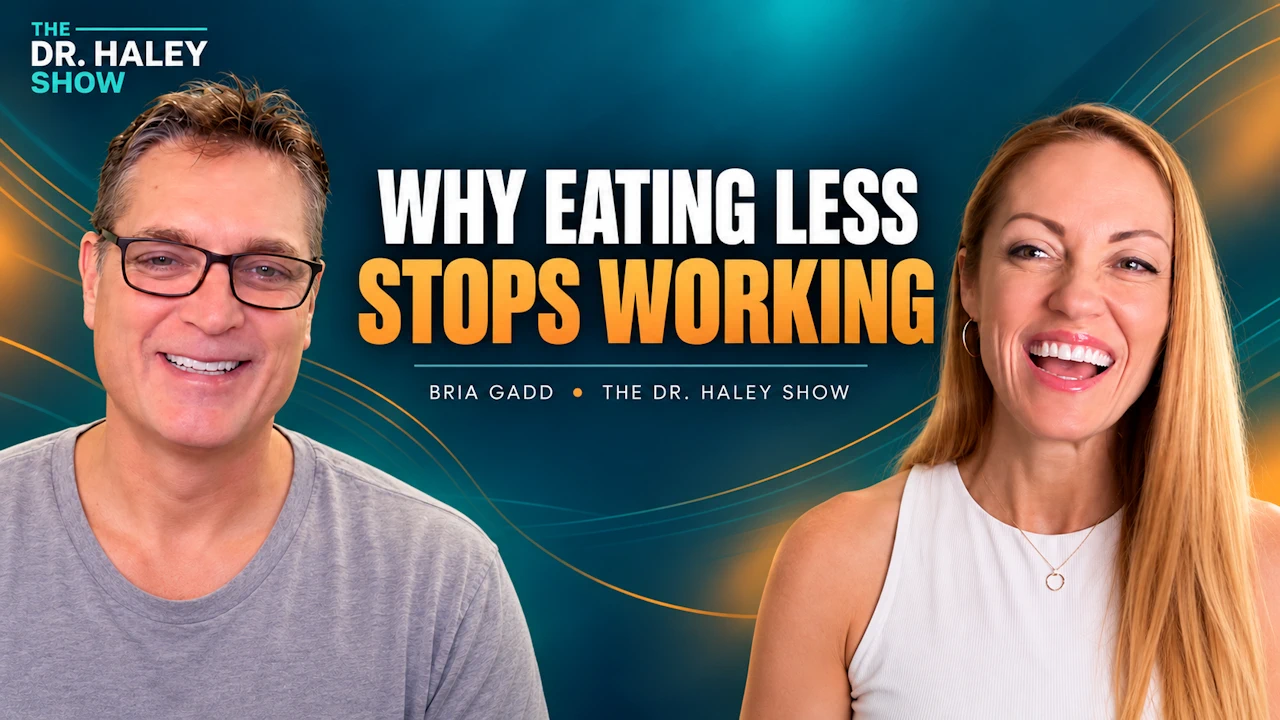
What happens when the strategies that once kept you lean and energized—eating less, exercising harder, and pushing through fatigue—stop working?
In this episode of The Dr. Haley Show, Dr. Michael Haley speaks with Bria Gadd, also known as The Period Whisperer, about the accumulated strain she calls health debt. Bria explains how chronic stress, inadequate recovery, under-fueling, poor sleep, illness, and demanding exercise can leave the body without enough energy to meet its daily demands—especially during perimenopause and menopause.
They discuss why midlife weight gain is not always a discipline problem, how intense workouts can become another expense the body cannot afford, why protein and recovery matter, what waking between 2:00 and 4:00 a.m. may reveal, and how symptom tracking and functional testing may help identify where support is needed.
Watch the Interview
Listen to the Podcast
Resources
- Bria Gadd’s website: briatheperiodwhisperer.com
- Work with Bria: One-on-one perimenopause coaching
- The Period Whisperer Podcast: Podcast website
- Apple Podcasts: Listen and follow
- Spotify: Listen on Spotify
- YouTube: @bria_period_whisperer
- Instagram: @bria_period_whisperer
- Facebook: Bria The Period Whisperer
- LinkedIn: Bria Gadd
- Midlife Mojo: Community and resources
- Haley Nutrition: Plant-based nutrition and skin-care products — listen to the podcast for the current listener coupon code.
Quick Takeaway
When the body’s energy supply no longer meets its demands, pushing harder may deepen the problem. Bria’s central message is to stop treating stubborn weight, fatigue, poor sleep, and brain fog as failures of discipline. Begin by restoring the foundations—adequate food and protein, appropriate movement, recovery, sleep, stress support, and individualized evaluation—so the body has the resources to respond.
Episode Timestamps
00:00 — Why the body protects its energy
00:55 — Why eating less and exercising harder may stop working
02:29 — Introducing Bria Gadd, The Period Whisperer
04:24 — Can men accumulate health debt too?
07:33 — Energy supply, energy demand, and health debt
10:04 — How Bria accumulated her own health debt
13:19 — When exercise becomes another burden
15:15 — Strength training, mobility, and recovery
17:51 — Why more cardio may not produce weight loss
20:05 — Midlife nutrition mistakes and inadequate protein
22:47 — How long should you fast?
25:27 — Why coffee is not breakfast
27:07 — Eating 1,400 calories while gaining weight
29:23 — Sleep, recovery, and waking during the night
33:00 — Caffeine, blood sugar, and 2:00 a.m. waking
34:53 — Measuring symptoms and tracking progress
38:31 — Hormones, peptides, and foundational health
40:22 — DUTCH hormone testing and GI-MAP testing
42:12 — Individualized gut-health protocols
44:01 — Bria’s professional scope and working with doctors
48:25 — How to work with Bria
48:48 — The opportunity hidden within perimenopause
What Is Health Debt?
Bria uses the financial metaphor of health debt to describe what happens when the body repeatedly spends more energy than it receives or can produce. Nutrition, sleep, recovery, stress management, pleasure, digestion, thyroid function, hormones, immune function, and the nervous system all influence that energy supply.
A temporary deficit may improve after a good meal or a full night of sleep. Debt is different: it represents accumulated strain that may continue compounding when the same demands remain in place. Perimenopause may not create every underlying problem, but its additional demands can make previously manageable weaknesses much harder to ignore.
Why Eating Less Can Stop Working
Bria describes gaining approximately 15 to 20 pounds while eating about 1,400 calories per day and continuing the workouts that had worked for her in the past. Her explanation is that a body without adequate energy may begin conserving rather than freely spending its limited resources.
She encourages women who identify with this pattern to return to basic nourishment: eat enough food, prioritize protein, include an appropriate balance of fats and carbohydrates, and pay attention to whether a meal provides stable energy and satisfaction for several hours. The objective is not to prescribe one universal diet, but to observe how an individual body responds.
Exercise Must Include Recovery
Exercise is an investment that requires enough sleep, nutrition, hormones, and recovery capacity to produce a return. Bria explains that repeatedly adding high-intensity exercise when the body is already depleted may create another demand without allowing the adaptation that makes training beneficial.
Resistance training remains important for muscle, metabolic health, and healthy aging, but it must be supported. Walking, mobility work, stretching, yoga, functional movement, appropriate rest, and adequate protein all belong in a balanced fitness plan.
Sleep, Caffeine, and Blood-Sugar Clues
Falling asleep immediately is not always evidence of ideal sleep; it can also reflect profound exhaustion. Bria and Dr. Haley discuss nighttime waking—particularly between 2:00 and 4:00 a.m.—and how caffeine timing, inadequate nourishment, stress responses, or blood-sugar dysregulation may contribute.
Rather than assuming every symptom has one cause, they emphasize awareness and experimentation: notice patterns, change one variable thoughtfully, and evaluate how sleep, energy, mood, digestion, cravings, and cognition respond.
Tracking Symptoms and Using Functional Testing
Bria tracks symptoms across hormones, digestion, immune function, detoxification, energy, and other metabolic functions. She also asks clients to observe what they eat and how they feel one to two hours later, including fullness, cravings, mood, clarity, energy, gas, bloating, and digestion.
When additional information is warranted, her work may include functional tests such as a DUTCH hormone test, GI-MAP stool testing, thyroid markers, minerals, and broader blood chemistry. Bria is a non-prescribing Functional Diagnostic Nutrition Practitioner, not a licensed medical physician, and she refers clients to licensed clinicians when diagnosis, treatment, prescribing, or medical evaluation is required.
About Bria Gadd
Bria Gadd, known as The Period Whisperer, is a Functional Diagnostic Nutrition® Practitioner, certified holistic health coach, certified personal trainer, and educator specializing in perimenopause and menopause. After experiencing weight gain, fatigue, disrupted sleep, anxiety, and changing periods while following the nutrition and exercise practices that had previously worked for her, she began investigating the relationships among energy availability, recovery, hormones, metabolism, stress, sleep, nutrition, exercise, and gut health.
She now helps women understand the patterns behind their symptoms and create individualized strategies intended to support energy, strength, metabolic health, and quality of life. She is also the host of The Period Whisperer Podcast.
Medical Disclaimer
This podcast and article are provided for educational and informational purposes only and are not intended as medical advice, diagnosis, or treatment. Always consult an appropriately qualified healthcare professional before changing your diet, exercise routine, medications, supplements, hormones, or healthcare plan. Bria Gadd is a non-prescribing Functional Diagnostic Nutrition Practitioner and does not diagnose, treat, or prescribe.
Full Transcript
The transcript below has been lightly edited for readability while preserving the meaning and substance of the conversation. Commercial breaks have been removed, and the listener coupon code has not been printed.
Read the Full Transcript
Why the Body Protects Its Energy
Bria Gadd: I think what a lot of us don’t recognize or don’t honor is that our body is beautifully designed to survive. So when your energy supply is not meeting your energy demand, that is a really scary place for your body to be. So it’s brilliant. And it’s going to say, okay, I don’t have what I need. So what’s the first step? And your body is going to shut down nonessential personnel because it’s an expense we don’t need.
Narrator: You are listening to the Dr. Haley Show, the podcast dedicated to helping you optimize your health. Each episode there will be an interview or a message to help you discover better health. We will be featuring health radicals on the show to bring new ideas to the table, as well as doubling down on key fundamentals to support you living your best life. Your host is no other than the founder of Haley Nutrition Dr. Michael Haley.
When the Old Health Strategies Stop Working
Dr. Michael Haley: This is Dr Haley at the Dr Haley Show podcast. And today. Well, have you reached maybe your 40s and suddenly discovered that the health strategies that always worked. Eating less, exercising harder, pushing through exhaustion. Those things don’t work anymore. Perhaps you’re gaining weight despite doing everything right. Or at least you think they’re right. You’re tired during the day, but wide awake in the middle of the night. Your concentration, your mood, or even your tolerance for stress has changed. But the doctors, well, they tell you everything is right. Your lab tests are normal. Today’s guest may suggest the problem is not a lack of discipline or even your hormones alone. She calls it a health debt. The accumulated effects of stress, inadequate recovery under fueling poor sleep, illness, and years of asking more from the body than it’s able to give. What’s your health debt? Is it connected to perimenopause? Can the wrong diet or exercise program actually make things worse? And what can a woman begin doing today to restore her energy, strength and trust in her body? That’s what we’re exploring today. Bria Gadd, also known as the Period Whisperer, is a functional diagnostic nutrition practitioner certified in holistic health, a coach, a certified personal trainer and educator specializing in perimenopause and menopause. After more than 15 years in fitness and nutrition, Bria noticed that the approaches that had previously helped women improve their weight and health often stopped producing the same results during midlife. She experienced that change herself as she approached 40, exercising six days a week, eating 1400 calories a day, struggling with weight gain on a birds diet 1400 calories a day. She had disrupted sleep, night sweats, anxiety, fatigue and unpredictable periods, even while being told she was the picture of health. The experience led her to investigate the relationship among hormone changes metabolic health, stress, sleep, nutrition, exercise and recovery, and today she uses education, functional testing and personalized coaching to help women understand what their symptoms are telling them. The Period Whisperer podcast she is the host of her own podcast, The Period Whisperer. I checked it out today and she has something like 450 episodes, so she’s been doing this a while. Check out her podcast on iTunes is where I saw it and where she discusses perimenopause, weight, energy, gut health, nutrition, hormones and stress. Bria, welcome to the show. You know your story. It kind of reminds me a little bit of things I’ve experienced myself. And I’m wondering, you know, maybe this episode isn’t just for women because I, myself and I remember when I used to be able to, you know, exercise whatever I ate into, you know, this superior health. At least I thought that was the case. I thought it didn’t matter what I eat, I can just eat anything. Because look at this body. You know, I thought I was a picture of health. I was super strong. And as I got older, those things didn’t work anymore. I thought that started accumulating. I didn’t sleep as good as I used to. And, you know, I went from being able to eat whatever I want, whenever I want to, actually having to eat real food. So I’m guessing that this isn’t necessarily only for women. Is that the case?
Understanding Health Debt
Bria Gadd: Absolutely. You’re absolutely right there, Dr Haley. I think, you know, health debt doesn’t discriminate by gender. What I have found, though, is that, you know, where I think I have niched into women is that it’s wonderful these days that perimenopause has now become a household word. But I think is kind of like, don’t kill the messenger. Like it has been blamed for health debt, when in fact there are often other issues at play that can really make our perimenopause and menopause transition much more manageable. So yes, all people can have health debt, and that looks like a whole lot of bad symptoms.
Dr. Michael Haley: Now our men can also maybe understand their spouses better after this conversation.
Bria Gadd: I would think so because I think we both, especially in a couple. Right. Just like I really like to think of our health debt and our health wealth, just like our regular, you know, debt and financial wealth. And when you’re in a, in a relationship, I mean that those are blended things. So your health really is tied to your partner just like your finances are. And so I think that there’s a lot we can both be doing to build health, wealth and get out of health debt.
Dr. Michael Haley: You know, I think that men tend to be more like, oh, come on, you know, I can eat anything. It’s not going to affect me. It’s not going to change me. And a lot of times it’s a woman in a relationship that finally convinced them, hey, this is the way to eat and this is what it’s doing for me. And then eventually the men come along. Not all the time. I’m not going to be so, you know, broad brush that. That’s the way it is. But, you know, if you’re listening to this, My hope is that everyone can learn men, the women. And let’s all understand the next level of health, this health debt or, you know, I think of it maybe like a deficit, meaning, you know, I haven’t gotten enough sleep or I haven’t gotten enough nutrition or I haven’t gotten enough of the right kind of exercise. What’s the difference? Debt, Deficit I guess they’re pretty related.
Bria Gadd: Well, I think you’re absolutely right. If we understand that the currency of the body is energy, then we have like energy demands all of our output in a day, and then we have an energy supply, which is what you’re talking about. You know, like our nutrition, our quality sleep, you know, managing our stress, things like that, or pleasure. Pleasure is a great source of energy for the body. And so if it’s simply that where we don’t have the energy coming in compared to the energy going out is not matching, then that is a deficit. But where I think the debt piece comes in like and we’re talking like credit card debt here, this is what the debt that we’re wanting to avoid. Often by the time we reach midlife, we really have been living a bit paycheck to paycheck. And it’s not just about the energy that we’re putting into the body. It has also a lot to do with the energy supply chain into the body. So what a lot of us haven’t really understood or been taught is that, like, nothing works in a vacuum in our body, our hormones, our digestion, our immune system, our detox, our energy production, our nervous system are all connected together. And so if the energy supply chain like how we are breaking down, absorbing our nutrients in our gut, or how our thyroid is functioning, or you know, how our hormones are balanced, or how our detoxing or how our adrenals are any of these energy supply chains, if they are off for whatever reason, and most of us have some of that, then that now becomes not just a deficit, but a debt and a debt that is compounding at midlife. If we don’t address it, it is now compounding faster than we can often pay off.
Dr. Michael Haley: Yeah, that makes a lot more sense when you put it that way, because it’s not just, you know, a deficit. I can deal with my deficit today and I can get enough sleep tonight.
Bria Gadd: Yeah.
Dr. Michael Haley: But that that’s still there. Yeah. The damage has been done.
Bria Gadd: Exactly. There’s still a compound. It’s not. Now you’re trying to make minimum payments and you’re not paying down the balance. And that’s the difference, I think. And when we are born till for most of us, until midlife, we have like a great trust fund of energy. But we start to burn through that as we head into the years of raising kids and building careers and being up half the night because of kids or whatever other reason, you know, burning the candle at both ends and suddenly that trust fund is gone. And we’re having some functional health issues. So the leaks in the supply chain, and that lands us in a place where, you know, oh, now I can’t even pay my minimum balance anymore.
How Bria Accumulated Health Debt
Dr. Michael Haley: Yeah. Well, tell us about you. How did you burn through your trust fund?
Bria Gadd: Yeah. Yeah, probably like almost every other woman I know. And again, I will speak to women because that’s who I work with and who I talk to. So this is never to alienate the men. But for me, you know, I got into health and wellness in my late 20s when I was having babies. And so from 27 until 37, which is I feel like when my health debt really hit, really came for payments, that’s when it came to repayments. I, you know, I had a lot of late nights. I had a child that really struggled with anxiety and sleep. So there were a lot of nights that I didn’t sleep in there. And then simultaneously, I, you know, have all the other things that everyone goes through, like Covid or moving or changing jobs and things like that. But I was a, you know, a nutrition and fitness coach. So every day I was very rigorous about, you know, no matter where I was in the world, no matter what I was doing, I was working out 45, 50, 60 minutes every single day pretty intensely and probably not fueling myself to the best of my abilities or trying to live in that calorie deficit. So I would say that alone was a really massive demand. And that along with stress and Covid, just kind of tipped me over the edge where here I was at 37, thinking maybe it’s my hormones because I’m having wonky periods and then I’m having this weight gain and all of this stuff is happening. But my doctor was like, your blood work is fine. You’re the picture of health. So I learned after that moment that just because I’m fine in my labs, that’s nice to know I’m not diseased. It doesn’t mean I’m functionally fine. And I think that’s a really important piece. So, yeah, a lot of a lot of bad decisions. And like so many people, you know, when you’re working out and you’re not getting results and you’re not sleeping properly, you know, you start to make other bad decisions. You’re like, oh, well, I’ll just, you know, start my day with extra coffee. I’ll have sugar in the afternoon to get through it, and I’ll have a glass of wine at night. So it all starts to compound in a negative way.
Dr. Michael Haley: Hey, coffee to wake up and wine to cancel the coffee.
Bria Gadd: Exactly. Yeah. So that was my life. That’s where I was. I was falling apart.
Exercise, Recovery, and Midlife Fitness
Dr. Michael Haley: What were you doing wrong from an exercise perspective?
Bria Gadd: Yeah, I think the biggest thing that I was doing wrong was not recovering properly for the exercise. I did not understand. I was a trainer, you know, and I’m teaching people how to do this, but I had sort of active recovery days. But like most women, anyway, when my body stopped responding, my instinct was not to be like, hey, what’s going on here? My instinct was to double down on effort. And so instead of recognizing like, hey, maybe I should pull back on this energy investment that I’m making because fitness is really again it’s an investment. It is a cost. It’s an energy demand. It should be one that eventually pays you back when we’re doing the right type of fitness. But I was doing a lot of like high intensity interval training. and I wasn’t recovering properly from the muscle that I was trying to put on. So my body was just starting to crumble and I wasn’t even taking time off to recover when my body was sore. I wasn’t listening, I was just doubling up on a scoop of pre-workout caffeine and pushing through anyway, which is a habit that a lot of us fall into because we think I must just not be doing enough.
Dr. Michael Haley: Yeah, I remember training hard growing up, and it was a lot of stuff in the gym. And you know, for guys, you know, they like to lay on the bench pressed and see how much they can press up and stuff. And they wouldn’t necessarily balance the exercises by doing things in the back. And then their bodies kind of curl forward and they don’t do the flexibility training. Well, I was one of those guys. I didn’t do the flexibility training. was missing part of the exercise plan and I wasn’t necessarily doing endurance training. Yeah. And there’s so many different areas of exercise. What have you learned as far as that goes?
Bria Gadd: Yeah, I mean, I think obviously it’s always going to depend a bit on the person on where they are in life, on how much time they have. But what I have found that is that you’re absolutely right, like lifting weights and hopefully we’re lifting in a, you know, a progressive overload. So we’re actually putting the body under that stress to adapt is only one piece of the pie that makes a fit and fit body right. And I get so many pushback from my clients because I’m always like, hey, I can see in your labs that you don’t even have the cortisol stores or the hormones to be repairing from muscle. You got to stop working out because it’s an investment you can’t afford. We need to be focusing on recovery movement, functional movement. So walking, yoga, stretching, mobility work. And then when we add that fitness back in, we have to keep that. Like you can’t just contract a muscle, contract a muscle, contract a muscle and expect it to perform. We have to elongate it back out again. And a lot of people just skip the stretch or at best or getting like a, you know, a little one minute warm up and a one minute cooldown. And then probably along with that, I think the important ingredients of like, muscle adaptation is you also have to make sure you’re eating enough protein to be supporting that. You need to make sure you’re getting enough sleep. So I think it’s really helpful. We all know that, like lifting heavy things. It’s a big theme of midlife for women especially, but lifting heavy things is a is kind of the gold standard for helping your body age. Well have good hormones on its own, but it is still an investment. And if you cannot afford that investment, you’re wasting your time and doing more damage. So it’s kind of like thinking, oh, I should be, you know, investing in a mutual fund that’s going to give me a 10% return one day while you’re bleeding out, a 25%, you know, credit cards charge, you know, APR on the other end. So it’s just not the smartest move.
Dr. Michael Haley: Yeah. You know, I think of this one friend of mine, and actually, she was a massage therapist that didn’t like the way her body looked. Had a little extra weight, not much. She looked great, but she wasn’t satisfied with that little extra bit of weight that she was carrying around. So her answer to it was the treadmill. And she would push that thing as fast as she could, you know, keeping her heart rate as high as she could for as long as she could. And because she wasn’t losing the weight, she would just increase the time and the duration. And that was her one exercise. And it never worked.
Bria Gadd: It never worked. I mean.
Dr. Michael Haley: Why is that?
Bria Gadd: how many times do you see people running that are overweight? It’s like and not I mean, I want people to move for sure. It’s never that. But here’s why it doesn’t work, Dr Haley, because level two cardio or endurance training cardio is kind of like buying a car or investing in a car versus investing in a house. So lifting heavy things, resistance training is like investing in a home. We know that if you keep that home long enough, there is going to be a return on that investment with the car. When you drive that car off of the lot, it is never going to be worth the same. So you better love like it better set your soul on fire, long distance running, or any type of running except for maybe sprint interval training, which is a little bit different. Otherwise, you know you’re never going to get the ROI on that that you want. And it is simply because like, well, for multiple reasons. One, it really does pull on our cortisol, which becomes very sensitive in midlife, especially for women. It doesn’t build our muscle mass. So then our basal metabolic rate doesn’t change. You’re done that run your calorie burn is done. And so those are I think two of the biggest reasons is that we just can’t hormonally support that stress on the body at this age and beyond. So you better love it. Better set that soul on fire.
Dr. Michael Haley: Set the soul on fire. I like it, yeah. And I know that there’s a certain level where you go from fat burning to a different kind of exercise, and they work differently in the body. I always like to go back to balance things, keep things balanced.
Bria Gadd: Keep things balanced. Yep. And functional movement is so helpful. You know, the things like lifting, you know, getting up, getting down, moving your body in all three planes of motion, because that’s real. That’s what we do every single day.
Dr. Michael Haley: Yeah, I’m out of balance right now because, I love playing pickleball. So that occupies all my time, all my extra exercise time. It’s all poured into that. Then I get home. I’m too tired to stretch because I played for three hours.
Bria Gadd: But you know better. You should.
Dr. Michael Haley: I do but.
Bria Gadd: It’s Fun That is an imbalance. Then you’re right. You’re not balancing out your work.
Nutrition, Protein, Breakfast, and Fasting
Dr. Michael Haley: At least I’m having fun. So, we talked about some of the exercise issues. What about food challenges? What were you doing? Right? And what were you doing wrong when it comes to the food you were eating?
Bria Gadd: Yeah. So I was kind of, you know, peaking in my early fitness career during the times of like, of fasting and hot buttered coffee, I like to call it. So, we get away with a lot of things as women when we’re younger because again, we have that buffer, that vital reserve, that kind of trust fund of energy that I’m talking about. But you go through decade after decade and especially for women, I mean, our bodies go through war having children. That is essentially what it’s like for our body. And then raising those children and being up at night and still trying to, you know, build businesses or create careers or things like that and all the things we have to do. And that vital reserve really starts to, to wear us down. So with nutrition, I think some of the biggest mistakes I was making was not eating enough, especially the first part of the day, not prioritizing protein. So I had been a vegetarian since I was nine years old, and although I think I was a pretty good balanced vegetarian, I really struggled to prioritize my protein that way. I since did start eating fish a couple of years ago. I just found that I needed it, but I’m still primarily vegetarian, but I am not getting enough protein and Not breaking your fast in the morning with a proper breakfast. So if you are someone who is in health debt, the part of the first phase of getting out of health debt is really coming back to kindergarten. Basics. When it comes to our health, and with nutrition that looks like waking up and having breakfast within two hours of waking, eating enough in that breakfast that keeps you full and satisfied for 4 to 5 hours. And that is going to include protein, fats and carbohydrates.
Dr. Michael Haley: So what would your protein source be as a vegetarian?
Bria Gadd: So I for breakfast I’m a big eggs and Greek yogurt person. That’s a pretty common breakfast for me. You know obviously vegans are going to be a whole different ball game. But if I ate meat, you know, I would for sure be having some, some type of animal protein at breakfast, because we know it’s really helpful for a lot of people. In fact, I’ve worked with a few women who, you know, that has unfortunately, and I’m a big believer in like you should follow your heart with your nutrition, for sure, but you also have to listen to what your body is saying to you. And I’ve had a few people, you know, where it’s like, we’ve got to increase that protein. Most women need a significant amount more protein than they think in midlife than they have been eating. And so how do we get that protein? And that’s what makes it challenging, I think, especially as vegans.
Dr. Michael Haley: You know, Bria, you talked I think you said something about breaking that fast within two hours of waking where I’ve heard other people say, you know, don’t eat anything for the first four hours. How do you come up with the two hours? And, what is the optimal timing for eating? How long should you fast from the time you go to bed until you wake up?
Bria Gadd: Yeah. So, you know, I know we’re talking to a lot of different people here. I’m going to talk specifically to women kind of in, in the midlife. And I’m going to talk to people who are in health debt. How about that? Because just like how we handle our finances when we’re in debt is very different than when we have wealth, you know, or maybe our habits, what we can afford. The same thing goes, you know, with our health debt and our health wealth. So if you are, again, if you are working out and you’re not getting results, if you’re have stuck weight or you’re gaining weight, if you’re not sleeping properly through the night, if you have cravings or brain fog or energy issues or no libido, these are all signs that you are in health debt. You’re doing the things and the things aren’t working. So why? It is absolutely critical that we have, you know, nourishment and food within, you know, and I would say like 30 minutes to 2 hours. So like there is a window there like wake up and get moving is because of how our blood sugar regulation and our cortisol pattern is really the frontline defense to our healthy sex hormones. So if you are waking up, we’re going to have our, you know, in a healthy circadian rhythm. We have a nice big spike of our cortisol and those first couple hours of the day, if you are not eating during that time, that is going to spike higher for you. If you’re having caffeine, that’s going to spike higher for you. If you’re doing a fasted workout, it’s going to spike higher.
Dr. Michael Haley: so coffee’s not a good breakfast.
Bria Gadd: No, not when you’re in debt I’m talking with people in debt. If you are out of health debt if you’re feeling great and you’re like, I’m great, and I just want to optimize and you want to try that out as a tool and biohacking tool, go for it. But no, it is. You know, I think people think coffee gives them energy, but really it’s like sucking up all the cortisol that you have in your body and blowing it in your face like a fire hose. Then it’s gone and we need some for the rest of the day. We need it for fighting illness, for repairing from workouts. We need those pieces of the puzzle. So most people who aren’t eating a proper breakfast are often finding themselves having an energy crash in the afternoon, or not being able to fall asleep properly at night. So their circadian rhythm is a bit upside down and sideways.
Dr. Michael Haley: Yeah. Okay. And are you having fat and protein and avoiding the carbohydrates early on or minimal fat? How do you do it?
Bria Gadd: Well, again, I think everyone here is a little different in what is going to feel best in your body. Like our metabolic type dictates what you know, whether you are better off with, you know, higher fat, lower carb or lower fat, higher carb. I think I prefer, especially for most women, that all the macros come to the party and you just get to decide like what you prefer, and you can really simply pay attention and notice your meal really should. Unless you have major blood sugar issues, your meal really should keep you full and satisfied for 4 to 5 hours. So if it is not, we need to come back and readjust that fuel mixture. But protein is the non-negotiable. And then you need to have a little bit of every other one at the party.
Why Undereating Can Lead to Weight Gain
Dr. Michael Haley: You know, for you, you said you were eating 1400 calories a day.
Bria Gadd: At that time. Yeah.
Dr. Michael Haley: I’m guessing you were like, super skinny.
Bria Gadd: No, I had gained I had put on about 15 to 20 pounds over maybe a year and a half, doing the same workouts, eating the same way. So I was eating in a calorie deficit for way too long, and I had functional issues in my body, so I was not. And it’s funny, I’ve been in the wellness industry online for a very long time now. You can go way back in my social media and you can see this belly just kind of growing on me in my fitness videos. Yeah. And it was simply because I didn’t. Again, I think what a lot of us don’t recognize or don’t honor is that our body is beautifully designed to survive. So when your energy supply is not meeting your energy demand, that is a really scary place for your body to be. So it’s brilliant. And it’s going to say, okay, I don’t have what I need. So what’s the first step? And your body is going to shut down nonessential personnel because it’s an expense we don’t need. This is where we start to see, you know, women specifically being like, oh, you know, maybe you’re having period changes. There goes my libido. You’re just not feeling the same way that you were. Maybe your sleep gets a little funky. And then if we don’t correct that still, then the body’s like, okay, I still need more energy. So I’m going to conserve. I’m going to conserve the energy I have and slow down that metabolism. So this is where we see this weight gain come on. Especially in the belly, butt, and thighs, where we start to, you know, just feel like we can’t even recognize ourselves in the mirror anymore. We just have that brain fog or that fatigue all day. And then finally, even if everything you’ve done in your life has been correct and you don’t have genetic weaknesses, if you still don’t address this health debt, the body will pilfer energy from your other functions. So from your adrenals, your thyroid, your digestion, your nervous system and all of these pieces from your liver because it needs to keep you alive, maintaining the demand that you’re requesting. So you’re going to keep doing what you’re doing, but you’re going to feel pretty crappy doing it. And that’s what happens in health debt.
Sleep, Caffeine, and Blood Sugar
Dr. Michael Haley: You know, I like how we’re exploring the different areas, because we’ve talked about nutrition a little bit and how it applied to you. And we’ve talked about exercise in the different kinds and what you did and what you may have been doing wrong. let’s talk a little bit about rest and how that’s affecting people and what they’re doing wrong. And then I wanted to essentially go into how do we fix it and how do we measure results, and how do we know what to change? Yeah. Tell me about your what kind of sleep habits were you having at this time, and how has your sleep changed? And did you have to force the change or did changing other things make it happen?
Bria Gadd: Yeah. So I mean, I’ve always been a really good sleeper. I always thought of sleep as my superpower, so I never had problems falling asleep. But what I started to notice, you know, and I would go to bed an appropriate hour I have kids. So we had schedules. But I did start to notice is that I I fall asleep in, like, two point seconds flat. I was exhausted, and or I’d fall asleep reading books to my kids in their bed or fall asleep watching TV at 7:00 at night. So we start to see these things kind of creep in. And again, they’re little indicators of health debt, but I’d never had a problem sleeping through the night. And then what started to happen for me was all of a sudden I was waking up to sometime between 2 and 4 a.m., like clockwork in a sweat, heart racing. And again, these are key signs that a function is off in your body. But I didn’t know that at the time. I didn’t understand that. And so again, my answer was like, oh, well, I guess I’ll set my alarm 30 minutes earlier, double up on my caffeine and push through a harder workout at the time. And that’s when my whole body just fell apart. And I say this, Michael, because I think it’s a natural human instinct. But when you put it in the concept of a body that’s in survival mode, choosing to do what I did and what a lot of people do is push harder, right? You know, eat less, move more is just like being stranded on a deserted island and thinking the smartest thing to do is go for a run on the beach when you have no idea where your water is, where you’re safe, sleeping, you know, sources, where your food is coming from. We don’t want to expend that kind of energy when we have no idea when energy is coming in.
Dr. Michael Haley: Yeah, that’s a good picture, I get it.
Bria Gadd: Yeah. So that was anyway, my sleep became a mess. And frankly, a hundred other things should have sent me to my doctor. But that was what sent me to my doctor because I just couldn’t cope at that point.
Dr. Michael Haley: Yeah, I think I had some similar experiences myself when it came to sleep. Meaning, I know that I like coffee, I like my morning coffee, I have my organic coffee with my organic coconut milk, and I happen to like to put a little organic vegan protein in it just,
Bria Gadd: Well, there you go.
Dr. Michael Haley: Makes me feel balanced.
Bria Gadd: Yeah.
Dr. Michael Haley: But I know that if I have coffee after about 8 a.m., it’ll interfere with my sleep. Not necessarily my early sleep. Because when we reach a point of exhaustion, I’m that person I can be. I can lay down and be a asleep in less than a minute. But that’s the exhaustion sleep. And once you meet that immediate deficit, the caffeine is still there. Yeah. And that’s what woke me up from 2 to 4. But it was great because I knew that, you know, come 4:00, I’d fall asleep again because by then the caffeine would wear off, right?
Bria Gadd: Right.
Dr. Michael Haley: So that was what was interrupting my sleep. And I finally realized, okay, dummy, don’t have, you know, too much caffeine. And certainly not after 8 a.m.. Yeah. And then you sleep through the night.
Bria Gadd: Yeah. That’s good. It’s like. But you were. You have the awareness to notice that, pay attention and try things. And a lot of the times and we’re in the wellness industry for a lot of people listening, they don’t have that awareness. They haven’t prioritized paying attention to themselves that way. But it’s an interesting thing that you bring up because also between 2 and 4 a.m., like if you’re waking up and cannot get back to sleep, it can be a common blood sugar dysregulation issue for people. So whether you’re just not insulin sensitive enough to be having, you know, the glucose get into the cells to make the ATP and energy or you aren’t eating enough for your body. If you go to sleep and you wake up at 2 a.m. and you have that racing, it’s commonly because your glucose has dropped so much. So cortisol has got to come to the table. And that’s what wakes us up and keeps you from getting back to sleep. So caffeine can do it. But also blood sugar dysregulation.
Dr. Michael Haley: Well, interesting. I always associated it with caffeine because there was almost like a buzz, kind of like, you know, zooming a little bit, kind of like you just had a cup of coffee. Yeah. So who knows?
Bria Gadd: And I’m sure it was for you that was enough. Like removing that or making that change was enough to allow you to get your better sleep. Architecture.
Dr. Michael Haley: Absolutely. Yeah. For me. For me. Everyone’s different. And I also like, you know, when we were talking about food and everyone being different, I like what you said because we are different and some people are going to function better on more proteins, others on more fats, and others on more carbohydrates. And in the same way, okay, if you understand what macronutrients you work best on, you might also decide whether or not you work better on animal foods or plant foods and switch your emphasis in that particular direction. We are all different. Yeah. So if we’re all different and you’re
Tracking Symptoms and Functional Testing
Dr. Michael Haley: helping people, fix these problems. How do you diagnose or figure out what their issue is? How do you measure how do you track progress?
Bria Gadd: Yeah. So in my practice, I think there’s a few ways that I like to track, but I do have like a health debt scorecard, which is where we kind of measure all symptoms that are coming from kind of each of the main, you know, metabolic functions of our body, our hormones, our immune, our digestion or detox and so on. So I like to have my clients fill that out right up front so we can really start to recognize, I mean, first of all, it’s never just one area because they are all connected. But who’s the biggest problem child and how do we support that health debt, and then we like I like to track that every month that I work with someone. So we’re really actually seeing the analytics of their numbers change. So that’s kind of priority one for tracking. But as we work on getting out of health debt, I think one of the most important things we do is take a little bit of time to pay attention, not necessarily to our calories in and calories out, but to our fuel mixture and how our food makes us feel 1 to 2 hours after we eat. Because that tells you a lot. Everyone. And I was this person to just tell me what to eat and I’ll eat it. Tell me what to eat to, you know, have that body or to get these results and I will do it. But unfortunately, there’s no blanket answer the answer and that’s not sexy. Like it’s not marketable. But the reality is, is the answer is within you, only you. You can tell me what feels right for your body, but you have to pay attention. So we do. I always like to do a couple weeks, you know, to a month of tracking in the beginning. And then again when we layer in fitness again, because as your metabolism boosts that fuel mixture is going to need to change again. So that’s kind of, I think how I like to track,
Dr. Michael Haley: But Bria what is tracking look like. is it documenting on paper. Is it a food, mood, poop journal or.
Bria Gadd: Oh yeah. So for me it’s going to be it’s a document, you know, like an Excel document that has things kind of measurement tools already in it. So it’s just popping in numbers and notes okay.
Dr. Michael Haley: Yeah. I’ve, you know, I’ve often suggested people write down what they eat. Yeah. And more importantly, how they feel and the how you feel isn’t, you know necessarily your digestion. It might be. You know I feel gassed up, bloated, weighed down. What about your happiness, your energy levels, your thought patterns. Because the food you eat is going to affect those things. Are you moody. Are you angry. Are you happy. Do you have clear thoughts? Are you able to hold a conversation or are you just agitated?
Bria Gadd: Absolutely.
Dr. Michael Haley: So not only the food when you ate it, the mood, and you might also have a look at your digestion.
Bria Gadd: Of course. Yeah. And I think you write those are often more noticeable for people if you bloat up after a meal. But you know. Did you finish your meal feeling that you’re full but still looking for something else? Those are signs that it’s even not the correct fuel mixture. So little things to pay attention to, but you can get the clues pretty quickly.
Dr. Michael Haley: So as we figure out the issues, is the correction all through diet and or nutrition and maybe supplements or better sleep and these things. Or is there sometimes medical intervention. Do we do peptides or hormones.
Bria Gadd: Yeah. So I was thinking like peptides and hormones are for building health wealth. If you’re in health debt, it’s not a time for you to be using those things, with the exception of a few things. And I’m a huge believer of test. Don’t guess. So. I think, you know, we always have to sort out our energy supply and demand, our foundational pieces of health. So everything you and I have talked about, like our movement, our sleep, you know, our nutrition and we didn’t quite get into. But like our stress management, those things are foundational. So we will always start there. But then in my practice to really identify, you know, where things have gone wrong in that energy supply chain. I really like to look at functional lab work. I like to look at each of these systems how is your hormone production, how are they balanced, how are they clearing. Because that tells us a lot about where the slow drains and the blockages are in your energy supply chain into your body. I always like to look at the gut microbiome, what’s happening in there. And then I really like to look at some kind of like deeper functional bloodwork. So like a full thyroid panel, your minerals, you know, things like that that we want to see just to really get a holistic picture of all of those metabolic functions and see, hey, now where are these loss of functions? And then what is the ideal protocol for you, you know, nutrition wise, supplement wise, to move forward and coach up that function again?
Dr. Michael Haley: Yeah. What tests do you give more emphasis to or more credibility to? And which ones do you maybe say, oh I don’t know about this one.
Bria Gadd: Well in my land, because I primarily work with women who are, you know, late 30s to late 60s. So we’re, I what I find is most efficient for me to see everything in the body is going to be something called the Dutch test. So a dried urine test of comprehensive hormones, which is for nobody who knows what that is. It comes to your home, you pee on strips, it dries, and then we’re able to tell a whole lot about your sex hormones, your adrenal hormones, their metabolism, and some of your organic acids. And that’s critical, because if we don’t know those things, I don’t think it’s right to even go on hormone replacement therapy if we don’t know how your hormones are clearing. I love to run a GI map or some type of micro gut microbiome test. So a stool test that tells us really like certainly rules out, you know, parasites and pathogens and bacteria and things. But ultimately, how is your gut doing breaking down and absorbing nutrients? How is your immune function and your gut doing? How’s your pancreas doing? can you handle gluten? All of these pieces of the puzzle and what I find is that my clients are they like exhale when they see this because I think it’s a very validating and it helps us stay on track because now you’re working a protocol that is customized to what is happening in your body.
Dr. Michael Haley: So, yeah. So they do those tests. Yep. And, you know, maybe, the what was the one where you’re actually testing? You the Dutch test was the urine. And then there’s a fecal test as well.
Bria Gadd: Yes, a GI map. Yeah.
Dr. Michael Haley: GI map. You get and that’s using DNA. I’m guessing measuring DNA from the. Yeah. Of specifically like DNA of the bacteria of the stuff that’s in there. Yeah. How do you correct it?
Bria Gadd: Well, it’s really going to depend on the person. But this is why I like to work on lifestyle first, because often if people’s lifestyle hasn’t been dialed in, that alone can make a big difference. But let’s say we get into a GI map and we can see, well, we aren’t breaking down. And like, we have low stomach acid, we aren’t breaking down, absorbing nutrients properly. Then, you know, we might look at some digestive enzymes, you know, if we have what I like to call a desert gut. So I see a lot of especially high achieving women who have been, you know, into fitness for a while. They don’t seem to present as having gut issues. But you get in their gut and it’s like a desert. So it’s hard to grow anything in that desert. So we might need to do a proper like probiotic or prebiotic, but which one do we do? That’s going to depend on the bacteria and the gut. If the gut immune function is low, we’re going to need to support that. If the mucosal barrier is weak or there’s leaky gut, we’re going to need to address that. If there’s a parasite, that’s going to be a different plan. And there is an order of operations. And this is why I like to always run a Dutch simultaneously, because I’ve had women come to me that have a parasite, really low gut immune function, and then their cortisol is pretty flat and you can’t go around stirring up, mucking up like making a mess, calling your body to war for a bacteria that shouldn’t be in there. When we don’t have the cortisol stores of the gut immune function to handle it. So sometimes how we address it really is so individualized, depending on what we’re seeing in the reserve of the body.
Dr. Michael Haley: How do you know they have a parasite. Does that show up in the GI map?
Bria Gadd: It can yeah, sometimes parasites don’t shed. So there’s no absolute guarantee. But yes, it does test for a lot of parasites specifically for H. Pylori and other pathogens on the lab. So if we see those, we definitely know they’re there.
Dr. Michael Haley: All right. Now I want to make sure everyone understands one thing because you talk about your practice. Oh, yeah. Are you a licensed healthcare professional and if not, how does that work out?
Bria Gadd: Yeah. So I’m not a I’m a non prescribing practitioner. So I am what they call a functional diagnostic nutrition practitioner. So I am certified in being able to run and read labs for my clients and recommend, you know, supplement protocols from practitioner grade levels. So I and then I work alongside doctors when I need to refer out whether that is for bioidentical hormone replacement therapy or whether it’s something that I see in a lab that is above my pay grade.
Dr. Michael Haley: Okay. You know, and it is kind of funny because above your pay grade, what is it to be a doctor? I went to school for a lot of years. Yippee ki a. And then I take a handful of continuing education hours on the side to maintain my license.
Bria Gadd: Yeah.
Dr. Michael Haley: I learn so much more as a podcaster than I do in my medical training and my training to maintain my license.
Bria Gadd: Yeah.
Dr. Michael Haley: And I have always felt that the licenses are a little bit overrated. Your doctor is just a human being.
Bria Gadd: Still a human being.
Dr. Michael Haley: With a thing hanging on their wall.
Bria Gadd: Yeah.
Dr. Michael Haley: It doesn’t make, you know, we would treat them like gods. And there’s a lot of great doctors out there. There’s some that really keep up with things, and they’re always on top of things, and they even have that intuition and they can look at someone and know, right, exactly what the problem is.
Bria Gadd: Yeah.
Dr. Michael Haley: But not all know. Just like there’s people that don’t have that doctor’s license and can do the same thing.
Bria Gadd: Yeah, yeah. I love that you said that because I think, you know, I think there’s two important things that I didn’t understand until I really, you know, until I felt like I was losing my health and then had to turn it around. You know, one, we work in partnership with our practitioners, whoever they are, you know, but I think we’ve gotten into this habit of, like, going to the doctor and thinking they should know everything about us and about our body and what the body is. But everybody is different. So we still have a responsibility, I think, to be aware of how we’re feeling, the patterns in it, of what’s going on so that we can bring that to the table to our practitioner, whether they’re a doctor or a functional practitioner. The other thing I did not understand, I think, was that it is really important is that, again, our medical doctors, who if I had if I was if my appendix was rupturing or I was breaking a bone or I had cancer like I would be, I know where I’d be going to the doctor. But if you go to your doctor and you do not have a physical problem, like there is nothing diseased about you, then we know it’s a functional problem. If you don’t feel well, so just make sure you’re going to the right area. They are not replaceable to each other. They’re different areas. And if we can address function before it becomes a problem then you often get to avoid your doctor.
Dr. Michael Haley: Yeah. The things that you know, you teach the things that I teach, you don’t have to be sick to benefit from them.
Bria Gadd: No,
Dr. Michael Haley: And what is sick, you know, because you might still have a debt.
Bria Gadd: Yeah.
Dr. Michael Haley: For a deficit. What is sickness? I guess there’s always, you know, there’s always room for improvement. Everyone can be healthier tomorrow than they are today.
Bria Gadd: Yeah, absolutely. And I think that is one of the beauties of functional health is yes, a lot of us won’t reach out for a lab worker testing until we’re suffering with something and looking for answers. But if you can get to that point, just like with wealth, if you can get to the point where you get are like investing for fun, investing for your future, that’s what we can do as well. Like if you’re feeling like, hey, I feel like an eight, can I feel like a ten? That’s where functional lab work can be really helpful. And it’s also a great way for us to understand what a peptide be beneficial for me in this phase of life. Like, do I even need that message happening in my body? Yeah.
Dr. Michael Haley: For someone that’s listening and saying, I can relate to that. I, you know, I fall asleep right away and then I wake up in the middle of the night and I, I have night sweats or my energy is up or it’s down and there’s, you know, inconsistency
Where to Begin and the Opportunity in Midlife
Dr. Michael Haley: and how I feel as a person. Sometimes I get brain fog, sometimes I have pain or fatigue. Yeah. If this message is resonating, someone and they want to specifically, benefit from your services, what’s your call to action? Where can they go to find out more?
Bria Gadd: Yeah. I think it’s best if you just come straight to my website briatheperiodwhisperer.com From there. I have a lot of great tools on there. You can access the podcast, which is all I talk about is this stuff, or you can book a free call and we can have a conversation and just better understand what’s been going on.
Dr. Michael Haley: Excellent. Bria. What should I have asked that I left out and didn’t that you’d really want to share with everyone?
Bria Gadd: Oh, that’s a really great. Well. You know, although I know we’re talking about health debt and that can apply to everyone. I think for the women listening who are in midlife, I think it’s really important to recognize the gift of this season of our life. It’s not the gift you wanted or, but it is the gift that you needed kind of thing, because it comes in these hormonal transitions. And men have andropause as well, these hormonal transitions in our life. They add an energy demand that irritates what is all ready there. So take that as an opportunity instead of being like, oh, this is awful. I’m getting older, I feel terrible and be like, what is this telling me? So that you can address it? Because at 45, 50 you still have decades left to live. You know the life that you want. So address it now and don’t wait.
Dr. Michael Haley: You know, as you say, that 45, 50 of decades to live. I remember being a kid, and I realized that one of my father’s friends was 35 years old. I thought, my goodness, that guy is old.
Bria Gadd: absolutely I remember when my parents turned 40 and thinking like everything was about over the hill, and now I’m almost 45. I’m like, I feel like I’m in my 20s. What are we talking about here? Yeah.
Dr. Michael Haley: Oh, boy. Crazy perspective. It’s perspective. But yeah. You know, at my age, I feel great, and I still feel I have, well, at least a couple decades, maybe a few. Yeah. And May as well make the best of them.
Bria Gadd: Yeah, I agree.
Dr. Michael Haley: All right. Well Bria I want to thank you for joining me today. and hopefully we’ve encouraged someone that, you know, they heard and they said I can relate and there is hope. And I want to make a change and improve my life. Even if you don’t go to her website and hire Bria, check out her podcast, her YouTube channel, you have Instagram. I noticed a few different places where your content is spread out and yes, you have been doing it for years.
Bria Gadd: Yes. I’ve. Been doing it for years. It’s there. So. All right. thank you so much for having me
Dr. Michael Haley: I enjoyed it. Thank you.
Narrator: I hope you enjoyed that episode today on the Dr. Haley Show. Make sure to hit subscribe on whichever platform you are listening to this. If this episode made you think of someone, go ahead, take a screenshot and share this exact episode with them. You can catch the show notes for this episode on drhaley.com. If you want to geek out with Dr. Michael Haley on other radical health topics. Be sure to check out his YouTube channel where he posts exclusive video content. All the details are at drhaley.com and we can’t wait to hang out with you on the next episode.