
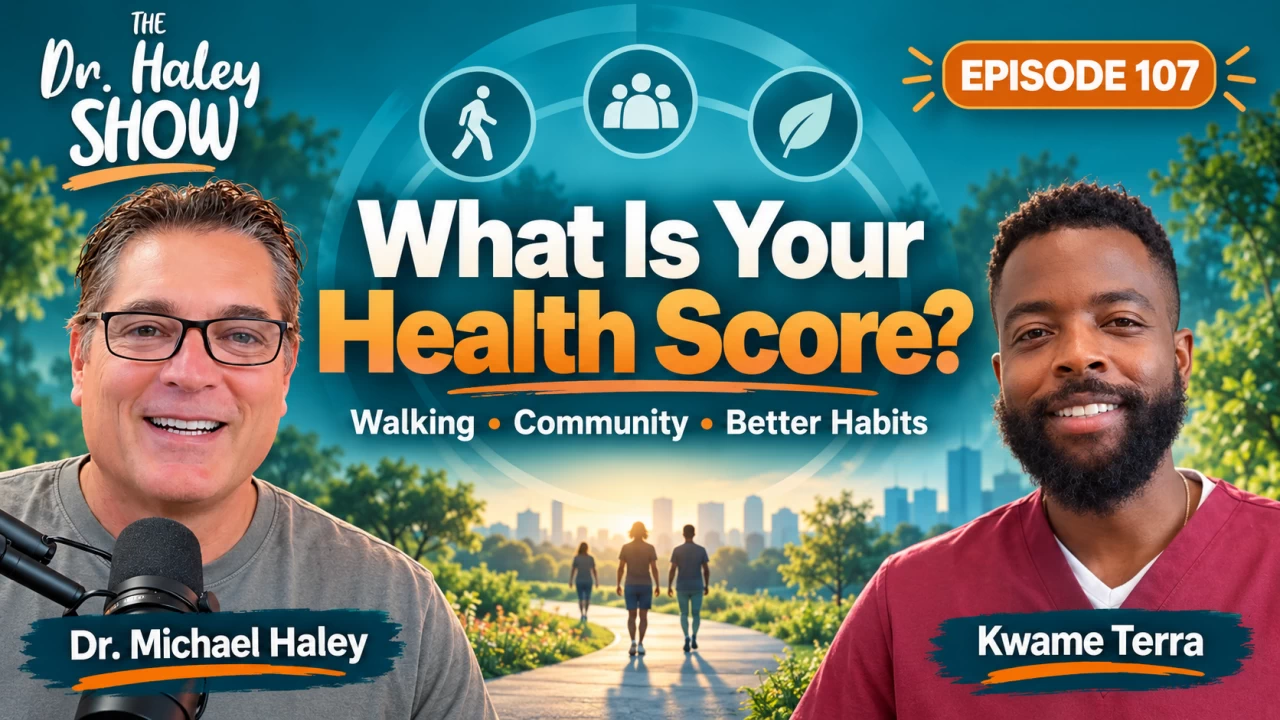
What can a health score tell you about your everyday habits? Kwame Terra, founder and CEO of bEHR Health Systems, joins Dr. Michael Haley to discuss a platform that combines health tracking, community challenges, and feedback to help people engage with their health.
Kwame also shares his experience walking 2,007,178 steps in 30 days, the motivation behind bEHR Health, and why he wants healthier living to feel like part of everyday life. At the time of this interview, he said his record submission was still awaiting ratification.
Watch the Interview
Listen to the Podcast
Resources
- Visit the bEHR App Website behrhs.com
- Visit bEHR Health on Instagram
- Visit bEHR Health on X
- Visit Kwame Terra on Instagram
- Watch this episode on YouTube
- Listen to this episode on iTunes
During the interview, Kwame directed listeners to the dacadoo app and access code DRHALEY, while describing a planned transition to a dedicated bEHR Health app. App access, pricing, challenges, and launch plans discussed in this recording reflect the information shared at that time; visit the bEHR website for current details.
Quick Takeaway
Kwame describes a health score as a feedback tool that can help people notice patterns in activity, sleep, nutrition, and other habits. His larger goal is to connect that awareness with community experiences that make healthier choices easier to sustain.
His own walking challenge illustrates the importance of balance: he says his score declined somewhat during the two-million-step month as sleep suffered and physical stress increased. The accomplishment was an extreme personal challenge, rather than a daily activity target for listeners.
ENJOYING THIS CONVERSATION?
Get the Next Episode in Your Inbox
Get notified when a new episode of The Dr. Haley Show is published, plus occasional highlights and resources worth exploring.
By subscribing, you agree to receive email from The Dr. Haley Show. Unsubscribe anytime.
Episode Timestamps
00:00 Intro Snip
06:50 What inspired Kwame Terra to start bEHR Health?
09:27 What is your mission and goal with bEHR Health?
11:00 Do you have to be black to use the app?
12:53 Are white and black people different in their susceptibilities to illness?
16:22 Does the bEHR app tell you how you are doing compared to everyone else?
18:00 What is Kwame Terra’s health score on the bEHR app?
19:17 What is the best search to find the app in the app store?
19:48 What is the access code to use the app?
20:48 Is the data separated by nationality?
23:00 Can others access this data and use it for profit or is the data secure?
23:10 How is the app being monetized
24:25 Will the data be sold?
27:55 What are the metrics tracked by the app?
29:20 What are your favorite testimonials from people using the app?
30:15 What do you mean by “properly offended” and “consequence motivated”?
32:12 Other than the app on a smart device, what else do you need to use bEHR?
35:13 Did your score go up or down when walking 2 million steps in a month?
Why Kwame Started bEHR Health
Kwame says the disproportionate impact of the pandemic on the Black community inspired his vision for bEHR Health in 2020. He wanted to pair greater awareness of health risks with ongoing support, rather than leave people with information from a workshop and little follow-up.
Although the company’s mission focuses on health in the Black community, Kwame explains that people of any ethnicity can use the platform. He discusses why he believes community-specific solutions can better address the circumstances that shape people’s health.
How the Health Score Provides Feedback
In the interview, Kwame describes a score ranging from 0 to 1000, with feedback across areas such as physical activity, physical health, sleep, nutrition, and mental well-being. He explains that users can view their overall score, compare it with the community average, and identify categories where they may want to focus.
Kwame uses his own changes in sleep and resting heart rate during conference travel to illustrate how the score responds. He also shares user stories about walking, weight changes, and dietary habits. These are experiences reported in the conversation, rather than guarantees of results or a substitute for medical assessment.
Community Challenges and Everyday Experiences
Kwame describes walking, running, and calorie-burn challenges as ways to encourage participation and friendly competition. He also discusses plans for bEHR Connect, with experiences such as run-club meetups, shared grocery shopping, and community meals.
His aim is to make health-promoting activities part of the things people already do. He emphasizes connection and purpose, while explaining that he does not want to create a culture of constant tracking or obsession with health metrics.
Health Data, Privacy, and the Business Model
Dr. Haley asks how personal health information would be protected and whether insurers or other organizations could gain access. Kwame outlines his vision for subscriptions, advertising, aggregated reports, and partnerships with clinics, community organizations, and researchers.
Kwame says community consent would be part of arrangements for access to reports, and describes an aspiration to reinvest some data-related revenue into community health. These statements describe the model and plans he discussed during the interview.
Two Million Steps: Accomplishment and Recovery
Kwame reports walking 2,007,178 steps in 30 days, averaging roughly 30 to 35 miles per day. He describes the discipline required to keep going every day, indoor walking when needed, and the process of submitting the achievement for record ratification.
The conversation also covers reduced sleep, elevated resting heart rate, tightness, and Achilles pain during the challenge. Kwame shares his experience consulting a podiatrist, while Dr. Haley discusses his concern about injury. These personal accounts should not be treated as instructions for managing pain or attempting an endurance challenge.
Medical Disclaimer
This podcast and article are provided for educational and informational purposes only and do not constitute medical advice. The experiences and opinions discussed are those of the speakers and should not replace diagnosis or treatment from a qualified healthcare professional. Do not begin, discontinue, or change any medication, supplement, diet, or treatment based solely on this episode.
Full Transcript
The transcript has been lightly formatted for readability. Because it was created from the recorded conversation, it may contain minor transcription errors.
Read the Full Transcript
And so my goal is really to create health promoting life experiences, help restructure people’s lives, to where they are health promoting. And in order to access our experiences, you have to be a user of the platform. That way we are making sure that we’re getting the data and that is being tracked.
You are listening to the Dr. Haley Show, the podcast dedicated to helping you optimize your health. Each episode there will be an interview or a message to help you discover better health. We will be featuring health radicals on the show to bring new ideas to the table, as well as doubling down on key fundamentals to support you living your best life. Your host is no other than the founder of Haley Nutrition Dr. Michael Haley.
This is the Dr Haley Show podcast. I’m Dr Michael Haley, show host. Today’s guest is Kwame Terra. He is the CEO and founder of b e h r Health Systems, and he’s also someone who set a unique world record that we’re going to talk a little bit about. And I’m going to ask the same question again before we got cut off, because I do think you’re the only person that has the answer to this. Kwame. How many miles can you get out of a single pair of sneakers?
Well, I think you can get a lot of miles out of a single pair of sneakers. I don’t know the ultimate number. I got about 944 miles of walking out of one pair of sneakers. But they do say you’re supposed to replace them every 3 to 400 miles, particularly if you’re running. As far as walking, you probably do a thousand.
You know, I don’t know what’s more traumatic to a shoe walking or running, you know, because you’re getting further steps when you’re running and you’re kind of got a little bounce and you’re probably more gentle on the sneaker, but then maybe the internal impact on me, I don’t know, I don’t know.
There’s definitely there’s definitely more force applied with running probably about I don’t remember exactly. But in my head, what’s popping over right now is about three times four times more force. But you’re spending less time on the ground running than you are when you’re walking, right? So you spend a bit more time obviously on the ground, when you’re walking and you hitting every part of the shoe. So I don’t know. But, my guess is that running, running causes a bit more wear and tear.
So if you haven’t figured out, Kwame set a world record for walking the most distance in one month. 30 days?
Yeah. Most steps.
The most steps.
Yeah, the most.
Yeah. And, and it was over 2 million.
That’s right. Yeah. 2,007,178 steps.
That’s definitely crazy. And this might, you know, it might even be offensive. People get to hear me say this, and they’re going to be like, Dr Haley you don’t know what you’re talking about, but it’ll make sense in a minute. So I’m not that impressed because I think that as humans, we’re supposed to be capable of that.
Yeah,
but we replaced walking with. well, first, you know, there were horses and camels for the people that could afford them. But the automobile, bicycles, electric bikes now, you know, and we’ve got all of this transportation and we don’t walk anymore. I think we’re supposed to, for good health tracking, walk like 10,000 steps a day anyway, right? So I think we should be capable of doing five or 6 or 7 times that, you know, in a day we should be capable. But if I tried that, I’d probably rupture my Achilles tendon.
I feel like I almost ruptured my, I was averaging about 67, 70,000 steps per day. So like as you were talking like seven times as much and it came out to about 30 to 35 miles of walking per day.
Yeah. But but what I’m. Yeah. go ahead I was going to say what impresses me more than that though, is the, you have to be a person that kind of sees no barriers and, you know, driven for accomplishment, and you’ve got a purpose and you’re going to get things done. And to me, that is more impressive than the accomplishment, if that makes sense.
No, I agree, I agree. That’s why I tell people that the hardest part was that I had to do it every day, that I had to cover that distance every day, and I had no margin for error. And so just being able to execute on that, if I missed 20,000 steps a day now I got to do 75,000 steps a day, you know? And every time I did, you know, did any math, okay. If I take it off day here, what would that look like? It’s just like, no, not a chance.
So what’s the most you did in one day?
I did 87,000. In one day.
87. Okay. To make up for maybe a slow day, Or. Oh. What do you rain? What if it rained and stuff?
I was able to walk inside. Yeah. So there’s a walk path in the fitness center here at Xavier University of Louisiana. And so I would just I spent hours in there. I spent a lot of hours in there.
Wow. Yeah. Yeah. So it’s it’s not necessarily a documented world record because it was counted by an app of some kind.
Yeah. So, so we’re still in the process of getting it ratified. And I think this is part of why the Guinness Book of World Record doesn’t have this record, just because you’re going to have to watch somebody for 30 days walk all day you know by their standards and it is something I would like to do with them, at a future date. But we, sent into the International Book of Records and again, so we’re in the process right now getting it ratified. And, it seems like I just had to, you know, complete a few forms and, and, identify my witnesses, and, and we’re good to go. So, yeah, it’s definitely a hard record to track.
Well, you’re going to set another world record. Someone’s going to set a world record with you for counting the most in a month.
Right, right.
I can divide that up. I guess multiple people can do it.
Yeah.
Counted. They won and then they, we add them together. But I mean that there would be a feat in itself.
Yeah. I mean hopefully it’s just a matter of witnessing that they were all steps in that, you know, you know, moving my phone back and forth and, or my watch back and forth, you know, because that counts. Counted steps sometimes when you’re, when you’re just laying down, moving your arm back and forth. So I think it’s hopefully it’s just more of that. I don’t think it would be a matter of somebody legally tallying that would be ridiculous.
Well, let’s talk about the why. And you know, what in life brought you to do what you are doing.
Yeah. So you know I started bEHR health I came up with the vision for bEHR health in 2020 during the C…19 pandemic where you know the virus was just having a disproportionate effect on the black community. And I just wanted to do something so that next pandemic or next challenge that we face, we’re in better health to have a better outcome. And my first thought was that we don’t know how bad we’re doing it. We know we’re not doing well. We know we need to be exercising more. We know we need to be eating better.
But I don’t think that we are clear on the short and long term implications of our current health status that if we don’t get it together, we can have a heart attack at 45. my mom’s friend has actually lost her husband to a stroke at age 46. Leaving this, 13 year old son had to grow up without a father. And, you know, these are preventable conditions. And again, the virus is preying on these co-morbidities. And I know that it’s it doesn’t take much take to, you know, restore health as it relates to, you know, most of these conditions, you just got to remove the things that are driving the condition and make sure you’re getting the nutrients that the body needs to function.
And I’ve seen it happen, right? People come down. They’re off their medications in a matter of weeks after following, you know, a healthier diet or exercising more. And but the first step was like that awareness, making sure that people understood that. And so that’s where we came up with the idea of a health score. And we use that as a core feature of our app. where you get an individualized score and it changes every day depending on how you change. Right. So if you go on a run or walk one day, your score goes up a few points. If you get three hours of sleep a night, your score goes down. And then based on those changes, we make recommendations for how you can improve as well as connect you with health care providers, resources and experiences to help you, elevate your overall health.
And those experiences is kind of how we got to these steps. And so last year, around May of last year, I was working with a local doctor who’s a community health doctor here in New Orleans, and I told him I wanted to do 1 million steps in 30 days to raise $1 million for bEHR health in 30 days. So that was the idea. And, you know, a million steps. It’s a significant amount of steps in a month, but something doable, but I think would be, you know, exciting for folks. And so he said he would help me train for it. And so in May in 30 days, he did 1 million steps, about 33,000 steps per day, 15 miles of walking per day.
He actually ended up losing 20 pounds. And got taken off his blood pressure medication. And so when I think about when I think about my mission, yeah, this is this is two months into our mission last year because we just launched the app last year, somebody walks off their medication. Our goal is to predict, prevent and reverse the chronic conditions that plague our community. and we did that in.
And so that’s what impresses me. That is huge. That’s impressive. You know, the walking thing, you know. Sure. Challenging and stuff, but not did you raise $1 million,
didn’t even launch the campaign. his story kind of took off, you know, because he’s also a health educator for Fox eight here in New Orleans. And so he’s talking about it, raving about it. And, yeah, never, never got around to launching that campaign. So he actually passed me to torch for June. And so I did it in June. And then another one of our users did it in 28 days in July, two users did it in August and then another one in October.
And so we all got to talking about, you know, hey, what’s the world record? Do you think any of us can go out to the world record and then, you know, fast forward 4 or 5 months, I decided to go after it in April. So that’s kind of how we got to that’s how steps became a big part of the culture at behr health. Where we have about 2500 users on the platform now since our launch last year.
And you said, did you say 25 thousands ,
hundred, 2500
Oh, okay. Okay.
Yeah. Not quite.
Well. Yeah. That’s good. Well, I, you know, that would have been a huge number. I said, whoa, wait, this is huge already.
Yeah.
But you have a oh yeah. You have a growing platform.
Yeah.
You have 2500. That’s a lot of data.
Absolutely.
Is it at this point right now because it’s, you know, b e h r Tell me again about the B how important is that. And do you have to be black to use the app.
Yeah. Yeah. So obviously you don’t have to be black to use the app. anybody can use the platform get their health score. It’s normalized by, you know, all ethnicities and genders and ages. We are interested in solving this problem in particular as it relates to health in the black community, the policies, practices and beliefs that created these disparities were very targeted and unique in creative ways. And based on my education and training. The solution should be equally targeted. So it’s not really a matter. It’s not really a like a racial or political thing. This is just, if you create solutions for specific individuals or specific communities, then the solutions will be more effective for those individuals and for those communities.
you enjoying the show thus far? One of the many health secrets that we have covered on the show is all around aloe vera. Specifically drinking raw aloe vera. Our aloe vera has helped our customers effectively heal their gut, increase their intestine health, lower inflammation in the body, eliminate and or decrease acid reflux, have glowing skin and hair, and so much more.
Now, as a frequent member of our audience, you will be exposed to exclusive specials and coupon codes for the awesome products manufactured by Haley Nutrition. That’s right, for simply being awesome and tuning in. You can get a mini discount to help you optimize and better your health. To see how we can help and support you on your health journey. Tune in to the episodes and listen for coupon codes that you can use at haleynutrition.com. Before you make your orders of raw aloe vera. Once again, it’s www.haleynutrition.com. Now back to the show.
As a healthcare professional, I’m, you know, taught things like, black people are more prone to cardiovascular disease. White people are more prone to skin cancers. There are differences. And as we understand these and realize that, well, okay, I can do something about the skin cancer prevention by avoiding too much sun. And when it comes to cardiovascular disease, you can do something about that.
Yeah.
To prevent these from happening. So there are real differences, real susceptibilities. And gathering data and understanding it I think is brilliant.
Yeah. No, I appreciate it. You know, I really, really proud of what we built, because, you know, I wanted to do two things I wanted to communicate clearly to the black community our current health status. But then I also wanted a way to be able to follow up with people once that awareness was created, because there are tons of workshops and seminars all over the country that are, you know, effective. And we need these things. But the follow up is maybe, you know, an email a few months later to, ask them how they’ve been doing with their health journey since then. But what if I could see how many steps they were taking per day for the next six months, what their diet was like for the next six months?
And as they, fall back into maybe their old habits as we naturally do because life is stressful and then we need the convenience and the food tastes good and all that stuff. We can send them nudges, or we can at least remind them, hey, or we going to show them that their health is declining through this score, in real time. And then maybe that’s the reminder that they need to either go engage with their health care provider or go exercise more. And we call that the health score report. And it’s again, this real time database of our user health insights, that we track month over month. So we’ve been tracking the health score report with behr Health since November of last year.
And it’s really cool what we get to see on a month to month basis. So we see total steps taken, total calories burned, total distance covered, the total number of workouts. We also get to see the average health score changes overall. So we see the average health score within the entire community by gender, by age. And then also the seven categories that we track, which is physical activity, physical health, which includes like blood pressure, cholesterol, glucose, things like that. Your mental well-being, your nutrition, your sleep, your substance, use of alcohol, caffeine, things like that. And we can see these changes month over month.
And since we started tracking it in November, there was a dip from November to December. Right? So again, there was there was probably a 10 million drop in total steps from November to December. But we can infer what may have been going on. Right. So people are, you know, celebrating the holidays with their family. So maybe not moving around as much, not focusing on that as much. A lot of, you know, kids are home now. And so just a lot of other factors. And so we talked to the users to find out what maybe was driving that.
But then we saw a significant bump in January. And again, we all know why there’s a bump in activity in January because everybody’s got their New Year’s goals and things like that. And then but we’ve seen an increase in the average house for month over month since then. And there’s nothing more fulfilling than being able to create a platform. carry out interventions, you know, events and challenges and messages and then watch that score improve over time. And so that was a this are ultimate goal is to, you know, raise that awareness and then be able to see that know that we improved the health over time.
Now if you’re using the app, is there like a you’re in first place or you’re in the top 10% or you’re in the middle.
Yeah, yeah. So you can see your individual score. So as far as like your where you fall compared to everyone else there, it shows the average. It’s like on your health score dashboard. It shows the average score. So you can see if you fall above or below the average. But it also shows you what range you fall in generally. Right. So anything above 680 is considered excellent. The score is from 0 to 1000. So anything above 680 is considered excellent. You could say you’re aging at a slower rate right. your risk of chronic conditions are lower than the average person, 610 to 680 is considered very good. 550 to 610 is considered good. Anything below 550 is considered fair or poor.
And in those ranges, those are the folks where, they’re at slightly elevated risk of developing hypertension, type two diabetes if they don’t already have the conditions. Right. And so what we are able to do is when people from on the platform, they get their initial score, we say, hey, based on your score, you may be at risk for these conditions. We highly recommend that you connect with your health care provider to go get some testing done to see if you do have these conditions, and we highly recommend that you also join one of our challenges, where these are these general fitness challenges.
So we have steps every month. Total distance covered. Every month we have a running challenge, total mileage challenge But it’s exclusively running. And then we have a calorie burn challenge every month. And, you know, anywhere between, 50 and 100 people join these challenges, on a monthly basis. And it, you know, people are competing with strangers all day, every day.
I think that’s great.
Yeah.
What’s your score?
My score is 803 right now. I’ve had, It’s funny. it was 850 something, few weeks ago. But I’ve been traveling for conferences over the past two and a half weeks, and these have been conferences, but there have also been parties, as far as I can tell. And so lots of late nights, lot of alcohol and so at night, my, you know, obviously when you know, you drink your, your resting heart rate goes up. Right? And especially when you don’t sleep as much, so much so that my sleep score is getting a knock, so I get points down for that. But when my resting heart rate goes up as well, I get knocks for that in my physical health. And so I’ve just been interesting I’ve just been getting knocked around over the past two weekends, but I’ve been sleeping great this week, my score´s being going. because it actually dip down to 790 something. But now it’s back up to 803, and it’s largely because of my sleep. And, resting heart rate, getting back into it, back in order.
That’s interesting.
Yeah.
And going back to the, app, I looked it up and I realized it’s not b e h r health. You’re not going to find it in the App Store if you do a search for that. For someone that wants to even right now pull out their phone, go to the app store, what should they search for?
Yeah. So you should search for an app called dacadoo You. So dacadoo is our technology partner. That’s spelled D A C A D O O So they’ve been, an incredible partner to us over the past five years, and they’ve invested nearly quarter million dollars into the company, to help us get to this point. And in about three months, we’re going to be migrating over to our own independent platform, where it will be called behr health. and you’ll get that experience. It’ll be more or less the same functionalities, within the platform. but the app will say behr health. You will need an access code and you can type in Dr Haley for that. DRHALEY, it’ll be all caps. And yeah, you can create your account, get your health score, join a challenge.
We’re giving away a bunch of shoes this month. We do we do challenges that usually are centered around some sort of cultural event, or a partnership that we just got. So at the beginning of this year, we actually did, Super Bowl steps challenge, where we gave away two tickets to Super Bowl 59, which was here in New Orleans, for, anyone who completed 59,000 steps in a week. So not a crazy amount of steps, right? Maybe 7000 a day or so. However, every 1000 steps past 59,000 gave you ten additional entries into the challenge. So people one person did 50,000 steps a day. It was nuts.
I love the competition aspect of it.
Yeah.
The, yeah. You know, I’m going to guess that maybe 14% of my audience is black because that’s kind of like a population average. So for the other 86%, download the app anyway. And I’m guessing to keep your numbers pure you probably enter some information about who you are and what your nationality is and stuff like that. Is that how it works?
Yeah. so that’ll be the case on the official behr health app. As of right now, it’s all aggregated together. And as far as you know, the breakdown, currently the demographic breakdown, currently we focus on new Orleans for the most part, which is 60% African-American. And so the spread right now is probably closer to like 80%, 85% African American and then 15% non whether that’s Hispanic or white, what have you. But when we migrate over to the official app, we’ll be able to stratify the data by in any way that we want.
Right now we’re kind of limited to one data set. And cleaning it up is a bit complex. And so right now we just have this one set that we like to say represents the city of New Orleans. But as we’re getting closer to our official launch in October, we’re just kind of bring it on as many people as we possibly can, especially for this, big campaign that we’re launching here pretty soon. But yeah, at that point, it’ll aspirational be a data point for that. And we’ll go over stratified and kind of parse things out from there.
Yeah. The data that you can get out of this, I mean, what is the healthiest state in the United States? And then, well, why might that be? You know, temperatures, activity levels, you know, people are more dormant in the winter time, unless you’re in Florida like I am. Yeah. And, you know, we’re closer to the ocean, so we are probably exposed to less pollution in Florida here. But we have our other challenges. And, you know, as you can start imagining how big this could be from a data perspective. I mean, literally huge.
With that there, I would consider potential problems. For instance, is my data protected? And how do you handle that? Because what if life insurance companies got Ahold of that? Oh, well, your score is not good enough to be insured under our company or whatever the case is. Yeah. How is that?
that’s a great question. You know, and right now our business model is direct to consumer where the user, coverage across the app right now is free. But when we migrate over to the official app, it’ll be $5 per month or $50 per year. To start, you know, when I started this, my goal again is to solve this particular problem and elevate health, not necessarily to, build the most lucrative business. We do need to build a lucrative business.
And as of right now, the plan is to monetize, again, direct to consumer as well as to advertisers, where we’re not sharing data, we’re just saying we have these demographic profiles. Are you interested in marketing to them? And so we do have some advertisers in the app right now, vitamin companies, gyms, things like that who are just interested in this, you know, fitness forward, population.
Oh, sure. Our yeah, I would imagine you can have all kinds of sponsors and deals, things like that.
Yeah. And any we’ve done a few of those already and we actually got a $10,000 sponsorship from a pharmaceutical company for our Super Bowl challenge. Right. That helped us get, get those tickets. But yeah. So that’s the, the optimal model. However, from a data perspective, what I just share with you the general health score report, where we’ve seen the average scores, total steps and all that stuff, we’re going to share that publicly. But it’s all aggregated data. So, you know, anonymized and all those individual information is being shared. But we’re also going to be able to see stratification by city, state, zip code, partnering organizations, clinics.
Right. And they may be interested in that data. So the vision right now is as we, for example, partner with run clubs and clinics throughout the country. We bring their users or we bring their communities or their patient populations onto the app. And if they want access to those reports, they have to pay for it and also get consent from the community. Right. And so no one’s data is being shared unless there’s that agreement is in place. And, and so that’s the vision, right now. That’s how we monetize that data safely and responsibly, in my opinion as of right now.
You know, there there’s also obviously an opportunity, for research institutions, right, to leverage the data. Right. To have real time health data is valuable for institutions, researchers. Right. but ideally, someone who has a vested interest in, improving health in communities. if we structured right, we can get buy in both from the community and obviously the institution whereby a percentage of the funds, let’s say there’s a zip code that everybody’s really interested in and they want access to that real time data in that community.
So you have to subscribe for access. But you have to understand that, a percentage of what you’re putting in goes toward investing in improving health in that community. And then we’ll leverage our expertise from our team as far as like from a health equity perspective on how to improve health in that community, is that investing in make sure that there’s sidewalks in that community. Let’s put a grocery store over here. Right. Let’s do the seminars. Right.
So because that is our largest financial opportunity. Leveraging the data, we have to figure out how we can get buy in from the community so they can see how this is an opportunity not only for our company right to grow our revenue, but to use some of that money to improve their community to where your lifestyle, you being on the platform is almost like a vote for money, to garner funding for your community.
That’s a good way to look at it because it makes sense.
Yeah.
So what are the factors that go into the scoring of, a person you mentioned? Yes. Sleep steps. What else it’s looking at?
Yeah. so we tracked over 100 different metrics or can track over 100 different metrics across the seven categories of health that we measure. So as I mentioned, sleep, mental well-being, nutrition, mindfulness. Even. So, where your attitude or perspective toward your life, physical activity physical health. So blood pressure, cholesterol, glucose, BMI, waist circumference, and we can add others, right? A1 C just depends right now the generic ones that we use are the generic ones I just listed. But you can add protein levels all kind of stuff.
And then essentially so the algorithm is based on 300 million person years of, of health data. And so we know that if someone is eating this many fruits and vegetables per day, that’s associated with this, you know, improvement in life expectancy, longevity. And if they’re eating this much fried food for a week, it’s associated with this reduction in life expectancy. And so those are the current data. So each of those answers has a data point associated with it. And you get scored essentially based on that data point. And then You get a score in each category. So you have your nutrition score, your sleep score, your mental well-being score. And then you have your overall score.
What’s cool about it is that while you may be doing good overall, you may be struggling in one category or another. And you can you will you be able to notice that based on how full the bar is. And so you can go focus on that category. So for me right now it’s sleep right. Again I just missed a bunch of sleep for the past two weeks because just been nonstop at conferences. And so my sleep, everything looks great. And then my sleep is like halfway full, you know. And so now my focus over the next month is to make sure I’m getting my sleep, take care of, but yeah,
I think that’s one that would get me, you know,
I think you get most people, even though it’s like the most important thing for your health, it, it is absolutely been hijacked by our society.
Yeah. I don’t know when I get to the end of my life, it might be shortened by not enough sleep, but one thing I’ll be able to say, at least I was awake during it, and,
Right. Yeah, there’s probably the sweet spot.
Yeah.
So where you get to enjoy the whole while you’re awake? Because, you know, I wouldn’t be when you walk around when your sleep deprived. And that’s having problems.
what kind of testimonials have you gotten so far from people using the app?
Yeah.
What are some of your favorites?
Yeah, I mean, it definitely starts with Doctor Griggs, walking off his medication. In 30 days, each user who’s done this, like, million steps journey, has lost 20 plus pounds. The guy who did it in July last year, he lost 28 pounds. He’s actually been walking about it. He’s been averaging a million steps a month over the past all of this year. And he’s down almost 100 pounds. And again, like being able to see someone come on the platform learn their health score, be triggered by that. Because again, we know we’re not doing great, but like to be able to put a number to it.
Has created these visceral experiences for people, but it’s not so bad that they just throw it away because they’re like, well, you don’t know anything. You don’t know me. Why are you telling me what my health score, you know, how do you know how healthy I am or not? It’s I think they’re properly offended. And then as a consequence, motivated. And they get that feedback loop every day, every week based on their changes, because their scores are changing and so
properly offended. I think that’s what you said.
That’s what I said. I think people are properly offended. There was one time, we were at a run club and we were doing health score assessments, and the young lady got her score. You know, overall score was okay. It was in like the maybe close to good, right around fair to good. But her nutrition score was like 300. And she literally screamed. She grabbed her chest and screamed and you know, okay, that was that moment.
Two weeks later, we’re at the same roof. She comes up to me. She’s. Hey, Kwame. I stopped eating Chick-Fil-A all the time I’ve been cooking at home. I’ve been eating more. More fruits and vegetables and all that stuff, and Everything is flowing.
Yeah, yeah.
You know great. Obviously story about moves improvement. But like that is that’s the impact right.
Yeah. that’s you know not just probably weight loss. But now we have, gut changes which probably makes healthy skin and probably less autoimmune problems. I mean, it all ties together.
Yeah. Yeah. That I mean that’s our goal. and I just love seeing that executed on
Thank you for tuning in to the Dr Haley Show podcast because you made it this far. I have a special coupon code that you can use throughout the month of July 2025. Get $10 off your purchase of $100 or more at Haleynutrition.com The coupon code is xxxxxxxx. That’s xxxxxxxx. And as usual, you can even use this coupon with on sale and already discounted bundled items. Enjoy the rest of the podcast.
Other than the app, what technology do you need to participate.
you only need the app. You need a smartphone. A smartwatch or wearable enhances the experience for sure. Right. We get more real time data. So if you have a smartwatch, we’re getting your resting heart rate right. We’re getting better sleep data. if you sleep with your watch We integrate with Fitbit, Apple Health, Google Fit, Samsung Health, right. Pretty much all all of the trackers. And so if you’re not using one of those, so long as the one that you are using can send data to Samsung or Apple, we can figure out how to get it to our platform so that enhances the experience. Absolutely. Being able to have a wearable, device and as our, you know, society country, you know, leans more into this remote patient monitoring, this real time monitoring with like, continuous glucose monitored and continuous blood pressure monitors.
You know, ultimately I would not like to create a culture where people are obsessed with tracking their health. That doesn’t really strike me as health. And when you look at the longest, the populations in the world, they’re not like tracking every aspect of their life and grinding out in the gym. They’re just like living a good life, and they end up healthy because they’re living a good life.
And so my goal is really to create health promoting life experiences, help restructure people’s lives, to where they are health promoting. And in order to access our experiences, you have to be a user of the platform. That way we are making sure that we’re getting the data and that is being tracked. But that’s not the focus. That’s kind of like the background feature. And yeah, that that’s kind of something that we’ve pivoted to over the past year as run clubs. And what have you become increasingly popular and, hitting so many important aspects of health, especially like community and purpose, that we’re shifting as a company to focus on that.
Again, because I don’t if I look outside and I see a bunch of people obsessing over counting calories and then count their steps and comparing their VO2 max, and I had anything to do with that, I would not be very happy. But if I look outside and I see a group of women walking together in a community and or family sharing a meal together, because we recommend that in the app or, just things that are actually, you know, representative of a good life, then I’ll be happy that I created that.
And so we’re launching what we call behr Connect all connected to the app whereby, so long as you’re on it, you can, engage with and participate in our experiences. But it’s focused on like it’ll be run club meetup, it’ll be, you know, go grocery shopping with behr health. It’ll be, you know, Breakfast Club. all of them will be centered around some form of health promoting activity. But it’s really just the activities that people are already doing in their day to day life. We’re not we’re trying to avoid making people feel like health is an extra thing.
So instead of going grocery shopping by yourself go grocery shop with us, we hit community. And now we’re probably going to have a list that’s a little bit more health promoting. Then you know what you maybe typically doing.
Yeah.
So then that way it’s kind of seamless. It’s not this, this extra thing that you have to do.
Yeah. What happened to your score when you were walking 2 million steps in a month?
Yeah. It went down a little bit when I wasn’t sleeping as much as I was walking 14 hours a day and still trying to run my company. and then also like, stress like that. You know, a lot of people think that professional athletes are, like, unequivocally healthier than the average human being. But there’s a trade off when it comes to professional sports, especially in extreme endurance sports. Right? I used to work in a heart clinic, and everybody that came in either had type two diabetes, obese, heart disease, different things like that. There was one guy that came in who was a triathlon, former triathlon, and he had scarring on his heart.
Right. Your heart and muscle, as you know, and, yeah he overwork it, it you can damage it and it can cause problems. And that’s the trade off with professional athletes anyway. It’s like you’re putting your body at risk for the, for the financial gain. And that’s the trade off. But, yeah, you know, marathons even to me, other professional feats, you know, and it is sometimes crazy to me that a lot of people just on a whim go out and do a marathon. It’s like, I don’t think you understand what kind of, you know, wear and tear that puts on the body. And so, yeah, doing 2 million steps in a month isn’t something I would consider to be good for my body. It’s good for my mind. I think,
oh, there’s trade offs. There’s, you know, you accomplished something that was, very, very difficult. And now that you accomplished that, it’s probably easier to accomplish other things.
Absolutely.
Right.
Yeah. That perspective has definitely been shifted as far as what’s hard and what’s not or what’s a long walk and what’s not. You know, I did like 6 or 7 hour walks on a regular basis, but yeah, my, my overall health score though, because again, I’m walking all day. So my static health or my static resting heart rate, definitely was elevated because I also wasn’t able to sleep as well in the evening. And so just so you know, I was stressed for 30 days, you know,
and probably inflamed.
Yeah. But yes, the whole time, the whole time,
you know, you mentioned your Achilles tendon and it being a concern. Well sure. Too much stress and inflammation. And you probably have to start every day. When you start you’re walking again probably a little slower and get the blood flowing in them and get them stretchy again.
it’s funny, I after like the first five days, I would have to do kind of like, like a two minute jog before I started walking because everything was so tight and because walking compared to running, like you’re just not getting as much rotation and flow that if I was if I warmed up a bit in the morning with a jog, the walk was better and easier. And so that was something that was unexpected for sure. But yeah, my Achilles was I couldn’t jog for like ten days. I could walk with no pain. But there they got to a point where any pressure to try and run ten out of ten pain.
But I ended up talking to a podiatrist, right before I did this, there was a 10-K. We were all training for me in my run club members. We’ve been training for this 10-K since we started our club back in August. So we were all really excited about, you know, doing this 10-K. But my Achilles was killing me. And the day before the race, I was at the expo, behr Health had a booth at the expo, and I’m literally walking around the expo as my as my interns are manning the booth and I see a podiatrist on stage talking about, you know, foot stuff for and you’re gearing up for your race tomorrow.
And so I figured I’d stop by and ask him a question about my Achilles. And so I told him everything I was doing was like, hey, you know, I’m doing 2 million steps this month I’m already 1.3 million steps in, you know, and I really want to run tomorrow. But my Achilles, it’s killing me. Is it? Should I even consider running tomorrow? Like, is it safe at all? I feel like if I go too hard, it’ll tear. And he just casually was like, you know, you’re probably be okay. Just, make sure you’re stretching, like, mostly because everything is obviously just super tight and get a heal. Insert put your heel insert in there and you should be all right.
So I walked to Walgreens immediately to get a heel insert. I put it in and all of a sudden I can run with no pain.
Wow.
Yeah. It was it was unbelievable. And so I ended up running the race the next day.
Yeah. So you were having heel pain, Achilles.
Yeah. Like Achilles.
Yeah. Okay. Because yeah, the Achilles comes down and kind of wraps underneath the heel there. Yeah. And I was trying to understand why how the, heel support or whatever it was helped.
Yeah. I don’t know. It’s I think it just took pressure off. The pressure off the, I guess the flexing of the Achilles didn’t, didn’t flex as much because it was lifted up and so kept it in a more stable. I don’t really know. But whatever, whatever was happening,
I, I’m a fan of good support of the feet and, you know, arch supports and things like that. They definitely make a difference. But when it came to the Achilles thing, I don’t know, that’s new for me. I don’t you’re the first person I’ve known that has done 2 million steps in a month.
Yeah. No, I, I think that that’s a valuable insight if anybody is dealing with any Achilles pain, or just, you know, rehab, I wouldn’t I would encourage them to consider that and talk to their provider about that.
As a health care professional, I probably went the other direction and said, no, you better sit this run out, because last thing I want is, seeing someone rupture their Achilles and what a horrible, painful injury deabilitating
Yeah.
All right, well, tell us, Kwame, where do they go for more information? And tell me the name of the app again, that they’re going to search for if they haven’t downloaded it yet.
Yeah. So if you want to find out your health score, download dacadoo. So that’s D A C A D O O. Use access code, Dr Haley. D R H A L E Y ,
which is just like that Drhaley.com blog, so that works. That’s a good one
and. Yeah. So once you’re in complete your health score assessment make sure you connect a tracker. So Fitbit Garmin apple health. If you’re on Apple you’ll be instantly prompted to connected. If not you had to go down to the track tab and connect trackers. And that way all of your steps and stuff can track and your health score, can updated real time and then. welcome to the behr health community.
We have a mission over the next, 30 day or not in the next 30 days, our next campaign is, for what we’re calling the behrathon, which will be a virtual run slash walk event where we’re going to try to cover enough ground as a community to reach them. So to celebrate the launch of Behr Health, we’re going to try to cover, as a community, 239,000 miles in one day. And so to find us on Instagram, pretty much all social channels @behrHealth, that’s b e h r health. And, my personal, account @KwameTerra. So just how my name is spelled K W A M E T E R R A, you know, yea, follow the journey.
Perfect.Kwame thank you so much for spending time with me today and sharing your experience.
Yeah. No, thanks for having me.
I hope you enjoyed that episode today on the Dr. Haley Show. Make sure to hit subscribe on whichever platform you are listening to this. If this episode made you think of someone, go ahead, take a screenshot and share this exact episode with them. You can catch the show notes for this episode on drhaley.com. If you want to geek out with Dr. Michael Haley on other radical health topics. Be sure to check out his YouTube channel where he posts exclusive video content. All the details are at drhaley.com and we can’t wait to hang out with you on the next episode.