
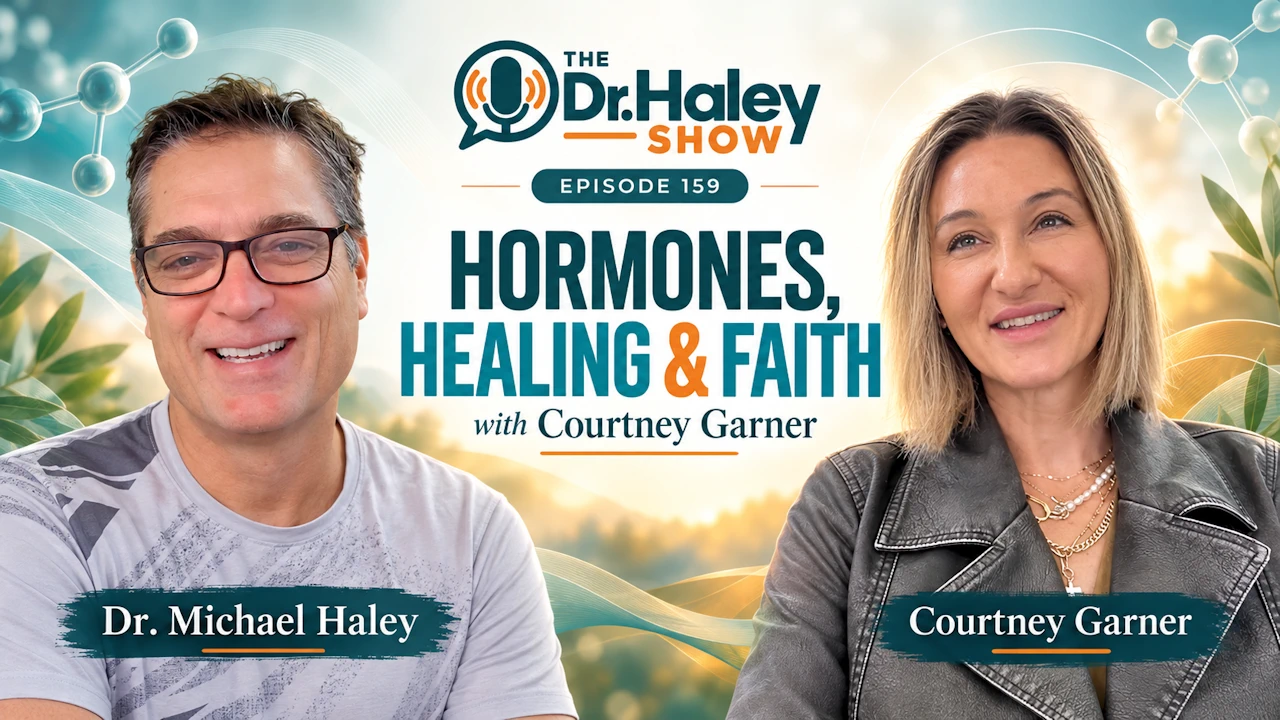
What happens when your lab results are called normal, but you still feel exhausted, struggle with sleep, or notice changes in your body? In episode 159 of The Dr. Haley Show, Dr. Michael Haley talks with Courtney Garner about hormone health, personal experiences of healing, and the role of Christian faith in her approach to care.
Courtney shares her experiences with infertility, restrictive eating and intense exercise, a period of rapid weight gain during severe stress, and the loneliness she later recognized in that season. The conversation also explores lab reference ranges, nutrition, nighttime waking, environmental exposures, and fasting.
About This Episode
Courtney Garner is introduced in the interview as a board-certified Family Nurse Practitioner, founder of WellSpot Functional Medicine and WellSpot IV, and author of Where Faith Meets Medicine: A Woman’s Guide to Health, Hormones, and Longevity. She describes how her personal health experiences and Christian beliefs shaped her work with patients.
This discussion includes personal testimony, clinical observations, and health claims that are not independently established by the interview. Courtney’s experiences are her own and should not be interpreted as a prediction of another person’s results or a reason to delay appropriate care.
Watch the Interview
Listen to the Podcast
Resources
- Courtney Garner’s website and resources
- Get the free download “Functional Lab Reference Guide”
- Where Faith Meets Medicine — book information
- WellSpot Functional Medicine
- WellSpot IV
- Courtney Garner on Instagram
- Courtney Garner on YouTube
- Courtney Garner on LinkedIn
Courtney mentions a downloadable lab guide on her personal website and a QR code in her book. Visit her website for current resource availability; the interview does not supply a direct download URL.
Quick Takeaway
Persistent symptoms deserve a thoughtful conversation about your history, daily habits, and test results. Courtney’s central message is to consider the whole person: physical symptoms, nutrition, emotional strain, relationships, and spiritual life.
Her personal stories also raise a practical question: could the pursuit of health itself become too restrictive or demanding? She describes intense exercise, limited food intake, and isolation as important parts of her own experience. Specific testing, hormone treatment, supplements, and fasting require individualized decisions with a qualified clinician.
ENJOYING THIS CONVERSATION?
Get the Next Episode in Your Inbox
Get notified when a new episode of The Dr. Haley Show is published, plus occasional highlights and resources worth exploring.
By subscribing, you agree to receive email from The Dr. Haley Show. Unsubscribe anytime.
Episode Timestamps
These chapter times follow the supplied timecoded transcript, including the recording’s advertising intervals.
- 00:00 — Opening excerpt: where faith meets medicine
- 01:06 — Normal labs, ongoing symptoms, and introducing Courtney Garner
- 02:52 — From Miami to building a practice in Oklahoma
- 04:24 — Faith, healthcare, and finding a sense of calling
- 14:08 — Scripture, health, and personal responsibility
- 17:06 — What Courtney means by emotional toxins
- 19:29 — Lab reference ranges versus optimal levels
- 23:42 — Fertility, PCOS, and Courtney’s personal experience
- 32:08 — Environmental exposures and Courtney’s approach to detoxification
- 35:59 — Plastics, bottled water, and food processing
- 40:00 — Rapid weight gain, stress, and loneliness
- 43:51 — Waking at 2 a.m. and hormone discussions
- 46:42 — Protein, carbohydrates, fats, and individual preferences
- 50:24 — Inside Where Faith Meets Medicine
- 51:49 — Fasting, emotional health, and Courtney’s perspective
- 55:48 — Where to connect with Courtney
When Normal Lab Results Do Not Explain How You Feel
Courtney describes reviewing symptoms alongside laboratory results rather than treating a reference-range flag as the entire clinical picture. Dr. Haley asks where her preferred “optimal” ranges come from. She identifies professional education, providers’ observations, and some research, while acknowledging that the research is limited for certain targets.
A useful distinction runs through this exchange: a laboratory reference interval, an individual’s symptoms, and a treatment target are different kinds of information. The episode does not establish a universally appropriate optimal range. It also does not provide the studies needed to substantiate the specific progesterone and cancer-risk claim made during the discussion.
Infertility, Exercise, and the Pressure to Be Healthy
Courtney recalls being diagnosed with polycystic ovarian syndrome while training intensely and maintaining very low body fat. Looking back, she wonders whether an unrecognized athlete-triad pattern also contributed to her missing cycles. She describes adding nutrients, allowing herself to gain weight, and later becoming pregnant without fertility treatments.
She interprets that experience through her faith and explicitly recognizes that it is not everyone’s story. Her account cannot isolate which factors contributed to conception. Her separate assertion that each year of birth-control use permanently reduces fertility is not substantiated with a study in this episode and should not be used as a basis for stopping contraception or other prescribed treatment.
Stress, Loneliness, and the Whole-Person Conversation
One of the most personal moments comes when Courtney recounts gaining roughly 15 pounds over ten days to two weeks during a major stressor. She describes anxiety, poor sleep, changes in her thyroid testing, and later realizing she had no close friend with whom she could process what she was experiencing.
Her reflection brings connection and community into the conversation alongside medical evaluation. The speakers also use the phrase “emotional toxins.” Here, that phrase describes their perspective on unresolved emotional distress; it is not a laboratory diagnosis. Their claims about emotions being stored in cells and fasting reversing trauma-related damage are not demonstrated by evidence presented in the interview.
Nighttime Waking, Nutrition, and Hormone Care
When Dr. Haley asks about waking at 2 a.m., Courtney discusses meal timing, alcohol, blood sugar, cortisol, and sex hormones as possibilities she considers. She also explains her preference for bioidentical hormone therapy in selected patients and cautions against using high hormone levels to mask another problem.
The nutrition discussion focuses on protein intake, carbohydrate balance, food quality, and differences in how people feel with different eating patterns. The episode offers Courtney’s clinical perspective rather than a diagnostic method or a nutrition prescription for every listener. Nighttime waking alone does not establish a hormone deficiency or identify its cause.
Environmental Exposures and Questions About Detox
The speakers discuss plastics, heating food in plastic, bottled water, and handling during food production. Dr. Haley shares observations from visits to aloe-processing operations. These examples are part of their discussion of exposure concerns; the episode does not quantify individual exposure or establish the health effect of a particular container or product.
Courtney also discusses binders, antioxidants, sauna use, and medically supervised approaches to heavy metals. She notes that binders can also remove desirable minerals and that specific problems may require testing and supervision. The interview does not establish the efficacy or suitability of these detox approaches for a particular listener.
Faith, Fasting, and Personal Experiences of Healing
Faith is central to this conversation, from Courtney’s account of relief from depression and OCD as a teenager to the way she describes prayer and encouragement in her practice. Dr. Haley also reflects on his own experience of connecting clinical work with spiritual purpose. These are personal religious testimonies, not evidence that another person should expect the same outcome.
Courtney identifies fasting as her favorite chapter in her book and describes her belief that fasting’s cellular effects correspond to damage associated with trauma. She also discusses specific hour-based neurotransmitter benefits, but does not provide supporting studies in the interview. Those claims should not be read as established treatment schedules for depression, anxiety, or trauma. She acknowledges nuances for women and says she does not ask people to move directly into a prolonged fast.
Medical Disclaimer
This podcast and article are provided for educational and informational purposes only and do not constitute medical advice. The experiences and opinions discussed are those of the speakers and should not replace diagnosis or treatment from a qualified healthcare professional. Do not begin, discontinue, or change any medication, supplement, diet, or treatment based solely on this episode.
Full Transcript
The transcript has been lightly formatted for readability. Because it was created from the recorded conversation, it may contain minor transcription errors.
Read the Full Transcript
Courtney Garner: My clinic became my way of praying with people, encouraging people, and just helping people associate where their faith does meet medicine, and tracing back roots to things in a way. we still get to the nitty gritty of their lives and their hormones, and we’re going to fix the problems we can find on paper. But I would be sorely mistaken if I never pointed them back to their internal spirit, right. In faith and God and His path and his desire to heal all people.
Speaker 1: You are listening to the Dr. Haley Show. The podcast dedicated to helping you optimize your health. Each episode, there will be an interview or a message to help you discover better health. We will be featuring health radicals on the show to bring new ideas to the table, as well as doubling down on key fundamentals to support you living your best life. Your host is no other than the founder of Haley Nutrition doctor Michael Haley.
Dr. Haley: This is the Dr. Haley Show podcast. I’m Dr. Michael Haley. Your show host, Your labs come back normal, but you’re exhausted waking up in the middle of the night and wondering why your body suddenly feels different. What should happen next? And how do you get real answers without chasing every test, supplement, or hormone trend on the internet? Today we’re talking about women’s health, the meaning of optimal, and where faith fits into the search for answers. My guest is Courtney Garner, a board certified family nurse practitioner and founder of WellSpot Functional Medicine and WellSpot IV IV. I wasn’t sure. Okay. I was not sure. Thank you for.
Courtney Garner: Not the first person to say that
Dr. Haley: WellSpot IV her own journey through gut problems, infertility, low thyroid help shape the way she cares for patients today. She’s also author of Where Faith Meets Medicine A Woman’s Guide to Health, Hormones, and Longevity. We’re going to explore why feeling unwell deserves attention, even when your labs look normal, and how to ask better questions about hormones and fatigue, and how faith and medical care can work together. Courtney, welcome to the Dr. Haley show. Are you in Oklahoma?
Courtney Garner: I’m in Oklahoma. Thanks for having me.
Dr. Haley: Oh, thank you for being here. I understand, though, you have some kind of roots. Or at least places here in Fort Lauderdale. Did you know I’m in Fort Lauderdale?
Courtney Garner: I did not know that I love that.
Dr. Haley: Yeah. How does that work for you? How do you have a place in Oklahoma? In a place in Fort Lauderdale. And are you from here?
Courtney Garner: So I’m from Oklahoma. I moved to Miami, Florida for almost five years, and I was COO of an medical organization there. And then I transitioned into, kind of going back to my roots and functional medicine and kind of some anti-aging care. And I ran a clinic in downtown Miami, and then when Covid happened, I got put on furlough, and it was like the writing on the wall. It’s time for me to start my own thing. And so I didn’t really know where I was going to end up. So I have a Florida license in Oklahoma license. So I have a Florida address so that we maintain our licensure status and footprint a little bit there. And I’ve got a good hub of patients in the South Miami area. And then a couple a little small micro places and throughout Florida.
Dr. Haley: Okay. Now the nice thing about it, because I know like vitamin D is, you know, very important for health and stuff. We have that advantage here. You don’t get so much in Oklahoma.
Courtney Garner: We get it seasonally. So we’re headed into fall right now. and then we will hit winter pretty hard. We really get all four seasons. So you’re right. You do have a much. You have to probably supplement vitamin D a little bit lower than what I have to do here in Oklahoma.
Dr. Haley: Yeah. And maybe that’s why people are so happy here, I don’t know.
Courtney Garner: I think I love Florida, I still I’m like, Lord, why did I have to move? But there was obviously some good reasons for it. My family’s here, and I had some family with health problems and a number of things kind of going on that was just like, made sense to come back here. But Florida will always hold a special place in my heart.
Dr. Haley: Yeah. Let’s talk about your book title. And, well, you bring faith into wellness. When did that become important to you?
Courtney Garner: Well, always. But I think it just became more pronounced with each year, probably in specific situations. You know, when you work for other people, sometimes you feel like you can’t really fully go there to kind of tiptoe around. And when I started doing my own thing, I just really felt like I wanted to have open conversations when it was needed and not to, you know, beat people down or make that the leading topic of the day. But it is important. God made us beautifully and designed us wonderfully. And the more I know about science, the more I feel like for sure. We were made intricately and there was a God designer to us.
Dr. Haley: You know, I don’t talk about this much on my podcast, but I feel compelled to. it’s a thing that I struggle, that I actually went through early in practice because, you know, I got out of college and then went to our, my pre-med and then got the chiropractic thing and stuff. And when I got out and went into practice, I decided to kind of keep on going. Just I enjoyed school. So I was in practice, but I was also going to Bible college for a couple of years, and I was. And the reason I’m sharing this is because I got confused because and it was weird because some of my patients, even, you know, called me pastor. Now, I’m not saying that in any way to boast, but it was one of those things that confused me. More. It’s like, where did that come from? I’ve never referred to myself as that.
Dr. Haley: Why would they be calling me that? And I remember going to this. Well it was a chiropractic event where they have your motivational speakers and this one amazing chiropractor, Ron Schiffman, was speaking, filled with the spirit. And at the end of a lecture, a lot of people want to ask their questions and they kind of rush to the front. And he looked at me. You know, he’s pointing people out, you know, you and they would give him a question. He’d rapid fire the answer. And for me, I said, Dr Ron, I struggle with. And he pointed at me and said, stop struggling and went on to the next person. That was a life changing moment for me because it applied to so much, and I don’t know if you had any of that similar experience. Was there any confusion in, you know, what am I? Am I some kind of a minister? Am I a healthcare professional?
Courtney Garner: Yeah. So I thought I was going to become a nurse practitioner to do medical missions, and that was my original thought when I committed that actually in eighth grade, and it came out of my own personal health struggles. I had some significant depression and obsessive compulsive disorder as a teenager. That really put me in a lot of isolation, and I didn’t know what to do. And so I would pray all the time and just praying for freedom. But pastors didn’t know what to do. Like, you know, it was just a confusing and spiritually confusing time. And so through a series of events, God broke me free. And I went in that moment, it was through surrender that I would do whatever he asked me to do. And part of that my commitment was, Lord, if you had me go to the ends of the earth and be a missionary, I would say, yes. Just please, whatever you do, break this free. Give me freedom. Like whatever this bondage is that I’m in of depression and OCD lifted and in an instant I was healed and I got.
Courtney Garner: I had no medication since then for antidepressants. I have no symptoms of OCD at all. And so actually, I was confused in the opposite way because I was going through in intending to do ministry work and be an occupational minister in some way, shape or form, even if it was like part time but part time practitioner and every door kept getting shut for ministry. And so my office, my clinic became my way of praying with people, encouraging people, and just helping people associate where their faith does meet medicine, and tracing back roots to things in a way. And, you know, we still get to the nitty gritty of their lives and their hormones, and we’re going to fix the problems we can find on paper. But I would be sorely mistaken if I never pointed them back to their internal spirit, right. In faith and God and His path and his desire to heal all people. So mine was almost confusing in the opposite way of like a frustration of like, God, I was willing, but you put me in a medical office. So what is it that you would have me to do here?
Courtney Garner: And really working with people one by one by one by one?
Dr. Haley: Yeah. My ways are not your ways, as the heavens are higher than the earth. And you know, he has a plan and you want to be in his plan. absolutely it’s needed. A way of ministry in a way that is more unique. To unconventional.
Courtney Garner: Right.
Dr. Haley: Like definitely. In your gifts.
Courtney Garner: Absolutely. And that’s a that’s a beautiful thing, right? You probably feel that too, that, you know, we reach a lot of people being a practitioner and a clinician that the church won’t reach or can’t reach in a unique way. Right? There’s people that have conversations with me that are pastoral conversations that they don’t have a pastor who will have those conversations with them. So it sounds like you feel like the same way, but it’s just amazing. I mean, you really could be in any industry and find a way to be the hands and feet of Jesus.
Dr. Haley: Yeah, but you know, when it comes to wellness, especially if you think about it, if God is in you and directing your life and you’re actually listening to him, if you can learn to hear the voice of God and follow his direction, the answers are so much better than the stuff you could come up with, or the stuff you can get out of even books. You know, I’m sure that your book is faith based, so that might teach people this concept or lead them in a way. But the voice of God, when you if you can listen to that still small voice and apply it to everything you know right now, I’m happen to be having my well, it’s a kind of a elixir, a drink. Here and I’ve got some ginger. It’s funny because I have a green screen, so it probably looks like. A chemical experience it does.
Courtney Garner: That’s so cool.
Dr. Haley: But it’s. It’s actually just it’s got some matcha tea in there and, you know, as I’m consuming this, I might not feel that good. So I should probably pay attention to that and maybe not consume so much. Or I might feel like this is a, you know, I just I just feel great and I feel like I’m getting great nutrition. I should probably listen to that voice. And there’s something that kind of tells you how much you should have of something and how much you shouldn’t have. And, I applied that more often, you know, as I pray over my food and say, okay, I’m going to consume this. And what if I was paying attention to what I should consume and how much of that I should have and when I’m done, and what supplements I should take or what advice I should listen to, you know? Have you ever gotten advice and it just doesn’t feel right? Something’s not right about it. Could that be the voice of God? Am I listening? So I think when it comes to health, helping people understand, that they have a, connection to the king of the universe. Yeah.
Dr. Haley: And that advice that you can get from God is so much better than any you can get from me. Yeah.
Courtney Garner: And it’s unique and personal, right. That’s the beautiful thing. And I think sometimes we just don’t stop to ask the questions. We just kind of push through and we call things normal that are just common, but not meant to be our normal. Does that make sense? Like, we’re not meant to live with the fatigue and this and that, right? But it’s so common that we just kind of brush under a rug and we’re like, oh, we’re a busy parent and we’re a busy entrepreneur, and we just got too much of our plate and we’re not really addressing some of the root cause things. Without a doubt.
Dr. Haley: Right now we are going to get for people listening. We’re going to get into some of the medical stuff, but I want to press this issue a little bit more. Do you have a life verse for yourself? And also, are there a certain verses that kind of stand out that you like to share with people for the principle sake. Of being? Well? Well.
Courtney Garner: I haven’t been asked that in a while. And you know what? I made the dangerous mistake of probably picking Romans 8:28 God works for all things, for the glory of those who love him and are called according, which means that I had to live through a lot of things. I don’t know why I picked that at 13. It sounded so insightful and then I had to live it. And so. So I have been on a journey personally to and. But when it comes to health and I think there’s so many beautiful principles I always like to point people to. By his stripes, we were healed in that being past tense. And so there’s a covering that we have under the blood of Jesus. But we also have to learn how to walk in alignment with our bodies are made. And because we’re beautifully and wonderfully made, that means there’s biochemistry and there’s cellular health that was intentional. But in our American a society especially, we’re very out of alignment without being incredibly intentional about being in alignment. With the stress, with what we carry, with our sleep, with our nutrition, with what we allow in toxin wise.
Courtney Garner: And that can be physical toxins and emotional toxins, you know, and so it’s important that we realize how our bodies are made. And that was part of my intention of writing the book, is teaching the average person, the average woman in particular, in the situation on the topic of hormones how God made her body, the different phases of hormones that we have in our lifespan, and how to really bring alignment. What are things that we can do naturally and with biogenic hormones and those kind of things to bring people into alignment. So definitely is a piece there. You know, I point back to this verse, especially when it comes to nutrition. It was Paul, I believe, who said it. And, I wish I could recall the exact place that that was, but he said all things are permissible, but not all things are beneficial.
Courtney Garner: And we really need to learn as a society and as people that, yeah, we can do this and we can do that and we trample snakes. And people like to use that verse of like, well, I have power and authority, but you’re also leaving an open door in your life because you can, you know, not to eat inflammatory foods or whatever it is. You know what you were saying? Like, you know, your body seems like it’s not responding well to something, but you continue doing it anyways versus listening. And so it’s important for us to realize that.
Dr. Haley: Yeah. You know, I heard a pastor once say, you’re not going to go to hell for smoking. You might even see Jesus sooner. You know. You might get to heaven faster. All things are permissible, but not beneficial. Not necessarily beneficial. I want to explore something else you said there because I’ve never heard this term before, and it makes complete sense. You know, when we’re talking about toxins, this is not the Garden of Eden. And we’re all exposed to physical, chemical toxins. We’re breathing it right now. But emotional toxins. I never put those words together. What’s an example of some emotional toxins?
Courtney Garner: Well, I think most of us would identify points in our lives that felt traumatic to us. May not have been a car wreck that just left us severely wounded, but may have been an experience that led us emotionally wounded. And it could have been physical too. But so many times we have wounds, rejection, you know, things, bad things that happened. And there’s a, there’s a root of unforgiveness in our life, and there’s some angerness and bitterness that we hold on to. There’s isolation that we hold on to, as a guardrail sometimes. And so some of those things actually are stored inside the cells and are part of what we have as mitochondria damage. And we can give all of the supplements. I can give all the NAD and the methylene blue and the CoQ10 and N-acetylcysteine and da da da da da. I can make a huge formula
Courtney Garner: But if someone doesn’t go through and start working through those wounds, those emotions that they’re storing inside, then I cannot fully get them well. And it’s the most missed opportunity inside of medicine, because we’re real fast to throw an antidepressant or this or that at somebody. But we never stopped to ask them about their life history and hard things. And it’s not my job to counsel people, necessarily. It’s my job to kind of point it out and help them see maybe there’s something there they should work through in counseling, in prayer, and in, you know, their private time.
Dr. Haley: A joyful heart is like a good medicine. But a. Broken spirit dries. The bones.
Courtney Garner: That’s so true. And it’s medically the data is there to prove that.
Dr. Haley: Yeah. The emotional made physical. Absolutely. So if a woman comes to you and there are labs are normal, but they can tell something’s wrong, what do you do?
Courtney Garner: So the first thing is just like kind of an understanding of how we got the reference range, because those things are statistics. And, you know, any lab company can take a thousand lab samples of women, and often they do it really broad, like 18 to 65. And it’s like, wow. Our lifespan and our hormones, thyroid hormones and all kinds of things are very different at those two blocks. But you have to be in the low 2.5% of the top 2.5% of that, a thousand sample reference range. Right. To be able to get diagnosed as abnormal. And even now, over the last year or two, I have seen the lab companies come back and they’re shifting the reference ranges lower and lower on hormones. And it’s not because that’s healthy. They’re not evaluating health, they’re not evaluating signs and symptoms. They’re just literally basing it on a 95% median of the population. So that’s.
Dr. Haley: One of the. What if the population is declining.
Speaker 5: Oh we are that’s what’s happening.
Courtney Garner: Yeah. I mean, same thing for men with testosterone like I’ve seen in my career over the last 14 years. The reference range dropped by 100 points probably. And it’s like, well, like we’re declining. But does that mean what we’re supposed to be doing? You know, so getting people to grasp that I think sometimes is just freeing, like, oh my gosh, I’m not crazy. And so then I usually sit down with them and just go through their signs and symptoms and associate where I tend to see most people feel optimal, where their signs match, where they are. Right. And sometimes like it’s complicated because like thyroid and, sex hormones can overlap. And so there’s a little bit of all of those things at play. And it’s getting people to connect the dots that like your blood sugars and your cortisol affect your thyroid and your sex hormones. And you having better sex hormones improves your insulin resistance. And so getting people to kind of realize that we’re interconnected, internally in our metabolic system versus just isolating one problem at a time.
Dr. Haley: So one of the things you mentioned was can you kind of alluded to that optimal levels are kind of based on where you see people that are doing best. Is there any reference optimal ranges that we can look up.
Courtney Garner: Oh yeah. So, data wise, a lot of my teaching or my learning on that has come through American Academy of Anti-Aging Medicine and American, AMMG forgetting what that stands for Age Management Medicine Group. There it is. And it really came from a collection of providers coming together and giving what their data and research has been on this. And there are some things like TSH is an example that I think there are some, like, bigger studies coming out on, but you don’t see a lot of research data on optimal free T4 and free T3. We see it, some data point to, on, like, progesterone being above a six reduces breast cancer, ovarian, and uterine cancer risk. So there are some things that are coming out.
Courtney Garner: But a lot of it really came from, you know, collective groups coming together who are in the trenches with patients each and every day and saying what they’re seeing as optimal, you know, the happy medium point of improving somebody but not putting him in a risk of having side effects. And I, formulated my list of those things, and I actually put it as a freebie on my website, courtneygarner.com and inside my book, again, scan the QR code and download it right from there. But I just give every lab I normally check where optimal is, because a lot of people, you know are trying to navigate their provider with their provider that they have locally of, okay, where should I actually be and how do my symptoms line up with that?
Dr. Haley: Excellent. That was a great answer. With. Resources links in the description. Links in the description.
Courtney Garner: Yeah, it’s totally free.
Dr. Haley: You know, one of my favorite, measurements for wellness. Well, there’s a couple one of the things I think of is survival of the fittest. Because some diets, you know, are for detoxifying, but that’s not necessarily the best survival of the fittest diet. You know. It’s more cleansing than strength, and you’re going to be able to take on the line. But there’s also a kind of a measurement of the general wellness of the population. And the best measurement for that is probably fertility rate. And we in the United States are declining. The way we’re maintaining our population is by importing it for the most part. Well and I understand that fertility is near and dear to you. What’s your experience and what’s causing infertility. And I’m going to say obviously there’s the physical and then there’s also the mental emotional. You know, some people just don’t want to have kids. Yeah, sure. But something’s causing that too. Yeah.
Courtney Garner: I think that the it’s going to be a little ouchy, I think. But the thing of not wanting to have kids is coming from trauma and then just some socioeconomic status situations. Right. And there’s probably a root for some people that’s a little bit of selfishness of like, I don’t want to give my time to any other being. Like, the buck stops here. And I’ve had people tell me, like, I don’t want to have kids in this crazy world. And I’m like, well, but you’re raising a world changer, right? Like, you’re raising someone who can go infiltrate society in a positive way. But anyways, that would be kind of the what I see as an emotional part for me, my story. I had polycystic ovarian syndrome, and I would, you know, typically with that diagnosis, you see a lot of insulin resistance. You see individuals overweight, you know, extra hair on their arms and little things like that of, like, showing that they had high testosterone and, you know, irregular cycles and a number of symptoms. And my journey on that was actually, like, quite the opposite.
Courtney Garner: I was a CrossFit athlete. I was a size 0 or 2 and shredded to all. I had like no body fat. And I actually think I probably had a little bit of athletes triad that was undiagnosed and unmentioned, and kind of shut my cycles down by just over dieting and over exercising, in a borderline eating disorder ish pattern. And I ate very clean and well, but it was almost like too strict, too religious with it. And so anyways, so that was a little bit my journey, and I was told I would never have children without fertility treatments. And I was like, that was. That’s a weighty conversation for any woman, right? 25, 26 years old being told this. And I’m like, I do not want this to be my story. I do not want to choose this story. And, you know, but what do I do? I desperately want to be a mom. And so, I was the day before I was supposed to go again. I’m not in functional medicine at this point. I’m in grad school. Right? And navigating my own feelings of traditional medicine versus, you know, versus what’s my reality, right?
Dr. Haley: I’m actually a little shocked that a doctor would say that.
Courtney Garner: Oh, I’m not shocked.
Speaker 5: They’re, you know, a surgeon will cut, right? A.
Courtney Garner: Fertility specialist will give you fertility treatments. Right. So if you go to the person who makes money off of those things, then what else do I expect their answer to be? To some extent. But that’s my jaded perspective. It is shocking, I know. But anyways, I’m 26 years old and being told this. And so the day before I was supposed to start my fertility treatments, I heard an audible voice of the Lord in my apartment that said, if you’ll wait on me, I will do it. And it was so pronounced. I stopped and I looked at my husband and I said, did you hear that? And he goes, no, what? And I go, I just heard and I stated it. And he goes, he looked at me and he goes, well, cancel the appointment. What are we doing? And so I called, I.
Dr. Haley: Canceled.
Courtney Garner: My I canceled my appointment, and I did a couple of things on my self on my own doing I added in some nutrients. And then I purposefully allowed myself to healthfully gain about 8 to 10 pounds. And within a matter of 4 to 5 months, I was pregnant, naturally. And now I’ve had three children with no fertility treatments at all. And so God can do the miraculous. And that was my story. And I know that’s not everybody’s story, but I do believe that there’s something there in the mix of nutrients and micronutrients. I believe there’s a, some data on like the micro things like vitamin E, vitamin A, vitamin C, just like some cofactors, I think. And, you know, hormones, thyroid, insulin resistance are we getting a good luteal phase? Rise of progesterone and balancing progesterone, estrogen are all playing a role. But I think the very root of a lot of that is our environmental toxins. We’re putting women on birth control way too early when they don’t need birth control. They need menstrual management. Right.
Dr. Haley: And they need.
Courtney Garner: That could be done a.
Dr. Haley: Lot healthier. For acne, aren’t they?
Courtney Garner: Oh yeah. It’s crazy. I mean, it’s unbelievable. And so a lot of things that people are getting prescribed in their teenage years are leading them to be infertile. And We also have an insane amount of environmental toxins: heavy metals, molds, and things that women are specifically more subject to, like parabens and phthalates that would be coming from skincare. BPA, we know, throws off our estrogen metabolism and causes a rise in an unhealthy estrogen called estriol. You know, so there’s a lot of factors to that. Those toxins are thyroid disruptors, right? So I think a lot of it at its root is coming from unregulated toxin load, you know, micronutrient deficiencies and nobody really optimizing the hormones and the thyroid and the insulin resistance.
Courtney Garner: And just fourthly, just sticking everybody on Band-Aid things. Right. We are sticking women who are a little down on antidepressants, and we’re not talking to them about why they feel that way or looking at their hormones. We’re sticking women on birth control just because they have heavy cycles. And I’m not saying that that’s not a serious issue, but there’s much safer ways to manage that than shutting your natural hormone production down altogether. And the data there is substantial a permanent drop in DHEA and a permanent drop in fertility for every one year that someone’s on birth control.
Dr. Haley: Wow. I wasn’t aware of that.
Courtney Garner: It’s substantial
Dr. Haley: It makes sense.
Courtney Garner: Yeah, but it’s interesting. Primary care is are continuing to do GYNs are continuing to do it. And it’s a shame really because we are naturally, you know, decreasing our own population and our own reproductive lifespan.
Dr. Haley: Yeah that might even come before antibiotics damaging the gut and ruining health. Yeah. It’s up there no doubt about it.
Courtney Garner: It is up there with it. I don’t know the data is on that. I mean, there’s for sure a million reasons people get over prescribed antibiotics, but the amount of young women I see that got prescribed birth control when like just something simple like chasteberry would have stimulated their progesterone and probably taken care of a lot of their PMS or heavy cycle symptoms.
Dr. Haley: Well. You know, when it comes to toxins, I believe that avoiding what you can is probably the number one thing you can do. But when you’re already have this toxic load on you. How do you get rid of it.
Courtney Garner: So I always think of our system like a funnel right. We were a made through our lungs, our lymphatics, sweat glands, our liver, our kidneys and our gut to detoxify. And but somewhere along the way, a lot of us get a little kink. And one of the one, two, three or more of those pathways. And so while we should be, we were made to filter a lot of things out. We’re either getting over-inundated and or we’re also having a breakdown in those natural detox pathways. And the piece of that is cofactors have nutrient deficiencies and things like that are our food not being as nutrient dense. And people by and large, eating a lot more out of boxes than their realizing they are, which, you know, really has no good nutritional value in terms of, you know, things that support us, like, antioxidants and B vitamins and, you know, micronutrients. So I think that
Courtney Garner: There’s a couple reasons for it. And so usually when I’m looking at someone’s toxic load, I mean, there’s some basics that everybody could be doing charcoal and bentonite clay and silica with, you know, some people do folic acid and some things like that that are gentle binders that I think most I don’t say everybody because you should consult with your provider, but most people could probably get by with doing a little bit of that work on their own without ever running necessarily a specific toxin test, things like glutathione rotating in antioxidants and supplements. And some of those things are key foundations, so that when you do do charcoal, I will just put it out there. You need to replace minerals because you can bind up your good minerals to. So there’s definitely not to just be go kind of crazy and do your own thing. You know, you do need some due diligence in what you’re doing.
Courtney Garner: When it comes to like, molds will also get rid of a lot with charcoal and bentonite clay. But of course, it’s important to try to identify where we’re getting things, you know, things like plastics, BPA. Well, a lot of that probably comes from us storing foods in plastic containers, plastic water bottles, heating up foods in the microwave on a plastic plate, you know, just things that it’s like, we probably know better, but we’re just continuing to kind of do out of convenience. And glutathione pathway, glutathione, garlic, onions are actually really big and sweating. Getting into infrared sauna is huge for environmental toxins. And then the things that are heavy metals like lead, mercury, aluminum, a lot of those metals really need specific treatment for under some medical supervision. So we’ll get into all of that. But it needs to be tested in a specific plan depending upon the load. But I think the number one thing we could all be doing is probably just trying to find our way to an infrared sauna.
Dr. Haley: Yeah, Courtney, that was a lot of information there. But if someone was overwhelmed, I understand you also do telehealth.
Courtney Garner: Yes, we do some telemedicine. Because we’re prescribers. If you’re in Oklahoma or Florida, we are golden. But otherwise people have to travel to us for one visit so that we can establish care. So we have to work a little bit differently than, you know, a coach, so to speak, because we are prescribing some things. But yeah, we do do that. So I know I firehose everybody, but just know that you can detox. It is possible to detox. And there’s some definitely some protocols out there that we all need to make ourselves aware of.
Dr. Haley: Yeah. You know, the plastics is one that comes up a lot. And I personally think it’s the bottled water. Being I agree. It’s contributor. Yeah. Because they do literally blow those bottles. They start out like the size of a little thimble and they blow them on the line and they it flips upside down. They shoot a little water in it and then the bottle flips the other way, and then they fill it up, the cap goes on, and those bottles really never had a chance to fully cure and gas off it. Kind of like when you buy a new rug and it has that chemical smell for the first couple of weeks or however long it’s gassing off. Yeah. And that’s why you smell it. And I think the, bottled water industry, I believe that’s what’s happening there. And, you know, use fill up your own containers with well made cured. I mean, heck, the bottled. Water. They have glass liners. They have stainless steel. Yeah. Options that are better than plastic. But even if. It’s plastic, if it’s a bottle that was made a long time ago and cured and gassed. Off.
Dr. Haley: But not too long ago to where it’s degrading, I’ve actually learned something in the food industry about plastics, which shocked me, and I happened to be in the aloe vera business, and there’s pretty much four main farms supplying the United States, all of the brands with their aloe vera. Not necessarily. In our case. We actually harvest from a local farm and processing house where one of the few that do this. But in visiting some of the big farms, they pretty much all do it the same way. I’ve been to two out of the four and a third one. I’ve seen the video of it. I’m not of their process, and the three out of the four are definitely the same process. And what they do is they pasteurized the juice and then they hot fill it into either the big 55 gallon drums which have plastic liners. So and the specific number I got from one of the farms was, yes, we put it into that at 170 degrees and then seal it up, because now we know it’s pasteurized in there, sealed up so nothing can get in. Or they put them in the big like 500 gallon IBC containers. To.
Dr. Haley: Ship back and hot fill those. Yeah. So it’s actually hot in the plastic. And that hot kind of activates the molecular activity and the leaching that’s going to happen. Now the funny thing about this is brands will buy that and they’ll reprocess it and they’ll put it in glass jars. So you think, oh well it’s in glass. It’s got to be better. Well it was at 170 degrees in plastic before it was in the glass.
Courtney Garner: Wow. And these are ingestible aloes.
Dr. Haley: Oh yeah.
Courtney Garner: Absolutely not. Just like our topical which is a problem too.
Dr. Haley: But yeah. That’s pretty. But I. Think the amazing. Like you mentioned the heat in the plastic. Yes. And the bottled water is I think those are. The you know. Top two things to avoid.
Courtney Garner: A thousand percent I agree. And just our, you know, when we go to the grocery store or the convenience store to grab a bottle of water if you live in a hot place, well, it was also baking in the sun, you know, or getting transported in those hot trucks from the sun. And yeah, there’s like no shelf life to bottle water. So absolutely, plastics are a big deal.
Dr. Haley: Yeah, but I don’t think it’s coming from storing your food in plastic Tupperware in a cold refrigerator. Where you.
Courtney Garner: May be right. You may be right. But I do see people heating up their food in plastic containers.
Dr. Haley: Yep. Don’t do that. Yeah. Definitely don’t do that. So your one sheet mentions 15 pounds in ten days. Was that a gain or a Loss a gain.
Courtney Garner: My journey of life. So I was at a healthy weight. I have had two kids at this point. I go through, a major life stressor and in a matter of two weeks I gained like 15, ten days, two weeks I gain like 15 pounds, and my adrenals and my thyroid were just like shutting down my TSH Normally I don’t see this with other patients, but my TSH climb to like six almost overnight and there was no antibodies present. It was literally just a huge influx of stress at one time that was not well managed, I think. but yeah, I was a hot mess. I had anxiety through the roof, wasn’t sleeping, was barely getting through my work days because, you know, you just have those moments sometimes in life where it was like emotionally overwhelming and trying to process some personal things kind of happening, really quickly weighed in to my physical well-being.
Dr. Haley: Yeah. What did you do wrong in that circumstance? Yeah.
Courtney Garner: I mean, there’s no of it I probably just could not have avoided with the traumatic situation that happened. But, one of the number one things that, looking back on it, I realize, is I was even writing the book, I felt prompted to do a short section at the end on connection and community, and I had the epiphany that I was actually very lonely in that season, and I had really no one to process what I was going through with. So I was internalizing all of my pain and issues in a lot of ways, and I got counseling and all the things. But even when I was in counseling, I had kind of a coach type of a counselor, and it was amazing. And he said, Courtney, who do you have that you can call and just talk to and be a friend?
Courtney Garner: And I looked at him with tears, my eyes, and I said, no one. And I realized now just the impact. And now the data is catching up with that about how loneliness really impacts our cellular health and the risk of dementia, the mortality rate after a cardiovascular event. There’s a number of different studies out there on how loneliness dramatically worsens our longevity scores.
Dr. Haley: So for someone that’s going through that kind of stress and maybe gained a tremendous amount of weight or something like that in a short period of time, what would you recommend?
Courtney Garner: So have your adrenal health looked at, have your thyroid looked at? Have your hormones looked at? I’ll usually do a big workup of those things. Go ahead and get your inflammation markers and your insulin resistance markers and blood sugar, A1C, and your fasting insulin and get that worked up and start having someone help you put the pieces of the puzzle back together. Get nutrients on board. I use a lot of supplement support for those situations. get some healing happening right? Like sometimes we just need to start pouring back nutrients into our cup while we go and fix the holes in our cup or our bucket. Right? Like when you’re in that situation, me telling you to go find a friend, is it going to make you drop 15 pounds overnight? It’s just to recognize that, hey, it’s a piece of the puzzle. And, you know, having those important pieces of our life in place, you know, helps us get through things much more gracefully.
Dr. Haley: All right. Let’s dig into one more challenge that a lot of people have. The waking up wide awake at 2 a.m.. What’s causing it and what can we do about it?
Courtney Garner: Yeah. So it can be a number of issues hormonally. I also find that there’s a pretty big correlation between cortisol levels and blood sugars. For a lot of patients, they will find that they are eating their snacking after dark. And when you do that, your melatonin as the sun goes down, your melatonin is rising. When your melatonin is higher, your sensitivity to your insulin that your pancreas naturally makes is not as sensitive. Right? So just that natural time of day, we don’t metabolize what we’re eating well. And so sometimes people are snacking late or they’re having a glass of wine or whatever, that wine’s got sugar, it’s raising your cortisol. And then you try to go to bed. And as things are wearing off, your blood sugar starts dipping.
Courtney Garner: Your cortisol starts elevating, trying to get your body to wake up because it thinks it needs to eat again. And so that can be one reason. And then other things typically hormonal, look at progesterone levels and estradiol levels for women. For women and men. Look at testosterone. Those are really the big drivers. And testosterone, a low testosterone in men and women will cause a lot of sleep disruptions. And it will cause usually night sweats or waking up feeling hot kicking the covers off.
Dr. Haley: Yeah. So it might be as simple as changing when your last meal is. Yes. Or maybe more complex needing to get your hormones measured. How do you address hormone imbalances.
Courtney Garner: So if there’s if they’re young like you know 30 under and there’s some natural things that we can do, it’s subtle. You know a lot of times like fixing lifestyle things, then we’re going to do it as we kind of start hitting 30 to 35. All of this. And not to say that we should be, but really statistically, everyone’s starting to see a little bit of just natural glandular decline of our hormone levels, men and women. And so obviously there’s lifestyle parts of that. But I’m not opposed to using bioidentical hormone replacement therapy. I’m a big fan of it. It shouldn’t be abused. It shouldn’t be masking other issues. You know, women don’t need a testosterone of 150 to feel good. If you’re having to do that, then you’re missing your thyroid or something else in the picture. So it’s just sensical. Like, how do we find good ways to help people really get back to a youthful state on their hormone levels and keep them in a safe range, but optimize quality of life. And so, you know, short answer bioidentical hormone replacement is usually my go to.
Dr. Haley: Okay. And talk a little bit about diet protein fats carbohydrates sources of them.
Courtney Garner: Yeah. So I think we’re naturally really carb heavy as a society pretty easily. And carbs have their place. They’re definitely fuel. But we just have to understand that when we eat a carb, we’re raising our insulin. And so a lot of people I find, especially that are under eating protein and just not giving a good balanced diet end up with insulin resistance, especially as hormone levels decline, because we’re just not as sensitive to our insulin as our sex hormones. Testosterone, progesterone and estrogen decrease. So it’s important for women especially, I tend to find that we need less carbs than we think we do as we’re aging. There’s definitely timing. You know, your post exercise glycogen restoration I’m good with it. I understand all of that. But just typically I think we need a little less carbs than we think we do. And protein. I think we can’t under source in a way. Right. I think that’s our one of our big natural deficiencies, especially for women we know we would rather have, you know,
Courtney Garner: The almond Thins and guacamole than a piece of steak. I don’t know, you know, just we just naturally don’t have men are kind of the opposite and then are like, typically my male patients are like meat, no problem. Right. You know, but protein is a big deal. And I think most women need, you know, a minimum of 80g of protein a day. And the amount of times I find women coming in initially and they’re at like 30 or 40, I’m like, okay, that’s a huge you know, part of our problem is we’re just not getting good fuel to our muscles and, you know, balancing our carbs and healthy fats. I think we have a problem of just a little bit of overindulgence, of processed fats. And so I just try to teach people real basics with that, like healthy things: avocado, olive oil, coconut oil, you know, ghee, grass-fed butter. You know, don’t be as scared of eggs as long as you don’t have, like, a GI sensitivity to them, which is another topic, But, you know, I think that there’s some ways that we can get in real Whole Foods sources of those good fats.
Dr. Haley: Yeah, I agree with you. And, you know, not all eggs are the same. A.
Courtney Garner: Thousand.
Dr. Haley: Percent and.
Courtney Garner: And not all protein. Yeah, right.
Dr. Haley: There’s, I like people to figure out for themselves what they do better on more fat, more protein or more carbohydrates. Because we’ll probably all have little different balances in those. I happen to do very well on fats and protein, I carbohydrates. I don’t feel good when eat Yeah. I’m the same Eat too many of them. So that makes I can relate to that. But then once you figure that out okay. Do I want animal sources or, vegan sources. And I don’t know let’s, let’s see how I do on them and how I feel on them. For me personally, vegan sources, I just never feel satisfied. You know, for me. So I probably I consume a lot of vegetation because it’s good for you and there’s a lot of nutrients in there. Yeah. But I also make sure I get the satisfaction that I need.
Speaker 6: So
Dr. Haley: Yeah but everyone’s different so.
Courtney Garner: I agree I agree there’s some basic foundational pieces. But you’re right. I mean totally fine with people, you know, experimental and those kind of things. I think a lot of the problem is just how much inflammation people are eating, right? It’s like, oh yeah, the processed foods, the unhealthy oils. And so that’s probably one of my foundational things besides getting into the macros is just let’s pull out foods that are inflaming you and test and try to confirm what’s inflaming you, because I think that’s such a big driver to so many of our health issues.
Dr. Haley: So where faith meets medicine, someone chooses to get your book. What should they expect to get from that?
Courtney Garner: Yeah, you’re going to get really solid foundational medical science. You’re going to get information on how to heal your gut, how to heal your thyroid, your adrenal health, your sex hormones. We talk about detoxifying. I teach some fasting principles, which I think has a incredible propensity to heal a lot of the damage that emotional toxins cause. So there’s great science, but you’re going to see a faith forward approach. You’re going to feel that, you know, we don’t need to separate in healthcare over here with God’s design for our body. And so I think it really encourage you. It’ll help build you, strengthen you, and give you really good resources and tools as you walk forward into optimizing your overall health.
Dr. Haley: What’s your favorite chapter?
Courtney Garner: Probably the fasting one, and it’s the probably the one that’s the most cringey to everybody because it’s like, oh, that’s hard, that hurts. But I just think that there’s something powerful there that God wants to do and he meant to do when he talks so much about fasting.
Dr. Haley: Before you said it, that was the word that came to my mind was powerful. I was thinking it. You said it, and there must be something to it.
Speaker 6: Yeah.
Dr. Haley: Boy. I feel like I’m leaving something out here. What should I have asked that I haven’t?
Courtney Garner: Let’s, Well Since we’re on the subject and you said it was powerful, let’s just tie the fasting real quickly to emotional toxins. We’ll circle back on that. That. I was in a I have been ministering up in new Jersey with some friends of mine, and, they just have had I just was watching this group of women with so much trauma and so much pain and health disparity and I’m like, God, like, what is it that’s not getting said? Like they’ve set under amazing word and powerful prayer. But what are we missing that’s helping these women heal? And, I heard again so clearly in my spirit, look up every cellular damage that comes from trauma. And I looked it up. And it’s things like inflammation and mitochondria damage and, you know, different specific scores that we look at for cellular health and what really creates disease, heart failure, dementia.
Courtney Garner: I mean, so many disease processes cancer. And then I heard I got the list. I’m like, okay, understood. This is familiar. And then I heard look up every cellular benefit that fasting provides. And I promise you they match a line for line for line. So it was one of those big epiphany moments where I was like, whoa, like we have missed it as a church. We get very, you know, a lot of people in America anyways, like we’re used to doing, you know, a fast with our church in January or something like that, a kickstart, right? Or we might, we might call detoxing like a detox fast, right? Where we do juice cleanses. I mean, you hear all kinds of things, right? And but there’s something really powerful, for people to do on somewhat of a routine basis, not just for quickening of our hearts to the Lord, which I’m here for, but also to help ourselves heal and to repair a lot of that damage that life has brought us out of the Garden of Eden, you know?
Courtney Garner: And so that’s probably the one of the things that I think will shock people than most about the book is just that epiphany. And seeing the graphs of like, line by line, the pros, the damage of trauma and the benefits of fasting. And I know that can be an overwhelming topic, but I always want to tell people fasting. There are some nuances, especially in terms of women’s health, so I’m not negating that whatsoever. But it doesn’t mean that we shouldn’t fast ever, or that we can’t work into it. And it wasn’t to be miserable. It wasn’t to be, you know, traumatic also of like, I’m starving. You know, but there are some ways that we can build into, healthy fasting techniques. And I explain all of that in the book, but I think it’s probably the most unexpected chapter that’s just fresh and I’m in love with.
Dr. Haley: Yeah. When you say you’re explaining it in the book, there’s kind of a guided way to fasting so that somebody is not going to go in blindly.
Courtney Garner: And yes, I’m not asking people to go from 0 to 72 hours, right. Like we need to build into some of those things. And sometimes people don’t even need to get up to the 72 hour mark. But I laid it out in terms of, twofold, like the benefits of fasting, but then also the hour by hour benefit, right, so that we can build into and people can begin to say, okay, I have a lot of depression history or I have a lot of anxiety. So the target I need to aim for is at least making it, working myself into making it to 36 hours or 48 hours because the GABA surge and the oxytocin and dopamine surge happen at this point and this point, and so there’s that part of it. But also just like, how can we go from an unhealthy diet to being able to tolerate that and some of the stress foundation. So I teach all of it there and just get people step by step, just one little step at a time to build you into fasting in a healthy way.
Speaker 6: That sounds great, Courtney.
Dr. Haley: Be a little selfish here. Tell us all your social links and your website and what they need to go download or sign up for.
Courtney Garner: So website courtneygarner.com is my personal page. It’s got our podcast links and it has the book link and kind of all the details. You can grab the book there and then my functional medicine office is called well Spot Functional Medicine. The website for that as wellspotfm.com and really follow me on social. I’m on everything I love Instagram the most is probably where I spend most of my time, but we have YouTube and Facebook and all the things and it’s at Courtney Garner, so pretty simple. No D in there. COURTNEY GARNER and I would love to connect with you.
Dr. Haley: Fantastic. We’ll have links in the descriptions of the video on the blog post and everything like that. So Courtney, I want to thank you so much. This is great.
Courtney Garner: Thank you so much for having me, Dr. Haley
Speaker 1: I hope you enjoyed that episode today on the Dr. Haley Show. Make sure to hit subscribe on whichever platform you are listening to this. If this episode made you think of someone, go ahead. Take a screenshot and share this exact episode with them. You can catch the show notes for this episode on DrHaley.com. If you want to geek out with Doctor Michael Haley on other radical health topics. Be sure to check out his YouTube channel where he posts exclusive video content. All the details are at www.DrHaley.com and we can’t wait to hang out with you on the next episode.