
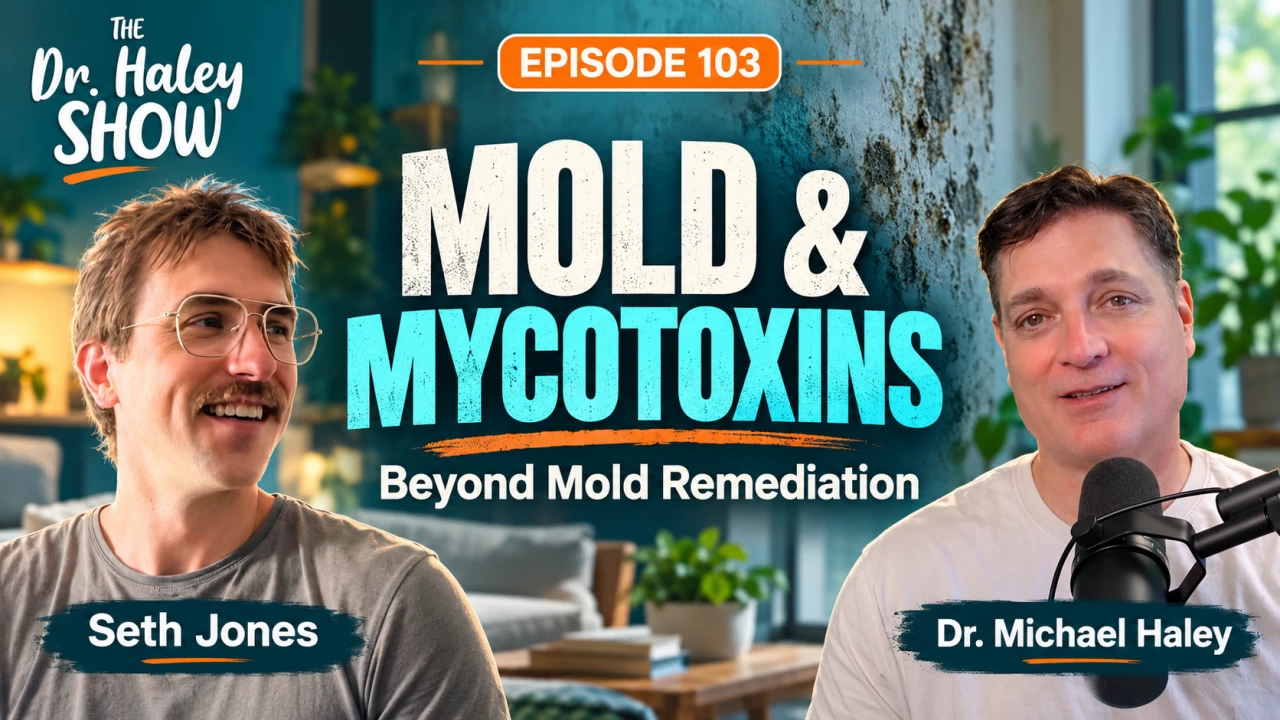
Can a home remain a problem after visible mold has been removed? Dr. Michael Haley talks with Seth Jones, CEO of Hygia Living Corp and the visionary behind Superstratum, about mold, mycotoxins, building related illness, and the distinction between mold remediation and whole-home cleaning.
Seth shares the experiences that changed his career direction, explains his company’s approach to environmental testing, and describes its three-phase home treatment system. The conversation also explores cleaning, maintenance, and mold-resistant coatings for existing homes and new construction.
Watch the Interview
Listen to the Podcast
Resources
- Visit Superstratum Labs HERE: superstratumlabs.com
- Visit Superstratum Labs on Instagram
- Watch this episode on YouTube
- Listen to this episode on iTunes
Quick Takeaway
Seth’s central message is that removing mold and addressing the remaining contamination are different tasks. He describes how Superstratum approaches testing, surface cleaning, and mold-resistant coatings, while emphasizing ongoing home maintenance.
The health experiences and product performance claims discussed are Seth’s accounts and explanations. This episode introduces his perspective and company’s approach; it does not establish a diagnosis or provide an individualized treatment plan.
ENJOYING THIS CONVERSATION?
Get the Next Episode in Your Inbox
Get notified when a new episode of The Dr. Haley Show is published, plus occasional highlights and resources worth exploring.
By subscribing, you agree to receive email from The Dr. Haley Show. Unsubscribe anytime.
Episode Timestamps
00:00 Intro Snip
00:55 Introduce Seth Jones from Hygia Living Corp
02:05 a reading from the book Leviticus about mold infested homes
07:05 How Seth Jones was affected by mold exposure
13:08 How do you diagnose and treat “building related illnesses”?
19:25 How do you test for mycotoxins?
23:37 How do you get rid of the mold and how do you get rid of the toxins?
26:24 What is the 3 phase home detox and is it safe?
29:55 Can anyone do it or do you have to hire a specialist to do the 3 phase home detox?
32:00 Does the superstratum endurance coating work on any surface?
Mold, Home Maintenance, and a Reading from Leviticus
Dr. Haley opens the discussion with a passage from Leviticus describing the inspection and removal of mold-contaminated building materials. Seth connects that passage with the broader idea of maintaining a clean living environment, then discusses how modern construction and ventilation differ from the dwellings described in the text.
Seth’s Experience with Building Related Illness
Seth recounts living on a property in Los Angeles where leaks and mold became part of his investigation into the residents’ health problems. He describes anxiety, other residents’ experiences, and the research that eventually redirected his focus from music to his company. These are his retrospective accounts of the events and their possible connections.
Testing for Mold and Mycotoxins
Seth distinguishes tests that look for mold spores or mold DNA from tests intended to identify mycotoxins. He describes his company’s mold tape and mycotoxin swab kit, its laboratory partnership, and the use of mass spectrometry. He also explains the sampling approach his company recommends for dust collected throughout a home.
Remediation and the Three-Phase Home System
The conversation separates removing the source of mold from cleaning the rest of the home. Seth describes Superstratum’s three phases: surface cleaning, a chlorine dioxide gas phase, and application of a mold-resistant coating. Dr. Haley asks about safety and whether the process requires a professional.
Seth discusses both do-it-yourself ordering and professional services. His descriptions of chemical safety, toxin removal, and product effectiveness are presented as the company’s claims. The interview is an overview of the process, rather than a complete set of application or re-entry instructions.
Mold-Resistant Coatings and New Construction
Seth discusses applying the Superstratum Endurance coating to clean surfaces, including framing, subfloors, and certain exterior areas. He explains that the coating is intended to resist mold growth rather than remove existing mold, and shares examples and longevity claims from his company’s experience.
Medical Disclaimer
This podcast and article are provided for educational and informational purposes only and do not constitute medical advice. The experiences and opinions discussed are those of the speakers and should not replace diagnosis or treatment from a qualified healthcare professional. Do not begin, discontinue, or change any medication, supplement, diet, or treatment based solely on this episode.
Full Transcript
The transcript has been lightly formatted for readability. Because it was created from the recorded conversation, it may contain minor transcription errors.
Read the Full Transcript
helping people to understand that there’s this other part when you’re sick and your home is making you sick. Mold, remediation is not enough. you also need to get back into these rituals of cleaning, of maintenance. And when your home has gotten to a place of toxicity, you have to detox the home
You are listening to the Dr. Haley Show, the podcast dedicated to helping you optimize your health. Each episode there will be an interview or a message to help you discover better health. We will be featuring health radicals on the show to bring new ideas to the table, as well as doubling down on key fundamentals to support you living your best life. Your host is no other than the founder of Haley Nutrition Dr. Michael Haley.
This is the Dr Haley Show podcast. I’m Dr Michael Haley, show host, and we’ve got a great show today. Today’s guest is Seth Jones, the CEO of Hygia Living Corp and the visionary behind Superstratum. The first patent pending process designed to remove mycotoxins from homes with a background as an international DJ and songwriter, Seth’s journey took a dramatic turn after a personal encounter with building related illness. BRI. Now he’s dedicated to healing the estimated 66 million U.S. homes that contribute to toxic conditions, affecting 170 million people. Seth mission is clear to elevate our health by purifying the environments we live in.
Man, welcome to the show. You know, Seth, is it okay if I start up with reading something that was written, like, over 3000 years ago?
Please,
I know that things have changed since this was written, and it’d be interesting to hear from the expert, but about 3500 years ago in the book of Leviticus, and this is from the New International Version, the Lord said to Moses and Aaron, when you enter the land of Canaan, which I am giving you as your possession, and I put a spreading mold in a house in that land, the owner of the house must go and tell the priest I have seen something that looks like a defiling mold in my house. The priest is to order the house to be emptied before he goes in to examine the mold, so that nothing in the house will be pronounced unclean. After this, the priest is to go in and inspect the house. He is to examine the mold on the walls. If it has a greenish or reddish depressions that appear to be deeper than the surface of the wall.
The priest shall go out the doorway of the house and close it up for seven days. On the seventh day the priest shall return to inspect the house. If the mold has spread on the walls, he is to order that the contaminated stones be torn out and thrown into an unclean place outside the town. He must have all the inside walls of the house scraped, and the material that is scraped off, dumped into an unclean place outside the town.
Then they are to take other stones to replace these, and take new clay and plaster the house. If the defiling mold reappears in the house after the stones have been torn out and the house scraped and plastered, the priest is to go and examine it, and if the mold has spread in the house, it is a persisting defiling mold. The house is unclean. It must be torn down its stones, timbers, all the plaster, and taken out of the town to an unclean place.
You know, Seth, I’m guessing at that time that was probably a pretty good plan. It’s like, you know, we did what we could to clean it. This house is going to make you sick. This is bad. They knew way back then. This is bad. Tear the house down. Just get rid of it. Start over.
Yeah. Yeah. And I love that you started the show with that. And they also. You know, I think one thing that’s often the people who are aware of that. And I love that you’re aware of that sometimes overlook the fact that it’s the priest who is doing this work. Right. It’s not a tradesman in the town, but that this idea of keeping the home pure, the environment pure, was actually ritualized and written into the religious law. And that’s common across religions, right? That there are these rituals around cleaning and how the environment has to be maintained because they understood the connection between the health and the spiritual health and the relationship to God, you know, and the way that things needed to happen.
So there’s so much there’s actually so much wisdom in that, in that passage. And you’re right, a lot of things have changed. But actually a lot of things haven’t changed. And it’s funny when you go back and you and you hear that knowing everything that we know now, we have completely different types of buildings now. So it’s a whole different conversation. but the philosophy hasn’t really changed. And one of the major, you know, debates within mold remediation or that has been or people who use chemicals or who fog to try and kill mold and people who scrape, mold and physically remove that mold. And, you know, it’s specifically indicated in that passage that it’s to be scraped and removed.
And if they can’t get the mold out, then you have to, you know, destroy the house. So even those principles are still present today in, how we handle mold remediation. But and I’m sure we’ll get into the problem goes much, much, much, much further today than it did then, because the dwellings of those times were built with certain materials that were very natural. They had obviously a lot of fresh air. There was no central AC. And now we have airtight buildings in central AC, and crawl spaces and all these things, and those same molds grow. But when they grow in these environments now, they release mycotoxins. And it’s really those chemical toxins in that environment that is causing this. And that is much difficult to heal from on a healthside. And when you’re dealing with the building, it’s much more difficult to decontaminate. You know, a home that has that is airtight and it has these mycotoxins in it from the mold.
Yeah. Yeah. Now, what happened to you? How was your health affected?
Yeah. Well, you know, it’s a funny story. My. I don’t know who wrote my bio. It’s it makes me sound fun. And I guess I had a fun time in my career in music, but I was actually living in Los Angeles, and I was a DJ, and I was touring and, you know, living a whole different life. And I lived in Los Angeles, and I lived on a property that had kind of an apartment, and it was a little bit bigger property, and there were some different people who lived on that property.
And I had made a transition into starting this company, actually, and was working on the mold problem. And not realizing at the time that, my business partner is that is the startup house. So I had a business partner there, and, there were a couple other people who lived on the property. This home would leak when it would rain and there was mold growing in a home that I didn’t know of, and it became very toxic.
And everyone who lived in that, house got extremely sick. I got the least sick, probably of everyone that lived there. I had anxiety and some different things that just kind of appeared and developed. But there were cases of like, extreme gut issues. One and it was during C…d too. So you had compounded vaccines and viruses and things, but in that home, one girl, like, lost her appendix. Another girl had to go, went to rehab from all the drinking because she was so depressed. Another couple of guys, you know, for two years when to different doctors trying to figure out what was wrong and most impactful in my partner. I was in a relationship at the time, and she had had a prior exposure to when she was young, and I wasn’t.
Even as I was entering the space, I didn’t really understand the impact. I didn’t understand, and unfortunately, she got extremely ill, both physically and mentally, and became convinced, paranoid that I was going to kill her. And she ran away and, you know, it was just this extremely traumatic thing that no one could explain and no one really understood.
And it wasn’t until a couple of years later, after a couple of years of research, building this company, where in retrospect, you know, I kind of looked back at everything that had happened. And, by that point, you know, there had been testing. We have been working with it, developed a way to test these toxins, because there was no way to even know if you had mycotoxins in your home. And I went back to that house and knocked on the door with one of these new testing devices, and I was like, hey, will you let me come inside and, you know, things in the house? And sure enough, you know, there track of the scenes and, I’ve countless and countless stories now, now I understand this. Now we’re getting more data. Now we’re starting to understand. But, you know, that was for me, really the genesis that shifted my whole career. You know, 15 years as a musician, you know, into chemicals.
that’s fascinating. I’m, interested in knowing and how this mycotoxins detection works is the music chapter closed or you still dabble and are still.
Yeah, I still dabble. You know, I, I did it for so long, and we had a great time. I’ve traveled the world, and, I had a lot of cool experiences. And I met a lot of really fun people. And then, this company started, and all of this happened in this really has become the life mission and the passion and, it’s the impact that we have every day. it fills me with so much significance that, you know, being onstage, it’s fun, you know, and I do it every once in a while when they call me. But, music has now become the hobby. And this has really, you know, become the thing that’s taking over my passion.
We’re similar in that, I love music. And, you know, for me, it’s just playing drums in the church, and I love playing the drums. Yes, I have a history as a Dj and worked in clubs and stuff like that, and that was fun. And I also did private events, you know, that was fun. Playing the drums. That’s my, my passion. But I’m not really changing any lives by playing the drums. You know, it’s fun, but it’s not life changing for anyone.
Yeah. I felt the same way. You know, I it was fun. I said, you know, millions and millions and millions of people heard my music and saw me and they had a good time, you know, but the stories and the people that we help and the, frankly, the lives that we save, and the magnitude of the impact, you know, of.
Yeah.
of a positive, you know, doing something positive in this way because it’s so big. I mean, when you look at the scale of this problem and when you begin to understand how this is contributing to the chronic health epidemic, it’s an exciting thing to do.
Yeah. I’m sure you’ve heard people say to you, if it wasn’t for you, I wouldn’t be here today, no doubt.
Yeah. And that’s powerful.
you enjoying the show thus far? One of the many health secrets that we have covered on the show is all around aloe vera. Specifically drinking raw aloe vera. Our aloe vera has helped our customers effectively heal their gut, increase their intestine health, lower inflammation in the body, eliminate and or decrease acid reflux, have glowing skin and hair, and so much more.
Now, as a frequent member of our audience, you will be exposed to exclusive specials and coupon codes for the awesome products manufactured by Haley Nutrition. That’s right, for simply being awesome and tuning in. You can get a mini discount to help you optimize and better your health. To see how we can help and support you on your health journey. Tune in to the episodes and listen for coupon codes that you can use at haleynutrition.com. Before you make your orders of raw aloe vera. Once again, it’s www.haleynutrition.com. Now back to the show.
It’s one of those weird illnesses, you know, it’s the building related illness. It’s hard to diagnose. It’s hard to treat. It’s weird because some people don’t get sick and other people get tremendously sick. And there’s, you know, everything in between. Some people have immune systems that just go berserk, and they have all the gut problems and allergy responses and body pains and chronic fatigue and you start getting confused with these other diagnoses that are so difficult to treat. Prevention is certainly better than treating. But what are you seeing in the people that need help? How many of them are getting better, and how many are continuing to suffer for the rest of their lives?
Yeah, that’s a great question. And, and I think to go back to the first part of your question, what makes it so difficult to understand and to diagnose and, and I think it’s because it’s what building related illnesses is not another disease, right? It’s actually a different paradigm of illness. And, you know, we in kind of the germ theory that we’re all trained in how we understand catching a cold, right? Catching a virus, our body processes that and fights it off, and we get better. Chronic illness and building related illness is not like that. It can be related to that. But what this is, is toxicity.
It’s an accumlation of toxicity and the compounding and complex effects of that toxicity in the body. Over time. And everyone is different. Right. And this is the obviously reflected in our genetics. And this is becoming much more popular now, we’re beginning to understand this. And I like to explain to people when we think about genetics, you know, we think that, oh, it’s just a, it’s a roll of the dice, right? I have this mutation or this gene or and so that means that I have this chance now of getting this thing that this study says that there’s this chances and that’s not how it works. Right? Our genetics are what create the environment of our body, which makes us susceptible. It’s health. it’s about our susceptibility. In that environment, you can actually have a lower chance of developing all of those things. If you understand that susceptibility and you manage your lifestyle and your health in that way.
And so when you know, with building related illness, number one, most people, they can be dying and they won’t believe that they have it. So that’s the first problem is that it just people miss it. And that obviously isn’t an impediment to getting better because over and over and over, there have been clients and friends and family members that I’ve had conversations with over years, as they’ve been seeking traditional solutions and pharmaceuticals and those types of things. And it was a very simple issue in they’re building. Right? They had mold or their HVAC wasn’t clean. That obviously eliminates someone’s chances of getting better.
The people who realize it who go, okay, this is a problem in my home. I’ve got mold, I believe it. Whatever it is, let me go try and get better. it’s still pretty low. Because it so individualized. It’s so difficult. But number one, because most people never address their environment correctly. And so even the people who get on the right track, who begin to do the right things, it’s they’re fighting an uphill battle that they’re never going to win because they can’t control that environment.
And I think the final piece of this that I have seen as a generality is that the people who begin to get better, most of them get to 80 to 85%. They get to that point. And it’s really the cellular health issue, the cellular response that they can’t they never quite recover from and that they’re so susceptible to re exposures and so then they kind of enter into this post, you know, post healing phase that limerence of okay, well I’m not sick like I was, but if I go to an Airbnb or the wrong hotel room now for two weeks, and that creates a psychological effect. So you know what is true healing. How many people actually heal? I don’t know, but I do know that it is very, very difficult.
Yeah. I feel like whether it’s cancer or building related illness, number one is get rid of the cause and a percentage of people will get better just by getting rid of the cause. That is the most important part of the equation would be like if you had lung cancer, you know, oh well, I’m going to start eating, you know, green vegetables and drinking juice smoothies. Well, did you quit smoking? You know, number one, get rid of the cause. And obviously with, building related illness, get rid of the cause.
Yeah. I’m one of those people where I detoxify very quickly. And, you know, you can have two people in the same house. One of them is always testing high for heavy metals, and they can do all kinds of detoxes, and they still test high for heavy metals. You can’t get rid of it because your detoxification system just isn’t working as good as it should other people. They completely detoxify. I happen to be one of those lucky people. But that doesn’t mean I’m okay in a home full of mold and mildew. I will definitely feel it in my eyes and like a burning sensation in my nasal passage in something that says get out! Get away from this. If I’m lucky, I’ll feel it. You don’t always feel it. How are you actually testing for the mycotoxins?
Yeah. So, it’s good timing. Actually. We just relaunched, our mold and mycotoxins detection kit. So traditional environmental testing and mold testing. That’s looking for mold spore, or DNA of mold. It can tell you the species of the mold that’s growing, but mycotoxins are the chemical byproduct of mold. There’s a defense mechanism that the mold creates to fight bacteria and other molds, and those are chemicals that will they’re separate from the mold. The mold test doesn’t detect what weapons the mold is using, right? Whether or not the mold was using bio weapons as it was spreading throughout your home.
Now, within the last 2 or 3 years, there have been some testing methods that have come on the market that are PCR based test, but those are really meant for like DNA. They’re meant for, microbial, on the molecular side, it is really mass spectrometry that does the most accurate testing of mycotoxins. So we have partnered with a laboratory and have brought to the consumer market now an at home, in that mass spectrometry test that you can do. And this has a mold tape and a mycotoxins swab.
And it’s designed to be affordable. It’s, I think about 400 bucks or even less than that. And you take the mold tape and you can put it directly on to mold. So like if there’s something growing and you want to know, is it mold or what type of mold, you know, is it and you want to know, is that mold creating a mycotoxin? Then you would take the mold from the mold tape, and then you would just swab that mold and get a good sample, and you send it off to our lab. And we now detect over 40 different types of mycotoxins. So we can tell you with, you know, into the parts per billion what is there. And that’s very it’s the largest panel.
So you can also do it. And we recommend people to do this because this is a little bit more important than, the specific testing. But what’s going on in your whole house. So we tell people to take that swab. And you can walk around to each room and you swab the tops of the door jams because you want to see what’s in the dust. The dust is really where those toxins and spores are, and that gets airborne, and we breathe them in and they go straight into the bloodstream. So you’ll take a sample throughout the whole home, and then we can determine, you know, are there any mycotoxins throughout the home? And what mycotoxins are there. And then you can take the mold sample of the dust as well to see. Are there any mold spores that might relate to these toxins. So that is available now. And we’re in the process of actually developing an air test. So this would be something that basically does all of that. But it’s sampling the air so we can get an idea of what the occupants breathing.
Oh that’s pretty interesting. That’ll be great when that’s available.
Yeah.
As you’re saying these things, it’s reminding me of certain illnesses like pertussis as an example. It’s this bacterial infection. And initially when someone is sick, they might not even have the symptoms. And then when the symptoms are developing, it’s actually from the toxins from the bacteria.
Yeah. The endotoxins.
Yeah. And the bacteria could be completely dead within a few days. But those toxins over the next 4 to 6 weeks that people are, you know, coughing, coughing and hacking and, slowly decreasing as our body’s getting rid of the toxins. But the toxins are still there for a long, long time.
That’s really interesting. Yeah, I haven’t heard that, but that’s a great thought because we try to tell people that too, that, okay, a mold mediator can come in to that house and can kill the mold successfully, but those toxins are still going to remain and your body has you know, is detox of has processes to remove those toxins. Your home doesn’t have that. So those toxins will stay in that home in for a subset of people, they’re extremely, extremely sensitive to it.
Are you involved in getting rid of the mold and getting rid of the toxins in the house?
We do. So, we have an EPA registered, mold and biofilm killer. It’s called pure one. But really, what super stratum has focused on is the small particle cleaning, the mycotoxin cleaning, the detoxification of the chemicals within the building molds, remediation. We work alongside of. Right. If you have mold in your home, just like in the Bible, you got to get it out. You want to remove the source and that’s what mold remediation does.
But one of the things we like to say is you wouldn’t, have your car mechanic detail your car, right? Those are two processes you need a mechanic. He’s ripping stuff out. And there’s all that’s for mold remediation. But oftentimes, especially for people who are sensitive, that mold remediator will make the home more toxic after he’s done his job. And there was not a solution for that. And that was what really left people in a difficult place when, okay, we got the mold out, but all of the spores, all of those toxins now are spread throughout the home. You know, we didn’t think about the home like that holistically.
So super stratum, our chemistry, we were the first chemistry to be able to demonstrate that we could destroy the molecular compound of the mycotoxin. And that’s what HE-HOCl does. So in our three phase whole home system, this is a whole home detoxification that we’ll clean and we gas with chlorine dioxide gas, the building envelope. So this is really focused on destroying those mycotoxins, VOCs, you know, all of the chemicals and things. And then, you know, we do have some more products if people are spot cleaning mold or they’re doing it themselves, but our goal was to create products that people could use themselves, you know, to fit in in those gaps so that even if they couldn’t, you know, fix the source or they had a they had an affordable solution that they could do to make their environment, a little bit better.
I hope you’re enjoying the podcast. If you haven’t already, be sure to like and subscribe! During the month of June 2025, get $10 off your purchase of $100 or more at Haley nutrition.com. The coupon code is XXXXXXXX. That’s XXXXXXXX. You can use this coupon with on sale and already discounted bundled items. Enjoy the rest of the show!
All right. I’m just thinking out loud on this because it almost sounded like getting rid of termites where you tend to house and gas the place. Is it dangerous? Is it safe? How does it work?
Yeah. Okay. Great question. So, the whole home system is a three phase process. The first phase is the cleaning phase. We use a product called our building cleaner. It’s a special type of chemical called Hypochlorous acid. Hypochlorous acid it’s actually generated in the human body, and you may be familiar with it. in chemical manufacturing, when you’re manufacturing Hypochlorous acid, you can do it a number of different ways.
Our product is unique. It’s called AG-HOCl it’s a pH neutral, solution that essentially has a very high oxidation power of. It’s extremely safe. I, you know, for the biohackers, there’s a whole rabbit hole. And how what you can do with HOCL, and I use it for a lot of different things. But within our cleaning protocol, we walk into the building, we fog it on all the surfaces that will destroy, most mycotoxins on contact. So we let that fog dry, and then we wipe down all the surfaces in the home. And people can do this at home with our with our wipes or with paper towels after that micro clean, then, it comes to the second phase, and that second phase is the gas phase.
So this is our product that’s called our super stratum, de-odor bomb. It’s a little, dry sponge that when you add water to it, it generates chlorine dioxide gas. Now chlorine dioxide gas. You’re thinking of termites, you know, tenting buildings. Chlorine dioxide was brought in to clear out. Anti anthrax, during the anthrax attacks. And that’s really what they had to do. You had big generators, you had the tent buildings, and that’s what it is the most, oxidative chemical. it’s extremely effective, but wasn’t very economical. It was difficult to, you know, deliver this patented product that we have is, a precise delivery system of controlled amounts of it. So you can put one in each room by depending on the size of the room. And we can accurately fill up a home for just the right amount of time.
You do that overnight, and that chlorine dioxide penetrates into all the areas of the home that you can’t see. It will destroy the VOCs. All the mycotoxins. So it’s a part of this multi-phase process. And then the third phase, we come back in the morning, you open the house up, you let it air out, get that gas out. Now, the gas is toxic. When it’s in the gas form, you want it. You have to wear a mask. You know, when you go back in the house to air it out. But once it airs out, it breaks down to a salt. All these. Both of these chemistries are, just salts. So it doesn’t leave any toxic chemicals in the environment once it’s done its job.
And in the third phase, involves a, a proprietary, product that we have, which really started our company. It’s a water resistant, and abrasion resistant, mold resistant coating. So it’s invisible. You can spray it on outside your house, you can spray it on your deck, but inside of a home, on the wood or the drywall, it can last for 20 years, water resistant and go through hundreds of wet, dry cycles. No mold will grow on it. And so that’s an extremely powerful, you know, tool. There’s nothing else in the market like that that can resist mold, you know, in those extreme moisture environments. So we put those in all the places where moisture may re accumulate and you might have a problem. And so that’s the whole process.
All right. And I’m getting a lot of questions coming into my head. You know as you’re saying these things the fogging stuff and you know, as we’re does anyone do it. Or is it, specialist that’s trained in it specifically has to come do this to your home.
Oh, anyone can do it. We’ve designed it to be do it yourself. In fact, you can get on our website and we have an order wizard, and you can create a profile with your home and enter in all of the rooms of your home and your ceiling height. And that’ll actually create a custom order of all the products. For all these steps, you get instructions for how to do it. We’ve got a super helpful staff so videos on how to do each step. So we’ve try to make that as easy as possible.
But for a lot of people they’ve got very big homes. Or you know, they, they’re elderly or they’re very sick in a lot of cases. So we also have a professional, cleaning service as well. We do operate around the country, primarily in the, Tennessee kind of Carolina areas. And then we have a lot of professional companies around the country who utilize our products in what they do. So they’re trained in our products. They can do this. And so oftentimes will help customers around the country, you know, get connected with the right professional
okay. So if they contact you, you would say in such and such a part of Florida or North Carolina, call this particular person they know how to do it.
Yeah. And a lot of people who are in the middle, you know, okay, they’re doing remediation. They said, well, I want to I want you to use we’ll talk to their mediator and we can get them trained really easily and get him set up. They can. Anybody who you know needs anything like that, they can just go to our website and they’ll be connected to the right person.
Okay. The other question that was popping up in my head as you were talking about something that’ll make a surface that it cannot grow mold, are there you know, I’m building a house. Are there certain building materials that are conducive to, mold that I should avoid? You know, what are some of the things to avoid if I’m purchasing a home? What are the structures that you want and the materials you want? What should I avoid?
Yeah, it’s. Well, mold free building is, is a whole, you know, rabbit hole of information and different things. But, one of the things that we do with our coatings, it’s our super stratum endurance coating is the product. I don’t think I mentioned the name of it. That’s the third phase. That is, a product that a lot of builders use when they’re building homes. So what begins mold growth in homes many times is before the homes even built, those trusses come to the job site. They sit in the mud. They’re innoculated. You know, buildings just get rained on before they go under dry. So you’ve got moisture, you’ve got mold oftentimes growing on the studs and the trusses, before the house is even closed up. And builders don’t do anything and architects don’t do anything about that. But that’s mold that’s waiting to grow when future moisture enters that or when that moisture that’s in that wood leaks out over the next six months of your brand new home.
So one of the things that you can do if you’re in that stage is take our endurance coating and you spray all the studs and all the trusses, and in the plumbing drops, you know, where those would be. And that will last for, I mean, we say ten years, but 20 plus years, you know, back behind the wall and a coating and they give you an example, you know, even we had a mediator who, a couple of years ago did a job. Open up the wall. There was a leak. There was mold growing. They remediated the mold, and they thought that they fixed the leak. Well, they sprayed the coating in that area that they had just cleaned all the mold off, you know, to protect it in the future. And but they didn’t realize they didn’t fix the leak. So two more years went by and it leaked behind that wall until the homeowner discovered it.
And they called the company back. When they opened it up again, mold had grown everywhere, right? But where that coating wasn’t a hit, it stopped. Even though for two years that water had been leaking. So, you know, that is the protection that that coating has. And, and it’s very easy and very economical to apply once you’re in that stage.
Now, most of our business is focused on fixing problems. But like you said at the beginning of this, you know, prevention is the is the best. And so that’s what I would recommend is, you know, to have your contractor apply this, to that those trusses when they get to the job site to just keep them protected. And then when house and studs go up in the drywall, then you can just spray everything so that, you know, you got you got coverage there.
You know, I’m also thinking of all of the flooring that people put in where, you know, it’s like a fake wood kind of thing. And maybe there’s a cushion underneath it and maybe you’re in a condo, and the people above you have a leak and it ends up underneath your floor. Is that same stuff going to, you know, if you put it underneath the floor before you lay the floor going to protect it,
that’s great for subfloor. If you can put it out, you can put it everywhere. It’s actually a great to use outside too. If you’ve got a slippery sidewalk or that shady side of the house that grows algae, you just get it cleaned and you spray a real light coat and let it dry, and it’ll last for about two years.
Okay, on the exterior now, what’s the technology? Because if it kills mold, is it going to kill bugs? Is it is it safe?
Yeah. So it doesn’t kill mold. It’s not a mold killer or mold cleaner. It’s a mold resistant coating. So you would want to clean that surface first. And, you know, we have cleaners. There’s other cleaners you can use. You can use soap and water. Right. But you want to start with a clean surface. And then you spray it.
The technology. it’s a funny story. How it started, there was a very, very smart R&D chemist who had worked at Sherwin-Williams for many, many years. And he had a very unique chemistry knowledge that he had worked in, like craft paints for children. And so he like very nontoxic materials. But he was also working in kind of the antimicrobial side. And he retired. And when he retired, he was living in his house up in the mountains, and he started getting algae growing on his vinyl siding. So he had these two very different kind of parts of chemistry that he brought together into this. This novel technology.
And there’s no other product that has this type of performance. And it’s because what he did is he found, a very unique polymer matrix that’s very, very safe, and preservatives that aren’t really like, in when you’re in mold remediation and disinfecting, when you’re trying to kill mold, you get these powerful chemicals to do that. But in preservatives, things that you put into shampoos or, inside cauks and sealants, these aren’t meant to kill mold. They’re just meant to resist the growth of mold. Right? While it’s in that can. So he took these kinds of components and put them into a coating so that those preservatives protect that coating. But the coating is so light and safe that you never know it’s there, it’s invisible.
So it’s a coating, but you can spray it on to your clothing, and it won’t change you know, the feel or the fabric of your clothing, but it holds those preservatives so that any mold spores or anything that lands on that coating, it can’t grow. And, you know, I’m not a chemist, but, the way the chemistry works is so powerful that it can give you many, many years. It just that coating will stay there, invisible and resist that mold.
Very, very interesting. Good stuff. Where should people go to find out more?
Sure. They go to superstratumlabs.com We have a whole shopping experience with all of our products and all the things that you need, cleaners and all different types of things. We’ve got a knowledge section they can read for the science people who want to understand our technology. We’ve got a whitepaper, talks a lot about the third party research that was done on our products and how we, demonstrated all of this.
And then, you know, a lot of people or just, don’t know what to do, I need help. I’m in the middle of the job. You know, what do I need? They can go straight to the website there. We’ve got chat bots, but, you know, any way to contact us? Our team is helpful. We’ll reach out to you, and we can help you figure out what you need.
That’s awesome. Is there anything that you wish I had asked that I’m leaving out? I didn’t know where we were going with this. I’m thinking it’s more mold remediation, and I didn’t realize, that this industry that you’re in even existed within mold remediation and help and…
Well, it’s, it’s we’re new. we’re building it, you know, and that’s I think that, that’s a great question. And I can’t think of anything because for us, it’s really just about getting the word out. You know, most people don’t know this. And every day we’re helping people who they’re like, I’ve been looking for this. We’ve been looking for this. You know, we’ve had this problem. Nothing else is solving it. So it’s really just helping people to understand that there’s this other part when you’re sick and your home is making you sick. Mold, remediation is not enough. You know, you need the Mold Remediation, but you also need to get back into these rituals of cleaning, of maintenance. And when your home has gotten to a place of toxicity, you have to detox the home
Yeah, yeah. If people have questions beyond what we talked about here, do you got a contact form on the website or something? Can they reach you on the website?
And we’re very active on Instagram, especially to lots of information and videos there. People can follow us. So it’s superstratum.co.
Awesome. Well, Seth, thank you so much. I learned a lot. This was really cool.
I hope you enjoyed that episode today on the Dr. Haley Show. Make sure to hit subscribe on whichever platform you are listening to this. If this episode made you think of someone, go ahead, take a screenshot and share this exact episode with them. You can catch the show notes for this episode on drhaley.com. If you want to geek out with Dr. Michael Haley on other radical health topics. Be sure to check out his YouTube channel where he posts exclusive video content. All the details are at drhaley.com and we can’t wait to hang out with you on the next episode.