
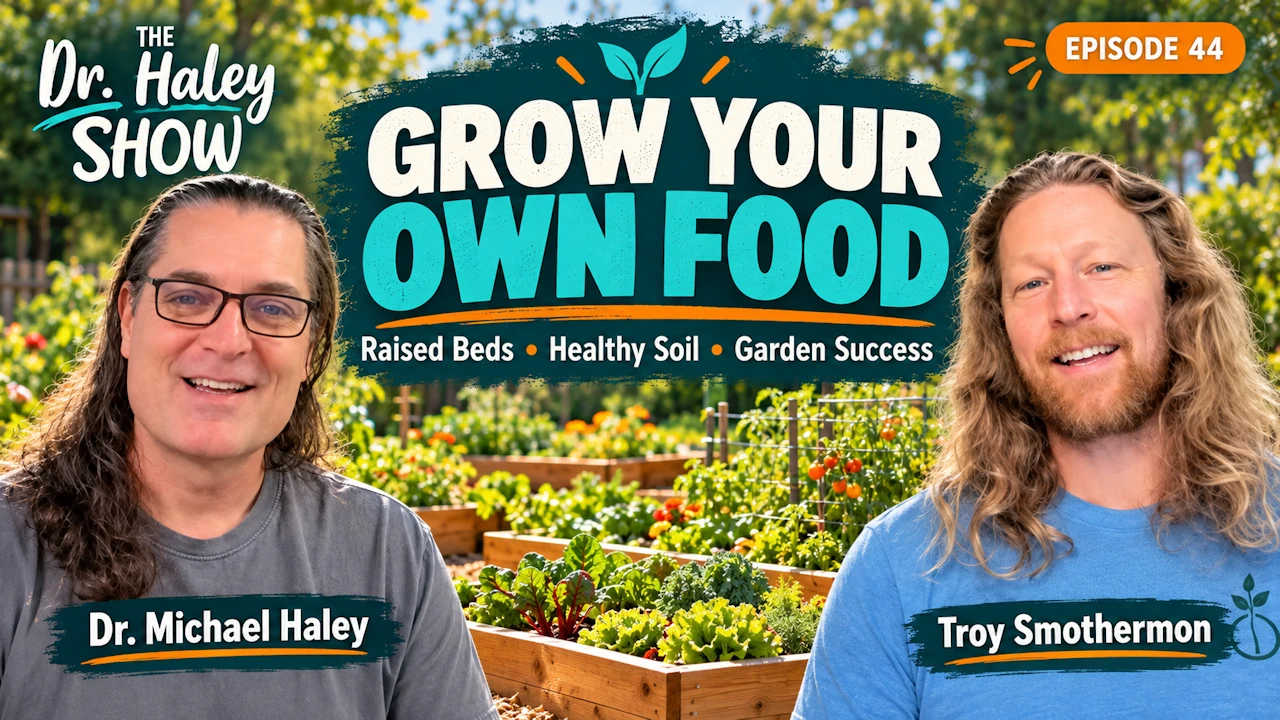
Growing your own food can begin with a single garden bed. In this episode of The Dr. Haley Show, Dr. Michael Haley talks with Troy Smotherman of StartOrganic about setting up a vegetable garden, building confidence as a beginner, and helping more people learn where their food comes from.
About This Episode
Troy and his business partner, Josh Levine, teach people to grow food through garden education, online courses, and corporate gardening programs. Troy shares how StartOrganic began and describes its work with companies including Intuit and PayPal. The conversation covers raised beds, containers, soil, watering, composting, chickens, pest prevention, and his vision for gardening education in schools.
Watch the Interview
Listen to the Podcast
Resources
Quick Takeaway
Start small, plan carefully, and grow something. Troy emphasizes choosing a suitable location, preparing the soil, arranging irrigation, and anticipating local pests before planting. His advice is to build confidence with a manageable garden before adding more growing space, composting, or animals.
ENJOYING THIS CONVERSATION?
Get the Next Episode in Your Inbox
Get notified when a new episode of The Dr. Haley Show is published, plus occasional highlights and resources worth exploring.
By subscribing, you agree to receive email from The Dr. Haley Show. Unsubscribe anytime.
Episode Timestamps
03:10 What is 9 meals to anarchy?
05:00 How did startorganic.org come to be?
12:50 Why grow close to the house?
14:29 Above the ground or in the ground and why?
22:30 How much weeding is there in a raised bed?
25:27 the difference between containers and raised bed
31:30 What are the different areas of startorganic.org?
34:00 What online courses does StartOrganic.com have?
39:25 Is it OK to have chickens or goats with raised bed gardens?
41:40 How do you define composting
42:30 The benefits of a chicken tractor
46:00 How do you control pests in your garden?
50:37 How do you prevent aphids?
59:15 What is your favorite garden tool?
1:05:00 Where do you see StartOrganic.org going in 5 to 10 years?
1:11:50 Where should people go to learn more?
Raised Beds, Containers, and Garden Setup
Troy explains why he often recommends raised beds for beginners: they provide a defined growing area, allow gardeners to start with a selected soil blend, and offer a structure for irrigation and protective covers. He distinguishes open-bottom raised beds from containers and discusses the extra attention container soil may require.
Preventing Pests Before They Become a Problem
Troy recommends observing the yard before choosing a garden location. The discussion covers identifying rodents and insects, planning physical barriers, and planting herbs and flowers to attract beneficial insects. Dr. Haley shares his experience protecting young papaya plants while welcoming lizards elsewhere in the yard.
Watering, Composting, and Chickens
The conversation connects watering habits with root development and highlights a simple tool for checking soil moisture: your finger. Troy describes composting as caring for microorganisms and discusses how chickens can contribute to a gardening system, while also needing protection and boundaries around vegetable plants.
Gardening at Work and in Schools
Troy describes corporate gardens as a way to teach groups of employees who can take those skills home. He also shares his hope of developing school gardening programs so future generations learn how food grows. Dr. Haley reflects on a high school gardening program he helped with in Hollywood, Florida.
Medical Disclaimer
This podcast and article are provided for educational and informational purposes only and do not constitute medical advice. The experiences and opinions discussed are those of the speakers and should not replace diagnosis or treatment from a qualified healthcare professional. Do not begin, discontinue, or change any medication, supplement, diet, or treatment based solely on this episode.
Full Transcript
The transcript has been lightly formatted for readability. Because it was created from the recorded conversation, it may contain minor transcription errors.
Read the Full Transcript
– I’m Dr. Michael Haley. This is the Dr. Haley show podcast. Today’s guest, Troy Smotherman from startorganic.org. Troy and his business partner, Josh Levine, teach people to grow their own food. They have virtual classes you can take and they also teach in person. They helped corporations like into it and PayPal, implement gardens at their work location for employees. Troy has a magnetic personality and a wealth of knowledge. I think you’re going to like this one. And confident, many of my listeners will be inspired to make positive changes today.
I didn’t anticipate that you haven’t long hair. I couldn’t tell from your photos, and stuff.
Yeah, I can’t hide it back there, but it’s there. You know what I can’t tell the business right now.
Yeah, you know what I can’t do, though, for some reason. I should, I should try. I’ve never been able to just let it down. Uh, because for me, it always ends up in my face and, you know, like, like here, just for a good, let’s see what it looks like here. So, if I, so I’ll start like this, okay? Now, by the time we’re done, it’s gonna be here. Yeah, yeah, I’ll be eating it, I’ll be eating it as we get into the conversation for sure. So we’ll see how it goes. And now I can feel like I’m from California. And I don’t want a stereotype or anything, ’cause I’m sure you don’t serve for anything.
No, I definitely do serve. I assume so, really. That’s why, as joking about the stereotype, you and Josh, you look like people that like to have fun. And at the same time, make a difference. And you make fun, you make work fun.
That’s true, that is true. We’ve been doing that for a long time.
That’s great, that’s great. And you have a wonderful YouTube channel. And people listening, now I don’t know where I’m gonna start, the editing and stuff, but I’m gonna use this. The YouTube channel is excellent, very clean, really quick, accurate videos. I saw one on checking moisture in the ground. I saw one on growing garlic. And I thought, man, I could do that. I’m gonna start doing that. Why don’t I learn? I don’t know if I can grow garlic in Florida. Does it grow everywhere? I don’t know.
You should be able to, garlic is one of those magic ones where there’s really no pest problem. So, you know, everyone should grow garlic. If you’re first time growing anything, you should try growing onions in garlic, you know?
I’m gonna get that started. I know I’ll show my wife that video to say, I can do this and you made a lot of sense. Like, you know, start with the bigger ones, plant those eat the small ones. It’s like, okay, that makes sense. I kind of do some of that when I’m growing papaya, so I’ll drop seeds and see which ones spring up the best and I’ll get rid of the small ones to start with something nice and big and strong. And I seem to get good fruit from those.
So I wanna shout out to Max Goldberg from inside or organic for connecting us. It would a great guy and when I, you know, when he introduced us and I saw what you were doing, I got excited. It’s what I’m all about. And I feel like this growing food in your home space, on your property, if you have property, in your kitchen sink, if you don’t have property. I feel like this is so important.
And I think of something that, it was Lord Cameron of Dillington said probably 20 years ago, he coined a phrase nine meals to Anarchy. And the concept was, you know, about three meals a day, if the food supply was somehow cut off, we’d become so reliant on the system that there would be Anarchy within three days.
Now, I think he was wrong. I think it would be Anarchy on day one. And he also considered it the oil supply was cut off. Meaning, you know, that they couldn’t re-stock the grocery stores, they would run out of food in three days. But the reality is it wouldn’t take the oil supply. It could take the internet because every transaction is over the internet now. There’s a lot of ways that things can be completely interrupted and our food supply would be in jeopardy. And we’ve seen from hurricanes and storms that people run to this store and wipe out the shells on day one. And we’ve seen riots break out. We’ve seen anarchy following Hurricane Katrina.
So this whole concept of not being completely reliant on the grid and the system that’s in place for us to get our food, it makes complete sense. We should all be contributing in some way, even if you can only grow one food on your property. And maybe more in abundance than you and your family would need, which gives you the ability to trade with the other food that your neighbor’s growing. So I love what you’re doing. I love what you’re doing.
I totally agree.
So you started organic.org. Right? When organic.org. When did you begin that?
It’s a good story, man. It’s a good story. Wait, Josh Levine and I co-founder Josh Levine and I met in college. We both went to UC Santa Barbara. We were soccer buddies. We played, we were on the same club soccer team down there. And one day, we were both talking. And our friendship started developed because we were both going to go study abroad. Both of us are avid kind of world traveler people. Try to speak different languages. I speak Spanish, I speak Spanish, I speak Spanish.
We actually really met and became friends in Spain. And around 2002, we were in a program to go study abroad in southern Spain and to Lucia and Cordova. And we became really close friends there, just pailing around, going to soccer games, studying, living with our host families there. Both of us, as we returned from Spain, we finished up college at UC Santa Barbara. And we kind of both went off into the professional world. I became a general contractor. I was building houses and Josh went into brand marketing. He was working for CBS in San Francisco area. And we both had our shot at the corporate world for four, five years after college. And I learned a lot. You know, I learned how to build houses. I got a contractor’s license. Josh is a little learning a lot about brand marketing. What it means to be in a major corporation.
And both of us were happy learning, but not fulfilled, really. And then start again, it really took shape around 2009, 2010. Right after the housing collapse in 2008, I kind of got disheartened by building houses. And I didn’t want to build. I didn’t want to go out there and be a general contractor anymore. I was like, you know, people I see people losing everything. You know, there’s not a lot of creativity in it. Uh, and I was like, all right, you know, I learned a lot about building houses, but I’m getting out of here.
So I wouldn’t took a trip. And I think a lot of inspiration in life comes from taking trips, like getting out of your bubble. So I took off and went to Thailand, and Vietnam, Cambodia, and Lao, and a travel for, there’s almost a year backpacking out there. And the trip ended in 2010’s summer in the world cup. This is in South Africa.
And Josh and I were talking over that distance and he goes, “I’m going to try to get out there.” I’m like, “Yeah, man, take all your vacation time. Come out here. Let’s pile around. Let’s go cruise around for the world cup in South Africa.” He comes out. He manages to get a month off, a month off of a corporate job. So he took all the vacation plus time. And while he was out there, we got to talk in, and both of us were like, “I said, “I’m not going back to the corporate world.” When I finished up with this trip, I’m going to do something different.” And he said, “You know, I don’t want to go back either.” So we started talking and we’re like, “Okay, well, let’s start something together.”
You know, and timing and cost of living all these things kind of came together once. I came back from that trip, a Josh and I came back from that trip. I had been gone a year. He was gone a month. And both of us were like, “All right, let’s start something on our own.”
So really, I got kind of lucky in that housing crisis of 2008, really helped too. My folks had bought a house in Lake Tahoe, okay? Four closure house. And they wanted someone to live in there for the winter. So they didn’t have to winterize it. They were like, “You know, we want someone to be there.” And I said, “Hey, twist my arm. You know, I’ll go there. I’ll go live there with Josh.” We’ll pay next to nothing rent to be in Lake Tahoe. And we’ll snowboard every day, you know?
And that gave us the time. There’s a little window of time over, I would say, October 2010 into the spring of 2011. For us to develop a concept. You know, we could set down at the round table. We called the round table. And we threw out ideas. What could we do is a business plan? And both of us were like, you know, we both had a passion for growing food.
I had started gardening way back before then. I grew a garden at my parents’ house. They didn’t even know how I was growing a garden back there. I was just curious about the process. And I found some success with it right away. And Josh basically grew up on a little farm in Southern California.
So we both had this passion and I said, well, hey, if we started a company where we use my, my contractors license, we use your marketing skills. And we start one garden at a time. I got a truck. I got a contractor’s license. We can get clients through my mom was an athletic director and athletic club. Like we can, we can reach out to these athletic people at this club in the Bay Area. And we can get clients. We can start one garden at a time and start organic was born. That was, that was the origin story. That was right around you two, two, 2010. So we’re 14 years in now.
It’s really perfect. And as you were telling that story, I was hearing that coming together, because, you know, making a real good garden if you really want to have a good strategy and maximize the beauty, the returns that it gives to you. It’s going to take some planning just like building a house. So you have you bring that skill. Getting it out there in front of the people does take a brand marketing skill. So it is neat to see how those came together.
Yeah, absolutely. And it is the end of the Tahoe time, which neither of us wanted that time to ever end. Yeah, the best of all of these things. We love snowboarding. We love being out there. We were the probably the only people we always jumped around with the only people growing plants indoors that was not weed. And in South Lake Tahoe, because we had a we had transformed the laundry room into a plant nursery. All right, so we got throw lights and we had the trays going. We started our own tomato plants. We thought, okay, these we’re going to learn a little bit about starting plants from seed. And then we’re going to bring those plants back. And those were actually the very first plants that we planted at our clients homes where things that we started from seed in South Lake Tahoe over a winter.
Yeah, yeah, and growing tomato plants indoors does look a little suspicious, but that’s cool. And we made, I mean just have to just starters, right? Just starters. So when you only grow, you’re growing them until they’re, you know, a foot tall, then you’re bringing them outside and planting them. Yeah, that’s that’s great. Um, absolutely love it. And I have spent some time in Lake Tahoe, love skiing there and I’ve been there about that time. I wouldn’t be surprised if we shared some slopes at the same time and probably cross paths the time or two.
What do you got behind you in that picture there? I love the above ground.
Yeah, this is a, this is the garden at one of our corporate clients. Um, I can’t imagine. This is that into it. Uh, you know, and they make turbo tax. Except they have a, they’ve invested their employees. They have an employee, they’ve invested the garden on campus. This is only about a third of the garden in the photo. But yeah, these are raised garden beds. You know, we set up is garden beds. We manage this program. I’m where employees. This is kind of later in the development of starter organic where we got into teaching people how to grow food at work. You know, so, I mean, for the first, for the first eight years, all we did was one garden at a time. You know, I mean, we would go to your house, Michael, we go to your house. We’d look at your best area to grow. You know, where do you get the maximum sunlight? How can we find a place that’s close to the house like physical proximity close to the house?
Why is that everyone?
A pest, you know, as it turns out, you know, even the squirrels and rodent pests and stuff, don’t like to get up right next to the house. And you’re likely, you’re more likely to engage with a garden that is really close to you physically. And if you put something in the back corner of your property, even if you get good sunlight, protection from pests becomes kind of an issue.
So yeah, we kind of perfected this equation, you know, we started this equation of like what makes a successful garden? And I physically, personally, I was the guy, the kind of sales guy, and I was the contractor. So I met with absolutely every individual that we worked with for the first eight years. You know, I went to everyone’s homes. Like I had to have gone to more than 10,000 homes of people who live around the Bay Area. And I would assess people’s yards. And if they decided that this was for them, and they liked the idea of the design we put together, we would start this garden.
And then we slowly learned, we slowly learned from a business reflective that it was a lot better business plan to teach people how to grow food than to grow it for them, right? So we started educating and then that kind of spun off and got into corporate garden programs, too.
Yeah, and that’s obviously a more sustainable plan because you can only grow for so many. Do you know what they say? Teach a man to fish, right? Yeah, yeah, makes make sense.
Um, about the ground or in the ground and why?
You know, you can do, you can do either one. There’s a lot of ways to grow and we want to encourage people to grow something, whether you’re just getting started. You could do a tray of microgreens in your kitchen, right? I mean, you could you could start growing food in a pot in your kitchen. You know, you can do a container garden. If you want to get serious though about about growing your own food at home, you’re your first time or you never done this before. A raised garden embed does quite a lot for you.
So we typically suggest you try to do around a hundred square feet. So that’s three of these garden beds. I got I got garden beds behind me here. Three of these garden beds are, you know, 96 square feet. Four by eight is a nice shape. Uh, it’s a couple. We kind of, we kind of, we kind of coin that is like the standard raised garden bed size. Four feet by eight feet. Um, because you can reach inside of there. You’re not stepping on the soil. You never compacting the soil. That holds, happens to hold around a cubic yard of soil. So it’s a really good unit of measure.
Um, but raise beds give you protection from pests. Right. It gets things up off the ground. So if you have smaller rodent pests or things are going to be along the ground, wandering along the ground, they’re not going to be engaging with your food as much. Um, it gives you a physical framework. When you have a nice structure, you can build onto that. Let’s say you need to build a little greenhouse on top, or you need to build a little like a wire cage on top because you’re having bird problems in the beginning. You have something to physically like nail something to.
You also get this opportunity to build the best soil blends from day one. So you’re not trying to build soils over a three, four-year period, which is what it would take if you were home composting to get your soil to this vibrant and alive, I guess, like text, not only texture, but the physical micro. There’s a lot of biology living in our soil, and it would take you a long time to build that, whereas I could go start a garden at your house tomorrow. And I know that the companies that provide me with organic compost or get a compost, a chicken manure, a screened loamy top soil, I can blend these into the perfect blend that will absolutely explode. Your veggies will explode the first year, because they’re just full of the nutrients that they need to thrive.
So you’re jump-starting this game, right? You’re giving yourself protection with a raised garden bed. You’re filling it with the very best soils. We’re doing automatic irrigation systems. So you’re– I mean, my garden– I mean, not today, because it’s winter of right now, but my garden waters itself. I’m not really an early riser. I won’t– I want my garden to use as much technology as I can. You know, rain sensing. You know, it’s sensing if it’s hot. It’s watering the right amount to the plants. Use technology, right?
It’s a complicated organization.
It’s not really, no. I mean, the technology’s improved drastically. Even in the 14 years that I’ve been doing, this technology is improved drastically with, you know, Wi-Fi controlled timers that are even battery operated. So you don’t even need to be running power out to where you needed to do that before.
So gardening in a raised bed, especially for a beginner gardener, for your first few years, is, is the way to go. You know, it’s, it’s a way to guarantee that you’re going to be successful your first time, which I can’t stress this part enough, either. If you, if you’re trying something for the first time, especially gardening, a lot of people have labeled themselves as brown thumbs, right? They tried growing something once, and they, at some point, in that process, in the setup of their garden, did something a little bit wrong, and of Josh and I were always saying, in part of our biggest pitch is 90% of your success in any vegetable garden is the setup. And so a lot of people think they’re brown thumbs. Oh, I kill every plant I touch.
No, you probably killed one of the earliest plants that you engaged with, and now you think that you can’t do it, and so for us, not only from a business standpoint, but for a sustainability standpoint, we need people to be successful there first time. We can’t afford, as a company, we can’t afford to fail, but also as a human race, we can’t afford for people to fail there first time.
So we set these infrastructures up where failure is way, way, way less likely, because at least they have this proven and protected system. We call that the raised bed gardening system. That most sure most assuredly works.
I like it. And I want to learn from someone that’s made the mistakes already rather than making myself. You know, I think of the avocado tree I planted last year. And I never really knew what made a tree strong and healthy until I bought and planted a bad one. And then realized, okay, you know, the graph is kind of sideways and the main shoots going off to the side and have branching too early, which eventually they’re going to split down the middle. And there’s no real one, you know, solid structure going upward. So I learned that after attempting to grow this tree for a year and I was like, okay, let me wait for the right season and start over. And now I know how to at least pick a good start from the nursery.
And without avocado tree, avocados aren’t, you know, true to fruit. If you plant an avocado, you’re not going to get something that tastes like what you plant it. So you’re want to start with a graph, and you want to done right. But I wish I just knew, and when I was purchasing a tree, someone could just say no, you don’t want that one because of this. In fact, we shouldn’t even sell this one. Let’s get rid of it. And you know, I wish I had instruction from the start to do it right, and it would have saved me some big headaches.
But that’s one example. Now, I’ve grown many, many things. I had a yard that was on John Colors, you know, YouTube channel growing your greens for how much food we had on it. And everything from, you know, the fish tank creating fertilizer to, you know, chickens running around and, you know, it was our own little farm that created a lot of food. I’m starting over in a new home now. I want to do it right from the start this time.
Yeah, I’m an infrastructure infrastructure, every dollar that you spend and every minute that you spend and planning and preparing your vegetable garden will come back to you ten times.
If I had only one tool to improve most people’s health, if I could make only one recommendation for everyone, it would be to eat 10 servings of fruits and vegetables every day, representing all the colors. For those that just can’t do that, I recommend a scoop of I-A-Green’s powdered fruits and vegetables. Sure, you can buy powdered fruits and vegetables in capsules, but you would need to swallow about 40 capsules of a high-quality product to get the antioxidant power of 10 servings, or you can add about a cup of water to a scoop of greens and drink it down as a tasty beverage. To get started today, head over to hailynutrition.com and put some eye greens in the cart. Use the coupon code “anti-oxidants” before February 15th, 2024 to get 15% off your eye greens vegetable and fruit powder. The coupon also works for the haily pro vegan protein powder use a scoop of each in your favorite beverage as a perfect meal replacement.
Now back to the show.
How much time is going to be spent waiting and is that a benefit to above ground is easier and less weeding to do?
You will definitely get less sweets in a raised garden bed for sure. I don’t typically have a whole lot of weeding issues because when we plant these, for example, these raised garden beds, we really densely are planting. I mean, you’re covering every square inch of that thing. So, as long as you plant and you stay on top of early weed development, right? If we’d start coming up in between your plants, if you kind of pick and pluck those on a weekly basis, it’s like a very, very small amount.
It’s all about competition. You know, plants are the tallest, one wins. The biggest, broadest, one wins. That’s just the nature of plants, right? So, as you get into forests and forests are developing, the ones of the biggest cannabis and ones taking in the most sun are winning. You know, so if you don’t let your weeds win from the earliest days, they won’t have a chance to compete, right?
So, it’s really, I mean, whether you do that in a raised bed, you get a lot more weeds in the ground. Your soil blends are a little bit different. There’s a lot more chances for bird to drop seed in there, because you’re, you’re usually gardening over a much bigger area. And I don’t want to discourage people from growing in the ground. It’s totally doable. It’s just, I, if you were going to say, I’m going to do this big area in my backyard, I would say, okay, let’s start you off with one raised garden bed. And let’s make sure that you’re successful in that bed for one whole year. All right, we’re lucky. I’m California, you’re, you’re Florida. We got year-round growing, right? We’re not in Minnesota, where it’s like negative 15 right now. I don’t even know. But they cannot grow a winter garden there, no matter how many green houses they do. So we’re lucky.
But I would say, have success with that one, but garden bed. And the next year, we’re going to double that. We’re going to put another raised garden bed. You’re going to grow a bunch of different kinds of things there. You’re going to make sure you have success with that. Then two, three, four years down the line. Okay. Now let’s convert your lawn into a big growing space. And you’re going to start growing in the ground. Because now you’ve learned to manage past problems, you learn what, you know, what weeds, you learned a little bit of tricks along the way. Now you’re, I would say you’re qualified to start growing in the ground.
That sounds like a good plan. I, in fact, it’s one that I want to follow. I’ve been only in the ground. Haven’t done raised beds. I have a lot of pots. And technically, that’s about ground, but their, you know, eight inches off the ground, the top of them. So there’s still a lot of the seed and weeds that get into them. And it’s a lot of weeding and it’s a little out of control. It’s probably, I’m doing more work, probably, then I would have to if I was in a raised bed.
Definitely. Containers are a whole different story, right? Container. So, I mean, it doesn’t seem like that. Essentially, for a beginner gardeners that a container and a raised bed are that different. The difference is that these raised beds are connected to the earth underneath. They’re just a four-sided box. They’re not a five-sided box. They don’t have a bottom.
So, the earth is communicating with your plants. Your plants are reaching out through their roots and the mycelium network of fungi is down there. And so, they’re actually able to share, “Oh, hey, I need a little bit of iron. Can you go out there and search out some iron for me? I need some manganese. I need any more sulfur. Go out there and find it and they’re finding it.
In a container, you the gardener are responsible for absolutely every input, right? And you can fill that container with great soil. You grow a plant in there like you grow a tomato plant. Tomatoes take a lot out of the soil. So after even one season of growing a tomato in a pot, even if you had a big enough pot, which I would say for a tomato is like a five gallon like a paint bucket size pot for one tomato plant. It’s about as small as you want to go. Even after that one season, you are almost starting over with soil.
You’re you’re dumping that soil around the base of a tree, you’re spreading that out as as food for that tree or something, but you’re not trying to grow square foot gardening in that soil year after year, because it you will deplete what’s in there. It doesn’t have the ability to go out there and say I need a little bit of something from over here. You need more nitrogen from this plant. It’s not sharing like it is with a raised garden better growing in the ground.
So container gardening, as we talk about this development of a gardener, you start with this raised bed. You can grow in the ground. I would say then become a container gardener after all of that. A lot of people start with container gardening and that’s, I think one of the more difficult ways to be successful.
Wow. You know, one of the things that you mentioned having the open to the earth, it reminds me of what Dr. Natasha Campbell McBride, the author of the Gats diet, had talked about. And just like we have a micro biome, there’s a micro biome to the earth. And there’s a communication that happens, almost like an internet so to speak, where communication happens, you know, among microbes and the fungus is like a network of communication to where literally this side of the field can talk to that side of the field. And you would be cutting that off with a layer of plastic, or forcelin, or whatever your containers made of, if you’re doing container guarding, I never thought about that. That’s brilliant.
Yeah, yeah. It’s, you start to see, if you’ve done this for a number of years, you start to see just plants and containers are not happy. They’re not as happy if plants. You know, you can sort of trick them and say, you know, if I was going to use like a half one, and barrel, for example, you know, Josh at one point, Josh, and I created a product we called the Solcebaryl. We did a one-to-mado plant, a hot pepper plant, some like onions and chives, right? So we were trying to create all the ingredients that you would need in one container, right? And we quickly learned that that was not going to be a very good, product to sell because they became so heavy and to try to transport them on the free way to another person you’re going through 60 mile an hour winds or whatever 65 miles an hour because you’re driving it.
But you can trick plants to be in a container as long as a container is big enough, right? So when I’m saying that if you’re going to grow a tomato in a container it really needs to be like a five gallon paint bucket sized container. It can’t be, you can’t grow a tomato with 10 pounds of tomatoes on it in a gallon pot, you know, it’s just, it’s not, you know, it can’t get, I guess it’s that you can’t get something from nothing, right? There’s just that thing as a free lunch and it when soils are well fed, if you keep your soils well fed, you get a nice living biology in your compost. That’s, that’s, that’s the something, right? You’re getting something from something. These little organisms are actually working in there.
So I would, yeah, I would, I mean containers are, I don’t want to discourage people from growing anything. I want people to grow one thing that, you know, that’s, I mean, we’re going to have a takeaway from today. Grow something this year, connect with nature, grow something, but containers are a more difficult way to be like productive enough to like live off of or anything.
They’re limiting, beneficial but limiting, because, you know, let’s face it if we’re growing in our sink, we’re growing in a container, you know, if you’re doing bean sprouts or something simple, you know, on your kitchen counter or whatever, for us, they have their benefits, you know, my specialty is aloe vera, and it makes it easy for me to transplant little babies and you know, grow it into something strong that I can hand to somebody and say here, now you can go plant this in your garden.
That’s awesome, and aloe is amazing. I see this, I see your background is like just fields of it. That’s, that’s really cool, man.
Yeah, we grow a lot of aloe vera. It’s funny, I’m actually waiting on a container. I was afraid I was going to get interrupted because we’re waiting on a 40-foot container of frozen aloe vera to arrive here at our business and going to our freezers and it’s do this morning. But so far, we’re good. We’re in the clear. But at my home, hundreds of aloe vera plants, among fruit trees and other things that we’re growing,
let’s talk about the different areas of your business, of start organic because you’re doing some corporate, some one-on-one, there’s some virtual, there’s some in-person stuff. What do you got going on?
I mean, for the last four years, we have really spent most of our time on corporate gardening programs. We’ve really transitioned shifted. We’re not doing a lot. I would like to go back a little bit, but we’re not really engaging with individuals all that much. We are working with companies. We kind of figured out that, you know, this, you know, two birds with one stone mentality, except for we can teach 8,000 people at one company, and it feels like we’re accomplishing more of what our mission was. You know, we were really naive when we started this for, like, we’re going to, we’re going to change the food system. You know, we’re going to do this grassroots revolution. People are going to grow food. You know, we’re going to be taking out all these lawns in the Bay Area, at least starting out here, and really like inspiring people to get out there and transform their yards, use their water wisely, grow their own food.
And I wouldn’t say we made no impact. I mean, we met a lot of people. We started thousands of vegetable gardens. I personally was there for starting a lot of people’s individual gardens. But the impact that we make when working with big companies, you know, we’ve been at PayPal for 10 years. We’ve taught rounds and rounds of rounds of employees. How to grow food at war at PayPal for 10 years, right? That’s our longest running corporate vegetable program. People are stoked. I mean, you get to go out on your lunch break to your own garden bed, harvest your own organic produce, get the education, and then we get new rounds every year of employees.
And I would say COVID for us was a blessing, because we were already prior to COVID. We were Josh and I talk a lot about where we want to go with things. And I mean, I want to be able to work a little bit remote, but also, I want to be able to teach people all over the place how to do this. So we started building online courses and before COVID hit. And so right around the time like that, that March of 2020, when things were getting kind of serious and strange, we were poised to launch our first online course.
And so we actually made two courses. One is how to start a successful garden. These courses are still available as through our website, started Organic.org. How to start a successful garden? And my goal with that, I want to continue refining that course, but it’s essentially everything you need to know in a didn’t take maybe three hours to complete this course on choosing the right location for your garden. What is soil and how to locate the best soil blends? What’s automatic irrigation? How to do that and then your first round of plants?
Is that something like a one-time purchase and then people have access to it or how does that work?
Yeah. And that is something that we still offer for employees. For individuals. And so that’s a good place to get started for sure.
And then my goal with this, I really only want to do two things in my life with this. And I end Josh and I are committed. We’re going to do this until we die in some capacity. Because it’s fun and it feels good to do. Not only teaching people how to do this, but doing it myself, I go to my garden every day. You know, it’s a, it’s a really, it’s a fulfilling way. I feel super healthy because I go out there and I grab my own food.
So the two things I want to do is give you an idea of how to build that infrastructure. Because we already said, I just, I said a little bit ago, 90% of your gardening success is how you set up your garden. So we have that first course, how to how to start a successful garden.
And the other one’s called the home gardening series. And that is trying to give you a background of growing and really guide you kind of hold your hand through one year. Because if we, I know, from my, from experience with these, I don’t know, thousands of individuals who started their garden. If you have someone giving you the information that you need right when you need it and keeping things fairly small. Okay, today you’re going to go out into your garden when you wake up with your cup of coffee and you’re going to look for this past. I’m going to have you look for five minutes for this kind of past. Here’s what they look like. Here’s how you can mitigate them. Here’s how you can plan for the future where you don’t have this past problem anymore.
So the goal with that is consistent information. We started with just like, you know, it was like a monthly class and we were doing webinars, right? So with COVID, we shifted a lot to that was almost all online content.
And now, after COVID, now we’re all returning back to normalcy and everyone’s going back into work. Everyone’s, you know, having to leave their house, go home, go to work. Now we do this hybrid type program where we help people start gardens, or corporations, in this case, starting, starting gardens. And then we’re coaching people through the process, ideally for just their first year.
You know, I don’t profess to be this, you know, garden with me forever for life, you know, and probably it’s not like the greatest, you know, business model, Josh and I kind of talked about this, but like, I would be happy just setting people on to the path, being there, because what motivates me to do this is, I mean, it seems like you’ve grown things in the past year, you’re, you’re into growing your own plants. There’s something that is indescribable, you know, this feeling that you started something, you put a seed in the ground, you transplanted something, you cared for it, and you got to eat that. And there’s a strange connection, like this, this sense of accomplishment, this connection with nature that I, I mean, my motivation for continuing to do this is seeing that for the first time in the new person.
So with our corporate, you know, corporate gardening programs, I get to see that in hundreds of people at each campus every time, every year. So it’s a big, you know, big renewal.
Yeah, you know, I’m glad I can pay the bills, but the best paycheck is hearing from the customers and seeing the joy on their faces, truly, you know, and I can relate to the things you’re saying. I actually get to see that, you know, from both viewpoints as the urban farmer at home growing my own food, but also because I contract with commercial farmers for our allow. Now, I do things a little different. They have our processes for our allow and their processes for everyone else’s. So it’s more of the, you know, personal touch, know, everything’s just people and rakes and hands and knives and, you know, there’s, there’s no chemicals or machinery. ours is very, very different. There’s no filtering. There’s no processing on our end product.
So I get to grow my own food and see the benefits and understand where the food comes from, but from seeing what they do for everyone else. I get to see what’s in the food that you’re actually purchasing from the grocery stores, which makes you say, okay, this is important. I now, even if I’m not going to grow my own food, I know what standard has to be applied to the food that I am purchasing.
So, you’re doing this. You know, like, there’s a good chance that I would have, you know, if I had raised beds, I’d probably still have, you know, chickens or maybe a goat running around in the backyard, too. Is that okay?
Oh, yeah. It’s, uh, it’s not only okay, but if you, as we, it’s funny, because you, you take these little steps, right? Little, little baby steps on to, like, the path of sustainability, you know, and the truth is, there’s no real sustainability without having animals in that process. Like, I think everyone should have chickens. I went to the grocery store this three times this week, there are zero eggs. We’re having an egg shortage. There’s avian flu, not just like the idea of scarcity or, you know, this, this fear, fear tactic about, you know, there’s not going to be enough or, you know, get out there and get your food. I just wanted eggs, you know, and my, when I had chickens a couple of years ago, they got, they got pretty old, and they stopped laying, and then finally, coyotes got them, but it was a great process. You know, I mean, I want to stress the best parts of it.
You do need some sort of organic fertilizer. To be a consistent and productive vegetable gardener, you do need something. You can buy organic composted chicken manure in bags. You can go to a local nursery, you can go to a bigger source. We would go to rockeries that are blending bigger sources of these. It is becoming more and more difficult to find organic sources for soil blends on a, on a, on a industrial level when you’re buying kind of big cubic yard amounts as big become a lot more difficult.
So taking those inputs into your on hands is the weight, the path towards sustainability, right? So I would say yes, absolutely good chickens. But remember, like also chickens like to eat veggies.
So you need to, there’s the, I would say like, okay, we start, we start with like a very small vegetable garden. We get you some success. Then you grow onto that vegetable garden. You get a little bit more success. Okay, in your second or third year, we’re going to take on composting and composting is a whole other process. I mean, you should start at the very beginning. So you’re learning it side by side, but it can be a lot to do it right. There’s a dedication to it.
You know, when we talk about composting, we say you are growing micro-organisms. We don’t say you’re recycling or you’re building soil or whatever. You are growing something. You’re growing organisms. And that requires the same, if not more care, than growing plant organisms in the form of gardening.
So you, you know, you’re first year you’re gardening. You’re second year maybe you’re taking on some composting. Then I’d say two, three years down the line, you’re adding chickens to the process, right? And or goats or sheep, or whatever you need.
If you want, we’ll get sheep. If you want goats, I don’t know about goats. I had them both. They used to just jump all over my cars. They were just running and jumping all over my cars. And I was like, I don’t know about this. What are they really doing for me here?
There’s applications for each chickens are fairly easy. You can corral them. They can have their coop. You can create a little chicken tractor, which I don’t know if you heard about that, were they? They’re basically in like a rolling cage and you can put that cage over here and then they’ll eat all the weeds there and then you can move that cage over here and they’ll all eat the weeds there. But letting them loose into your vegetable garden, they will also eat your veggie plants.
Right, right. They, I mean chickens are crazy. They will eat your boot if you left your boot outside, you know, like they will eat absolutely anything.
Uh, there’s a benefit to the chicken structure. I like it because, you know, it gives them an area where they can consume fresh ground because you’re going to keep them there for a period of time, then you’re going to move it. Uh, but they’re also controls where they go so that they’re not destroying everything. And it protects them from the coyotes, raccoons, or whatever you have in your area. So, uh, people say, “Oh, that’s, you know, you’re keeping them in a cage. It’s good for them. Trust me. It’s safe for them. It’s beneficial for them. It’s a good thing.”
I mean, keeping the, if you provide a cage, they will volunteer to go into that cage every night and hope that you close the door because that’s what they want to be. You know, I mean, they like to, they like to get out in the days and go room free. I did a lot of free ranging with them. It’s just fun. Chickens are hilarious. They’re one of the funniest creatures, man. Pretty many who hasn’t, you know, entertained the idea of getting chickens. It’s awesome. It’s not like they are the funniest.
Yeah. It’s not like the show Rocky, where you can’t catch them. They’ll actually let you pick them up and, you know, they become like a pet and, you know, every morning is an easter egg hunt. So, you know, it is cool.
It’s part of the magic. Magic and surprise that you can get from daily life. You know, these chickens are just doing the funniest things. And it’s why there’s all these funny chicken, chicken memes and stuff out there. There’s just hilarious animals.
But also, I mean, what other animal do you get? Where the care is pretty minimal. You can do automatic feeders, automatic water. You can go out there and just kind of engage with them to get your eggs basically. And you’re getting like, you can get an egg a day from a productive chicken. But really, I was getting like half an egg a day. Right. You know? So every any given chicken every two days lays an egg. And that’s amazing. Yeah. Considering their body size and what they’re doing. I don’t know. I don’t know. I don’t know. I don’t understand how something the smaller than my cat can produce. Can produce an egg every other day. Right. That’s filled with the kind of every all the protein that you need as a human to keep going.
Yeah, if we would add feed to the yard for them, we’d get maybe five eggs a week or if we would make them thin for themselves, we might get three or four eggs a week, but they’d be a higher quality. So there’s a trade off, you know, you can increase production, but decrease the quality of the egg.
What do you want to know? I mean, sorry. And their byproduct is great in our nitrogen rich manure. That you can use if you add that to your compost, as you can create, it was kind of everything that you need to boost the production of your plants in the following season. Yeah.
That’s great. What are some of the techniques you would employ to keep unwanted pests down?
Well, it starts with assessing your yard really well. You know, that’s if there’s anything that I’m good at in a professional sense, that’s, that’s, it is like after going to 10,000 people’s homes, seeing all the different layouts so you can get into the first step and this is the first step for any gardener. If you, if you’ve never grown food before and you’re thinking about growing food, you want to do this.
I would say for the next week, go outside in the earliest that you can get up and drink your morning coffee out on your back porch or wherever you’re considering putting that garden and observe. What is passing through your yard? You’d be surprised. You might be amazed that, oh my gosh, I have raccoons, awesome. I’ve got squirrels. I’ve got mice and other rats. I’ve got underground rodents, right? I’ve got like moles, moles, ground squirrels, gofers. So what kind of birds interact with your garden? Do you see butterflies? What other what insects do you see? Do you build this connection with your garden before there’s a garden there? That’s the first thing you can do. I’m considering gardening. Okay, my challenge to you is for you for the next week with your morning coffee, go out and spend 10 minutes breathing, relaxing, keeping your eyes open and observing. What passes through your yard?
In the earliest parts of the morning and right around sunset and a little laughter sunset. That’s when these animals are most active. Middle of the day, they’re not. They’re not really out there. There’s too much going on, a lot of human presence and stuff, but that’s the time they’re going to be active.
So the first step for pests is identifying what you already have, right? So if you already know, okay, I got these, you know, grounds. I got these goafers. That’s a big one of so many people. I went to their houses and they’re like, I’m having this problem with goafers, I’m like, well, you have to start over. You know, there’s not really, if you’ve got goafers, you know, we’ve had projects where we literally took Ray’s garden beds like the ones behind me. We dug all the soil out, put goafer wire underneath, like lined it with this galvanized wire mesh, put all the soil back, and now I’m like, now you’re going to be successful growing. Wow.
So there’s things that identifying the pests very, very early and having a plan for how you’re going to mitigate that saves you so much trouble. I mean, one thing I always tell people is, you want to be proactive. You don’t want to be reactive. You don’t want to have a pest problem halfway into your season that you could have had a plan for before you even started. So identifying the pest huge. I mean, that’s I can’t stress that enough. And again, that’s 90% of your gardening success is the setup of your garden, right? So identifying, understanding what pests there are.
Then you start into create a network of kind of deterrence. Things that will make it so that this is not such a fun environment for pests. One of those things can be having a pet that you’ve got a cat. You’ve got a little dog, even a tiny little dog. But it doesn’t seem like it’s going to protect you from anything. Actually, you’re some of the most like vigilant anti rodents or at least little tiny like docks and you know of a little weiner dog can be the very best because they’re actually they go after rodents that’s like their thing you know. So having something that physically deters the pest by something that’s moving.
That makes sense you know if I planted seeds and the birds were coming in the seeds well there’s a good chance a cat would keep them away from that garden. If the squirrels are you know bearing their food well a dog would probably love to scare them away. So that’s a pretty neat thought there. I like it.
So that’s the beginning of pest problems and then you also get into this whole you know what is each pest doing? How can I how can I plant for example? I mean you got insect pests you got aphids. A lot of people get aphids on their winter gardens like broccoli being cauliflower covered with aphids.
Well if you had planted let’s say beforehand we started a season beforehand where we planted sage oregano time lavender right and any flowering plants.
We’re now building this ecosystem of companion plants. We are attracting beneficial insects into the garden before we even started our garden you’re getting lady bugs into the garden because you planted sage and oregano in particular. Both usable kitchen herbs, great things to grow in your garden fragrant, flowering they looked they look great they taste great they’re usable for your cooking but they’re attracting lady bugs lady bugs eat aphids so if I want to do a great season of broccoli I want to do a ton of broccoli I’m gonna surround them or inter mix plant them with these companion plants and now my job as a gardener is it’s like nothing you know you get to kind of sit back relax you get to watch it grow because you thought through all this stuff or you kind of knew where to start to and that’s I mean that’s what we’re trying to do.
Yeah you know I like that approach better because you know I remember being told well if you get lady bugs that that’ll get rid of them so we you know bought a bunch of lady bugs and then they just flew away but if you was everyone has done that everyone has done that I did that everyone has done that.
But if you create an environment to attract them that’s that’s a different story.
Yeah and it’s still you know what it still feels good to release 500 lady bugs into the world but if you were going to do that approach what I’m what I might do because I had success still buying I’ve bought lady bugs because I had clients that had we’re having an issue we put essentially a you know like screen door material small enough that a lady bug couldn’t get out still you’re getting air through the plants and engagement with the wind.
We would put these little cages over a plant that was badly infested with aphids and I would release the lady bugs inside of there.
Got it. And then they would have no choice but to just eat and you would be amazed that even 100 lady bugs how much they can do in two days. You know, whatever, whatever raised garden bed, whatever area you put them in. That is an aphid free zone in two days.
That’s great. And then then you can take the cover off and be like you’re free, you know, you’re free lady bugs. I’ve had a lot of people who just release lady bugs in their garden and they they released hundreds of lady bugs. But it’s still cool.
Yep. And actually that’s my technique for keeping the lizards off of my papaya sprouts because they don’t love to eat the little leaves. They’ll eat the big ones too. But when when when the tree gets big enough to where it’s making big leaves, they grow faster than the lizards can eat them. But at that young stage they will eat on to death before they have a chance to take root. So I have my level.
It’s really cool. Sorry and what’s really funny is you need those lizards. Lizards are eating small insects that can be issues for later. So you actually you want Lizard. I would put Lizard into the friend to cat it to go away.
Oh, absolutely. Oh, we were out every day checking our pool first thing in the morning, rescuing the ones that fell in. Absolutely. We want them. Yeah. Yeah. So it keeps a nice balance. You know, they eat some of the things that would otherwise get to us. So for sure, for sure.
If I want one of those raised beds, do you guys sell plans for it? Do you sell the materials or how does it work?
We don’t, man. We got it. We got away from brick and mortar sales kind of stuff. I physically built all of those raised beds. We are not even doing a whole lot of garden installations anymore. We transitioned a lot into education. We want people to know where to start and have someone to hold their hand for the first year. We really want you to, and we have online courses for, you know, how to build these and, and you know, because it’d be so hard to be able to do that. Like I can’t shift. These are, these are redwood raised beds. We, I living, we’re in California. We have redwood for us and I started working with a lumber yard. It was responsibly harvesting redwood. They would, for every, you know, serious obtries they would cut down. They would section off. They were very responsible with how they reforeaced at the nearest areas and what’s trees they selected and stuff.
For us, California redwood’s the way to go. If you’re doing it somewhere else, maybe see there’s going to be a good way to go. You need to wood that’s going to stand up to outside. So I could maybe try to ship one of these to Florida. I don’t think so. Like that’s not going to work.
So now we’re really, we’re really, we’re really focusing on education now. I mean, I can, I can teach you how to grow. You can find any number of contractors in your area. If you’re looking for someone to build a raised garden bed for you, I would say.
I want to do it myself, but I want to know how to do it. And I think you said that there’s something in the question.
Yeah, yeah, we do a little section in the, you know, how to start a six-way garden course. That’s, you know, how to, what is a raised bed garden? How big should it be? What kind of material should you use? You can do them in a lot of shapes and get creative.
If I do, I do have one piece of advice though, for anybody who’s looking to start a garden, you can pay someone to do something for you. And that’s okay, right? There’s the, we were in a service service world, you know, but if you build that garden yourself, even if it doesn’t turn out to being looking like, I mean, this is for a, this is for a, multi-billion dollar a year corporation, right? This, this corporation does everything has to look real nice.
But for your house, you can save a lot of money getting recycled fence boards, right? You can, people are replacing wooden fences on a daily basis. Usually the, the actual boards of the fence are in really good shape. It’s the posts that had rotted out. So people are looking to off, like they’re, they’re looking to dump materials. Use recycled materials. Do as much of it as you can yourself. If you’re moving cubic yards of soil to fill these up, you need to get all this soil, get some friends over, have a party, get off our beers, the more that you do yourself, the better experience you’re going to have with growing food. Because you are actually attached to what you’ve built, versus paying someone to set up this infrastructure.
Because I’ve done that for a lot of people. I’d say, you know, pretty high percentage, 80% of the people that we started gardens were still garden. But there’s that 20% that we’re like, I’m doing this because it’s cool. One of my friends told me to do it, I’m going to just pay someone to set it up for me. And the connection to the garden wasn’t there from day one, because someone else did it for them, you know?
This is very much DIY able. Like, it’s really not that difficult to set these up. And I get it. Everyone’s working, maybe not a carpenter, maybe you get someone to build a box for you, but get your hands at least a little bit into that process. You know, some of the soil yourself, connect some of those irrigation lines yourself. It will go a long way toward your continued gardening experience.
I do want to build it myself. I just want to plan so that I don’t mess up the irrigation system and I get the right parts and, you know, that kind of that’s huge.
That’s you. I would absolutely like whether you, you know, work with us and go through this, you know, online course or you, you know, get a contractor for that. That’s not a bad idea. Uh, because like I said, if you do something wrong with the setup, you are making life much harder for yourself for, I mean, these, these are 15-year items and they cost, they cost some money to set up, but you’re recruiting all of the costs that you put in to setting up that garden within the second year of growing food.
Almost no matter what you choose for the, you know, if you’re going to do raised beds of wood or if you’re going to do like horse troughs of metal or whatever you’re going to do, you’re going to recoup all of the the money that you spent within the second year of growing food. And this is a 15-year item, maybe longer.
Yeah, gardening is definitely not expensive. In fact, when it comes to the tools of gardening, this is a little bit of a trick question because I saw a couple of your videos. What would you say your favorite garden tool is?
Oh man. Uh, my favorite garden tool that could have been a video that I did for ever ago. I think my favorite tool is the cultivating fork. All right. I don’t know if that’s the same tool that I mentioned back then, but it was cultivating fork. It looks like a shovel. It’s a little half-size shovel. And it’s got instead of a big blade for digging. It’s got these four very thick times.
I have one right? Is it every day almost when I’m waiting when I’m in the yellow garden. Absolutely.
Yeah. Yeah. I mean, they could be used to pull plants up and stuff and move plants, but I like it just for because it makes tilling, which we don’t really do a lot of soil tilling, but we do aerate soils. We do poke holes around plants. We do move and kind of create air gaps in there. And that, I think, is my, I think that’s probably my go-to fortunately, I only have to use it twice a year, you know, when I’m doing some major kind of garden turnover with for the seasons.
Yeah, it seems to me like the tools are not expensive and the one that I’ve seen you use the most on the videos is your finger.
Oh, yeah, that’s okay. Okay, that’s fair. That’s fair. That is the most inexpensive tool that you got and we’ve all got ten of them. Well, not everybody, but most of us have ten of them.
This is your moisture meter.
That’s right. You know, your, your index finger is your moisture meter. And that is a huge lesson for anybody who’s getting into gardening is, I mean, water is a huge issue. How much you water? How often you water? Where you deliver the water to plants can determine a garden that’s going to be thriving and pumping out 10 pounds of tomatoes for each plant or a garden that is dead or dying in the first month.
So yeah, your moisture meter. That is a good one. I kind of wish I would have remembered that that was my favorite. But yeah, stick your finger in the ground. You know, you don’t really need to water your plant. It goes for houseplants, too. You don’t need to water your plants. If there’s still moisture at the tip of your finger. Stick in your finger down in the ground. If there’s still water at the tip of your finger, you do not need to water those plants.
Yep. Yeah. Right. And so you know, you can buy fancy moisture meters, whatever. So if you don’t want to get your one fingernail dirty, but that is a very valuable lesson to learn is water when your plants need water.
And just just standing, if the water’s down there, the roots are going to grow towards it. So you’re going to grow a better root system than keeping them saturated.
Exactly. Exactly. I mean, that’s, you’re, you’re, as a, as a gardener, your job. Really, you’re trying to, you’re trying to grow the biggest and most extensive root system that you can. Right. And so by watering only when they need water, the roots will chase that water down from the watering that was four days ago. They’ll go, I’m going to try to, I’m going to get a little longer because maybe I can reach this water table this down there. And if I do that on a consistent basis, and I continue to train my plants to look for deeper water, your biggest root system is pulling in the most nutrients for your plants. That’s the strongest plants.
Now, I saw you use that same tool to plant garlic.
You know, first yeah, these are really handy, man. It’s good to be humans, you know? We got these, we got these like tools attached to us that are super useful.
And that’s what the animals do. You know, I have squirrels in the backyard. You talk about having the coffee and observing me, I like to sit out in the morning and enjoy my backyard and we have, you know, blue birds and red birds and squirrels and lizards and iguanas and they’re all out there. I know what’s in my yard and in watching them, you know, the squirrels will, you know, take berries or nuts and they get in there with their paws and they dig a little hole and they bury him and we’ve even found their little peanut farms. If you go back to one of those peanuts that they planted and you pull them out of the ground, there’s peanuts growing off the little roots.
They’re doing farming for us using their hands. That’s their tools.
So we’re giving them a lot of people think squirrels are major pests. They’re going to a lot of them are actually not really even engaging with your plants. It looks like they’re a problem in the air. They’ll jump in there and they’re burying or burying food that they put there.
Yeah, they will dig little holes, but they’re not digging up our plants. They’re digging around them. Probably keeping to do your loose a little bit.
But they can be tough, man. They can be tough. That’s actually my biggest pests that I have at my place. I think I’m a squirrel farmer as well because I’ve got, I have ground squirrels. A little different. Three squirrels and ground squirrels are very different. I’ve got ground squirrels. I have to basically grow all of my things inside of cages in my garden boxes, because these squirrels will eat certain veggies. You know, and certain ones they won’t touch. I’m learned over the time, which ones I don’t need to cover, which ones I need to cover. But I, I certainly, yeah, squirrels can be a big pest for sure.
Yeah, but you can eat them.
I don’t eat squirrels. But hey, if time’s got stuff on my clothes and growing, we need those squirrels.
Yeah, if we get into this, whatever three days of not having food, you know, the, the, what does it, nine meal anarchy, or whatever?
Right, right, right, got to feed the family. A lot of people feed squirrels, the, yeah, try where do you see this going in five to ten years from now?
That’s a good question. We’re talking about that all the time. Josh and I are actually talking about that a lot now, because both of us are very conscious about our lives, like we want to live happy lives, you know, what it, what is that mean?
We’re not intending this, you know, as we grow as a company, I don’t see that much changing between five and ten years. We’re getting to a point where we’re happy with the systems that we’re building, right? I would love to still be engaging people at companies, you know, would love to be teaching people how to grow food at work.
I would like to slowly transition, and this is this is very much, this is coming very soon, but I would love to have this idea about replacing myself. I don’t want… I don’t want me to need to exist to teach adults how to grow food, and I accomplished that by teaching kids.
I’d like to get involved, and I want to go with like middle school and up really like high school and up. I kind of have this strange like question in my head like why, you know, why didn’t I learn how to grow food through school? Right.
I just, I don’t, it’s a disconnect, it doesn’t seem to make sense to me, so in the next five or ten years, I would love to very slowly transition and build curriculums for particularly like high schools. Yeah.
See if we can get funding from these major corporations to help start school gardens, or maybe convince the government that school gardens are important, because even if we’re not raising a next generation of farmers, which we kind of need to do, we need to do that.
No one’s really going into farming as, I’m in, I live in Silicon Valley, this area where I lived, the 60 years ago was called the Valley of the Hearts Delight.
We have transitioned as a species toward tech, right? I still think, even if you’re going to do tech, and people are learning coding, and you’re getting into building software, flying drones, or whatever you’re going to do, fine. But if you don’t know where your food comes from, if you don’t know what the natural process of food is, it seems so natural for corporations that are in the agro business to cut corners.
That’s the new norm. Is, hey, you’re having, you’re having weeds. Well, we’re going to do round up ready GMO corn. We’re going to spray round up on corn. It’s not going to hurt the corn. It’s going to dewey the field. We’re going to deplete all of the soils of the earth because we’re not growing micro organisms anymore. But we’re producing lots of corn. Yeah.
You know, and you got to wonder, like how is that corn not dying when you spray poison on it? Well, it is round up, right? It’s genetically modified to have round up in its genetics. So it’s you’re eating that you’re consuming that all of the beef products that you’re eating are consuming that chicken products are consuming that we’re surrounded by this. And if you’re not aware at least, I’m not saying everyone’s going to be growing food in their yard. But if you’re not aware of the process, then you are a victim of the process. You’re great.
So I’d like I’d like to slowly transition to a point where when I die, there are still digital media versions of me and start organic. Teaching next generations, how to grow food, you know, through apps and, you know, Instagram and anything else that we can do to influence people. But ideally, it will be a staple part of what education is.
I like it. You remind me that yeah, I want to encourage you in the high school thing because you do remind me of a program that actually, I had the pleasure of helping in Hollywood, Florida, a high school that has a gardening program. And my part in it was helping them to grow an aloe vera section and teaching them about aloe vera and how it grows. But that was in a high school and they had their little farm section. And it was part of their program. I would imagine it still is to this day.
But why only in one high school in Hollywood floor to how come this isn’t in every high school. It should be. But we’ve become so reliant on the system to provide our food for us. And it is a house of cards. So I do see that. I think that’s a good vision to have. And I want to encourage you on it because I think you could really make a difference in that area. Getting some of these programs.
Yeah, we’re going there. If I can, you know, if I’m, you know, 90 years old, I’m on my death bed. I go, okay, you know, like, I’ll feel good about going out. If I see that there’s a system in place where I’m not needed any, you know, I don’t need to go educate adults. All the adults are have gotten old. The kids that I started teaching are getting older. Then there’s a system where there’s gardening in schools. I’ll be like, all right, you know, I’m good to go.
Yeah. Well, for anyone hearing this podcast, that’s in the school system and says, wow, that is a good idea. We should have that at our school. I encourage you to make something happen in your school and talk to the right people and encourage them. We have to teach the children. It starts with them.
So I love that vision. It’s a good vision, Troy. So I expect good things for it. Man, we could talk for hours. I love your knowledge base where it comes from what you’re doing, making a difference in the world.
I do think that you’re reaching a far bigger audience than you realize because when you do something at into it, or PayPal, or one of those big corporate environments, you know, there’s a good percentage of them that are taking that back home, starting it in their gardens, affecting their friends, their family, their neighbors, or whatever the case is. So I do believe that that initial vision you had, where it was, you know, growing in everyone’s yards in the neighborhood, I do believe we’ll get to that point. We just, it just starts here and grows out.
So I’m expecting good things to happen from this. Where can people go to support the mission, support your business, and at the same time, of course, benefit from the knowledge that they’ll gain from you.
Where’s the best place to start?
Uh, probably the best place is the website, startorganic.org. We have options there. Uh, it’s splitting into two options. One is corporate, level, and then one is individuals. Um, and the online courses are a smart way to, to like get a little bit of targeted information for starting a vegetable garden.
Um, and also, I mean, if people are either working at a company that they think they should be offered for their employees, or if they’re an employee engagement specialist, or a company culture specialist, or chief people officer, you know, and you want to change the culture of your company a little bit and offer something really fun for employees. This is a really good program for them.
Yeah. Uh, so it’s an organic.org.
Yeah. I mean, it’s, it’s, I would say, startorganic.org the website, or you can follow us on Instagram, too. Instagram handles startorganic as well.
Yeah. Because something happened in my heart in this discussion with you, you know, when you mentioned into it, well, I do business with into it because they provide my, uh, accounting software, the QuickBooks, and their payroll service and things like that. I have a new perspective of who they are now, and I appreciate that.
It, it makes me want to do continue to do business with them. And the same thing with PayPal, you know, when people purchase from my website, PayPal is an option. I do business with them. I have a new little different perspective, you know, a good light shining on them that wasn’t necessarily there.
So it’s a good thing for them for many reasons, not only helping their employees, but being, you know, active in our future and saving the planet, literally.
I know it sounds like it’s a sales pitch is something, but it really is a huge win-win for companies to do that, because it makes their employees happier. It’s giving them something that, I don’t know if you know this, but in my area, in the Bay area, there’s a four-year wait list to get into a community garden plot.
So if you’re in an apartment, you don’t have the ability to grow your own food except for maybe a few containers on a patio. You want to start growing food seriously. You’re going to put your name on a list, and four years later, you might get a community garden plot.
So these companies are providing space for something that is very difficult to get into. Employees are loving the program. They’re able to grow their own food. They’re taking this knowledge based home. They’re getting away from their desks. They’re destressing the work environment. They’re making new friends. This is my gardening group and my gardening friends. They’re hosting alternative meetings in the garden. Oh yeah, we’re going to meet in the garden this week, team, you know.
And then from the employer standpoint, you’re providing a program that doesn’t really exist anywhere else. You’re getting this positive PR that your company is working towards sustainability. And a program that frankly doesn’t cost you very much. Our programs are very affordable for these companies.
So you’re getting these huge perks of transforming your campus. This was a non-productive space on campus. This is right near where people eat. It’s a pretty thing to look at. But you also have a bunch of employees engaging in there. You can say, “Hey, yes, our company is investing our employees. We’re dedicated to sustainability. And this is our proof in the pudding. This is our visual representation that we care about this type of thing.”
No, man, it’s awesome. Who’s background social media, yourself or Josh?
Josh should be. But we’re both realizing that we, we both need to be more active. And we are. We’re taking this dance to be a little bit more active. And we’re going to launch a couple of new things this year. We’re not kind of able to announce it quite yet because we’re still brainstorming how this might work the best.
But we’re kicking around ideas like gardening happy hours and inviting everybody there where we’ll tell a little, you know, a little bit about what you need to do in your garden this week. But then start telling stories and then encourage others to share their stories and maybe answer questions for people live via these broadcasts and stuff. So we’re working towards that too.
But you need, and we’re just a US tour when you come to Florida. I’m coming to your event.
Dude, I would love to go out there. You’re lucky, you know. Like, I’m jealous. I live in California, and I’m even jealous of people living in Florida for what you can grow. You got a whole slew of tropical fruits that I cannot do, you know. So, I mean, you’re, nothing is off the table for you in a growing sense. Like, you have absolutely everything on the list.
Right, you know. One of my favorites is papaya because, you know, we figured out that if you have seven trees in a row, which doesn’t take up much space, and it’s just a stem, you can still grow things around them, and they’ll give a nice little shade. You know, I like open sun, but at the same time, the some things grow better with a little bit of shade over them.
Right. Those seven trees, you can literally pick up a pie every day, because they’ll produce about one pie per week. Each tree, we’re going to grow a nice and healthy.
So it’s something that provides a lot of food with very little space of growing. So you’re right, we have so many things we can grow here from, you know, avocados grow like basketballs here. They’re not as tasty as the house. There are some that are pretty darn good though, but literally four and five pound avocados, uh, amazing. So that’s a good stuff.
I’m jealous. I’m jealous. And I have a great growing environment. I’m growing food right now. You know, my winter gardens in full force right now. This is like, this is like the glory days of the winter garden. Starting from that, I want to tell March, broccoli, cauliflower, cabbage, kale, lettuce, spinach, arugula, onions, garlic.
You get a lot of really good production from a winter garden. People are surprised. Most people that we engage with have never even attempted to grow winter garden. And they’re always really surprised with how much comes out.
I love it. I love it. Troy, I want to thank you so much for joining me in this time. Literally, I could talk for hours with you, but we’re already win over an hour and I might have to break it up into a couple of different shows for people’s attention span. We’ll see. Uh, okay. But thank you. I want to stay in touch with you. Let’s, uh, you know, reconnect and help change the world, man.
Sounds good. They’re all right. Thank you, Hayley.