
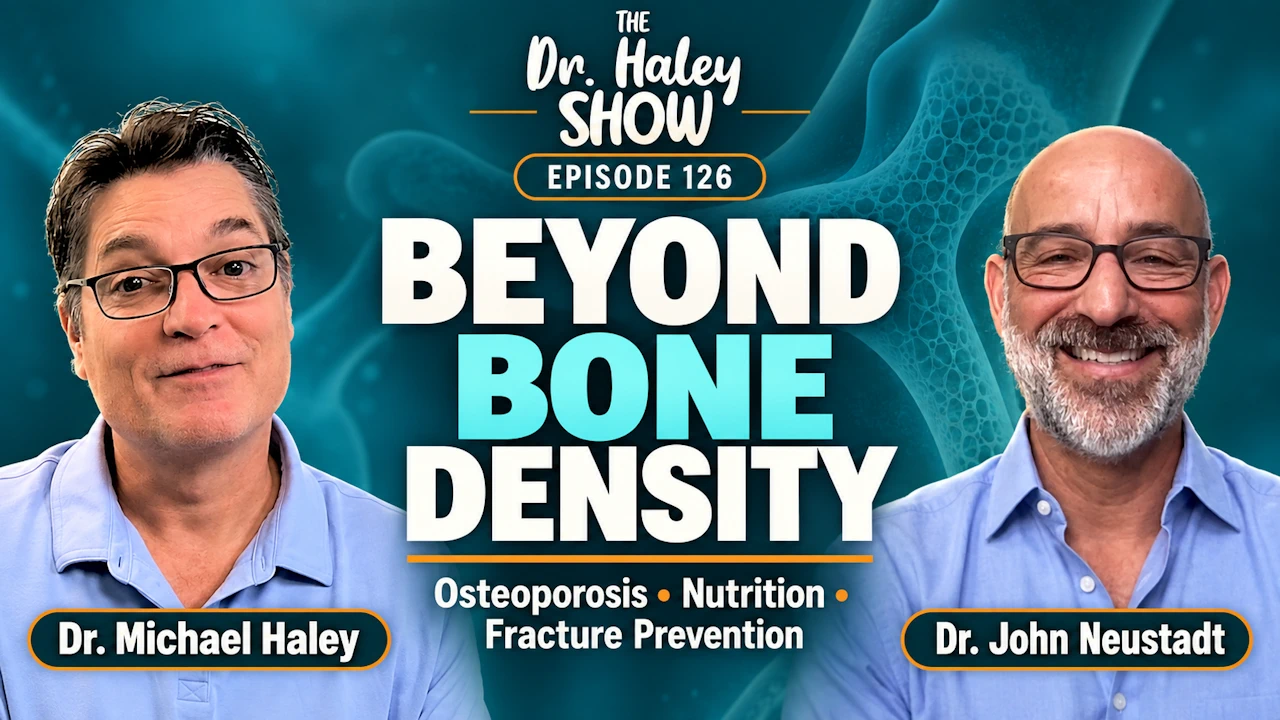
Dr. John Neustadt is a Doctor, Author, Researcher, and integrative medical expert. He’s an expert on Bone Strength, fracture prevention, and reversing osteoporosis. Many of us could benefit from the books he has written about bone strength, including “Fracture Proof Your Bones: A comprehensive Guide to Osteoporosis“.
In this episode of The Dr. Haley Show, Dr. Michael Haley and Dr. John Neustadt discuss osteoporosis, bone density testing, fracture prevention, and the role of nutrition and movement in bone health. Their conversation explores medication-related bone loss, protein intake, calcium, vitamin D, and the differences between forms of vitamin K2.
About This Episode
Both speakers share personal stories about hip fractures that shaped their interest in bone health. Dr. Neustadt explains his approach to evaluating bone density alongside other factors, including strength, balance, diet, and medication history. He also discusses his interpretation of supplement research and discloses that he develops and sells supplements through NBI Health.
Watch the Interview
Listen to the Podcast
Resources
- Buy the book “Fracture Proof Your Bones: A comprehensive Guide to Osteoporosis” on Amazon
- Order Dr. Neustadt’s bone health supplements from NBIHealth
- Follow NBI Health on X.com
- Follow NBI Health on Facebook
- Follow NBI Health on LinkedIn
- Subscribe to NBI Health on YouTube
- Subscribe to Dr. Neustadt’s podcast on iTunes
- Watch this episode on YouTube
- Listen to this episode on iTunes
Quick Takeaway
Dr. Neustadt’s central message is to look beyond a bone density number when discussing fracture prevention. In his approach, nutrition, muscle strength, balance, fall risk, and medication history are all part of the conversation about protecting bones.
He emphasizes a varied, whole-food dietary pattern, adequate protein, and movement that fits a person’s abilities. His recommendations about supplements, doses, and treatment reflect his interpretation of the research and clinical experience; they are topics to discuss with a qualified healthcare professional.
ENJOYING THIS CONVERSATION?
Get the Next Episode in Your Inbox
Get notified when a new episode of The Dr. Haley Show is published, plus occasional highlights and resources worth exploring.
By subscribing, you agree to receive email from The Dr. Haley Show. Unsubscribe anytime.
Episode Timestamps
00:00 Intro Snip
00:59 Introduce Dr. John Neustadt from NBI Health
02:04 The story of Mary who broke her hip and died a few days later
05:35 How long do women live after breaking a hip and how often does someone break a bone because of osteoporosis?
06:47 What is the bone density test and what is lacking fracture risk prediction?
08:40 What other tests can screen for bone strength?
10:31 when people get to the point of vertebrae collapsing, can they turn it around and restrengthen those bones?
11:50 What is the most common timing of bone loss and osteoporosis?
13:00 What are the medications that contribute to osteoporosis?
15:55 What is the difference between how medicine treats osteoporosis vs. how naturally we treat osteoporosis?
21:25 What are the natural things to do to reverse osteoporosis?
25:50 what four nutrients have been shown in clinical trials to prevent fractures?
27:46 What is the safe levels of daily calcium intake?
32:50 What is the difference between Vitamin MK7 and MK4?
36:00 Why did you create your brand of supplements?
38:00 What form of vitamin K is in the foods and what will I find in the health food stores?
40:10 What are the best food sources of protein and the k vitamins, and nutrients that prevent fractures?
44:12 Where do we find your supplements and which are your most popular? NBIHealth.com
48:07 What are your favorite exercises to prevent fractures?
Bone Density and Bone Quality
Dr. Neustadt describes bone density testing as an important tool for osteoporosis screening, diagnosis, and monitoring, while arguing that it does not capture every factor involved in fracture risk. He distinguishes the mineral quantity measured by the test from the collagen and other proteins that contribute to bone quality. His mother-in-law’s hip fracture, despite an improving bone density result, prompted him to examine those distinctions more closely.
Medication History and Fracture Prevention
The discussion includes Dr. Neustadt’s concerns about medication-related bone loss, including acid-blocking medicines, prednisone, certain antidepressants, and antiseizure medications. He also distinguishes prevention of a first fracture from prevention of subsequent fractures and discusses circumstances in which he considers osteoporosis medication useful. These are the speakers’ clinical perspectives, rather than instructions to discontinue a prescribed treatment.
Protein, Calcium, and Vitamin D
Dr. Neustadt favors obtaining nutrients from food when possible and using supplements to fill dietary gaps. He discusses protein from both animal and plant foods and emphasizes the overall dietary pattern rather than a single preferred food. In discussing calcium, he distinguishes total intake from food and supplements from the amount supplied by a supplement alone.
The speakers also discuss vitamin D testing and the relationship between calcium, vitamin D, and arterial calcification. Dr. Neustadt presents his interpretation of the research and emphasizes tailoring intake to the individual. The amounts and blood levels mentioned in the interview are part of that discussion, rather than a personalized dosing plan.
Vitamin K2: Dr. Neustadt’s Comparison of MK-4 and MK-7
Dr. Neustadt compares vitamin K1 with the MK-4 and MK-7 forms of vitamin K2. He argues that supplement claims should be evaluated by the outcomes studied, distinguishing changes in a laboratory marker or bone density from evidence about fractures. His preference for MK-4 reflects his interpretation of the clinical trials discussed in the interview.
He also explains why he developed NBI Health’s bone health products and discloses his commercial interest in those supplements. His comparisons and claims are presented here as his views; the conversation is not an independent review of every study or product.
Movement, Balance, and Everyday Habits
The exercise discussion includes walking, gardening, strength training, functional movement, and balance practice. Dr. Neustadt describes incorporating small changes into daily routines, including a supported single-leg balance exercise while brushing teeth. He emphasizes choosing activities that a person enjoys and can sustain.
He also cautions that some exercises and yoga positions may need modification for people with osteoporosis. The conversation emphasizes working with someone who understands those limitations so that movement supports strength and stability without creating avoidable injury risk.
Medical Disclaimer
This podcast and article are provided for educational and informational purposes only and do not constitute medical advice. The experiences and opinions discussed are those of the speakers and should not replace diagnosis or treatment from a qualified healthcare professional. Do not begin, discontinue, or change any medication, supplement, diet, or treatment based solely on this episode.
Full Transcript
The transcript has been lightly formatted for readability. Because it was created from the recorded conversation, it may contain minor transcription errors.
Read the Full Transcript
So 80% of cases of osteoporosis and bone loss are postmenopausal when estrogen drops But we know that up to 30% of cases, are caused by other things besides the drop in estrogen.
medications is a huge problem, medication induced bone loss. And we’re seeing that affecting people even at younger ages.
You are listening to the Dr. Haley Show, the podcast dedicated to helping you optimize your health. Each episode there will be an interview or a message to help you discover better health. We will be featuring health radicals on the show to bring new ideas to the table, as well as doubling down on key fundamentals to support you living your best life.
Your host is no other than the founder of Haley Nutrition Dr. Michael Haley.
This is the Dr. Haley Show podcast. I’m Dr. Michael Haley and today Dr. John Neustadt is with us. He is a doctor, author, researcher and integrative medical expert. His work with the FDA on evaluating the use of natural products for potential treatment of rare diseases especially interests me. Many of us could benefit from the books he has written about bone strength, including Fracture Proof Your Bones A Comprehensive Guide to Osteoporosis.
His accomplishments, quite frankly, are way too many to name here. And if I were to name them and go through them, we’d never get to the podcast. So with that Dr. Neustadt, thank you for joining me on the show. And I love the fact that you know so much about bone health.
I have an interesting story that I think is going to set the pace for this, an experience I had when I really realized how important bone health is. Welcome to the show, man. Thank you. I’m excited to be here. Really appreciate it. Yeah. Probably 20 years ago. I go outside my front door and there’s a guy banging on my next door neighbor’s front door.
And kind of aggressively, too. So I go over there, and now I play the bodyguard role, and I’m wondering what’s going on. And I know dear old Mary lives in that house. And here’s this big man, big burly man banging on the door. What’s going on? He said, well,
I mow her lawn and you know, I haven’t gotten paid.
And usually I knock on the door and she’s right there, so I’m concerned. I said, oh, okay. So let’s be really quiet for a second. I knock, you know. Mary, are you in there? I couldn’t really tell if I heard a response or not. I couldn’t really tell. I thought maybe I did. So I said, you know, I pounded a couple of times.
I said, Mary, if you can hear me, I’m going to break in your door. Don’t be afraid, you know, kind of thing. And I broke into the house, and she was there laying on the kitchen floor with a fractured hip. She clearly smashed her head and split it open because there was a puddle of blood there, that had dried.
And she had been stuck on the floor there for at least a couple of days with a broken hip. We called the ambulance, got some, you know, got her the medical attention, she needed. And the story doesn’t get any better from there. She died in the hospital a few days later. Yeah. That’s unfortunate. It’s one of those things when it comes to bone health.
You know, we had a strong woman. She was always out in the garden and stuff. But when the bones are weak and something happens like that, that’s often what accelerates them to their own end. And whether it’s chronic pain that they never get back to their activity levels. Something about that. It’s one of those things where we don’t ever want to get there.
And that’s why I find this discussion that we’re going to have so important today. Well, I got involved in this because of a personal story myself with my mother in law. She had osteoporosis, this is 20 years ago, and
I was a
baby, doc. in practice starting out my private practice. And I was helping her with
Her bone health with some, you know, dietary recommendations, supplements, recommendations for exercise. She had a medical doctor, her physician she was working with who had her on fosamax, and her bone density was going up. So she was happy. I was happy. Her physician was happy. She should have been protected by that objective measure that is almost universally the only thing that’s tracked when it comes to bone health and osteoporosis and evaluating fracture risk.
And then she tripped on a throw rug in her house and broke her hip. And I thought, something’s wrong with this picture. And I started looking
closer at the research. And what I found shocked me. You know that almost, you know, myopic focus on that bone density test result is missing the most important fracture risk. So what we’ve known since the 1990s is that a bone density test predicts less than half of people with osteoporosis will fracture.
And then in in 2008, another study came out. It showed that a bone density test only predicts 44% of women with osteoporosis who will fracture, and only 21% of men in fracture risk depends on factors, you know, largely other than bone density. And like, unfortunately, with your neighbor, a lot of people who fracture her hip end up dying.
Up to 36% of women with osteoporosis who fracture a hip will be dead within a year. And over half who survive never regain that pre fracture level of mobility. And in fact, just to sort of drive this point home about the seriousness of this and how, you know it’s under treated and it’s mistreated every 30s someone somewhere in the world is breaking a bone because of osteoporosis.
It’s second only to cardiovascular disease
as a global health issue and a woman’s risk for an osteoporosis fracture is equal to her combined
risk of breast, uterine and ovarian cancer. And yet, the vast majority of people who are at risk for osteoporosis are not getting screen We’re talking over 90% of the people who are at risk for osteoporosis aren’t even getting the basic screening test, which is the bone density test.
Despite the limitations of that test, it is one important piece of a much larger puzzle.
Let’s talk about the test. What is the bone density test? How does it work? And
why is it limiting? Why is it not so effective? It’s an x ray. It is the gold standard for osteoporosis screening,
diagnosis and monitoring.
It is puts, you know, x rays through the bone that that bounce off the minerals. And
the machine detects
what’s called the bone mineral density, the quantity of minerals that are in there. And then based on that it gives
two scores actually called a T score and a Z score. And
those scores compare somebody’s bone density in the case of a T score to a younger person in their 20s of the same sex and race.
So if you’re a 65 year old woman, Caucasian woman, you get a bone density test. A T score will be comparing your bone density to a Caucasian woman in her 20s. That’s when peak bone mass occurs
in our 20s. But it’s not such a great indicator of fracture risk because bone is a tissue and all tissues are made up of different things.
The mineral component is only one part of the bone. Bone has an extra cellular matrix. It has proteins. It has all sorts of different, you know, components in it. And it’s really the proteins that give bone its ultimate strength, specifically the collagen. Bone collagen
is considered that gives the quality to bone. So there’s the quantity of bone as indicated by the bone density.
But the quality of the bone is created by
the collagen. And the other proteins are 180 to 200 different proteins in bone in addition to collagen. So just boiling it down to the mineral component again is missing many aspects of bone physiology that are important for creating bone strength. I see, but it’s still a good test. Well, it’s the best we got.
There are other tests out there
that have different utilities and different clinical applications
that can be important, like ultrasound can be a good screening test at health fairs or at pharmacies that they’re portable.
There’s some new technologies that are coming online, but everything is compared against the bone density tests in terms of fracture prediction.
And nothing has been shown to be superior at this point to that. Okay. And we’re going to talk about some of the other, you know, factors that are important from, you know, hormone levels and nutrient levels and things like that. But getting back to that bone density test, which is looking at minerals, only a little bit of my chiropractor experience, I’ve taken a number of X-rays.
And yes, as people get older, their bones tend to be thinner. We can see through them on an x ray more than usual, but that doesn’t mean everyone thins out at the same rate. Some people in their 50s, you can see right through their bones, other people in their 80s you can’t. They still have a lot of bone density.
A lot of times the first indication that people have of their bones being weak or less calcified or less dense is they wake up a few inches shorter. We take the x ray and we see that some of their bones, one or more, have collapsed. They just collapsed and they’ve lost height and they have some kind of pain.
So they go to the chiropractor, didn’t even have an injury, but their bones are getting to that point of weakness. My question is when people are that weak in their bones, can they turn it around? Oh, absolutely. Yeah. The research is clear. There’s no ambiguity when you look at the different, you know, potential approaches that people can take
bone quality and bone density, both can be improved.
When you look at a holistic approach with diet, lifestyle supplementation. Exercise, all of those things work together to promote healthy bone density and bone quality and maintain bone strength. And one of the things to understand about human physiology and biochemistry is that it responds to the environment that we give it, that it’s in part of the environment is
food, the quality and the quantity of the food part of the environment is the stressors that we’re putting on bone with exercise or not.
And, that stress can be, you know, it could be good stress, but it also
with osteoporosis, you know, people need also be careful because exercising the wrong way can increase their risk for fracture. So that’s just one caveat. You’ve got to really work with somebody
who knows what they’re doing with that. Supplementation has been shown unambiguously not only to promote healthy bone density, but to maintain strong bones in people with osteoporosis.
not just you know, with osteoporosis, you know, with bone loss, postmenopausal osteoporosis, which is the most common. So 80% of cases
of osteoporosis and bone loss are postmenopausal when estrogen drops through menopause. And for the ten years after, that’s the fastest rate of bone loss.
but there are many other causes as well. In fact, one of the challenges with this condition is that, a post-menopausal woman will go see her doctor be diagnosed with osteoporosis.
And that’s where the examination stops. But we know that up to 30% of cases, even in post-menopausal osteoporosis, are caused by other things besides the drop in estrogen. And what are those medications is a huge problem, medication induced
bone loss. And we’re seeing that affecting people even at younger ages. I mean, the most commonly prescribed medications damage bone and increase fracture risk.
And
it’s a blind spot
for clinicians who are prescribing these. They don’t know most of the time that the medication they’re prescribing
is creating
this issue. So what are some of those medications acid blocking medications like Prilosec Onyx. Prednisone
which is well known. Doctors know that prednisone damages bone. But antidepressants anything that artificially raises serotonin SSRI, SNRI or, you know, Lexapro, Prozac.
There are serotonin receptors in bone. And when
you artificially increase serotonin, it stimulates the osteoclasts cells. Those are one type of cell in bone that break bone down. And so working longer and working harder and you’re getting bone loss. And research has shown that for every 19 women taking an SSRI for more than one year, we’ll expect one of them to break a bone.
And there’s a much longer list as well of drugs, the anti-seizure,
medications, do it as well. That many things that doctors just aren’t aware of. You know, a lot of what you are saying has me squirm in my seat because I’m getting a little upset knowing that a lot of people are putting on being put on medications and a lot of what you just described, there is things that could be improved with just simple gut health.
That’s, like, you know, the, the antidepressants. Well, a lot of times a healthy gut people are happier and healthier in their mind, in their thoughts. The acid blockers, a lot of times people don’t have too much acid. It’s not enough, you know? Yeah. Things that could be fixed very naturally. This is an interesting definition. I read it on another podcast, but I want to drive it home because we are going to be talking about this difference.
Mainstream medicine and this definition you’ll find on cancer.gov. By the way. So government website mainstream medicine is a system in which medical doctors and other health care professionals such as nurses, pharmacists and therapists treat symptoms and diseases using drugs, radiation or surgery, also called allopathic medicine, biomedicine, conventional medicine, Orthodox medicine, and Western medicine, and what you just described there was treating symptoms instead of getting to a cause.
And so they’re given these medications to treat symptoms. And now they have all kinds of new symptoms that need treating. And it reminds me of the old comic post of a medicine cabinet where it says it’s the medications on the second shelf are to offset the complications from the medicines on the first shelf. There’s got to be a better way.
What are some of the differences between the way medicine? And we’re not saying all medicine is bad, but what are some of the differences between the way medicine would treat osteoporosis and the way naturally we would treat osteoporosis? And is there a crossover to where sometimes medicines actually help? That’s a great question. If you’re talking about the conventional approach to osteoporosis, it is almost exclusively about, defining what the bone mineral density is.
So that bone mineral density test and then treating that number on the test. So they’re trying to improve the test result. And many doctors, frankly, are unaware of the research, in terms of the limitations of that test result and what else they can do, they also, even if they’re well intentioned and would love to do more holistic and integrative approaches that take more time, necessarily in terms of conversations with patients and educating patients, they’re often restrained by the number of minutes they can spend with a patient.
They’re restrained by their own education because most conventional doctors don’t have more than about, I believe it’s 10 or 20 hours of nutritional training in their entire education and it’s not worked into their clinical rounds and clinical training at all. And so they’re quite limited. Also, legally, if they’re not practicing within the scope of practice, they could be, at risk for being taken up in front of their board.
And
what is considered, the best practice and the best practice conventionally, is prescribing a medication for the density to improve the bone density, with the assumption improving that bone density reduces fractures. What we know, and this is the American Academy of Clinical Endocrinologists position statement, that
improving the bone density with a medication is not an indicator that the medication is reducing somebody’s fracture risk.
So even they’re saying, look, we’re going to monitor, we’re going to give you a drug and
the bone density is going to improve. But that’s not an indicator that we’re actually helping you. And in fact it just fits the medicine model of here’s a number and we have to change it. Exactly. And in fact what we know
there’s primary prevention and secondary prevention of fracture.
So primary fracture
prevention is if you’ve
never had a fracture before. Never broken a bone with osteoporosis. And we’re trying to prevent the first one from happening. Of all the medications that are FDA approved, they all
improve bone density tests, for all of them
that are approved, only one of them has been shown to reduce the risk of both primary vertebral fractures and primary hip fractures.
They all do a pretty good job of reducing vertebral fracture risk. But hip fractures are the most dangerous, and almost all of them don’t reduce hip fracture risk. If you haven’t had one. So where is medication? You know, more indicated and possibly better choice if you’ve already had fractures, or if all you want to do is reduce your vertebral fractures risk.
If you’ve already had fractures and secondary fracture prevention, the medications are much more effective. But if you’re only looking at taking a drug for the bone density and for fracture prevention, you’re missing so many other things that can be done with this holistic, more integrative,
of approach. And I’m happy to walk you through sort of how I evaluate somebody and what I look for, and how I would approach it and the recommendations that I would make and that are all in my book.
So it walks people through creating a holistic bone health program for themselves, and that gives them questions to ask their doctor so they make sure they’re getting the best possible recommendations. But
there’s so many things people can do. Yeah, yeah, we’re going to have a link to that book, by the way, on the blog post or beneath this video or wherever you’re consuming this.
So, definitely check it out.
you enjoying the show thus far? One of the many health secrets that we have covered on the show is all around aloe vera. Specifically drinking raw aloe vera. Our aloe vera has helped our customers effectively heal their gut, increase their intestine health, lower inflammation in the body, eliminate and or decrease acid reflux, have glowing skin and hair, and so much more.
Now, as a frequent member of our audience, you will be exposed to exclusive specials and coupon codes for the awesome products manufactured by Haley Nutrition. That’s right, for simply being awesome and tuning in. You can get a mini discount to help you optimize and better your health. To see how we can help and support you on your health journey.
Tune in to the episodes and listen for coupon codes that you can use at haleynutrition.com. Before you make your orders of raw aloe vera. Once again, it’s www.haleynutrition.com. Now back to the show.
I want to, just emphasize something. You said that medicine can be used, but there are so many other things you can do. Medicine, when used, should only be a temporary tool to bridge a gap while you’re making the changes to reverse the condition. Medicine should never be long term prescribed without a change in lifestyle that could actually reverse things.
So I do like what you’re saying. And yes, what are some of those things that people should be doing? Well, first of all, when I’m evaluating somebody,
I want to see how stable and steady they are on their feet. I want to see how easily they can stand up from a seated position. Can they do it unassisted?
How is their gait?
Are they wobbly?
When they walk and unsteady because 95% of fractures occur. Because somebody falls. So anything that we could do to increase strength and stability is necessarily going to reduce their fracture risk. And so that’s important in meeting people where they’re at. Not everybody wants to go into a gym or should go into a gym and lift weights.
There are many things in terms of exercise and movement that people can do that can be helpful, whether it’s gardening, even just walking 7000 to 7500 steps a day is linked to a 50 to 70% reduction in all cause mortality.
so movement is important. Diet is important and crucially important. Right now in the US, about 60% of calories are consumed as ultra processed foods.
These highly refined Franken foods, these industrial products with very little
nutritive value have now been linked to osteoporosis as well as acid reflux and cancer risk and dementia risk. Obesity, diabetes all cause mortality. I mean, you name it. So eating a more of a plant forward whole foods diet. The Mediterranean dietary pattern less packaged foods is associated with a
20% reduction in osteoporosis risk and a 21% reduction in hip fracture risk.
So impressive just by eating. And we all have to eat. So with every, you know, spoonful of food, you’re either, you know, feeding the disease or promoting your health within that dietary pattern which is very high and, you know, fruits and vegetables and whole grains. What also is crucially important and often missed is making sure you’re getting adequate amounts of protein.
So I mentioned the amount of proteins that are in bone, the amount of protein that somebody consumes. That alone can account for 2 to 4% of bone mineral density. So what I recommend based on the research is the minimum number of grams of protein somebody should be consuming a day is based on their body weight. So if you take your body weight and pounds and you multiply it by 0.6, that’s the minimum number of grams.
And I like getting,
all those nutrients from food when possible.
I believe that the US, FDA,
definition of dietary supplement is appropriate, and that is as a supplement to a healthy diet, not to take the place of a healthy diet and where supplementation becomes really important
in this case, is to bridge that gap.
If somebody is having a hard time getting like for me,
my minimum protein amount is about 90, 95 grams of protein a day. I struggle every day to get that consistently. So I’ll take a protein dietary supplement to bridge that gap when I know I’m not getting enough. The other thing with supplementation is
there are a lot of claims made by companies.
There are a lot of products on the market, many of them with they can have six, seven, ten, 12 nutrients in it. Kitchen sink. I call these kitchen sink formulas. And
I evaluate the research by asking two questions. Two very simple questions. Has the nutrient been shown in clinical trials to promote healthy bone density? But more importantly, has it been shown to maintain strong bones?
And
the best indicator of bone strength is if somebody does not break a bone. So has it been shown in clinical trials to reduce fractures? And that’s how I’ve, you know, settled in terms of evaluating the research, because people can spend a lot of money on dietary supplements and frankly, aren’t doing what they hope it’s doing. And they could spend that money elsewhere.
They could save that money
spend
on, you know, better food or going to a gym. And so my approach is just very simple and streamlined. We’re targeting not just promoting bone density because that’s one piece of the puzzle, but maintaining bone strength and anything else that has not been shown to do that is not my first line is maybe, you know, a recommendation that might be good, might be not.
It requires some conversation. And let me give you some examples. So there are only four nutrients that have been shown in clinical trials that meet both of those criteria. They are calcium and vitamin D. Those have been shown to reduce fractures in osteoporosis by about 18 to 23%. Not everybody needs the same amount of calcium though. So this is where to me really being, you know, supplementing and being, you know, thoughtful.
And the approach being tailored to the individual person is important because a lot of people are still getting being told by their doctors to take about, you know, 1200 or 1500 milligrams of calcium every day. And that’s too much. The US RDA for calcium is 1200 mg for a woman, 1000 mg for a man. And that’s from all sources, both diet and dietary supplements.
The average American woman consumes 800mg of calcium in her diet, and the average American man 1000mg of calcium. So for women, just getting something that’s, you know, if you’re just eating the average diet, maybe 400mg of calcium
is enough. For most men, they probably don’t need extra calcium as a dietary supplement.
want to,
the calcium thing.
I want to interject something here because I have an unusual reason for agreeing with you that, people are maybe taking too much calcium when I would see x rays and the bones not showing up as they should, a lot of times the calcium would still show up, but it was in the wrong place. It was in the arteries instead of the bones.
So I’m. Yeah. Yeah. Go ahead. Yeah. Interesting. So
there’s ongoing research about calcium safety and whether it contributes to arterial calcifications or not.
the current position statement of the Bone Health and Osteoporosis Foundation, of which I’m in the corporate advisory roundtable for that association, as a disclosure and the American
College of Preventive Cardiology, their current position statement is that calcium is safe, up to the limit set by the National Academies of Medicine of 2000 and 2500 mg per day.
That’s from all sources, again, from all sources. So and clinical trials have shown that up to 1000mg as a dietary supplement appears to be safe when looking at cardiovascular outcomes, heart attack, for example. So
that’s kind of my position and I agree, you know, most people don’t need the thousand milligrams. The definitely don’t need the 1250 milligrams as a supplement.
And I think it’s more probably
the factors that are there telling the calcium where to go. You know, the mineralized. We need calcium. Take it out of the bone. Versus we have this calcium. Put it into the bone. Well, one of the things
that can create that issue is low vitamin D,
vitamin D, is responsible for many things.
But of, you know, some of its activities are to increase calcium absorption in the intestines and calcium retention, meaning calcium is excreted through the kidneys in the urine. And vitamin D will enhance the preservation of the calcium, meaning that, As it’s passing through the kidneys, the kidneys will reabsorb the calcium to keep it in the body instead of sending it out of your body in your urine.
And, but I think even with that, it should be tailored to somebody’s specific need. Mostly, the research shows that for maximum hip fracture reduction, a vitamin D blood level or serum level of
30 to 44 nanograms per milliliter is associated with a maximum hip fracture reduction. So I think people should get their vitamin D tested.
And for immune health, a lot of doctors, myself included, want an even higher 50
or 60. But with vitamin D, if you just take 2000 IU’s of vitamin D3 per day for most people, that’s going to be sufficient to get them into that 30 to 44 range. Nanograms per milliliter range that’s linked to maximum hip fracture reduction.
And then people may want to, again customized to take even more if they need more and they want it higher for more of immune boosting. Or if their doctor has counseled them
to go higher in that, but calcifications of the arteries is that’s a whole topic. And one of the challenges is, you know, low vitamin D can increase calcification of the arteries because it increases parathyroid hormone, which then increases the, absorption or
the breakdown of calcium in bone to put more calcium into the blood.
And so you get more calcium circulating. And that could enhance that uptake into the arterial walls. But fundamentally
atherosclerosis hardening of the arteries, calcifications, the arteries is an inflammatory process. So it starts with inflammation and immune activation in
the lining of
the arteries getting nicked or getting damaged, and then immune cells being recruited into the air.
And the calcium that’s there is taken up by the immune cells as a patch, like a patch in a dam or patching a hole in a wall. And so over time you get this bump or what’s called an atheroma. And then over even longer time you get this, you know, calcification and hardening even more
the arteries.
So it’s a multi-step process and it’s, you know, just saying taking calcium increases that risk. So the research just is not clear on that. I think that there are multiple factors involved. And currently we know, like I mentioned, that taking, you know, up to 1000mg of calcium as a dietary supplement
is considered safe. But I think most people need less than that.
And getting more than that as a supplement has not been shown to have any increased benefit
for bone health. Now, there are two other nutrients, if I may, that have been shown to both promote healthy bone density and maintain strong bones. One of them is a specific form of vitamin K2 called Mk4. Vitamin K is a category
of nutrients.
There’s vitamin K1 or phylloquinone, which is found in green leafy vegetables and consuming that in food has been shown to reduce fractures and improve bone density. However, supplementing with vitamin K1, the clinical trials show it doesn’t improve bone density, it doesn’t reduce fracture risk. And that’s an important thing to understand, that just because something has been shown in diet to work, doesn’t mean that it works as an isolated nutrient in a dietary supplement, because a lot of companies will be citing, you know, dietary research to justify their studies instead of or their formula instead of control clinical trials, vitamin K2 there are different types of vitamin K2, MK-7, and MK-4
two of those subtypes of vitamin K2. Most people have heard of MK-7 because it is the more popular form in dietary supplements. But what does the research show about both of those types of vitamin K2? Well, every clinical trial on MK-7 is shown that it does not stop bone loss and it does not improve bone density.
At the very best, it slows down how fast somebody is losing bone, as indicated by a bone density test. And in one study, the women who taking the MK-7 lost bone at the hip faster than those who did not. And if you look at the marketing of MK-7 they talk about, well, changes a molecular marker called Undercarboxylated osteocalcin or it’s beneficial for bone health.
Nowhere does anybody say Clinical trials have shown that MK-7 improves bone density, because that has never been shown. In fact, the opposite is true. It does not. And there are no studies showing that it maintains bone strength. There are no studies that looked at fractures as the endpoint with MK-7 In contrast, MK-4 45mg per day has been approved by the Ministry of Health in Japan since the 1990s.
For bone health, there were 25 clinical trials. Repeatedly. Study after study has been shown to not only stop bone loss, but improve bone density in clinical trials and maintain strong bones, as indicated by over 70% fewer fractures. from trial volunteers. And who are these volunteers in clinical trials?
what populations has it been studied in? Well, most of the research has been in postmenopausal women with osteoporosis, but it’s also been shown to stop and reverse bone loss.
from medications, people on prednisone, people taking androgen deprivation therapy like Lupron or leuprolide which is used for prostate cancer and endometriosis, those sorts of things. There are cases of post stroke victims, with bone loss and it helping there as well in terms of the bone density, there’s a case report of anorexia nervosa, so on and on and on.
It’s been incredibly well studied, and there have been three meta analyzes done for your listeners who might not know what that is. A meta analysis is where
the researchers look at clinical trials that have been done. And oftentimes clinical trials might be designed differently or have a little bit different criteria for who’s included. And so they combine the data from the different clinical trials to say, is there really a true trend
Here?
what these individual clinical trials showing when you group them together, you know,
is that still the case and the
meta analyzes showed that yes, indeed. That is the case with MK-4. And so I’m a big fan. It’s safe. And there have also been, studies done in people with, you know, with different cancers.
And it’s not a cancer treatment. But in terms of physiology and promoting healthy physiology, it has many different health benefits beyond just bone health and so it’s been studied in all of these different areas for decades. And, I’m a fan. And, you know, again, for full disclosure, because I always want people to understand where I’m coming from.
20 years ago, in clinical practice, when I could not find the doses of nutrients shown in clinical trials to work that I needed for my patients, I started to create a company and solutions for these challenges that I was seeing. And I created, the clinical trial dose of MK-4 with D3 and calcium. Now there’s different versions of that product, one without any calcium Osteo-K, Osteo-K minis and Osteo-Mk4 to powerfully promote somebody’s bone health and physiology.
Now it’s not a medication. It’s not approved by the FDA to diagnose, treat, or prevent any disease. But the research is clear as a nutrient and as a combination of nutrients. They are incredibly effective at pushing
the biochemistry and the physiology in a healthy direction. All right. I do want to talk about your, products and your vitamin K products.
And, I also, you know, if I went to the store and I from this podcast, I said, oh, okay, maybe I should have vitamin K if I go to the store, am I going to find bottles that say vitamin K? Or are they going to say MK-4, MK-7? What are they going to say? What’s available to the people out there, and how do you know if it’s good?
So over the counter you’re going to see MK-7 primarily and D3. So it’s a very popular D3+K. You know D+K you’ll see that on bottles it’s the MK-7 form, always the MK-4 form. In the clinical trial dose
that I mentioned. And that’s multiple times a day getting 45mg a total of 45mg.
And the studies show taking it, you know, more than once a day. So dividing
that up
is what the studies are supporting. And that just doesn’t exist. My products are distributed, over the counter in some pharmacies, limited distribution, but primarily online. When people go to a health food store in the supermarket, Whole Foods, for example, what they’re going to be getting is this MK-7 and that’s cheap.
It’s very inexpensive. And people. Yeah. What form exists in the food. So it’s interesting. So food has the different forms. MK-7 is in fermented foods. Our gut produces MK-7 and gut bacteria can produce it. And fermented foods have it. But in the body it is transformed into MK-4 And the predominant form of vitamin K in all tissues in the body that have been studied except the liver.
The predominant form is MK-4 so it accumulates in tissues throughout the body as MK-4 which hints at MK-4 is more wide ranging. Benefits and vitamin K1 is the predominant form in the liver. MK-4 is produced by mammals, so we have the biochemistry, the enzyme to produce MK-4 from vitamin K. In fact, all forms of vitamin K when they’re ingested are transformed into MK-4
in our bodies.
But you can’t get enough from diet to reproduce what’s been shown to work in the clinical trials. That’s where the supplementation and supplementing the diet becomes very, very important. And vitamin K1, as I mentioned, found in vegetables like green leafy vegetables.
As a thank you for tuning in to the Dr. Haley Show podcast. I have a special coupon code that can be used throughout the month of November 2025. Get $10 off your purchase of $100 or more at Haley nutrition.com. The coupon code is XXXXXXX. That’s XXXXXXX. And as usual, you can even use this coupon with on sale and already discounted bundled items.
Enjoy the rest of the podcast.
as we were talking about protein and calcium, vitamin D and the various vitamin K,
what are the food sources that people should be making sure to include in their diet?
What’s the best food source of protein, for instance? And then if we’re looking to get it in a, easier supplemental form, what forms of protein. And, you know, what do we want to get in the supplement form? Great questions. First, I would say that there’s no research showing that one form of our source
of protein is superior to any other when it comes to bone density or fracture risk.
What we do know is the
quantity of protein is what is important. And that’s why
vegans and vegetarians are at higher risk for osteoporosis and fractures. Not all the studies showed that in the speculation, and the research is the ones that showed that they did not have any increased risk. Where they were eating enough protein, adequate amounts of, of protein.
So just making sure you’re getting a wide range and there’s protein found in a lot of things that the densest protein, you know, ounce per ounce is going to be in red meat, you know, muscle protein.
and then chicken and then salmon less than that. And then you get into more of the plant based sources. But if you look at, you know, breast of chicken, a serving of meat is three ounces, which is about the size of a deck of cards that fits in the palm of your hand.
And for chicken, that’s about 23g of protein. So it’s a very dense you know, these meats, these muscle proteins are more dense source of protein than plant proteins. But getting a variety of food is really important. Getting
nutrition from a variety of foods is very important because they also provide, you know, other things as well besides just
the vitamins and minerals and protein for dietary supplements, like there’s whey based protein powders.
There’s which is derived from dairy. There’s plant based protein powders, garbanzo beans, pea mixtures of those. And I would just say, you know, it’s a supplement. And when people ask me, what is the one food I should eat, I it’s not really how I think about it. I think about the entire dietary pattern, you know, not just one isolated thing.
So if all you’re doing is getting an entire protein just from pea protein powder, I think that’s a problem. But if it’s a supplement
and then you’re also eating a variety of other foods and getting protein and other nutrients from other foods, I don’t think it really matters. The research doesn’t show that it necessarily matters one protein source over the other.
Okay. And the way I would look at that personally, my favorite protein bar is actually dried meat, but that’s for me. And if I was trying to build my immune system to fight some horrible disease, it’d probably be a more plant based protein, such as maybe sprouted beans or something like that. Great point. Yeah. So I would imagine that your purpose on what you’re trying to accomplish with might also determine where you would look for a protein source.
When it comes to vitamin D, I happened to be in Florida, so I’m going to spend more time outdoors making vitamin D. But that doesn’t work for everybody. but I would like to point out that even if people are in the sunshine,
studies have shown in the Phoenix area for example, that even in that climate, a significant number of people are still insufficient.
They don’t have enough vitamin D. And so that’s where I believe that when you go in for, you know, annual blood testing, if they’re not going to test it, ask for a vitamin D test just to know your numbers, because even though you live in a very sunny location, even in sunny locations, a lot of people spend times indoors.
Yeah, or wearing too much clothing or too many sunscreens or whatever it is.
they have it right there, but they’re shielded from it. Tell us about your supplement line. Where do we find it, and
what are your most popular products? You can find all the information, research, you know, lots of free articles at nbihealth.com N B I stands for nutritional biochemistry incorporated nbihealth.com, a very targeted, line of products we have I think, you know, I’ve developed, I think, 13 products at this point of two more next year
that are in production or being formulated that I’m working on now.
The most popular products are for bone health. Not surprising. That’s what I lecture on in medical conferences. It’s what I’m most known for. But my, sleep formula is, probably second in terms of popularity. It’s the only time release biphasic sleep product on the market. And so people are loving that, give them a full night’s sleep and then, my iron supplement, it’s the only one on the market.
Highest dose ferrous bisglycinate, no nausea, no constipation, no cramping guaranteed to improve, serum ferritin on testing. And that’s one of the things, because of the research, many of my products are very unique guarantees on them. Because I had to work. I was creating these to help my patients. And so tracking them on tests was one way
to understand.
Besides, they just feeling better, you know, are they getting the benefits of that. And so you can see all that information as well as other products, that I’ve created on my website, Dr. Neustadt are you still seeing patients? I am not in a clinical practice. What I do is I will consult as people, you know, kind of reach out, and have free, you know, half hour conversations
with people, at no charge.
And they can send me labs. I can look at or test results, and I can ask them questions and send them back to their doctor
with questions. Or maybe they are, you know, tests that they should have gotten. And I can answer their questions about medications and I can provide
some insight about, you know, how they might be able to improve their diet or, you know, dietary supplements
that might help them in terms of
promoting and supporting
their health.
And that’s kind of the service I do. It helps. I love it because it keeps me in contact
with patients, while also allowing me to, you know, understand their questions and their struggles and what they’re dealing with. And sometimes I learn, okay,
There’s a need out there for me
to help, in an area I had not recognized.
Is there something I can do better or do more of, or do differently to help more people? You know, I’m relating to you because I essentially talk for a living. I answer the phone and I talk to people and hopefully get them pointed in the right direction. I happen to have a website that has products on it that I believe in and that we manufacture, and certainly people, buy those and that pays the bills.
But ultimately, we’re both in the situation where we get to help people for free. And my goodness, what a joy it is. What an amazing, fulfilling life. Yeah, yeah, I’m really happy for you. I mean, in talking to you, you just sound so fulfilled. You love what you’re doing. And I enjoy, you know, conversations like this when it’s really evident the person I’m talking to is as excited as I am about what
they get to do every day.
I love to hear your, perspective on the, fitness as well, that you went into it a little bit and you mentioned things like strength training, but you also talked about agility. And I like to remind people that there’s
lots of forms of exercise from strength training and endurance training. And there’s the flexibility training, but that agility, that balance and control so that you don’t fall down.
And there’s all of those different components that all participate in some way in strengthening your bones. Are there any particular exercises that you like, such as rebounding or vibration for the bones or, where do you. Yeah, there’s some exercises I absolutely love. The first thing I like to talk to people about is what can they do just in their routine of their daily lives?
Like, how can they just make small little adjustments to improve their balance, strength and stability? And one of the things people can do is a stork exercise when they brush their teeth. So they stand on one foot while they’re brushing the bottom teeth. That’s a minute. When you switch to the top teeth, you switch feet. Stand on the other leg for the second minute and that works.
A little bit of the core muscles, works the adductor muscles, a little bit of the quads and helps just increase that stability. All movement is cumulative throughout the day. So I talked about just walking. So park further away
at the store park a few rows further away. Take the stairs instead of
the escalator. You know, simple things like that.
And then if you want to be, you know, other types of activities
that I love are, there are classes that people can take if that’s their thing. I personally love P ball. It’s a relatively new fitness class. It’s functional fitness. Not a lot of weights, a lot of body weight,
but some weights involved.
And it’s 360 degree exercise
strength, stability and mobility. And so I’m really enjoying that because it’s natural movements. So it’s lubricating the joints
as they move in very natural ways in which we’re going to move during
our day to day existence, like getting in and out of a car or getting in and out of bed.
doing movements that are not just isolating a muscle,
like lifting weights, but you’re actually moving in the way that the body moves during the day. Lifting weights are great. There’s great research, amazing research on,
high intensity interval training, and weightlifting, but it has to be done carefully, safely and under the instructions to really knows what they’re doing to reduce the risk
of injury.
I mentioned gardening already. Yoga can be fantastic. I love yoga, but when you have osteoporosis, there are some poses that can increase your risk for fracture, like a Peak pose that puts a lot of stress
on the pelvis. You definitely don’t want to be doing headstands that are going to compress the spine. So they’re just modifications that need to be made in their books that are written on that, that people
can get really good resources.
In that way. But I think we’re only limited by our imagination. And one of the things in conversations with people that I talk about is, is what interests you.
what do you like to do? Or what did you used to like to do when you were younger? Do you want to try that again and that it’s a process and what excites you now, six months from now, you know you may want to switch and that’s fine.
getting different activities over time
is great to
stay engaged. But I find that it’s really important that it has to be something that somebody is interested in doing. Because to get the results, whether it’s from diet, exercise, dietary supplements, to get those benefits, the health benefits of it, they have to be done consistently for long periods of time.
Yeah. When you were talking about the fitness program that has the wide motions and kind of incorporates everything in one, I think that’s actually the new trend finding and a good one finding ways to do more in less time where you’re not just, you know, one motion. I’m strengthening my biceps right now, and now
I’m stretching, you know, I’m stretching my tricep.
But exercises that are using that whole full range of motion and strength training and doing some balance and agility training all at the same time, getting a lot more done in less time. I think that’s actually, a good thing to look into for those that haven’t. Yeah. I also like how you talk about walking and maybe parking the car a little further away.
There was a time when walking was basic transportation. Yep. Yeah. People would walk miles every day.
Yeah,
yeah. So something so simple, like incorporating more of that or even stairs. I haven’t ever tried to multitask. Brushing my teeth. Give it a shot. And I’m. I’m going to I like it. Yeah. It’s, you know, you can balance yourself if you got to.
People have to hold on to the counter a little bit with their hand initially and steady themselves. That’s great.
but also these challenges, they’re fascinating to me because exercise is not moving muscle. It’s not just moving joints.
it’s increasing and creating new neurological pathways. Oh yeah. And so anything that
you’re challenging your body with new movements that you haven’t tried before, you’re also exercising your nervous system as well and creating new neural networks.
Yeah, I heard a study recently on the news and they were talking about people that, you know, ride bikes so much and how it improves their brain function. And I know that there’s things like, you know,
cross crawling that infants might miss out on by learning to walk too soon, where they’re moving arms and legs in opposing directions and that having to do with brain function.
So yeah, there’s, there’s so much more to it than just moving weight. So yeah. Good stuff. Do you have any favorite social media channels? Do you have a YouTube channel? What do you do? I do, yeah. There’s, and NBI YouTube channel, with videos of, you know, podcasters. I have a podcast, the Delivering Health podcast.
And so those are up there and also on, you know, Apple Podcasts and Spotify and all the all the platforms I have, Instagram and Facebook and the different social media presences. You can find all those links on the nbihealth.com website. Great. And links to your books on the same website. Yes, links to books on there as well.
A fantastic, fascinating discussion. I appreciate
you taking time out of your day to educate us. Thank you so much. Thank you. Was fun.
I hope you enjoyed that episode today on the Dr. Haley Show. Make sure to hit subscribe on whichever platform you are listening to this. If this episode made you think of someone, go ahead, take a screenshot and share this exact episode with them. You can catch the show notes for this episode on drhaley.com. If you want to geek out with Dr. Michael Haley on other radical health topics.
Be sure to check out his YouTube channel where he posts exclusive video content. All the details are at drhaley.com and we can’t wait to hang out with you on the next episode.
———————–