
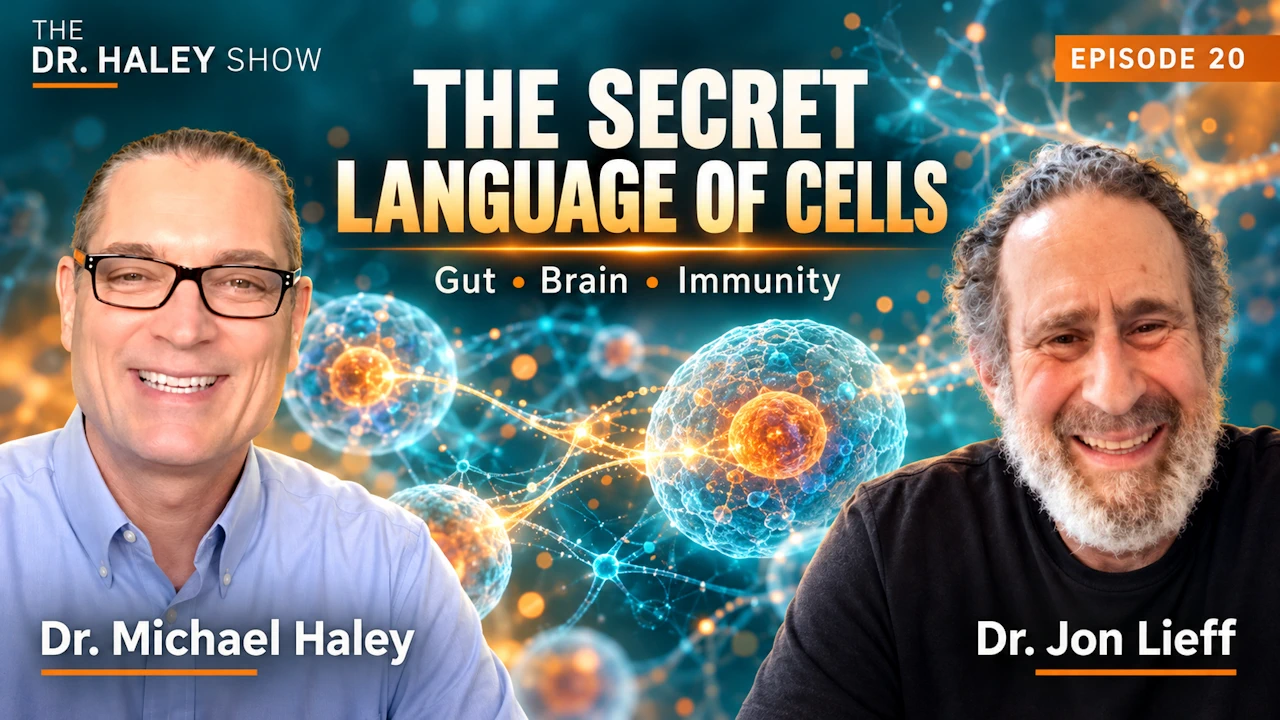
There was a time when the medical community studied specific kinds of cells, with no thought to the idea that different cells from different parts of the body had the ability to communicate with each other. Thanks to new research, we’re beginning to see ourselves as superorganisms, a community of communities.
In today’s episode of The Dr. Haley Show, Dr. Haley chats with Dr. Jon Lieff, a medical doctor graduate from Yale with a doctorate in medicine from Harvard Medical School. He is a leader in the field of neuropsychiatry, an expert in cellular communication science, and the author of, The Secret Language of Cells.
You’ll learn a little about Dr. Lieff’s book, The Secret Language of Cells.
You’ll discover how cells communicate with each other throughout the body.
You’ll also learn how cells control our thoughts, emotions, and even our health.
Join Drs. Haley and Lieff for this fascinating and eye-opening discussion.
Enjoy!
Watch the Interview
Listen to the Podcast
Resources
Quick Takeaway
Dr. Jon Lieff describes the body as a network of ongoing conversations among neurons, immune cells, blood-vessel cells, gut-lining cells, and microbes. In his view, understanding these signals helps explain why brain health, immunity, and the gut cannot be considered in isolation.
The conversation moves from cellular signaling to everyday habits. Dr. Lieff emphasizes sleep, exercise, meaningful activity, time in nature, and food choices, while also discussing open questions about consciousness and molecular communication.
ENJOYING THIS CONVERSATION?
Get the Next Episode in Your Inbox
Get notified when a new episode of The Dr. Haley Show is published, plus occasional highlights and resources worth exploring.
By subscribing, you agree to receive email from The Dr. Haley Show. Unsubscribe anytime.
Episode Timestamps
- 00:08 — Introducing Dr. Jon Lieff and cellular communication
- 02:03 — The wired brain and the wireless brain
- 03:55 — Microbial signals and the gut lining
- 07:02 — Platelets as first responders
- 09:30 — Capillaries and stem-cell signaling
- 10:59 — Telomeres, cancer cells, and inflammation
- 15:14 — A community of communities
- 17:49 — Viruses, genetic information, and evolution
- 22:12 — Are viruses alive? Defining life and intelligence
- 25:50 — The Secret Language of Cells and translating research
- 31:20 — Food, preservatives, and the microbiome
- 37:36 — Fungi, digestion, and ecological networks
- 42:18 — Nature, meditation, and brain health
- 45:36 — Neuroimmune communication and acupuncture
- 50:31 — Practical habits: sleep, exercise, and meaningful activity
- 54:20 — Memory, immune signals, and re-remembering
- 57:38 — Memory accuracy, perception, and subjective experience
- 60:57 — Dr. Lieff’s daily routine and next book
- 63:08 — How to find and follow Dr. Lieff
What You Will Learn In This Show
- A little about Dr. Lieff’s book, The Secret Language of Cells
- How cells communicate with each other throughout the body
- How cells control our thoughts, emotions, and even our health
- And so much more
Cellular Communication Beyond the Nervous System
Dr. Lieff contrasts familiar electrical signaling in neural circuits with the chemical messages exchanged throughout the body. He discusses platelets, capillary cells, stem cells, and traveling immune cells to illustrate why studying one cell type alone can miss the surrounding conversation.
The Gut Lining, Microbes, and Food Choices
The interview explores how gut-lining cells communicate with immune cells and how microbes participate in signaling. Dr. Haley asks about preservatives and digestion, and Dr. Lieff offers his perspective on food processing, plant foods, and the relationship between diet and microbial populations.
Viruses, Cancer, and the Meaning of Intelligence
Dr. Lieff discusses viral genetic material, evolutionary processes, and how cancer cells interact with neighboring tissues. His language of cellular intelligence is a way of describing complex responses and signaling. The conversation also considers where established measurements end and questions about life and consciousness remain unresolved.
Brain Health, Meditation, and Meaningful Activity
Dr. Lieff connects his discussion of signaling with sleep, exercise, meditation, nature, music, and activities that carry personal meaning. He also discusses neuroimmune pathways and a proposed explanation for acupuncture, distinguishing that discussion from broader electrical theories he describes as unproven.
Memory and Perception Are Active Processes
The speakers explore how memories can change when recalled and how expectations influence perception. Dr. Lieff describes his approach to placing difficult memories in a more positive context and acknowledges that remembering can move toward either greater accuracy or distortion.
Medical Disclaimer
This podcast and article are provided for educational and informational purposes only and do not constitute medical advice. The experiences and opinions discussed are those of the speakers and should not replace diagnosis or treatment from a qualified healthcare professional. Do not begin, discontinue, or change any medication, supplement, diet, or treatment based solely on this episode.
Full Transcript
The transcript has been lightly formatted for readability. Because it was created from the recorded conversation, it may contain minor transcription errors.
Read the Full Transcript
[Music] dr john leaf thank you so much for joining me today
well i’m very happy to be here thank you
you know i i am absolutely fascinated by this topic uh myself i kind of focus on helping people get well through diet through what they eat and i’ll even say nutrition because nutrition is obviously more than what you eat it’s chemistry in your body and it’s affected by things like well how you think can change your chemistry and exercise can change your body chemistry but focusing on gut health there seems to be this microbial community in there that is so delicate and has such a interesting balance to make things work and when i started uh discovering your content i thought wow it’s about the communication of cells
and i’m realizing that everything i thought i knew is different now i remember reading in grey’s anatomy i think it’s on page three of grey’s anatomy and grey’s anatomy is a book that you know most medical doctors and and and physicians of all types have owned a copy at some point and i think it says something like you know the the brain or the central nervous system controls and coordinates all the functions of the body and relates itself to the environment around her something along those lines and our understanding was this electrical system almost like hardwired from the brain to the body but when i’m reading your content i’m finding out that there’s a whole another system in place so to speak for communication is that right
well yes i show that i call it the wired brain and the wireless brain uh and that they’re in constant communication such that uh it was interesting i don’t my book is not a business book although for some reason harvard business review read it and said we’re very moved by the fact that uh the body is the mind and the mind is the body that you really can’t separate them in reality
because everyone knows that neurons send signals in circuits and talk to each other we’re all taught that in school but we’re not taught that the same amount of communication is occurring with every cell including platelets even and capillary cells and but the most is known about the traveling immune cells and the master of that is the t cell and uh of course the leukocytes and the white blood cells and uh so um actually harvard was very interested also in the uh how the platelets are very intelligent they’re like first responders they’re not just a plug they’re they’re a smart cell that sends a lot of communication that individually fights off bugs waiting for help to arrive
but so the communication is vast and basically everything is based upon wide-ranging conversation it used to be you could study the kidney and you’d study the kidney cell and that would be it and now you can’t you have to realize that that kidney cell is talking to the capillary cell who’s talking to the neurons all through the body and there’s um uh so the traveling immune cells are really as much part of the brain as the neurons are and and the astrocytes and the microglia so it’s a whole new world of looking for these uh
and and you mentioned microbes so we just science discovered 30 years ago that microbes send signals they used to call it quorum sensing where they make decisions together but it’s taken until now and and then you read in the newspaper well microbes influenced obesity microbes influence diabetes microbes influence the brain everything but it’s never clear why how can microbes do that and then the reason is very simple but it’s not clearly understood is is that we discovered these signals 30 years ago but only now can we see the the details you know the science has gotten so good that you could follow a molecule in the middle of a tissue and see what’s going on with the cells
so really it’s because the microbes are constantly chattering and talking to each other but more importantly they’re using the same language as ourselves and they’re involving themselves in all the conversations and there’s so many more of them it’s ten to one really they have ten times more cells in our body than we do so they’re making ten times as many proteins and gene products and and they’re all floating around there
and and and i have to throw in that there’s another 10 to 100 times more viruses around every cell and those viruses i think are smart as well because they now have been discovered to have signals like the microbes so we’re back you know many years in with viruses it’s going to take a long time because they’re so tiny they’re so much smaller than than cells and microbes are a thousand times smaller than our cells so um but they’re talking also and they’re part of the conversation and there are friendly microbes and unfriendly but there are friendly viruses and unfriendly as well who are helping ourselves so
it’s a vast communication network really and certain of ourselves become sort of masters of that communication like the gut lining cell is the master in that arena and the gut lining cell educates the t-cell i mean the t-cell is already pretty educated it it grew up in the thymus it learns how to um what to do and who it should talk to and who it should attack and how can it study every cell in the body but it still is learning from the gut lining cells teaching it don’t attack this food particle don’t attack this tell your armies to wait don’t attack
because we’re eating every day thousands of chemicals some of which the body’s never seen have never been in nature before we’re inventing these chemicals and the and the t cells deal with every single molecule and they’re saying well what is this one what is this one and and there uh should we attack this cell should we attack i mean this molecule or not so the the communication between that lining cell instructing the the the the t cell to instruct the other immune cells is stopping food allergies that we would have massive food allergies every day with everything if this constant chatter was not going on
well you know you said so much there and i find this so amazing you know one of the things you talked about was uh platelets which seemed to have some kind of decision process and if i recall correctly school was a long time ago for me but if i recall i don’t think platelets have uh a brain so to speak they they’re fragments uh without a nucleus if i recall that’s what we thought
yes they don’t have a nucleus so we say well what can they do without a nucleus well it turns out that you don’t need a nucleus what you need are ribosomes to make proteins and you need messenger rnas so they the the mother cell the megakaryocyte before it breaks up into a thousand platelets it packs all kinds of messenger rnas into that platelet so the platelet is just as smart as all the other cells it just can’t make brand new stuff that um you know like other cells can go back to the factory and say well let’s manufacture this instead of that but so but they have a lot of material and they have very particular granules to attack this virus and that virus and this bacteria
so they really are the first responders they are the ones who are everywhere and they don’t just we thought they were a plug well they are a plug but they’re more than a plug because they actually calculate the blood flow and they try to keep things going keep the blood going but they also particularly size up the situation and send signals to the capillary cells the capillary cells in the platelets are sending signals down through the blood say send leukocytes send white blood cells and then the white blood cells are sort of the masters until the t cells get there you know a day later
so uh and the t-cells that are really ones that that that are that but until they get there the white blood cells uh and the macrophages are working uh and um the capillary cells are inviting them and sending signals and then letting them into the tissue and the platelet is right there working with those other cells so it it’s really um remarkable i mean harbor medical was blown away by the platelet chapter that’s what they like the most because they whoever thought that a platelet would be intelligent
and the other thing is um the stem you know capillaries tell stem cells in each tissue what to do and who would have thought that i mean aristotle said that two thousand years ago you know more he said uh the blood vessels determine the organs and everyone thought well that’s aristotle he’s crazy he’s never looked inside of a body he doesn’t know what he’s talking about i don’t know how he knew this but he was right
so basically the the the the blood vessel cell the tiny capillary in the smallest blood vessel that deals with the oxygen exchange that little tiny lining cell is the intelligent cell telling the the the stem cell that’s in a niche right next to them uh well we need more of this kind of liver cell we need more of this kind of cell uh who would have thought that was true
so then you’re coming out with this new science of signaling when you start looking for signaling and now we know that’s where all the treatments are going to come from from the signaling so that’s at least we know where to look it’s more complicated but at least we know where to look and
i i think that’s going to be the most fascinating thing as and this is a lot of new information we’re all we’re learning this we didn’t know this stuff when i was in school 25 years ago
it is five years ago ten years ago we didn’t know
yeah and the coolest thing about it is the doors it opens up to understanding problems and possible solutions to them i mean it really open you know
one of the things that they started talking about when i got out of school was telomeres and you know we understood them to be uh these you know projections that you know eventually run out and as i’m reading your content i’m realizing for the first time wait a second there’s you know i think you mentioned enzymes and stuff that extend them and they can somehow be regenerated it’s like wait a second you know i i don’t know that will ever achieve immortality but understanding how these things work sure you know sets us up for maximizing our lifespan and our health
telomeres there are these enzymes that will build telomeres under certain circumstances and not in every cell but obviously if we can learn how to do that we can help dying cells of certain kinds of course cancers learn how to do that and that’s a problem because they become immortal and they they they’re so smart can’t you know if we think a microbe is smart the cancer cell is so much bigger and stronger and smarter they build colonies just like microbes do they’re talking to each other they’re sending resistance genes against our medications they’re sending ways to fight against viruses or bacteria they’re going to attack the cancer cell
and they are a community and they build their community and they like microbes learn how to manipulate the conversation so what they do is they get involved in the uh fibroblasts in in the connective cells and they get them to become friends thinking they’re building an organ together and the fibroblasts actually help build the structure and they do the same with blood vessel cells they they manipulate them to build different kind of blood vessel cells that won’t let the immune cells escape into to come attack them so they they’ve learned how to manipulate the language and they’ve learned the tricks of the t cell how to maximize reproduction how to and they love inflammation inflammation the chaos of inflammation
and of course inflammation is a double-edged sword it’s absolutely necessary and important to clean up things to fix things and like on the skin you know in the gut the lining cell is there and beneath it it can attract the kind of t cells that they want and they can build a little lymph node under there’s room to build the lymph node right under the lining so that they have available all the tools that they need to fight different infections and things like that
but on the skin there’s nowhere to build these lymph nodes so instead of that what they do is they keep a low level inflammation like a little infection a little inflammation all the time so it keeps the immune cells crawling around in there and they have a large number of memory cells floating around they have the greatest number of memory t cells on the skin and they remember every little spot like where a fungus went in and went down below that this this t cell is sitting there memory cell well i remember exactly what happened then and if they come back i’m gonna i know what to do now i can attack them so um yeah it it the communication is mind-boggling
wow wow you know another thing that you mentioned was uh how outnumbered we are in numbers of cells you know we uh and yes the human cells i think you said that they were larger but far fewer in number i think you said uh like ten to one and then viruses being a ten to one over the bacteria even or over the other microbes uh right we’re outnumbered i i don’t think this is i don’t know if you know the comedian um howie mandel uh you know he’s a a little paranoid of microbiota this is not a conversation for him we are out we’re a shell of a a person with human cells and it’s almost like we’re the host and for them to exist and they’re running the show in a sense
yeah we’re a super organism we’re a community of communities and somehow they you know there’s this view that came from a misinterpretation of darwin and the evolution that everything is is conflict and fighting and competition the fact of the matter is 99 is cooperation uh and there is a little competition here and there and of course there is some selection you know certain things work better and they went out
no question about that but most of everything is through communication and cooperation these huge massive super organisms that we are are all through uh cooperation and uh we work through cooperation the lining cell that there’s this mass of trillions of
yeah you know you mentioned numbers so in in numbers like in the brain in the fetus we build a trillion brain cells and then cut it down to a mirror just below a hundred billion and then there ends up being somewhere five six trillion so total cells in the body and we make a lot every day of certain kinds but there’s ten times as many microbes and those microbes all have a lot of dna just like our cells do even though they’re tiny they’re a thousand times smaller but they have still they have a lot of dna and they make all kinds of products and the our cells have to sort through those products and get rid of some and stimulate others and some just work by themselves you know
but it’s the the gut lining cell is determining well this microbe is absolutely essential to make this vitamin this this uh this one is really essential to to eat fiber and to um [Music] and to make brain signals and to make omegas and to make so they uh the lining cell has to figure out which are the dangerous ones draw them near the edge where the mucus is
and in the mucus there’s a whole families of phage viruses bacterial viruses that that are very helpful to keep enemies viruses and enemy bacteria away from the lining and not only that but they recently discovered there’s a whole lot of these viruses coming into our gut cells we don’t know what they’re doing but they seem to be friendly and it’s not clear what’s happening yet it’s very hard to study viruses they’re so tiny but they do seem to have be part of the intelligent conversation that’s going on
i mean to me viruses are the dominant life form on earth and they they contain more if you consider dna and rna as information which i do uh although there’s also added information of the control and the regulation of it and how it works is a whole nother story how all these molecules come together into complexes and everything works through communication among molecules
that’s my next book actually what i’m working on now is about communication inside where the molecules are talking and creating these complexes that that start the initiation of using a gene for example um so you have the viruses are part of that they’re tiny and they they contain they’re like a storehouse they’re like a warehouse of every possible strand every possible type of information
and i don’t think people realize that there’s more virus dna in our cell in our dna than our regular dna in other words let me mention that so because we all view viruses as bad but they aren’t bad they’re an essential part of the source of information for evolution and for everything
so what’s happening in our cells when they did the big genome project they found that uh you know they thought it would be most of the dna was only two percent was what we call genes our genes and that and two percent but eight percent are from retroviruses in the past that are sitting there and these retrovirus genes are very very important they are very vital to the brain uh they’re when the guy won the nobel prize for turning a muscle cell into a neuron like a stem cell changing it bringing a cell back to they had to use these factors and those factors it turns out come from virus genes lo and behold sitting there um
and the other virus gene is syncytium you couldn’t have a placenta the placenta comes from a gene like the spike that we’re all learning about about covid it’s a it’s a thing that connects so the syntheticium was an old connecting protein and they the virus put it in our dna and our cells said wow that’s great i can use that to build a placenta so to connect the placenta the amylase enzyme is a virus enzyme it’s from a virus
now that’s eight percent but there’s another 50 percent that are jumping genes and these are virus like strands that are moving around they have their own ability to move they have proteins that cut them out and then sew them in and so they can jump around
and it turns out that these are active and that a lot of the activity inside our nucleus is fighting against the negative effects but the positive effects are there’s reason to believe that the rapid size of the human brain came from jumping genes and our unique ability to use them
and to use alternative splicing it turns out that we have a our brain developed very rapidly if you think about evolution i mean the dinosaurs are dead at 60 million years ago and we’re left with little tiny mammals the size of a squirrel and we developed in 60 million years from that little squirrel which is kind of amazing and six million years ago which is really a flash in the billions of years of evolution suddenly we have this huge brain appears and so but there seems to be reasons from these jumping genes are helping do that
so viruses are an essential part of evolution of how things work and they are the the filing cabinet let’s say of information in in in the earth every day viruses kill half of the microbes in the ocean
every day and they they grow again and that’s how the atmosphere works the atmosphere is based upon you know the the oxygen coming from uh plank you know uh photosynthesis and it all this is working through algae and through microbes and it’s controlled by the viruses anyway i don’t care i started talking about viruses it’s uh i could go on uh
i i love it it’s fascinating because you know and it and you’re touching on well there there’s a discussion a debate of whether or not viruses are even alive and everything i’m hearing from you is saying somehow they’re alive it’s more than just genetic material
well there that’s a re yeah it’s a silly argument because viruses what most people think of the virus is a spore in other words you wouldn’t think a spore is not alive because it’s it’s inert and traveling and then it lands and it builds you know a plant um you wouldn’t think i’m not alive because i can’t reproduce because you know in past reproduction uh
you know zimmer wrote a wonderful book about the definition of life and he every single definition is completely faulty i mean he just shows how every single one is completely inconsistent it used to be a cell with metabolism and reproduction well i would have to add a cell with metabolism reproduction and information the ability to communicate which is a whole another level
but you really viruses when they enter the cell they become the directors now it’s amazing when you think ebola and hiv that completely take over cells like hiv takes over the most intelligent t cell and they have seven g and eight genes i mean they have almost no genes and almost no proteins and yet with this small number of incredibly smart proteins they create a room they build a room where they place their enzymes they take our enzymes they build a factory and they manipulate our system which is so complicated they get inside the nuclear pore which is almost impossible to do they trick everyone so when they’re in the cell we call that a a virus cell
they build a virus factory that’s when if you want to define them as alive that’s when they are basically running a cell and then they become a spore they build a little you know a gadget they build a spaceship they surround themselves and they shoot out and and they protect themselves until they land somewhere else and then they you know manipulate the way in and uh with their surface molecules and and then they i mean so in any
i think you know we just don’t know what life is i mean the truth of the matter is no one can define life we don’t have a definition of we don’t have addition of consciousness we don’t have a definition of intelligence
modern science is very very good for describing matter and energy in the conventional sense and the quantum i’m doing a lot of study of quantum chemistry and that’s really going to be the basis of communication ultimately
but then there are the whole all the other philosophies where they think consciousness is is a substance which i sort of believe but there’s no evidence for it and then matter sort of solidifies from that energy well that’s a great philosophy but there’s no evidence for it and we can’t prove it and there’s no study
on the other side we have materialism and here we’re finding out i feel there’s enough in the material science the western science to show that life is intelligent and intelligence goes through it communication is everywhere and cells are smart so i always work with the existing science but you know it’s clear we don’t know anything
dr leaf i want to give you a a quick plug here because um everything you’re saying is expanded upon in your book now for those that are listening and are going to purchase the book don’t do what i did okay read the title before you make the purchase the first my first attempt went wrong and by the time it showed up in the mail i got the the cds the compact discs i didn’t see the compact disc in the in the title you know i love a good book that i can take with me and open up anywhere then i i actually downloaded it on on the ipad so that i but i don’t take this with me everywhere so it’s not just a convenient
but the book is excellent and it talks about all these things in great detail you know just now you were talking about the uh the genes of in hiv and ebola and i think you expanded on that very greatly uh somewhere around chapter 19 or 20. um when you talked about the numbers of of um you know bacterias in our body and their relative size that was earlier in the book
there’s a lot of amazing uh content in your book very well written very clear very easy to understand and uh to me it just you know opened up my mind in in the understanding of these things
even though it is such a huge subject that we still know very little about uh i don’t know how you do it you you i mean um it seems like you have you know 10 lifetimes worth of study concise you know in one book it’s amazing really really good i encourage anyone that really likes this stuff get a copy and and to be more specific the secret language of cells john leaf md
so well thank you very much of your kind words there is a kindle edition which is i think pretty good some people like the audio uh you know it actually won an award it’s the guy who reads it is is good i guess and um i guess a paperback is coming out in the spring so there will be a paperback as well uh if that’s
i thought there was a paperback and i just got the wrong thing
no there’s a hard cover there’s um a cd there’s an audio
okay hardcover okay
just get it uh online um and there’s a kindle uh kindle
but thank you very much i appreciate uh you’re saying that uh yeah it was a lot of work
what i did is i basically for 10 years on my website i i translate i see to me no one can understand these articles they’re written in gobbledygook genes and receptors and you know you’re working in a lab and down the hall there’s a guy working on a slightly different subject similar they can’t even understand each other’s papers because the words are so complicated so what i saw myself and in the hospital people ask me if i speak foreign languages i said yes i speak molecular biology and molecular genetics
and so i saw myself as translating into english these papers and what i did is i find the the the lead reviews the lead papers and for ten years every week i would translate them into english
and then i realized what was happening i realized i’ve written about the human brain the tiny animal brains the insect brains the bird brains the cells how smart microbes and then it dawned on me that there’s nowhere a book just explaining simply that it’s all based upon communication that everything is signals and that’s really what what all of uh biology is about um and that’s the way we’re understanding and that’s the basis of of modern advanced medicine
all the cancer treatments are based upon understanding the natural communication between like a virus a bacteria and a cancer cell so you use one to fight the other or you build one up in a way or you build up the t cell and teach it to fight better against the long battle that has to go on with cancer as opposed to the rapid battle that occurs with a virus you know t cells aren’t used to the long subtle fight that goes on with the cancer because they keep having different subclones within the cancer and the t cell has to adjust and go after this one and go after this one so we’re helping the t cells along as we learn about this the signaling between them um but thank you very much for saying your kind words
well you know it it’s really great content to help understand and you just now you know talking about cancer again i think that was around chapter 15 or so a whole chapter dedicated to understand uh cancer and and how it works and i’m certain as you allude to that this is going to open up doors for um understanding treatment options as you kind of look at the pathways that they use and if we can somehow interrupt that pathway right there i mean it’s brilliant it’s absolutely brilliant
i i you know i think one of the most important things though right now is rather than being overwhelmed with this um it is a lot and you’re going to have to add a language when people say do you speak foreign languages from what i understand with your upcoming book there’s going to be uh you know i speak biochemistry or organic chemistry or you know it’s a whole other language
but if we were to dumb it down simplify things a little bit and you know you mentioned the layer in the gut that is there kind of keeping deciding what is allowed in and how there’s you know chemical attacks and i think that’s where we’re probably doing the biggest amount of damage for instance um we don’t we do very little digesting we chew our food and it goes through this acid environment in the stomach and then into our you know uh stomach from from the stomach to the small intestines and into the large intestines uh eventually oh and i learned something in your book about the appendix a possible reservoir for all like a safety area we always wondered what’s it for
but in this digestion uh process we have very little bit of digesting that is our responsibility it’s more like i see it as preparing the things we eat for the microbiome to digest
and i look at something so simple like preservatives in food what is the purpose of the preservative it’s to not allow microbiology to inhabit it so it’ll stay on the shelf longer but wait a second we’re supposed to feed that food with these chemicals to our microbiome how could they possibly eat it if it has chemicals in it if we were to dumb it down are we are we essentially killing ourselves with this chemistry and damaging it to the point and that’s why the layers are breaking down and allowing miscommunication what’s going on
well you’re absolutely right well there’s another reason for preservatives and that’s to screw up ourselves also um because these are chemicals they don’t know what to do with and of course it creates massive hassle and problem for the cells to what do you do with this chemical um so
one thing that’s interesting um so people say meat red meat is a problem and but one of the reasons that it’s a problem is that it attracts a particular kind of microbe uh so and this particular microbe likes to eat carnitine from the meat now we don’t need carnitine we make carnitine inside the body in the cell but this particular microbe likes carnitine eats it and then creates a product called tma that then goes out into the blood goes to the liver and they turn it into a gas called tmao and that’s what causes atherosclerosis so it’s not that the meat did that the meat didn’t do anything it’s just that the microbe that likes the meat is the one causing now there are other reasons why red meat may be a problem but this is interesting to note that the type of food we eat attracts a particular kind of microbe and of course a vegetarian isn’t going to attract those microbes and they’re not going to get the heart disease in that same way they can get it in other ways of course by eating way too much fat you know but so
so we have to realize that the food we eat um and the particularly the processing i mean processing is a very serious problem because you’re adding chemicals and you’re taking away nutri stuff that we need
i mean people for example want to like why is a blueberry good well we create a vitamin a flavonoid we create a you know vitamin c or whatever but the blueberry has like 10 000 chemicals in there we have no idea what’s in the blueberry and
the same with marijuana i mean we’re creating individual chemicals out of marijuana but there was a study just done where the type of marijuana oil that that has been approved to treat a particular rare kind of seizure disorder didn’t work on these eight kids so they took whole marijuana as a plant gave them that and the seizures went away so it was not just the chemical we thought it was but one of the other thousands of chemicals that we have no idea about
and the problem is we cannot reproduce what’s in plants and food and these plants and food and fungus are creating all the medicines we have they’re creating all the good stuff that we need and we can’t duplicate it so we have to create an environment that allows the proper microbes to be there and that’s based upon whether we eat crap or not it will determine what kind of like we
there are microbes when the oil spill occurred in in the gulf everyone said oh my god this is awful this is going to take forever to get rid of well we were very surprised microbes came and ate it and and they ate it up much much faster there are microbes now learning how to eat plastic because the plastics everywhere in the ocean so the microbes i mean are going to take care of that in their own way even though we may kill off all the humans the microbes are going to do just fine they’re going to do very well so they’re going to adjust to whatever electrons they want to eat whatever kind of electron movement that works they’ll adjust to it because they’re a basic form of life searching for electrons and energy and anyway so uh
so the problem is everything we eat has an effect on the types of microbes and that’s a very important point because uh so that’s why we need natural foods and that’s why we want no chemicals in the food because the chemicals need a special kind of microbe there that that could be a dangerous microbe you know the kind of microbe that’s eating plastic isn’t the kind we want in our gut and and uh the kind that’s eating uh preservatives we don’t want in our gut it turns out with the kind that eats red meat we don’t want in our gut uh so it’s very very important that we eat natural foods and plant-based foods and uh it’s also for the planet but that’s a whole other issue but in any case um
and and uh really yeah you know one of the one of the things you said uh you were talking about the ocean being cleaned up uh and in inside us sometimes we need to be cleaned up i heard someone say that i i don’t know if it was candida specifically or a fungus infection in our in our guts would actually be there possibly cleaning up heavy metal toxicity so you know we have this overgrowth of a certain something inside us and it’s actually overgrowing to clean up the mess that we’ve put in there that should have never been put in to begin with
no you’re absolutely right and fungus is you know it’s funny i say everything is the most dominant life form you know micro bacteria the most like form uh fungus of the most dominant life form and uh it’s like on this show uh the voice the the judge says well you’re the greatest i’ve ever seen every time you know each time someone does a great performance
but so but fungus i have another article our fungus the most dominant life form because they are the digesters they’re the masters of digestion and they’re the ones that take apart everything in the forest and then re help rebuild everything else they’re the ones that talking with plant cells allowed them to come out of the ocean onto land plants would not be here without fungus without these without the wires
and i’ve been recently reading more about uh i thought that it was fairly um not simple but there were certain kinds that go through all the fires turns out there are many different kinds of fungus wires in the forest it’s not one simple internet it’s a lot of different internets but they are communicating between all the plants and we wouldn’t have plants without them plants would not have ever made it onto land without fungus
and the fungus like you say are the you know almost anything will decompose and that’s because of fungus basically mostly i mean other bacteria do that archaea do that but fungus are really the remarkable ones and they of course are also talking and making nitrogen for the plants and making deals about uh with plants just like bacteria do but you’re absolutely right everything we eat attracts microbes fungus included and that’s what determines what happens inside of us
i i think it’s neat i hear your passion for these things and i absolutely love it um i you’ll probably agree with me that these things are supposed to be very plentiful around us in the soils this communication network of uh of you know bacteria and archaea and protozoa and and worms and up the chain everything eating up the chain pooping out making everything more rich and nutrient dense and then here come the silly humans with their insecticides or besides fungicides killing everything off that is so essential for the vegetation that we rely on for our food
and upsetting the ecology so that viruses that have lived happily with bats for a million years will will jump and say oh what is this this is a human this is interesting let me jump on to this human and oh wow there’s billions of them i could really make a life here uh and so i’m going to try to stay with the human not the bat
we’re allowing these dangerous viruses to reach humans by destroying all the uh natural uh places where where they live so uh you know there’s a limit to how much we can destroy the planet and and survive um and i think we’re close to that so uh i hope we’re not at that point of no return
dan coming outside and seeing you know dead bees everywhere because the city came by and sprayed the you know for the mosquitoes and you know everything this planet is being sprayed and killed off and and you know we’re we’re eating the chemicals and we’re killing ourselves from the inside we’re we got to make a change and understanding these principles the secret language of of cells and and how important how reliant we are on their existence
if you killed off the viruses you kill us off
you know people you know it’s fascinating to me is it when people ask me what should they do for their brain health you know clearly food is very important exercise is very important for memory and neuroplasticity what you think about builds the circuits in the very dynamic brain and focusing on positive things
but among these things for some reason if you just walk into nature and you have an eeg a beanie on your head you’re immediately in a meditation in other words just being their nature has an effect on us that’s dramatic and um just if you give a little plant to someone in a hotel in a hospital bed or if you have an apartment and you can see a tree it makes all the difference in the world something very magical and it makes me wonder i mean it’s a little mystical to think this way and i don’t know you know i don’t understand it it’s not scientific it is scientific that this happens in other words we we are uniquely affected by being in nature and it’s one of the main ways for us to have a brain health is to expose ourselves to nature on a regular basis
but is this because we’re complementary with plants which we are we’re totally necessary for each other the oxygen and the co2 back and forth and we’re just a complementary being really and we don’t respect that complementarity
uh you know we really need to learn from the native americans like the chief seattle’s lecture was wonderful about how really the trees and the rivers really are our relatives they really are connected to us we really are totally dependent upon each other in this unique breathing thing anyway so i get carried away
as we’re walking through nature do you feel that maybe somehow that is affecting the uh microbial communication in our bodies in a positive way what’s happening you know more specifically uh something written you know several thousand years ago uh in the book proverbs it says a cheerful heart is a good medicine but a a crushed spirit dries the bones what does science say about these things
well like i said before we have no idea what consciousness is we have no idea what mind is so these it’s all speculation or the different kind of experimentation like from the many many years of the yogi’s and the you know the meditators and you know their their knowledge of the mind so we really don’t know we have no clue what the mind is or how the brain operates and the mind isn’t in the brain the mind is between brains as well it’s it’s in culture it’s in science the mind is in these cells the mind is throughout to me the mind is throughout nature uh but
specifically i mean obviously microbes are everywhere and they influence everything so there has to be part of it but i i can’t say what exactly uh and and i don’t have any idea i mean i’m just being a little uh artistic to say that we’re complemented with plants i mean we are but we don’t understand why how the brain works
but there’s no question that meditation is a thing that affects the brain has positive effects on changing the brain on immunity it has dramatic effects on immunity
now again here no one knew why that was true but in the new science of the neuro uh immune circuits the communication between uh brain and immune it was just so we all know that when you meditate the vagus nerve calms the heart rate it comes to breathing it calms the gut
but we never knew how could it affect immunity but it does when you meditate for a long time you have 200 genes that are an immunity that are altered you have all kinds of changes in the ability to fight viruses and all kinds of stuff how is that possible
well when you realize that neurons can create any kind of immune function they can create what they call neural inflammation and they use this for for various purposes so we realize that that same vagus nerve can send cytokine signals to the immune cells and have an influence on immunity
so um by the way the neuroendocrine the neuroimmune circuits explain acupuncture no one really understood how acupuncture works i mean there are theories that it’s the electricity going through fascia but that’s not proven it’s not near blood vessels you would think it’s near an energy line of some kind but we don’t have any it’s it’s not near blood our thought would be blood vessels or uh neurons but it’s not but so you take
but a recent study showed that you take an acupuncture point in the wrist that affects the spleen and the kidney it turns out that if you study it in great detail that point is right right below that is a t cell and the t cell gets activated and simulated and it moves a little bit and then it signals to the neurons the single back and forth and that message goes over to the spleen
so it’s again the communication between the immune cells and the neurons are are causing um the effects of meditation on immunity but also the effects of acupuncture um i’m not sure why i went off on this tangent
no i think i initiated that tangent i wanted to know your thoughts on acupuncture because you know it is interesting because you know we i always wondered you know well you’re if you’re not hitting a stimulating a nerve or or the vascular system you know there’s got to be another way that this is working and i’ve heard the terms meridians which i’m not sure what a meridian is clearly uh acupuncture has merit and i think what you’re saying is we’re understanding why now
well this is one mechanism that’s been proven but there there is a whole alternative medicine view which is not disproven it might well be true that things are more electric than and i do believe that
and that’s part of what i’m studying about the uh the way reactions happen through uh uh electron attractions and because things happen much faster in a cell than are explainable by this random diffusion idea you know things banging into each other it doesn’t make any sense when it happens instantly and you have 10 reactions occurring instantly within milliseconds
so what’s happening is it’s creating these complexes uh that are drawn together rapidly through uh these electrochemical uh and even photon because when a charge vibrates it sends out photons so if you’re vibrating charges and you do everywhere in molecules these large and you have the the water molecules are polar also they have charge
so all this vibrating charge involves communication between molecules uh so um
yeah yeah i think your next book’s gonna be fascinating as we’re looking at the molecular communication and uh you know electrons ions um and clearly these things are happening in our bodies
is that yeah so a lot of people think it’s not just ionic movement on the axon but it’s actually electrons like a wire because electrons moving are what work the the mitochondria they work the photosynthesis they work and they’re and they’re working in all of our big enzyme communications this electron
so there’s some belief that the large collagen type molecules in the body the fascia are electric conduits and that could be related to meridians but it’s unproven but this one new mechanism of the um with the t cell and the neuroendocrine is proven and that makes a lot of sense uh how it can work
yeah interesting um let’s dumb things down a little bit and uh in a almost like a summary fashion i know this topic is overwhelming for a lot of people it’s overwhelming for me and it’s it’s huge um i love it and i could talk about it all day but for others that aren’t medically trained it might be completely overwhelming you mentioned walking in nature being a form of meditation what are some real practical things that people can implement right now today understanding they’re going to benefit this whole communication system
okay well one of the so we we mentioned sleep sleep is absolutely necessary for consolidation of memory and sleep also at night the neurons shrink in half and there’s a fluid that goes through and cleans out clumps of protein that cause neurodegenerative disease so sleep is very very important for memory it’s very very important for cleaning out the brain so that’s a very important part of it
exercise has a unique effect on what’s called neuroplasticity that’s the ability of the brain to change circuits to make stronger memories and feelings and it turns out that neuroplasticity which is creates meaning is very important in uh um
they used to think there are different modules in the brain and the mris work in like seconds but this is all happening in milliseconds so we’re not measuring any of this in reality everything in the brain happens in all of the brain and you basically want wide circuits to be working
so for example music triggers a lot of different parts of the brain there’s rhythm there’s body movement there’s thought there’s you know you’re at a concert you know the band you know the meaning of the song you know the people you’re with all these parts of the brain create a circuit and the memory is very strong with a musical event
and if you take it into a church uh event uh i spent by the way a lot of times singing in a gospel choir i mean so you um you take it with spiritual meaning rhythm people it’s just the most powerful event because it’s involving the entire circuit so you want something that is powerful
let me give you an example so the high jumper is visualizing a high jump and if they visualize it it’s 30 percent better but if while they visualize it they go like this with their hands it’s 45 better because they’ve involved the muscles in the visualization
the same is true there’s a study with a math teacher of 10 year olds one classroom just teaches the other classroom she points here and here the pointing makes it 10 better because of the physical observation of the hand associated with the meaning
anyway you want a wide neuroplasticity for um and the brain is very very active so the way we use our brain people say well all people are demented they’re not actually all people who use their brain in meaningful ways have much better brains than young people they’re building all kinds of circuits to the frontal lobe they’re building all kinds of circuits to the right and the left so we want
not just people say well should i do crossword puzzles well there’s nothing wrong with doing crossfield but that’s not what we want we want meaningful activity gardening art business charity something that grabs you something that means something and that includes intention motivation the movement of your body uh thought meditation all of that that’s what builds these these brain circuits that are so necessary for the for the health of the brain
there’s one other thing so the t cells are in the spinal fluid communicating back and forth to the neurons that’s a new thing we’ve learned and one of the messages is when we get sick create the sick feeling the neuron creates the sick feeling and only when when we’re better only the t cell can tell the neuron get rid of the sick feeling and go back to normal thinking
but also new memories are based upon new cells we have a thousand new cells coming in the memory center and these new cells somehow associate to memory build a network and then gradually replace the old memories the old network of memories and that new memory is so it’s like the difference between i i remember there was a car there and the new memories oh i remember it was a red chevy that was there uh the memories clearer or more focused on certain things
so i always tell people um what you do is you you you re-experience a attract the traumas but when you re-experience the traumas you bring into it a little bit of love something good that’s happened your family something positive on top of it and you slightly alter the traumatic memory uh in the new the new memory and you keep doing that and you keep re-remembering it and the new memory that puts it in a context of healing uh takes over and so that’s one way to sort of gradually chip away at the effect of traumatic experiences
so we have meaningful activity for the brain we have now exercise creates a window of learning and neuroplasticity for several hours but if you take mice and you exercise them and you give them cocaine they become more addicted more rapidly during that two hours so you can do it for good or bad you have to use that two hours or three hours for something positive in your meaningful activity
and then of course there’s uh nature the effect on nature is um is very dramatic and it’s very shown so you need to somehow make time to be near a plant or to walk in the woods or to sit outside something uh and that should become a regular part of the day
yeah yeah and and unfortunately there’s less and less nature and more and more concrete
right right and we talked about food already i mean obviously food is if not i mean perhaps the most important thing is eat don’t eat chemicals eat natural foods you know figure out what’s best for you and attract the good microbes and the good viruses
a lot of those things that are sold as food aren’t really food they’re packaged stuff that really isn’t food it’s got chemicals in it and it’s not good for your microbes
look at the label and if you see a lot of capital letters and you have words there that you’ve never heard before don’t eat that in other words just look at the label it has all the crap not all of it but it has a lot of the crap that’s in it and if you can’t see that it’s peas if it’s ed something bbb whatever you know a bunch of letters uh chemicals don’t eat that
yeah the yeah good good good word good advice there um the re-remembering thing as these memories change are they improving and becoming more accurate or are we remembering things that maybe didn’t happen
it can go either way
okay it’s whatever you do with it in other words memory is very tricky
in fact the whole idea of perception is tricky in other words the brain doesn’t see reality the brain sees a very narrow band of certain kinds of light waves and then doesn’t even take most of them in because it goes from so many receptors down to one neuron
so you’re getting a very narrow bandwidth of stuff coming in i mean you ask if if something happens in the forest and there’s no one there it would it be real well if it happens in ultraviolet we’d never know if we were there if it happened in x-rays we’d never know so it’s a very narrow band hearing is very now touch is very so
and basically more occurs coming down modulating so the sensory information is coming in and then going up the spinal cord there’s 60 of the what’s happening are are these thinking the cortex sending signals down to manipulate this and it’s basically really an expectation
there’s a famous study where you tell people to focus on what’s happening on the stage and there’s a performance and then a guy in a gorilla suit walks by and no one sees the gorilla suit because you don’t expect to see a gorilla in the middle of the performance it’s so basically the brain is an expectation based on what happened before and then gets surprises and fills in gaps and then restructures it based upon the new information
so what we call a perception is really not what’s out there it’s just a
and we don’t know what subjective experience is we have no idea and there’s a whole new science has to be developed to what’s subjective i mean the scientists want to have you believe that it’s like the it’s like the emperor with with no clothing i mean they want you to believe that there’s no such thing as subjective experience because they can’t figure it out and it has nothing to do with the brain and we don’t know what the hell it is
everyone knows what subjective experience is i mean it’s obvious we all know it’s subject we all have subjective experience and we all know exactly what it is we just don’t have a science that can measure it and describe it but it’s there
and um somehow it’s a it’s an amalgam of stuff coming in from the outside and stuff that’s internal uh and the spiritual thing says that the internal thing is very real and you can get bigger and bigger on the messages from the internal uh world and it’s it’s a communication between them but we don’t understand any of that we really don’t
what’s a day in your life look like what are you going to do today and how are you going to practice some of these principles
well as much as possible i try to have a long meditation every morning and then i do stretching and yoga and i do some aerobics
and i’m in the woods uh in martha’s vineyard so we live uh what what happened is our house in town was destroyed by fire two years ago so we moved to our summer home in martha’s vineyard and then coveted it and we’re basically in the woods i used to be here a lot but now i’ve been permanently here and it’s wonderful we love it it’s not a winterized home so we have to fix it up and it’s hard to do that with covid on this island but but i’m in nature
and i basically uh i only do telemedicine now so i do some of that and i basically work on my new book
i i’m reading a lot i’m writing a lot i’m studying about how chemical reactions occur and how they could know how to make dna for example like what is that information where did that come from and i believe it has to do with the layer below that which is the electrons moving around which is basically what causes all these reactions to occur and anyway that’s a whole nother story
yeah now is telemedicine does that mean you’re seeing patients via zoom or something
yes that started with covid i treat hospi i’ve always treated hospitalized patients who have neuropsych and medical problems and this a lot of them are the elderly so i specialize in treating the elderly and i specialize in brain injury for many years i ran brain injury programs
so i still have one brain injury program and i do some hospital work but i do a lot less than i used to do i’m semi semi retired working on my book mostly more than half of my book
all right um if someone wanted to get an appointment with with you could they
not really because um i only work at hospitals
okay and we worked at hospitals for many years and i wouldn’t advise anyone to try to get into one of these hospitals to see me
what they can do instead is is join twitter uh it’s at johnleafmd uh and i’m very active on twitter uh on my website there’s a contact information there uh
so i have my website i have twitter i do facebook but not that much uh and but no one ever spells my name right so it’s j-o-n and l-i-e-f-f this was a name invented when they came to ellis island 100
three letters in the first name and an extra f right
yes l-i-e-f-f they invented this so no one ever spells it right but it’s at johnleafmd and my website is johnleafmd or searching for the mind uh so either one of those are way to contact me
fantastic i’ll make sure that uh below the video form of this message and in the description on the itunes podcast page as well as all the other podcast platforms that are that you might find this will have links to your content and so that people can find and follow you um
dr lee i want to thank you so much for taking time to be with me um i i love what you’re doing i love how how you put things i can’t wait i’m kind of an organic chemistry type of guy so now i can’t wait to see your next book
well thank you you’re very you’re really good i really appreciate what you’re doing and
[Music] you