
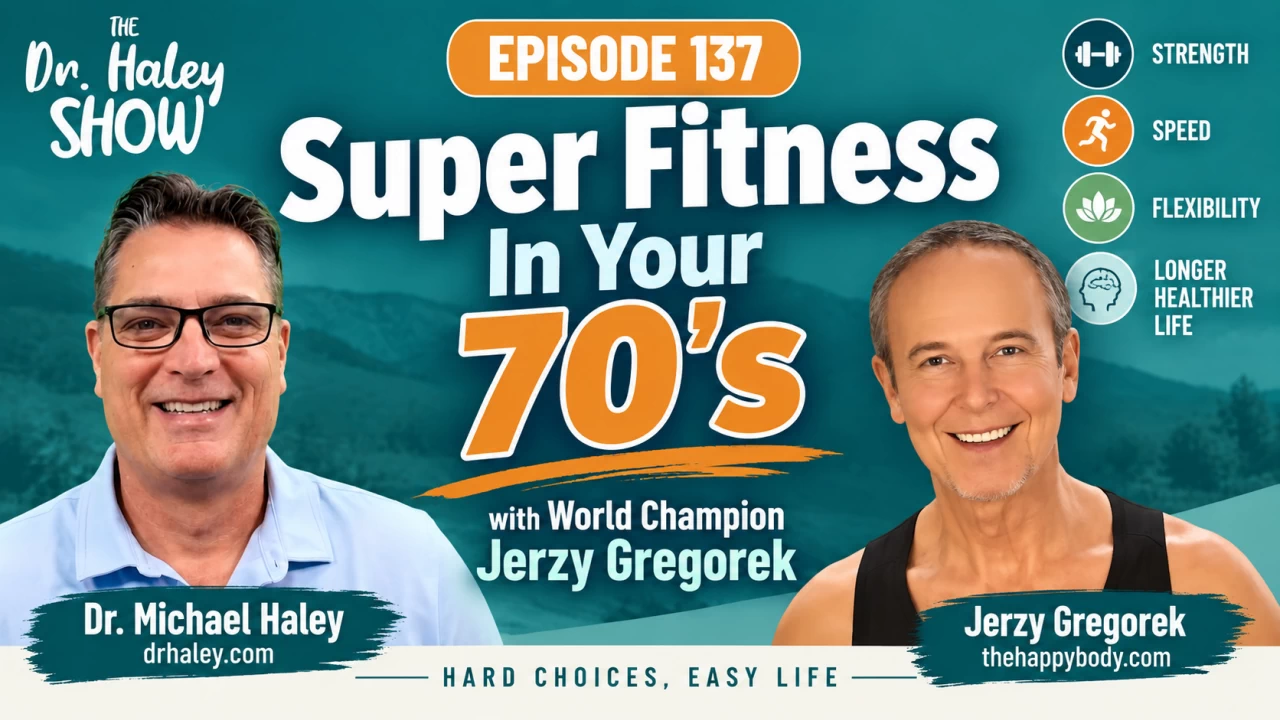
What would it take to feel stronger, move better, and have less pain as you age? In this episode of the Dr. Haley Show, Dr. Michael Haley talks with four-time world champion Jerzy Gregorek about strength, speed, flexibility, discipline, and the mindset required to build a “happy body” for the long term.
About This Episode
In this episode, Dr. Michael Haley interviews Jerzy Gregorek, a four-time world champion weightlifter, coach, author, and co-creator of the Happy Body Program. Jerzy shares the remarkable story of his early life in Poland, his role in the Solidarity movement, and how hardship, discipline, and personal transformation shaped the philosophy he teaches today.
The conversation then turns to fitness, aging, and performance. Jerzy explains why strength alone is not enough, why speed matters as we get older, how flexibility supports performance, and how “micro-progression” can help people improve without progressing too quickly. He also unpacks his phrase, “Hard choices, easy life. Easy choices, hard life,” and explains how long-term goals, daily practice, and compound growth fit into his approach.
This episode is for anyone interested in staying strong, mobile, and physically capable later in life.
Watch the Interview
Listen to the Podcast
Resources
- Buy the book “Happy Body Program” on Amazon
- Visit Jerzy Gregorek’s website: The Happy Body
- Follow Jerzy Gregorek on X
- Follow Jerzy Gregorek on Facebook
- Follow Jerzy Gregorek on Instagram
- Connect with Jerzy Gregorek on LinkedIn
- Subscribe to The Happy Body on YouTube
- Listen on Apple Podcasts
- Listen on Spotify
Quick Takeaway
Jerzy Gregorek’s central message is that aging does not have to mean abandoning strength, speed, flexibility, or ambitious goals. He describes “power” as the combination of strength and speed, emphasizes gradual “micro-progression,” and argues that meaningful improvement comes from consistent practice rather than short bursts of motivation.
Throughout the conversation, Jerzy connects physical training with a broader philosophy he summarizes as “Hard choices, easy life. Easy choices, hard life.” His approach is not about instant transformation; it is about choosing a long-term direction and building toward it in manageable steps.
ENJOYING THIS CONVERSATION?
Get the Next Episode in Your Inbox
Get notified when a new episode of The Dr. Haley Show is published, plus occasional highlights and resources worth exploring.
By subscribing, you agree to receive email from The Dr. Haley Show. Unsubscribe anytime.
Episode Timestamps
00:00 Powerful opening: lose everything to gain everything
00:49 Can you be stronger in your 70s than in your 30s?
01:57 Jerzy’s role in Poland’s freedom movement
03:52 Freedom honors vs. world championship medals
05:25 Persistence, discipline, and early life struggles
07:05 The first fire that changed Jerzy’s life
08:15 Unconditional love and personal transformation
09:31 “Lose everything to gain everything” explained
10:34 Injury, comeback, and world championship success
12:13 The foundation of strength, speed, and flexibility
13:25 What Jerzy means by “power”
16:54 Full range vs. partial reps in training
18:43 Snatching on a balance board
22:14 Micro-progression and training fast reflexes
23:08 Speed, aging, and Jerzy’s view of physical decline
25:50 Hard choices, easy life
29:36 What micro-progression means
30:08 Jerzy’s cerebral palsy case example
33:24 What the Happy Body Program is
36:21 Is the book enough to get started?
37:26 Daily practice, coaching, and building a lifestyle
40:00 Where to start with the Happy Body
41:14 Why movement leads to more movement
42:26 Dancing, skiing, and training coordination
43:22 Snowboarding, soreness, and flexibility
46:22 Jerzy reveals his age
48:22 Advice for people who feel weak, stuck, or unmotivated
52:38 Jerzy’s final message: choose a huge goal
Strength, Speed, and Flexibility as We Age
Gregorek distinguishes strength from power, describing power as strength expressed with speed. He argues that maintaining quick reactions and practicing athletic movement are important parts of his approach to later-life fitness. He also emphasizes flexibility as a foundation for movement and training. These are Jerzy’s training views and should not be interpreted as a guarantee that any particular exercise will prevent age-related disease or injury.
Micro-Progression: Improving Without Rushing
One of the recurring ideas in the episode is “micro-progression.” Gregorek uses the term for making small, manageable advances rather than attempting dramatic jumps that may exceed a person’s current capacity. He illustrates the idea through balance-board training, weightlifting, and his experience coaching a young man with cerebral palsy. The cerebral palsy discussion describes an individual experience; Jerzy explicitly says further research would be needed before broader conclusions could be drawn.
Hard Choices, Easy Life
Gregorek connects training to a larger philosophy of delayed gratification. In his view, hard choices are choices that move a person toward growth and capabilities they have not yet developed. He compares this process to compound interest: modest improvements accumulated over years can produce substantial change.
The Happy Body Program
Gregorek describes The Happy Body as what he calls “athletic lifestyle medicine,” combining regular exercise, flexibility, strength, speed, body-composition goals, and daily habits. He explains that some people use the book independently, while others benefit from classes or coaching. His emphasis throughout the episode is on making the practices part of everyday life rather than treating fitness as a short-term project.
Choose a Goal Big Enough to Change You
Near the end of the interview, Gregorek encourages people who feel stuck or unmotivated to choose a goal with a five- or ten-year horizon rather than focusing only on short-term outcomes. He also cautions against attaching the goal too tightly to expectations: in his view, the experience, habits, mentors, and capabilities developed while pursuing the goal can have value even if the ultimate target is never reached.
Medical Disclaimer
This podcast and article are provided for educational and informational purposes only and do not constitute medical advice. The experiences and opinions discussed are those of the speakers and should not replace diagnosis or treatment from a qualified healthcare professional. Do not begin, discontinue, or change any medication, supplement, diet, or treatment based solely on this episode.
Full Transcript
The transcript has been lightly formatted for readability. Because it was created from the recorded conversation, it may contain minor transcription errors.
Read the Full Transcript
Dr. Michael Haley / Jerzy Gregorek: we need to lose everything, to gain everything to gain different way of life sometimes. I experience that when you come out of the darkness, come out of the fall, you always come out with advantages. you become a healer, you become knowledgeable. you are somebody more than before. This is the Dr. Haley Show podcast. I’m Dr. Michael Haley, your show host. And what if you could have better physical performance and less pain ten years from now? How would you like to have more strength and flexibility in your 70s than you did when you were in your 30s? Jerzy Gregorek is a four time world weightlifting champion and co-creator, along with his wife, also a world champion of the Happy Body Program a program that combines mindful exercise, nutrition and emotional eating intelligence.
Dr. Michael Haley / Jerzy Gregorek: Jerzy. Welcome to the show. Oh thank you, Michael. It’s great to be here. You know, I did a little bit of digging, about you. And just now I only read a guess when I was a credential on, what would you call it? An accomplishment that’s related to what we do here at the Dr. Haley show. It’s about health and fitness, but, you actually have some greater accomplishments than just setting world records in powerlifting. I understand that there was a, country that awarded you some medals for doing something great. Can you tell me about that? Well, yeah, I was twenty-seven and a half and I was a student at the Fire Protection Academy in Warsaw. That was ’81, Solidarity, and the government wanted to use fire department against demonstrations and particularly wanted to color the water, spray on demonstrants, and arrest them later.
Dr. Michael Haley / Jerzy Gregorek: So we said no. We went on a strike. I was one of the leaders. And then what happened after that? Ten days after negotiations, they took us out by coming with, helicopters, tanks and everything else. And, then they asked me to, you know, sign allegiance to the new way. Well, I objected. I was on the ground, solidarity for about four years. And my mentor and friend was captured and, you know, tortured and murdered and then after that shortly I left the country. So, that in a short what happened there. But, you know, in 2018, I was invited back to Poland to receive medals and honors. And the time I was receiving this, cross for fighting for freedom of Poland. And the president of, Poland who was giving me this medal and said, you know, I was nine years old when you were fighting for the Poland I am living right now. And I’m very grateful to you that you did what you did. And thank you so much. That’s awesome. What felt better that moment or winning a World Powerlifting medal?
Dr. Michael Haley / Jerzy Gregorek: Well, it’s hard to compare right? You know, the first time that I won the world championship, it was very emotional, I bet. But, receiving the cross was probably a bigger thing, and it’s like, it made me really happy that, Poland became, you know, a free country. and that was the part of the fight for that Poland that is today. I’m so proud of, Polish people and myself that we arrive where we are with Poland today to. I’m really, I’m happy about that. What’s going on? And are proud of it. Now you can safely visit. Back then, you couldn’t. Yeah. After 89, we could because the 89, you know, left. So when I was leaving Poland in 85, I, I was leaving Poland and could never come back, but, 89, happened solidarity. Won the votes
Dr. Michael Haley / Jerzy Gregorek: and then the whole world flip and Berlin Wall collapsed. it was amazing. You couldn’t really predict such a thing, you know, four years before, it was just like, wow, what happened? I read that you rebuilt your life through persistence, creativity, and discipline. And that reminds me of what I call power. Words that were spoken into my life at a young age. When I was about seven years old, and I went with my father on a business trip. I remember this guy, one of someone he was doing business with, pulled me aside, looking at me in my eyes and said, persistence will get you anything you want. And when I read that about you, you know, through persistence, creativity and discipline, it remind me of that time. So those were power words that were spoken into my life that I had used and applied to other areas of my life. I’m wondering if you ever had an experience like that where someone spoke power words into your life and that kind of maybe formed who you were?
Dr. Michael Haley / Jerzy Gregorek: When you were fighting for Poland and who you are even today, to this day, I had a different father. So, my father was telling me that going to high school is not up to me, is not for me. Because we were not born to, go to high school and go to college. You need to go and become the, locksmith and do that. So, that’s my father. So when I went to high school, after two months, I fell into darkness, became alcoholic until 18 and angels came into my life. Saved me out of that that is the story, for that. and after that, I went to Olympic weightlifting, became the fireman and fireman. That was the first, message that I received. Great feeling inside. I was going to my first fire, and the first time I felt good, I felt good that I was a fireman. And somebody was waiting for me to save somebody, rescue somebody. And that that is. That’s the feeling that I had first time in my life.
Dr. Michael Haley / Jerzy Gregorek: And I liked the feeling. So my whole life I pursued that feeling that, helping people, rescuing people and have that feeling. But when I was twenty-seven and a half, when the strike happened and then attracted a lot of people, solidarity people and people that, had something what they’ve never seen and thought it was a fake. It was unconditional love. There were people in Solidarity that loved people, and that’s it they just loved people. And I somehow became, you know, in a very small circle with these people. I became some kind of a friend with Weychert and Popiełuszko and Seweryn Jaworski, and these people shifted completely my way of life. That means that I dropped my fakeness and my, disbelief that there are good people in the world. And
Dr. Michael Haley / Jerzy Gregorek: that effected my therapy that I did with people in Stockholm and therapy that I did over my whole life. I began loving people, and people like those people. And if I didn’t, meet this people, if I didn’t lose everything to gain everything, I would never be affected by this kind. And then I don’t know who I would be today? Yeah. So it sounds like yours wasn’t so much power words, but like a power experience. Yeah. So, you know, not so much mental, more, emotional experiences that loss, the experiences of loss that, flipped me into a different way of living, it could be that we need to lose everything, to gain everything to gain different way of life sometimes. I experience that when you come out of the darkness, come out of the fall, you always come out with advantages. you become a healer, you become knowledgeable.
Dr. Michael Haley / Jerzy Gregorek: you are somebody more than before. It’s just amazing. I have clients who are addicts, and it’s a lot of, easier for me to, talk to them and to inspire them, to motivate them and help them to come out of it. Why? Because I was an addict, I was that person, and I lost everything. So, you know, yeah, I, I like to say what the devil meant for bad God use this for good. And you know, the just it life is like that. It works that way. You know, we have these experiences, we have tough things happen to us and if we use them to our advantage, good things happen. What were your world record? Powerlifting. Accomplishments is the Olympic weightlifting. So, I competed in Poland in Olympic weightlifting. Got injured when I was, 23 and almost paralyzed my L5 move forward and took me many, many years to come out of it. Mostly
Dr. Michael Haley / Jerzy Gregorek: I used all the techniques to, regain flexibility and strength and build up the body. And after 35 returned to master division and build up the system and started competing in 90 4 or 5. And the first championship that I won, world championship, it was in Poland actually world championship in Poland in 97. Then. been in Poland having Polish coaches and being an American in Poland. And it was crazy and but it was wonderful, you know, Polish embraced me there. Aniela won also the world championship. They call us golden couple and the coaches that coached me before they embraced me with whatever I was. I was American, or I was Polish. Really? Didn’t matter for them. So weightlifting was above nationality. I would say, but we know it was stunning receiving in Poland. The medal, the American anthem was playing, and I had my hands on my heart it was just like, wow, that was the moment I could imagine. Wow. Exciting.
Dr. Michael Haley / Jerzy Gregorek: Do you feel like you had secrets to the success? Things that maybe you used to help other people gain strength and flexibility? Were you doing something different than what everyone else was doing to get strong? You know, I was, underdog in life. I was weak, I was short, so, bigger boys would beat the shit out of me. So, you know, like you say, you were highly motivated, so I got motivated. and became a weightlifter. So, it was not like I kind of was underdog all the time, so I was searching for something, but, weightlifting eventually, develop certain strong base. What it means to be flexible, to be strong, to be fast. And that base. When I started coaching people in, Burbank, in Power Source in 87, that base, was the guidance. And so when people came to the gym and tried to lose weight or gain,
Dr. Michael Haley / Jerzy Gregorek: strength or get rid of pains, or become more attractive, I didn’t follow that. I follow the power. And that was the guidance, you know, and when I follow the power people, we became flexible, became strong, became leaner, became more attractive. Everything was happening. So that was, the guidelines and the pursuit. The goal was clear more power. and people loved that. People love to become more powerful, to become more flexible and easier in their life when you say power. Are you talking about strength? Yeah. Strength and speed. Because there is a connection. How fast we do things. not really that we are strong, because you can be strong but not fast, like a powerlifter. But Olympic weightlifters are strong and fast. a pole vaulter is really fast running and doing the pole vaulting The same, sprinters jumpers and throwers, you know, discus or, you know, javelin was kind of the same old track and field is power. Power, power. And the only time to act is only about five seconds. And the five seconds decides about the manifestation of records and, and motivators. So, athletes,
Dr. Michael Haley / Jerzy Gregorek: They are strong, but they also fast at right. And that’s the nervous system. How does that translate to flexibility? Or is that flexibility is the primary thing because flexibility is needed for it. So flexibility is train. So flexibility is also improving while doing the skills. without the flexibility can be injury can be problems and so on. Flexibility is not the part of the power is the ability for the body to just to move, to be mobile. But the strength and speed really decides about quality. But without the flexibility, you can be injured. and be out of the sport for three months or four months without recovery. You can be diet overtrained. So there are a lot of elements, waiting for you not to be powerful and to break. So, you know, you have to be smart and wise, that you have to have mentors and coaches. It’s not. So like, you decide and you do is that compound interest here? Question hard choices and skills and capabilities.
Dr. Michael Haley / Jerzy Gregorek: I’m wondering how something relates to power that I’ve seen in the gym lately. And they’re lifting weights differently than when I grew up lifting weights. And as an example, I just went back to the gym. And this is how I know this. I took years off and I just started going back and training again on the bench press. I see everyone doing half presses. They’re only coming down halfway now, from my perspective, when you go down all the way, you kind of you just take advantage of something called the stretch reflex. And I’m wondering what seems to be better when it comes to training for power. Would it be the half repetition where you don’t go down all the way? Or would it be where you use the full range of motion? First of all, the, bench press is not a power movement, so it’s a strength movement. So it develops on the strength, not speed. So, this movement also, it’s a supporting exercise to support power, like snatch and clean and jerk and, that supporting exercise can be done with different range of motion.
Dr. Michael Haley / Jerzy Gregorek: You can do full motion. Half motion. Quarter motion is the same like squat. quarter squat, half squat, full squat. All of them. They are trained by weightlifters. Right. So but, they have different purpose and different strain on joints and different strain of and gaining, feeling to deal with the weight. So sometimes we do the quarter or, you know, half of it to gain more, weight on the bar. So you can, you know, finish the bar, finish the movement and not start it. So, yeah, that is has its purpose. Okay. Now, I’ve seen something kind of interesting on your YouTube channel. You were, and I’m not familiar with the terms. What’s it called when you, you know, bring the bar up, the snatch, snatch? Yeah. It’s like a one power movement up. Really good. Oh, okay. Throw a new catch it. Yeah. Okay. So this snatch is referring to catching it over your head. Yes. As opposed to something to grab. Yes. You know, if you stop here and you jerk it, then you say clean and jerk. Okay, well, so I have one up. I have never seen anyone, accomplish something like that on a balance board.
Dr. Michael Haley / Jerzy Gregorek: Well, what is that. Yeah. That, that, that is one that is like, but you know, I have a lot of surfers, skiers, skateboarders, all those that balance, for them is, extremely important. And that’s what they do. I put them on the balancing boards, different kind to create micro progression. some boards are dangerous. Some boards are quick and very fast to react. So I, you know, I love the boards. That’s like, that’s a huge challenge because, there are a lot of elements when you do the snatch on the balancing board is that the body is quicker than the mind. So when you do it, the body is adapting everything. You don’t do anything. It’s just amazing things like, the mind is shut off and the body’s doing the stuff, so you don’t know when you do this, not sure where you are. Right to the left or the right, to the forward and back. And the body is adjusting everything
Dr. Michael Haley / Jerzy Gregorek: to balance everything. So, you can actually lift and perform. It’s just amazing. Yeah. I love it. Well, in that short, one of the things I noticed is, you know, you got it over your head nice and good, and you’re on a piece of wood that’s essentially rolling back and forth on a big pipe. But now in the very end, and this is the problem with shorts, they’re not long. I don’t know what happened at the end of that. I saw you go down and the board hit on one side, and that’s where the video got cut off. Did you was there. I was just step up, I step off, you stepped off like you step on like you put one foot and the other one and you start balancing. When you finish, you go step up and you step down okay. So you know so there was a safe bending. And that’s what happens. I was just making sure it was a safe good ending. It looked dangerous. I was definitely I don’t know if I would attempt that without weights in my hands, let alone try to put them over my head like that.
Dr. Michael Haley / Jerzy Gregorek: Now it takes time, you know? So balancing boards are dangerous. Yeah. You know, you can slam to the floor very quickly if something is wrong, then is the boom very fast. So, there’s no way that you can save yourself. It’s just when something is wrong, you are on the ground and very quickly. And, there are different boards that I teach, to start just on the small boards that you stay on, there is no rolling thing under. And so I developed micro progression to, teach people and put them up and then control, hold them to find a balance. But it’s really fast. It’s very fascinating. Response of the body to train the nervous system and not to get the delay reflexes in life when you trip and you fall because that this delay reflex is, because people don’t train power, don’t train speed. They can be strong. But strong is not enough when you trip. Strength is not going to save you is this. Speed is going to save you. You have to be quick. You know that to save. And that’s, training, speed. When we get older is crucial. It could be even because it’s the nervous system and communication between the brain and the body.
Dr. Michael Haley / Jerzy Gregorek: It could be even who knows how that relates to dementia and other stuff that because, you know, the brain slows down, the brain also shrinks. So in 1960 was there’s, doctor who did a research about the body going through the, aging process and then found out that actually, the body shrinks inside the brain shrinks lungs shrink heartstrings and the digestive system, everything shrinks. And he called it senile atrophy. And people didn’t like this senile atrophy, he came up in 1980 and replaced it by sarcopenia. Sarcopenia is just muscle loss, but he lost all the shrinking. So if people think about that, the brain shrinks after about 35, then, it is time to do the power. Is this time to run 40 yards running meters and not marathons, because that is not going to help you. So but, the speed, the power, the quality of the speed is crucial in life. This is life. Yeah. I think they should, change the name of those diagnoses. What would you call it? Something atrophy. What do you call it?
Dr. Michael Haley / Jerzy Gregorek: senile atrophy. senile. Okay. Senile atrophy. I think it should be called optional senile atrophy. Yes, I think it’s optional. So exactly that it is optional. And, you know, we need a lot of, information and a lot of, communication between people and experts to deliver the why why we would train speed, why we would actually do that. And if I do that the right way to my clients? They understand it. And if they don’t, even they know why they will deliver it. They will train it, they will, do what is needed. They will, you know, get the hard choices going and they are able to do that. The worst thing is that, we do not expand the imagination of people to why we need to do whatever it is that would help us to get better. Is it just on the, you know, the idea that is good or it is really necessary when we go through life and,
Dr. Michael Haley / Jerzy Gregorek: looking at aging processes, devastating systems that eventually, ends us, right? So, you know, and how to deal with it. You know, this ties in with one thing you have said. Hard choices, easy life. Easy choices, hard life. If dementia is optional or shrinking is optional. How does that relate to the that phrase? The hard choices, easy life, easy choices, hard life. Well, you know, hard life is a choice, right? So it is optional too. And hard choice happens when you become a person that you’ve never been. So. But better, not worse. So, you know, if you, want to get stronger and you becoming stronger, you chose hard choices because supports the growth. if you evolve in any way that you go to unknown, that you’ve never been. That’s. What about the, hard choices, something that happens when we engage compound interest.
Dr. Michael Haley / Jerzy Gregorek: It is not something that we do on a daily basis. If we do on a daily basis and we know how to do and we repeat, that’s entertainment. That’s not really hard choices. We know two plus two is four. So why do bother to learn this again. So hard choices go to another element. how to learn something more than before. So for me is like, hard choice is like, you have $5 and you put into a drawer and after 40 years you have $72,000. Okay. But if you have 10% interest, you have $1 million. So here it is. The hard choice is to really be able to engage that 10%, compound interest because that involves gains, it is related to improvement. And then that 10% is dangerous. And then present is in a way that you can lose all the money. And so it is not just, you know, 10% that, is available now. It’s 10% is comes with coaching plans, teachers, mentors and knowing how much really and how to deal with it because you can reach for 20% and easily crush.
Dr. Michael Haley / Jerzy Gregorek: So, that’s just too fast. Could be. Right. So it is something that, is, extremely hard. And that is why, we need help. We need help of, people, who knows how to really, create such a 10% compound interest. Go.
Dr. Michael Haley / Jerzy Gregorek: To the. You used the word earlier. Micro progression, which I’m. You know, if I wanted to understand that. Is that the same as baby steps? What is it? So, micro progression for me is the, progress that helps to improve. So micro progression in a way happens, when this 10%, compound interest happens as well. So, if you progress too fast, you crash. So to visualize micro progression and effect of that. I coach this cerebral palsy boy who came to me, he was 25 years old and he was crippled completely and on toes and lethargic and he knew only one thing, go to toilet or, eat or sleep. He couldn’t dress himself. He couldn’t go to toilet on his own.
Dr. Michael Haley / Jerzy Gregorek: and he knew only simple words he knew what two plus two is. That is four. But he didn’t know what three minus one is. So here is the boy that I took to the gym. First time I gave him aluminum bar to lift, and he was not able to take this bar off the rack. 15 pounds bar, 25 year old right. so I had this wooden bar that I created for, three year old, four year old to lift, to learn the snatches. it is 3 pounds bar. So I put it that one, and I ask him to take it off. And he did. And he presses that bar a couple of times. So I put, you know, 5 pounds on each side and it was 13 pounds. He did that. And then I put the aluminum bar back and he did that. I knew it that this boy is going to progress five years after through all the changes and adaptations. He is
Dr. Michael Haley / Jerzy Gregorek: in community college now. and after about one year, he could go to toilet on his own. He could dress himself. And, he went online and he did elementary school. He went high school. And through, all the getting stronger and, poetry and challenges of, that thinking process. And slowly this boy evolve. That’s the micro progression. So it’s like, after five years, the parents have the boy that they never had. They have the boy that is independent. He goes to school, he takes Uber. It was impossible five years ago. So when we think about micro progression in action that would be the image. Did you call it muscular dystrophy? No. Cerebral palsy. Cerebral palsy. Okay. Which, yes, it almost sounds like you found the cure for it. Well, I don’t know. Really.
Dr. Michael Haley / Jerzy Gregorek: documentary was done on work that I did. And it’s waiting now for people to respond to it, to learn the, method how to create a method. I think that we need to do the research or something. what I had done there and learn from that. I hope that, community will step up and recreate what I actually did. So I hope so. That’s awesome. Well, tell us about the Happy Body program. How does it work? Is it a book? Is it one on one in person? Is it coaching over the internet? What is it? I call it now. Athletic lifestyle medicine. Of course. Is that up your body? Yeah, it is right that I call it, athletic lifestyle medicine. Why? Because I for a long time, I, I called it lifestyle medicine. The why? Because it is really helping people to heal themselves from inflexibility, stiffness and pains and rehabilitate them
Dr. Michael Haley / Jerzy Gregorek: to a better place in life when it comes to the body posture and speed and strength, flexibility, Leanness body weight, all of it, standards of the happy body. But recently I added Athletic. So athletic means that these are the hard choices. And these are the things that connecting the person to the compound. Interest is 10%. if we lived a life of the 10%, we evolve, we get better. If we don’t have 10%, we can heal but never evolve, never get better, never improve. these three words are really important here. A lifestyle is important because lifestyle, when it comes to the chronic pains and chronic problems in life, they are, because of lifestyle, they are not because of, injuries or problems that, occur, accidentally. So you have lifestyle causing the problem. And the solution for that, it has to be also lifestyle that corrects that problem. And people start living a different lifestyle, the lifestyle of a robust life or lifestyle of the happy body. So, if somebody wants the body to be happy, that’s what we created. We created the plan, the book standards and pursuit of it on a daily basis.
Dr. Michael Haley / Jerzy Gregorek: Okay, so you call that lifestyle medicine, right? Athletic. Lifestyle medicine. Athletic lifestyle medicine. Okay. Which I’m still going to refer to as the, Happy Body program because. No, no, this is a happy body. Yeah. The happy body call on athletic lifestyle medicine. Right? Definitely. Yeah. But I want to explain when I want to explain, what is the happy about it? It’s really hard to explain. So, I use that metaphor. I understand now, how does it work? Someone that wants to go through the program is getting the book enough is everything they need in the book? Yes. For some people it is enough. And is a textbook. So everything is in numbers. Everything is, showed by how to do it. So that whole plan is in the book. You get the book and you’re able to create that for yourself independently. While the difficulty is that people you know, but five, 10% will be people like that. And they are, you know, people send us, thank notes, emails. After 4 or 5 years of doing The Happy Body, they bought the book, never really talk to us at all.
Dr. Michael Haley / Jerzy Gregorek: And they write how the lifestyle change, how they change and evolve. And they are very thankful. So these are the people, but they’re also you know, more people is that they have difficulties to, engage, to learn from the book, to create a lifestyle and for that, we did the videos and I, coach classes and now I decided this in January 5th, I’m going to start doing the happy body and let people to drop in into what I do to develop this, habits or even, you know, learn the forms or when they are bored or whatever it is, they can always drop, they can use the subscription or just drop in. I will be doing this every day, 9 a.m. Pacific time everyday. So, you know, I tell people that if you want to have a certain way of living, you have to do it every day. Every day. You have to be. That has to be your lifestyle. So I’m going to do that and yeah, we’ll see how it goes.
Dr. Michael Haley / Jerzy Gregorek: You know, interesting timing as we’re approaching the new year. This might be the, hard choices, easy life option for someone right now to do it right this year. Yes. Let’s do it right. I know it’s hard. The choices are choices. You know, taking energy because anything good in life takes energy. So it’s like, if you want to create anything that has the value, it will take time and it will take this 10% compound interest If it’s not, then we can evolve. And, to help people to embrace that It’s magical. It’s like, when it’s actually delivered. It’s really amazing how people become independent. They love what they do and they don’t need you. And that’s what they’re happy body is, you know,
Dr. Michael Haley / Jerzy Gregorek: you really don’t need me. And, you can actually create that. And if you need me, I am there, you know, like, 80% of people probably need help and 10%, they will be able to do it and 10% it will be very hard. These are the people that, they have instant gratification, and it’s very hard for them to, do anything that is delayed gratification. So these people, need a lot of more, help care mentorship like that. Jerzy give me a call to action for those that want to look into this more. Where should they go? Well, they can go to thehappybody.com and they can read there a lot about what we do and how we do. And they, can, get the book through it and they can watch the media, podcast and all the other videos, testimonials and is there, you know, to look into, to get the why and go on and do something valuable, but something valuable just spent two, three years to get there and not really think about that.
Dr. Michael Haley / Jerzy Gregorek: You’re going to get better in two months or three months. Although, you know, when you start doing the happy body in three months you will feel a little bit better. But this is a micro progression that eventually create an awesome body system. That body becomes happy. And if you have pains, if you are depressed, if you are lonely, then you do the happy body and guarantee you will feel better. You will get better. And then slowly, slowly, more, better, more. But then eventually you will go and go to a studio and dance, you know, and or do Olympic weightlifting or whatever it is, but, or surfing. But you pick up something because the happy body will take you out of the house if you spend a little bit time, improve yourself, then you will start craving physical activity. You will crave to play with others, go to, surfing or skiing, whatever it is that you are, pickleball or whatever. What are you doing? It’s got it. Which one is it for you? It’s got to be at least one of those. Surfing, skiing, pickleball. What do you do for fun? Yeah, well,
Dr. Michael Haley / Jerzy Gregorek: I like Olympic weightlifting, those. So, it’s not just, really fun. Especially balancing boards. And I like the surfing and the, skiing. I didn’t have opportunity to learn, but I have some clients that they want to teach me snowboarding, so I’m really excited about that. I love dancing, and I would start out on the skis. Well, yeah, the dancing is interesting because, if you are, man, you are the leader. So you have to remember the steps. You have to remember when to give the sign, when to turn. So really good for the brain. It’s not, like it can be challenging physically as well. So and the speed and the movement and the music is fantastic,
Dr. Michael Haley / Jerzy Gregorek: I remember learning how to snowboard and, you know, the first day my goal was to make it all the way down the hill one time without falling down. Now, on that first day, I probably fell down 2 or 300 times. I was sore, but I went back the next day and all of a sudden it was like everything just clicked the next day. Oh well, that’s good. You know, what the happy body people Say about next day is that they are not sore They don’t have any, feelings of soreness after skiing, after coming back on the mountain, after, you know, some months of not doing the skiing, their friends, are sore But the happy body people. are not sore. Everything is like, is the flexibility, because once you do the skiing or something, you go into, places where you stretch the muscle beyond and then you pull it a little bit and that’s why you are sore. But if you are flexible, you’re not sore because there is no reason for it. And I’m not not even falling down a couple hundred times. Oh, well, then you bruise yourself. You know, that’s a different soreness. You know, when you hit something you know you bruise yourself but, you know, if you don’t really bruise yourself, you shouldn’t be sore at all.
Dr. Michael Haley / Jerzy Gregorek: Yeah. If you have a good body system with snow snowboarding, it’s funny because when you go to turn if you don’t know how to really commit to it, or sometimes even just going straight, you’ll slip a little bit and the edge of the board catches the snow and you don’t just fall down, but all of the speed that you have is transferred to accelerating towards the ground now. So you don’t just fall down, you fall down hard. it’s fun though. It’s a good time. Snowboarding is very interesting is it’s, it’s the body responds to whatever, you know, and learns how to keep going without the fall and eventually does it depends how fast it is. We talked about the brain and the speed. The faster the brain communicates with the body, the faster you will learn the snowboarding no matter what. So that speed eventually, the body uses the speed and uses, you know, the learning system and can learn very fast snowboarding if the body is quick and is fast. And I so just with, with the balancing boards, when people are fast, they learn very quickly and stay and the body learns
Dr. Michael Haley / Jerzy Gregorek: It’s not the people learning is the body learning because the movements of, changes, are faster than thinking process. So is the body’s doing it. It’s not really the that we do it. You’ll probably take it next level and do the snatch on the snowboard. Yeah, well, that’s what it’s about. I love the snatches on the board. Have you seen them right now? I’m wondering when you’re, training in the gym and you’re doing these things. Well, how old are you? Oh, you know, it’s really funny with the age because, you know, when you are, young, then you don’t want to say. How old are you? But when you are old, you really definitely don’t want to say, how old are you? Unless you are old and great like me. So now I’m proud. I’m old was I’m 71, 71. And I would imagine people must look at you in the gym and say, how does this guy do it? Exactly? So they come all the time to me and then ask, and I send them to the Happy Body page. I say, Go first
Dr. Michael Haley / Jerzy Gregorek: do that, keep this for about 3 or 4 months and tell me how it was. So this is, something that, you check, people’s devotion, people, their commitment to it, when you, give something to people and say, practice this for three months and talk to me after three months. While, you know, most of people don’t like it because they, they kind of, one the second day and third day and, you know, not three months, but some people really love it. And the very most they come and I say, no, I did a practice. This is it. And the communication can start. You know, coaching can begin. And coaching is interesting because, can be the, change of skills and change of plans, like once, you know, every two months. And it’s pretty much really good enough to, help athletes to evolve. And because they need to practice, the practice is the most important factor here. The plan is if the plan is good, great, great. Well, any final words you wish? I ask something that maybe I left out.
Dr. Michael Haley / Jerzy Gregorek: I was on that podcast, before and I was asked about how to help people that they have this, sluggishness and, and weakness, and they are 50 years old and they think that they are old and, you know, unwanted, depressed, and they will die soon and so on. So what would be the help here? And so I said, you know, that we need to goal the big goal, not a small goal we have too many small goals. And, we, are Attracted to variety or entertainment taught us to pick up variety. And variety is the killer of the quality. So the quality is really making us a certain way. So I, tell people, pick up a goal. I mean, goal that is for five years, at least ten years not the goal for losing 10 pounds or go to the gym in January, now they pick up the goal. You know, it can be an a goal. It really doesn’t matter. So, like, you know, our daughter went to,
Dr. Michael Haley / Jerzy Gregorek: university three years ago and I said, what are we going to do? To my wife? I said, I said, well, let’s go and do PhD so. We both enter the PhD program. We are already at four years at Saybrook University, and it’s a fantastic journey it’s a journey of constant hard choices, constant, you know, compound interest and understanding science. So these are the goals that, I thing that you are looking for as something that can help you to drive yourself toward, evolve progress at the compound interest and all of that because of the goal. One thing that I need add on that the goal shouldn’t be, attached to expectations and it shouldn’t be really, progressed too fast. My coach was saying to me that Olympics is a flicker over the horizon is not a fire. So it means that it will take five years or more and maybe you will get there.
Dr. Michael Haley / Jerzy Gregorek: So that is not important that you get there or not. And that the expectations should be removed and you should progress. Find the goal for five years. Then you will find the plans. You will find the habits You will find the support to make it happen. It is not important to, really make it happen. So because it’s a big goal, if you don’t make it happen, that’s okay too. Because it’s like Olympics. You want to go Olympics, but it doesn’t mean that you go to the Olympics. So expectations have to be removed and you give yourself everything who you are to actually get there. But whether you get there or not really doesn’t matter. But you will get the experiences of working on getting there and that the value that eventually will be with you and if goal is, let’s say Mount Everest, you want to climb, climb Mount Everest, it will take five years or more to actually, you know, getting there to Mount Everest.
Dr. Michael Haley / Jerzy Gregorek: Well, if you want $2 billion, well, you give yourself ten years. Let’s say a new focus is a billion dollars. And once you have that goal, that goal will drive you will wake you up, will, you know, send you to do things, send you to find mentors, send you to find plans and practice on a daily basis to get there. And that is, you know, my message really to the people first, find your goal. Huge goal. What, what a pleasure I appreciate you. What’s the website again? Thehappybody.com It is the YouTube channel Also the happy body. Yes. Yeah, yeah it is. There. Okay. Another great place people. And there is Facebook to the happy body tribe and the happy body Facebook. Fantastic. I’ll make sure I have links to all of those locations in the show. Notes, the video on the podcast everything. Jerzy Thank you so much. Yeah. Thank you for, creating this possibility for,
Dr. Michael Haley / Jerzy Gregorek: you know, passing some, you know, good information to them. And it is important it’s, really important to, to find a way, the language to talk to people so they could embrace the hard choices and, and get better. And why not, moving forward is a good thing. I’m going to make some good hard choices, to start my 2026 and take it to the next level. Fantastic. God bless you. Thank you. Mike thank you. bye bye
Dr. Haley Show Outro: I hope you enjoyed that episode today on the Dr. Haley Show. Make sure to hit subscribe on whichever platform you are listening to this. If this episode made you think of someone, go ahead, take a screenshot and share this exact episode with them. You can catch the show notes for this episode on drhaley.com. If you want to geek out with Dr. Michael Haley on other radical health topics. Be sure to check out his YouTube channel where he posts exclusive video content. All the details are at drhaley.com and we can’t wait to hang out with you on the next episode.