
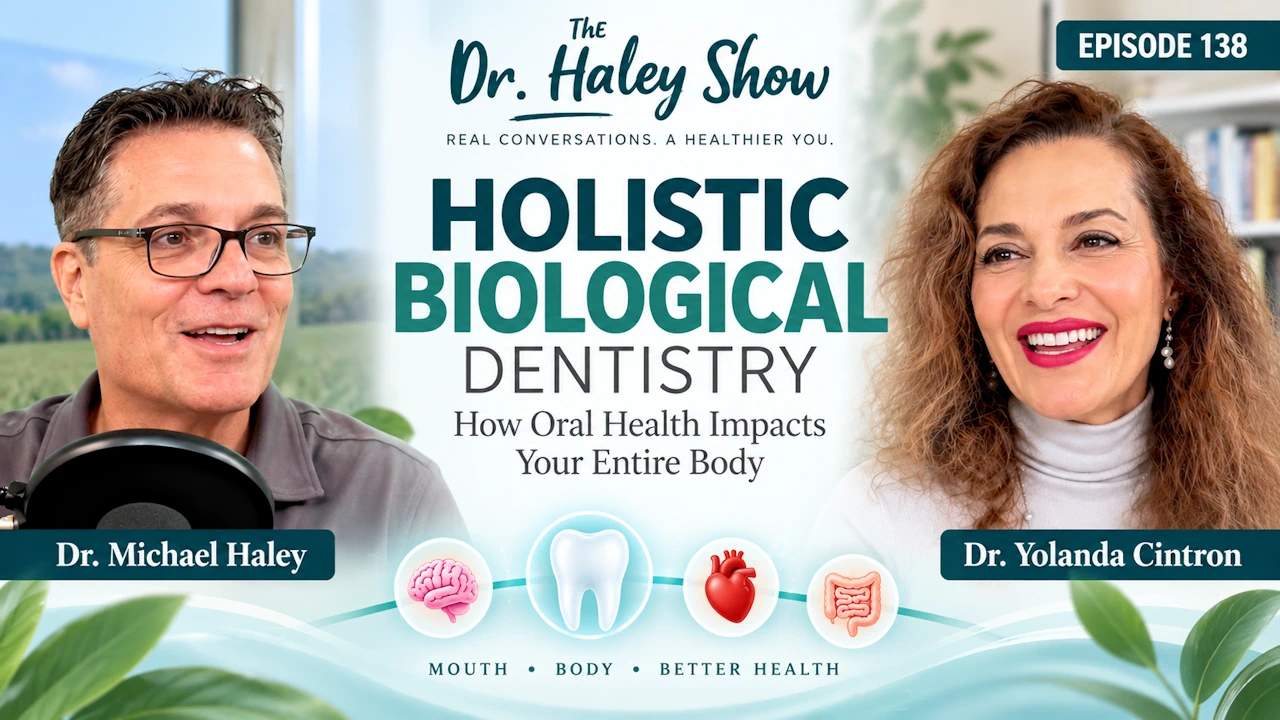
Oral health is far more than clean teeth and fresh breath. In this episode of The Dr. Haley Show, Dr. Michael Haley sits down with biological reconstructive dentist Dr. Yolanda Cintron to explore biological holistic dentistry and the relationship she sees between oral health and whole-body health.
Dr. Cintron discusses root canals, mercury amalgam fillings, oral infections, biocompatible dental materials, zirconia implants, bone regeneration, preventive dental care, and why she believes the mouth should be evaluated as part of the whole person.
About This Episode
Dr. Yolanda Cintron has been a dentist for nearly 40 years and a biological dentist for almost 30. She is a biological reconstructive dentist at the International Center for Dental Excellence in Fort Lauderdale, Florida. Patients travel from across the United States and around the world to seek her expertise in complex, health-focused dental care.
Watch the Interview
Listen to the Podcast
Resources
- Watch Root Cause on TubiTV
- Visit Dr. Cintron’s dental practice website fortlauderdaledentistry.com
- Visit Dr. Cintron’s health coaching website dryolie.com
- Subscribe to Dr. Cintron on YouTube
- Follow Dr. Cintron on Instagram
- Follow Dr. Cintron on LinkedIn
- Get the Aloe Vera Dr. Cintron recommends from Haley Nutrition
- Watch this episode on YouTube
- Listen to this episode on Apple Podcasts
Quick Takeaway
Dr. Cintron presents biological dentistry as a whole-person approach that considers dental infections, restorative materials, jawbone health, medical history, and patient goals together rather than viewing the mouth in isolation.
Throughout the conversation, she shares her clinical experience and views on root canals, mercury amalgam, oral “toxic loads,” tooth-organ meridians, zirconia implants, bone regeneration, clenching and grinding, diet, and preventive care. She also emphasizes informed decision-making, second opinions, practitioner experience, and collaboration with other healthcare providers.
ENJOYING THIS CONVERSATION?
Get the Next Episode in Your Inbox
Get notified when a new episode of The Dr. Haley Show is published, plus occasional highlights and resources worth exploring.
By subscribing, you agree to receive email from The Dr. Haley Show. Unsubscribe anytime.
Episode Timestamps
00:00 Root Canals and Infection: Opening Clip
00:34 Podcast Intro
01:02 Meet Dr. Yolanda Cintron
04:25 Aloe Vera, Education, and Healing
06:10 Prayer, Spiritual Health, and Healing
09:33 Why Biological Dentists Are Hard to Find
11:00 How Dr. Cintron Became a Biological Dentist
13:35 The Learning Curve in Biological Dentistry
17:19 Aloe Vera Sponsor Break
18:21 Mercury Toxicity and Whole-Body Symptoms
20:46 What Is Biological and Reconstructive Dentistry?
22:00 Hidden Wisdom Tooth Infections
24:19 Removing Root Canals and Rebuilding the Mouth
27:22 Inflammation, PSA, and Dental Meridians
28:23 How Teeth Connect to Organs
30:07 Oral Hygiene and Whole-Body Care
32:15 Root Canal Removal and Bone Regeneration
35:24 Titanium vs. Zirconia Implants
38:30 Clenching, Grinding, and Implant Success
42:06 January 2026 Coupon Code
42:41 Can All Dental Problems Be Fixed?
44:57 Rapid Fire: Fillings, Invisalign, Crowns, and Root Canals
51:31 Sedation Dentistry, Ozone, and Safer Procedures
54:57 When It May Be Time to Change Dentists
56:13 Diet, Sugar, and Cavities
57:06 Long-Distance Consultations
58:35 Final Advice for Patients
59:02 Root Cause Documentary Recommendation
01:02:30 Dr. Haley’s Personal Takeaways
01:04:03 Outro
What Is Biological Holistic Dentistry?
Dr. Cintron explains that biological dentistry is not recognized as a specialty by the American Dental Association. In her practice, she combines restorative and cosmetic dentistry with medical history, imaging, biological testing, biocompatible materials, and evaluation of what she describes as oral toxic loads.
She describes her transition into biological dentistry after attending an international meeting on oral medicine and toxicology in 1996. That experience led her to reconsider mercury amalgam, learn additional surgical techniques, and pursue testing and treatment protocols that she believed better reflected a whole-body approach.
Root Canals, Mercury Amalgam, and Oral Infections
A major focus of the episode is Dr. Cintron’s concern about root-canaled teeth, mercury amalgam fillings, and chronic oral infections. She describes her experience with biopsies, surgical sites, and patients referred by other healthcare providers, and explains why she believes these issues should be considered when evaluating a patient’s broader health.
These are areas where Dr. Cintron presents her clinical perspective and experience. Patients considering removal or replacement of existing dental work should discuss the potential benefits, risks, alternatives, and evidence with appropriately qualified dental and medical professionals.
Bone Regeneration and Zirconia vs. Titanium Implants
Dr. Cintron walks through what can happen after an infected or root-canaled tooth is removed. She discusses decontamination of the site, laser and piezotome techniques, plasma-rich growth factors, bone-grafting options, and the healing period before tooth replacement.
She also compares titanium and zirconia dental implants, explaining why her practice increasingly favors ceramic zirconia implants while acknowledging her long history of successfully treating patients with titanium implants.
Prevention, Clenching, Grinding, and Daily Dental Care
Prevention is another recurring theme. Dr. Cintron discusses frequent flossing, brushing, tongue cleaning, professional hygiene visits, diet, and the increasing number of patients she sees who clench or grind their teeth. She also explains how mouth guards, veneers, crowns, gum grafting, braces, and Invisalign may fit different patients depending on their individual circumstances.
Faith and Whole-Person Care
Faith is an important part of Dr. Cintron’s approach. Her intake asks patients what they would like prayer for, and she describes prayer before procedures and her belief that physical, mental, and spiritual health should be considered together. She repeatedly emphasizes listening to patients, collaborating with other healthcare providers, and focusing on what she believes is right for the individual patient.
Medical Disclaimer
This podcast and article are provided for educational and informational purposes only and do not constitute medical advice. The experiences and opinions discussed are those of the speakers and should not replace diagnosis or treatment from a qualified healthcare professional. Do not begin, discontinue, or change any medication, supplement, diet, or treatment based solely on this episode.
Full Transcript
The transcript has been lightly formatted for readability. Because it was created from the recorded conversation, it may contain minor transcription errors.
Read the Full Transcript
After 12,000 patients and thousands of biopsies of teeth that are dead, with root canals, it is undeniable that there’s not one tooth with a root canal that’s not infected. So not that many doctors are going to have the courage to go into biological dentistry. But there’s about a thousand dentists right now in the United States that are learning how to become biological dentists, getting trained. And there’s a learning curve, right?
You are listening to the Dr. Haley Show, the podcast dedicated to helping you optimize your health. Each episode there will be an interview or a message to help you discover better health. We will be featuring health radicals on the show to bring new ideas to the table, as well as doubling down on key fundamentals to support you living your best life.
Your host is none other than the founder of Haley Nutrition, Dr. Michael Haley.
This is the Dr. Haley Show podcast. I’m Dr. Michael Haley, your show host, and today we are talking about biological holistic dentistry. And if you’re already going to a holistic dentist, this episode will help you know how on point your dentist is. But if you aren’t, we’re going to help you make better decisions when it comes to the care and repair of things in your mouth.
Dr. Yolanda Cintron has been a dentist for nearly 40 years and a biological dentist for nearly 30 years. She is a biological reconstructive dentist at the International Center for Dental Excellence in Fort Lauderdale, Florida. Dr. Cintron is nationally and internationally recognized as a leader in biological and holistic dentistry. She is known for integrating advanced restorative, cosmetic, and implant dentistry with a comprehensive whole-body approach to oral health.
Patients travel from across the United States and even around the world to seek her expertise in complex, health-focused dental care. Pay special attention here, everyone that has been following me, because this is where we really tie things together. Dr. Yolanda Cintron. Her practice is centered on the identification and removal of oral toxic loads and the restoration and rebuilding of not only the oral cavity, but all systems connected to the mouth.
Dr. Cintron’s clinical philosophy is grounded in the understanding that oral health and systemic health are inseparable, and that true healing requires addressing the body as an integrated whole through precision diagnostics, biocompatible materials, and evidence-based protocols. She also places a strong emphasis on patient education and whole-body wellness, recognizing that when one part of the body is compromised, the entire system is affected. And I can go on and on talking about her education and her extensive training and expertise, but instead, trust me, this is going to be a great episode.
Dr. Cintron, thank you for joining me here today. I was watching your YouTube channel this morning, checking out a few of your videos. And, you know, I shouldn’t say this because people might just leave and go check out your YouTube channel right now, but it is awesome.
You have so many videos there, and they’re all broken down with great titles that help you answer whatever question it is. You know, from dental implants to, you know, amalgams. And everything’s nice topically, where you can get some real information for whatever problem people are having. That’s a great YouTube channel. How long have you been doing that?
Maybe for five to seven years.
So organized. I love it.
Yeah. My daughter, you know, she has a degree in marketing, and I hire her because I’m working on patients, you know. First of all, thank you, Dr. Haley. Finally, I meet you. Finally. I’ve been treating your mother-in-law forever, and she spoke very highly of you. So we love your product, your aloe, and we adore the impact that it has on our patients.
We do a lot of surgical procedures, and I send them from my office, “Go to Dr. Haley,” because, you know, truly, aloe is so healing. You know, it has like 50 benefits. But, you know, the reason why we have been doing YouTube videos for over seven years is because there’s such a lack of knowledge.
You know, and my daughter said, “Mom, you have to educate people because you know so much, but people out there, they don’t know anything like this.” So I hire her. I said, “Okay, I cannot do it. I need help because I’m actually doing physical work.” You know, it’s hard for me to do a surgical procedure and also do the educational part.
So we have been doing that together and are more committed to, you know, spreading the news of wellness starting in the mouth, like we are committed to spreading the gospel.
I love that too. And I know that about you. And, in fact, I called you earlier, and you may not know this because I got the message on your phone, and that there just brought a smile to my face because, you know, Jesus is in your greeting on your cell phone. I love it.
Yeah. In my medical history also, we ask, “What can we pray for?” You know, because there are many people that have such infections in the mouth that actually are spreading into the different organs, and a lot of the patients are terminal. We have patients with cancer, with neurological conditions, and we want them to actually express where they’re at with their spiritual life because part of healing, the physical part is the easy part, right?
I can clean somebody’s mouth, but there is more than the physical part that makes a human being. So that’s part of our intake: “What can we pray for you?”
I love it.
That’s what we do.
Yeah, yeah. We like to help people understand that, you know, there’s different aspects to health, and we can look at one thing like diet, but you can’t—it’s not all-encompassing. You know, there’s nutrition, but there’s also exercise, there’s mental well-being, and we tie in the spiritual with that, right? Because they go hand in hand. You need to get proper rest, and you look at all aspects of what contributes to health, and spiritual health is the most important.
Yeah, that’s number one. Number one.
So on your YouTube channel, and even something you already said, you know, you talked about the aloe vera. And people that are listening know that I have a unique aloe vera. It’s very different. And once you have our aloe, you’ll think you’ve never had aloe vera before. From the other products you consume, it’s very different.
And the fact that people have come here mentioning your name already tells me a lot about who you are and what your standards are. And I think that’s going to be so key in understanding this conversation about biological holistic dentistry.
But I also saw some other names. One that I don’t really know—I know of her—but there was a Dr. Claudia Marcelo giving a testimonial, and she happens to be a local, well-known functional medical doctor. And the fact that I’ve seen her name on the “Who should I thank for referring?” box on my checkout site tells me something about her standards. And the fact that she’s there tells me something about your standards.
I also saw someone else that I know, Dr. Jeff Middleton, on your YouTube channel, and he’s a good friend of mine. And, you know, a few decades ago, he had a severe health challenge that literally had him in a wheelchair. And it really forced him to learn natural health. And now he’s just an awesome guy in the community teaching people how to live good, healthy lives.
So I think it’s neat. It all comes together as we, you know, know the same people. And it just tells me something about your standards and what you do. And I think that’s going to be why this is going to be such an excellent conversation, even for people that are already going to biological holistic dentists.
How many are there? Because I know that I have told people they need, you know, a holistic dentist.
Yeah, but they’re hard to find.
And I also know that the people that have come here for aloe, that have been sent by you, some of them are from Canada. We had people from Texas and literally from all over the world.
Yeah.
Are there that few biological dentists, or are maybe some of them not truly practicing holistic dentistry?
Yeah, well, that’s a great question because biological dentistry is not recognized as a specialty by the American Dental Association. And a general dentist actually is going to mock, you know, what we do.
I personally, you know, have been a victim of my colleagues mocking me in Fort Lauderdale, in Florida, in other states. So when I go to a dental organization, just general dentistry, they are not that knowledgeable.
And there’s an actual closed-mindedness, you know. I came to become a biological dentist by the grace of God. I relocated from New Jersey, sold my practice. I wanted to just see the palm trees and the sun. I didn’t care about three houses and two dental practices. I just wanted to have a place that, out the window, I could see a palm tree and the sun. That was my aspiration.
And then when I started looking for a dental office, I met a biological dentist, and he was brilliant. He was an engineer. He invited me to an international meeting for oral medicine and toxicology back in 1996. So I went, and my background is in science.
So everybody there was a very sophisticated scientist—toxicologist, immunologist, pharmacologist—all speaking about the danger of mercury in the environment and the human body. And me, as a dentist, I was placing mercury without knowing that this amalgam, you know, filling that they taught us how to do in dental school was actually poisoning all my patients and my family.
So once I came from that seminar—I was in Toronto, Canada; that meeting was an international meeting—I came back very, very, very humbled and then asked myself, “What else don’t I know?”
I swore that I would cause no harm, and now I find out that I’m harming people. So then I went, “Do I get out of this mess and start all over again, you know, after I spent ten, 12 years of my life becoming a dentist, or do I learn what ways I can do it better?”
So under the wing of this doctor, you know, I spent a year with him. And then I realized that there’s biological testing, blood work that I can do on my patients to see what dental materials are compatible with their immune system. I learned about DNA biopsies of surgical sites, gums, and root canals.
And after 12,000 patients and thousands of biopsies of teeth that are dead with root canals, it is undeniable that there’s not one tooth with a root canal that’s not infected.
So it’s not a popular belief. So not that many doctors are going to have the courage to go into biological dentistry. But there’s about a thousand dentists right now in the United States that are learning how to become biological dentists, getting trained. And there’s a learning curve, right?
In my journey of being a dentist, I realized, okay, so for me to do this kind of dentistry, I became a surgeon. I went to courses to train myself. How do I do a surgical extraction? What equipment do I need? I have a laser. I have a piezotome.
So because my colleagues were not interested in removing the teeth that were infected because they were like, “I don’t see anything wrong in the X-ray.”
“Well, what about that huge abscess and that cavitation?”
“Oh, no. Send it to the specialty and let them open the jaw, scoop out the infection, leave the rotted tooth there, and put mercury, and that’s called an apicoectomy.”
So that’s one of the protocols that is practiced and the standard of care in the United States.
So for me to be able to do biological dentistry and not be prosecuted by the Board of Dentistry, you know, they did not want me to speak to the patients about mercury being toxic.
Oh, boy.
So they had a little conversation with me, with attorneys present, that, you know, I shall not tell patients. But then came a law. They removed the gag law, and then I could educate people properly.
So it’s been an interesting journey. And what I have done, because I want to prove that what I do is above standard of care, I document everything. I photograph every step of what I do to prove that there’s decay, there’s infection. We do biopsies and also we have a lot of consents.
You know, the state of Florida is one of the states where a patient has the right to choose their medical care and dental care. You know, I’m not going to be prosecuted because the patient decided that they want to remove the infection out of the mouth.
Well, that is within the patient’s right. But it was not like that before. So a lot of advancement has occurred in benefit of the patients. We live in a great state. We’re very blessed, for sure. In other states, it might be different.
My prayer to the Lord is that more dentists would become more interested in not being right, but doing what’s right for the patient.
Because when we go to school, they teach us just basic information. You really are going to become a dentist when you go out and you listen to the patient, you look at their medical history in a comprehensive way, you work with the medical healthcare providers that are helping that patient, and then together, you know, as a team, we achieve great, great results.
Yeah. You know, you said a few things that really perked me up a bit. For instance, one of the things you mentioned was the persecution and the things that came from your own profession, which really is a badge of honor.
You know, I would never compare myself to Jesus, but I would recognize the fact that He, being perfect, was persecuted.
Yes.
We, being flawed, how much more should we be persecuted?
Yes.
But when you’re doing something and you’re persecuted, it’s usually because you’re doing something that might be against the grain. But essentially the change comes, and it becomes accepted and understood. So it’s a badge of honor.
Are you enjoying the show thus far? One of the many health secrets that we have covered on the show is all around aloe vera, specifically drinking raw aloe vera. Our aloe vera has helped our customers effectively heal their gut, increase their intestinal health, lower inflammation in the body, eliminate and/or decrease acid reflux, have glowing skin and hair, and so much more.
Now, as a frequent member of our audience, you will be exposed to exclusive specials and coupon codes for the awesome products manufactured by Haley Nutrition. That’s right. For simply being awesome and tuning in, you can get a mini discount to help you optimize and better your health.
To see how we can help and support you on your health journey, tune in to the episodes and listen for coupon codes that you can use at haleynutrition.com before you make your orders of raw aloe vera. Once again, it’s www.haleynutrition.com. Now back to the show.
And at this point in my career, after being a biological dentist for 28 years—and I have been a dentist for 38 years—so I did not know how to do it right for ten years.
But it took a lot of humility from me to go and listen to something and say, “How can I deny what all these scientists are saying?” And I spoke to the toxicologist, and I went to him and I’m like, “How can this not be mainstream media?”
And he said, “Well, the toxicology book is this thick, right? And this is the mercury toxicity.”
So most of it now is being recognized that mercury is a neurotoxin. Who’s going to deny that mercury toxic in fish is toxic in your body?
The American Dental Association has recognized a whole page of all these things that are connected to mercury toxicity. Well, that’s a big step in our medical intake for the patients. Say any of this: Are you feeling anxious, depressed, suicidal? Do you have autoimmune? What about your thyroid? Hashimoto’s? You know, neuropathy?
We have patients with severe restless leg syndrome, with the mouth packed with mercury and root canals. We remove all that stuff, and you see a change in their medical history. Or somebody with cognitive decline, you know.
So we work with a lot of very good healthcare providers that are like, “Hey, I want to help this patient. They have, you know, signs of dementia. Can you check them and see if there’s any toxic loads in the mouth so we can actually do detox? Because how can I do detox if they have all these infections?”
So, you know, there’s a small percentage of dentists and a small percentage of healthcare providers becoming more interested in treating people as a whole, not just, you know, “I’m going to see your heart, but I don’t do lung. You know, I don’t do gastro.”
You know, those are really, for me, doctors that are heroes because they take a lot of flak too.
Sure. Well, you know, I want to define a couple of terms just to help understand, because for most people, I would imagine, you know, they go to the dentist to either have their teeth cleaned or to fix something that hurts.
What is reconstructive dentistry, full-mouth reconstruction, cosmetic dentistry? You know, how is that different than general dentistry and holistic dentistry? Can you tell us something about those terms so we can kind of understand why people would go to a dentist?
Yeah. So as a dentist, you get a general education. So the more you know, the more you know. So I became a dentist because I wanted to be a cosmetic dentist.
So when I look at a person, I see balance, I see color, I see shape, you know, structure. But then when I became biological, I combined that with: What is the person here for? I look at the structure from the base—the bone, the gums, the positioning of the teeth. Where are the toxic loads, and what does the person need?
So every person is so unique. So, for example, I had a 19-year-old young man. They drove from very far away, five hours. And he was having very high blood pressure at his age, 19.
And when we did a full comprehensive examination, what did we find? We found out he had four wisdom teeth. A wisdom tooth is like an organ, right? The head of the tooth is intended to be outside of the mouth. But if you have a tooth that’s impacted or partially impacted, that is similar to having an ingrown hair.
So if you have an ingrown hair, you know, that doesn’t come out, it’s going to create infection. Going back, so here he is with massive infection at 19—gum infection, abscess, impaction, a pocket of ten.
So when I meet a patient, if I meet you, we do 30 photographs, a CT scan, and we’re going to do X-rays. We’re going to check your medical history, your blood pressure, EKG, everything—past medical history for five years.
And we’re going to say, okay, this person, just by looking at the CT scan or the X-rays, I already know their medical history because I see this person has a root canal, number 14.
Well, what a coincidence. The medical history says he has liver cancer. That’s a tooth that’s connected to the liver. Wow. That person has mercury on all the liver meridians. What a coincidence. This person has stage 4 liver cancer.
So when I see a person, I’m very comprehensive. I’m going to see the whole person—spirit, where you’re at, mind, what they’re seeing, what their goals are.
And they might need nothing. They might just need a cleaning. But now other patients that come to me—the patients that come to me are mostly referred by doctors. Most of the doctors are my patients.
So what happens is that they have a problem, and they want to see if the root cause is related, or if removing toxins in the mouth is not only going to harm them, let’s put it that way. It’s not only like, build that up.
So I have a patient that has eight root canals. We remove the root canals. And what are you going to do?
I have no idea.
I’m on the edge of my seat waiting for the answer.
Well, nobody wants to be missing eight teeth, but nobody wants to have eight teeth that are infected and giving them lung disease or, you know, a brain infection.
So we design a plan. I take records of their mouth, models. So I have what they came with in a three-dimensional form, in photograph, in CT scan, in two-dimensional X-rays.
So we go over their photos with the patients, and then they see what I see. I ask, “What do you want to do about it?”
Well, with the young kid, it was very simple. We removed the abscesses that are connected to the wisdom teeth. And he came yesterday, nicely healed. We went over hygiene. He’s done for the day. He learned how to floss. His gums are perfect now. They don’t have ten-millimeter pockets. So, done.
Really?
The session yesterday was about, you know, God. You know, what do you think? Renewing your mind and what you speak and having purpose.
So that was how I finished that relationship. And he will come every three months. I’m going to check him out.
But somebody with eight root canals that they need to remove, we use a laser and a piezotome to remove it without traumatizing the jawbone. We’re going to use plasma-rich growth factor from their own blood.
You know, that’s like something new now, but I’ve been doing it for over 20 years. And we rejuvenate the jawbones to have new bone. So that way the patient has the option six months down the line. They can do a zirconia implant.
A zirconia implant is like putting a root inside the jawbone. And then they can decide: Are they going to get zirconia implants, or do they want to do bridges, or do they want to do a partial or a denture?
So in the interview with the patient, we find out what their goals are. Okay, if they are terminal, then we get a lot of blood work, either from their doctors or baselines, because we are going to do over standard of care.
We’re going to document what the changes in C-reactive protein are going to be, what the A1C is going to be. And you would be so shocked.
So what do we do? We are constantly learning. How can I work with a doctor, a healthcare provider, to not only get the toxins out of the mouth, reconstruct and regenerate, right? We have to regenerate the bone first and then improve all those values.
So somebody has C-reactive protein, which is a marker of inflammation. I had a patient that came from Trinidad, and his C-reactive protein was 834. It’s supposed to be zero. So he has so much inflammation.
But he really was diagnosed with prostate cancer. So the PSA, which is an indicator of inflammation of the prostate, was at 73. That’s supposed to be zero, right? So men start getting two, three, four, five, six—it’s a problem.
So we had many patients, many male patients, that have a higher C-reactive protein, high PSA. We removed the toxic loads of the meridians that are connected to the prostate. Bingo. Problem resolved.
You know, this is new to me because you mentioned liver and prostate already. So certain teeth are connected to certain organs through meridians. And how many of the organs can be affected by your teeth?
Yeah. Well, there are 32 teeth, right? There are 32 organs, 32 buds that, you know, when we’re developing as a fetus, you develop from the feet to the head. So everything is connected.
You know, we women love pedicures because we get a massage. And then actually every single organ gets stimulated. So men should get pedicures too. Because what happens is that a person that massages your feet, they’re actually stimulating all the different meridians, all the organs, the heart, the brain, and it’s just magnificent.
So acupuncturists, for example, are very, very educated about the connection between all the meridians.
You know, it’s like electrical currents. It goes from the feet all the way to the brain. It goes through the teeth. So each tooth has different organs connected. So the wisdom teeth are connected to the heart.
So when I treated the young man, his EKG was erratic. His blood pressure was scary. And I said, “I want to do what I need to do.”
So we went in. We removed everything, and yesterday when he came back, I said, “Now I’m going to do a post-op comparison of the way you came.”
His EKG, thank God, was normal. His blood pressure was normal. And his healing was beautiful.
So on a daily basis, if we see two patients or ten patients, we are looking at the medical history. We’re looking at the meridians.
And then once all that is established and you’re clean and you’re educated, and they know how to floss five times a day, and the cleaning of their tongue, and they are brushing after every meal, before they go to sleep.
You know, I count that if somebody has three meals, if they brush when they wake up so you don’t take all that bacteria into your stomach, breakfast, lunch and dinner, and before you go to sleep, that’s five times, you know.
And then I see patients that have advanced periodontal disease with teeth moving, bad breath and, you know, migraine headaches. All these disappear after we stabilize, you know, healthy gums and teeth. Then we go into, “What else can we do for you?”
Right. We’re going to pray for you, where you are with God. We pray before every procedure, before every surgery. Because although, you know, in my bio I’m internationally known, I want the patient to know God. I don’t care if they remember my name. I just want them to have an experience that is going to get them close to God.
And we thank God for everything that we do, every outcome. We give all the glory to the Lord because it is Him who anoints our hands. It is Him who truly heals the patient.
So we try to encompass all the different things, from the spirit, the physical, the mind. And then I say, “Well, what you said is a limiting belief.”
You know, God says that you are wonderfully and perfectly made. So it’s changing the mindset, and it’s really great. Like you said, Dr. Marcelo, Dr. Middleton, Dr. Rothman—I have many doctors that are trying to practice at a higher level with the people.
Yeah. So I’m learning a lot. One thing that I heard you talk about was when you take the root canal out, there’s bone that needs to be rebuilt.
Yeah, yeah. The first thing will be to decontaminate first.
Okay.
Well, it’s a whole protocol to actually get that out. Get the ligament, get the infection. Because when a doctor does the root canal, they use formaldehyde, chlorine, EDTA—one of those or all of it.
So what happens is those are mummifying agents that were used in the morgue when I went to dental school and we had anatomy. Formaldehyde is where they embed the dead bodies so they don’t putrefy.
But it is so carcinogenic. I couldn’t even be in the room. It was so toxic.
I do remember being in that room, and I forget what it was we used to put on our lip to help us smell what was on our lip instead of what was in the room.
Right. It was the formaldehyde. So we were just covering up the toxic fumes that we were inhaling.
But, yeah. It is carcinogenic, and that’s what root canals are embedded with.
Yeah.
So that formaldehyde goes to the bone. So then once you get the tooth out, you have to rejuvenate that bone. You’ve got to take part of the bone out.
So that way you remove the bone that is putrefied and it’s mummified. And then you get blood flow. And then you put the plasma.
And then other doctors, instead of using the plasma, I think they’re using cadaver bone.
Correct. Yeah. We have five different options for patients because we want to give the patients the opportunity to choose what they think is best for them.
So some patients, we do plasma and the factors of growth of the plasma. And then you have factor one, two, and three, and those are going to become the bone.
Some patients have very advanced infections, and we might use a type of bone that’s called calcium phosphate, and the brand is AtmaBone. So that is fantastic because that was used for people with tuberculosis back in the day.
People would get tuberculosis, and then the bones would kind of rot and kind of disintegrate. So we use that product.
If the patient decides that they want to use that product to build up their jawbone, it depends. How big is that hole? What kind of walls do you have? There’s cow bone. There’s human cadaver bone. There’s pig bone.
We try to stay away from things like pig bone and cow bone. Try to keep it kosher.
Yeah, yeah, yeah.
We try to do that. But there’s doctors that use it. You know, that’s the protocol that they have. So we try to develop protocols that are more biocompatible for the patient.
But ultimately, you know, we tell them the advantages and disadvantages of all the different options, and then they have to make a decision.
Okay. And then are you eventually recommending, when they put the rod in there and the tooth on top of it, or—
No. Well, there are two kinds of implants. So I started putting titanium implants in 2000. That was the only option. I put titanium implants on my mom, on my ex-husband.
And the titanium refers just to the post, correct?
Yeah. They’re titanium.
Now, the latest information that is available to us—and I’ve been doing zirconia implants for maybe over 15 years, since they came out—I was one of the first dentists in the Northeast region of the United States to start putting ceramic implants.
And I would consult my surgeons, my local surgeon, and say, “Please, you know, I want my patient to get ceramic implants because a zirconia implant is only 0.04%.”
Zirconia versus titanium is 100% metal, because I was concerned with metal. You know, now we have Wi-Fi. Wi-Fi—metal is a conductor. So, you know, moving away from heavy metals, mercury, aluminum. You know, all crowns have aluminum. You know, all fillings have mercury. And then what’s the next thing, you know?
So I have placed many titanium implants. They have research that they’re finding titanium in other parts of the body. I don’t know what system they used.
We always use the highest quality of dental materials because we know that that matters. You know, if the dentist gives you a deal with a titanium implant and it is from China, I’m sure that’s going to corrode.
You know?
Yeah, yeah.
So, yeah. I understand. I have placed titanium. My first patient that I did titanium on visited me recently. I saw him 25 years ago, and he came. He had everything in perfect condition. And then one crown came loose, and they wanted to do some kind of treatment.
And I couldn’t believe it. It’s like, “Oh my God, 25 years have gone by.”
So he had all his titanium implants. They looked perfect, like I did them yesterday. And then one of the crowns came loose, and then the gum had overgrown.
So I used my laser, removed the excess of the gum, cleaned and sterilized the crown. And I said, “See you in 25 years.”
All right.
But, you know, we prefer to do ceramic. Ceramic is more expensive than titanium. And we’re moving away from titanium. Most probably the last three years I’ve done very few, because of the strength of the ceramic compared to—obviously titanium is very, very strong.
Are there any issues with people that really are clenchers or grinding or anything like that?
Yeah, that’s a very good question. So if you’re a clencher and you have Wi-Fi in your house and you put metal in your mouth, I think that’s going to make you even more neurologically sensitive than zirconia.
The advantage of zirconia over titanium is cosmetic, is less electrical current, because it’s only 0.04 versus 100%.
And then the disadvantage is that you have to place a bone, wait for the bone. At least me, I’m very conservative. I like success. So I wait six months for the bone to be super healthy and super strong. And then I place the ceramic implant.
And our success rate with the ceramic implant is like 99%. We have had a few cases where a patient had cancer.
He wanted implants. I said, “You’re not a good candidate for implants. Why don’t we focus on getting you healthy?” But he’s like, “No, no, no, no.”
So he actually had one titanium and one ceramic as a test. He’s like, “Use me as a guinea pig.” And then he actually lost a titanium. So what happens is that you never know.
If you are pretty experienced in implants—like, I have 25 years of experience, that’s a long, long time—what happens is you choose case selection.
If somebody is a clencher and obviously they lost the back teeth because they cracked them, now they need the implant on the back. So what happens is that the implant cannot take the first force of mastication.
It cannot take the brunt of a doorknob because then they are going to maybe damage the implant.
Right now I have many patients with back implants where I make it. So far, so good.
We had an 87-year-old male that wanted all his root canals to be removed and he wanted all ceramic. And we did seven zirconia implants, and one of the implants didn’t take because he did not follow post-op instructions.
So he liked to chew on the right side, and then he chewed while that was healing on the implant. So I learned from that. Put a temporary bridge, put a stent, because they’re not going to listen to me. So they’re going to continue to eat and do whatever.
So he wanted the implant, wanted the implant, and he made me do it again. So eventually, eventually it worked. But, you know, I had to really emphasize, “You know, I need your help.”
He’s sweet. He says, “I’m 87. I eat whatever I want. You give me too many restrictions.”
But usually when you do surgical procedures, I like the patient to be on aloe vera, on moringa, on a green diet with protein, collagen, and soups, you know, at least seven days, if not more. It depends how extensive the surgery is.
Moringa. We haven’t talked about that. I used to have my moringa tree in front of my old home. I don’t have one anymore. We used to just go out there and strip the leaves off and throw them in our salads. It’s the best.
Yeah. Amazing.
As a thank you for tuning in to the Dr. Haley Show podcast, I have a special coupon code that can be used throughout the month of January 2026. Get $10 off your purchase of $100 or more at HaleyNutrition.com.
The coupon code is 2026HEALTH. That’s 2-0-2-6-H-E-A-L-T-H. And as usual, you can even use this coupon with on-sale and already discounted bundled items.
Enjoy the rest of the show!
Is there anything that, for a healthy person who doesn’t have cancer or some condition that’s going to get in the way of them getting the care they need—is there any dental problem that just can’t be fixed?
Well, a lot of people are healthy. And then what I have seen, in the past I would see 100 people or maybe a thousand people, and one person was clenching or grinding.
Now 100% of the people are clenching and grinding, which is like, this is bad.
I saw a young 21-year-old female yesterday, beautiful teeth, and she had ground her teeth to the degree that the eye teeth are called canines, right? The eye teeth are supposed to be longer than the others. She shaved them off so much that now all the teeth are grinding at the same time.
So in her case, besides her cleaning and flossing, she must wear a mouth guard. We have a new mouth guard that is made out of nylon that people, you know, it’s going to be really hard for them to break that, and they’re not going to be eating plastic.
So it’s called Panthera. It’s phenomenal.
And it’s a learning curve. You know, people that like to clench and grind, they don’t want to have a mouth guard. They want to break their own teeth. They don’t want to have something that’s going to interfere.
So is that during the daytime too, or just at night?
Some people. And it depends. You know, I had my cousin say, “I don’t grind,” and I’m looking at all the fractures on his teeth.
“I don’t do any of that.”
I’m like, “You’re my cousin. Why would I make this up?” And I said, “Okay, tell your subconscious mind to wake you up or show you what it is that you’re doing.”
And he calls me from I-95. “I’m clenching when I’m driving.”
I say, “You see? At least now you know that you’re doing it. And now you can have a mouth guard in the car, and you know that’s stressing you out. Put it in the mouth and drive.”
So you break that because breaking your teeth is very expensive.
Well, one thing I would like to do, because we’re going to wind down here—we just have a few minutes left—I’m wondering if we can kind of rapid-fire some common conditions and just maybe, you know, give a do-and-don’t kind of thing for each of these things that someone might have an issue with.
Okay.
We’ve already talked about it. Cavities and fillings. Do, don’t. What do you do? What don’t you do?
Well, if you have a cavity, try to get a material that’s compatible with your immune system. Try not to get mercury fillings, amalgams. That’s what the insurance pays, but that’s not what’s good for you because it’s a neurotoxin.
And then try not to get white plastic fillings if they’re too big because many people, they have an increase of estrogen when they get plastics. So the plastics, you know, they last between five and eight years.
And then if it’s a small little plastic, you know, it’s not going to kill you. But if you are a woman with breast cancer, you know, you don’t want any plastics in your mouth because that’s going to actually increase the estrogen in your body, possibly.
And then, you know, floss. The best dentist is no dentist.
Floss five times a day. The best prevention is flossing, brushing, cleaning your tongue, and seeing a hygienist.
I put my patients every two months to three months. Six months, one year—that’s not for people that are really mindful.
Do I agree?
Yeah, yeah. I could never understand what’s this, you know, twice-a-year stuff.
That’s a lot of time.
Yeah.
What about straightening teeth? Metal braces, Invisalign. What’s the do? What’s the don’t?
I’m not, you know, crazy about Invisalign because Invisalign only moves the head of the tooth. When you have the need for braces, because some people need braces, most dentists are moving towards the Invisalign trend because it’s easy.
It’s a computer. You give it to the patient. It’s less work for them in the office.
But the most beautiful results and more long-lasting results are when the teeth are moved from the root up, not just the teeth. They’ll take forever to move a canine with Invisalign.
So also, if you are grinding and you have Invisalign, you’re eating all that plastic. Some people have reactions to the Invisalign trays.
Okay, so that’s a different kind of plastic compared to what you had mentioned as far as the mouth guard.
Yeah. The new mouth guards that we’re doing are made out of nylon, and Invisalign doesn’t do that.
No.
It’s plastic. You know, it’s a different kind of plastic.
So it depends where you’re at, how healthy you are. You know, do you want to add toxins to your body? You know, we evaluate the whole picture.
If you are 20 years old, healthy, and you have a crooked tooth, and you’re a model, you’re not going to get brackets because, you know, you’re doing photo shoots and Invisalign is going to do it.
So you have to work with the patient and lifestyle.
Yeah, yeah.
Cracked teeth and crowns.
A lot of people clench their teeth and fracture the teeth. So if you have a lot of fractures because you’re clenching, you might benefit from a veneer. As simple as that. It’s like a contact lens on top of the tooth.
And it’s going to make that tooth 80% stronger.
As people get older, what happens is that they’re losing bone from clenching, and then a tooth that was this long now is like this long. And then they have no bone surrounding it. So a veneer would not work. You would have to do a full coverage to actually add, you know, material to make that tooth stronger.
So each case and each tooth is very custom-made. You know, we are not like one fit for all. And the patients are involved in the process because we take photos and they see the problem.
“These are the fractures. What do you want to do with it? You know, these are your options.”
And then a lot of people, when they clench, they lose the bone and the gum goes down. So we can actually raise the gums and then cover the teeth again. So that’s called gum grafting.
We have a surgeon that’s working with us who is adding bone to areas that we never saw. The bone was growing up like that. So we’re learning a lot with him.
He’s bringing new techniques that are really cutting-edge, you know, to our practice. We love him. He’s fantastic.
Great. And the do’s and don’ts when your dentist tells you you need a root canal.
Well, that’s an option in the United States, a legal option. And we give that option to our patient. But because we don’t believe that’s the healthiest for them, we refer them to an endodontist.
There are many endodontists, you know, everywhere that are willing to do a root canal. In our practice, the patients that come are seeking for me to remove the root canals.
So in the United States, you have to follow protocols of what’s legal and what’s available versus—it’s like the vaccine, right?
And that’s removing the root canal. And is that replacing it with an implant?
It could be. It could be a bridge.
Say the person has a root canal here and two teeth with mercury here. They’re destroyed. We can remove that bad one, get the mercury out, and connect them into a bridge. Bridges have been around for a hundred years.
So, you know, we do bridges as well. There’s Maryland bridges, there’s full-coverage bridges, and trying to stay away from heavy metals.
You know, the old crowns—and I even put gold crowns with aluminum, porcelain. You know, aluminum also is connected to cognitive decline.
So, you know, do not use deodorant with aluminum. Try not to cook on pans with aluminum, and try to replace your aluminum crowns with something like zirconia, which is more biocompatible.
I see. Now, when I go to the dentist, if I need work done, I hate dental pain. To me, it’s the worst kind of pain.
Are there do’s and don’ts when it comes to getting numb?
Yeah. Well, you don’t want to drink coffee before getting numb, right?
And in our practice, we practice sedation dentistry. So we have the opportunity to give somebody either intravenous sedation or oral. That works 99% of the time.
We do a nice cocktail so that way the person is relaxed. They might not even remember the experience.
If they can afford to be, like, loopy for 24 hours, we do that.
And then preparation of the nervous system. We have NuCalm, we have oxygen, we have red light, we have BEMER.
So we try to get that patient, even with natural herbs, to get them relaxed. We give them L-theanine, turmeric. So we try to get your body prepared before receiving treatment.
What is the body going to react to something new? It’s going to have an inflammatory response.
So we’re going to give you anti-inflammatories like arnica, turmeric, L-theanine for, you know, chilling you out, and NuCalm.
So we prepare the patient physically before we touch them, so that way they have a good experience.
That’s great. And those are things that I would have never thought I would hear coming from a dentist.
Yeah. Turmeric, arnica. Yeah. We have all that colloidal silver.
You know, we do a lot of things that work really well to detoxify the sites. You know, we rinse the patient with acid water, which is very effective to remove mercury tattoos.
We use ozone, but we use ozone very cautiously because people come to me that went to a biological dentist, and the biological dentist injected ozone into an abscess without removing the abscess, and the infection went into the brain or into the heart.
Ozone—it’s like the new trend. Everybody, “Oh yeah, we do ozone.”
Well, you better know what you’re doing when you do ozone. Because ozone—you must remove all the infection before you push ozone into somebody’s body.
Because what happens is that ozone is going to push the infection into the brain. And we see it all the time. And they’re like, “Yeah, I went to it,” you know, and then they troll and they feel like they have a cap.
The brain is just—you have to do your homework before you let anybody, you know. And that applies to any profession.
There’s people that practice at a level of excellence, and they’re always wanting to do unto others as unto the Lord. And there’s people that just want to get things done fast.
It happens in construction. It happens in any, any profession.
You know, you have to feel the heart of the person because they have to be in it with you. You want somebody that wants to have a relationship with you, that wants to get to know you, and then analyze what your body is able to handle.
So that’s part of what we do.
All right. You know, a lot of times, people are so committed to their dentist, or it’s kind of like going to your chiropractor. You never want to switch because you love your chiropractor and you love your dentist.
What are some things that you’ve heard from new patients that were, for the longest time, unwilling to change?
Well, like you said, most people appreciate relationships. So they have been going to the same dentist for 20 years, 25 years, and that’s okay.
But it gets to a moment that if that’s not serving you, you can get a second opinion, you know. But people feel like they’re betraying the person that put the mercury or put the root canal.
They did the best they could with what they know.
Something that I would never, ever do is speak against another professional because, you know, I didn’t know what I didn’t know when I didn’t know it.
And by the grace of God, you know, now I know a little bit more. But I always humbly say, “Lord, what else don’t I know? Please don’t let me harm a person, because what else are we going to find out?”
So that’s why I am so prevention-oriented.
Because I have gone to Africa to practice in a dental clinic in Nigeria. And this is what I see: the old people don’t have cavities. They have teeth that are worn out from age.
Wow.
And they have maybe gum infection because they don’t have anybody cleaning their gums.
But all the young people have abscesses and cavities because the diet changed.
Sure.
You know, the sugar. And it ruined their entire life because the ancestors—all of them, people in their 80s and 90s and 70s—they eat root vegetables, no cavities.
But our diet is damaging our teeth.
So that would be another, you know, indication for me to say, “What about if we change our diet?” You know, reduce carbs and no processed food. No wheat, no bread, you know.
Now, for someone that’s thinking about changing and maybe they’re on the other side of the country, do you have consultations, phone consultations available? How does that work?
Yeah. So many patients, what they do—you know, like say I have a patient in Ohio and she has these abscesses. And to ask a second opinion, so she sent me the CT scan and the X-ray, and we do a Zoom meeting and they fill out the medical history.
So we know what we’re dealing with and we have a conversation.
And you will be surprised. I have literally had people that get on a plane and come.
I just treated a lady that they wanted to do root canals on two teeth that were not even salvageable.
And I told her, “Please go to the first surgeon you’ll find and have this surgeon remove those teeth. They’re eating the jawbone into your brain.”
And she said they don’t want to do it. They wanted to do root canals.
I said, “It’s not even salvageable. You have no bone left.”
So she got on a plane with the abscess.
I said, “Don’t get on a plane. That’s going to blow up.”
So she got on a plane and she let us treat her, and we got the infection out and, you know, helped her out.
And it’s just one of the things that, you know, we have many people coming from Germany and England, Australia, Hawaii, France. We have people from Spain, Portugal, South America.
And every day in my practice, we have people from all over.
You know, what should I have asked you in this interview? One thing we didn’t talk about was, you know, the dangers of removing mercury improperly.
Yeah.
But what else should I have asked you that’s important for someone to understand about biological holistic dentistry?
Well, I think that the more educated you are, the better equipped you’re going to be to make better decisions.
There’s a documentary that’s called Root Cause, and it was removed from Netflix, but you can find it in the Tubi app. It’s a free app. It’s Tubi.
And you can watch that documentary. It’s got over 30 doctors—not dentists necessarily. They are all over the world, and they are doctors practicing at a high level.
They will not treat a patient that has root canals, mercury, or cavitation because they know that they cannot achieve their level of care that the patient is looking to receive.
They say, if this person has these toxins in their mouth, there’s no way we can, like, have their immune system operate properly because your immune system is so busy with this dental infection.
So I would urge everybody watching to watch that documentary because you can make better decisions.
Also, we have a lot of YouTube videos, like you said, on different topics. We try to make it simple.
But do not remove something out of your mouth without having an expert with experience. They can show you their photos. You interview people and see if there’s a match.
You have to be compatible with the person that is going to be touching you. You know, a person is going to be in your space. It’s very close, very intimate.
And then write down the questions. What is it that you’re concerned about? Once you have a consult, you can read what they’re recommending and then go back on a second visit and revisit, you know, what are the other options or more questions.
There’s no rush.
Things didn’t happen overnight, right? If somebody developed cancer, you know, it did not happen like yesterday. It took maybe ten, 15 years.
So finding out what the options are. Because if somebody gets radiation, for example, then they cannot get extractions because the bone will not heal.
If somebody is put on a medication that blocks the osteoblasts, which is a type of cell that is going to help you build the bone, then you can’t go to surgery because most likely your jawbone is not going to heal.
So it is better to remove and clean your mouth before you get any kind of treatment. Because maybe you cannot go and reverse it all—yeah, get all that out—but now it’s too late because now your body’s not going to heal.
So the steps and the order of things, and work with people that know a lot, that have a lot of experience, because it really makes a difference.
You know, we redo a lot of work, and we’re getting a lot of patients from health coaches that are trying to get the patients to get the mercury out and get the root canals out because the word is out.
All these influencers are flying in there, getting the work out there. Like, “I didn’t know that this is giving me that.”
And it’s really cool because some of them are wanting to do podcasts to educate the others, and they’re being persecuted.
They’re like, “Oh my God, I get so much hate mail because I said the root canal was doing this.”
I’m like, “Yeah, yeah, that’s what you get for doing the right thing.”
That’s right.
Well, this has been very informative.
You know, to be a little transparent and tell you one of the things that I learned—and some of this I learned on my own, but now I’m going to connect some dots.
Of course, I’m older and I’ve got dental problems, and I’ve had a crown that came off just a couple days ago, which I know means there’s probably underlying infection based on some of the things you said.
And this is what actually blew me away, because I thought I had all my mercury removed.
No, there’s still some under the crown.
Yeah. I wonder how many people have that. And now I know that that could be affecting a meridian, possibly affecting one of my organs.
So I would imagine, for everyone listening to this, they were able to make some connections based on the things we talked about and what might be happening in their own mouths.
So definitely very, very informative. And I want to thank you for taking so much time.
I’m going to make sure also in the show notes, you know, wherever your people are getting this podcast, there will be a link to your YouTube channel, your website, and even the documentary that you had mentioned, Root Cause.
We’ll make it nice and easy so people can just click a link and watch that and see your videos and more.
Dr. Cintron, thank you so much. This has been great.
Thank you so much.
And it was finally a pleasure to meet you.
Long time in the making.
Finally.
Thank you, and God bless you.
And you.
I hope you enjoyed that episode today on the Dr. Haley Show. Make sure to hit subscribe on whichever platform you are listening to this.
If this episode made you think of someone, go ahead, take a screenshot and share this exact episode with them.
You can catch the show notes for this episode on drhaley.com.
If you want to geek out with Dr. Michael Haley on other radical health topics, be sure to check out his YouTube channel, where he posts exclusive video content.
All the details are at drhaley.com, and we can’t wait to hang out with you on the next episode.