
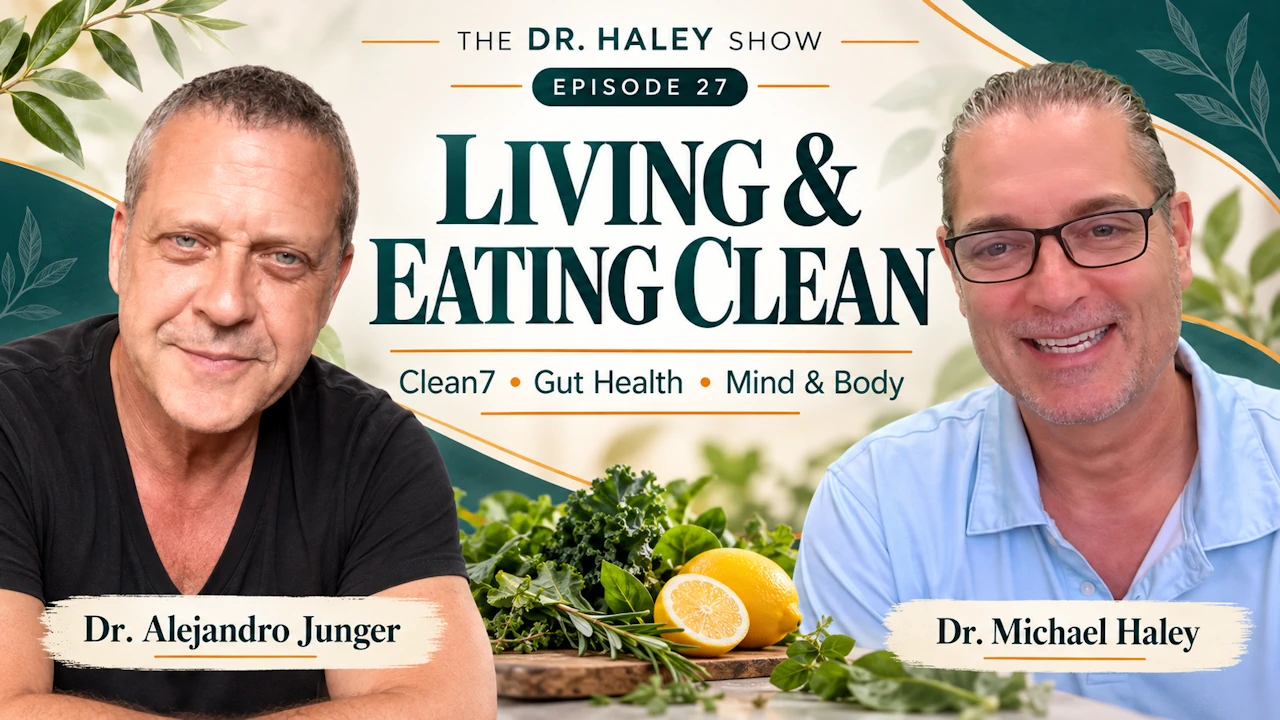
Dr. Alejandro Junger, MD, is a cardiologist, founder of the Clean Program, and a New York Times best-selling author. He graduated from medical school in his home country of Uruguay. He then moved to New York City for his postgraduate training in internal medicine at New York University and fellowship at Lenox Hill Hospital.
The drastic change in lifestyle and diet resulting from his move to New York City soon showed up as irritable bowel syndrome and depression. Becoming a patient of the system he was practicing was such a shock that it started his journey in search of an alternative solution to his health problems. His findings are the subject matter of his New York Times best-selling books, “Clean,” “Clean Gut” and “Clean Eats,” all of which are a manual for readers to learn how to turn on and work with their own detoxification systems to restore and maintain optimal health.
After his medical training, Dr. Junger studied Eastern medicine in India. He has been called “The Father of Detox”, and his Clean Program is followed by people worldwide, including dignitaries, A-list celebrities, and media personalities. He is frequently interviewed in the press for his detox expertise and has been featured on major national shows including, “Dr. Oz,” “Martha Stewart,” and ABC News.
What You Will Learn In This Show
- Who is Dr. Alejandro Junger?
- What is the "Clean" detox program?
- What are the three pillars of the Clean program?
- And so much more
Watch the Interview
Listen to the Podcast
Resources
Quick Takeaway
Dr. Junger describes how his own health challenges led him to develop the Clean Program and, later, Clean7. He explains that Clean7 combines functional medicine, Ayurveda, and intermittent fasting, while emphasizing that fasting and supplements are not prerequisites for the body’s ongoing detoxification processes.
The conversation also explores meditation, food choices, supplement quality, and the Ayurvedic concept of doshas. Dr. Junger’s program explanations and patient stories reflect his perspective and clinical experience; individual experiences may differ.
ENJOYING THIS CONVERSATION?
Get the Next Episode in Your Inbox
Get notified when a new episode of The Dr. Haley Show is published, plus occasional highlights and resources worth exploring.
By subscribing, you agree to receive email from The Dr. Haley Show. Unsubscribe anytime.
Episode Timestamps
- 00:02 – Introducing Dr. Alejandro Junger
- 01:35 – Clean7 and Dr. Junger’s personal story
- 02:18 – From Uruguay to medical training in New York
- 06:15 – Acute care and chronic health problems
- 08:13 – The three pillars of Clean7
- 10:55 – Thoughts, depression, and meditation
- 18:45 – Food choices and chemical exposure
- 20:19 – Dr. Junger’s explanation of detoxification
- 25:58 – Intermittent fasting versus detoxification
- 28:05 – What participants may experience
- 30:26 – Supplement quality and individual needs
- 35:33 – A patient story
- 36:58 – Stress, exercise, and cold exposure
- 39:35 – Where to find Dr. Junger’s work
- 41:34 – Ayurvedic constitution and current imbalance
- 43:13 – Closing thanks
From Medical Training to the Clean Program
Dr. Junger contrasts the home-cooked meals and family routines of his upbringing in Uruguay with the demanding schedule and convenience foods he encountered during medical training in New York. He shares how digestive problems, allergies, and depression prompted him to explore other approaches to his health. He also explains why he values modern medicine for acute emergencies while taking a different approach to chronic concerns.
Clean7: Functional Medicine, Ayurveda, and Intermittent Fasting
Dr. Junger distinguishes the three pillars of his Clean7 program from a universal definition of health. He describes developing the seven-day program after his original 21-day program, adding Ayurvedic principles and intermittent fasting to the functional medicine framework. Near the end of the interview, he explains the distinction Ayurveda makes between a person’s underlying constitution and their current imbalance.
Meditation and the Experience of Repetitive Thoughts
Reflecting on his experience with depression, Dr. Junger describes becoming aware of repetitive thoughts and exploring meditation in India. He says his practice helped him observe thoughts with less identification and emotional involvement. The discussion focuses on his personal experience rather than a prescribed treatment for depression.
Detoxification, Food Choices, and Supplement Quality
Dr. Junger presents his explanation of the roles of intestinal flora and the liver in processing substances the body encounters. He discusses nutrient availability and digestive workload, and clarifies that detoxification is ongoing even without intermittent fasting. When discussing supplements, he emphasizes sourcing, screening raw materials for contaminants, and individual needs. He also describes his use of Ayurvedic adaptogenic herbs.
Patient Experiences and Everyday Routines
Dr. Junger shares a patient story and describes changes he says participants have reported during his programs. These accounts are individual clinical observations. The conversation closes with his perspective on exercise, cold exposure, and balancing stress with daily life, followed by guidance on where listeners can learn more about his books and programs.
Medical Disclaimer
This podcast and article are provided for educational and informational purposes only and do not constitute medical advice. The experiences and opinions discussed are those of the speakers and should not replace diagnosis or treatment from a qualified healthcare professional. Do not begin, discontinue, or change any medication, supplement, diet, or treatment based solely on this episode.
Full Transcript
The transcript has been lightly formatted for readability. Because it was created from the recorded conversation, it may contain minor transcription errors.
Read the Full Transcript
– I’m Dr. Michael Haley, and this is the Dr. Haley Show. Today we’re gonna talk about getting clean from the inside out and detoxifying safely. We’re meeting with a cardiologist, medical doctor, a New York Times best-selling author. He graduated from medical school in Uruguay, and completed postgraduate training in internal medicine at New York University and fellowship at Lennox Hill Hospital.
The stress of the drastic changes gave him his own challenges that would lead him to create a program that would help countless others around the world. He got irritable bowel syndrome, and depression. He essentially became his own patient. He realized the shortcomings of treating these with medicine and sought alternative solutions. After his medical training, he studied Eastern Medicine in India. He’s been called the father of detox. His research and experience led the findings that are the subject matter of his New York Times best-selling books. Clean, clean got, and clean eats.
I’ve almost finished reading Clean7. It’s excellent. I’ll be completing his Clean7 program in the next month or so to experience the benefits. I’m sure I’ll go on to repeat, rinse and repeat, again and again. And again, today’s Superstar guest is Dr. Alehandro Younger. Dr. Younger, thank you so much for being on my show.
Thank you for having me.
You know, I’m reading your book, Clean7. I’m almost done with it. I’m getting to the part where we’re getting to the diet and the different kinds of diets for different people. I have to figure out what Doshah I am. Is that in my saying that right? I’m saying that correctly.
Yes, absolutely
excellent. I love your book in the intro and everything that got you to the point where you are today and I was hoping that you could share your own experience. What your life and your health was like in Uruguay. What happened when you came to the United States and why you came to the United States and and what was the big culture shock for you? Why were things so different in the United States than in Uruguay?
Well, in Uruguay, when I was born a few years ago, life was very simple. There were no supermarkets, you know, my mother used to cook meals from scratch. We used to buy food at the farmers market and everything was very simple. And we ate as a family altogether.
I went to medical school in Uruguay and after graduating from medical school, I decided to go to the United States to New York specifically to do my internship, residency and fellowship and internal medicine and then cardio.
And the pace of life was very drastically different in the United States. To begin with, I didn’t have my family. I wasn’t eating the foods that were prepared from scratch by my mom. I was running around like a chicken with no head from being on call to, you know, to being on call again a day later, sometimes three days in a row taking care of life and death situations and eating on the go from venting machines from the hospital cafeteria. And when I had some time I used to go to the supermarket and buy, you know, some kind of container that I put in a microwave and in five minutes I got a meal.
So I started gaining weight. I started getting sick. I started having difficulty digestion. I started having allergies where seasonal to begin with but then all year round and then I started getting depressed. And I ended up going to three specialists, a gastroenterologist and allergies and a psychiatrist and I was diagnosed with three diseases. Irritable bowel syndrome, severe allergies and severe depression and I was given seven prescription medication
and what shocked me into trying to find a different solution for my problems. One that did not include prescription medications because I knew by that by then that these chemicals were not going to correct the dysfunction that were causing my problems. It was just going to mask or kill the symptoms as it were leaving the problem brewing behind and maybe later on expressing in a different way.
You know I wonder if that’s partly because the difference between where you were raised and then coming to the United States where I don’t know if a lot of us would have painted that same conclusion you know I’ve been bombarded with TV programming commercials drug commercials you know I did some math one day and I figured that it was you know probably you know for every decade that we’ve been alive watching the average amount of TV probably about 2,500 you know commercials any year or 25,000 per decade well for someone that’s been watching TV for 50 years or however long possibly over a hundred thousand of those little brain-washing segments to where we think that health comes in a bottle so we was supposed to that in a river.
Not really but but it doesn’t really matter because you’re not a doctor so so when I see those commercials I mostly understand what the chemistry behind them are and I understand that they are not really correcting anything just you know masking the symptom.
Okay now there is a time for medicine right we how would we know the difference of when medicine is important when it’s not
well depending on what you call medicine. I you know I call medicine everything maybe you’re referring to modern or pathic medicine that the one that we are accustomed to in the modern hospitals these days right so and it’s a great question because because understanding the place of modern medicine is really important see human beings are affected with all kinds of disease for the diseases that are the acute diseases the programs that are acute problem. Modern medicine is the best thing in the world.
If I break a bone, I’m not going to go meditate or drink some herbal tea. I’m going to go to the best orthopedic surgeon and having put some screws and plates and reconstruct my bones. If I’m having a heart attack, I’m going to go to the best hospital with the best cardiology center and that they can put a catheter down my groin up to not my coronary arteries and and blow up the artery with a balloon put a stent there so that the blood can be restored. The blood flow can be restored and those are the acute problems of humanity.
But the chronic problems that are not best solved with the modern tools of modern medicine. And the thing is that human beings, 90% of the problems that they are suffering from are chronic problems and doctors are trying to address them and treat them with modern tools. So that doesn’t make, that doesn’t make sense, right? So the problems, modern medicine, best thing in the world. Chronic problems? No, so much.
Yeah. So when you were given the seven prescriptions and you realized there must be a better way. You did some, you kind of became your own patient at that point, I guess, and you started doing your own research. And it eventually led you to what I read about, repillers, and what are those, and how do they integrate together?
Well, you’re talking about my latest book, Clean7, and in Clean7, I describe the three pillars of the program, as functional medicine, I read medicine, and intermittent fasting.
But that’s not really the three pillars of health. And these are the three pillars of the program that I describe in that book, right?
Okay, that makes sense. And how do they integrate together, and why is it important to look at all three?
Well, it’s a big more complex than that, right? This program, the Clean7 program, which is the one that you’re referring to, is a detox program that I created after I created my first program, which was a 21-day program. Now 21-day program is a detox program. Basically what it does is creates the conditions for the body’s detoxification system to work at maximum capacity or at optimal levels.
Now what I realized that even though people were having amazing results when they did the 21-day program, many more people than the ones that were doing the program were not ready to embark on a 21-day program. So for many years, I tried to shorten that time. And that’s when I introduced to the 21-day program is based on principles of functional medicine and to accelerate the results. That’s when I introduce principles of Ayurvedic medicine and intermittent fast.
Okay, I see. And as I read about it too, I’ve heard of intermittent fasting. And I guess maybe I do that in my own life, just because it happens. You know, you have a busy long day and realize you haven’t really eaten yet today. And so, you know, I might go 24-hour periods, but I never realized the real benefit. I never had the understanding of the importance of it. And how it related to detoxifying.
So, yeah, go ahead.
Go ahead, what’s the question?
Well, in your book, I love this. You, and in Clean7, you were very, I’ll say, vulnerable and transparent about how it affects the mind, how the chemistry, the toxicity in our bodies would affect the mind. And, you know, it was introduced earlier on in the book where you talked about sleep, for instance, and dreams. And, you know, I have realized in my own life growing up that if I ate certain foods, I would have very aggressive, angry, survival, fighting dreams, bloody disgusting dreams. And it was related to the chemistry that was in the foods that I was eating. So I understood and certainly connected with you on that.
And then you went on to talk about the mental wars in the brain that people would have. And I thought, you know, that’s funny because I can relate to that. I’ve done that. And not so much anymore. Um, I don’t know how, I think I have some ideas how in my own life I got away from that. And part of it was probably chemistry and part of it was probably training my brain to do different things. But how does all of that tie in and how did you, you know, what were the mental wars like and how did you get out of those patterns?
So it’s a big question that you’re asking but I’m trying to tackle it in some way. When when I was diagnosed with severe depression, one of the things that I noticed was that there were always thoughts in my head. I was always experiencing thinking.
Now I’m not saying that I was thinking because if I had a choice at that time, I wouldn’t be thinking, I wouldn’t have been thinking 90% of the thoughts that were appearing in my head. So, I, you know, I question, wait a minute, if I am not choosing these thoughts that were, you know, constant, repetitive, and mostly negative, if I’m not choosing them, but within who it’s? And with that question, I started trying to understand where thoughts come from, who chooses the thoughts that appear in in your head, how do they appear?
And by exploring Eastern philosophy, Eastern religions, was made aware that this is something that 99.9% of the population of the world is experiencing, the constant thinking. Now, the lucky ones have constant positive things, and then, and the unlucky ones have constant negative things, or a mixture of both, right? But, but the fact is that we are almost all the time, just being taken by our thoughts, and they are automatic, and they’re repetitive, and many times negative, right? And when they’re negative, they play with your emotions as well, because when you’re thinking about something that’s negative, then you either worry, or you get angry, or whatever else is a reaction that you’re having as if what you’re thinking is true.
For example, if you’re starting to think about a fight with your boss, you’re going to get angry, as if the fight was actually occurring, even though it’s just imaginary, it’s just in your head.
Once I realize that the thinking process is automatic, then I started to wonder if there is a way to slow them down, and even maybe stop them and just only think when I decided to think, that’s when I came across the concept of meditation, as the practice through which I’m slow down the constant automatic thinking process. And maybe even stop it.
That’s when I started to be interesting in learning how to meditate. And eventually I ended up living in a monastery in India where I went to try to learn how to meditate and slow, or stop my automatic thinking process, right? That was my journey into discovering this or becoming aware of this and trying to somehow resolve that big problem that I was experiencing.
And now, as time went by and I learned how to meditate and have been practicing for many, many years, I realized that even though maybe I haven’t slowed down that much, I think in process, or stopped it, except for certain moments, I don’t identify with them so much. I just watch them, just like you watch the clouds going up, you know, buying the sky before I used to getting to the thought and then, you know, now I just watch them and I kind of, you know, wave at them and observe them as if I was detached from them and they don’t affect me as much.
Yeah and I think you would agree because you mentioned it a little bit that the difference between those two choices is really, you know, sympathetic or parasympathetic, you know, are you as your body and a fight or flight mode or, you know, is it okay to just acknowledge things but let digestion and things continue in your body? Does that make sense?
Not really, five people have been honest because you talk about choices, but the truth is that most people have no choice. There is no, this concept of choice is an overused, you know, very American, a concept, you choose these, you know, we basically have no choice. These are just happening on themselves, right? So, the work of really attaching oneself from the thinking process is an arduous, continuous work, right?
Now, you also talk about the association between sympathetic and parasympathetic and parasympathetic. I think that it’s kind of the other way, right? I think that thought is first, and then sympathetic or parasympathetic is activated. Depending on what it is that you think in most cases, it can go the other way, too. Your sympathetic system may get activated, and that will maybe attract different thoughts, you know? But in general, I think that thought is first, and then sympathetic or parasympathetic as a result, as a consequence.
Okay, and I think the, you know, reason it is,
hey, this is just my understanding, and I’m no expert on this, I’m just a student.
Well, we’re all students, but I do think you are an expert. And you have been referred to as the father of detox.
Yeah, that’s a whole different, set of things that I really do understand, which is, which is how the detoxification system in the body works and how to create the conditions for that system to work optimally, which for most of us, it isn’t.
Yeah, and it is tremendously important, because even if we are eating the cleanest diets, and you know, we’re all being bombarded by chemicals that are getting inside us, and some of us are holding on to those and storing them more than others, you know, whether it’s, well, you know, it happened to be in a room with carpet beneath me that probably has chemicals that are off-gassing, you know, there’s things in the air living on this planet, you know, they used a lot of smoking on airplanes.
I’m thinking about talking about the carpet, you know, there’s, there’s something much more intimate and much more pervasive than that, which is all the chemicals that we put in the food-like products that we consume. Right. When we’re being these days in, at least in modern cities, they get there, you know, whatever they eat, they get it from supermarket, and if you take a look at a supermarket, 90% of what is sold in consume in supermarket comes in some kind of container, a box, a can, a jar, a tube, a bag, and in order to be in these containers, and in order to have a shelf life, they have to have chemical preservatives, conservatives, and then in order to sell you more, they have to have chemicals that make you attracted to them, so they have coloring agents and smelling agents and texturizing agents, and all this chemical, they keep going into your system all the time, and those are the chemicals that are mostly the ones that affect us.
We get those in us from our diets, how do we get them out?
So, incredibly, the body has an ability to get them out, to detoxify them, to neutralize, and to change their chemical structure. The way that the body does that is, it in many ways, but the two main ways in which the body does that is, when these toxins come into your system, through your digestive system mostly. The first thing they encounter is your intestinal flora. The intestinal flora, the good bacteria, the good fungus in your inner intestines, they do 30 to 40% of the detoxification work of these chemical.
Once they are absorbed into your bloodstream, then the rest of the work is done by the liver. The liver has the power to the ability to manufacture enzymes that will break these chemicals and that will extract parts of these chemicals, part of the molecules, and add different molecules so that it renders these chemicals non-toxic and converts them from fat soluble into water surely. Most of these chemicals that we’re exposed to are only fat-solid. So they have to be converted into water soluble so that the body is able to expel them to eliminate them, right? We mostly eliminate strings, things through water, sweat, breath, you know, the breath has moist urine and your feces. So they have to be converted from fat soluble into water. This is done by the liver, mostly once these chemicals are absorbed.
Now it’s amazing that our livers that were, you know, created by nature thousands or maybe millions of years ago. They are able to deal with the chemicals that we invented yesterday, in many cases. Or last week, it’s just miraculous.
The plural of the wounds, the problem is that the liver needs certain nutrients as building blocks to manufacture these enzymes. And if you’re not consuming or absorbing these nutrients, then the enzymes will not be manufactured. And the liver will not be able to do its work. And this is what’s happening to a lot of people. We are not eating the right nutrients. We’re not absorbing the right nutrients.
And furthermore, there is an energetic problem. Because the body needs energy to do all these things. And for example, we think of food as where we get our energy for. But in order to get this nutrients into the body, you have to digest them. And digestion consumes energy. And the problem is that we are digesting all day long because we’re eating all day long. And that requires an energetic consumption that takes away energy from other systems. The detoxification system being one of them. So because we’re eating all day long and because we’re eating crap and not absorbing the right nutrients. And then the liver is not able to have the energy available. All the nutrients are available to produce the enzymes wound up with a toxic overload. We have the backup of toxic.
Now these toxins continue in the circulation. And as I said, 90% of them are fat soluble. So they’re going to go in large in your fat tissues. Whether where are the fat tissues in the brain, in the thyroid, in your mammary glands, in your testicles, in your kidneys, in your liver, and where are all the cancers where we’re seeing these days in those organs.
Now once these fat soluble toxins saturate, your tissues, then the body will turn its metabolism into a mode of retaining and generating fat. In order to defend itself against this chemical, when that leads to the conditions for obesity, which is a huge problem in the world today. Nobody talks about this. Everybody thinks of all the best ideas. Okay, you’re eating too much and exercising too little, but obesity is not only that. It’s also a very intelligent way in which the body is defending itself against these fat soluble toxins. So, you know, it’s a big subject and we’re paying the consequences for the way that we’re living and the way that we’re eating.
That’s interesting because I’ve never thought about it that way. The fact that somebody might be gaining weight because their body is actually saying eat more to gain more fat to protect from the toxic overload that’s already in you.
Matt, and that is, and it’s not even eat more because whatever you eat can be burned or can be turned into fat. So, you know, you may be eating the same but but if your metabolism is on a on a fat retaining and fat generating mode, you’re going to you’re going to gain fat and you’re going to gain weight and you’re going to become obese.
Okay, so we start a detoxification program with that includes intermittent fasting and because of that that’s when our body goes into the fat burning mode. Is that why detoxification is accelerated at that time or are there other reasons?
Well, you’re mixing, you’re mixing people.
Okay. Okay, give me straight. I’m going to do this program. I want to do it right.
Well, the intermittent fasting is one thing. Detoxification is a different thing. I mean, of course, they, they, you know, intermittent fasting accelerates detoxification, but intermittent fasting is not necessary for detoxification.
You know, your body is detoxifying all the time. You know, you’re, you’re breathing out. You’re getting CO2 out. So that’s detoxification. Your body cannot even stop for a minute detoxifying, because otherwise you will die. So the detoxification process is always trying or always go along now. You can be more effective or less effective, right?
Now how do you make it more effective? That is when reducing the workload of the digestive system comes in handy. Because the less energy you consume, the more that it will be allocated to other functions, detoxification being one of them.
Now that is the energetic aspect of them making sure that you have the right nutrients for the liver to produce the enzymes is a different aspect. So there’s many different aspects of detoxification that are not just reducing the workload of the digestive system. And the intermittent fasting is just one way of reducing the workload of the digestive system.
All right. And thank you for your patience. It’s coming together. It is, you know, a little as I’m, as I’m understanding, okay, the the pillars. We’ve got, you know, intermittent fasting that we have a diabetic medicine, herbs, and things. And so I’m starting, it’s coming together. I’m probably still going to mess things up. But it’s having finished the book here. I have to to.
We’re learning.
Yes. Yes. Yes. Thank you.
In this detoxification program, is it symptomatic for most people or how does it, how does it work? How do people typically experience detoxification? Or what might someone expect to experience?
So when you start a detoxification program, the first few days are a little difficult, because usually a detoxification program involves some drastic change in your habits. So for example, coffee is not allowed during a detoxification program, and people that drink coffee may go into withdrawals and have headaches and feel low energy.
So the first few days are a little hard, but then later on, it just becomes a beautiful thing. If you sleep better, you poop better, you’re not aware of your digestive, you know? A lot of people are aware of the digestive, because it’s gurgling or it’s, you know, the gases, they’re bloating. That all disappears. Your skin becomes more softer and starts blowing. The wider around your eyes becomes more white. I mean, the effects or the things that people feel when they’re detoxification system is working optimally. Involve every, or an every part of your body.
And, you know, I have people that, that, um, that stop having aches and pains or, or, or, you know, diabetics, type two diabetics that stop needing insulin or, or, stop needing medications for, for, for, for diabetes. I mean, it is quite remarkable what happens. The detoxification system is one of the systems that most human beings have somewhat screwed up, but when you, when you, when you correct that and and and create the conditions for that to work optimally, it affects every system of your body.
Okay. As we’re talking about supporting detoxification with herbs, supplements, and we’re going to get to, we’re going to definitely below this video and on the blog page, I’m going to have links to your website as I will be visiting myself when I know which products I’m supposed to get. I haven’t figured out my type yet and I haven’t been to the site to figure out how that all connects together.
But how would we know what makes a supplement good or not good? We talked a little bit about foods and the differences between food and Uruguay that you were brought up on where your, you know, mother would actually spend lots of hours preparing real food versus what it’s like here where you can go in the shelves and get something and stick it in the microwave in 30 seconds later have what appears to be a meal. When it comes to supplements, what are some of the things we might recognize as good versus bad?
Well, to begin with, I want to clarify that you don’t need supplements for, for, for, for a detoxification program. The reason I do use supplements is because they, they help and they accelerate things, right? So, so, but they’re not needed. They’re They’re not absolutely necessary, right?
Now with supplements, as with everything, there’s good ones, and there’s bad ones. And you know, it’s good to know or to learn how to distinguish between them. There’s organic, for example, when you’re talking about herbs, there’s organic herbs, versus non-organic herbs, there’s biodynamic farming, versus non-biodynamic farming. Certain supplements, contouring, certain pollutant chemicals like heavy metals or things like that. So it’s always good to get your supplements from reputable and serious components, right? That do their work and vet their raw materials for contaminants and things like that, right?
Yeah. Now, when you’re talking about supplements, the very individual thing, no? And there’s ways of determining which supplements you need and which supplements you or which supplements will help would benefit you the most and which supplements may be not so much. Now, you can do that. There’s a whole spectrum of accuracy to do that. There’s ways with a very, very accurate. If you do certain blood tests and urine tests and certain laboratory tests, you can really pin down what supplements you would benefit you. But there’s always a more educated guess work on supplement.
Now, most people in the world benefit from magnesium because our foods and our soys are depleted of magnesium. And even if you’re eating the best organic foods, they’re usually depleted of magnesium, right? So I give magnesium to people without even doing any any tests because there’s a more likely good than not that it will help.
Same thing with vitamin D. We’re all sun deprived. So sun is the source of vitamin D. So for most people supplementing with vitamin D is going to be a beneficial.
Same thing with the B vitamins, they’re very difficult to absorb and they depend on a good intestinal flora to be predigested and be viable for absorption. So a lot of people are lacking be vital. So I give them to my patient.
And then there is supplements that will likely most likely help. And those are the supplements that I use in the clean 7 program, which is the book that you’re reading now. And those are the Ayurvedic adaptogens. These are plants that have the ability to help your body adapt.
And you know, whereas certain supplements have a definite effect, for example, there are certain supplements that will lower your blood pressure. There are certain supplements that will increase your blood pressure. These adaptogenic herbs will help your body adapt, meaning if your blood pressure is low, they will have to, will help your body elevate. And if your blood is high, it will have your body bring it down. So it’s like an, it’s a very intelligent supplement, right? These are the, are your very adaptogenic herbs like Ashwaganda, Dulce, Turmeric and things like that.
Oh, that’s beautiful. And that was a good explanation of adaptogenic, um, so I like that. Um, what would you say your favorite, it’s probably your own, but other than your own, your favorite testimonial to, um, you know, someone that has been through the, uh, one of the detox, whether it was the 21 day or the seven-day program.
You know, I have so many that I, I wouldn’t be able to choose a favorite one, but, but I can tell you, you know, that, that, that some people have completely changed their lives. Like, I can, I can tell you about this patient in New York, and I mean, it’s Anna who had an autoimmune disease, um, that completely destroy her, her, her, her skin. And it was almost unrecognizable and through, and through my programs, started, um, counting down her autoeunity and, and was able to restore her health and her, and her skin started to look, uh, healthy again, or healthier, right? Um, that completely changed her life. I mean, I, I have so many that is hard for me to do. I worried one there.
I can see that as you light up with excitement and that’s neat. And there were so many aspects of, of people’s lives, you know, oh, right, yeah. That’s a beautiful thing.
So, you know, I’ve also heard you say that, you know, a little stress can be good for you. What will your day look like today? How will you balance stress and relaxation and diet? And what will you do today and how will you enjoy your day?
When you go for a run, you’re stressing your body, but everybody knows the benefits of exercise, right? So yes, there are things that you introduce in your life that force your body to adapt, that have a very beneficial effect. Then you could call that stress.
For example, the liberal-called exposure. You know, look right here, in my backyard, let me see if I have good reception. I have a river right here, right?
And so I wake up in the morning with my kids, we jump in the river and it’s really freezing.
No way.
Oh wow, you can say that that is stressing the body in some way, right? But but but we all know now that the river it called exposure is really beneficial for the body because it does a lot of things to metabolism. And it turns yellow fat into brown fat, which is healthy fat, yellow fat is the unhealthy fat. And it changes, it changes, you metabolically makes you more resilient, it strengthens your immune system. So there are stresses that are really beneficial for the body.
That’s cool. You know, I heard you talking about the, you know, the contrast treatments with the, you know, cold water to hot water and how you can even do that in your own shower just by adjusting the temperature to get the vessels to, you know, contract and part of the detoxification. I was hoping that, you know, you mentioned going in the water, if I was able to pick up my computer, I would say, “Hey, let me show you what we have here, and we get in the freezer, we got the big walk in freezer. That’s at -20, cold there. It’s blowing. It might do it a little. It’s not the same as jumping in cold water.
It’s something people are paying to get into freezer. It’s like that. It’s going to cryotherapy and these shops are popping everywhere. And it goes anywhere from $20 to $60 for you to getting for a while, you know? So use it and take it in take advantage of it.
We are in and out of it all day long, grabbing things to pack and shit so, but anyway, it’s fun.
Where is, and I’m going to have all of your links that are important to you. I have already found your YouTube channel and your Instagram channel and you have a website and a place where people can go get books and the programs. What would you say the best stop? The number one source that people should go to to find out more about you and maybe purchase your books or find some of your content?
Well with my Instagram account, you know, DR Alejandro Junger, Dr Alejandro Junger, that’s a good way to start familiarizing yourself and learning a little bit about my work and the other one is www.cleanprogram.com which is my company where we sell our kids and books and we have the best customer support ever, you know, whenever you enter one of the one of the programs we support you all the way, we have three consultations and guidance that those are the two main places, right? And of course, my books.
Alright, so I’ll list those first, right below this video on YouTube, or if you’re on the blog page, I’ll have the links at the bottom of the page in the resources area. Dr. younger, I want to thank you so much for turning your your stresses in life, your challenges, your health challenges, into something that benefits so many people all around the world. When I’m done with clean 7, I’m going to get clean guts because
we’re more important than reading the book is doing the program.
Oh yeah, for sure.
Why? Because it’s really remarkable what you can do for you.
Oh, I’m fully convinced. I’m, you know, I just started reading a book a couple days ago and I’m right now getting to the the food part in the end, the where it’s figured out what your dose is and and you know, which I think is similar to like body type and what foods are appropriate for you, I don’t know, I haven’t got there yet.
Well, I don’t know what you referred to as body type, but the dose is in a way body type of body constitution, but according to Ayurvedic principle, you know, and say, you know, and Ayurveda, the world is made of the five elements, which is not from the from the periodic table, right? But it’s the fire, water, earth, wind, and ether, right? And depending on depending on the influence of these energies on you is what your body constitution is going to be. So, for example, if the fire influence is more, then you’re going to have a pitta constitution, a firey constitution. And that has certain body characteristics, but also has tendencies of how your body reacts, not only to foods, but to situations, and to, you know, to life in itself.
So, so by answering the questioner in the book, you’ll find out what your what your dose is, but more importantly than finding what your dose is, is finding what your current dose in balance is, which is a little bit different in its explain in the book, right?
Yes. And the difference is, when you answer the questioner, if you think of your whole life, then you’re going to determine your constitution, your the the constitution you were born. But if you answered, thinking of only the last month or two, then you’re going to find out your dose, your current dose, I’m balanced. That’s the important one for the program.
That’s where I am right now, is that that questioner? So I got I got some work to do. I’m going to figure some things out and get on the program. So awesome. Dr. Younger, thank you so much. I’m truly blessed to have you and everyone who’s watching this and listening on the podcast, I know will be as well. So thank you so much for joining us.
Thank you so much for having me.