
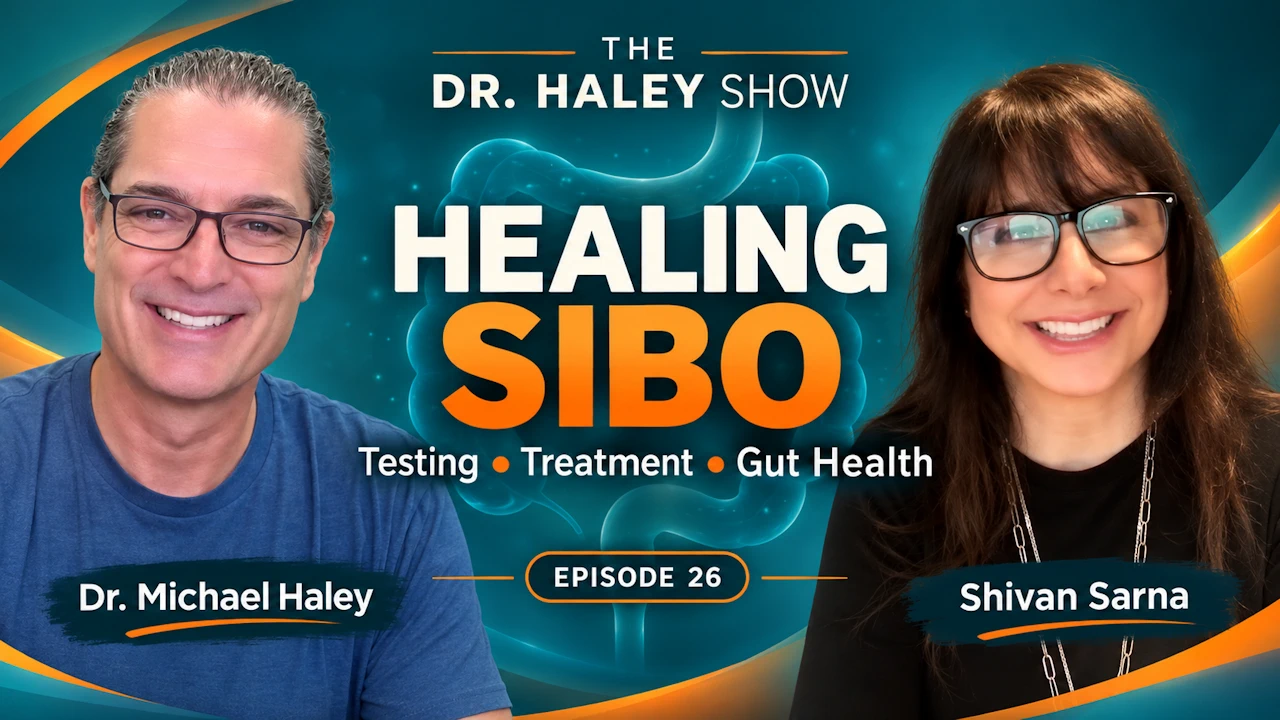
In to today’s episode of “The Dr. Haley Show”, Shivan Sarna, author of “Healing SIBO” joins Dr. Michael Haley to share her experience and wisdom to help those that have suffered with this condition.
About This Episode
Shivan shares her experience with digestive symptoms beginning in childhood and discusses small intestinal bacterial overgrowth (SIBO), intestinal methanogen overgrowth (IMO), testing, treatment approaches, and finding a practitioner who understands these conditions.
Watch the Interview
Listen to the Podcast
Resources
Quick Takeaway
Shivan’s central message is to identify the type of overgrowth, investigate the underlying cause, and work with a knowledgeable healthcare professional. She describes testing and retesting as important steps in choosing and evaluating treatment, rather than assuming that bloating or irregular bowel habits reveal the cause.
She distinguishes dietary symptom management from treating the overgrowth and emphasizes the role of the migrating motor complex and prokinetics in her discussion of relapse prevention. Treatment choices and outcomes, she explains, vary from person to person.
ENJOYING THIS CONVERSATION?
Get the Next Episode in Your Inbox
Get notified when a new episode of The Dr. Haley Show is published, plus occasional highlights and resources worth exploring.
By subscribing, you agree to receive email from The Dr. Haley Show. Unsubscribe anytime.
Episode Timestamps
- 00:02 — Introducing Shivan Sarna
- 01:20 — Shivan’s story, SIBO, IMO, and food poisoning
- 02:47 — IBS Smart and breath testing
- 03:50 — Bloating, pain, and the migrating motor complex
- 05:25 — Dietary symptom management and treatment outcomes
- 07:06 — Motility, constipation, and testing resources
- 09:06 — Finding a practitioner who understands SIBO
- 11:15 — SIBO SOS and educational resources
- 11:53 — Why treatment needs knowledgeable guidance
- 12:24 — Elemental diet, antibiotics, and herbal antimicrobials
- 15:30 — Silver hydrosol, probiotics, and the microbiome
- 18:58 — Specialist knowledge and the SIBO Recovery Roadmap
- 21:02 — Prokinetics and relapse prevention
- 22:20 — Hope, testing, and patient experiences
- 24:06 — How common is SIBO?
- 24:57 — Closing remarks and resources
What You Will Learn In This Show
- What is SIBO?
- What causes SIBO?
- How to test for SIBO?
- How to find a healthcare professional that understands SIBO?
- Effective Treatments for SIBO?
- How Common is SIBO?
SIBO, IMO, and Digestive Symptoms
Shivan discusses small intestinal bacterial overgrowth and the related term intestinal methanogen overgrowth, which she associates more with constipation. She describes constipation, diarrhea, alternating bowel patterns, bloating, and pain as symptoms discussed in this episode. The conversation distinguishes methane, hydrogen, and hydrogen sulfide and explains why identifying the gas pattern matters when considering treatment.
Shivan traces her own symptoms to food poisoning at about age five and describes food poisoning as an important underlying cause of IBS and SIBO. She also discusses adhesions, endometriosis, scleroderma, opioid use, and impairment of the migrating motor complex as possible contributors. Her explanation of the migrating motor complex centers on its sweeping movement of food, bacteria, and debris out of the small intestine.
Testing and Finding a Knowledgeable Practitioner
The episode discusses the IBS Smart blood test in connection with antibodies following food poisoning and the Trio-Smart breath test in connection with methane, hydrogen, and hydrogen sulfide. Shivan explains that these tests address different questions and that identifying the type of overgrowth helps guide a treatment plan.
Shivan recommends asking a prospective practitioner whether the practice orders SIBO breath tests and which laboratory it uses. She discusses gastroenterologists and naturopaths with relevant training and encourages listeners to find someone familiar with the details of testing, treatment, and follow-up.
She points listeners toward SIBOSOS.com for education and support, including the SIBO Recovery Roadmap.
Treatment Approaches Discussed in the Interview
Shivan describes three main approaches to reducing the overgrowth, followed by retesting and attention to the underlying cause. The discussion presents these as options to consider with a knowledgeable healthcare professional:
- Elemental diet: Shivan describes a specialized liquid formula used for 17 days in the protocol she discusses, followed by retesting. She distinguishes it from an ordinary protein powder.
- Antibiotics: She discusses Xifaxan/rifaximin for hydrogen-associated overgrowth and combinations with metronidazole or neomycin when methane producers are present. She describes rifaximin as acting locally and contrasts it with medications that may affect a broader part of the microbiome.
- Herbal antimicrobials: She discusses allicin from garlic, oil of oregano, and other herbal preparations, while emphasizing that responses and the evidence for different products vary.
The conversation also addresses silver hydrosol and probiotics. Shivan says she is not aware of supporting studies for silver in this context and describes probiotics as highly individual: some people report improvement, while others do not tolerate them well. Dr. Haley emphasizes the importance of professional guidance when attempting to reduce bacterial counts or address suspected parasites.
Diet, Prokinetics, and the SIBO Recovery Roadmap
Shivan says diet can help manage symptoms without necessarily resolving SIBO or IMO. She describes some people improving after one treatment round and others needing more time or repeated treatment because of their underlying condition, contributing factors, or gas levels.
She attributes the treatment algorithm discussed in the episode to Dr. Mark Pimentel, with additions by Dr. Allison Siebecker and Dr. Steven Sandberg-Lewis. Her explanation of the SIBO Recovery Roadmap includes testing, dietary symptom management, selecting a treatment, retesting, and continuing to investigate the underlying cause.
Shivan also discusses herbal and prescription prokinetics, which she describes as stimulating the migrating motor complex, as part of relapse prevention. She shares that ginger causes burning for her even though some people tolerate it well. The SIBO Recovery Roadmap and related resources are available through SIBO SOS.
Medical Disclaimer
This podcast and article are provided for educational and informational purposes only and do not constitute medical advice. The experiences and opinions discussed are those of the speakers and should not replace diagnosis or treatment from a qualified healthcare professional. Do not begin, discontinue, or change any medication, supplement, diet, or treatment based solely on this episode.
Full Transcript
The transcript has been lightly formatted for readability. Because it was created from the recorded conversation, it may contain minor transcription errors.
Read the Full Transcript
– I’m Dr. Michael Hailey, and you are listening to the Dr. Hailey show. And today we have an incredible, incredible guest. I’m so excited. In fact, one of the most common questions that I get is going to be answered today. We’re gonna get help from someone that knows more about this than anyone I’ve ever come across. Today’s guest, Shivan Sarna. Shivan, thank you so much for joining me.
Hey, Doc, it’s good to see you. Thank you so much for having me. I’m gonna really love this conversation, because Sebo is so near and dear to my heart. And before we started when you said, you know, there are a lot of people out there that can be dangerous. When it comes to Sebo and you’re so right, because it can go terribly wrong, terribly quickly.
Yeah, and for the most part, I’m helping people that have gut issues anywhere between the mouth and the anus. And when we– and there’s hundreds of inflammatory, bowel, and problematic conditions, but Sebo very focused in the small intestine. Other areas are going to be affected by it, of course. What can you tell us about Sebo? What is it? And why do you know so much about Sebo?
Well, I’ll try to make my story as educational as possible, because it’s not really about me, but that is how we got here, because I had Sebo probably since I was five small intestine, bacterial overgrowth. Also a new nomenclature is a merging called IMO. And that is intestinal methanogen overgrowth. And that’s usually associated more with constipation. But if you constipation diarrhea or alternating constipation diarrhea, bloating, bloating, then this could be what is challenging you. And that’s what challenged me since I was five when I got a couple of rounds of food poisoning, which is the number one underlying cause of IBS and Sebo. I want to say it from the mountaintops. Dr. Marc Vimentel at Mass Program in the Pimentel Labs at Cedar Sinai out in San Diego, California has proven that IBS is most of the time caused by food poisoning.
Even if you were five, and you have these problems now. So I just want that to soak in for a second, because IBS in the past has been a diagnosis of exclusion, as you know, right? Like, you don’t have crones, you don’t have ulcer to apply that collitis, well, you have IBS. So you’re taking an antidepressant, have some metamusyl, see-up. And that is like one of the worst things, by the way, you can give advice on in terms of careful of the fiber. I know that’s counterintuitive, based on the way we’ve all been raised. But there are other things that can cause it.
Mind was caused from food poisoning, and there’s a test called the IBS smart blood test, where you can actually see if you have the antibodies, which is a huge relief, because once you figure out your underlying cause, which is a primary focus of my work, then you can help work on resolving that, but SIBO can also be treated regardless of your underlying cause.
You do need to know what type of gas you have, however, and there are a lactose breath tests that you can take to find out if you have a methandrogen producing gas producer, hydrogen producer, we use a little overgrowth, right, in the small intestine, or hydrogen sulfide, overgrowth. And once you know what kind of overgrowth you have, you can customize your treatment for it.
– Okay, and when you said methandrogen, I think you mean my, like what I might know is like methane gas.
– Yes, thank you, thanks a lot.
– And the other two were hydrogen sulfide.
– And hydrogen sulfide.
Okay, now, and the other thing that you said was bloating bloating bloating, which sounded like pain-pain-pain.
– Can be, is that one of the primary symptoms that people with–
– It is, you know, some people who bloat don’t have pain, some people who have pain don’t bloat, but bloating and pain are two of the most common, symptoms for sure. And then the irregular, if you will, bowel patterns.
And like when you eat and then right after the meal you bloat, you go to bed, you stomachs flat, you wake up in the morning, you stomachs flat, you eat breakfast and your stomach bloats. This is telltale signs of small intestinal bacterial overgrowth, which happens when the migrating motor complex isn’t working properly. And the migrating motor complex is the sweeping motion of food and bacteria debris out of the small intestine. And when that works, you won’t be so susceptible to overgrowth.
And because it’s sweeping it out. But when that’s impacted from adhesions, endometriosis, antibodies from food poisoning, scler derma, opioid use, when that happens in that migrating motor complex is impaired, it’s a recipe for sebo.
Now, not everyone who has adhesions has sebo. Not everyone who’s ever had food poisoning has sebo, right? So, but for those of us, you, anybody who has, that could be your underlying cause. That’s just as important as what kind you have, because the treatment is determined by the kind you have.
And one other thing is that diet will manage your symptoms, but it will not cure your sebo. Diet will manage your symptoms, but it will not cure your sebo or your IBS. It’s wonderful to manage your symptoms, however.
But there, you know, there are, you know, there are b vitamins and iron and causation, and restless lakes and germ that all can be side effects from small intestine bacteria, lower growth. You really do want to get it addressed and under control, as much as possible, because it does lead to, and I think more and more it will be discovered at least to other health conditions.
– Yeah, and you mentioned that you might be able to manage symptoms a little bit, but it does not cure it. Is there a cure?
– So that’s a great question. You can get rid of CBO. It depends on why you have it. So if you have it because you have scleroderma or endometriosis, which is pulling some of that tissue out of place, and your migrating motor complex could still be working, but the tissue is out of physically the location to like help with the plumbing, then you know that might not be able to be resolved, but you can still treat it and you can still drop the loads of gas. So a third of the people that have scleroderma take one round of treatment, they’re done by that you never hear from the get it’s awesome,
but other people that have maybe co-contributing factors, like leaky gut, candida, um, vagus nerve impairment, um, those might be you know reasons why it might take you a longer time, it also may be that you have high gas levels, so you have to do multiple rounds of treatment. So is it curable for some people? Yes, for some people, yeah.
Yeah. When you’re talking about that, that neuromote or type sweeping, whatever it is, is that the same kind of motor complex?
MMC, baby.
Okay, thanks. Is that similar to like parasolysis and just gut action moving things, motility time?
I’m really glad you asked. So it’s a think of it as a micro. This is a non-doctor talking here. Micro, uh, parasolysis. It is micro, motility, but it’s very, very important.
Okay, okay, I understand, um, and is that also because, uh, I understand that constipation could be a common cause as well, other, you know.
Well constipation doesn’t cause sebo. Um, it now theoretically, like, I think it doesn’t help the situation and it can impact lebo, large intestine bacteria overgrowth because you really want to keep things moving. But the main focus is to address the bacterial overload at overgrowth and get those levels down.
Dr. Pimentel, which is sounds like I’m a fan girl for. I am a big fan of his and I really like him and we’re buddies but, uh, like, I’m not I was they were already saying, but I’m happy to shout this from the mountaintop. Um, he’s working on, I think he’s going to find a cure in our lifetime, which I’m super excited about,
but he is also has those breath tests, the breath test, the test, the three different gases. So that breath test is called trio smart, the blood test that I talked about is called IBS smart. There are other great breath testing labs, um, like aerodagnostics, we love quintron machines, um, and so at this time, right in the second, there’s only one that tests for all three. And cool that you can order it on your own without a doctor’s note, you know, doctor’s prescription, you just need to reach out to the lab and they’ll take you through the process.
Okay, and I’m hopeful that maybe I can get any important links to some of these sources and put them below the video and below the podcast to so people have that one click. This is what you might help you. So thank you. Are there particular healthcare professionals that coach people through this and if so what kind and how does someone find one?
That’s a great question. So you one may have to rely on one self-educating gastroenterologist. Do not ever let someone say oh I don’t believe in it. It’s not real. That is like not accurate. Challenge them to stay up to date with the literature, bring your own literature, bring the labs with the studies with you and also if that’s not a fit, go find another doctor.
So naturopaths, a lot of them are aware of it. A lot more now thanks to DDW and these big conferences digestive disease, we can easily be conferences which are seeing papers presented about CBO much much more. I mean, but CBO’s been around like go to PubMed, type in SIDO. You’ll see from ages that it’s been talked about and then you’ll see increase as the velocity and information has been going through good works that it’s been improving.
But but absolutely validated studies that the lecture is breath test works that it is real that people with ideas and CBO respond to certain antibiotics to help reduce the load so you know you might want it when but where the rubber hits the road is you’re calling to make an appointment. Ask at the front desk do you all do CBO breath test? What lab do you use? This is something that I’m concerned about and if they’re like yeah and man yeah and then just keep going through the yellow pages so to speak and find that doctor.
We have a list of speakers in our Facebook group CBO SOS community with 25,000 people in there. Talking about this like non-stop 24 hours and there are good people that are out there but it’s not you know it’s not like age pyelory it’s not like super common but we’re hoping to change up.
Is CBO SOS is that like an organization, a public website that people would go to and find.
I’m going to my website CBO SOS and there’s tons of information there. A guide for testing is my IBS CBO you can you can find it all there.
Dr. Allison C Becker, one of my big colleagues and collaborators. She has an incredible site CBO info.com and we have courses on how to deal with your CBO. If you’re a pro, she has a CBO pro course that is incredible. She’s a world-renowned CBO expert and teacher out at NUNM in Portland, Oregon. So we’ve got some resources that I’ve just really sprouted up in the past three years.
Okay, one of the things I really want to drive home here is helping people understand the importance of doing this right for instance. One of the things you mentioned was anti-biotics and some people will go to whether it’s CBO or Parasite to may just try to nuke the entire intestines and they end up worse than they ever were before. Why is this so important and tell us a little bit about how there are different ways of beating down the bacterial load without nuking?
Right, I say the word “new” too, so it’s funny that you say that. Okay, so this next conversation is about treatment. So we talked about diagnosis, here comes treatment. Treatment can be done in one of three ways and maybe you’ll have to rotate it and maybe you’ll have to do a couple of them over again because unlike UTIs where you’re taking antibiotic and you hope in 14 days it’s gone. This comes down in chunks, I call it. So it depends on how high your gas levels are.
Okay, you can do the elemental diet. The elemental diet is literally a liquid diet that of powder and elements, I mean no acids, but you do for 17 days and then you retest to see how much you drop the bacterial load.
It is not a protein powder, like you know, you get a GNC nutrition or whatever. It’s a very specific matrix of amino acids. Now previously they were really disgusting and they tasted like vomit, but some people like an integrative therapeutics and Dr. Michael Ruchio, they’re a couple more that have made it palatable, right? It’s not the greatest tasting thing, but it’s doable. This is the most efficient way to address the reducing the bacterial overload. Regardless of the kind of preguess producers you have, it’s also the most inconvenient, but I hear a lot of people say “Oh, I wish I’d done this first,” because it was, you know, “I’m done.”
So that’s one way, and then the other ways are with antibiotics, primarily zyfax and or refaxement, which is the antibiotic that they treat, uh, diers, uh, traveledage diarrhea with. So it, it stays in the small intestine, it’s quite a unique antibiotic, and if you have the hydrogen, you use this by itself.
If you have the methane producers, then you use it in combination with either metronitis all or with nice stat, not nice statin. Neomison, the other end. Neomison, um, and so, or sometimes you can use elicin, which is like alley med, alley max. Um, so those are the, those are the primary ways, then there’s herbal.
The third way is antimicrobials with herbs to your point. Do antimicrobial herbs impact the entire microbiome? Well, yes, but do they do that as much as typical antibiotics? Or faxman stays in the small intestine. So that’s really cool. Uh, but it’s when you get into the metronagosal and the neomycin where you have a larger spectrum of the microbiome that can be impacted.
The, um, antimicrobials are elicin, like alley, uh, max pro or alley med, which is the active and greedy and in garlic. Don’t just eat a girl to close. We won’t be happy. Um, the, um, candy back to an AR and VR have been studied. Oil of oregano, um, let’s see what else. Name is handy, but it boosts the other herbs. It’s really not usually strong enough on its own, but it is a great accelerator. And, um, trying to think of some other ones off the top of my head.
What about silver hydrosol? I know some people tell them.
You know, I don’t think it’s been studied. And I’ve asked Dr. Seabekker about this in the past and we do multiple Q and A’s and I know it’s been asked about. And it was just not like a, yeah. It wasn’t, it wasn’t like a huge response.
Yeah. And I’m, you know, on the fence on these things too, because, you know, like you say, there’s only so much documentation. And again, you know, we, it’s our micro biome. And, um, once it’s damaged, it’s hard to get back. Um, what about probiotics?
They’re so, but before, that’s why I was going to say a few minutes ago, Dr. Pimantil has proven that because he and Dr. Ellie Resi are mapping the small intestine, which is so cool. They actually developed a special scope, um, so that it didn’t get contaminated. It’s fascinating.
But, he found that it’s primarily E. coli and Clebsiella that is causing these micro biomes disrupt disruptions. And, when they get reduced, the microbiome does come back into more homeostasis. So, and, you know, it’s a civilization in there, right? So, it’s very cool to see that it can recover on its own
probiotics, probiotics or mixed bag. Some people take, like, mega-spoir and they are transformed, life is better. The birds are singing its blue skies. Other people take them and they, whatever the strains are. And, some have been studying to help with IVS and with CBO. And, they don’t do as well. It’s really snowflake time. It’s fingerprint time. It’s your own personal microbiome. What is going on in there? So, we do think, you know, we do talk about trying some and seeing how it goes.
Dr. CBO, your suggestion is, once we go through all that and you’re doing great, she doesn’t really like people to introduce probiotics at that time. She’d rather have it do it before. So, you don’t mess things up.
That being said, they’re miracle. I mean, really, they’re miracle. But you just have to be very careful and you have to be resilient enough and willing enough to keep trying them.
Yeah, and I realize like one of the benefits of probiotics is really creating the environment that is healthy for your microbiome. You know, there’s you have different pHs from the start to the end and different nutritional components and the bacteria play a role in establishing and creating that environment. Just like when you, well, if anyone’s ever made kombucha at home or something like that, you measure the pH of it and it continues to drop as more bacteria are creating a more acidic environment, makes arrive in that environment. And with probiotics, if we wiped out your gut flora, you’re no longer creating the environment that makes a healthy environment for the bacteria you want to before.
So, so, so much things to balance and be careful and not mess it up and I always say if you’re going to try to beat down your bacterial counts or your parasites be guided by a professional that truly, truly understands this. And that’s why I said I know enough to be dangerous, you know, and what I do know is enough to say go to someone that really treat these things.
Yeah. It’s like cranial sacral therapy. You don’t want to just go to a massage therapist that’s going to hold your head. Like you really need to go to someone who’s obsessed with it. Brain surgery, you know, that kind of thing like I want to go to someone who lives each brain sleep, strengths it.
But what I also want to say is a story about me and Brune Brown. So, well, I don’t know her. I would love to. I read, I butter books, you know, Brune Brown, the shame researcher. I bought all these books and I gave them out to my friends and I, you know, had it on my nightstand. Like, I really loved the ideas, but I never really read the book, okay? It’s just like I dig it. I saw your TED talk. I saw you on Oprah. Cool. Love it.
So, I was on vacation and it was dealing with some difficulties and cracked the book open and really read it. I was like, oh, oh, oh, cool. Is this so much better than I thought it was? And what I thought it was wasn’t really, really wise. Oh my gosh. Okay.
So, the reason I’m making that is that a lot of people think they know about Ceabab because they know a little bit. It is imperative that you find someone who knows the twists and turns and the next thing to do because if you do it out of order, you will set yourself back financially, time-wise, health-wise.
Let me just quickly show you what we have called the Ceabab Recovery Roadmap, which is the protocol that was originally created by Dr. Mark Pimentel, then Dr. Ellison, Seabacher, and Dr. Steven Sandberg Lewis added to it. This is it. I mean, this is one version of it. So, you think you have Ceabab? Test. Do the diet simultaneously. Choose a treatment. They’re those three treatments. I was just talking about retest. And then what’s missing here was a typo in the book. My fault. Find out your underlying cause the whole time. Keep working on that.
So, if you do it like this, you will have a much higher chance of getting it done right within the first couple of times. And then to prevent relapsed to do a pro kinetic. Something that stimulates the migrating motor complex. Because people say, oh, Steve, oh, you’ll never get rid of it. If you’re only relapsing, those people typically are not doing properly the pro kinetics. That is a big missing piece that so many people don’t get right.
Now, can the pro kinetic be an herbal as opposed to a medicinal medical?
Yeah, you can do ginger, but if you have this flat sort of a lax upper, what is it? A soft-a-geal sphincter? Lower substance, like good. Yeah, if you get a sphinct, a lot of people can get ginger burn. I do. I can not take ginger, it will just burn my soft-a-geas. So, some people take it and it’s like the best things ever happen on this awesome.
So, ginger is a pro-kinetic, so it is wrestler, which is a pharmaceutical, low-dose earthworm is, which is crazy. You’re thinking what? It’s an antibiotic. Well, low-dose, it does a beautiful job. They even use it in gastropreases with stokes, low stomach emptying. So, there are a lot of options, a lot of options.
Wow. Well, you know, I did promise you I’d keep you to the 30 minutes. Let’s give somebody some hope. What’s a story that you can think of? One of your favorites where someone struggled for however long, and they learned what their problem wasn’t got well.
There are so many people that have gotten done this, what you’re talking about. I mean, just to, I can think of Ramona. I can, I mean, there’s so many people. So, basically, once you figure out what kind of gas you have, you go, it’s literally you go to the chart, you see the three treatments, you pick one, you do it, you can retest, you do the, the pro-canetic afterwards, see how you’re doing.
So, what I want for people is to know it is treatable, you can have these symptoms in your rear view mirror where it’s just not running your life and keep in mind that you need to test them here’s why. It mimics the same symptoms as parasites. It mimics the same symptoms as Candida. You can even mimic the symptoms of ovarian cancer. So please get tested empower yourself with this information train your doctor if you need to, but answers are there people do get better.
I mean go to the Facebook group, they’re tons of success story CBOSOS, and SOS has come to mean save ourselves. When I first started in 2016, I was like “someone save me please” and then I realized we all have to save ourselves with a guiding professional with you empowered with this much information and some hookspot to be able to like, you know, carry on.
But it’s not nothing, okay? I wouldn’t acknowledge the chronic conditions or something and a lot, but also I want to acknowledge that a managed chronic condition can make you feel a hundred percent better than one that is left untreated.
Yeah, yeah. They should have one more. How common is CBO?
It’s a proximate about a billion proxignantly to rotate it.
That’s a lot.
It’s a lot.
So there’s probably a lot of people walking around with having problems and not realizing it. I’m guessing.
Yes. And also if you abuse alcohol, that’s common that they have CBO. There’s just so many people who have it. And it doesn’t have to be that way. It really doesn’t. You have the information now available to you. I mean, my heart breaks for people who, you know, back in the day had it and thought they were just losing it in their minds and their bodies. And it was an overgrowth of bacteria. It’s not going to affect you. It’s just an overgrowth and it can be managed and also resolved.
It’s an, I want to thank you so much for your time. I’m going to send you an email if you could reply back to me with all of your favorite links to your website or YouTube channel sources that you found the testing sources that my listeners can go to to find out more and get pointed in the right direction. That would be awesome.
We have it all in one place at cbls.com, so it’s a quick, quick link click.
You got it. Thank you so much.
Thank you, you’re the best. Thank you.