
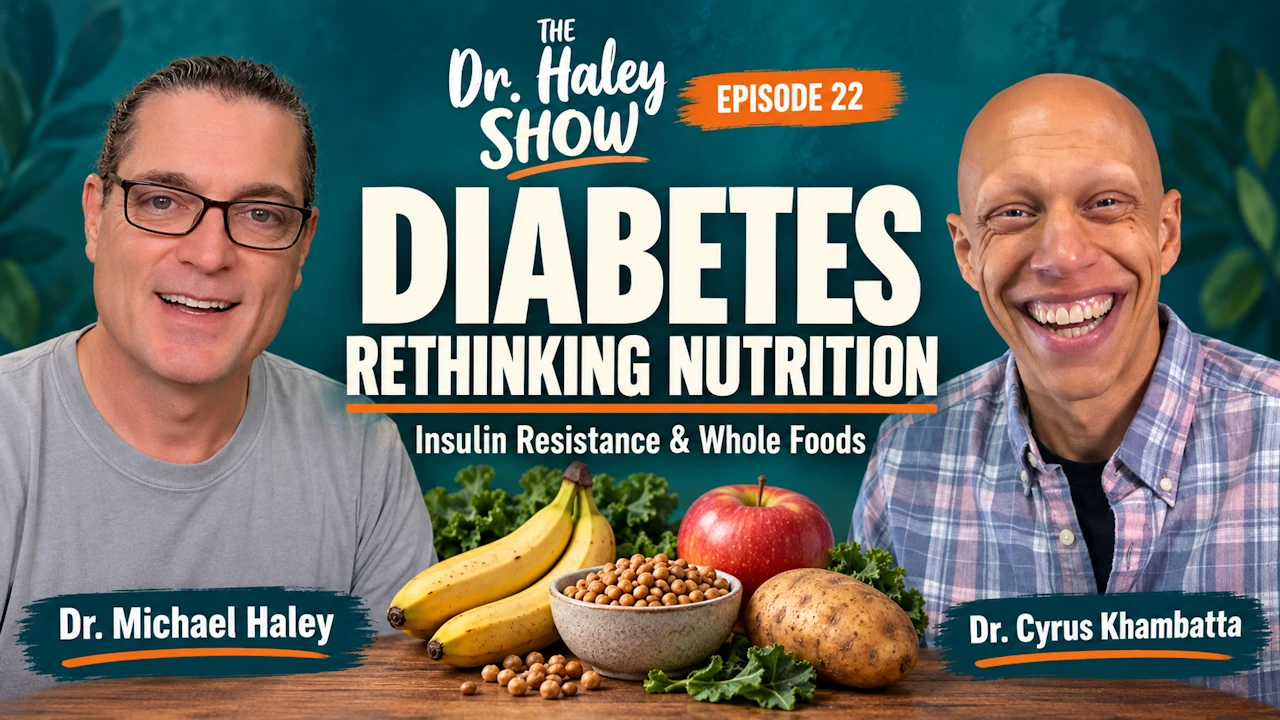
There is a tremendous amount of confusion surrounding nutrition, featuring many differing and often contradictory viewpoints and conflicting research results. Today’s guest has attempted to compile and summarize over 100 years of evidence-based research, specifically around the area of food and blood glucose control.
In today’s episode of The Dr. Haley Show, Dr. Haley chats with Dr. Cyrus Khambatta, co-founder of Mastering Diabetes and Amla Green, and an internationally recognized nutrition and fitness coach who has been living with type 1 diabetes since 2002.
Dr. Khambatta co-created the Mastering Diabetes Method, which he describes as an approach to reversing insulin resistance in all forms of diabetes. He reports helping more than 10,000 people improve their metabolic health using low-fat, plant-based, whole-food nutrition, intermittent fasting, and exercise.
You’ll learn a little about Dr. Khambatta’s personal experiences, many of which went into the creation of Mastering Diabetes.
You’ll discover why the world of food and nutrition seems so confusing with conflicting studies and opinions by experts in the field.
You’ll also hear Dr. Khambatta’s perspective on why much of what we know about blood glucose control and food and nutrition may be wrong, and how a better understanding relates to the fight against diabetes.
Join Drs. Haley and Khambatta for this fascinating and challenging discussion.
Enjoy!
Watch the Interview
Listen to the Podcast
Resources
Quick Takeaway
Dr. Cyrus Khambatta challenges the idea that all carbohydrate-rich foods belong in the same category. He distinguishes whole foods such as fruit, starchy vegetables, legumes, and whole grains from refined carbohydrates, and explains why he favors a low-fat, plant-based approach to improving insulin sensitivity.
His personal account of living with type 1 diabetes is central to the discussion: he describes changing his diet and reducing his insulin requirements while continuing to use insulin. He also discusses the importance of considering both short-term blood glucose control and long-term health.
ENJOYING THIS CONVERSATION?
Get the Next Episode in Your Inbox
Get notified when a new episode of The Dr. Haley Show is published, plus occasional highlights and resources worth exploring.
By subscribing, you agree to receive email from The Dr. Haley Show. Unsubscribe anytime.
Episode Timestamps
- 00:09 — Opening conversation and challenging nutrition beliefs
- 01:54 — The research and personal experience behind Mastering Diabetes
- 04:50 — Short-term results and long-term health
- 08:20 — Dr. Khambatta's diagnosis and dietary changes
- 13:35 — Whole carbohydrates versus refined carbohydrates
- 17:46 — Potatoes, fruit, and rethinking food choices
- 22:40 — The role of animal foods in a plant-focused diet
- 26:55 — Digestive inflammation and gradually increasing fiber
- 29:26 — Type 1 diabetes, autoimmunity, and proposed risk factors
- 36:19 — Different forms of diabetes, genetics, and lifestyle
- 40:47 — Insulin requirements and living with type 1 diabetes
- 45:13 — Insulin resistance and the coaching program
- 47:28 — A coaching client story
- 51:02 — Where to find the book, podcast, and other resources
- 52:44 — A future conversation and an aloe vera experiment
What You’ll Learn in this Show:
- A little about Dr. Khambatta’s personal experiences, many of which went into the creation of Mastering Diabetes.
- Why the world of nutrition seems so confusing with conflicting studies and opinions by experts in the field.
- Why Dr. Khambatta challenges common assumptions about blood glucose control and food, and how he connects that discussion to diabetes.
- And so much more…
Whole Foods and the Carbohydrate Debate
Dr. Khambatta explains how he separates whole carbohydrate-rich foods from refined products. Dr. Haley asks about foods he enjoys, including potatoes, bananas, mangoes, papayas, and home-dehydrated fruit. The conversation explores how food categories can shape eating habits and why Dr. Khambatta encourages a closer look at the foods behind those labels.
Plant-Based Eating, Animal Foods, and Fiber Tolerance
Dr. Haley asks whether animal foods are necessary and describes his own experience with satisfaction after meals. Dr. Khambatta discusses the distinction between a fully plant-based diet and a diet that includes smaller amounts of animal foods. He also describes a gradual approach to increasing fiber for people who experience digestive discomfort, rather than assuming everyone can immediately tolerate large amounts.
Diabetes Types, Autoimmunity, and Insulin Requirements
The speakers discuss type 1, type 1.5, type 2, prediabetes, and gestational diabetes. Dr. Khambatta shares his perspective on genetics and lifestyle and discusses proposed links between autoimmunity, early dietary exposures, and microorganisms. These explanations and interpretations are presented as the guest’s views.
Returning to his own experience, Dr. Khambatta describes changes in his daily insulin requirements after changing his diet and explains that he continues to rely on externally supplied insulin. His account distinguishes improving insulin sensitivity from eliminating his need for insulin.
Coaching Experiences and a Future Aloe Vera Conversation
Dr. Khambatta describes the Mastering Diabetes coaching program and recounts a client’s reported changes in weight, blood glucose markers, medication use, and daily life. This is an individual story shared by the guest, rather than a prediction of results for every listener.
At the end of the interview, the speakers discuss a planned conversation on the Mastering Diabetes podcast. Dr. Khambatta says he is trying aloe vera juice and is interested in whether it affects his blood glucose, while acknowledging that other factors make that question difficult to answer. No result from that experiment is established in this episode.
Medical Disclaimer
This podcast and article are provided for educational and informational purposes only and do not constitute medical advice. The experiences and opinions discussed are those of the speakers and should not replace diagnosis or treatment from a qualified healthcare professional. Do not begin, discontinue, or change any medication, supplement, diet, or treatment based solely on this episode.
Full Transcript
The transcript has been lightly formatted for readability. Because it was created from the recorded conversation, it may contain minor transcription errors.
Read the Full Transcript
[Music] dr cyrus cambada thank you for joining me today
i gotta say thank you dr haley it’s it’s uh it’s great to be with you here and i’ve enjoyed our conversations leading up to this point so let’s uh let’s make some positive change here
we’re gonna do that and i gotta tell you the truth man you’re rocking my world here i’m confused
you’re confused
let’s talk about it let’s talk about it what are you confused about
this is painful
why
well i’m reading your book and it is excellent and it’s i’m a science guy i really rely on science and there’s a lot of research that has been done to justify a position that you’re teaching that sounds like i’ve been wrong about a lot of things up to this point
interesting
yeah and and and it’s uncomfortable i have to look at food very very differently i’m not going to give it away quite yet because you know we’re throwing that out there for the audience i want them to tune in i know they’re going to have the same problems and struggles that i’m having right now changing the way i think about food and and eating all kinds of things okay and i can tell you’re a science guy too
yeah so i’m i’m actually very glad to hear that there’s a little bit of like either confusion or frustration or like annoyance that you’re like god damn it like i thought that was true but now you’re telling me that the opposite is true how’s that how’s that possible
um i’m glad you’re going through that process because here’s the first thing number one that book is not the ultimate source of truth that book is is designed to basically summarize over a hundred years of evidence-based research specifically about blood glucose control and food
okay that’s the first thing secondarily there’s also a lot of personal experience 20 years of my own personal experience plus almost 20 years of robbie’s own personal experience put into that book plus there’s also the experience of thousands of our coaching clients that have gone through the mastering diabetes method and we’ve learned a lot from them as well
so point being is that i want this to be a challenging process science should be challenging because it should always make you think that you don’t know what you’re talking about and that’s a that’s a mark of a good scientist who’s like open-minded and willing to be like you know what like i thought i thought the world was flat and now you’re telling me the world is round what how’s that possible right
oh boy you know when we had spoke the other day i mentioned a lot of people that influenced me to where i am right now you know people like dr joe mercola and gabriel cousins and and and sally fallon with the wesson a price and you know jordan rubin and and so many people that have different uh positions mike adams the health ranger and brian clement from hippocrates health institute
and and a lot of these nutrition experts leaders in the field of health have different stories different beliefs and there is a lot of science mixed in but there’s a lot of still a lot of confusion and we all have a very similar agreement on certain things like you know processed foods bad um you know organic whole foods better you know and but within organic whole foods there’s a lot of confusion because we have animal foods and we have you know uh raw vegan we have cooked we have you know there’s all kinds of different takes on it and some diets emphasize protein some emphasize carbohydrates some emphasize fats
well add to the list of people that uh influence me dr cyrus cambada you’re up there you’re in that list now of wow this is one of those people that really um helped form who i am and what i believe and what i understand to be true
so i have to change some of the things you know people listening to me uh have heard a lot and i might have to take some things back and reshape um some of my beliefs and hopefully our audience’s beliefs um this is this is going to be a great great life-changing episode for a lot of people
cool i dig it um one thing that i would say here is that one of the things that i’ve learned over in the in the course of many years studying science is that studying nutrition i should say is that if you apply this like good better best mentality to uh food it’s actually very helpful in giving you an idea so like what’s uh you know what’s a reasonable strategy to like improve your overall health right
so good better best basically means there’s a good way to do things there’s a better way to do things and then there’s the best way to do things or the there’s the optimal way to do things right
and the position that i come from and the position that we come from and maybe this is why it’s slightly different than other health experts is because i’m always trying to accomplish two things simultaneously number one i want you to eat in a way that’s going to improve your short-term health and what i mean by that is i want you to find i want you to employ the principles that we’ve outlined in our book that help you get better blood glucose control lower your a1c value lose weight if you are overweight or get you closer to your ideal body weight help you gain energy help you gain mental clarity and improve your overall cognitive ability
okay all of that is like short-term stuff that you could measure literally within hours or days
in addition to that i also want to teach you how to improve your nutrition so that 30 years into the future your long-term health is optimized okay
so what that means is that i don’t want you to make decisions that are going to improve your short-term health today and give you the impression that you’re getting healthier even though 30 years into the future your chronic disease risk is higher and your risk for diabetes and cancer and heart disease is higher that’s not good enough
what i want to do is try and teach you a way where you can improve your short-term health and improve your long-term health such that you can go to sleep at night knowing with a high degree of certainty that what you’re doing is not only making you feel better right here and right now but that 30 years into the future your risk for cancer has gone down and your risk for pre-diabetes and type 2 diabetes has gone down and your vasculature is in a significantly improved place and
so much of what i see in the world of health is short-term only it’s literally about losing weight quickly and dropping your a1c quickly and lowering your blood glucose quickly and it’s not designed to improve your long-term health and it’s certainly not designed to help you live a longer period of time or improve your longevity
right so if you always think about decisions as basically being i want the short-term benefits and i want the long-term benefits then it becomes more clear as to why we wrote mastering diabetes because it’s it’s both the short-term and the long-term strategy at the exact same time
yeah that’s a beautiful thing and i i completely understand what you’re saying because if you lower those numbers in short term you might feel great and think you’re on the right path but you know you might find your need for medications insulin going up up up gradually over time and leading to more chronic disease and other problems associated with diabetes or cardiovascular disease
tell us your story what brought you to this point where you said you know i have to learn how how to control my sugar levels and you know eventually write a book about it what happened
great question so i was diagnosed actually with uh three autoimmune conditions when i was 22 years old so i was it was the year 2002. i was a senior at stanford university and i was just trying to graduate and move on with my life i was studying mechanical engineering and i was uh you know literally in my like second to last you know semester of college
so i started to feel really ill and when i say ill i mean i was so thirsty it was like mind-boggling i would drink you know between a gallon and two gallons of water per day and every single sip i got thirstier in addition to that i couldn’t sleep very well i was like very restless in addition to that i was urinating every 30 minutes like clockwork in addition to that when i would go to sleep my muscles would cramp so tightly that it felt like i was in full body rigor mortis sometimes where my left breast muscle or chest muscle was was cramped and then some of my abs were cramped and then my right calf was cramped and then my left butt cheek was cramped and before i knew it i was like this is terrible i don’t know what’s going on
so i picked up the phone i called my sister who’s a doctor of osteopathy she’s family practice doctor and she’s brilliant and i said shanaz can you explain to me what all these symptoms are like what did i do to myself
and she started crying immediately she said cyrus go straight to the health center you’re giving me the symptoms of type 1 diabetes like do not mess around go right away
so i followed her advice i went to the health center and they they measured my blood glucose while i was there my blood glucose came in at over 600. okay blood glucose is supposed to be between about 70 and 130 all day long every day so if i were to check your blood glucose at any moment in time whether you’re sleeping whether you’re in the middle of exercise whether you just ate a meal your blood glucose would probably be between 70 and 130 because you’re non-diabetic and we want to keep you that way my glucose was six times higher than it had to be than it needed to be and six times higher than that range
so they immediately took me to the hospital they gave me a iv in one arm and then a drip irrigation of insulin in the other arm and they tried to lower my blood glucose using insulin
and then they explained to me over the course of the next 24 hours that i had three autoimmune conditions number one i just got diagnosed with type 1 diabetes so sorry to hear that but that’s the truth number two i also had hashimoto’s hypothyroidism which had developed over the course of the previous six months and then number three i also had alopecia universalis which is just a fancy scientific way of describing why my hair was falling out literally my hair was falling out in chunks in my head and on my chest and on my legs and i now you know for people who can see this i have no hair i have no eyebrows eyelashes nothing i literally have not a single hair on my body
it’s an autoimmune condition all three of them set in within six months and i was like what the heck happened to me i don’t understand
so the doctors at that time told me that they don’t know how to treat hashimoto’s hypothyroidism other than using levothyroxine or synthroid which is a you know prescription medication number two no idea how to treat alopecia there’s really like no you know known intervention that will actually regrow your hair
number three but for type 1 diabetes you can eat a low carbohydrate diet because if you do number one your glucose will stay more controllable and number two you can prevent yourself from using more insulin into the future
so i was like okay i think i’ll do the low carbohydrate thing so for the next year of my life i started eating things like red meat white meat turkey burgers quote unquote lean meat i had eggs i had cheese i was eating dairy products i had some oil in my diet but i was trying to avoid all the carbohydrate-rich foods like fruits and potatoes and breads and pastas and cereals and it was supposed to keep my blood glucose controllable
but it did the exact opposite my blood glucose was a disaster it was a roller coaster it was all over the place and my insulin use started creeping up started 25 units per day went to 20 29 32 36 39 42 sometimes i was using 55 units of insulin a day even though my carbohydrate intake was super low so i knew that there was a problem
so long story short i ended up learning that there was an alternative way of eating which was this thing called a plant-based diet so under the guidance of a nutrition pro his name is dr doug graham he took me under his wing and said listen i’m going to show you how to switch over and eat a fully plant-based diet and in the process you’re gonna you’re gonna lower your fat intake and effectively eat more carbohydrate at the expense of less fat and i was like cool i’m in let’s do it
i was expecting my blood vessels to go through the roof because that’s a story that everybody else had told me that carbohydrates are bad for you and when you eat carbohydrates all of a sudden your glucose is going to go out of control but when i did what he said i went from eating 100 grams of carbohydrate per day to 600 grams of carbohydrate per day
that’s amazing
it was ridiculous and my blood glucose came down dramatically which then lowered my insulin use by 40 in one week okay
we gotta pause right here for a second make sure the audience gets this it’s time for a happy dance okay more carbohydrates carbohydrates are possibly a good thing right what what does that not mean though what does that not mean
what what do you mean by that
well uh what kind of carbohydrates obviously don’t get do too happy of a dance and think hey you know let’s go get that that pie that cake that ice cream right
yep okay very good question so the type of carbohydrate that i was eating at that time the type of carbohydrate that has also been extensively studied through uh you know scientific research dating back to the 1920s as well as very sophisticated modern research methods is whole carbohydrate energy
okay there’s i want people to sort of think about carbohydrates that’s coming from like two two main sources right there’s either edible and inedible carbohydrates or there’s another way to think about it which is more um more accurate is that there’s whole carbohydrates and refined carbohydrates okay
so carbohydrates are effectively just a class of molecule that is found very abundantly in nature okay carbohydrates are found all over the place you find carbohydrates in potatoes and it’s stored in the form of starch you find carbohydrates inside of fruits and it’s stored in the form of what what biologists refer to as free sugar okay
you also find carbohydrates in an inedible format in many other parts of nature including things like wood okay tree bark wood contains carbohydrate energy doesn’t mean that you and i can eat it okay
you also find the single most abundant molecule in all of nature is a carbohydrate and it is called fiber or cellulose okay and that fiber is all over the place i mean it’s in grass it’s in leaves it’s in twigs it’s in fruits it’s in vegetables it’s in stems it’s everywhere okay
fiber is like the rebar of nature that gives plants structure and and humans actually can’t digest fiber but we have microbio uh trillions of bacteria inside of our microbiome that can and that’s part of the reason why they’re so beneficial for us
so long story short there’s whole carbohydrate and refined carbohydrate whole carbohydrates come from basically four main classes of foods fruits uh starchy vegetables legumes and whole grains those are the sort of four uh whole carbohydrate-rich foods that we recommend
then you have a whole collection of refined carbohydrates that come from things like cookies crackers breads chips pastas soda sugar sweetened beverages refined sweeteners and the list goes on
so the type of carbohydrate that science has discovered over the course of many years to be very beneficial and optimal for human health is the whole carbohydrate it doesn’t take a leap of faith to understand that but the more natural the carbohydrate quality is the closer it is to nature the less cooked it is the better it is for you as a human being
the more processed it is the more steps it had to go through in order to go from being on a plant to on your plate the less healthful it is for you so the more milling and cracking and grinding and dehydrating and processing and extruding that that that a food has to go through in order to become an edible product the less its nutrient value the less it’s micronutrient value and you end up with something that yes it’s carbohydrate rich but it’s also very nutrient poor and it can become inflammatory and increase your risk for chronic disease
yeah yeah sure it sure does and you know i i think that i i think i was the timing for your book was right for me i’ve been hearing enough from people like um well patrick vickers with the gerson therapy who helps people overcome cancer through diet and people like chris work from crispycancer.com and he teaches people to eat things like carrots and and whole fruits and things that you know patrick vickers i remember him talking about the baked potato and how it was good energy and your body needs that energy to fight cancer to defeat cancer which was already contrary to everything i had been taught up to that point you know when it comes to okay wait a second isn’t the white potato a bad thing
now here’s the good news and um for people listening um i love white potatoes and i always i felt guilty i would boil them keep them in my refrigerator and every now and then reach in and eat one like an apple and i’d try to limit my intake of them thinking they were bad for me and i’m finding out that could actually be some really good powerful energy and nutrition to carry me through the day
um i love bananas always got them there and i try to limit like i want to eat three or four sometimes more in one sitting and i felt guilty but i’m thinking i’m i’m understanding that i’m not doing such a terrible thing when i eat those foods i love mangoes i love papayas we grow them all over in our yard and stuff and and can i just eat one after another
you you absolutely can you absolutely can and i’m actually glad to hear you like going through this process internally because so much of the information that we are provided with on social media and on google and on webmd and on instagram and on youtube is all about avoiding things like white potatoes white potatoes are bad for you don’t eat white potatoes because we’ll just turn into this thing called sugar and sugar will increase your blood sugar which will make you more diabetic and it’ll make you fat so don’t do that right
and the the problem with that methodology is in general okay the the foods that are considered like white like white table sugar don’t eat that stuff that stuff is napalm absolutely not okay white bread again that is a highly processed carbohydrate-rich food that we just talked about is like has no place in the human diet so of course eliminate that
but a white potato should not be in that category by any stretch of the imagination because a white potato is a whole carbohydrate that uh even though it has a pale color does not mean that it’s inflammatory or that it’s going to make you fat or going to increase your blood glucose okay that’s just a fallacy
so to answer your question could you should you eat a lot of those foods the answer is absolutely the people who eat the most fruit starchy vegetables legumes and whole grains the people who eat the most fruit starchy vegetables legumes and whole grains have the most exceptional health
and we see this in the scientific literature over and over and over again they’ve done studies on individuals either in you know isolated metabolic wards or they’ve done epidemiological studies on large numbers of people over large periods of time and have discovered the exact same thing which is that the more starchy vegetables fruits legumes and whole grains you consume the more likely you are to achieve your ideal body weight the more normal quote-unquote normal your biomarkers become the lower your cholesterol the lower your blood pressure the lower your a1c the lower you’re fasting blood glucose the lower your c-reactive protein
and the list goes on so if you enjoy those foods then please my friend eat them in abundance and eat them as much as you want because the more you do that the more likely you are to achieve optimal short-term and long-term health at the same time
oh yeah that’s awesome uh wonderful to hear and uh in the past couple days i’ve been enjoying a food that i haven’t had in a while um you know we we filled up our dehydrator with bananas and apples and had you know banana chips and and apple chips and i would imagine those are still considered whole foods that’s minorly processed maybe not the fresh apple right out of the fridge but probably still pretty good for you
absolutely yeah i mean you’re basically just taking the apple cutting it and then dehydrating it
correct
that’s right
oh yeah 100 so yeah did it go through a manufacturing process no technically not you just effectively like lightly cooked it 100 whole at that point right so go for it
now i’m about a a week into modifying my diet a little bit and what i have been personally uh decreasing haven’t eliminated 100 i would i i don’t know if i will be able to we’ll see how this goes um and i you know my audience knows that i’ve always differentiated between you know healthy animal foods and conventional animal foods but i’m understanding that i might have to change my thinking in that area and my audience knows i’ve never you know it’s been small animal amounts of animal foods
what do i do with that are they still needed or do i got to throw them out the window
okay that’s a great question actually i think the word need is actually the key word in your in your question here right do you need to have animal products in your diet in order to uh optimize your short-term or long-term health that’s that’s the main question that you’re asking
and animal products for clarity include either red meat white meat fish poultry eggs or dairy products okay and then i maybe would throw in like organ meat as well okay
the answer is do you need any of those foods or some combination of those foods in order to live an optimal life the answer is absolutely not and again we know this not only from you know personal experiences from working with other people we know this from scientific research this is like this is uh this this concept shouldn’t be debated anymore it really shouldn’t be debated but unfortunately it still is because everybody wants to have their opinion all right
but if you did incorporate some animal products into your diet does that mean that you are doing yourself a disservice and that you’re going to dramatically increase your chronic disease risk and you know die at a younger age and the answer is it depends on how much you consume
okay so the general consensus within the scientific community of nutrition experts who really understand the distinction between plant-based meals and animal-based meals the general consensus in this community now is that the more plant material the better
but there is there’s there’s not necessarily a consensus on whether or not eating 100 plant-based is better than having a small amount of animal products in your diet okay so it becomes really hard to tell from a scientific perspective whether or not you having like i don’t know call it ten percent of your calories from animal foods versus zero percent of your calories from animal foods if that makes that much of a difference right
so if you have a couple of servings of meat and or dairy products in your diet on a weekly basis and you just really enjoy eating those foods and you don’t want to get rid of them and or you know feel junky if you got rid of them i would say don’t stress about it right if you want to become fully plant-based go for it you know i’m all about that
but um there’s a main there’s a big difference between eating approximately 10 of your calories you know from animal products which again the scientific community would generally consider to be a very healthy diet versus eating 40 of your calories from animal-based foods which the scientific community generally agrees is going to likely increase your risk for chronic disease
yeah and i think my audience knows that uh they’ve been listening enough to know that you know big salads including all kinds of you know from and i like steamed uh vegetables on my salad you know i just prefer them but whether you’re having raw carrots or steamed or you know cucumbers and and beets and you know there’s so many delicious foods uh having a salad that aren’t animal foods
for me when i consume some animal foods i feel more satisfied um i i’m not returning to the kitchen so quickly um and i think that’s probably what why i crave them personally um
you know we have to cross over because type 1 diabetes create there’s an immune component involved in this
yes
an autoimmune component possibly related to uh some kind of inflammatory leaky gut
do you think that’s why you got type 1 diabetes to begin with
yeah that’s a great question so uh okay let’s back up here
and the reason i’m asking is because i’ve i have had a challenge helping people heal from their inflammatory bowels apart from things like bone stock or some animal foods so that’s that’s why i need some clarity here
got it okay okay so really what you’re asking basically is that if somebody has an inflamed digestive system mainly pertaining to their large intestine whether it’s ibs or ibd or it could be something like sibo small intestinal bacterial overgrowth or could be this general term called dysbiosis
those individuals often report that when they consume fiber-rich foods just like we’re suggest what i’m suggesting are actually optimal that if they were to increase their intake of fiber-rich foods good luck game over drive home safely it’s too hard it causes more gas more bloating more constipation abdominal pain and is is very uncomfortable
and there’s a biological reason for that okay in an inflamed state when your large intestine is is currently experiencing a significant amount of inflammation the microbiome is in a altered state which makes it very challenging to process small amounts of fiber as an especially large amounts of fiber
so in order to get to the goal of increasing your fiber intake and and maximizing your fiber intake you have to go through a stepwise process where generally speaking oftentimes people benefit from lowering their fiber intake to begin with and then slowly and i mean painstakingly slowly increasing not only the total amount of fiber but the diversity of fiber inside of your diet as well
and as a result of that over the course of time they can regain the ability to digest fiber and regain the ability to uh you know eat a large proportion of their diet in plant foods okay
but if we go back to the original question here about type 1 diabetes having an immune component the answer is yes both type 1 and type 1.5 diabetes have are are considered autoimmune conditions
so autoimmune is just a fancy scientific way of saying your own immune system has effectively like turned on itself your own immune system is now creating a destructive process in some tissue or some collection of tissues
so type 1 and 1.5 diabetes is an autoimmune process in which your own immune system actually causes beta cell death it causes beta cell what’s called apoptosis or beta cell suicide and the beta cells are the very highly specialized cells inside of your pancreas that are responsible for secreting insulin they’re the only cell type in your entire body that can make insulin and when they’re gone they’re gone they’re not coming back
so sacrificing that population is a very very very costly decision because there’s no other cell type in your body that can manufacture insulin and so if you have an autoimmune process that has compromised those beta cells now you have to rely on exogenous insulin which is insulin that comes from the outside world that either comes from a vial or an insulin pump or something of the like
okay so autoimmune conditions like why do they start in the first place well there’s a whole host of reasons why autoimmune conditions are likely to start it depends i mean if you go onto wikipedia and you take a look at like how many autoimmune conditions exist i mean there are hundreds of autoimmune conditions and most of them have unbelievably complicated names and unbelievably complicated pathology and scientists don’t really understand that much about autoimmunity in general so some of them are so sophisticated that like the scientific community is sort of like well i don’t really know i don’t really know right
when it comes to type 1 diabetes there’s there’s actually some evidence that there’s a couple of things that could increase your risk for type 1 diabetes or type 1 and 1.5 number one the the consumption of cow’s milk protein at a very young age
okay so in an ideal world a child who uh you know is a newborn infant would receive pretty much 100 breast milk and then they would be breastfed for approximately a year maybe even a little bit longer than a year
and part of that reason is so the mom can transfer the you know part of our immune system and give the baby antibodies but in addition to that there’s also a whole collection of uh you know fatty acids and carbohydrate and protein which is transferred to the baby to serve as its optimal form of nutrition
now sometimes mothers have a difficult time breastfeeding sometimes they don’t produce enough milk sometimes it’s painful for them sometimes they’re just tired and as a result of that many mothers transition their kids to formula and the formula if you actually read the ingredients on the phone on the back of a formula it’s a bunch of processed stuff
right they’re trying to give the baby sort of a macro nutrient and micronutrient distribution that’s similar to what the mom’s breast milk would have would have been but i mean if you look at the actual ingredients in there it’s a lot of uh it’s a lot of refined products and it doesn’t really have a you know it’s it’s not an optimal you know form of nutrition for the child
point being is that when you transition some kids when you transition children to a formula from a young age and they no longer receive breast milk that can dramatically increase the risk for the development of type 1 diabetes not right there but years into the future we’re talking 5 10 15 years to your immune system to make an immune process that can then progress over the course of time and then actually manifest itself years into the future
in addition to that there’s one other thing that can cause an autoimmune condition or there’s there’s two other things number one viral uh sustainability there’s one virus called the cocksacking virus and the coxsackievirus has a pretty close relationship when you get the coccyx virus you can dramatically increase your risk for the development of type one and scientists know this
and then in addition to that there’s also another bacteria that’s been identified called map which is mycobacterium avium paratuberculosis don’t remember that point being is that that’s a bacteria that is found inside of the digestive system of uh land-grazing animals particularly domesticated livestock and some of those animals develop a condition called john’s disease jones disease is where the map bacteria infects their gut
those animals defecate or poop on the soil that you know the bacteria is present inside of their poop it gets onto the workers gloves and boots and then when they’re packing the meat inside of the inside of the uh you know the slaughterhouse that bacteria can get inside of the meat and the dairy products it goes to the grocery store it can escape pasteurization before you know it now you have live map in your fridge
and then when you consume that map it can it can increase your risk for specifically the destruction of beta cells right
yeah and i know that you’re not just making this up you had written about it and you know there were samples that were actually taking from the stores and tested for this particular bacteria and there was certain percentage of you know all dairy products or meat products that had this in it and it was kind of a shocking percentage like you know it may have been and i i forget the numbers but maybe it was 11 percent of all dairy
wait a second okay so you know if i’ve if i had dairy from 10 different sources in my lifetime i probably one of them probably had it you know so i’m already exposing myself to these things
it’s pasteurized
no these things actually were tested in pasteurized products and they found them still
yeah and what’s another really uh powerful statistic here as i’m reading from our book on page uh i don’t know 91 the connection between map and type 1 diabetes is so strong that a recent review of current scientific literature showed that 100 percent of human studies analyzed detected the presence of mhp bacteria in people who are living with type 1 diabetes
so doesn’t that doesn’t necessarily mean that if you are exposed to map you will develop type 1 but it’s showing that people who have type 1 100 of them have the map bacteria
right so that’s cause for you know investigation
absolutely yeah
you know i’m finding this to be absolutely uh fascinating it’s it’s completely changing the way i think about food i’m i’m enjoying food more now because i was saying no to things that i loved that were actually good for me and i probably knew they were good all along but because i heard or read differently i put them away
yeah
right i decreased them i thought i was doing bad i um how much does genetics play a role
how much does genetics play a role in in what the development of type 1 or type 2 diabetes
well you know maybe we should differentiate between them a little bit too because you had mentioned type 1 type 1.5 type 2 there’s how many kinds of diabetes and yeah what does which which ones are susceptible to genetics
okay uh so just like we talked about type 1 and 1.5 are autoimmune conditions but they do have a strong genetic component so what that means is that if you’re your mother your brother your sister your cousin your aunt your grandfather if it’s if it’s within your family lineage then your chances of developing type 1 are probably a little bit higher than the general population
all right [Music] secondarily there’s pre-diabetes type 2 diabetes and gestational diabetes
pre-diabetes affects the largest proportion of the population let me give you a ridiculous statistic in the world in the in the united states right now there are 85 million people approximately who are living with pre-diabetes most of them don’t even know okay 85 million out of 350 million people that is almost one in three okay that’s like one let’s call it one in four that’s 25 percent of the di of the of the u.s population has pre-diabetes that is an absurdly large number
right and then if you don’t treat pre-diabetes you can go on to develop type 2 diabetes and then if you’re pregnant you can develop gestational diabetes so the question is are those three conditions related to each other and are they genetic and the answer is yes and no
there is a genetic component okay scientists have discovered that there are specific genes there’s a whole list of genes that show a connection to the development of blood glucose you know irregularity and you can go down the list and you can say okay what about what happens if there’s a mutation in this gene what happens there’s a mutation in this gene and yes that can confer and increase risk for the development of pre-diabetes type 2 or gestational diabetes
but what i want people to understand is that even if you have that genetic risk even if you were born with it and even if it’s something that you were you were given when you were born and there’s nothing you can do about that
the lifestyle that you live the uh the consume the exercise that you perform and your eating habits makes such a profound difference on your your risk for the development of pre-diabetes and type 2 and gestational that you can practically nullify the risk that you inherit by living an optimal lifestyle and i do mean practically nullify literally get rid of completely
right so if you eat a plant-based diet the way that we describe and it’s low in saturated fat in particular and it’s it’s un unprocessed plant material and you get approximately 30 minutes of exercise on a daily basis and you are close to your ideal body weight you put all these uh you know these uh this program into play then even if you have multiple genes that can increase your risk for pre-diabetes and type two and gestational it doesn’t necessarily matter because the gene expression or the you know those genes sort of effectively turning on and creating a blood glucose irregularity goes gets shut off
and as a result of that you don’t express those genes and by not expressing those genes you’re literally just carrying the information but it doesn’t translate into an actual disease if that makes sense
there’s hope for 85 million people
yeah exactly i mean the thing though that population needs to have too much their lifestyle in order to see change and you know just saying like oh my grandmother had type 2 diabetes or my dad had type 2 diabetes i’m going to get it is unfortunately it is an it is an excuse it is an excuse and it doesn’t it doesn’t match with the scientific um with with scientific knowledge
yeah and you know there’s a there is a lot to learn and understand and uh people get the book read it um it’s more than we can cover here uh but in mastering diabetes uh you talk about you know fatty acids and how they affect your insulin sensitivity and and um it just makes sense you know people have something they can do about it
now in your case let’s go back to to type one and i know you already gave the answer away but in case people didn’t read between the lines on that there’s certain cells that die that produce insulin and you already said you’re never getting those back but it doesn’t mean they’re all dead you still have some cells that are doing their job and in your personal story you had already mentioned that you had a an insulin requirement from the start where have you started where are you now and what can you expect going forward for yourself with type one
great question uh so at the beginning of the process 2002 my insulin requirements were approximately 25 units per day okay and that’s a combination of what’s called basal and bolus insulin together so it’s like background insulin plus meal time insulin okay so
25 units per day i ate a low carbohydrate diet my my insulin requirements actually went up which is i don’t know maybe i suck at eating a carbohydrate maybe maybe i’m an anomaly you know maybe i didn’t do it right who knows but the truth is that my my insulin requirements went from 25 all the way upwards of 42 units per day on average 42 units of insulin per day on average is what i was at one year into my diabetes career
and then i switched over to eating a plant-based diet 42 came all the way back down and it went down to an average of 23 units per day so as soon as i employed this methodology i went back down to 23 units per day and and now i’m somewhere between 25 and 28 units per day and that’s been stable for about 20 years
and the reason why there was a little bit of an increase is actually because when i was at 23 units of insulin per day i was underweight i literally was not eating enough calories so i had to increase my calorie intake and that necessitated just a little bit more insulin so now we’ll say i’m between 25 and 28 units per day and again that’s been stable for you know 18 years effectively
where do i see this moving forward into the future the answer is i would probably be between 25 and 28 units of insulin per day 10 years into the future and if i’m not then i’m either trying to gain mass which is unlikely or i’ve done something that’s uh you know increased my insulin requirements even though that you know i’m making a mistake in my lifestyle or i’m doing something that’s leading to insulin increase requirements
because my pancreas makes zero insulin at this point so there’s no contribution from me anymore it’s purely from the outside world so if my insulin requirements go up it’s because of my lifestyle
oh okay all right yeah cool and had you continued to follow uh mainstream medicine where would you likely have been instead of where you are now
that is a phenomenal question um if i had to just sort of like pure conjecture but if i had to get i would that i would be using probably between 50 and 60 units of insulin per day call it 45 to 60 years insulin per day you know and i can guarantee you i would not be feeling well i’d be you know i’d have probably a very suppressed immune system i’d be sick all the time um digestively i would be in a world of pain so yeah
yeah now these aren’t guesses because the reality is you have coached many people over the years
yes
and you hear from them and you help turn their lives around
yep
okay let’s get let’s get back to that um when we wrap up okay so
yeah we sorry go ahead
no no no no no go ahead
so we’ve developed a coaching program and a coaching pro the coaching program is basically designed to help people transition to a more plant-focused diet to reduce their to to reverse the underlying cause of high blood glucose and that underlying cause is this thing called insulin resistance
so insulin resistance has become like a a very important topic in the world of overall health because insulin resistance not only influences your risk for pre-diabetes type 2 diabetes and gestational but it also is the thing that makes your life very complicated when living with type 1 or 1.5
but it also funny enough is the thing that can dramatically increase your risk for many chronic diseases most of the chronic diseases that we experience in the world of of health today including things like high cholesterol chronically high cholesterol hypertension which affects a ridiculous number of people and fatty liver disease chronic kidney disease many types of cancers neuropathy which is nerve tingling you know fingers and toes alzheimer’s disease every single one of these is positively influenced by reversing insulin resistance
so if you can reverse insulin resistance then you’re going to lower your overall chronic disease risk and who doesn’t want that
so we teach people in our coaching program how to reverse insulin resistance and that’s the beauty is that when you do that not only does diabetes tend to just kind of fade away into the background but your overall chronic disease risk goes dramatic it goes down dramatically and as a result of that you can you know you’ll probably be alive on this planet for a longer period of time and even if you’re not you’re just going to be a happier camper the rest of your life
right so you know coaching program is something that we’ve been you know we’ve probably hand held maybe 10 000 people’s lives 10 000 people’s hands as they’ve walked through our coaching program and made some significant improvements in their overall life and we’re only honestly we’re just getting started just getting started
tell me a favorite testimonial or two from that program
okay favorite one of my favorite testimonials is from um okay we have lots of people who come to us with uh type 2 diabetes okay so it’s probably like the most common condition in general okay so um we have i’m just trying to think of like who’s the best type 2 testimonial that i can think of right now
don presnell okay don came to us many years ago he had type 2 diabetes plus he was oh no you know what i’m starting let me go back i’m gonna go raj raj raj was number one obese uh number two had diagnosed with fatty liver disease uh number three high cholesterol uh and number four type two diabetes okay he had all four of those conditions
and he his son making fun of him one day his son had a friend over and they were about to go play basketball outside and his son’s friend said hey do you want to invite your dad you want to invite your dad to come play with us and his son responded by he said our dad my dad’s too slow he can’t play with me anymore don’t don’t say anything
raj heard that and he literally like his heart sunk and he was like my son doesn’t even want to play with me anymore because i’m too slow that feels terrible
so literally that day raj was like i’m done i’m done like raj had multiple businesses he has plenty of money in the bank and he was just like you know what like i gotta i gotta fix this because my son doesn’t wanna play with me anymore like that’s terrible right
so what he did he uh came to matching diabetes and we taught him how to change his lifestyle within a very short period of time okay a short period of time being approximately eight months which is in the grand scheme of things not that long raj lost 75 pounds he reversed type 2 diabetes okay what i mean by that is a1c fell by like one and a half percent he was up in the sevens and he came down to the low sixes which is which is massive
um he had was also diagnosed with fatty liver disease which is a a tough condition to overcome it just takes a long time
he went back to his uh his doctor and his doctor um basically said um you had fabulous disease i did an ultrasound i saw the nodules uh you no longer have fatty liver disease how did you do that i’ve never seen that before
and raj basically explained the methodology to him and his doctor said wow you are literally a unicorn i have never i’ve seen this happen before
and rock was obviously very ecstatic about it he was using metformin as the oral diabetes medication gone no longer needs that anymore okay
so what we see oftentimes is that people come to us with multiple chronic diseases or multiple comorbidities and by reversing in some resistance they can get rid of multiple at the same time and i hear stories like that and it touches my heart
not only did raj become a healthier version but he plays with his kid all the time now and he’s like like damned if my kid doesn’t want to play with me anymore like i’m going to show this kid out of play basketball right and now i mean his life is a 100 times better right
oh that’s a beautiful story
yeah yeah
wow cyrus man i’m honored to have you on my show um where can people go to find out more about your coaching program where should they go to order your book uh mastering diabetes what’s the next best step
awesome thank you for thank you for the invitation to come here today
uh that’s what i recommend uh since you’re listening to podcasts you guys like podcasts uh go to uh the apple store and go to uh just type in mastering diabetes we have a podcast as well and you can learn you know a thousand things there
we also have a youtube channel if you like watching youtube videos which i’m obsessed with uh so you can just go to mastering diabetes type that into youtube and you’ll find us
we have a website masteringdiabetes.org and we also have a book it’s called mastery diabetes uh just go to amazon and uh mastering diabetes and you’ll see the book there um
however you absorb information whether it’s through your ears through your eyes whether you like to read text we have got you covered so you choose the best form of information into your into your head and then you can choose the right platform for you
that’s great yeah i visited your youtube channel earlier today and i looked at your uh lead video that had over a million views on it um yeah so it’s a popular channel you got some great content people go check it out and i’m going to say get the book too man if you’re like me and you like to carry a book around and and and chew on it a little bit there’s a lot of good content here really helped um change my thinking so you can change yours too
i love it thank you my man
cyrus thank you so much and i am gonna be on your show if you’re listening to this people check out his channel and you’re gonna ask me about some things that we didn’t talk about today so we’re gonna have a good time
absolutely so um yeah and you’re doing a little experiment for me
that’s right that’s right
so just to give some background here uh you were kind enough to send a bunch of aloe vera juice my way and i’ve been drinking that aloe vera juice and i’m trying to get it every single day
and part of what i would like to determine is to whether or not the aloe vera juice actually helps me lower my blood glucose or control my blood glucose with even more precision
and truth be told that’s a very hard question to answer because there’s a lot of things that are present in my daily life that help with that i don’t 100 know if i’m gonna come up to an answer
but um i will reveal all of my secrets uh in our episode and i can’t wait to have you on because honestly i’ve been i’ve been sort of casually learning about aloe vera and it wasn’t until i met you that i recognized that you are a true master and you have a whole world of knowledge that i could benefit from so when we have a conversation and we do our podcast together i’m really looking forward to learning a lot more
i’m looking forward people go check out that episode when you’re done with this one you’ll probably find it in a week or two on your mastering diabetes podcast
that’s exactly right
dr cyrus cambada thank you so much
thank you thank you have a great day [Music] you