
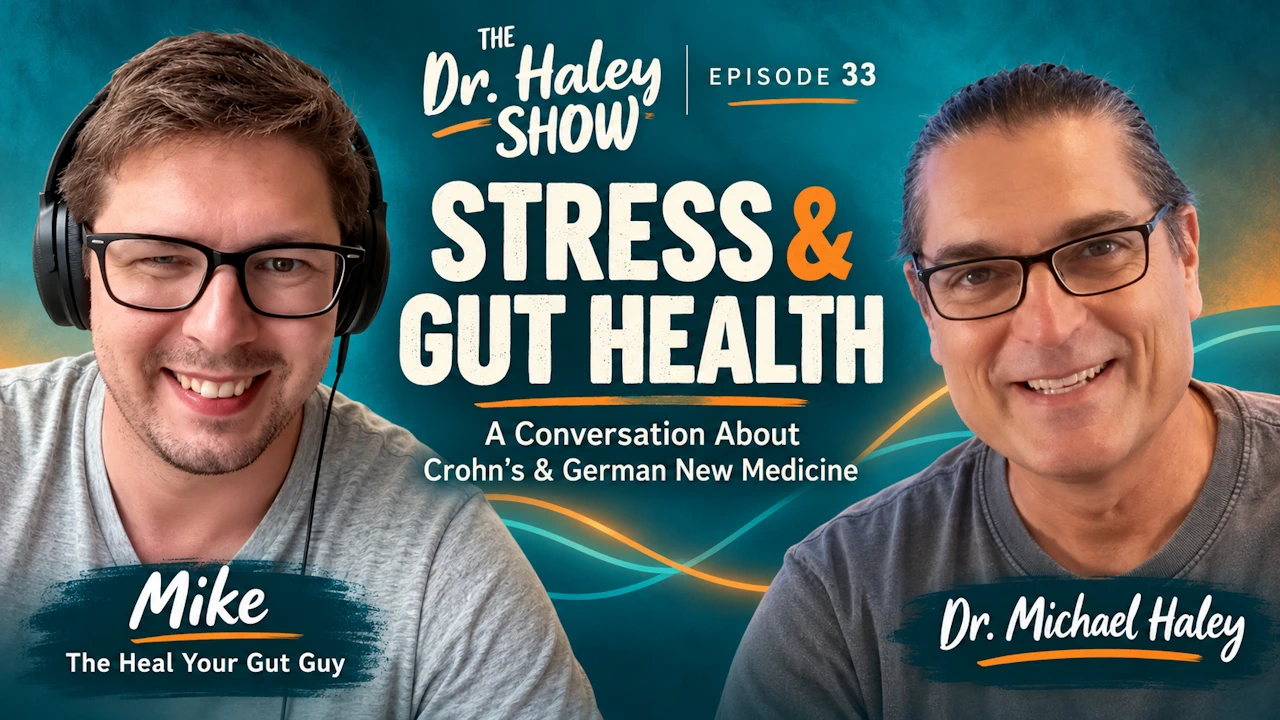
Mike the “Heal Your Gut Guy” tells us about his previous Crohn’s disease. He tried medicine and all kinds of gut healing protocols but real healing didn’t come until he discovered “New German Medicine” by Ryke Geerd Hamer.
About This Episode
Mike shares his personal account of living with Crohn’s disease, trying medication and restrictive diets, and adopting the framework he calls German New Medicine. The discussion explores his views on emotional conflict, food fears, and traditional diets. His explanations of disease mechanisms and recovery are presented as his claims and personal experiences.
Watch the Interview
Listen to the Podcast
Resources
Quick Takeaway
Mike’s central message is that his approach to gut health shifted when he began examining emotional stress alongside diet. He describes looking back at when symptoms started, exploring stressful events, and reconsidering fears surrounding food.
His account is a personal experience, and the interview does not establish that German New Medicine cures Crohn’s disease or that emotional conflict explains every digestive disorder.
ENJOYING THIS CONVERSATION?
Get the Next Episode in Your Inbox
Get notified when a new episode of The Dr. Haley Show is published, plus occasional highlights and resources worth exploring.
By subscribing, you agree to receive email from The Dr. Haley Show. Unsubscribe anytime.
Episode Timestamps
- 00:02 — Introduction to Mike the Heal Your Gut Guy
- 00:56 — Mike’s Crohn’s disease story, medications, and diets
- 02:23 — Discovering German New Medicine
- 03:25 — Dr. Haley’s perspective on stress and health
- 07:41 — Mike’s views on food, genetics, and the gut microbiome
- 10:42 — Mike discusses Dr. Crohn’s research and stress
- 11:49 — Looking back at when symptoms began
- 13:12 — Mike’s explanation of emotional conflict and digestion
- 16:45 — Mike’s coaching approach and program
- 17:59 — Healthy eating and fear of foods
- 20:41 — Mike’s current diet and traditional foods
- 21:59 — Bread, grains, and gluten sensitivity
- 25:13 — Mike’s account of working with restrictive diets
- 27:47 — Closing advice on identifying stressful events
What You Will Learn In This Show
The following topics reflect the speakers’ experiences and perspectives, including Mike’s interpretations of disease, research, and recovery.
- Mike’s experience with trying to get well from Crohn’s disease
- Medicine’s failure to provide a cure
- Various diets used in attempt to treat his condition
- Misconceptions about the cause of gut problems
- Dr. Crohn’s research surrounding Crohn’s disease and the microbiome
- Mike’s discovery of “German new Medicine” (GNM) and his “Indigestable Anger”
- A bird’s eye view of the system for mental discovery to get to the root of digestion issues
- Dicovering the conflict that is at the root of digestion disorders
- How the brain stem and gut deals with conflict centered on survival and attaining food
- And so much more
Mike’s Experience with Crohn’s Disease
Mike describes digestive symptoms beginning in childhood and a Crohn’s disease diagnosis during college. He recounts frustration with medication and experiments with several diets before discovering German New Medicine. He attributes a later change in his weight and health to understanding what he calls “indigestible anger.”
Emotional Conflict and the Start of Symptoms
Dr. Haley asks whether there is a process for uncovering emotional problems. Mike describes asking when symptoms began and exploring relationships, school, work, and family circumstances around that time. He uses examples of perceived threats to survival to explain his framework and makes claims about the brain stem and gut changes. These are Mike’s interpretations rather than conclusions demonstrated by the interview.
Traditional Diets, Food Fears, and Gluten
The conversation turns to the traditional diets associated with Weston A. Price, including dairy, liver, grains, and fat-soluble vitamins. Mike explains why he favors a more relaxed attitude toward eating and recounts experiences with people who had followed restrictive diets. The speakers also discuss bread and gluten, sharing opinions and anecdotes rather than individualized dietary guidance.
Medical Disclaimer
This podcast and article are provided for educational and informational purposes only and do not constitute medical advice. The experiences and opinions discussed are those of the speakers and should not replace diagnosis or treatment from a qualified healthcare professional. Do not begin, discontinue, or change any medication, supplement, diet, or treatment based solely on this episode.
Full Transcript
The transcript has been lightly formatted for readability. Because it was created from the recorded conversation, it may contain minor transcription errors.
Read the Full Transcript
– Michael Hayley here. Welcome to the Dr. Hayley show. And today I have a guest that, well, if you’ve been searching on YouTube for how to heal your gut, chances are you stumbled on some of his videos. Mike, they heal your gut guide. I believe that we’re gonna talk about an area today that I’d probably fail to introduce you to enough. We’ve been so focused on diet and eliminating this to heal your problems. And I’ve always known the importance of what we’re gonna talk about today. But I fail, probably because I’m in the food business. So with that, Mike, the heal your gut guide. Mike, tell me a little bit about yourself.
Yeah, so thanks for having me on the show. My name is Mike, the heal your gut guide. And you know, essentially, you know, I kind of had gut issues growing up, diarrhea, looked like a skeleton, growing up. And then in college, you got pretty serious. And that’s when I got the diagnosis of Crohn’s disease. And you know, I was like, okay, cool, I have Crohn’s. What’s the cause and how do we fix it?
And I was just shocked at just the pure, just incompetence of the medical community. Like, they’re just incompetent. I don’t know how you hand somebody a billion dollars for decades. And they still can’t have an intelligent conversation. And, you know, it’s like, what’s the root cause? I don’t know. I don’t care. And, you know, I was in the DC area, John Hopkins, you know, all these places. And it was just the same thing. We don’t know. We don’t care beyond these expensive drugs for the rest of our rest of your life. And so, you know, I eventually caved. You know, I wasn’t really taken it seriously. So, I, you know, I eventually, you know, did all those things. And, you know, they still didn’t work. And then, you know, uh, increase the dose. That didn’t work.
And so, that’s when I started doing diets. Things like gaps diet. Things like supercribe hydrate. Wasted a price diet was probably like, and still is like the foundation of like my nutritional wisdom. I guess you could say and that took me quite a ways. But it wasn’t until I started to learn something called German New Medicine, the work of Dr. Homer. And the first time someone like shared that info with me, I was like, because I was working with a guy and he was doing his diet perfect. And he still wasn’t seeing results. And then when he told me, he’s like, I went on GMM and I gained like 20 pounds. And like a month, it’s crazy.
And I started learning about this and the and Dr. Homer shows us that every single disease in the body, but like we can see it on a brain CT scan. And when I started seeing the CT scans, like when I started investigating it, like that’s I was like, wow, like this has to like and when I started so for me, like I have like a lot of indigestible anger in my life and I can explain that more. That’s a very like two simplistic way to explain it. But like once I started understanding GMM, like I went from 150 pounds to now I’m 200 pounds. Oh, like a normal person.
Yeah. Yeah. You know a lot of the things you just said, um, I know I understand why you sort of mastered this area. Um, when I was in college, I heard my back and I went to the medical doctors and people not being able to walk for eight months, uh, in two weeks, I ended out and I fixed it myself in two weeks. That’s when I decided to, you know, okay. I’m supposed to follow the the plan and be the chiropractor. So I learned how to help people with those problems.
Um, interesting. The more I practiced, the more I realized there was more to it then doing just chiropractic. I would see patterns and realize, you know, when people came in with these certain low back pains, it wasn’t just structural. It was something going on up here, usually people that had real significant stresses in their life, uh, such as, you know, going through a divorce or whatever the case was. And, you know, those are the things that would trigger that, that, that, that problem, that process.
You know, we, we like to teach people that when it comes to health, there’s nutrition, exercise, rest, positive mental, well-being, and proper, nerve function. And that, that mental, well-being, you know, whether, whether you consider a spiritual, emotional, I’m hoping that you can take that component that I’ve failed to,
I feel like the, like, it’s always kind of like when that’s like part of somebody’s plan, like, yeah, we’re going to give you the five pillars and then like the most important part, which I, I believe is the most important part, which is the dealing with the stress that’s putting that organ into overdrive. It’s, it’s just, it’s not explained well enough. We’re not explained how our body deals with trauma or how our brain deals with trauma. Like, it’s just, it’s, it, it is a, it’s not a complicated subject, but it, it’s not, it’s not very well explored in today’s time.
Well, is there a, uh, a system for someone uncovering that problem in their life, addressing them?
So you, you, so most, most of your audience they have like, what back issues are?
Well, no, actually, you know, I, I kind of morph from the, uh, paraphractor to the, go on. Oh, okay.
All right. My name’s also Mike, but I’m not the heal, you’re a cut guy. I’ve been more of the help, you’re a good guy. Okay, okay. That’s good.
You know, and I, you know, funny, I also, I’ve been to the Western-A-Price conferences and I am a certified gaps practitioner. Oh, wow. You know, I’ve also have taken out a lot of the teachings from Jordan Ruben when it comes on at diet and you know, I’ve studied, you know, fermentation from, I’ve really looked at diet from so many different perspectives and up to this point, I’ve always kind of, you know, picked and chosen the best of the best. Yeah. And I could understand how to avoid the foods that we’re causing the problems. Yeah. Yeah. And, you know, leave people towards gut healing diet.
Yeah. So yeah, well, well, what, what, uh, is there any condition in particular? You’d like me to talk about or you, well, going to my story a little bit more or you know,
well, the whole condition thing because, you know, you know, as it reflects, good, gastritis, crones, siliac, you know, my view has always been these are just a bunch of different names for this, you know, some kind of gut problem and we name it based on, is it high up in the gut or is it down low and what do you think caused it? Do we think it’s autoimmune? Do we think it’s, you know, uh, parasitic or whatever? So we’ve given it a different name just to satisfy our own, you know, pride in what we think it is.
Yeah, so, yeah, so when we like, look at gut issues like today, we were like trying to like find what the villain is. Like who’s the villain that’s causing all the all these symptoms? And so like we got food kind of being the first one, like that’s like most people’s belief, like oh foods causing it, but it’s also kind of like who’s the good guy in the bad guy. I got to eat these foods and not those foods.
And then we have, um, genetics on the screen, which is to have bad genes and I’m just stuck with it for the rest of my life. And even as it like a like a like a kid who was like watching teenage mutant into turtles, like, I knew that was like a stupid explanation because like genetics is about helping us survive. Why would I inherit something that would greatly decrease my chances of survive? Um,
and what also we got toxins? That’s a good one, toxins. And you know what I mean? Oh, the gut microbiome. That’s another really big one. And you know, I’ve been, instead of studying like when these terms like came into being like the gut microbiome, I don’t think that was a popular term used until the 2000s, like it just wasn’t talked about until then.
But the thing is, this theory was dead a very long time ago. So Dr. Crohn’s, the discoverer of Crohn’s disease, you know, like they think it’s like all cutting edge to like like gut microbiome this gut right microbiome at like the hard logic is I had, you know, I’ve just been doing this a short time. I’ve seen so many people take probiotics and get zero results. Some, some have gotten results.
And then, you know, there’s people like my brother who they were not breastfed, so they didn’t get like a good foundation. Um, they had antibiotics on and off throughout their childhood. He didn’t eat yogurt and all that fermented stuff growing up. Guys, fine, fine. He doesn’t have, he’s never had any serious health issues ever. And there’s tons of those people. So like,
like, we have to follow the hard logic, like, on what’s going on there. And so German new medicine gives us that hard logic. Like, it, it, it, he could not, Dr. Homer couldn’t have done this work without seeing those brain CT scans and, and having, having, like, oh, in the brain stem, I see this ring here and, you know, everyone with that, they all, everyone with that has Crohn disease. And, and, like, that’s where we, that we have, like, our strong foundation in logic.
Well, all right. So, sorry. So what what is causing these problems?
So, so what Dr. Homer saw was, and, and so, so about the gut microbiome, sorry about that.
So, what Dr. Crohn’s did is he would take a bad gut microbiome, somebody with Crohn’s. He would take that and culture it and put it into guinea pigs and put it into rabbits and they wouldn’t develop Crohn’s. And then he would do the fecal matter transplants and they their Crohn’s would stay. And so, even he back in the 1930s, the literature, the 1930s, the 40s, the 50s, 60s and 70s, the most of the literature, like medical literature, was about stress, like some cataclysmic event.
And, you know, one of the things that you hear some of these doctors say, like, in their, in their, you know, when they’re writing and their biographies and stuff, they’re like, most patients won’t just, they won’t know exactly what that conflict is. Like, you kind of have to be a little bit of detective and work it out of them to find out what that, what that thing is that through their gut into overdrive.
And is there a system for that? Or was there one develop?
So, so yeah, you know, when I work with somebody, it’s all right, you know, tell me when you’re symptoms starting.
And there we go. Oh, well, it was a senior year of high school. I was graduating high school. And that’s when my symptoms started. And then you go, okay, great. So, something happens. Senior year high school when you graduate. And then I’m going to try to keep this as simple as possible, because never the simple, because usually it’s like, wait a second, freshman year I had symptoms. But what’s just pretend that this person, they just, they just had symptoms, like, senior year high school when they’re graduating. And then you asked them, okay, what was stressing you out? And they’ll go, oh, nothing. Yeah. You know, okay. There’s nothing wrong with me. Nothing. Nothing. Nothing’s great up here. And it’s like, okay, um, were you dating anybody? They’re like, no. Okay. Tell me about the colleges you were applying to. Like, you know, what was going on with your dad? What was going on with your mom? Something, like, you hit one of those things. One of those things is going to come up. And so it’s, it’s just, yeah, yeah, it’s, it’s, it’s a, it’s a, it’s a troubleshooting process. You know,
and, and the specific thing, so the, the intestines are controlled by the old part of the brain, the brain stem. So it’s like a very primitive, as it’s very primitive way of like thinking about things. It’s like, it’s like, it’s like a cell, and it’s like, it’s, it’s, it’s, it’s job is to absorb things. I’m going to absorb this pen. I need to absorb this pen, so that I can make notes to do work, and then I need to get rid of this pen. If I feel like this pen, if I can’t find this pen, and it’s like this cataclysmic event, I can’t, I, I don’t have a pen, so I can’t get a, not a graph of Tom Hanks. Like, now all of a sudden, my perception of this pen is super skewed. And now any time, like, I, I don’t have a pen, my digestive system freaks out. It’s adapting because it needs to adapt. It needs to put itself into overdrive to to help our chances of survival.
And normally that’s food, you know, and most animals it’s going to be food, but we need things to survive. I need these headphones. I need my computer. I need money. I need I need food. I need drink. I need girlfriend. I need mom. I need dad. I need friends. Like there’s like somebody with crones and colitis. There’s a thing in their life. There are obsessed about and their symptoms are going to be centered around the dramatic spikes, the dramatic spikes, and their perception of the whole thing.
That’s making sense and you know, I mean, you know, a lot of most people, we all have a need for love and you know identifying where that might be missing. I could imagine that when that is completely lacking, stuff in here is not going to be right. If I were to simplify that,
I don’t think that’s quite German, so what’s happening is so let’s say it’s so it’s on the intestines, right. For some reason, this pin is what’s what’s making it of actual food. So I need this drink, like I’m stuck in a desert, like I need this drink. I need it’s a it’s a morsel, it’s something I need to consume. If I don’t have this, I’m dead. Like that’s I’m being a little bit dramatic and I’m like raising my voice because that is how the brain is say I’m dead if I don’t have this and you might not like speak it out that way but you’ll see it in the person’s emotions like they almost like wow you’re even crazy person you’re like you’re gonna die without this like chill out.
So the way that our body helps us survive is it’s going to develop extra gut cells to help us digest or absorb this heart. Well in this case this doesn’t really need to be digested just needs to be absorbed. To absorb this hard to absorb thing and pour into my survival I’m gonna die without this thing and then when that conflict gets resolved when I get out of the desert and you know this is no longer a you know scarce resource then it gets rid of those extra gut cells and we’re pulling away the extra gut cells are being removed and that’s that’s when you get the blood and the mucus and the diarrhea and all that fun stuff. Okay so that was physically happening. Okay
you know you know I have some other things I want to ask you about before I do let’s get it in here just in case people attention span isn’t long enough. Yeah yeah you help people you’re some kind of like a coach you actually will help people figure this out in their lives.
Yeah so I have like a 13-day program that I like it’s like a workbook and so you know I take them step by step I kind of have like a four-step plan that’s about understanding what our body is doing what our brain and what our body and what the organs doing understanding how the mind stores trauma and then die it and how to find that trauma and how to resolve that trauma so that’s how I help people.
Okay and where will someone find that or how do they find your contact or
so I have a ton of free content on YouTube and TikTok Instagram all the social media channels but on my homepage that’s that’s where all my products are.
Yeah and for you listening if you type in YouTube, Mike Hill your guy you’re not going to find me you’re going to find him so that’s an easy way to find a YouTube channel. I found that out it was quite humbling but so how important you know having been through Western A price and all of that how important is healthy eating to you?
What is healthy eating? I’m sorry what is healthy eating even?
You know healthy eating is you know I think I think extremely important but I think it’s does more damage to be super afraid of foods like I would rather like this this is going to rub people a lot of people the wrong way you know I would much I wish somebody would fall like I’ll I’ll what’s the name price diet to the T and and be relaxed about it when they go get ice cream or whatever go get pizza with their friends but being afraid of food being afraid of vegetable oils is going to cause more damage in the long run
but what’s the what’s the name price diet is all about you know understanding the importance of like fat soluble vitamins and you know not being afraid of carbs and so you know there there are specific nutrients that I think like really help with the healing process like vitamin C and you know the the cod liver oil with with the high mineral butter because that has the vitamin K2 I think a lot of people overlook that they just get the cod liver oil whereas the mineral butter is what where we’re west and they price really saw the magic
man there was one story in his book where he was like raising young turkeys and he had the control group of turkeys and they gained 10% body weight over a month and then the second group he gave them just cod liver oil and I think they gained 20% body weight and then the last group that he gave cod liver oil in the high mineral butter that had the the X factor the K2 they gained 40% body weight and and and these are animals that didn’t have chronic diseases so you know our people who are chronically ill like our entire need of certain nutrients
yeah the other thing i love about the west and a price is the the understanding of the traditions of food and you come to know where your food really comes from the difference between beef a hundred years ago and beef conventional from the capos today yeah yeah and and it’s a different food for certain for certain a different food
so what is your diet look
like um you know I saw you I did kind of like all sorts of crazy diets for you know like 10 years so the past I’ve been doing Germany medicine for the past two years so I’ve been like very just like eating whatever I want but now I’m kind of slowly raining it back into kind of cleaning it up a little bit um
but like if I were to embody the West and a price diet like as best as I could what would I eat it would probably be like the Swiss the Swiss diet to be completely honest so it would be some dairy products um you know raw dairy if available but the dairy products are super important um those summer dairy products are going to have the most nutrients in it because that’s when the grass is most green and like fresh growing and you know that that those were the dairy products that that eat still even to this day that the alpine cultures revere um
i’d if liver live i mean liver if if someone eats liver once a week i mean that covers so many bases it’s not funny yeah you know i i like the the a branch wagger that beef liver mix oh yeah at liver paté is probably my favorite way to eat it so wow
so what about what about bread and gluten sensitivity so
looking at less than eight prices work i know that the shocks a lot of people every single culture eight starches with every single meal the only exception would be the eskimos and some people might argue the aborigines and um western a price witnessed a very broken aboriginal culture like they were they were in shambles and um but if you read you know if you read Sally Sally founds book who’s you know the the torch bear of western a price nowadays if you go read the old settlers journals like they they find six that 60,000 year old grinding stones. Like that big desert that can’t grow anything in Australia that used to actually be a big grain field. And the people that lived there, they were called the grass people. So, you know, grain is the most nutrient dense plant food. It did it.
And, you know, when you think of Vikings, you know, they weren’t like, “Oh, there’s gluten in my beer.” Like, no, it’s drink it. Like, it’s like, the only reason, like, gluten allergy has exploded in the past few years. It’s just because we’ve become more likely to be in the past few years. It’s just because we become more conscious of it. Like, because it’s just pushed down our throats nowadays. And yeah, you know, I think the Catholic church the other day, like, refused to give gluten, gluten-free communion. And I’m totally, I’m totally on board with that. But like, you have to understand, like, where that belief that, you know, the staff of life is going to kill you. And yeah, it might be Mount Satan or whatever, it might, you know, all that stuff. But why can’t you even eat the organic stuff? Yeah. Why can’t you eat the gluten? Because there’s gluten. It’s an every, it’s just a storage form of protein. That’s an every single grain. And it’s just a little different between grains.
I’ve always felt that way, too. And, you know, I grew up in an Italian family and we had gluten every day. And to this day, I could probably snort gluten and not sneeze. But,
yeah. I find myself eating a lot less of it just because I know so much more about food. My mind’s been open to new foods, like, you know, a decade ago. I didn’t know what branch wagger was. Yeah, the food that I enjoy now. We grow a lot of foods around our, you know, yard and, you know, so I find myself eating less, you know, my family was pizza every Friday night. You know, there was like a night so the week and it was always a Italian pasta, gluten, something type dish with, you know, good beef and, you know, that’s how we ate. So anyway, what is it like? So, do you, do you, do you know how people eat gluten again that were once completely, you know, couldn’t have it at all, it would throw them into a spin?
So I, you know, I do with, yeah, I help a lot of people who’ve been on the carnivore diet for a while, and it’s just amazing to hear some of these people’s stories. Like the one guy we were working with, he was on a carnivore diet for three years. And it wasn’t just like carnivore today, like you’re allowed fruits and all that stuff. Like this guy ate nothing but rib eye, no butter, just salt, no pepper. God forbid you put pepper on it, like that’s on the AIP list or something. Within a week, he was going to restaurants eating whatever he wanted. Like that getting rid of food intolerances is the easiest part of the word.
That’s a beautiful thing to hear. And even now reminder people, Mike Behill, you’re got guy find a mine YouTube. Get his program if you’ve been stuck. If you have been stuck, this might be what you’ve been looking for.
Thank you. And I can tell by looking at you, you have that confidence, yes it is. I can help you.
I don’t know if anyone’s tried any more things and I have so.
All right. Well, Mike, I think you’ve really. Open my eyes up and you know, between talking to you today and some of the videos I’ve seen on your YouTube channel. You know, I, I’m seeing more and more than mental component of our health. Not just how our gut functions, but the pains we experience, our energy levels. I am seeing the connection between the mind and how our bodies are working. And just more and more and I thank you for your contributions to my understanding. And
for those, you know, we only touched on this today. His YouTube channel, you know, click on the videos tab and you’re just going to keep on scrolling and scrolling and scrolling. He has so much content and it is all just a genius level presented in a way that will so help you understand the importance of this. So, Mike, I want to thank you so much.
Thank you for having me on. I really appreciate it.
All right. Any last words of wisdom for the listeners?
Yeah. You know, I think the first thing, if you’re suffering from gut issues, just, you know, really sit down and be, you know, completely honest with yourself, like, and it does help to have someone kind of hold your hand through the process. But like, when did it start? What was the year? What was the season? Were you in school? Were you at work? Who were you in a relationship with? Were you living? Like, start getting those variables down and then start trying to figure out, like, what was stressing you out during those times? And how is that thing like kind of still haunting you today? And it can get pretty abstract.
But first try to find that event because that that’s what allows your perception to open up and kind of see this the world that like the time living in. And, you know, my students are living in where you can start to see, like, you need to see that like that conflict, that cataclysmic event to even be open for your mind to be even like looking. It’s kind of like when you buy a new car, you’re like, buy like a Honda Civic and you’re like, “Oh my God, Honda Civic’s are all over the road. I didn’t notice them before.” It’s kind of like that effect.
That’s beautiful. And then when you figure it out, you have a specific way of dealing with it, should we send them to the YouTube channel, right? It’s there?
Yeah, that’s a long conversation, so.
All right. Awesome. Mike, thank you so much.
Cool. Thank you. Thank you so much.