
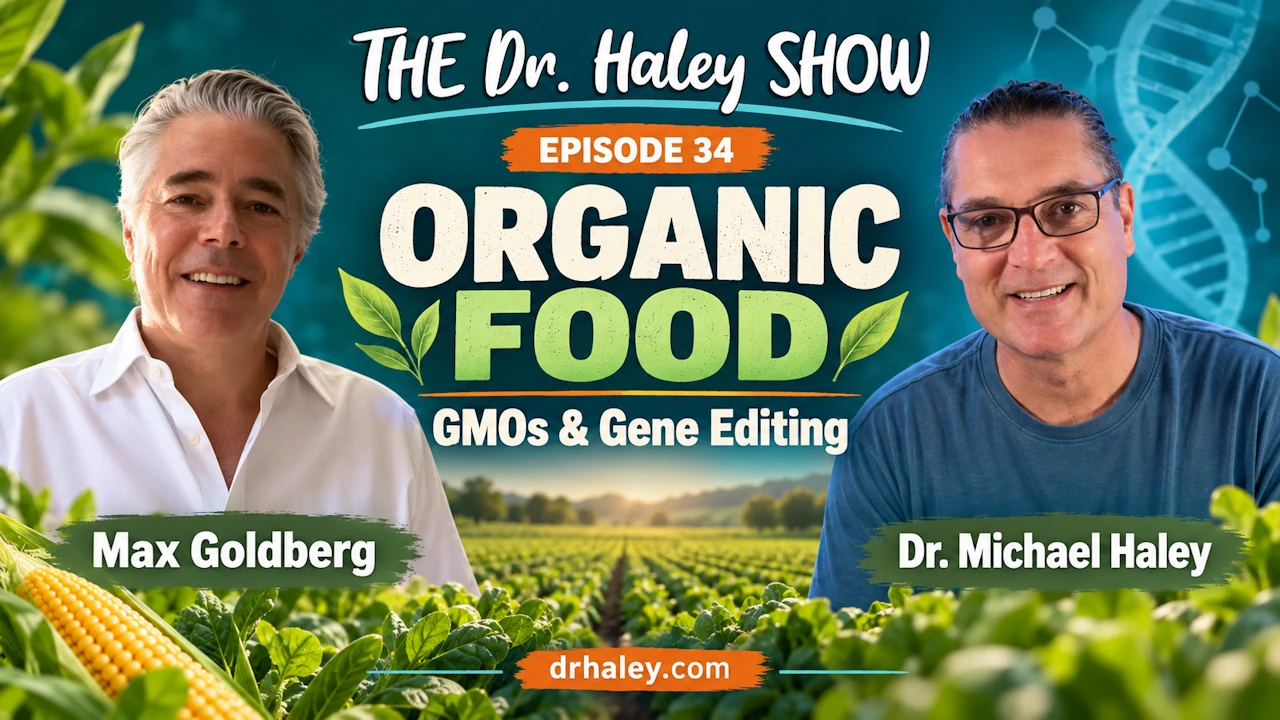
Max Goldberg is one of the most influential voices in the organic food movement today. His Organic Insider newsletter is considered required reading for those in the industry. Max also runs the Organic Food Industry group on LinkedIn.
About This Episode
Dr. Michael Haley and Max Goldberg discuss organic food labels, shopping at farmers markets, glyphosate testing, GMO and gene-edited foods, algae-derived DHA, and Max’s journey into organic food advocacy. The discussion reflects the information and perspectives shared at the time of recording.
Watch the Interview
Listen to the Podcast
Resources
- OrganicInsider.com
- Max Goldberg on Instagram
- https://haleynutrition.com
- Watch this episode on YouTube
- Listen to this episode on iTunes
- Glyphosate Residue Free Certification
- Regenerative Organic Certified
- Real Organic Project
- Institute for Responsible Technology
- Non-GMO Project
- E3Live
- Omega 3’s from Algae
Quick Takeaway
Max’s central message is to look beyond marketing language and ask how food is grown and tested. He explains why he values organic certification, additional verification labels, and direct questions to farmers and brands. He also shares his concerns about gene editing, labeling transparency, and the future of the organic movement.
ENJOYING THIS CONVERSATION?
Get the Next Episode in Your Inbox
Get notified when a new episode of The Dr. Haley Show is published, plus occasional highlights and resources worth exploring.
By subscribing, you agree to receive email from The Dr. Haley Show. Unsubscribe anytime.
Episode Timestamps
- 00:09 — Introduction to Max Goldberg
- 02:23 — Organic versus natural
- 04:36 — Questions to ask at farmers markets
- 06:17 — Glyphosate testing and certification
- 07:33 — Organic and Non-GMO labels
- 08:16 — Real Organic Project and Regenerative Organic Certified
- 11:33 — GMO and gene-edited foods
- 17:52 — Food supply concerns and supporting organic farmers
- 22:11 — Resources for tracking genetic engineering
- 22:50 — Common genetically modified crops
- 24:19 — Algae-derived omega-3 DHA
- 27:36 — Max’s personal journey and organic advocacy
- 33:28 — Organic Insider and Instagram
- 34:31 — Pressures facing the organic movement
- 38:15 — Shopping questions and closing thoughts
What You Will Learn In This Show
- The difference between Organic and Natural
- what to ask at a farmers market
- the various organic seals and how they are different
- Which non-organic foods are likely to be genetically modified
- The difference between GMO and Gene Edited foods
- What are the best sources of Omega 3 DHA
- And so much more
Organic Labels and Shopping Questions
The conversation explores the meaning of organic and its regulation by the US Government, compared with the marketing term “Natural.” Dr. Haley asks about food grown in his own yard without organic certification. Max explains that he sometimes buys from uncertified farmers after asking about their growing practices, while preferring to support certified organic farms.
Max also discusses how glyphosate contamination can reach organic food despite its use being prohibited on organic crops. He encourages listeners to ask brands about testing and describes Glyphosate Residue Free certification as involving quarterly product testing.
Understanding Additional Certification Seals
Max explains why he looks at Non-GMO verification alongside organic certification: a Non-GMO label alone does not answer questions about pesticide use. He discusses USDA certification of hydroponically grown crops and why he values Real Organic Project and Regenerative Organic Certified as additional labels that begin with USDA organic certification. He describes their emphasis on soil-based farming and, for Regenerative Organic Certified, soil health, animal welfare, and worker fairness.
GMO Foods, Gene Editing, and Transparency
Max distinguishes the transfer of DNA between organisms from gene editing that changes an organism’s existing genetic code. He discusses corn, soy, canola, sugar beets, potatoes, apples, and emerging gene-edited products. His concerns include labeling, potential contamination of organic farms, patents, and unanswered long-term questions. The Institute for Responsible Technology and Non-GMO Project are the resources he suggests for learning more.
Algae-Derived DHA and Max’s Organic Journey
The speakers discuss omega-3 DHA sourced from algae and Max’s involvement with Eversea. Max shares his views on DHA research, extraction methods, organic certification, and testing. Product availability and certification descriptions are those discussed in the recorded interview.
Max also recounts his personal changes involving alcohol, cigarettes, antidepressants, and cannabis; his meditation practice; and his transition from organic consumer to blogger and advocate. He explains how Living Maxwell and Organic Insider developed, and why he wants readers to follow regulatory issues as well as make informed purchasing choices. His personal experience is not a recommendation to change medication or treatment.
Medical Disclaimer
This podcast and article are provided for educational and informational purposes only and do not constitute medical advice. The experiences and opinions discussed are those of the speakers and should not replace diagnosis or treatment from a qualified healthcare professional. Do not begin, discontinue, or change any medication, supplement, diet, or treatment based solely on this episode.
Full Transcript
The transcript has been lightly formatted for readability. Because it was created from the recorded conversation, it may contain minor transcription errors.
Read the Full Transcript
Welcome to the Dr. Haley Show Podcast. I’m Dr. Michael Haley, your show host, and today. We’re going to learn about some new challenges with the term organic. And maybe pick up some tips on what to look for when shopping for organic foods.
Today’s guest is Max Goldberg. He’s widely regarded as one of the most influential voices in the organic food movement today. He’s been called an organic sensation by the New York Times, and named as one of the nation’s leading organic food experts by Shake Magazine. Industry CEOs have called his organic insider newsletter a must read and required reading. He’s been covering the organic industry for the past 13 years and also runs the organic food industry group. On LinkedIn, which has more than 40,000 members from all around the world.
A former Wall Street banker, Max received his BA from Brown University and his MBA from the Columbia University School Graduate School of Business on a personal level, Max has been so ever since 1999 and cigarette free since 2000, anti-depressant free since 2001, a drug that he was on. For more than a decade, pot free since 2004, his meditation practice began in 1991, and since 2001, he’s been eating close to 100% organic. Max, thank you for joining me on the Dr. Haley show podcast.
Dr. Haley, it’s a pleasure and thank you so much for having me and I’m really looking forward to our conversation.
You know, I want to give a shout out to Michael Saber from E3 Live for introducing us what a great guy and he spoke volumes about you, so you know, and we got into a little bit of a conversation last week and I said, “Wait a second, wait a second, wait a second, this is too good. You’re telling me things that I didn’t know about and I want to get it recorded because I don’t want to miss any of it and I know that my audience is going to feel the same way about it and they’re going to be glad that they can go back to this and share with their friends.
One of the things we were talking about was the word organic and you know, I guess that word has changed over the years, is that true?
Well, it’s a term that’s legally defined and regulated by the USDA, so when a company, people, I often hear, well, anyone can slap organic on a label and you know, that’s not true. This is a term that’s regulated by the government and if you put an organic on the label and it’s not certified by a third party, you know, you can be, you can get in some trouble. So this is a term that’s regulated by the government. There are rules, there’s regulations, there’s, there’s, there’s certification, there’s enforcement. It’s not a perfect system and as I will get into, but this is a, this is a term that is, is highly regulated by, by the U.S. government.
And one of the things that people may not know is, what, what the, what the, the, the most recent grocery shopping trends report said is that people are searching for the term natural as a, as a label in the supermarket. More than they’re looking for organic, which is, is unbelievable because natural represents, it’s not regulated. There’s no definition of it, there’s, it’s, it’s no enforcement, and yet consumers think natural is actually better than organic, and that is absolutely not the case.
Yeah, I’ve heard someone say that, you know, plutonium is natural or something like that. There’s a lot of natural elements that are very dangerous and harmful, so natural really doesn’t mean a whole lot.
So exactly, what should we be looking for then, like on, on packages and the various certifications, which ones are the higher standards, which ones are lower and and sometimes there’s foods that don’t have labels on them. I eat out of my own yard. I have a little bearer growing, I have avocados, I have you know, mango and in Florida we pick off the trees and we eat. They’re not certified organic. What should I be looking for in the food and should I be concerned when I’m eating food that isn’t labeled organic?
Well, you know, farmer’s markets, what I go to farmer’s markets two to three times a week and I try to buy from certified organic farms. Now, there are times when I’ll go to a farmer’s market and the farmer will say, I’m not certified for whatever reason, the cost or they have some philosophical issue with the USDA, but they’ll say, we have organic, we farm organically. We incorporate all of the organic farming practices, but we just don’t have the seal, the certification, and they may say, we’re beyond organic and then there are times that I’ll go to a farmer’s market and they’ll say, yes, we’re not organic and we actually do spray. So I find that when you go to the farmer’s markets, they actually more often than not, they’ll tell you the truth.
So I will buy from a farmer’s market, for example, even if they don’t have, I do like to support the certified organic farmers, but if I go to a vendor and they say, you know, look, we don’t spray, we don’t use any of the pesticides or chemicals, no GMOs. I would buy it, but I do prefer to buy certified organic, and I think when you and I initially spoke, it was the same question to you. You said, no, we don’t have the certification, but we’re not spraying anything. It’s grown in the Caribbean, and so I’m drinking your products, and so,
but I think people do want to look for the certified organic seal. Especially in the supermarket, and if a company does not have the organic seal, you know, you want to contact them.
And the other thing that I always tell people is, what we really need to do is we need to be asking organic brands, have you tested this for chemicals, for pesticides, for glyphosate.
Now what is glyphosate? glyphosate is the primary ingredient in Mon Santos, Roundup. And glyphosate has contaminated the organic food supply. This is something that a lot of people do not know. They think, okay, I’m buying organic, it doesn’t have any chemicals. Yes, it’s not chemicals are not like glyphosate or not allowed to be sprayed on on organic crops, but these chemicals have contaminated the organic food supply.
So there’s something called the glyphosate residue-free certification. It’s something that I’m involved with. And what it is, it’s a third-party certification. They have certified that the products, they’ve test the products on a quarterly basis, that the products do not contain this chemical glyphosate. So what I tell people, look for that seal as well.
And what I tell people is we have to demand that our brands, our favorite organic brands, our testing for heavy metals, chemicals, things like that.
So people should be looking for the USDA organic seal, the non-GMO project seal is another popular seal that you want to look in conjunction with the organic seal. It’s a mistake to say, oh, it’s got the non-GMO seal, it’s everything’s fine. No, non-GMO, the non-GMO project seal means at no, no GMOs. It doesn’t mean it hasn’t been sprayed with glyphosate with atrazine, with chloropyrophosate. Any of these very super-horned harmful chemicals. So you want to be looking for the organic seal and if it’s got the non GMO project seal alongside of it, that gives you more reassurance. Because your organic seal does not test for GMO contamination. And that is a problem as well.
Now I want to just mention two other certifications Dr. Haley, is that there’s one called, because there’s been a lot of criticism of the USDA that they’re not enforcing the rules, they’re allowed and we’ll get into this interlawing something called hydroponic, hydroponically grown crops. That is illegal in organic, but the USDA is allowing it.
So they’re two add-on labels that I am very optimistic and very excited about. One is called the real organic project and the second is called regenerative organic certified. So what are these? These are add-on labels, which means the product has to have USDA organic seal as a baseline. If it doesn’t have that, they can’t get these add-on labels. So these add-on labels go, they get added on, they get their added on top of these labels per say.
Regenerative organic certified is a regenerative organic certification that takes into account soil health, worker-fairment, worker welfare and worker-fairness and animal welfare. Those are the three pillars. And it was started by Dr. Broners, Hathagonia, and Rodale Institute. Rodale Institute is a non-profit of Pennsylvania. It is the where the organic food movement started in this country in the 1940s. Those three organizations started it. I think they have over a hundred brands right now that have gotten certified and this is the new gold standard in organic.
And the other one is called real organic project. And that does not allow factory farms in organic, which the USDA is turning a blind die towards. And it does not allow hydroponics. And that is primarily a farmer label right now. It is in the process of becoming more of a consumer one. But people are going to see the regenerative organic certified label more in the supermarkets than they will the real organic project label.
But if you want to find the highest quality organic food, you look for these two products that have these two seals on regenerative organic certified and real organic project and hopefully in the show notes you can put links to both of those so people can find them and learn about them. Because in my view these are the two labels that are going to save the organic movement.
Yeah you know I absolutely will include that in the description in the show notes and on the blog page in various places.
And why we’re talking about links and other sources for those to have a short attention span? Get over to organicinsider.com. Hit the green button on the top right. Well that’s where it is right now anyway. I don’t know where it’ll be went by the time someone’s hearing this message. But subscribe to the newsletter and you’ll be caught up on all the latest right. You keep us all up to date on what’s happening in the industry.
You were telling me the other day about kind of like a new type of GMO so to speak.
Yes.
What’s going on?
Okay there is many people know about GMOs and that’s traditionally the GMO corn and soy and cannola oil and they’ve introduced those are those are the traditional ones that people know about.
Those are the main ones. What they’re doing now is they have something called gene-edited foods. This is sort of the next generation of GMOs and this is something people really need to understand because I think this is the single biggest threat to the organic industry and it has not hit mainstream at all. It is just really beginning now.
So traditional GMOs say GMO corn, how it works, how these GMOs work is the following. What they do is they genetically engineer corn the seed so it is resistant to round up to glyphosane. So what happens is the farmer plants the corn seed sprays the glyphosane and all you know glyphos, it’s it’s round up resistance. So the farmer sprays round up on the corn and it kills all the weeds around it but it does not kill the corn itself. It is genetically engineered to be resistant to this glyphosane. So those are the traditional GMOs.
The next generation and what they’re doing is they take DNA from one organism and insert it into another one into the into the corn seed. So they’re taking the DNA of one organism putting it into another organism. That is transgenic.
These next generation GMOs are gene edited which means that they’re not taking DNA from one organism putting it to them. They’re just going into that seed and rearranging the genetic code. So that is called gene editing where they’re going in, they’re at their moving stuff around, their silencing, whatever they’re doing, and they’re making changes to the gene code to have different expressions.
So they are doing that with pigs. They did gene edited pigs. Everything’s going to be a gene edited. All the animals will be gene edited soon. And a company called Parwise, which is backed by Mon Santo, just released their gene edited salads. And I believe it is a, a, a mustard greens. So it won’t be as bitter. So these will not be labeled. The USDA is not requiring them to be labeled. And in Canada, the government there said that they are not GMO, even though these companies are using genetically engineering, using modern biotechnology tools. The Canadian government said that this is not GMO.
So people have to be super aware of what’s going on. And I foresee a time when all the restaurants, you know, not the organic restaurants, but they’re not that many of them. This will be in restaurants. This will be in schools. This will be in food service operations. And people will have no idea.
And what’s going to be sold to them is say, oh, we’re going to have more nutrients. And they’re going to sell them on these on these potential benefits. And what people are, we’re not going to know what the long-term human health risks are. And these gene edited crops out in the field, they could very well contaminate the organic farms out there as well. Because we know things like GE canola has certainly contaminated the organic farms. So this is a massive, again, these are people who are playing God with our food supply.
This is not crossbreeding. This is genetic engineering, using modern biotechnology. And these are engineers who are deciding how they want the evolution to proceed, not based on what could occur naturally in nature.
And I did a story a few years ago with the guy who invented. I interviewed the guy who invented the genetically engineered potato. It’s a genetically engineered potato that doesn’t bruise. And so this guy had real regrets. Many years after doing all this work and he goes, “Why are we changing things that have been around for thousands of years?” It’s that we have these plants have these expressed these certain traits for a reason. And what he said is he goes genetically. And not only to say the genetic engineering, there’s bound to be mistakes, but he said, “It’s like editing a book in a language you do not understand.” So it’s like you, you were eye editing a Chinese book and we have no idea how to speak Mandarin or Cantonese. That’s what he said it was like. Like everything a book and you do not understand the language.
You know, I’m listening to this and I’ll tell you what it’s going on in my head because looking at this from a logical standpoint, talk about a potato that doesn’t bruise. What is a bruise in injury and and somehow that changes naturally and it might even become susceptible to, you know, possibly microbes. But that would indicate that it was a real food. That’s perishable. Why would these other things not be bruising or changing?
It concerns me. And I’m thinking that, you know, well, I’ve heard that there’s places that will only buy potatoes without spots because they don’t want to serve french fries with dark spots to them, you know, or whatever the case is. I can see where this would make it into our food supply, and we don’t even know what those differences in the actual food are. How are they, you know, not susceptible to the bruising? What is the change and how is that nutritionally going to affect us for deplet us of something that’s important? That was inherent in that food that we would normally get, but now we’re not. Who knows?
Exactly. We don’t know the long-term consequences of doing this, and what I find really amusing is we’re hearing about AI and all these Silicon Valley people are warning about what could happen. We’re the warnings for the genetic engineering of our food supply, and potentially, I wrote a story about a month or so ago about something called genetically engineered microbes, and this, it’s frightening what could potentially happen with, if this gets out into the wild. So there’s tremendous concern about AI. Where’s the concern from Silicon Valley about the genetically engineered engineering or food supply?
The reality is this, the GM, the GMOs and the genetically engineering of our food supply have nothing to do with improved nutrition or any of those benefits. It’s all about money, power, and control. Because if we’re truly about improving everyone’s health, they would just make an open source and give it away for free, but they don’t. And it’s all about patents and privacy and lawsuits and enriching patent holders, that’s what it’s about.
So when people every day we get, we get to make this choice two to three times a day however many times as they people eat, we can have our money, directed towards organic farmers who are doing things the right way, who are not using the chemicals, who are supporting local communities, who are not spray, not exposing our farmers to super toxic chemicals, or we can support the companies that are the GMO companies, where it’s all about patents and privacy and secrecy and inventing food products that have never existed in the food supply before, that do not exist in nature and enriching Silicon Valley investors. That’s what it’s all about.
So consumers every day have a choice. Do we want to support the patent holders? Or do we want to support the organic farmers who are doing who are supporting the soil and keeping farming safe by not exposing them to super toxic pesticides?
You know, supporting the soil. Boy, you know, you think about the people that are spraying the fields, killing all the weeds, because, you know, well, they found this one, particular weed that was resistant to glyphosate, injected in all these foods. And now they’re spraying the fields, not only killing the weeds, but the microbiology and the things that make the soil healthy.
We’ve ruined the soil with chemicals. And now we have to add fertilizers to the fields to make the things. I mean, it’s crazy what this is doing to our planet and our food supply. So, man, I hear you. Wow.
Yeah, I mean, getting back to that I think people really need to reevaluate how they look at food and organic food in terms of the constant complain I hear is it’s just so expensive. And I know that there are times that it is more expensive, but as you know, food is not cheap. I mean, the food is medicine and we need to be thinking about and when I first got into it and I think when most people get into organic food, it’s all about me. I don’t want to put toxic chemicals in my body.
And then over time what happened, you know, as I started writing about the industry and really getting volucing, I don’t want my money supporting these companies. I also want to support the farmers that are not, you know, spraying these toxic chemicals on our soil and keeping the farmer’s safe. So the extra money is actually going to make to have a positive impact on our planet and our soil.
Yeah, yeah, you know, or there’s the herbicides with the pesticides and we’re killing our bees and so much more. Is there any like source or knowing what foods have been either genetically modified or genetically edited? Is there like a database where, you know, when they make this change, that has to go into the database or is it just right now free for all?
Well, there may, I don’t know, but I mean, people, there’s there’s a non-profit called the Institute for Responsible Technology and that’s probably and then also the non-GMO project, those two sites are probably the best resources for people. The non-GMO project is, that’s what the butterfly seal and you’ll see on all the packaging. They have three full-time researchers keeping track of all these next generation GMO companies. Okay. That’s, so probably I would say those two websites will have the best information. Non-GMO project and Institute for Responsible Technology.
You know, we all know to look out for corn, the flagship GMO food out there. What are some of the other big ones where, you know, chances are it’s modified if it’s not organic?
Corn, canola, sugarbeats, soy, soy is the big one, potatoes now. Now you’ve got these genetically engineered potatoes that don’t bruise apples have now become genetically engineered. Those are the big ones still are the corn, soy, canola, sugarbeats and canola.
Those are still the big ones, but these other gene-edited foods are coming. So like if you say, if I go to a conventional restaurant right now, am I going to be eating gene-edited foods? Probably not. I would probably say definitely not, but these things are coming. But there is, actually, let me take that back. I wrote about this company that was doing gene-edited oils. And so it’s those oils that are really problematic when you go out to eat.
Okay, scary stuff. You know, I know you have a limited time right now. I want to go back to Switch gears. Go to something else because, you know, I mentioned that Michael Saber introduced us. And, you know, I love his E3 brain on algae who doesn’t like more brain power. But he mentioned that you’re doing something with algae.
Yes. It’s a company out of Canada and they’ve come out with the world’s first certified organic Omega 3 DHA from algae. And so they have the company has an a gummy product out on the market yet. And hopefully soon they will have the powder available for sale as well. It’s not available just yet. But it’s called ever see you can buy it on Amazon and/or the company’s website. And that that’s the product that I’m super excited about it.
DHA is arguably one of the most important supplements that you can consume in the amount of research on Omega 3DHA is off the chart. There’s a ton of it out there. So this is not just me saying it. People can go look at the research out there and a study came out a few years ago and said high levels of Omega 3’s can increase longevity by up to five years. And arguably the best of these Omega 3’s are DHA. I believe it has the most research behind it and there’s ALA from Hempche and Flax. But only about five to 10% of that gets converted to DHA. The rest is used for energy.
So a lot of people get their DHA from fish oil. Fish is not certified organic and they’re using solvents, hexane and other solvents to extract the oil. And also if you’re buying non-organic DHA from algae they feed the algae synthetic vitamins and minerals. So there’s a reason that this DHA from algae is not organic.
Okay, so I’m guessing then I guess fish get their DHA from eating the algae.
Yes.
And this product how we we’re getting the DHA straight from the algae.
Straight from the algae and it’s grown in a way that’s organic and that’s how we know that it’s gonna be you know mercury free and it’s certified organic in the EU and by the USDA and it’s been tested for heavy metals. It’s glyphosate residue free certified.
So yeah that sounds great. I know that the omega freeze there, you know the anti-inflammatory system. I was told that we’re actually consuming about 20 to 1 of the inflammatory omega versus the omega threes and we need to get that ratio back and checked by having less grains and more of the DHA so that our bodies aren’t as inflamed and it’s you know better for our cardiovascular and our brains and so a lot of good stuff there and you know I’ve been consuming E3 live for years now just for the you know the all the benefits and the the anti-inflammatory benefits the brain support absolutely wonderful stuff
in your bio let’s talk about Max Gold very little bit you went through some significant life changes probably starting about well and and then I think it was 1991 I think you said you started doing meditation and over the years broke some bad habits yes what happened in your life why the change and how do you get to where you are now Max Goldberg the leading authority on organic foods
well Dr. Haley was not not not an a path to organic right out of college but you know during college I well I did start meditating in 1991 and also before that maybe about six months before that I had was going through about some depression and went on anti-depressants
so in 1990 I went on anti-depressants and what it actually did to me was it started to numb me emotionally you know really maybe it took a year or two and then I moved to New York City I went to work in a dressing tank and it really started to numb me emotionally and I started to drink a lot because that’s when I felt the most alive that’s when I felt free and developed a really bad drinking problem and then one thing led to another and I’ve reviewed putting myself in some very dangerous situations in terms of my personal safety
and then in 1999 I ended up quit I quit drinking and 2000 I quit smoking cigarettes and I used to wake up at 6.30 in a morning and smoke marble reds first thing I would do is jump up at a bed and smoke a marble red and run to the kitchen and so I quit cigarettes in 2000 I quit almost 11 years of anti-depressants of 2001 and then I quit smoking pot in 2004 so I’ve never relapsed on any of them I’ve been you know sober for coming up on 24 years now so I made a lot of changes and during that’s during that time in 2001 when I found when I decided to go off anti-depressants that was when I found organic food and ever since then I’ve been eating close to 100% organic
and several years later I had a guy who wanted to oh back me to open up a chain of coffee shops essentially Starbucks but organic. I went to work at Starbucks for three months to learn the business and I said I don’t want to be in the coffee business. I had just previously was working at a software company and we’d raised 20 million dollars and I was like I don’t want to have to bake for money from people anymore. So I decided not to do it and I just I said I’ll probably just end up being a organic consumer for the rest of my life and I didn’t know that all these trade shows industry trade shows existed and whatnot.
Several years later blogging starts to become very popular and I was in Boston at the time and someone told me said you know this big organic trade show is going on right now. I had no idea. I got the number of the woman who ran the press room. I got her cell phone and I told her who I was. I said and I said I don’t have a I said I’m going to start this organic food blog. I said I don’t have a website. I don’t have business cards. I said I have nothing. Can I but can I come and she said sure come come by so I went and had the the best day of my life and I realized that this is really what I wanted to be doing and that I started the blog living Maxwell.
I got some good press in the in the New York Times and what I would do is Dr. Hayley I would just show up everywhere. I was living in New York City I moved in New York City back back to New York City in 2010 and would literally show up everywhere. Every event, every party, everywhere and the organic scene in New York City at the time was really was burgeoning, was really getting popular. There was this juice bar organic avenue and that was really getting big and juice press, which I’m sure many people know, was just starting. So the community, the organic community in New York at the time was was growing and there was a lot happening and then I would go to the industry trade shows. Natural products, expo east, expo west. I would just go to one trade show after the next and then people just started to recognize me and and I just just I made a decision that I was going to make myself known in the industry and so I just would show up everywhere
and then I think it was 2012 was when the big GMO labeling movement started to take off particularly in California was Prop 37 to make mandatory to label GMOs and that became a huge issue within the whole organic industry and I got involved with a friend of mine we put on fundraisers I was involved I participated in marches so I really became much more of an activist in the movement during that time and and then a few years after that
in 2016 what I realized was many of the CEOs I would talk to they didn’t have any idea what was going on politically and a movement half of them didn’t know what glyphosate was and they were really busy running their companies and running an organic food company is very difficult and so I said but but I knew they were all interested in what was going on so I said if I could put together a newsletter and if it don’t take five to ten minutes to read and if they actually read it they would have a good idea of what was going on
so that was how organic insider was born it was initially behind a paywall and I said we’ve got to get rid of the paywall and make it available to anyone because as many people as possible should have this information and and it’s it’s it’s it’s 100% ad-free it’s completely supported by individuals and companies who want to support the work and and and that’s that’s kind of how the my organic journey evolved.
Now you mentioned another site so that your primary site is organic insider.com should that be the one stop or there are other places they should go to find more like a YouTube or anything like that. What’s your is everything on organic insider?
That’s where the bulk of my energy is is focused right now is organic insider.com so people should definitely go there if there you know people really need to know about what’s going on politically. They need to know what’s going on if you really care about organic we need people involved.
Yeah so you need to know what’s going on about you know politically from a regulatory perspective I think people it’s essential that people are involved and that’s what I cover. That’s really my focus organicinsider.com and Instagram is at living Maxwell.
Oh awesome awesome. Is there anything else that I didn’t ask you about that you want to get out on today’s message?
I think the you know one thing that is of real concern is what’s going on. We we’re facing the the pressure that is being that organic is facing. I’m not sure people realize just how severe it is. I think people may say I’ll just go to buy my organic at the farmer’s market or at Whole Foods and I’m doing my part. And we as I just mentioned we need people involved because there’s a movement to really wipe organic off the map.
And so what do I mean by that? Well we have USDA officials on the record you can go to organic insider and it’s there. A former USDA senior official testifying at a congressional subcommittee hearing saying we should be considering gene editing in organic.
We have there’s something called the National Organic Standards Board. This is a 15-member board that makes recommendations to the USDA secretary about rules, regulations, ingredients, processes, things like that. There are I’ve interviewed them. It’s on my site. Two members of the NOSB are not happy that we are not discussing the possibility of GMOs in organic.
So for people who might be listening to this, oh, GMOs will never be in organic. It is absolutely not the case. The first thing to get GMOs in organic is to have it being discussed. And there are people who are discussing it. It’s on a congressional. It’s on public record. USDA official saying we should be considering gene editing in organic. So this is the first step to get GMOs in organic.
And then if you go to the big trade show, which is called natural products XBO West at the 2022 show last year, at the keynote address. Again, if people are interested, go to organicinsider.com. Look up XBO my XBO West recap in 2022. And you’ll see it at the keynote address for organic natural during the show. The people got up on stage and said the only way we’re going to feed the world is through lab grown meat. That’s GMO meat genetically engineered meat 2.0. That’s at the largest organic trade show in the country. That is what prop that is the propaganda we’re being sold at an organic trade show.
And when I was at the show this year, I moderated a panel for GMO 2.0 and the pro GMO people in the audience were furious because GMO’s pro GMO people were not represented on the stage and we were distorting the truth and hurting the environment because we were not promoting GMOs. This is what’s going on at the world’s biggest, at the country’s biggest trade show. And the organizers, the only reason we didn’t approach GMO people up on the stage was because the non GMO project paid to put this panel on. The organizers did not, did not voluntarily put this panel on.
So, these are the kind of pressures that we’re facing, that organic is facing. So, if there’s one takeaway is people really need to be involved. And if you have kids, I mean, I’m very concerned about the next generation, what the organic food supplies are going to look like for them.
Yeah, well, I’m going to continue to vote with my dollars and continue to ask questions about where the food’s coming from. When you were talking about the farmers market and asking the questions and that they would tell the truth, you know, I think back when I was a green market, not necessarily a farmers market, but I asked the guy with the vegetables, you know, what’s the difference between this and what’s in the grocery store? He said perception, you know, think about it, ask the questions, okay, what’s different about your produce, you know, how are you growing it? Are you using chemicals? You know, so I agree 100% with you vote with your dollars, it is absolutely critical for the future,
so yeah, definitely.
And and I just want to rearrange, you know, some farmers might not truly tell the truth, but I’ve had many farmers who do tell me that they use integrated pest management. And I think the big thing to say to ask the farmers what I would say is, “Do you spray?” So I think if that’s maybe a softer way to approach it. And if they say, “Do you spray?” And then they’ll know what you mean. And I think more often than not, they will tell you the truth.
Yeah, and then look up in the eyes and if the answer and look away.
Exactly, exactly.
Oh, Max, I want to thank you so much for joining us today and providing not as valuable information to our audience.
Well, it’s been a pleasure, Dr. Haley and I really appreciate you having me on and any opportunity I can to speak to people about, you know, what’s going on in the organic food industry. It’s a, I really appreciate the, the opportunity. And I’m, and I’m a huge fan of your aloe vera product. I had some about a half hour before I came on.
Awesome. Thank you. Me too, actually, about the same time. People check it out organicinsider.com. Go there, hit the green button. If you haven’t yet subscribed to those newsletters, I did.
All right. Thank you, Max. Thank you.