
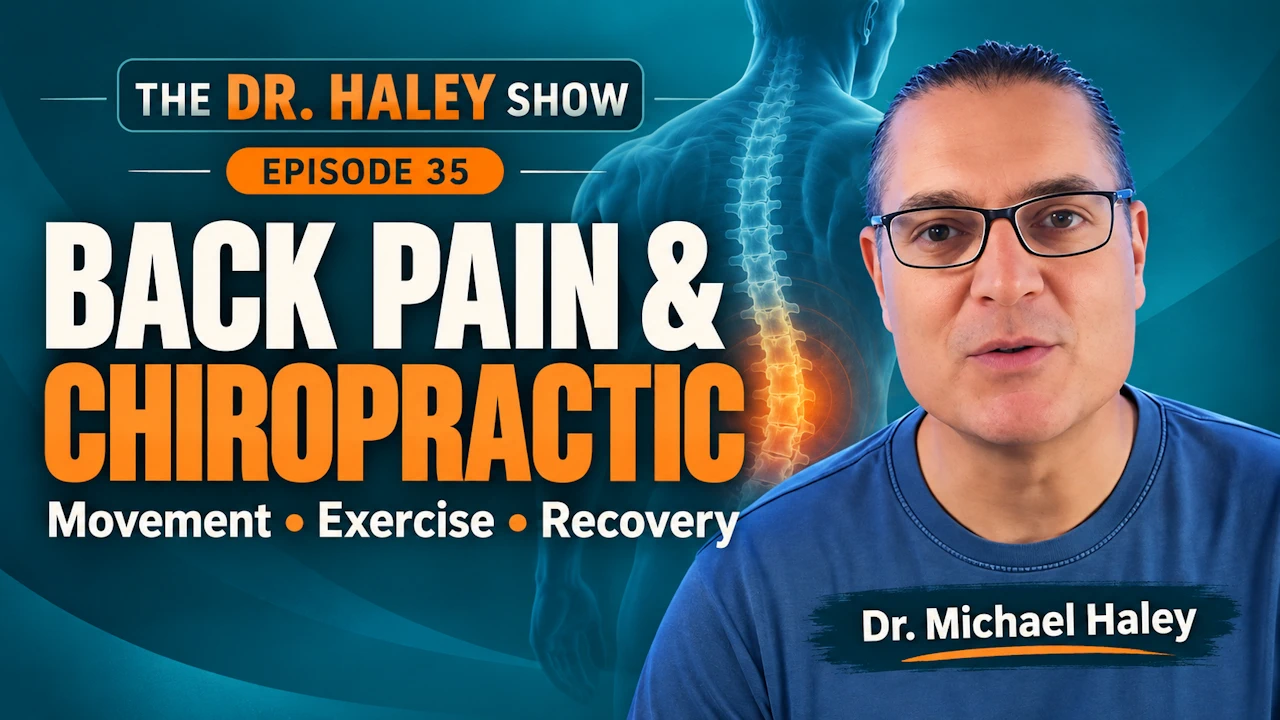
Welcome to the Dr. Haley Show Podcast. I’m Dr. Michael Haley, your show host.
I had a discussion about back pain and chiropractic with a long distant friend of the family. She had a recurrance of pain and was trying to figure out what to do next. I know there are a lot of people out there that also have pain and don’t know what to do, so we recorded the conversation that it might be of benefit to others.
Lately, I’ve been too busy running Haley Nutrition to take any new patients. We are not establishing doctor patient relationships here… But if you have pain, this episode will help you know what to do… or what not to do… I guess you are going to have to listen to see what that means. So here it is:
Watch the Interview
Listen to the Podcast
Resources
Quick Takeaway
In this conversation about recurring back pain, Dr. Michael Haley emphasizes paying attention to how particular movements affect symptoms. He discusses his approach to chiropractic evaluation, the role of consistent exercise, and why a movement that helps one person may aggravate another person’s condition.
His central takeaway is to notice whether you feel better or worse during and after activity and bring that information to your treating clinician. The conversation explores options rather than establishing a doctor-patient relationship or prescribing a treatment plan.
ENJOYING THIS CONVERSATION?
Get the Next Episode in Your Inbox
Get notified when a new episode of The Dr. Haley Show is published, plus occasional highlights and resources worth exploring.
By subscribing, you agree to receive email from The Dr. Haley Show. Unsubscribe anytime.
Episode Timestamps
- 00:00 — Exercise consistency: opening preview
- 00:19 — The Dr. Haley Show introduction
- 00:47 — Why this back pain conversation was recorded
- 01:52 — Recurring pain after a foot injury and yard work
- 03:37 — Returning to chiropractic care
- 04:21 — X-rays and identifying the source of pain
- 07:30 — Dr. Haley’s explanation of chiropractic and posture
- 09:21 — Home exercise and chiropractic visit frequency
- 11:09 — Anxiety and muscle tension
- 12:09 — Why some exercises can aggravate symptoms
- 13:53 — July 2023 promotional interruption
- 15:21 — Spinal mobility and cat-cow movements
- 16:18 — Exploring motion without pushing through pain
- 17:29 — When bending backward hurts
- 18:19 — Child’s pose, rotation, and side-to-side movement
- 19:42 — Mobility versus strengthening
- 20:38 — Slow squats, warming up, and stretching
- 22:38 — Questions about epidural steroid injections
- 24:30 — Aloe storage, thawing, and refreezing
- 25:44 — The main takeaway: tracking your response to exercise
- 26:08 — Closing remarks and outro
What You Will Learn In This Show
- How much or little do x-rays help find the problem?
- Does I have to go to the chiropractor so often?
- Should I do the exercises if it feels worse?
- Should I get a shot for the pain?
- And so much more
X-rays and the Source of Back Pain
Dr. Haley describes how he uses a hands-on examination and a person’s response to movement in his chiropractic practice. He explains his concern that visible changes on an image can draw attention away from other possible sources of symptoms, while also discussing situations in which imaging may be useful. These comments reflect his clinical perspective in this conversation.
Exercise Consistency and Chiropractic Visits
The conversation explores why pain can return after initial improvement. Dr. Haley discusses the role he assigns to strengthening, stretching, and ongoing home activity, while his family friend describes feeling better with exercises and then becoming less consistent.
When Movement Makes Symptoms Worse
Cat-cow, child’s pose, spinal rotation, and slow squats come up as examples in the discussion. When his friend says that bending backward hurts, Dr. Haley emphasizes that an exercise should be adapted to the individual rather than pushed through simply because it was recommended. The examples are part of the recorded conversation, not an individualized exercise prescription.
Questions About Epidural Steroid Injections
His friend asks about a spinal steroid injection suggested by her chiropractor. Dr. Haley says he does not have enough information to judge that option and discusses the importance of knowing what care and exercises have already been tried. He also asks how symptoms respond after warming up and stretching.
Aloe Storage and Refreezing
Near the end, the conversation turns to aloe storage. Dr. Haley describes an approximately one-year frozen storage period and a refrigerated period of up to 10 days, along with thawing a bottle and refreezing smaller portions. He notes that thawing and dividing the bottle uses some of that refrigerated time.
Medical Disclaimer
This podcast and article are provided for educational and informational purposes only and do not constitute medical advice. The experiences and opinions discussed are those of the speakers and should not replace diagnosis or treatment from a qualified healthcare professional. Do not begin, discontinue, or change any medication, supplement, diet, or treatment based solely on this episode.
Full Transcript
The transcript has been lightly formatted for readability. Because it was created from the recorded conversation, it may contain minor transcription errors.
Read the Full Transcript
Yeah, I started doing the exercises and then I felt so much better so quickly. I slept off.
And that’s what I tell them all the time. You’ll be back because you’ll be also good and you’ll start doing them.
You are listening to the Dr. Haley Show, the podcast dedicated to helping you optimize your health. Each episode, there will be an interview or a message to help you discover better health. We will be featuring health radicals on the show to bring new ideas to the table, as well as doubling down on key fundamentals to support you living your best life. Your host is no other than the founder of Haley Nutrition, Dr. Michael Haley.
Welcome to the Dr. Haley Show podcast. I’m Dr. Michael Haley your show host, and recently I had a discussion about Backpain and Chiropractic with a long distant friend of the family. She had a recurrence of pain and was trying to figure out what to do next. I know there’s a lot of people out there that also have pain, don’t know what to do about it. So we recorded the conversation. I hope that it’s of some benefit to others out there that are having similar problems.
And you know late lab in busy running Haley Nutrition, too busy to take new patients. So we’re not establishing a doctor patient relationship here, but if you have pain this episode will help you know what to do or what not to do. I guess you’re going to have to listen and see what that means. So let’s get into it.
So yeah, what’s going on?
Okay. I want to know, you know, how you deal with it with patients. What’s happened with me is when before I knew exactly what I had, you know, I broke the foot used the knee rover, but when I was able to start walking and be upright, it went away. I mean, almost entirely. I only felt a little glitch here and there. Then a physical therapist had me doing the wrong exercises, bending backwards, really aggravated it hurt. I’m sure the anxiety I was having made it worse. So went to a new place, carpractor and like almost after the first session, pain level went way down to like a one two and then eventually in a zero.
Okay, it starts to get spring. We go out in the work in the yard and have pain again. So just kind of update of what’s been going on. I’m just collecting information. All the different options what might be best. So somebody walks in to you.
Now if my memory serves me right, you had said two things and you can clarify. You don’t always do an x-ray and it doesn’t necessarily mean that’s where your pain is coming from. So take it from there.
Yeah, yeah and just to clarify, you know since you did well with the chiropractor and the pain came back in the spring. Have you been back to that chiropractor or no, yes.
Yes and then it just didn’t work as well. Now, I may not have given it enough time. I did about, I don’t even know, three, four sessions and I would get very bad pain after and then it would go down, but not down bar enough, like you know and I may not have given it enough. I’m willing to go back.
Okay. Yeah. So I’ll clarify what I meant by the x-rays and it might not be the same level. A lot of times we’ll take x-rays and we will see changes at a certain joint, like, you know, bony changes where the bone is kind of growing little protrusions and the edges are getting fuzzy and kind of ugly or maybe the disk is collapsing and we see that and we think, oh well there’s the problem but that’s not necessarily the problem because your pain might be coming from the one above or the one below or two above that level or you know a different place so I don’t like the fact that the x-rays will often take our attention away from the real problem or we might say, oh you have a herniated disk at L5. Well yeah but maybe the pain is coming from L3 or from your really act joint.
So that’s why getting on the table and actually feeling around and figuring out exactly which joint is the problem instead of treating what we see on the x-ray.
So cool, that’s just yeah, to me that makes the most sense.
Now sometimes they correlate perfect and the x-ray is helpful because we actually see well not only do I know that your pain’s coming from here because when I feel it and touch it you know you flinch and you know that I can see on the x-ray this particular change so that’s probably causing that particular pain and it might help me but the reality is in all my years as a chiropractor at the x-rays have never really helped because I’ve always focused on relied on what I felt and that got me the best results when I touched people and feel and poking and you know okay so it hurts in this track what if I hold this way that gives you relief you know when you bend it this way when you bend that way and we kind of figure out what’s going on that way and I think that’s more reliable than
X-rays X-rays are good for saying oh you don’t have cancer in your bones or any gross you know you don’t have a fracture here or some kind of gross problem that would say well we’re not this is not a chiropractic problem you know that’s kind of what X-rays are really good for showing that it’s not something that should be treated but even that it’s so funny because we usually figure that out and we say you know this is when I want to take an X-ray on and now when I see the results now I know why.
Okay so that’s not gonna apply in your situation because it was no traumatic injury and you’ve had this before and it just seems to be coming back and injuries tend to do that areas of weakness tend to come back.
Okay so let’s talk about chiropractic a little bit and what it is and why it works. Sometimes we do things like roll around on one knee like you did for a period of time and it makes things unbalanced and our spine or our posture muscles might tighten up on one side to try to keep everything kind of level so to speak but it’s keeping it level for being one knee on a wheel and the other foot walking and that’s not an optimal situation and then when that changes your spine has to adjust and there’s weaknesses and there’s tightnesses on one side. There’s inequalities.
What has happened is muscles have changed maybe length or ligaments or tendons have changed length. Maybe they’re scar tissue in there. It’s just not balanced and smooth functioning like it used to be. And that does affect nerves. If we can restore that function and decompress that area and take the pressure off the nerves, you should have less pain. Okay. Or more function, whatever that nerve went to, whether it’s muscle or an organ.
So how do we fix that? Chiropractors will try to figure out exactly where the problem is and push things in a direction of an improved posture and better function.
Chiropractic is not the only way to do that. In fact, I like to tell my patients that, you know, I can adjust you and I can adjust you forever. And if you don’t help me, you’ll probably need it forever. Also, but if you continue to do the exercise that I recommend and keep things moving on your own and keep things balanced and loose and you know, the the work the muscles evenly in and both strengthening and stretching, you know, you keep them healthy on both sides, you know, then you will need a lot less of me.
Usually when people come to me, some chiropractors will say, okay, I’m going to treat you three times a week for the next next number of weeks and you know, and then two times a week, then one time a week for this long and then you know, then we’ll see, we’ll reevaluate that and you know, you’re left thinking, oh, and then I should be good after this $5,000 plan. But the problem with that is it puts it all on the chiropractor and there’s no responsibility on you. Okay. If I’m transferring the responsibility to you, chances are, you’ll need a lot less treatments.
Yeah. Uh, that’s exactly what happened to me. And my chiropractor told me that. Yeah, I started doing the exercises and then I felt so much better so quickly. I slept off.
And that’s what I tell them all the time. You’ll be back because you’ll be also good and you’ll stop doing them.
Yeah, yeah, exactly. And that was one of my questions for you. So you just answered it. Like how important our exercises and what do they exactly do? And you you just explain that to stretch and strengthen and all of that.
Plus, a big one for me is the muscle tension. I clench my muscles so bad because of the anxiety. And I can tell, I probably do it all day too, but when I sleep mainly and because even my upper back will hurt like everything hurts. So, and how my upper back hurts is the same sensation of some of the same sensation of how my lower back hurts. So, that’s keeping things all discombobulated.
Yeah, you know, the easiest exercises and, you know, for some people they’re not right and maybe you go to a physical therapist and they give you particular exercises and you do it. It makes things worse. It doesn’t mean they were bad exercises. It just means although they might be good for most people, you know, for you in particular you have this particular weakness and this one aggravates it. And even in aggravating it doesn’t mean it’s bad, but it might be. You know, there are conditions where certain exercises will aggravate and prevent you from getting well.
So, you know, if you’re hyper-mobile in an area, you know, overstretched. Your ligaments are stretched and damaged. We call it plastic deformation, because ligaments can stretch like plastic and then not necessarily bounce back like a rubber band.
That would be plastic deformation, whereas rubber bands bounce back. So, let’s say that you have ligaments that were stretched and they were hyper-mobile and then you’re, you continue to stretch that area, making it even more hyper-mobile. You know, so you probably don’t have that, but it just shows that sometimes, you know, the exercises are good for most people, aren’t because you could have something that makes you weak in that area.
So, you should probably pay attention,
I like to say pay attention to the spirit. The doctor says you should do something and you’re doing it, but it doesn’t feel right. The doctor’s probably wrong.
It’s Dr. Haley interrupting this podcast to plant an Easter egg for my faithful fans. We’ve got some 4th of July sales starting early at haleynutrition.com. And with the coupon code fireworks, you’ll get an additional 7% off through the month of July 2023. So, head there now, get a tube of anti-sun SPF-20 so you don’t get sunburn on the 4th of July. And a tube of youth-thurm-allow-creen to suit the parts that you forget to protect from the sun. The youth-thurm-allow-creen is a perfect minor burn care and even better after sun tan moisturizer.
Now, let’s get back to the show.
I like to say pay attention to the spirit. The doctor says you should do something and you’re doing it but it doesn’t feel right.
Yeah. The doctor’s probably wrong.
Okay. You’re probably right because you have that information talking to you from above down inside out. Speaking to you, based on the information you feel that God that is in you that has turned everything you’ve eaten up to this point into who you are today, you know. That’s knowledge that we cannot as doctors compete with.
Gotcha. Paying attention to it is golden.
Okay. Yeah. Good. Good.
I would, I like to coach people in exercises and kind of say it like this. The most important area for your flexibility, for your good motion of joints, is your spine because that’s where your central nervous system is. And if you think about the easy movements, bending it all the way forward and all the way back. In yoga, there’s an exercise called cat cow and you’re in your hands and knees.
Yeah. Round your back up kind of like maybe angry cat posture and you know, you might breathe in and out with that and then you might, you know, exhale as you let your belly drop down and you look up towards the sky, bending your spine the other direction and you kind of go into the pumping flow of the cat cow position, watching out your whole spine, forwards and backwards from the top to the bottom.
Now, any time you do any of these exercises, the rule is to explore the end range of motion, don’t go into it, don’t experience pain, explore and be in tune with where does my body say it’s okay to go and when I get to a certain point, you know, I sense something telling me not to go there. Okay, this is not a no pain, no game thing. That doesn’t apply. Okay. This is a, I’m going to explore my full range of motion and I’m going to exercise within that full range of motion, nurturing it, knowing that even staying in the boundaries, there’s a good chance they’ll expand in time.
Okay. Now, not only bending it all the way forwards and all the way back, but in there’s other ways to do it, you can lay flat in the push-up position and push down into the floor, letting your low back relax and just bending your spine backward and looking up towards the ceiling.
Yeah, but that’s the thing that hurts me is the bending back like that.
Yeah, and the same rule applies, explore and if you perceive your body saying don’t do it, don’t do it because your body is smarter than I am. And there are conditions, for instance, there’s little tiny fractures that happen in people called like, well, antrolists, these are spondyl, low-less thesis. There’s these names for these very common fractures, like maybe 3% of the people have them. And going, you know, to a certain point in that particular exercise, can definitely make it worse. Okay. So, and maybe you shouldn’t do that when at all. If something says don’t do it all, don’t do it at all. But maybe the cat cows, maybe your body says no, this one’s okay. But be careful when you’re extending it.
You know, right, and then the other one is the child pose, the opposite of that, that one, where you, you know, on your hands and knees, you put your butt all the way to the heels and kind of like the prayer position, you know, on that particular posture, rounding your spine all the way forward again.
Well, rotation, same thing, lay on your back, maybe your knees go one way and your arms and shoulders go in other ways. We’re rotating and rinsing out our spine. But if you have one of those conditions that doesn’t like extension, you might not like rotation either. Pay attention to your body, maybe explore it. As you want to flush out your joints and all of their healthy ranges of motion, forward and backward, rotating, left and right.
You know, if you feel you should, when you’re on your hands and knees doing the cat cows, you think you should wiggle side to side, do something called like, I believe it’s called a dancing lion, you know, where your hips are, you know, getting in your shoulders kind of getting into this flow of just getting your spine nice and juicy.
Okay, that’s it.
Yeah, that the real key, you just do those exercises, you know, ask yourself what does it feel like I should be doing and try and explore that motion.
Okay, so the exercises, see if I have this right, they help loosen you and like decompression kind of get some space in there and also strengthen to protect from injury injury, is that all correct?
Well, the strengthening is going to come from more physical activity exercises.
And well, that’s what I’m talking about, exercises do these things.
Yeah, but the like the strengthening like think of lifting weights is strengthening.
Um, sometimes, yeah, no.
Yeah, kind of strengthening, just because my muscles are weak, you know, I haven’t exercised. I’m 67. So I’m just thinking, you know, strengthening my muscles.
Well, yeah, but as an example, um, you might do squats and, you know, at our age, we might say, okay, let’s do super slow squats with no weight. So I’m not going to go up and down and really be traumatic on my knees. I’m going to use 15 seconds to go down and make my thighs parallel to the floor and then 15 seconds to go up. And I might even hold on to something to, you know, a tree or something to, you know, just to secure myself and give me this stability. I need to do this and maybe even help pull myself back up if I need it. So I’m doing that.
You’re strengthening your muscles and you’re increasing the blood flow, not only in your muscles, but in the joints. See, those are good exercises for increasing blood flow and helping our hormones that help heal things. But at the same time, they’re muscle shortening, which is okay because once we get warmed up doing the muscle strengthening, now everything’s warmed up, now it’s actually safe to stretch. So now we can better go into those stretches and be more effective because we got the juices flowing in our muscles.
First, we warm them up, they’re more flexible. Now we’re going through the, you know, breaking the adhesions that are in there, you know, in our muscles, we could be like cross-sponstes. These adhesions with the strands are kind of connected to each other and that makes us stiff if we never break them as we continue to build those up. It gets like scar tissue and we get old and less flexible. But as we continue daily to flush out our spines and move side to side and forward and backwards and rotate left and right, we’re breaking some of those bad adhesions that happen in between the different tissues and muscle strands.
Yeah, so yeah.
Okay, yeah, this is good. Really one last question because this is one of the options. In fact, my chiropractor kind of he thinks this is a good option, but that epidural spinal injection of steroid.
I don’t know, I don’t have enough information to really know because he knows how many times you’ve been seen and what exercises you’ve been doing and if you’ve exhausted the proper options first.
One thing I would want to know is let’s say you did some mild activity warmed up your muscles and that could be as simple as walking or could be doing the super slow squats or could be playing tennis, you know, whatever you do that gets the muscles and the juices flowing. And then you did your stretches, maybe you spent 15 minutes doing your stretches. The question I would have is when you’re done with that, do you have less pain or more pain? Because if you have less pain, it tells me that what you need is more activity.
Okay, okay, I’m right.
Yeah. Well, I’m not ready to do that because I know I haven’t done the, you know, exercising and stretching and all that like I should. So, but since I have you on the line, I just wanted to cover that base.
Well, that covers, I think that is all of my questions and that really, that really helps Michael. That’s a confirmation, you know, of these exercises and all right, Michael, thank you so much.
Oh, gosh, I keep remembering. One more quick one.
Yeah. The allow. How long does that stay good in the freezer?
Good buddy year.
Okay, because I haven’t opened my second bottle and just wanted to make sure. And so you can, that’s real good. You gave me those little bottles. I can pour it and then put it back in the freezer.
Yeah. How long does it stay good for when you’re doing that?
We recommend that people keep it in the refrigerator up to up to 10 days. So if you melt the bottle completely and pour it into smaller containers and put them back in the freezer, we’re going to assume that you used at least one of those days.
All right, then I know exactly how to do the second bottle. All right, I got to get back on that. I wouldn’t happen to try so many different things between the constipation and pain management and you know all of this stuff it’s like, yeah, I’m tired of it. You know, really I’d rather just do some exercises and feel better. It’s like the easiest route.
You know, I think that’s going to be probably the real takeaway from this, meaning using it for diagnosing. When you do them, after you do them, in the hour after you did them, do you feel better or worse. I think that’s going to be the key takeaway.
Okay. All right. Awesome. Michael, thank you so much.
I hope you enjoyed that episode today on the Dr. Haley Show. Make sure to hit subscribe on whichever platform you are listening to this. If this episode made you think of someone, go ahead, take a screenshot and share this exact episode with them. You can catch the show notes for this episode on www.ductorhaley.com. If you want to geek out with Dr. Michael Haley, on other Radical Help topics, be sure to check out his YouTube channel where he posts exclusive video content. All the details are at www.ductorhaley.com and we can’t wait to hang out with you on the next episode. . .