
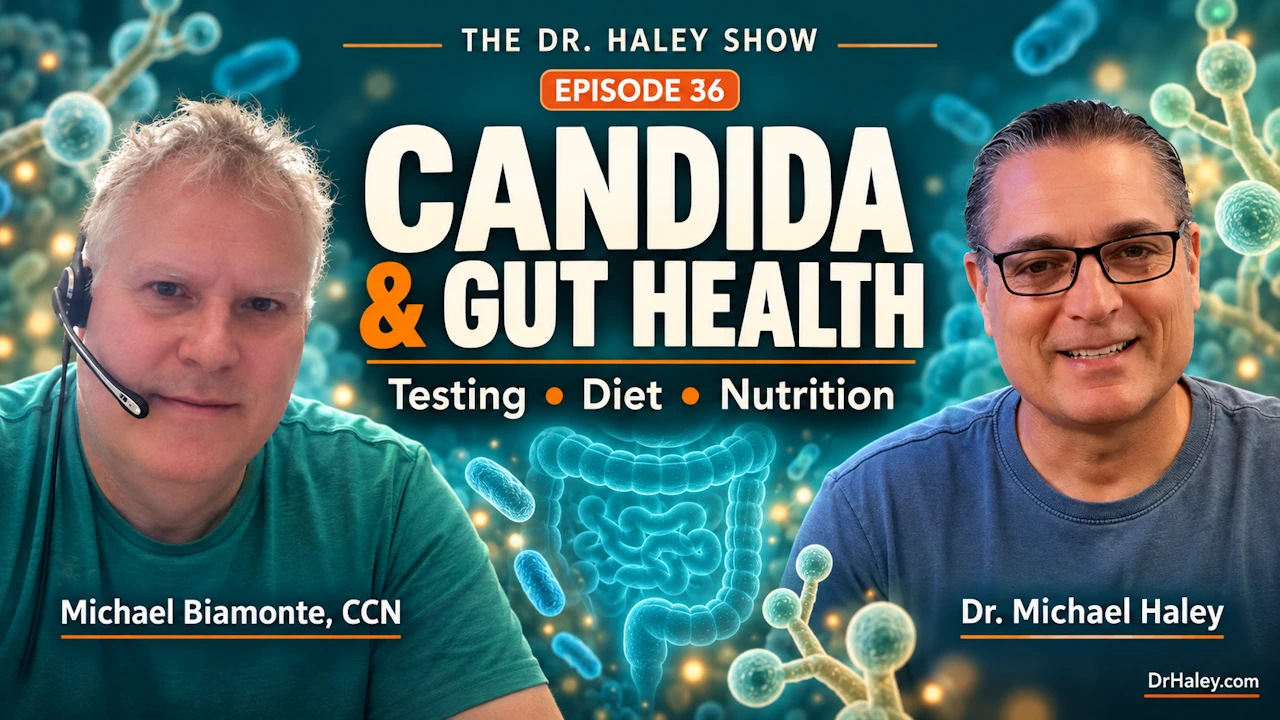
Michael Biamonte, CCN, specializes in helping those with candida problems. In this episode, he discusses his views on causes, reasons people may struggle to get well, and the testing and treatment approaches he uses in his practice.
Watch the Interview
Listen to the Podcast
Resources
- Health-Truth.com
- NewYorkCityCandidaDoctor.com
- newyorkcitythyroiddoctor.com
- Dr. Biamonte on YouTube
- https://haleynutrition.com
- Watch this episode on YouTube
- Listen to this episode on iTunes
Books and Websites Mentioned in This Podcast
- Who Is Dom Minasi?
- Stanley Tucci’s “Searching For Italy”
- David Kirby “Animal Factory” on Amazon
- Hulda Regehr Clark’s books on Amazon
- Candida Chronicles – Michael Biamonte, CCN on Amazon
- The Real Anthony Fauchi Robert F. Kennedy on Amazon
- Trace Elements Dr. David L. Watts on Amazon
- EAT RIGHT 4 YOUR TYPE – Dr. D’Adamo on Amazon
- Dr. Bruce Rind’s website
Quick Takeaway
Biamonte emphasizes testing rather than assuming that every digestive symptom has the same cause. He describes stool testing, organic acid urine testing, and his own approach to monitoring patients during treatment.
The conversation also explores food choices, antimicrobial rotation, the symptoms Biamonte associates with candida, thyroid function, and nutrient interactions. His treatment protocols and explanations reflect his clinical views; the discussion does not establish that these approaches will cure a condition.
ENJOYING THIS CONVERSATION?
Get the Next Episode in Your Inbox
Get notified when a new episode of The Dr. Haley Show is published, plus occasional highlights and resources worth exploring.
By subscribing, you agree to receive email from The Dr. Haley Show. Unsubscribe anytime.
Episode Timestamps
These chapter descriptions are retained from the original post and describe the speakers’ discussion and viewpoints.
2:32 Getting to know Dr. Michael Biamonte and his upbringing including his Italian family of musicians. Dr. Biamonte studied with the famous jazz guitarist and composer Dom Minasi Dr. Biamonte explained the more traditional diet from Italy such as seen with Stanley Tucci’s “Searching for Italy”.
12:00 What else, other than antibiotics, causes candida? Genetics, antacids, medications, and anything that can disturb the intestinal flora. Just the SAD American diet can do it when the genetics pre-dispose a person.
14:30 David Kirby in the book “Animal Factory” exposes the horror of how supermarket meat is produced.
15:25 Dr. Biamonte gives the most simple diet advice that would have the most impact
16:15 Why are we searching for the cure of cancer when we know what causes it?
18:08 The books of Hulda Regehr Clark regarding the causes of cancer.
19:45 Understanding “Dysbiosis” and how to determine what the bad flora is and the various tests that are available including stool testing for DNA. An orgnanic acid urine test can also help understand the microbiome.
24:55 The book “The Candida Chronicles” by Dr. Michael Biamonte explains how he learned to diagnose and properly treat candida and control the die-off reaction.
26:56 The biggest mistakes doctors make when treating dysbiosis and how they do it different
31:59 When candida over-grows, what other organs and systems can be affected?
34:24 Common initial symptoms of candida from fatigue, to digestive issues, skin issues, and eventually worse problems.
35:15 Dr. Biamonte explains the purpose of the three different websites:
36:10 the candida – thyroid relationship
38:50 the reasons why autism is increasing including the toxic environment and chemical exposure through medication
41:35 Dr. Michael Biamonte plugs the book Robert F. Kennedy Junior “The Real Anthony Fauchi”
43:00 What kind of doctor to find to get your dysbiosis diagnosed and treated… certified clinical nutritionist (CCN / CNC), Functional Medical Doctor,
45:05 What is a doctorate of Nutripathy?
46:08 What diet is “anti-candida”?
46:35 Aloe vera as a treatment for candida and why it doesn’t feed the candida
48:10 A testiomonial that stands out in his mind related to what he does involves a woman covered with skin rash.
49:27 How elements are essential but can be toxic and how elements and vitamins interact with each other
51:10 Dr. Biamponte also studied under Dr. David L. Watts from Trace Elements Inc. He recommends the book “Trace Elements”.
55:17 Why supplements are needed but dangerous and how to make sure you are taking the right amount of the right thing.
59:12 What is man’s ideal diet? Vegetarian? Fruitarian? Carnivore? Blood type is the most important starting point – Dr. D’Adamo Type O the carnivore (hunter – gatherer / Caveman diet); type A the farmer; type B high in fish and vegetables; AB who can eat a little of everything. From blood type, go to a functional medical doctor to determine the best based on testing.
103:25 Therapeutic diet vs. maintenance diet.
105:29 The websites to find out more (see the resources below) and Dr. Bruce Rind’s website
Understanding Dysbiosis and Gut Testing
Biamonte describes dysbiosis as an imbalance in intestinal microorganisms. He discusses DNA-based stool testing, digestive markers, organic acid urine testing, and a home urine test used in his practice. He explains why he prefers to investigate the gut environment before choosing a treatment approach.
Biamonte’s Approach to Candida Treatment
Drawing on The Candida Chronicles, Biamonte describes rotating antimicrobials and monitoring what he calls die-off reactions. He distinguishes his use of the term chronic candida from the medical meaning of systemic candida. These are descriptions of his practice and terminology, rather than instructions for self-treatment.
Food Choices, Aloe Vera, and Individual Diets
The speakers discuss Italian food traditions, food sourcing, sugar and starch, and aloe vera. Biamonte explains why he includes some aloe products in his protocols and shares his views on blood-type diets. They also distinguish a temporary therapeutic diet from a long-term maintenance diet.
Thyroid Function and Nutrient Interactions
Biamonte discusses the relationship he sees between gut complaints and thyroid or adrenal function. He describes his work with Dr. David L. Watts, mineral analysis, and interactions among nutrients, using patient stories to explain why he favors individualized supplement decisions.
Other Topics and Books Discussed
The conversation also includes music and jazz guitar, environmental exposures, cancer, autism, and books by Hulda Regehr Clark and Robert F. Kennedy Jr. The speakers’ explanations and opinions on these subjects are preserved in the transcript and should not be read as established findings simply because they appear in this interview.
Medical Disclaimer
This podcast and article are provided for educational and informational purposes only and do not constitute medical advice. The experiences and opinions discussed are those of the speakers and should not replace diagnosis or treatment from a qualified healthcare professional. Do not begin, discontinue, or change any medication, supplement, diet, or treatment based solely on this episode.
Full Transcript
The transcript has been lightly formatted for readability. Because it was created from the recorded conversation, it may contain minor transcription errors.
Read the Full Transcript
– Hi, I’m Dr. Michael Haley. Show host for the Dr. Haley show podcast and owner of Haleynutrition.com. We’ve done some podcast over the past couple years, but never with this particular focus when it comes to gut health, because quite frankly, I’ve never found someone that had so much knowledge and experience and expertise in this particular area. Today’s guest is Dr. Michael B. Monte. He’s the founder of the B. Monte Center for Clinical Nutrition in New York and he’s co-creator of a cybernetics platform used to help diagnose and focus a treatment where people with this particular issue. He has a doctorate and he’s certified in clinical nutrition in New York and author of the Candida Chronicles. His bio is quite extensive and I can sit here and take up all kinds of time going into some of the details of his training and how he became to be who he is now, but instead, let’s get to the show. Dr. Michael B. Monte.
– Yes sir.
– I am honored to have you on my show. Thank you so much for joining me.
– That was my pleasure, really, my pleasure.
– You know, and learning about you and reading some of your content and listening to some of your podcasts, you have so much knowledge. I’m curious, how did you get like that? I know how I got like that, but I want to go way back. Where do you grow up and what kind of foods did you eat and how did that impact who you are today?
Well, I don’t really think that had that much to do with us because I’ve been this way for millions of years and I haven’t changed. But I was tanned to your question. I was born in Valley Stream. Actually, that’s not true. I was born in Queens and Woodside and my family moved to Valley Stream and we were in Italian family. So that means that most of the family all lived within six blocks of each other. So I lived in a pretty close net. I had a pretty close net family and even though they were for the most part white collar, a lot of them were musicians, but they didn’t make a living with music. They had regular day jobs as we would say. But they were all very musical, very artistic. And they were all very curious. And one thing about my family, I could say is they never, they didn’t have a closed mind or a myopic mind.
So I grew up around that and that helped shape me a lot, also being in the music industry early, helped shape me a lot. Because I got to see some of the depravity that was there, which is why I’m not a professional musician anymore. At one time, I went to college, I have a degree in music. I studied classical guitar in college. I studied with some of the top jazz guitarists in the field. And I made a living playing rock guitar, and playing pubs and playing concerts, and teaching kids how to play like Jimmy Hendricks. And I just saw the the pravity that I saw in the music industry. Got me out of there quick. Right, right. Got me out of there quick. And but it got, it gave me a perspective of how the other half lived. Oh, to speak, because we didn’t have that going on in my family.
Yeah, but you know, it’s funny because even when you go down to the baseball, you talked about starting with the classical guitar, which is, you know, the nylon strings and you’re, you know, you’re using all 10 fingers. You’re not holding the pick and strumming. Yeah. And it’s a technical way of playing guitar and that’s still how your mind thinks.
And no, and actually you just, you just hit on something. I studied with Dom Manassee, who’s most people know who he is, but he’s a jazz guitar who, within his own circle or field, is highly, highly regarded. And from a technical viewpoint and from a viewpoint of music theory, he’s the highly advanced jazz theory. For those of you who heard of John Coltrane, Dom Manassee, as a guitarist, took John Coltrane’s music apart and was able to interpret it, step by step down to the very, my new fractions of everything Coltrane did. So by the time I got to college, I had from, from studying with him for so many years. I had such a, a high technical knowledge of music theory and music harmony from a jazz side. So when I got into college and I was looking at it from a classical side, it was very easy to understand, very easy.
And I would, I had, like, instances what my teachers in school were, I totally blew them away. And some of them, a few of them wanted to take lessons from me to understand how this, how jazz theory would work and how I think to gain the perspective that I had. So that, that’s, that’s, that’s part of, oh, I think that’s really maybe hitting into your original question. Because from studying jazz theory and then from studying classical theory, I got sort of a, a mathematical, but yet an aesthetic look at how things work in the universe.
Yeah, I took the long road myself. You know, when I grew up, I picked up these wooden chunks and I started swinging and met things and they eventually went along to music. They didn’t quite make music. And I didn’t learn how to break it down and actually be the musician until, well, you know, I would say even recent years. I still play the drums in the church on a regular basis. Now I’m learning to break it down and, you know, actually put it on paper and learn what I’m doing. Some of the things that I did along to the music and learning how to play without music and actually make music with the drum set instead of just swinging wood at things that would make banging noises.
Makes sense to me. Yeah, I got it.
But it’s a lot of fun. And this morning when I was walking around the block with my wife, we we talked about a particular musician and how that typically even for some of the best musicians doesn’t pay the bills. It’s a rough road for a way to make a living.
My classical guitar teacher, Stan Solo, who studied with Alfred Valdez Blaine, who studied with Andre Sagovia, so he was third generation down. He used to always tell me he or he was a jazz musician his whole life until he started his study classical guitar and then got the jobs in the National Community College and then in Queens College as the classical guitar teacher there. He taught me and also Hofstra University. He taught me to make a living as a musician was a true success. That’s if you could make a living as a musician you were a true success.
You’ve made a thing to get about being on billboards and all that because that’s a lot of hype and that’s that’s not so much always your skill a lot of times it’s it’s um you’re marketing like this is an example um with the the day that my guitar teacher Dom Anasi signed his contract with blue note records several other very prominent guitarists signed on the same day but they decided because Dom didn’t sing and these other fellows did that they were going to push them more because they would be more um acceptable through the media because they say so yeah yeah I get it and I understand and you know you probably miss an unsencerious talent if you have that view
I also relate to the Italian nut bringing because you know for me what did we eat um a lot of bread a lot of pasta a lot of gluten and I think my body has become immune to it a lot of people think uh gluten is the devil uh we’ve had so much growing up we could probably snort lines of gluten and not sneeze
well that’s the Italian and that’s the Italian American like the true luckily for me my half of my family was Sicilian so they more stuck to a more traditional diet that they brought over so because if you go to Italy at a bowl of pasta’s not what what it is here here and if you go to Brooklyn and you go to a restaurant a bowl of pasta’s is huge thing when you go to Italy you see like Stanley Tucci when he didn’t just show searching for Italy then when they have pasta it is truly a small dish instead of anti pasta means instead of pasta and it’s a small dish that in more or less introducing it’s a prelude to the rest of the meal it’s not just a gigantic thing but the other thing I would say too is that my patients who go to Italy who have Candida when they go to Italy they can eat things in Italy that if they ate them here they’d be in bed three weeks with symptoms because in Italy everything is non GMO and it’s all organic they don’t know they don’t know what GMO is over there and they don’t have no idea what you’re talking about.
If you say we’re at a patient once who is in this cafe in in Italy and he was telling the waiter this is the most delicious thing I ever ate my life where how do you do this and it goes well you see that hello over there we go there in the morning we put them back I sliced them I put them on the dish salt and pepper a little olive oil and garlic and then I bring it out to you and that’s it.
So it’s real food actually yeah um that that’s amazing I love it I’ve never been there and you know I can’t think of my grandmother from Sicily and you’re right the dinners that she prepared weren’t a lot of pasta in fact it was more like um you know with stuff cabbage and you know it’s a lot of vegetables yeah yeah yeah but the plenty of the you know homemade red sauces and um white sauces and you know lots of it was it was Italian it was good
or it’s it’s it’s amazing how diverse Italy is I didn’t really appreciate it until I watch Stanley two cheese series about searching for Italy because every every part of Italy he went to the food was so different it was so diverse depending on that region what they had to offer their culture if anyone hasn’t seen it it’s on demand TNN on demand Stanley two cheese searching for Italy it’s an incredible series
wow sounds neat I’ll have to make a note of that and look it up and if I find it even below this podcast we’ll put a link to it for giggles sure that sounds good to me
you know it’s funny because you know the today I obviously I want to talk about Candida but one of the things you mentioned already was GMOs and no GMOs being there and Italy well I don’t think people realize that Candida which can be caused by anti-biotics but some people get Candida and don’t take anti-biotics so how do you think people always ask and people always ask me that
there is some people who are genetically more prone to Candida there were I there are specific SNPs that make people prone to Candida I have the whole listing of those in my book the Candida Chronicle so that’s a possibility but there are other drugs also Candida is still mostly Ayatrogenic it could still drug and do antacids will cause Candida because antacids stop your stomach acid that affects the pH of your flora Credna zone or to zone estrogen medications will close Candida because those medications increase the amount of glucose circulating in your little blood vessels that the Candida So it’s absent soon. So there are other medications and other things that will cause Candida even the swimming pool if someone is a swimmer and they start drinking too much chlorinated water that will disturb your flora.
It really boils down to anything that could disturb your intestinal flora will close Candida and the antibiotics are a prime suspect but there are other things that could do that too but it is also possible genetic. If you, if the person unfortunately has bad genetics and they have those genes that predispose you to Candida if they do the sad American diet standard American diet we call it sad. If they do that diet would all the GM men GMO food that the nonorganic foods all the fast food that junk food that could easily get Candida just in that right
Yeah, and I think the foods are also kind of filled with a forms of antibiotics in themselves. For instance, you mentioned drinking the pool water A chlorine is against life. It’s in the water as an antibiotic in the water and for a lot of us, you know, we measure a pool water in Part for a million and we might keep a balance between three and five Part for a million. You might approach close to that in your tap water If you’re not drinking filtered water.
That’s very true. The my pool to see is salt water. I have a salt water pool Which isn’t really that much more expensive than the the regular pool But that’s how you get around it in case somebody has this one there. How do I get around the chlorine get a salt water pool? But even though there’s a minor there’s a minor amount of chlorine in the salt water pools minor compared to you can tell immediately when we got our our salt water system in school that I went in the first time I could tell immediately the chlorine level was like 80% 90% less
But people like if you look at food that we Huge problem is is animal protein because the the foods fault the best book on this is animal factory Because he goes through an animal factory except the horror of how chickens and and supermarket meat is really produced David Kirby really let it rip in this book, but if you you have chickens that are stored one on top of each other Deficating on each other being fed our snack as as an antimicrobial you have all the cattle that Are being fed corn and again, they’re stacked one on top of each other and they have a special guy who goes in there with his long glove Who sticks his arm up the butt of the animal to get the corn that the animal can’t Fully digest out so they’re not constipated.
I mean, it’s just horrible not to mention the hormones in the antibiotic these animals are injected with people ask me all the time If you could give somebody simple advice health advice. What would it be the simplest thing they could do eat non-GMO eat organic and don’t eat animal protein Which is not what wild fed? You know, you only eat grass fed meat only wild-fed wild-court salmon things in this nature just don’t eat the poor We would call standard production food that you find in the supermarket. That’s what’s killing people
Yeah, you know, I like what Jordan ribbon head said he said you’ve heard it well said that you are what you eat But I say when it comes to animal foods, you are what they ate. Yeah, that’s right. It’s correct
And another another another pun along this upon but another thought along this line of either of all of these the organizations out there that are raising money Searching for the cure to cancer and you know, I do applaud them for their work But on the other hand we know what causes cancer
What is this looking for the cure for cancer? The queen know what causes cancer We know what causes cancer from the in your environments. We know there are over 365 different isolated elements in your environment that we know are carcinogenic So we know what causes cancer and we know how those things all through your DNA that then cause the whole cancer Process even to the to the viewpoint of what happens with your pH so I mean we’re looking for again It goes back to the unfortunate viewpoint that we have in America is they’re looking for the magic bullet Yeah, and I don’t mean the one I don’t mean the one from from Dallas in 1963.
They’re looking for that magic bullet that pill That is just gonna instantaneously like you’re in Star Trek make the disease go away and we’re not at we don’t have that technology now But we do know what causes it so we are in a position where we can’t avoid the things that cause cancer
Yeah, you know, I’m in a unusual position where my company has a unique nutrition product We sell an aloe vera and people will consume it for it’s anti-cancer benefits There are there’s plenty of research to show unique ways in which it helps fight cancer even research that has been done by chemotherapy companies But I still have to caution you if you’re taking this to try to kill the cancer You’re doing it no different than using it as a drug right because what you haven’t done is said Why do I have cancer and let me get rid of the cause because even if you were to find that magic bullet that killed all cancer But you don’t get rid of the cause it’s coming back
That’s why I recommend people read the books from hold-up of hold-up Clark hold-up Clark was an absolute genius and Should them the media destroyed her they made her look like a lunatic and a and a lot of it was because in her book She actually names product. She names manufacture. She names that the brand name the trade names of these products that caused cancer So they had no they had no a solution other than to trash her because if everyone was gonna listen to her these corporations with those billions of dollars But she actually names what causes cancer in her books.
So yeah, I think the information’s there and we just have to open our our eyes. Hey attention and make wise decisions in our life
Right, don’t let corporate America run your life, which is a key thing
yeah, so I got a question for you And I kind of know the answer of course, but in terms that people that can understand I have customers I have people that follow me people that listen to the podcast ask questions and they are all in search of their one thing That’s causing their problems and people have these diagnoses like you know C-dif and C-b-o and H-pi-lory without ever really properly being diagnosed and it could be something else it could be Candida and what are some of the differences? How do you tell the difference how do you get to the right diagnosis and help people normalize their gut
for first thing Person asked understand as the word dyspios dyspios just means that you have an imbalance between the sum total or the sum aggregate of all the friendly workinisms in your gut the ones that the health food companies are trying to sell you as opposed to the bad one the the the Microads that are pathogenic that you pick up that caused disease. That’s the first thing you have to understand That’s what dyspios is someone with dyspios. This is imbalance. They don’t have enough good floor They have too much bad floor. So now knowing that the next thing you want to know is okay, so I’ve got these two groups I’ve good floor at bad floor. How do I find that what the bad floor is? How do I isolate it so I know how to properly eradicate it?
Well, there you need a test and what what I’m known What I’ve been known for in this field for 40 years is a big advocate of testing because if you don’t test you don’t know You that’s the blind leading the blind. So if a person wants to find out what’s happening with their gut environment They have to do a test now the best tests for the gut environment. There are two There’s the new age of stool tests that we have that are old DNA base and all the labs by now We’re doing them great planes mosaic genova doctors data diagnostic solutions all of the the The key labs are doing DNA stool tests
and can I interrupt for a second when you say they’re all doing this how recent is DNA Still tests. I’ve never actually heard DNA inserted into the test because I always thought they got a sample and put it on a plate And studied under a microscope.
Well, they still do that about about maybe 15 years ago One of the labs whose name I forgot because they’ve it they merged and that would genova lab I’m that lab started to introduce DNA technology. So they would look at they would have your DNA Um the DNA of your stool analyze not looking for crime scenes, but looking for looking for microbes So they would use the DNA of all the friendly bacteria the harmful bacteria parasites and whatnot to identify What was going on when you’re gut biome just in addition to the culture in the microscope?
Okay, so that’s about that’s about that started about 10 15 years ago and it’s infancy by now It’s a standard in the industry. It’s now an industry standard where any lab work that’s sold has a stool test off you That is not only going to do the standard culture and the microscope, but they’re also going to do a DNA panel Looking now what they look for on the DNA panel can very lab lab you guarantee they’re going to look for DNA A friendly bacteria and pathogens some of the labs also look for viruses and some other organisms But generally it they all will present a pretty good smathering of all the different microbes you could find so that you’re pretty Safe and understanding what your biome is about and then the better labs also include a whole digestive panel in there Where they’ll look to see your your short chain fatty acid how well you’re digesting proteins fibers from carbs fibers from vegetables They’ll look at a good a good assortment of things So if you go to any of the labs nowadays and you do one of the up-to-date stool tests You get a pretty good snapshot of your whole biome
the other way to do it. What’s not stool is your in test It’s a urine test. That’s called an organic acid test And with this type of test, they’re looking for organic acids that are produced by healthy organisms and bad Same kind of idea as the stool test. So those are the two tests somebody can do and now they can understand what their biome is about
Okay, and are you performing these tests? Are you ordering the tests? How do you do?
Yeah, I do the my side routinely do them on my patient We also have a test that I develop many years ago, which is only done in my practice. It’s a urine test that the person does at home It’s self-administered. We give them like this little chemistry kit They go home with it and they take a first morning urine and they actually can run these six different tests on their urine And this is up this as a test we frequently use because it’s less expensive than the ones I just mentioned But it’s also the person can do it at any time and get a real-time snapshot of what’s happening with the activity of Parasites and harmful bacteria and candida in their body So when I speak to a patient on a monthly basis, they usually do that test for me So I can understand what direction things are going and there’s one unique thing about that test That’s not found in any other test.
The test reacts to Herkshymer reaction. So if the person is on a program and they’re taking anti-fungles or anti-microbials If they’re having die-off at that time the test is going to register the die-off And that’s a huge advantage I have in working with patients compared to other doctors using even the tests I just discussed. Those other tests don’t tell you if the first having die-off So that makes it much easier for me to navigate what’s happening with them.
Okay. That’s pretty interesting Because I know a lot of people are afraid of that, you know, they’re afraid of going in too fast and having too much die-off symptoms.
Yeah, I would and I would agree that’s not a good thing. So I would agree with that. If when you read my book the Candida Chronicles It explains in the book how I discovered everything I learned about dyspiosis and handling Candida It takes you through all the mistakes I made all the mistakes I learned from other doctors that they were making and it takes you through how I learned to do it the right way How I developed my whole technology and then I go through what like why how do we cut back the die-off that somebody gets? How do we safeguard them from having the die-off? And I’ll explain that in each chapter of the book.
Yeah and since you mentioned it because a lot of people that are going to hear this are going to kind of have an idea how they got in their own situations Let’s talk about one of the biggest mistakes that people do in treating their dyspiosis, their microflorein balances. Traditionally, what would you say most doctors have hit that with and how have they gone wrong?
The biggest mistake they make, which is one of the first ever resigned made, which is in my book and the section of axioms is that you have to rotate antimicrobials. Everyone has heard about drug-resistant organism, drug-resistant pathogen. I learned that the hard way, but I was conscious enough to hear what the patients were saying. Patients would come in and I would hear the same story. It would almost be verbatim. I went to the doctor. He gave me niestat. He gave me berbering. He gave me whatever it was and for the first couple of months it was working. I felt better than all of a sudden it stopped working. Why? Well, when I heard that enough, I went back to the medical textbook and I learned that all of these organisms, these dysbiotic organisms are highly drug sensitive. They easily become drug-resistive. They genetically mutate and become super strains or drug-resistive strains and what I learned in one particular book.
And one particular book, Candida, will jump species after about 21 days of being exposed to the same medication every day. So if you’re taking Nyastatin, if you’re taking Citrocyl, Paramachyside and what Caprolic acid, whatever it is, after 21 days of continual exposure, the mother cells of the Candida organism start to import data to the daughter cells, DNA modifications in their structure, to teach them how not to be killed by this medicine.
So that’s where I came up, that’s where I came up with the concept of rotation of the organism. I’m sorry, you have to rotate the medications you’re taking. And in different phases, we do them for different time periods, depending on what we’re using. When we’re dealing with substances that killed the organism’s both in the gut, but also systemically, we want to rotate them in a shorter period of time, so we do four days. So we’ll typically take four different antimicrobials, have the person switch them around every four days. So 16 days would be one cycle through. We typically haven’t go through two cycles before we check them to see how it’s going.
When it comes to the substances that kill the microorganisms really deep in your intestinal tract, those we go a little longer with we go seven days on those. And those are typically fatty acid-based antifungals. Like the perlic acid on the selenic acid, monolor and they have the ability to get deep enough in your intestinal tract, and actually enter the tissues because they’re fatty acid, and they can kill the organisms right at their root. As Candida, when you look at it under a microscope, looks like this broccoli thing. And it makes these little roots. And these little roots that it forms, break through your intestinal tract, looking for glucose. They’re looking for food. That’s one of the ways you develop leaky gut syndrome is for the Candida naturally can cause leaky gut, because it can destroy those little inter-situal spaces in your intestinal tract, looking for a food. So they bust through there, just like roots growing into dirt.
And those fatty acids can go deep enough into your intestinal tract and get deep enough into the cells to destroy those root. Where other things can’t, that person might take, which would be Pau-Darco can’t, for instance, to hebo can’t. There’s a whole host of anti-fungals, which are very helpful, they can’t work, but they can’t destroy those root. That’s where the fatty acids were.
Interesting. Now you mentioned treating intestinal, but you also said systemic, and what did you mean by that?
Good, I’m glad you said that because I get a lot of trouble with this, but I get one of the things I’ll tell my patient very often is if you’re going to go to your medical doctor and you’re going to tell him that you have candida and you’re being treated. You do not want to say to the doctor, I have systemic candida. You want to say I have chronic candida, not systemic, was when a medical doctor hears the word systemic candida. He thinks blood culture, positive, a fungus, this person has fungus in their bloodstream, their terminal. That’s typically what happens. If you have systemic candida per the medical definition, it means you have a fungal infection in your bloodstream. And that only happens to end-stage cancer and stage 8 HIV or AIDS, and that usually means your terminal. So the doctor is looking at you. Here you are. Roll dressed up in his office. Swing in your arms around. I have systemic candida.
He’s going to think you’re out of your mind. You’re not. You’re nuts. You’re nuts.
A lot of the times when I hear people with their diagnoses, I want to ask, okay, what were you diagnosed with? And how was this diagnosis made because people do get confused? It’s true. Yeah. It’s true.
Now, this candida. So we know it as an intestinal imbalance, but where else can it go? And what other systems or organs can be affected by it?
Well, the first thing everyone has to remember is candida’s normal to have in small amounts in your intestinal tract. It is actually part of your bio, but it’s supposed to be a very minor part of your bio. Why it’s there on the first place is that when you die, candida starts to overnaturally overgrow in your body and it decomposes your body. This is why I’m bombing fluid is really nothing more than a big anti-fungal that you’re being given to the body. That’s one of the, if we want to call that useful, I guess it depends on your mindset, but one of the only function, practically, the candida has is that decomposes the body after you’re dead. So it’s normal to have candida there in small amounts. This is a normal thing. It’s when it overgrows that it becomes a problem.
Candida normally resides in your colon and your small intestine. It’s more, it’s more apt to reside in your colon, but it can move to your small intestine when it overgrows in your colon. Now that the lymphatic system of the body drains directly into your colon. So candida can be very sneaky. Candida can get in your lymph system. And from your lymph system to your liver to your spleen to other areas, but Candida, if you have leaky gut can also attach itself to the red blood cells. This is where dark field analysis would come in. Someone who does something called life, which is done with a dark field microscope. You can find candida attached to your blood cells. Now, that still doesn’t mean you have a fungal infection in your blood. It only means that candida cells have now attached to red blood cells.
But when they do that, they can hitch a ride so to speak through your bloodstream, and they can lodge in other areas. From being attached to the red blood cells, the candida can go to your lungs. It can go to wherever it wants to go, and it can attach itself into that organ or gland, and invade the organ and gland. But you see, it’s still not a fungal infection in your blood. But candida can’t go anywhere in the body if it gets bad enough. And then once it’s there, it causes various malfunction. The reason why candida is so interesting is that it can cause so many different problems, and it’s so commonly overlooked.
So what are some of the symptoms where people might say, “Okay, this might be Candida.” What do people experience?
This is alone the same line I was just speaking, why it’s so interesting. A person who gets Candida initially feels tired. They start having brain fog. They start forgetting things. They start forgetting names. They walk into the room and they forget why they’re there. Jennifer, love you. It posts something very funny on Instagram about this the other day. The geriatric GPS. It not only tells you where you’re going, but it reminds you why you went. But this is what happens to patients with Candida. This is what happens with them.
Now, as Candida advances further, the person starts to become allergic. They start having food react. They start getting bloating. Yes. Constipation diarrhea depends on their biome. What’s going to happen? But they have a lot of GI problems. And they can start getting skin rash. Now, if we just stop at this point, most people aren’t going to connect a skin rash to their bloating and gas. That’s what makes Candida so sneaky.
And then, as Candida continues to advance, it can cause rheumatoid arthritis. When it starts to cause leaky gut, now you become chemically reactive. You can’t tolerate any kind of chemical in your environment. In the old days, we used to call this a universal reactor. Somebody who literally can’t leave their house, because once they go outside auto-fumes, some industrial fumes, all these things cause so many reactions that they can’t tolerate. They can’t go to the supermarket and walk down the aisle where all the cleaning solutions are. They can’t do that. Now a person who is in that shape is not going to think they’re farting has anything to do with that. You see. And that’s why Candida can be so interesting.
You can get arthritic pains. You can have all kinds of auto-amuse. You can get hushy motos. You can have multiple sclerosis. You can have lupus. You can have all of these auto-amuse conditions that are caused by Candida. And the doctors don’t know this. Doctors think well of course you know they’re myopic. So they tend to think you know you have hushy motos. Well that’s that and that has nothing to do with anything else. But if you look at how hushy motos would start. Hushy motos typically store person as chronic Candida. They develop leaky gut. They can detect and invade their thyroid. And if you really look further you’ll find that that person very often is mercury toxic and mercury. Has an affinity for storing in the thyroid gland. So here you have your perfectly set up to develop auto-amuse and your thyroid. We call it Hashimoto’s. That’s the name we give it.
Yeah. You know, it’s a thing you say that because, you know, we didn’t have as much chemistry in our diets 30 years ago. You know, I guess GMOs started becoming popular in what maybe the 80s. I think they late late 70s, 80s. And essentially, you know, a GMO is essentially a food that is laced with antibiotics inherently because it almost makes its own pesticides and tolerates all the herbicides. So now they’re filled with chemistry. And we started making more packaged foods and preserved foods and things that last longer on the shelf. We’re bombarding ourselves with all of this chemistry. In terms like dyspiosis and all the microfluorin balances have become more and more popular as has something you just mentioned thyroid disease. It seems like 30 years ago, you know, we didn’t talk about thyroid disease that much. And not that many people were struggling with Hashimoto’s or other thyroid issues. I wonder if that’s the distinction.
This is why I have three websites. I have my main website, which is health-truth.com where I talk about everything. I have the New York City Candida doctor where I specially talk about Candida. And I have the New York City thyroid doctor website because Candida and thyroid are just so related. When you’re dealing with a Candida patient, when you clear up his Candida and you clear up his biome and you get his floor or his or her. The next thing you’re going to run into is that this guy has adrenal thyroid dysfunction. It Candida causes adrenal thyroid dysfunction in people.
And along the line that you’re just talking about with chemistry. Well, if you think about it, autism. Autism. Autism has been increasing since, well, first since we were able to identify it and categorize it and label it. It’s increasing, but there’s two reasons why. The bad reason why autism is increasing is because schools get a kickback from the federal government for having autistic children and having to put them in special class. That’s what autism is increased. The true reason why it’s increased is because we’re better able now to identify children who are compromised from a clinical view point of clinical ecology. These kids cannot detoxify. I’ve treated enough of them. And I also a few years ago was, I guess you would say, the primary care physician for Jenny McCarthy’s son. And I know Jenny, Jenny actually wrote the back cover of my book, the Candida Chronicle.
And when you look at these children, they were not identifiable until recently, and they were not getting autism until recently, because they weren’t being challenged. I know what the genetic errors are in kids who have autism that prevent them from detoxifying. Two hundred years ago, these kids were insubjected to the toxins in the environment that were affecting them neurologically. They didn’t exist. So these kids were fine. When you bring them up to present time in this environment that we have, now the kids are getting hit with thymarisol from vaccines. So they’re getting mercury copper toxicity from the vaccine. Now they’re getting a malgum fillings in the mouth, which are also another alloy of mercury and copper. So these kids are being challenged now and their genetic weaknesses are being challenged. So now they’re just playing autism.
Yeah, it’s interesting. I heard just recently it was in a, I think it’s way to post or something that one thing you don’t see as autism in omnisch areas.
Yes, right. That post was very busy with something. Oh, which yeah, if there’s truth in that, it’s like, okay, well, they do live very differently. They probably don’t have mercury in their teeth and they probably don’t use genetically modified. And they’re, they’re anti-vaxxers. They’re very much against vaccine. So it’s a very good point.
Yeah, you know, and that’s a funny topic too. We won’t get into that here because the, you know, this video will get shut down. So just mention in the word. Oh, my goodness.
Can I play a book and I plug a book?
Please do.
If people want to have their mind blown within three pages of a book by a book written by Robert F. Kennedy, the book is called The Real Anthony Fauci. I just got the book last week and I’ve already given like five or six people copies of the book as a present. That’s all I’ll say. Robert F. Kennedy, Jr. The book title of the book is The Real Anthony Fauci. It will blow your mind.
Yeah, and I know where that’s going to go already because I’ve listened to so much of his material. He’s got a well-studied brilliant mind in that area. So I know it’s going to be good, but I wasn’t aware of the book, so I’m going to read it. And in fact, on this where below the podcast below the YouTube video, wherever you see this, I’ll make sure there’s a link to that as well.
So you can, you know, I could talk to you for hours. And you know, and there’s a lot of other things I wanted to discuss, like, and maybe we’ll just go briefly on it, like, because I want to be respectful to your time, but some of the different treatments you talked about in antibiotics, and you talked about anti-bungles. And what is the difference? How many physicians are aware of the differences? Where do people need to go to be directed to the right kind of doctors to treat their dyspiosis?
Well, gee, I hope that all doctors know antibiotics have no effect on yeast and fungus. I hope that everyone knows that. I hope that all doctors know that antibiotics, and discriminately, per the mercman, you will kill bacteria. Friendly bacteria, which then allows yeast and fungus to grow. So I would hope everybody knows that, but where people need to go is to a clinical nutrition, if somebody who’s certified by their state, a CCN, we call them or a CNC, or a functional medical doctor. A CCN or a CNC, as a study, probably the same amount of hours, as a medical doctor, has been only in terms of nutrition and naturopathic medicine. The functional medical doctors have spent a lot of time on weekends taking seminars, learning all of these things that they didn’t learn in medical school.
Like I learned when I was in a naturopathic school, I had about seven or eight hours of pharmacology, where I learned about drug interreactions and how different drugs, new trained deficiency. Doctors have hundreds and hundreds of hours of pharmacology, and understanding how the drugs that they’re going to prescribe. Suggest the two of them by the drug sales, who will come and visit them once they’re in practice, are going to work. That’s so it’s quite a different.
You know, that’s one of the reasons why I love the, you know, the natural path, the people that are continuing in their own study, instead of being educated by the drug sales person, you know, they’re in the books and they’re studying, you know, they’re at PubMed.gov, looking up and seeing what works against what? And what’s the science say?
Right. It’s a big, big difference.
And it’s funny. It brings up a question too, because in putting some of your bio together, I saw a term that I wasn’t familiar with, and it’s a doctorate of Nutripathi, versus natural pathy. What’s the difference?
Well, the first school of the school doesn’t exist anymore, but at the time, I went to school. Natural, they’re only two naturopathic schools around. Most of them have been shut down by Orthodox medicine. Now, there are lots of naturopathic schools once again. But I found a school that’s emphasized more nutrition, which is where new tree path they came from. They taught naturopathic, but they emphasized more nutrition. And they were also emphasized more of the interpretation of study of lab work.
Okay. Yeah, and when was that? Like 80s? About 80s.
That was in the early 80s.
Yeah, times have changed, and that’s neat. That’s neat. So, one more quick question, and then a couple more questions, actually. Sure.
When it comes to the best diet, you’ve already mentioned a few things about where people should be getting their food. But if we were to say the type of diet that tends to be anti-candita, is there such a thing?
Yeah, carbs and sugars feed Candida. So, any diet that’s low in carbs and sugars is definitely going to tend to not encourage the growth of Candida. This is true. And the one thing that almost all Candida diets have in common is that they’re all low in sugar and starch, sugar and carb.
Yeah. You know, and on that topic, I actually need to do some research because a lot of people don’t know. My main product, Aloe Vera, is Mucopolysaccharides. And what’s that? It’s a complex carbohydrate made up of sugars. The neat thing is, and why doesn’t it have any calories are very minimal. There was actually research done. I think in 1935 it was where they put rats into ketosis and they gave them Aloe Vera and they stayed in ketosis. Somehow it lowers blood sugar levels in people with diabetes and in cancer research they found out that cancer cells will bind to it, but can actually ingest it and somehow by not being able to release it, it seems to starve them, which is why the chemotherapy works better. But I don’t know, is it food for our Candida?
No, absolutely not because there are, I’ve used that there are Aloe products I’ve used over the years and I still use as part of my treatment, which are their aloe and their part of my Candida treatment. So I absolutely does not feed Candida. The same reason you just mentioned Cancer and Candida have a lot of similarities. They’re biochemistry and how they act if their physiology is very similar. So if it wouldn’t feed Cancer, it wouldn’t feed Candida.
Okay, that’s interesting. Yeah, and see how I didn’t know that, but thank you.
Yeah, in your years, you’ve been doing this a long time. What are some of your favorite testimonials or transformations that you’ve seen in people related to what you do?
Well, well, I have to say one of them, one that just jumps to mind was back in the 90s. I had a, a daughter brought in her mother and her mother. I’d never saw anybody who was legally covered with a rash before. Her entire, every, I think every, every centimeter of her body had a rash that was on there. It was incredible. I have that how this woman was handling it. I don’t, I don’t really know. She was constantly in ice baths. She was inflamed and swollen. And what we found out about this woman was that she had Candida. She had Candida, she had leaky gut and it was pretty bad. But her genet, her genetics, her terrible. She was a really bad detoxifier when we tested her hair. She had astronomical levels of copper and mercury and other toxic metals. So we just standardly put her through the program. We just put her through the protocol as it is in the book, standardly.
And within six months the rash was gone. That one really comes from up because I just never saw anybody like that. Who was so covered.
Wow. And it’s weird too because a copper can be something that’s toxicity but it can also be a treatment.
Yes. Copper is unique in that copper is from a physiological standpoint. Copper is essential. It’s an essential element. Copper, for instance, prohibit efficiencies. Copper, it cause very aggressive cancers. Copper deficiency nearly causes the exact same symptoms as vitamin C deficiency. Because copper forms an enzyme vitamin the squabic acid oxidase. So it helps your body utilize vitamin C. But when it’s elevated, copper is highly toxic. It it it it it it over sensitizes your estrogen receptors. It can cause estrogen-related cancers. It causes crazy things to happen with your serotonin levels. Make your mind race like nuts. And copper toxicity can cause arthritis. And there’s a whole list of illnesses that copper can cause. So if the copper is kind of unique in that way. If you’re deficient in it, you can have a lot of trouble. But at the same time, if you have too much, it’s a legitimate toxic heavy metal. Just like iron would be.
Iron falls in the same category where if you’re deficient in iron, we know you can end up with all this different, all these problems, especially thyroid problems. But iron toxicity can damage your liver. So, they’re unique.
And now copper is responsible for attaching iron to the hem. So when you’re forming hemoglobin, you have to have copper to attach the iron to the hem particles. So they’re related in that way.
But it’s like, this is one of the more fascinating things. I was an expert, quote unquote, sometimes experts of people who know nothing but speak loudly about the subject. But I actually did notice, I actually did notice something. I was alone in this line, but I studied with Dr. David Alwats from many years, who’s the owner of Trace Elements Inc. And I consider him the world’s authority and expert truly on Trace Elements. And Dr. Wats specializes in mineral analysis.
And I was very lucky to learn from him, very early on the injury actions that occurred between nutrients. It’s not what the Vitamin Company is telling you. You can’t, if you can’t just take supplements, and whatever your body doesn’t need just comes out. That’s not entirely true. That’s propaganda from the industry looking to sell you supplements. When you take too much vitamin C, excess vitamin C can close you to become deficient in copper. Too much copper can close you to become deficient in zinc. Too much iron can suppress your copper. Too much calcium can imbalance your magnesium. Too much magnesium can suppress calcium and also iron and mangany. And you can go, I can, I can, I can just spew from hours about different vitamin reaction.
B, B, one, right? B, one when it was discovered was, it was a great discovery because they found that deficiencies of B, one closed berry berry. But yet, if you take too much B, one, you can get osteoporosis from excessive amounts of B, one. Niacin was discovered niacin was found to be the remedy for polygraph. But if you take too much niacin, it can elevate your blood sugar and it could close a copper deficiency. The brain biosensor in Princeton, New Jersey. They did phenomenal research and they found a lot of schizophrenia for copper toxic and their remedy was niacin to bring the copper down. But if you get too much niacin it closes these other.
So every vitamin, every nutrient that you have, that you have, has synergy and an anth, like an anti- synergy with others. And Dr. Watson’s book, people can buy his book on Amazon. It’s called trace element by Dr. David L. Watt. And his book he has a wheel. And the wheel shows all the interreaction between old minerals, which ones are synergistic and which ones are antagonistic.
That’s how we learned a lot about detoxing metals in people. When we learned out which nutrients were antagonistic to the toxic metal. For instance, manganese, zinc, selenium, and vitamin C, or highly antagonistic to mercury. Those elements help naturally remove mercury from your body. You can go around the wheel and he shows you all the interaction.
Well, now I’m afraid to take any vitamins.
Well, this leads me to one of our last topics, which is supplements. Supplements are great. People need supplements. The soil, especially the GMO foods, are so depleted in nutrients. I can talk about that for hours, but it’s not something I’m going to argue with anybody about. As far as doing needs supplements, yes. You can’t get enough nutrients from your food anymore. Even if you’re eating organic food from the best health food store in the world, this is not going to happen. The environment is too tough. There are thousands and thousands of studies that show that you need to hire much higher level of antioxidants to deal with the toxicity in your environment. However, nutrients when you take them as supplements are very powerful, because they’re isolated. And if you don’t know how to use them, you can imbalance your body completely.
When a person is looking at taking a supplement program, they have to go to a functional doctor or a clinical nutritionist and get tested to find out what you don’t need as well as what you do need. Because if you take enough of what you don’t need, you’re going to imbalance your whole system.
Yeah, that’s good advice.
When I was first when I was first starting out as a clinical nutritionist, I went around the neighborhood and gave my cards out to all the dentists, the chiropractors, everybody. And eventually they were for one of them referred me this medical doctor. The medical doctor comes in tells me the story. He tells me about his prostate. He said, I had prostate problems for years. I read in the literature this new study about the sink that sink was good for your prostate. So I started taking 50 milligrams of sink every day. And within about two months my prostate probably ended up with a miracle. I said, well, that’s good. So I continued to take the sink. Now my antenna is going up. I said, how long ago is this? So it was six years ago. So I’ve been taking 50 milligrams of sink for six years. I had no problem with what my prostate. And then about a month ago, the prostate probably came back.
And I’m thinking to myself, he says, I can’t understand why? Because I’ve been taking the sink. So he says, I know what I’ll do. I’ll take 100 milligrams. So he took 100 milligrams of the prostate problem within two or three days, went out of control. So the point where he was looking to help, he ended up being referred to me. I told him the first thing I want you to do is stop the sink and start taking copper. He says, why? Well, blah, blah, blah, blah, blah, blah, blah. I explained some little bit and I had him do a hair mineral analysis. He calls me in about four days later and he says, I don’t know what you did. I don’t know how this is working, but the prostate is fine. It just cleared up. So eventually his test came in and I showed him how his sink was four times higher than it should have been.
And as he was zinc toxic and he actually caused the copper deficiency.
Now, if people want to think to understand about copper as an essential element, it’s responsible for controlling bacterial infections in your body. Your thymus gland mobilizes copper and gets it into your lymph system and the copper actually electrocutes bacteria. That’s part of how your anti-bacterial function in your body normally occurs. So this guy suppressed his copper so low that he caused the prostate infection. And this is that he is the poster boy at this doctor. The poster child for somebody taking a myopic, myopic view. He’s going to take zinc is good for the prostate. So I’m going to take just zinc. I’m going to take it for years and years and years. I’m not going to pay any attention to the imbalances I could get by taking this one nutrient.
Yeah. Yeah. Thousands of men are going to be heading to New York to get their prostate spikes now.
No, there’s lots of help out there for that. You know, is there anything that you wish I asked that we should have covered in this?
What is the word to go? What is the ideal diet for men? People have been asking this question. Nutritionists have been arguing about this fear. What is man’s ideal diet? Okay. The vegetarian says the ideal diet is vegetarian. The frutarian says the ideal diet is the frutarian diet. The carnivores say you have to eat meat. Everybody has an opinion about what the ideal diet is. And usually it’s because that’s what works for them. That’s the part that not telling you. That’s what’s worked for them. The ideal diet for man is based on a few things.
First of all, there is no one ideal diet that works for everybody. Everybody because everyone is biologically individual. Secondly, how do you tell where your genetic individual is? Individuality is regarding your diet. Roger Williams talked a lot about this in some of his early book. But Dr. Dia Damo is the one who’s hit it on the head. Because your blood type genetically goes back to certain areas in this world. You first look at your blood type if you want to establish a foundation for what diet person takes. So it boils down to it’s pretty simple, but you also look at it geographically.
Like, I would challenge anybody to take an escamo out of Alaska, bring him down to the tropics and put him on a beach and have him eat tropical fruits all day. This is going to be a disaster. His body is not used to this. You can’t. And vice versa. You’re not going to take somebody in the tropics who’s eating papaya and all this stuff and bring him up there and give him well, blubberty. It’s not going to happen. The body genetically has adjusted to a diet, not only based on its environment and the weather, but based on time.
So you have your typo. The typo is the carnivore. A typo is supposed to be eating more of a palio diet. The hunt-a-gathered diet. The typo genetically comes from Africa. He comes from certain ports of Europe, especially the Germanic port. And he’s used to eating a diet that’s heavy and neat. But the typo has a hunt-a-gatherer went out in a tribe. Hunting an animal for a few days. They ate berries. They ate nuts. They ate vegetables that they could find the wrong way. They capture the animal. They bring it back. They feast on the animal for a week. And then they’re back on the road again. That was their diet. That’s what they did for thousands of years. See that’s why where the type O diet sometimes is called the caveman diet. That’s what that’s what you had.
As blood types of all of you develop the type A. The type A is a farmer. And you find a lot of type A’s. It’s natural to be a type A in India. You find it in the orient. They were farmers. So they ate a lot of grains. Their bodies are used to eating grains, eating gluten. They handle gluten better than we do.
Then you have the next blood type is B. B. Hales from the Mediterranean, from Greece, from Italy. That whole region. And the Mediterranean diet is higher in fish. I am vegetables. It has some animal protein. But it’s again those foods that were common to that area.
The blood type is AB. ABs can eat a little bit of everything and be fine. So you start out with your blood type. Then you go to a functional doctor and you get tested. You get your genetics tested. You get functional tests on how your body does with well. What food? What nutrients? And then you put the rest of the picture together. That’s how you find that the ideal diet for an individual. Start with their blood type and then you test them. You test how fast they’re metabolism. How their thyroid function. You do all these tests. You get it all together. And now you have concrete solid scientific facts that can back up what diet is going to be correct.
Yeah, it’s funny because it’s so contrary to what we’re programmed to understand is being best. Because people have these experiments. I was, you know, obese and I did this particular diet. Now look at me or I had cancer and I did this particular diet. Now look at me and it’s based on their own experience. And they want to give you that dogma.
That’s a therapeutic diet.
Okay. The person who does the person who has cancer, who goes on macrobotics, or who goes on a juice fast or something.
That’s a therapeutic diet. That’s not a maintenance diet. There’s a big difference in there. Between what you’re going to take to maintain daily health and what you’re using as a therapy. Or like a therapeutic diet as I’m saying.
Yeah, you know, it’s funny because you sound more like me than I do. You know, I like to help people understand, you know, there’s a survival of the fittest diet. And there’s a I need to do this because of this situation.
When you’re imbalanced, you often have to do something that is imbalanced itself. In order to put you back in balance, if you can follow the the the logic on that, but when you’re basically in your body’s homeostasis and you’re doing as you’re saying a survival, well, what is going to aid that survival as far as a long-term plan? That’s where you have to look at your blood type, you have to look at whatever any osync receives can be picked up about you through lab testing to put it all together.
This is what the doctor of the future someday will do. You’ll go to him and he’ll do all these functional lab tests about going to check your levels of toxicity. He’s going to check your nutrient levels, how they’re functionally operating. Then he’s going to look at your genetics. He’s going to see what your body’s genetically programmed for. He’s going to put all that together and then he’s actually going to give you a program. That’s going to be healthy and be self-correcting. That’s going to be when we enter Star Trek. But there is no one diet that works for everybody and it’s because of genetics like that.
You mentioned a website, actually a couple places to go. Tell our audience now the websites that you have their purpose and where they should go to find out more.
Yes, my three website is health-truth.com and health-truth.com contains all my data. Then there’s the New York City Candida Doctor which specializes in data on Candida. And then the New York City thyroid doctor with specializes on my research into thyroid.
As far as thyroid goes, I’ve taken the work of three men and put it together. Which I feel gives you the biggest look at thyroid function. Dr. Westin Childs, Dr. Rind, Dr. Rind’s website is amazing. Because Dr. Rind is the person who is completely nailed down using your body temperature to totally understand your thyroid function.
And then the work of Dr. David L. Watts who I mentioned earlier, because Dr. Watts is the one who clarifies the thyroid we call the thyroid ratio. Which Gaiton, in Gaiton’s physiology, Gaiton spoke about this. He mentioned that this existed, but didn’t really understand enough about it. Dr. Watts nailed it down. We know that the ratios of calcium to potassium and zinc and copper in your tissues are the ones that determine how responsive your body is to thyroid hormone.
Because how many there are so many people out there who’s thyroid tests are normal, and yet they have every symptom in the world to low thyroid. And the functional doctors go ahead and treat them with thyroid anyway, which is a step up. But between Dr. Watson, Dr. Rind, they really explained why. If you were to do a hair test on these people, you’d find that they’re, they don’t have a problem with their cellular receptors, accepting the hormone and utilizing it. And Dr. Rind will demonstrate these people to have lower than normal body temperature.
Is that Dr. Bruce Rind?
Yeah. Yeah, I know my audience knows him well. I haven’t had him on my show yet, but I know he’s a brilliant mind.
He is. Wow.
Okay. I am going to make sure that there’s links to those sources below the video on the podcast page. A lot of times on the podcast themselves. I know you know this because you have your own podcast. And I saw that on I think it was that health-truth.com website. We can’t necessarily put links in those sources. It’ll be just text-tone people where they can go. But I’ll make sure that audience, you’re going to be well-connected, look below the video, look below the podcast, all the information, all those little details. You need to write down. It’s going to be there.
Dr. BM, thank you so much. Thank you so much.
I really enjoyed speaking with Fred. I’d love to come back to speak with you again.
Ah, we can probably do this for hours and man. I would love to do that. I’m going to take you up on it.
You’ve got to deal with him, I’m there. All right. Thank you. All right.