
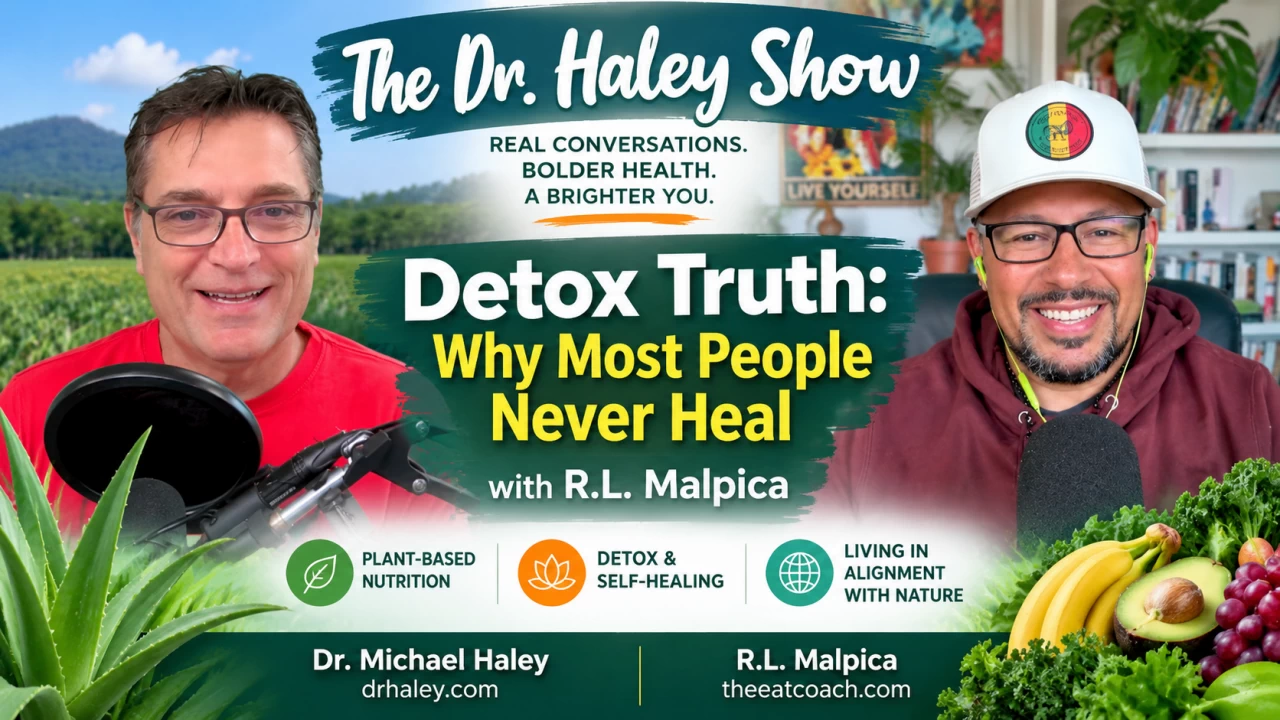
What if the biggest obstacle to better health isn’t what you’re doing—but how you’re thinking about it? In this episode, R.L. Malpica breaks down detox, plant-based nutrition, and the powerful idea that your body already knows how to heal—if you remove the barriers.
This episode challenges the idea that health comes from outside solutions—and instead shows how removing barriers allows the body to heal naturally.
About This Episode
In this episode of The Dr. Haley Show, Dr. Michael Haley sits down with R.L. Malpica, a certified detoxification specialist and natural health coach, to explore what it really means to live a healthy life.
R.L. shares his philosophy on detox—not as a short-term cleanse, but as a continuous, natural process the body is always performing. He explains how modern lifestyles interfere with this process and how simple changes can help restore balance.
The conversation dives into plant-based nutrition, the role of fruits and leafy greens, and the concept of “acid-forming” foods versus naturally alkalizing foods. You’ll also hear a fascinating discussion on mindset—specifically how many people unknowingly block their own healing by relying solely on external solutions.
This episode challenges conventional thinking and offers a fresh perspective on how to support your body, simplify your approach to health, and reconnect with nature.
Watch the Interview
Listen to the Podcast
Resources
- Visit R.L. Malpica’s website: The Eat Coach
- R.L. Malpica on YouTube: The Eat Coach on YouTube
- R.L. Malpica on TikTok: @rl_malpica
- R.L. Malpica on Facebook: The Eat Coach on Facebook
- R.L. Malpica on Instagram: @rl_malpica
- Watch this episode on YouTube: R.L. Malpica on The Dr. Haley Show
Quick Takeaway
R.L. Malpica views detoxification as an ongoing process rather than a temporary cleanse. His approach emphasizes fruits and leafy greens, reducing what he considers barriers to the body’s natural processes, and considering nutrition, environment, and mental and emotional factors together.
The conversation also highlights an important feature of this episode: Dr. Haley and R.L. do not agree on every dietary or health perspective. Instead, they explore those differences openly, including plant-based versus animal-based eating, acidic versus acid-forming foods, alkaline water, and R.L.’s perspective on germ theory and terrain theory.
ENJOYING THIS CONVERSATION?
Get the Next Episode in Your Inbox
Get notified when a new episode of The Dr. Haley Show is published, plus occasional highlights and resources worth exploring.
By subscribing, you agree to receive email from The Dr. Haley Show. Unsubscribe anytime.
Episode Timestamps
00:00 – What gets in the way of healing?
00:43 – Show introduction
01:23 – Meet R.L. Malpica
03:42 – Who he helps and how
05:10 – What “detox” really means
06:24 – Living in a toxic world
07:39 – Foods to avoid vs. consume
08:41 – Transitioning your diet gradually
09:10 – Plant-based vs. animal-based perspectives
10:44 – Why leafy greens don’t satisfy hunger
12:21 – Fruits vs. greens for energy
13:23 – A typical day of eating
14:58 – Raw hummus and food creativity
16:22 – Plant-based lifestyle transition
17:36 – Favorite foods and recipes
18:51 – Dominican Republic lifestyle discussion
23:55 – The E.A.T. philosophy explained
26:12 – Phytonutrients and detox
27:29 – Acid-forming vs. acidic foods
29:32 – The myth of alkaline water
30:43 – Biggest obstacle to getting well
31:56 – The “outside-in” health mindset
34:23 – Who R.L. helps most
35:31 – Germ theory vs. terrain theory
36:38 – Coaching, programs, and services
37:20 – His new podcast
38:13 – Final thoughts on nature and health
Detox as a Lifestyle
For R.L., detoxification is not something that happens only during a cleanse. He describes it as something the body is continually doing and believes the goal should be to create conditions that support those natural processes. The discussion expands beyond food to environmental exposures and the mental side of a healthy lifestyle.
Fruits, Leafy Greens and a Plant-Based Diet
R.L. describes a diet centered heavily on fruits and leafy greens, with a smaller portion of cooked plant-based foods. Dr. Haley contrasts that with his own experience eating animal foods and needing more calorie-dense foods for satiety. Rather than avoiding the disagreement, the two use it to explore calorie density, intermittent fasting, avocados, bananas, raw hummus, sprouted chickpeas and other practical food choices.
The E.A.T. Philosophy
R.L. explains the E.A.T. philosophy he developed from his study of natural and holistic health approaches. In his framework, “E” represents energy efficiency, “A” represents avoiding acid-forming foods, and “T” represents reducing toxicity. He uses the framework as a simple way to explain his approach to diet and lifestyle.
Acidic Foods vs. Acid-Forming Foods
One distinction explored in the episode is the difference between the pH of a food itself and the idea of a food being “acid-forming” after digestion. Dr. Haley and R.L. also discuss blood pH and why this conversation should not be reduced to simply drinking increasingly alkaline water.
Germ Theory vs. Terrain Theory
Near the end of the interview, Dr. Haley asks R.L. to explain what he means by germ theory and terrain theory. R.L. contrasts a pathogen-focused view of infectious disease with a terrain-oriented perspective that places greater emphasis on the condition of the body, nutrition, environment, and mental and emotional factors. This section represents R.L. Malpica’s explanation of these concepts and is presented as part of the broader discussion rather than as individualized medical guidance.
Medical Disclaimer
This podcast and article are provided for educational and informational purposes only and do not constitute medical advice. The experiences and opinions discussed are those of the speakers and should not replace diagnosis or treatment from a qualified healthcare professional. Do not begin, discontinue, or change any medication, supplement, diet, or treatment based solely on this episode.
Full Transcript
The transcript has been lightly formatted for readability. Because it was created from the recorded conversation, it may contain minor transcription errors.
Read the Full Transcript
Dr. Michael Haley: What do you think gets in the way of people getting well?
R.L. Malpica: The concept of looking outside of themselves, of always looking for the answer through medication or supplements or some type of therapeutic medium, per se, versus understanding that the body is a self-healing organism.
Show Intro: You are listening to The Dr. Haley Show, the podcast dedicated to helping you optimize your health. Each episode there will be an interview or a message to help you discover better health. We will be featuring health radicals on the show to bring new ideas to the table, as well as doubling down on key fundamentals to support you living your best life.
Your host is none other than the founder of Haley Nutrition, Dr. Michael Haley.
Dr. Michael Haley: This is The Dr. Haley Show podcast. I’m Dr. Michael Haley, your show host, and today’s guest, well, he’s a certified detoxification specialist and natural health coach who helps people connect to balance through the mind, body, and spirit. He’s author of Detox Yourself: The Secret to Freeing Your Mind and Creating a Healthy Life and The Natural Reset: A Beginner’s Guide to Transforming Your Health.
He’s got a pretty solid following on a lot of the social platforms and lots of content on, well, YouTube, TikTok, Instagram, Facebook. I was checking out some of his very cool content, and I’m going to have links to those in the description and the resources section, so check them out.
Today’s guest is R.L. Malpica. Man, welcome to the show. I’m glad to have you here. You know, I found you online, and I know I mentioned this to you already. We’re very different in a lot of things, in our beliefs and, well, in the way we live and the way we treat our health. But one thing I was drawn to you is not only maybe your differing opinions on things, but your delivery of those.
R.L. Malpica: Oh, thank you. Thank you.
Dr. Michael Haley: So many people are so dogmatic. It’s uncomfortable. And you can’t learn from that, you know, because it’s their way or the highway. But you deliver with a smile, not with a hammer. Does that sound about right?
R.L. Malpica: That does. And I just want to say thank you for that amazing intro. I appreciate everything that you said, but yes. Smile. I like to share love. I’m not trying to—I’m not into confrontation, per se.
Dr. Michael Haley: Yeah. And that’s why I think this is a good opportunity. You know, where we can learn. And for people that have differing opinions, including myself, with an open mind, who knows how that might affect me or someone else that’s listening?
And I can’t disagree with, you know, your diet perspective when it comes to detoxification and stuff like that. For me, it might not be for everyone, right, from my perspective. But then I have a lot of people that I would say, “You gotta do these things. The way—what he’s talking about, for you, this is right, and it’ll help you because of this particular reason.”
R.L. Malpica: For sure. For sure.
Dr. Michael Haley: That’s why I think it’s such a good, healthy discussion. Why don’t you tell us a little bit about yourself, where you are, what you do, how you help people, and let’s go from there.
R.L. Malpica: Yeah, for sure. I mean, mostly I work with individuals who are looking to make some form of transformation in their life, whether that is, you know, working with some type of illness that they’ve been diagnosed with and helping them kind of get to the root of that issue and help heal them that way, or people who want to lose weight, or people who are just looking to make changes in their lifestyle to, you know, live in more alignment with nature and, you know, ultimately becoming a better version of themselves, both from the physical standpoint, the mental standpoint, and the emotional standpoint.
And everything that I utilize in my coaching is what I’ve also applied to my life as well. So, you know, I live it as well as preach it. So that’s mainly where I’m at from the coaching perspective. And I also create content that, you know, educates individuals about the natural aspects of the body, health from a natural perspective and whatnot.
And, as you mentioned earlier, I wrote an e-book as well as a book that I just released earlier this year called Detox Yourself.
Dr. Michael Haley: Yeah, yeah. Now, who needs to detox? Do you need to?
R.L. Malpica: Well, I mean, that’s the thing about detoxing is we detox all the time. I mean, every time we sneeze, every time we cough, every time we sweat, every time we urinate, every time we have a bowel movement, we’re technically detoxing.
So, like, when I talk about detoxing, it’s more about getting the conditions right for your body to detox more, right? So we do so many things that block our body from cleaning itself, from actually detoxing, and my job is to help you eliminate those barriers. So yes, yes, I do need to detox. We all need to.
Dr. Michael Haley: Yeah. There’s, you know, when it comes to detoxification, I kind of think of, like you, it’s a lifestyle. We have to live like that. I’m reminded of some humor from this comedian from years ago. I think he’s probably still around, Andrew Dice Clay. And he was talking about the smoking section on airplanes.
Now they don’t have smoking on airplanes, but he said, “You’re in a tube.” You know, the smoke is going to go everywhere. And that’s how it is on this planet. The smoke’s everywhere. The toxins are everywhere. And even living the cleanest lifestyle possible, we’re all taking in toxins, even if you’re eating the most clean, organic food.
And I’m sorry, but the chemicals are raining everywhere, including on organic properties. Yeah, so it’s a lifestyle of avoiding the significantly toxic stuff while consuming as much detoxifying lifestyle as possible, not just nutritionally, but mentally even.
R.L. Malpica: One hundred percent. No, one hundred percent. Like, at the end of the day, you can only control what you can control. And, you know, unfortunately, unless you’re doing your own farming—and even if you’re doing your own farming—you can’t control what’s been in the soil, you know what I’m saying, for years upon, you know, generations upon generations.
So at the end of the day, you’re at the mercy of nature. And I shouldn’t say just nature, but what we have done to nature, pretty much. So you just have to do the best that you can. And it comes down to those conditions. Like, you want to modify the conditions and you want to eliminate as many of the barriers as possible to allow your body to, you know, do what it’s naturally been created to do. And that’s ultimately, you know, get to balance and homeostasis and clean itself when need be.
Dr. Michael Haley: Okay. When it comes to food, what are your guidelines for detoxifying, cleansing foods? What do you avoid and what do you consume?
R.L. Malpica: Well, I avoid all meat, avoid dairy, and processed foods. Like, those are the three foods that are going to cause the most burden on the body, you know, through the digestion process, plus the ash that’s left behind when those foods are ultimately digested.
And I consume majority fruits and leafy greens. So that’s going to be the majority of my diet. I do still eat some cooked plant-based foods as well. So that’s kind of the dividing line there.
So when I work with people, I try to see where they’re at currently and then try to incrementally shift those ratios, because the average person’s probably eating anywhere from 85 to 90% cooked, maybe 10%, 15% raw. So I try to shift those ratios incrementally to where they can start implementing more of those whole, raw, hydrating foods into their diet.
Dr. Michael Haley: Okay. And as I’m shaking my head yes—people are watching on video—it doesn’t necessarily mean that I agree with all of that.
R.L. Malpica: Sure.
Dr. Michael Haley: For me. But from a cleansing, detoxifying standpoint, that is the cleansing, detoxifying foods. And that’s what a lot of people will need, especially if they’re trying to overcome, you know, some kind of horrible disease where they need tremendous immune support. It’s a very cleansing, detoxifying lifestyle.
Now, do you have friends that consume animal foods?
R.L. Malpica: Yes, I do.
Dr. Michael Haley: Do you get along with them?
R.L. Malpica: Of course. I have friends, family members, you name it.
Dr. Michael Haley: Okay, okay. Not for me. You know, I consume animal foods, and the primary reason is I don’t ever feel satisfied consuming vegetation, for me.
R.L. Malpica: Yeah.
Dr. Michael Haley: I know a lot of people do get to that point of satiety. I don’t know if you—yeah, for me, I like shopping at Costco because they have a lot of organic foods, especially, you know, in produce. And I like getting one of those—it’s like a tub of mixed greens.
R.L. Malpica: Yes.
Dr. Michael Haley: And I might get with that a tub of, you know, mushrooms and some avocados and stuff. And I can chop that stuff up. I like—you know the pizza cutters?
R.L. Malpica: Yeah.
Dr. Michael Haley: I use one of those to chop it up into little tiny pieces because I can cook that whole tub now in one bowl. And I’ll eat that whole freaking tub in one sitting, and an hour later I’m still hungry. And I have the avocado. Now I have to douse it with, you know, olive oil to get any amount of satisfaction.
R.L. Malpica: Yeah. Leafy greens are so low in calories, and they’re not very calorie-dense. I mean, that’s why, like, when I create a dietary plan or a customized plan, leafy greens are always a major part of it, but it’s more about the quantity of them compared to fruits versus the actual calories you’re getting.
It’s just, the leafy greens provide so many minerals, not to mention minerals that haven’t even been discovered yet, that, you know, it’s an imperative piece of your diet to have leafy greens, for sure. But as far as getting you full and satiated, I agree. It’s very, it’s very tough for leafy greens to get me full as well.
Dr. Michael Haley: Now your emphasis, it seems, is on fruits.
R.L. Malpica: Yeah. I mean, leafy greens are just as important. But if you’re talking about satiation and you’re talking about calorie density, then fruits are going to be the majority of your calories that you’re eating.
Dr. Michael Haley: Okay. So maybe that’s the missing link for me.
R.L. Malpica: Yeah. Like I said, salads are—I mean, I should say leafy greens are extremely important, but you’re never going to match the calorie density with fruits, you know, because you’d have to eat, man, you’d have to eat like seven of those tubs.
Dr. Michael Haley: Yeah, yeah, yeah. I agree. And you know, it’s interesting because you kind of corrected yourself. You started saying salads. But wait a second. You know, salads can mean fruit.
R.L. Malpica: Yeah. You can have a fruit salad, dressings, all kinds of different things.
Dr. Michael Haley: Eggs.
R.L. Malpica: Yeah, yeah.
Dr. Michael Haley: So what does a day look like for you? What kind of breakfast do you have? Do you have breakfast? What do you eat?
R.L. Malpica: Yeah. So part of my philosophy is to implement intermittent fasting. So my eating window is between noon and eight, but usually ends around six. So my first meal of the day, the way I break my fast, is going to be roughly around noon.
And I usually start—like my main, I guess, breakfast food would be bananas. I love bananas. I’ll eat anywhere from seven to nine of them for my first meal of the day. Bananas are great because they’re very calorie-dense. Like each banana is going to give you about 105 to 110 calories. So you eat seven or eight of them, that’s—you’re getting close to a thousand calories right there.
And then I’ll usually have grapes or something for lunch, maybe a pound of grapes, maybe two pounds, depending on how hungry I am. And then for dinner is usually when I’ll do a salad, a big salad, you know, which will consist of romaine lettuce, tomatoes, cucumbers, sometimes avocado. I don’t eat an avocado every day just because it’s fattening. So I’m kind of sparing on the avocado, maybe every other day.
And then, like I said, you know, 15% of my diet is cooked plant-based. So, you know, the times where we do eat cooked will be, I don’t know, random things.
Dr. Michael Haley: Hummus?
R.L. Malpica: Hummus.
Dr. Michael Haley: Okay. Which I like. I like raw hummus. I don’t know if you’ve ever sprouted your own chickpeas.
R.L. Malpica: No, I have not. No, I’ve had somebody else do that, and I’ve tried theirs, but I have not done it myself.
Dr. Michael Haley: Yeah. You know, you can sprout chickpeas for a couple days, and they start developing a nice little point on them. And to me, that’s sufficient. And you can let them grow longer than that. But after about two days and they have that nice solid point, throw them in the blender and throw in your, you know, garlic and lemon. If you want to throw in some raw sesame seeds, just put them in there and make your own tahini, in a sense, at the same time.
R.L. Malpica: Yes.
Dr. Michael Haley: Blend that up. Raw, delicious hummus.
R.L. Malpica: Yes.
Dr. Michael Haley: Yeah. So that’s, to me, a favorite. And, you know, you don’t have to use chickpeas to make hummus. You can use other sprouted beans.
R.L. Malpica: Yeah. Awesome. That’s the thing. There’s so many. And when I, nine years ago, when I became vegetarian, like, I grew up, you know, the first three decades of my life, you know, in a family that a majority—like meat and potatoes and rice. Like, that’s what we lived on.
So I never even got to explore any of the vegetable kingdom. And when I became vegetarian, obviously, you know, I had no choice. So I started to just discover all these different things that I fell in love with that I didn’t even realize really existed.
Then becoming 100% plant-based, you know, it’s just your palate changes. You start to experience new things, and your body starts speaking to you in different ways once you start going that route.
Dr. Michael Haley: Well, for me, I still am a meat-and-potatoes guy. But my emphasis on my diet is vegetation. Now, potatoes are root. You consume potatoes?
R.L. Malpica: Yeah. That’ll be a part of my cooked—the small percentage of cooked food I eat. Potatoes, I love. One of my favorite cooked foods is—it’s kind of funny that I’m saying this is a cooked food—but is sushi. But it’s a sweet potato roll. So it’s cooked sweet potato inside of the wrap and the sticky rice. That is one of my favorite cooked foods.
Dr. Michael Haley: Okay. Right now, my wife’s new thing—you know, we go through phases of trying different things—but it’s sweet potato pancakes.
R.L. Malpica: Okay.
Dr. Michael Haley: Which, you know, I’m not sure what else she’s putting in it. I think it’s bananas for sure.
R.L. Malpica: Yeah.
Dr. Michael Haley: Sweet potatoes, and, you know, she kind of just mixes it up into—I don’t know if she adds any oats or anything like that.
R.L. Malpica: That would be flour, like maybe a little flaxseed.
Dr. Michael Haley: But that’s the, you know, the sweet potato pancake.
R.L. Malpica: Nice. And you can make pancakes out of anything. You know, you don’t need wheat, right?
Dr. Michael Haley: Right.
R.L. Malpica: Yeah. I’ve got banana pancakes that are very good. I haven’t tried the sweet potato ones. I might have to add that to the list.
Dr. Michael Haley: Yeah, you start messing around in the kitchen and, you know, you start adding some different elements to stuff. You’ll be surprised what you can come up with.
R.L. Malpica: Yeah.
Dr. Michael Haley: The flaxseed will help it stick together so that it actually eats like a pancake instead of something that just crumbles on your plate. But, right, good, good stuff.
And you mentioned avocados. That happens to be a go-to. I like bananas. I eat a lot of bananas, but I need the avocados for the satisfaction. And, you know, it could be three or four of them. And, you know, it’s like, okay, now I’m satisfied.
Not the Florida avocados, though. The Florida avocados, they’re like basketballs. They’re huge, but they don’t have that buttery, high-fat, you know, kind of satisfaction that you get from the Hass avocados.
R.L. Malpica: Yeah, I usually get the Hass. Yeah, those are the ones I usually get. But we frequent the Dominican Republic a lot, and we’re actually going to be moving there.
Dr. Michael Haley: No way.
R.L. Malpica: Yeah. In about a year.
Dr. Michael Haley: Yeah. And, man, they have some massive avocados.
R.L. Malpica: Yes, they do. And those are very good as well. But yeah, just depends on, like, what mood you’re in, what type of flavor you’re looking for and whatnot.
Dr. Michael Haley: You know, you see the wallpaper behind me?
R.L. Malpica: I do.
Dr. Michael Haley: That’s an aloe vera field from the Dominican Republic.
R.L. Malpica: Really? Okay. Yeah, that is awesome.
Dr. Michael Haley: I’ve been there many times. Yeah, to the Dominican Republic at least 20 times.
R.L. Malpica: What?
Dr. Michael Haley: I would always go there to supervise our aloe vera harvest and the production of it.
R.L. Malpica: Okay. Nice. What part? What part of the Dominican Republic do you frequent most?
Dr. Michael Haley: Well, initially, because they had fields in various places, initially it was out in Baní. But that was in the early years, and then we were using fields that were closer to Santo Domingo.
R.L. Malpica: Okay. Okay. Nice.
Dr. Michael Haley: But, you know, we’ve also done plenty of travels on the island to, you know, visit Los Damajaguas waterfalls, which is a great time. Anyone visiting the Dominican Republic, get a good, solid guide there and go through the waterfalls. You’ll have a great time.
And, you know, I’ve been all over the place, not only visiting the aloe farm, but I’ve visited other farms there. There’s a coconut farm where we were considering making coconut products and using them. So we toured that and saw how they did things there. There’s a lot of cool things there.
R.L. Malpica: Oh, for sure. For sure.
Dr. Michael Haley: Yes, but the fact that you’re thinking about moving there, I understand that too now. Probably 15 years ago, 20 years ago, when I first started going there, I don’t know if I would have wanted it. But now they have, you know, all the amenities that we have here. Back then, not so much.
R.L. Malpica: Yeah, their infrastructure is definitely growing exponentially, you know, in a bunch of different areas.
Dr. Michael Haley: Yeah, yeah. Everywhere I would have been, you know, from cell phone use to internet, you know, they just didn’t have anything in place around 2010 when I first started going there.
R.L. Malpica: Yeah, yeah.
Dr. Michael Haley: Interesting. Neat stuff. And why did you choose the Dominican Republic?
R.L. Malpica: Well, we’ve been looking to leave the United States, and we want more of a simple lifestyle. And one of the big things is we want to grow our own fruit, obviously, with us having such a fruit-based lifestyle.
So we tried some other places, and we actually got married in Punta Cana ten years ago, and it was our anniversary. So we were like, well, why don’t we check out the Dominican Republic? You know, we didn’t really have it high on our list, but we went to Punta Cana, spent a day there, and then we decided to drive to the Samaná Peninsula in Las Terrenas.
And, man, when we got to Las Terrenas, it just intuitively hit us, like, this is the place. And we’ve just—we loved it every time we went, every day we were there. And it just kind of aligned for us. And, you know, we’re just going to do it. We’re going to try it and see how it works and go from there.
Dr. Michael Haley: Did you do the driving while you were there?
R.L. Malpica: My wife did. Yeah, she’s a much better driver than I am.
Dr. Michael Haley: Wow.
R.L. Malpica: Yeah.
Dr. Michael Haley: Not that you really have to be a good driver there because there aren’t really many—there are no rules. It’s the most organized chaos you could ever imagine.
R.L. Malpica: That’s a great way to put it. It’s like playing a video game, only for real.
Dr. Michael Haley: Yes.
R.L. Malpica: Driving. I made a video that I put on my YouTube page of our trip there. And for the traffic parts, like, I kind of sped it up just a little bit so you can see the chaos and how it really actually happens in real speed. And it’s—you got to be aware. You can’t be on your phone and driving in the Dominican Republic.
Dr. Michael Haley: Yeah, funny stuff. I actually got a guy that I call. He’s, when I’m there, he’s like my Uber driver, only it’s on a motorcycle. And, you know, I’m on the back, and I’m not trying to look all wimpy, like holding on for dear life, especially. I’m trying to look all tough, like, I got this and stuff. But inside I’m hanging on for dear life.
Especially when we get near an intersection, because there’s going to be cars in front of us, and he’s hitting the sidewalk. Yeah, we’re taking the sidewalk to get around the cars. It’s absolutely nuts. A good time, though.
And I actually think that in the Dominican Republic, I’m certain that is where they hold the world record for fitting the most people on a single motorcycle.
R.L. Malpica: Oh, is it? I didn’t know that.
Dr. Michael Haley: No, I’m just making that up because I’ve seen literally—
R.L. Malpica: Wouldn’t surprise me.
Dr. Michael Haley: Yeah, yeah. I’ve seen like four or five people go by on, like, one motorcycle, and they’ve got toolboxes and ladders and all kinds of things. Very resourceful, very resourceful.
R.L. Malpica: Very resourceful.
Dr. Michael Haley: They get it done.
R.L. Malpica: They absolutely get it done.
Dr. Michael Haley: Yeah, yeah. You have something called the E.A.T. philosophy. What is it?
R.L. Malpica: Yes. Yeah. So it’s a philosophy that I created based on, like, all my studies of kind of the natural, holistic world, basically. So I’ve read, you know, Dr. Morse’s stuff and, if you’re—I don’t know if you’re familiar with him—Dr. Douglas Graham, a bunch of different naturopaths and natural hygienists and whatnot.
And while they all had similar messages, there were differing elements to them. So I’ve kind of taken those elements and applied them to myself and what worked for me and created my own philosophy off of it. Because ultimately, when you’re teaching people, you want to—you know, sometimes some of these people go over your head a little bit, you know, with the jargon and trying to go a little bit too deep.
And I wanted to create something that was very simple, very basic, on how to, you know, transition your diet and get to more of a natural, in-alignment type of lifestyle.
So the E.A.T. philosophy: the E is for energy efficiency, which basically is like your body’s profit-and-loss system. You want to eat foods with the most electricity and cause the least amount of burden during the digestive process. That’s your fruits and your leafy greens: high-electric foods, low digestive burden. That means your body has a surplus of vitality and vital energy to utilize in the cleaning and detoxing process.
The A is for avoiding acid-forming foods. When we eat a lot of cooked foods and meats and dairies and processed foods, they are acid-forming within the body and they are dehydrating. So they not only add acidity to the body, they also block a lot of the elimination pathways due to the dehydration.
And then reducing toxicity. That’s the T. And that goes to what you said earlier, not just food, but everything around you, from the smoke to the cleaners you use, the soaps you’re using, you know, the people that you keep around you, all that, all-encompassing in that. So that is ultimately the E.A.T. philosophy.
Dr. Michael Haley: Yeah. I think it’s interesting when you consider the fact that even your most organic fruits and vegetables are still going to have toxins in them, because it’s unavoidable, because the toxins are everywhere.
These phytonutrients have many, many properties, and people will call them antioxidants, which is one of their functions, one of their properties. And they also do other things like regulate hormones, and they increase intercellular communication. But they also help detoxify. They’re used in detoxification processes.
So as you’re consuming these phytonutrients, I don’t know why they call them antioxidants. They could call them detoxifiers, or hormone regulators, or intercellular communicators. You know, they call them antioxidants. That’s one little tiny function, right? Detoxification is one of their great functions, right?
R.L. Malpica: For sure. For sure. One hundred percent.
Dr. Michael Haley: Now, in the avoid acid-forming foods, this one could be a little confusing because a lot of fruits and vegetables are acidic. In fact, I think carrots have a pH of like four and a half to five, which are on the acid side.
You know, the picture behind me is aloe vera, which is, you know, 4.5 to 5 on the pH scale. It doesn’t mean avoid acidic foods. It means avoiding acid-forming foods.
R.L. Malpica: Yes, yes.
Dr. Michael Haley: What can you say?
R.L. Malpica: Yeah. So basically when you ingest it and it goes through the metabolic process and the digestive process, it leaves an acid-forming ash behind. So those acid foods that I’m speaking of that we actually ingest, they leave an acidic ash behind, whereas, like an orange, for instance, which is acidic, or the carrot, like you said, when we eat those, that is not going to leave an acid-forming ash behind. It’s actually going to be alkaline-forming within the body.
So that is the difference. And yes, that has always been confusing. That’s why I made sure that within any promotion of that particular philosophy, I always put “acid-forming” in it and, you know, try to explain it as easy as best as I can.
Dr. Michael Haley: Yeah. And that’s great. So it’s the ash of the thing you eat. We can still have citrus and carrots. It’s the residue.
R.L. Malpica: And an easy way to say it is, like, the residue that’s left behind after, you know, the entire digestive process.
Dr. Michael Haley: Fantastic. You know, and I’m going to also suggest to people, because some people, I think, get confused on this and they say, okay, I want to be alkaline, and therefore I’m going to consume, you know, pH 10 alkaline water because cancer can’t live in an alkaline environment.
Well, that’s not necessarily true, right? We really can’t change the pH of our blood. It’s going to be a very tight range.
R.L. Malpica: Yeah, I think it’s something like 7.35 to 7.45. Outside of that, you’re in trouble.
Dr. Michael Haley: Yeah. No, that’s not what this is about. And it’s about the food choices, not the pH. If it was about the pH, you can just have a teaspoon of bleach, right?
R.L. Malpica: Baking soda.
Dr. Michael Haley: Yeah. But that would not—that would not go well for you. Don’t do that.
R.L. Malpica: Yes. And I think the biggest misconception on that is water. Like, people are trying to buy these waters, these alkaline, extra-alkaline waters. Like, water is neutral. Like, it’s not supposed to be, you know, over-alkaline or over-acidic. You know, it’s supposed to be in that range, in the middle there, for a specific reason. Anything that’s going to be outside of that is going to be, obviously, chemically induced and not good for you.
Dr. Michael Haley: Yeah, yeah, yeah. Makes sense. All right. So, what do you think? Yeah, this is where we could go off the rails. Dangerous question here. What do you think gets in the way of people getting well?
R.L. Malpica: Oh, that’s a good one. Okay. I think getting well, just the concept of looking outside of themselves for the answer. As far as, like, I think we’ve been conditioned to look at health through the lens of a more germ-theory perspective, of always looking for the answer through medication or supplements or, you know, some type of therapeutic medium, per se, versus understanding that the body is a self-healing organism.
So we want to eliminate as many of the barriers to allow our body to be able to heal. So I think that’s the number one thing that stops people from getting well, personally, as far as that, if you’re asking how to get well.
Dr. Michael Haley: Yeah. I think that’s a great answer. And that would be something for everyone right now to consider, because we have been brainwashed into thinking there’s an outside-in approach.
And I can prove that. How old are you?
R.L. Malpica: Me? I’m 44.
Dr. Michael Haley: Okay. You might be too young for this. Oh, let me use one that’s more modern. Do you know what medicine might be the nighttime, sniffling, sneezing, coughing, achy, stuffy-head, fever-so-you-can-rest medicine?
R.L. Malpica: NyQuil?
Dr. Michael Haley: Yeah, yeah. And that’s a perfect example, because I did not say the medicine. But you knew which one it was because that commercial has been pounded into your brain.
So for someone that has the sniffles, they might think, I need NyQuil. Well, that’s an outside-in approach.
You know, plop, plop, fizz, fizz.
R.L. Malpica: Yep.
Dr. Michael Haley: Oh, what a relief it is, is what a lot of people would say if they were my age. Plop, plop, fizz, fizz, because that was a jingle, you know, 15 years prior for people my age. And it was Alka-Seltzer: plop, plop, fizz, fizz. Oh, what a relief it is.
Yeah, another one would be, you know—and they’re bringing this one back. They’re bringing this one back—how do you spell relief?
R.L. Malpica: Rolaids.
Dr. Michael Haley: Okay. And these are—yeah. So some of these commercials haven’t been on in 50 years, which is why you wouldn’t necessarily be familiar with those. But the brainwashing is real.
And people that are in their, you know, 60s listening to this and heard me say, “Plop, plop, fizz, fizz,” something in their brain automatically said, “Oh, what a relief it is,” because you have been programmed. You have been brainwashed into thinking an outside-in approach is the way to get well.
So I think that was a brilliant answer. And what gets in the way is seeing things from the, you know, outside-in approach instead of the inside-out. We are self-healing organisms that, well, we need certain input for our bodies to work, and we need to avoid other things. And our body works like it’s supposed to.
R.L. Malpica: Exactly, exactly. Yes, yes.
Dr. Michael Haley: What’s your target market? Your ideal customer. Who would benefit the most from your services?
R.L. Malpica: Anybody who’s looking to make a transition to a more natural-living type of lifestyle, who’s open-minded to looking at health from a more holistic standpoint, more of a terrain-based standpoint versus a germ-based standpoint.
And someone who’s just curious about, you know, getting into a plant-based lifestyle as well. Like, kind of my mantra is, like, living in alignment, and what I profess is being in alignment with nature and, you know, what our natural instincts are and what our natural bodily abilities are and whatnot. So those are the people that I work best with.
Dr. Michael Haley: Yeah, yeah. So on that point, because you use the words, can you explain germ versus terrain?
R.L. Malpica: Yeah. So, I mean, germ theory is kind of what we’ve all been conditioned and kind of born into from a societal standpoint, a germ-theory way of health. And that is that, you know, there’s billions of different pathogens attacking us at all times and that our immune system is always on defense.
And because of that, you know, anytime we’re infected, that is the manifestation for sickness and disease, right? Not all, but kind of the main point of it.
A terrain base is that the majority of everything that happens from the body is a manifestation from within. So it’s based on what we are inputting, what environments that we’re in, what we’re dealing with from an emotional and mental standpoint. Ultimately culminates into the dis-ease within the body.
Dr. Michael Haley: Yeah, yeah. And I think maybe if we looked at that from a, well, illustrative example: did the dump cause the rats or did the rats cause the dump?
R.L. Malpica: Yeah, yeah, yeah. If you go to a landfill, there’s going to be rats there for sure.
Dr. Michael Haley: Yeah, pretty much. All right. Now, how does someone see you, or how do you help people? I think you have some online programs. Do you also do one-on-one?
R.L. Malpica: Yes, yes, I do. I give free consultations, ultimately to kind of see what your goals are and ultimately to see if I’m the right fit. You know, I think that’s very important to me, in alignment and that connection as well.
So you can find everything that I do on my website, TheEatCoach.com. I’ve got my book on there. I’ve got my new custom GPT that I built that’s basically an AI natural health coach. I also have my programs on there as well. So you can get all that on my website, including my podcast and my YouTube channel.
Dr. Michael Haley: Oh, that’s right. And you started a new podcast. I saw your previous podcast. You had over 100 episodes.
R.L. Malpica: Yes.
Dr. Michael Haley: And what are you doing now?
R.L. Malpica: Well, my previous one, Minds Like Mine’s, I was doing it with somebody else. It was kind of like a collaboration effort. And then I started this new one called Nature Over Everything, which, if, you know, if you listen to this podcast, you kind of got an idea of what I’m about.
But it’s based on that understanding life from a natural perspective and getting in alignment with nature as well. So we talk diet, we talk mindfulness, and ultimately living in alignment.
Dr. Michael Haley: Okay. Now, when you go to the Dominican Republic, are you still taking customers from the United States?
R.L. Malpica: Yeah. I do all my stuff virtually, so yes. Taking all my clients, and we’re going to actually try to build a small little wellness community in Las Terrenas. So if anybody is making the move there or thinking about it, reach out to me. And if you want to be a part of it, maybe a vegan retreat to the Dominican Republic someday.
Dr. Michael Haley: Hey, sounds good to me. All right. Thank you for being on the show. Final words of wisdom.
R.L. Malpica: Oh, look, just look to nature. Nature has all the answers that you need. We’ve been clouded. You know, we’ve been conditioned and programmed to look at everything outside of nature. But our answers are right there.
Dr. Michael Haley: R.L. Malpica. That’s a good word. Thank you for joining me today.
R.L. Malpica: Man, I appreciate it. Thank you for having me.
Show Outro: I hope you enjoyed that episode today on The Dr. Haley Show. Make sure to hit subscribe on whichever platform you are listening to this. If this episode made you think of someone, go ahead, take a screenshot and share this exact episode with them.
You can catch the show notes for this episode on DrHaley.com. If you want to geek out with Dr. Michael Haley on other radical health topics, be sure to check out his YouTube channel where he posts exclusive video content.
All the details are at DrHaley.com, and we can’t wait to hang out with you on the next episode.