
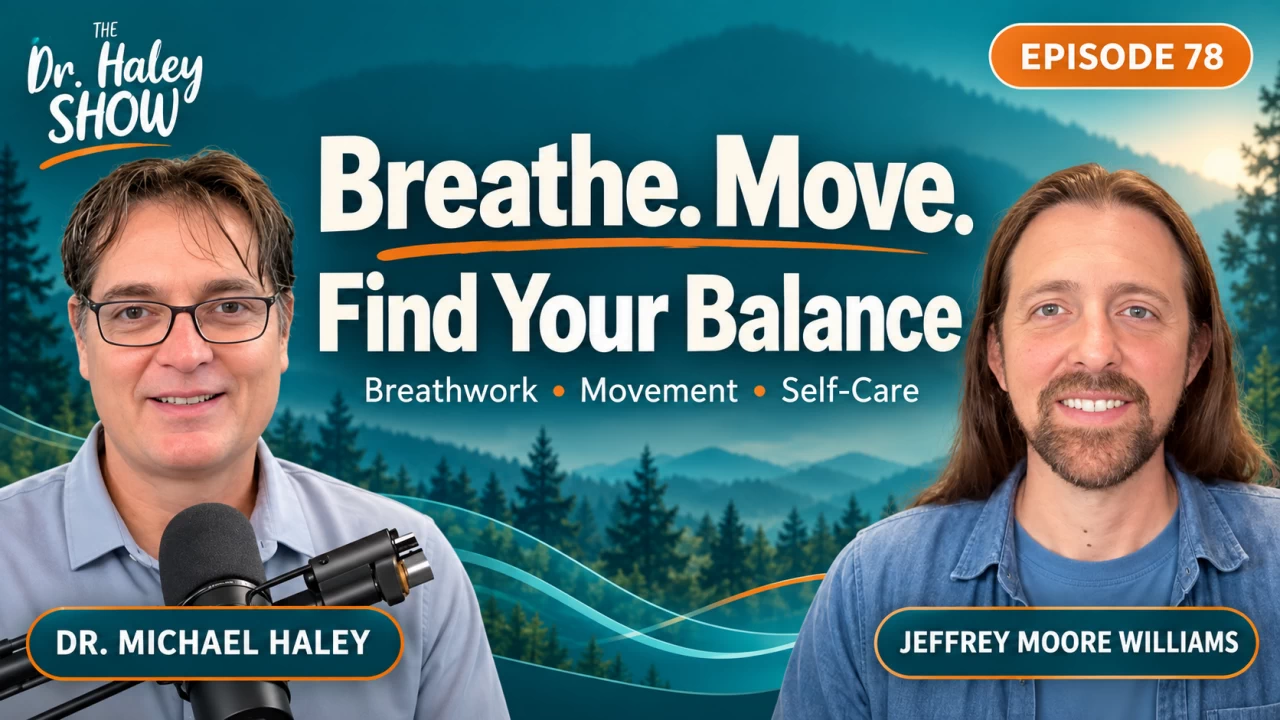
Jeffrey Moore Williams joins Dr. Michael Haley to discuss breathing, spinal movement, self-care, and the challenge of staying present in a busy world. Their conversation explores how Williams approaches stress and body awareness through EDGU, Alphabiotics, and everyday changes in routine.
About This Episode
Williams describes his background in anthropology and philosophy, yoga, movement, massage therapy, and acupressure. He also shares a personal turning point: after years of helping others, the demands of parenting, caregiving, and work led him to reconsider how much attention he was giving his own well-being.
Watch the Interview
Listen to the Podcast
Resources
- Visit Jefferey Williams at “Lifestyle of Light”
- Find out more about Vitalist Project
- Get Your Free Healthy Spine Course
- Watch this episode on YouTube
- Listen to this episode on iTunes
Quick Takeaway
The central theme is making room for self-care before the demands of work, family, and caregiving crowd it out. Williams describes breathing, movement, time in nature, and small changes in routine as ways he helps people pay attention to their bodies and become more present.
The episode also includes Williams’s explanations of EDGU and Alphabiotics, along with his views on stress physiology. These are presented as his perspectives and experiences; the conversation does not establish that either approach treats disease.
ENJOYING THIS CONVERSATION?
Get the Next Episode in Your Inbox
Get notified when a new episode of The Dr. Haley Show is published, plus occasional highlights and resources worth exploring.
By subscribing, you agree to receive email from The Dr. Haley Show. Unsubscribe anytime.
Episode Timestamps
00:00 Intro Snip
01:05 Who Is Jeffery Moore Williams?
02:36 The wisdom that comes with the human body
03:56 How can you use breathing to change your state of being
11:43 What happened in Jeffery Moore Williams life that made it necessary to take a week off to recover his health?
14:55 What changes did you make and what were the results?
18:33 What is the spinal maintenance technique “EDGU” and who is Jeffrey Page Redman?
25:47 What lifestyle requires the most self care?
28:45 Does a health guru still take risks and have fun?
31:50 What does it mean to get stuck in Sympathetic Nervous System?
34:00 What is the cause of disease?
34:45 What are symptoms actually telling us?
35:45 What do you mean by tithing to your body?
36:58 What is the reptilian brain?
37:48 What do you mean by “Chronic Stress State”?
42:15 What does it mean to be present?
43:48 What is a Pattern Interrupt?
44:50 What is Alphabiotics and who is Dr. Virgil Chrane
49:27 What breathing technique can someone use right now to reset their brain, come into the present, and get out of the fight or flight mode?
52:10 How to bring something from the subconscious to the consciousness
54:50 How food affects your dreams
Self-Care When You Care for Others
Williams recounts how caring for his children, supporting his former wife through illness, and running his business gradually displaced the practices he taught other people. He describes taking time away to rest and return to regular meals, walking, sleep, and movement. His lesson is that the more people he wants to serve, the more consistently he needs to care for himself.
EDGU and Spinal Movement
Williams introduces EDGU, which he calls evolutionary spinal maintenance, and recounts its development by Jeffrey Page Redman. He describes a sequence of movements performed with a stable standing stance or from the front edge of a chair, with the aim of directing movement into the spine. The discussion includes his claims about crossing the body’s midline, brain activity, and changes in muscle tension; these explanations reflect Williams’s account of the practice.
Breathing and Paying Attention to Your Body
Dr. Haley and Williams discuss breathing as a process that happens automatically but can also receive conscious attention. Later in the interview, Williams demonstrates a sequence he calls a vagal nerve tuning breath: a four-second inhale, a ten-second exhale, and a two-second pause. Dr. Haley describes feeling more connected to his body during the slower exhale. Williams’s claims about this sequence and its effects are his explanations within the interview.
Pattern Interrupts and Alphabiotics
Williams uses the phrase “pattern interrupt” to describe stepping out of an automatic routine and noticing what is happening in the present. His everyday examples include moving a toothbrush to the other side of the sink or changing where the coffee maker sits. He also describes Alphabiotics as a hands-on approach he uses in his work and shares his interpretation of its history and effects.
Nature, Presence, and Personal Priorities
Swimming, surfing, snowboarding, climbing, and walking outdoors are ways Williams says he reconnects with the present. Dr. Haley also reflects on a self-assessment workbook and the relationship between his enjoyment of work and his commitment to family. Their closing discussion considers how work can support a person’s highest priorities while still requiring deliberate attention to those priorities.
Medical Disclaimer
This podcast and article are provided for educational and informational purposes only and do not constitute medical advice. The experiences and opinions discussed are those of the speakers and should not replace diagnosis or treatment from a qualified healthcare professional. Do not begin, discontinue, or change any medication, supplement, diet, or treatment based solely on this episode.
Full Transcript
The transcript has been lightly formatted for readability. Because it was created from the recorded conversation, it may contain minor transcription errors.
Read the Full Transcript
I’m offering all of your listeners an opportunity to get kind of my take on brain and nervous system and stress physiology and what you can do about it. So it’s an introduction to EDGU is as you can find it for free at haveahappyspine.com And when you go there it’s a 75 minute workshop. So I get into the practicals of how stress is impacting our bodies and brains and how that results in our symptoms and ultimately disease.
You are listening to the Dr. Haley Show, the podcast dedicated to helping you optimize your health. Each episode there will be an interview or a message to help you discover better health. We will be featuring health radicals on the show to bring new ideas to the table, as well as doubling down on key fundamentals to support you living your best life. Your host is no other than the founder of Haley Nutrition Dr. Michael Haley.
This is the Dr. Haley Show podcast and today’s guest is Jeffrey Moore Williams. He has a BA in anthropology and Philosophy and has a lot of other credentials and certifications and things like Alpha Biotics, which I’m not sure what that is yet. Massage therapy. Acupressure. He’s a certified yoga teacher trainer and has worked with thousands of clients in over 20 years.
He’s a teacher trainer of evolutionary spinal maintenance. I’m a chiropractor that interests me. I want to find out more about that. He’s a transformation artist. Put another way, he helps people achieve their potential. A life coach of sorts. He studied many traditional and modern systems worldwide, and has developed some of his own techniques to help people live a healthy life to its fullest potential.
Jeffrey, thank you for being on the Dr. Haley Show. This is pretty cool because I’m a chiropractor and we study all kinds of techniques, and then we kind of take the best of them and make our own. Is that kind of what you’ve done?
Absolutely. Yeah. We’ll be right up the same alley. You know, trying to work with the brain and nervous system is the focus of my work. And really trying to give people back the keys to their own incredible body, you know, because these things are absolutely phenomenal that we’re all embodying and living in. And most people never got the, like, the user’s manual. You could say it’s a it’ll be,
you know, it’s crazy. What are some of the things that you ate today?
This morning I had the sauerkraut on avocado and eggs and some arugula.
Okay. The sounds delicious, sounds healthy. And somehow the life that is in you is going to take that and turn it into more living You. It’s going to use those raw materials and somehow make more of Jeffrey replacing cells that need replacing and just kind of updating your body. It’s amazing. Yeah. It’s phenomenal. That’s what we’re working with.
Exactly. And most people don’t even think about it one and second. They don’t have to think about it because the body’s just so well designed to how it operates and functions. It just takes care of that, you know?
Yeah, sometimes I try to take over. I mean, it’s working all by itself right now, but I try to, you know, let me, let me do breathing on my own and, yeah. See how that goes. I’ll just, I’ll go to bed and I’ll focus on my own breathing. I’ll breath let my body shut down. It doesn’t have to do it anymore because I’m doing it. Yeah, yeah, I’ve done it. It doesn’t go, that only lasts so long. Everything else, you know, it’s working by itself. The heart keeps on beating somehow.
Yeah. Regardless, all the abuse I’ve done to my body and you just mentioned, it’s crazy.
Now, one of the coolest systems in the body is the respiratory system. And one of the reasons it is so cool is that it’s both automatic. You don’t have to think about it, but I can pick up the remote control at any time and be like, I’ll change the station. I’m going to breathe like this. And you know, each type of breath is a different state key, you know, an access point to how I want to shift my state and it’s one of those things. It can be such a game changer in every aspect of your life just to like, oh, maybe I should take over breathing and slow it down, or deepen it or speed it up, depending on what I’m looking for. An outcome.
Yeah, it is a funny system because it is the one autonomic system that we can, use and change and do on our own a little bit and used to our advantage. And I know we’re going to get into that. Yeah. Today a little bit, but I’m glad it works all by itself when I’m sleeping because,
me to. sure, it’s nice to wake up in the morning. You know, they say tomorrow’s never guaranteed, but we always love it when we do wake up.
Oh, yeah, oh, yeah. You know, it’s funny too, because sometimes, I’ll have, like, a little sleep apnea and I’ll stop breathing. Okay? And that will wake me up eventually. And it’s pretty wild what the body does. If you get to a certain point, it’s actually like an electric shock that runs through your body to jumpstart you. And it’s like, oh, yeah, I need to breathe like that. And then that somehow it always makes you survive.
Yeah. I mean, you just reminded me of one of my favorite techniques when I’m really, you know, exhausted and have to do something is you breathe a for just a couple minutes, even just some deeper breaths and then do a long exhale and then just stop at the bottom of the exhale And you just hold that breath out as long as you can. And at some point in there, you know, all the bell alarms are going off like, hey, breathe, sucka, breathe. And then it’s like all of a sudden you take that breath and you notice you’re far more alert, because if you were exhausted and tired, you know, the body’s just starting to shift states. But by holding that breath out and just starving the body of breath for a little bit, it wakes you up. And so it can bring you online really quick. Kind of nap like interesting, you know, kind of inducing kind of one of those jump starts that you just described as sleep apnea.
It’s like a fast only from air.
Exactly. Yeah. I don’t recommend it for too long. Anybody out there?
I agree, yeah. It’s kind of like when you’re at the bottom of the pool trying to get to the surface, and then that feels good to get that breath, and sure does. How did you get into all this? You probably had some maybe challenges in your life or in the lives of loved ones that you’ve seen this benefit too, or what’s your story? How did you get into this natural healing?
Well, that’s a good question. I think I got into it really. Fortunately, I didn’t take any personal like hits or anything like that to lead me into it, but I went to a first time. I’ve always been like a naturalist. My dad is real big into outdoor, so it’s always spending a lot of time outdoors and then also doing a lot of sports, especially swimming and water polo, soccer. And so I just loved, like looking for ways to be at my highest performance and then also looking at ways to like, spend as much time in nature as I could so that I found that athleticism and, nature loving kind of led me to the path of looking at things a little differently.
After one year at university, I was just kind of like, what am I doing here? This does not… It seems like just more regurgitation. It was there was, of course, always a few great professors and things that I had. And you get to have and then you go to school. But I ended up pulling out and going and building trails in the backcountry for a summer. And on returning from that, I was like, I’m not going to go back to school right now.
And I ended up moving to Seattle and called the only friend I had that I’d known from high school, a few years older than me. I said, hey, you live in Seattle? Yeah, come on over. And I went over and just ended up meeting, a group of people that were just heavily into meditation, herbalism, I mean, it was like walking into a library of books on everything natural and holistic. And that just clicked for me. Everything made sense.
And so I ended up going back to school, and at the same time it was like, let me use this time while I’m in school to take every class that’s interesting. That’s on, you know, the catalog, but also was starting to work with a lot of other teachers in parallel, like using that time, like leveraging the freedom of being in college, to have as many other alternative teachers as I could.
And really, my beginning started with movement work, so that was a natural fit. I just found that it came to me like it was a remembering. And so I was like, this is super interesting. I first did my Kriya Yoga, Kundalini Yoga kind of classes, and I was doing a lot of African dance classes and really looking into those traditions and found it to be like every time I was like, I feel like I’ve done this before, you know? I think there’s a lot of innate movement that we do and have done as human beings and in a sedentary society where we’re not moving our bodies as much. It just felt so natural. It was like turning on. And what’s already near that power that’s within, that’s that wisdom that’s within us already.
And then that really drove me to look at philosophy in anthropology. But through the lens of like traditional, holistic, natural, indigenous approaches to wellness. And I just took it from there. I just kind of was like a snowball, just kept being like, oh, there’s more, there’s more, and looked into everything I could and just found that from there, movement was so awesome.
But I found a lot of people, and including some of the injuries I had, taken during my own activities was like bodywork. So got into how can if someone’s movement is limited, well, what’s the next step? Or then it’s like, get my hands on them and figure out how I could assist in opening up the range of motion and dealing with scar tissue and fascial adhesions, and just went down that rabbit hole and got my hands on as many people as I could.
And, you know, later in life, I was really fortunate to like kind of cruise through, feel great, get to serve so many people and then, to kind of tailor into where my own life and maybe you can relate as a chiropractor when we are in service, when at least for me, and I’ve seen it with so many others, it’s so easy to continue to prioritize everyone else’s health and well-being. I’m also a father. I’ve got four children and in my life I found that I had luckily built a kind of a good reservoir of self-care for a long time. But then more kids, you know, more business, more clients, wife, all those things. It was like squelching off the personal self-care.
And then my, now ex-wife. But, the mother of my children, she got really sick after a pretty crazy car accident. We just thought she had the flu with a few weeks later, but it turned out it was kind of the sudden onset of Lyme disease and multiple other co-infections that almost took her life.
And in trying to keep that together, do what I can for her, take on the kids, continue to run my business and serve the clients. I ran myself pretty ragged, to the point where at some point in 2018, it was like my doctor friends were like, looked at some EEG and they’re like, dude, you’re going to have a stroke. Like the amount of stress and weight you’re carrying is just too much in this activity across your corpus callosum. Just like unbelievable what your body’s trying to do to figure out, like, something’s going on.
I was actually having rashes on my arms and legs that I couldn’t figure out, like I wasn’t really allergic to anything, it seemed like. But this couldn’t shake it couldn’t figure it out. And I’m like, really good at figuring things out for everybody. And so it was pretty frustrating and just had to come to a screeching halt with everything I was doing.
And it was a real reset point where, you know, my kind of biggest medical guide was like, dude, just go take a week and do nothing. And to do that was the significant challenge to just stop everything.
But when I stopped everything, it was like that moment of just like, okay, horse rest and relaxation and like stopping the taking care of everyone else and just turning the attention back inside and really looking at, well, what were those Key pieces or elements to a lifestyle that I know I’m sharing with so many other people that I had been kind of over overlooking or just like, not prioritizing for myself. And so that began to kind of rebirthing into these basics was just like simple, like moving and breathing and expressing.
I use voice work a lot because I found it to be just kind of beyond the mind in a sense. So a lot of our emotions and traumas and things that we’re holding onto or distortions that we have going on, sometimes it’s just easier to just, let out a sound than it is to try to talk through it, because it can only sometimes it can just make it bigger or, exaggerated or collude with others around it instead of just release.
And so I spent over a week just doing really the basics like walking, sleeping, eating at regular times. I went to a hot springs and I just, you know, got in the water as many times a day as I could. I did my practices specifically, EDGU, which is something we’ll probably talk about because it’s that spinal maintenance and brain maintenance work and just kind of tune myself up and coming back out of that, I have in order to just kind of reset my life and still be able to show up for my kids and everybody else.
It just really turned that camera around and was like, hey, if I can’t serve myself first, I’m not going to be able to serve others for very long. And I had real evidence of that as a reality.
Yeah. So it sounds like you already helped probably thousands of people up to this point in time. Yeah. And you were having them do things that maybe you weren’t necessarily using in your own life. Is that accurate?
Yeah. Or I was doing like the bare minimum, you know, where I was like, yeah, cool. I’ve got these a couple little express, practices, you know, 5 or 10 minutes a day. And another thing about, you know, you probably know this, it’s business owner and dad and husband and I also have land and I have we have a farm going on with, like, food.
All the stuff is like burning the candle at both ends, because I really am a person that needs alone time and at the – So I would do all the things like be up at 5:30 or 6, do the kid thing, get them to school, and then get everyone to bed.
And then with my ex-wife being sick, I’d get, you know, I’d take care of her and then get her to bed. And then it was like 11 or 12 at night. I’d go into the bathroom and, like, close the doors and, like, have my own time, like, read and write and try to do a practice and then I’m up. And if I did stay up, up until 1 or 2 and then up again at 5 or 6, and it was just burning the candle at both ends. And wasn’t great results. I Don’t recommend it over long spans of time for anyone out there.
Are you enjoying the show thus far? One of the many health secrets that we have covered on the show is all around aloe vera. Specifically drinking raw aloe vera. Our aloe vera has helped our customers effectively heal their gut, increase their intestine health, lower inflammation in the body, eliminate and or decrease acid reflux, have glowing skin and hair, and so much more.
Now, as a frequent member of our audience, you will be exposed to exclusive specials and coupon codes for the awesome products manufactured by Haley Nutrition. That’s right, for simply being awesome and tuning in. You can get a mini discount to help you optimize and better your health. To see how we can help and support you on your health journey, tune in to the episodes and listen for coupon codes that you can use at www.haleynutrition.com before you make your orders of raw aloe vera. Once again, it’s www.haleynutrition.com. Now back to the show.
All right. How old’s your youngest child?
He’s ten.
Okay. Yeah, well, that explains a lot. Yeah. Like, because in those years, you know, I. I have four kids myself. Cool. Yeah. In fact, my oldest is, you know, on the other side of this wall right here having his lunch.
Cool. And, you know, I’ve got two of them that are in school, and another one’s in Cabo, you know, on a on a boat on the other side of the country. Well, actually, not this country, because technically he’s in Mexico, so they’re grown up. My youngest is, 16. Okay. So two of them still really need me, but when it was all four, that’s a lot of work. When you’re trying to juggle a business and you’re doing it on your own, you know, if you and your wife being sick and unable to help out as much. Yeah, I get it. Yeah. You have.
So you still, you know, I mean, mine ranged from 10 to 20 right now. And it’s it’s great to see the older ones kind of doing their own thing. And then there’s they still, you know, they say it’s 18 or something. It’s like not really. You know, they still want a lot of guidance when they want it, but they want their way. And especially as they get older when they’re ready. Yeah.
Somehow, somehow I always have enough energy for them. I don’t know that, you know, that That just lights you up to me. That’s, you know, but it takes time and totally takes you away from other things. And then it’s the stress of catching up on those other areas in life that can beat you down for exactly.
Now, what? What is this, spinal maintenance technique? What would you call it?
EDGU Yeah. E D G U. And it’s not an acronym. It’s kind of like the spine is the edge of you between the two halves of yourself. It’s an incredible practice, really. What I found is, it was born in the 80s from this guy named Jeffrey Redman. And he goes by Page.
And what happened for him was that in when he was two, in 1951 or something, he was thrown out of a car in a car accident and landed on his back, and he seemed all right. They kind of dusted him off and, you know, went through his life. But in his childhood, he was in excruciating abdominal pain quite often. So the chiropractor you can really appreciate the kind of experience he was having. And like, they kept being like, oh, let’s, you know, deal with his stomach. Deal with his stomach. Well, it turned out, by the 70s, you know, he had gone, done some military stuff, came back, and he was just not able to really function at a level he wanted to function.
He started getting, you know, if every kind of doctor, you could have look at it, look at it, chiropractors, osteopaths, regular docs and he also tried got into yoga and did try that out. And there was like just enough to where he could function. But the pain just never went away.
And they finally ended up doing several exploratory surgeries and in the x rays and in the surgeries they found where that impact had occurred to those vertebra never really developed fully into an adult vertebra. So he had about three vertebra in, like low thoracic upper lumbar that hadn’t developed right. And so, of course, the nerves that come out of those, vertebra junctions were affecting his gut and abdominal region. And basically they said, you know, there’s nothing we can really do.
And so his pain led him to the he would go up he lived in Lake Tahoe area, and he’d go up into the mountains and, and sleep. And he just like, was praying and meditating like what can I do? Like I really need either. Like, I can’t do this anymore. The pain is too much or maybe there’s a way.
And in his explorations he would sit and he said that he’d sit on these cliffs, the edge of these cliffs. And he kept getting these like. Like he call the sprinkler like motions where you his hands were like in this positions and different positions. And he was doing kind of figure eight motions with his arms and he wasn’t thinking about it. It was kind of intuitively coming to him. And so he just kept allowing those movements to come.
And he, as he says, like he didn’t find EDGU. EDGU found him. And one day he woke up and he was like, something’s missing. Like something that’s always been with me is missing. And that his pain had liberated in a way that he didn’t think was possible. And so he was like, what did what have I been doing that’s different. And he went back to those movements. He’s like, it has to be in these sprinkler motions. And so he started sequencing them.
He had become a storyteller and, an amazing little artist of, you know, painted things. And he told all these stories. And so he sequenced EDGU into a sequence that slowly kind of blossoms the spine.
But the big point of it is that it’s done in a wide open, stable stance or a seated position on the front edge of a chair. And what happens by stabilizing the hips and the legs and then gyrating, it drove all of the motion to the spine. So even in yoga, Asana and things, oftentimes your pelvis moves with your spine. So especially low lumbar they still stay kind of a unit. And they when you turn they stay together. This allowed those vertebra to start to turn on one another.
And he was doing a lot of crossing the midline. And so when we cross the midline, since the left hemisphere controls right side of the body and right hemisphere controls that left, what happens is you force activity across the modem. So across that corpus callosum and it starts to connect. And the two hemispheres start to exchange information.
And as it does so, it actually results in changing of brainwaves, reduction of contracted tense muscles in a turning on of weak muscles. So it started to happen was his brain started slowing down into alpha and theta. And the tissue along the spine started to get really much more supportive. Both supple and powerful. And his spine changed.
And so they went back and they looked at a bunch of stuff. It’s like what’s going on here? And his spine had started to change, and even some of those vertebrae had started to grow as they got movement. Because movement is so connected to life. And what they noticed about his brain when they did the EEG is like, wow! Rather than the typical one hemisphere beta that almost everyone’s walking around in. You’re in both hemispheres, Alpha with a lot of theta waves, like, what are you doing?
And so he ended up creating a system. And by mid 80s he was kind of sharing a little bit. At first. It was like maybe it’s a warm up for yoga or for athletes. And then he really started teaching it. In 1987 as a whole sequence just called EDGU, evolutionary Spinal Maintenance.
You know, it’s interesting because I’ve often taught various yoga moves like, you know, child pose and, and upward dog and he’s, you know, rotating the spine where you lay on your back in your knees go one way and your arms and shoulders go the other. And you can look in that direction and you’re essentially wringing out your spine, putting the motion into it. But he was in his movements, combining it with mental impulses. So it’s actually that nerve signals along combined with the motion, which is like a next level. Yeah. So that that is definitely interesting. Yeah. And you just, you know, go ahead and darn it, the more people learn this stuff, the less they’re going to need me. I mean,
I know, but you know that that’s the gift, right? Is like in our work, we want people, to actually be empowered. That’s the you mean their body knows how to do incredible things and it’s doing them all the time. And if we can help people access that wisdom that’s already within them, you know, that’s the gift. And then they’re going to tell more people who haven’t done that. And we still have a job. But slowly but surely, everyone’s getting more and more empowered and healthier and healthier. That’s.
Yeah, I’m well, I’m kind of joking because I tell I try to teach everybody how to keep their spine healthy and not need me. Yeah, but I know they’ll start doing those things and they’re, they’re going to eventually have to come back for a refresher course or a tune up and totally. And some new instructions and, and a little refresher course on the exercises that I give them, for instance.
Yeah. I mean, you know, I’m a testimony to that, like my story I just told you, it’s like even being someone who had spent already at that point, 20 years knowing this stuff and doing it, it’s just doing a little less and a little less and a little less because I got busier and busier.
Even though I know innately and I’ve known, you know, the best teachers always told me, it’s like my sphere of concern is, reciprocated or equivalent to the amount of self care. So like the ability for me to care for others, that sphere of concern. If it’s just me, I can get away with doing very little. If it’s my family, I have to do a little bit more. If it’s a whole group of clients, I’ve got to do even more. And if I’m trying to make a difference in the world, I actually need to do more self-care.
I need to turn that attention inside and really take care of myself both on a mental, emotional, spiritual and a physical somatic level. Because if I don’t, I just am going to run out of gas like I’m going to burn out or not be able to care in a way that I know I can. I’m not going to be able to be as present with others because my own pain and discomfort is going to go up in my own, you know, aggravation and other things that come with stagnation and not doing the self-care just increase.
Yeah. And how are you going to be an authority on this if you yourself aren’t practicing and achieving your optimal potential? How can you say, I’m going to help you achieve your optimal potential, but you yourself aren’t doing it for yourself?
Yeah. So and it’s the most common thing, you know, for us to get busier and busier and tell ourselves were too busy. But if you if for me, when I continued to tell myself, well, I just can’t fit it in like at some point the life in your body will force you to fit it in.
If if you even get that opportunity right to get the wake up, call me like, okay, I’ve got to do a little bit more for myself. I’ve got to go see someone like Dr. Haley or me and help get me on track or show up to classes because I found that for me, as a teacher, when I had plenty of classes on the schedule, I do the work with them. And so that was a great way to do it.
And when it’s just me, it’s easier to shorten the practice. But if I commit to like, hey, I’m leaving my house and going to someone’s class or setting up classes so that I’m teaching others, I increase that habit. You know, everyone has their own inspirations and what it is that gets them to do the things they need to do.
And that was work for me. It was like, hey, okay, doing it at home before the kids go to school and things. I can do a short practice, and that’s what I was kind of doing. But it was like at least a few days a week. I need to do much more and really increase that self-care on all levels.
Yeah, yeah. So in this self-care, you know, you eventually learned how to take care of yourself. Do you still take risks? For instance, you mentioned water polo. Yeah. That can be an aggressive sport. Yeah. And there could be injuries in it. Or do you have to at this point, you know, be all careful. And yoga all the time now. Do you still have fun?.
Oh yeah. That’s such a great question. And I was just talking with this about this same subject with my daughter who’s wanting to do the snowboard team, and I love snowboarding. And it’s one of those things that it’s one thing that I’ve actually done a lot less of because I’m kind of in work. Like you, I need my hands and wrist injuries, all that stuff, and at the same time, like, it’s still worth, you know, to go get into those flow states and be cruising down the mountain. There’s just really nothing else like it.
I also just love, you know, getting outdoors. I swim in the river and I go, surfing and do things that push me to that edge, and especially things that, like the snow or this or surfing, even rock climbing. I love to, and when I’m doing those, it’s like it combines the things, like I mentioned, nature. I just love this planet and the beauty and expression of nature.
And so to get and have a connection like a dance with the elements is a really easy way for me to get into a flow state where I’m just like, fully present and connected and everything else disappears and just me and the mountain or me and the waves, or me and the rock or me, even sometimes just hiking in the canyon, the river canyon where I live. It’s just so beautiful. And the sound of the river rushing, and all of the animals and birds and everything that are moving through the bushes, it just creates that state of a unified field of awareness, where all my senses come in and are really feeling and being right where I am, rather than a lot of times it’s the reality is, is like, oh my gosh, I got to get the kid at this time and did this. And you know, the million things that we’re up to where the mind is pulling some of that attention away from being in this moment fully.
And I think there’s a real medicine for me, and I’ve seen it for others, too. It’s just being fully present, those little snippets, even if it’s just a minute or ten that you can get, it’s getting that one taste of what life is really all about that can be so medicinal for us and give us so much life back in our bodies very quickly.
Yeah, I remember there was a time in my life where anything like this, even yoga, it was, you know, those of a freaky people. It was weird for me and for someone that, you know, grew up in, I didn’t grow up in New York, but if you could imagine someone that grew up in New York City and that’s all they knew. Yeah. And then they were thrown into, you know, a cabin that didn’t have any electricity, you know, out in the Amazon rainforest somewhere for a week. And they were by themselves. And you know, now they have to learn to exist in nature. That’s almost what it was like for me because, you know, who does those things. And quite honestly, it was weird. Yeah.
And now now I’m weird, you know, as I’ve learned these things gradually to apply to my life and started doing practices like, you know, yoga and meditation. And it’s a game changer.
Yeah, yeah. I mean, and, stress is like you mentioned, stress. And I know my story has a lot to do with stress. And the way I look at stress is, that there’s really every day we’re going to accumulate stress, just like, ever, because everything we do by day is stressful, including eating our food and thinking the thoughts that they use energy. Right. And so they create an impact. They draw from the body. And although like you mentioned, food is also getting converted into our energy, but it takes energy to make energy.
And then when we don’t get the right sleep or we haven’t moved or hydrated well enough, or eaten the right things, or had even the social connections like these things start to accumulate. So the body’s really designed and the autonomic nervous system is like, yeah, we’re more likely sympathetic during the day, but we’re supposed to go into sympathetic at night or parasympathetic at night.
And but most people and we’ve done extensive studies, thousands of people that people are chronically in sympathetic they’re chronically in a beta state. They’re chronically in one hemisphere of brain lateralization, which means that they’re in fight or flight. And when you’re in fight or flight, it’s a beautiful thing. And it’s a brilliant, response to life when it’s needed. Because when it’s needed for survival, if it’s up there, by golly, you better believe you want that sympathetic system to be work in fight or flight to be going full speed ahead.
But when there isn’t a bear and you’re stuck in that, what most people don’t recognize is that that system is drawing blood flow, glucose and oxygen from our viscera and putting it out into the limbs so that we can either run away or fight off the bear, or freeze and protect ourselves with the shield.
And so when we’re doing that, if we’ve taken the energy away from the immune system, the digestive system, the cell function, replication, all those things, they need to be in that sympathetic parasympathetic balance in order to function correctly. So from my perspective, what I found is that stress is the cause of almost all disease. And it’s not just like stress. I’m stressed. There’s a physiology of stress, and that physiology of stress is robbing those vital systems of what you need in order to thrive.
And so if you each day, if you don’t drop into that deep parasympathetic rest and digest, grow and repair, healing state and remove and eliminate waste and acids and all the things that we accumulate, then the account, the bank account doesn’t get, the ledger doesn’t get balanced. Right. And so every bit that you don’t clear out adds to this, what we call lifetime accumulated stress. And it’s just bigger and bigger the longer you’re alive. And so the longer that that is what leads to the symptoms, which I think of as brilliant feedback from your body and from your life.
And the symptoms can be both physical. They can be mental, they can be social, they can be cosmological. In all those four feedback loops, they’re brilliantly trying to wake you up to this, how your accounts are out of balance and the louder they need to get, like the more pain and discomfort you have in your body, the more depression, anxiety, your negative thoughts you have, the more you have relationship feedback that are people like giving you hard checks are not showing up for you or whatever it might be. And the more you start to think, man, the world is so tough or the world is messed up place, and all of those are actually the brilliance of your body and being trying to wake you up to how you’re out of balance. And the balance can only be kind of dealt with by bringing yourself into balance and starting to do some of the things that we talked about, which is like turning the attention back inside someone.
Metaphor I use for some of my clients is like tithing, like when you if you’re involved with a church or spiritual organization, they say, hey, can you give us 10% of what you know, help us keep going so that we can, do our work?
The very same thing is if you can take 10% of your even just your waking hours. So if you’re awake for ten hours a day, give yourself. And most people are more than that. But one hour a day can be massive. It’s just give the tithing back in to this incredible body that is showing up and keeps showing up over and over again. For us every day. It doesn’t stop.
Yeah, yeah. What’s it. Yeah. You you studied philosophy. So you’d be better at this part than I am. It’s the reptilian brain. Is that the same as, the the fight or flight? And you’re in that, like, you know, I need to survive. I need to get away from the bear, or I need to catch my food or whatever the case is.
Absolutely. That’s considered the reptilian. Yeah. I mean, the way the cool thing is, like, with the brain, the way the way I’ve understood it, is that kind of like a tree that, every year it grows, you know, it adds a ring and it doesn’t lose what was inside of it. And so we’re a product of evolution in some way. And so we still have the reptilian brain. We have a mammalian brain. Then we have our human brain. And even within that there’s a few levels of the mammalian brain, a few levels of the reptilian brain, and even an amphibian brain that’s connected more to the brain stem. And so when we go into stress, we drop back into those older, more primitive parts of our brain.
And the reason we do that is that they’re able to move bigger neurons faster, and so they’re able to override our finer, more human level of function to get us out of dodge and to get us into, you know, save our lives. And so when we go into those states, those parts override. But they also rob, like I was saying, they rob those vital systems from being able to keep up.
And so, yeah, I mean, what we’ve seen is about 98% of people are chronically in a stress state. And so the reptilian brains like there’s limbic and sub limbic system and that limbic dysfunction, which is basically maladaption, it’s working. But the thing is, is it’s now seeing the bills and the boss and the media and the elections and the wars as bears.
And since simple stress is what our hunter gatherer relatives and ancestors they dealt with, so they were like clear beginning. There’s a bear cuckoo, cuckoo, cuckoo bears gone. Okay. So clear beginning, clear ending with modern stress which is rampant. Right. It’s many beginnings, but no clear ending. So the nervous system and brain is just mal adapted to the modern stress in a chronic.
And so those start to be start to accumulate waste. The body starts to load up calcium phosphate into distally away from our heart and organs. It’s like, okay, okay, we’ll get to it when the threat is gone. And most people just rarely get out of that threat and survival response in their life. So they accumulate that waste and they get behind on the processes and the self You know, the regeneration and the symptoms get louder and louder.
So most of my focus has been is like went from, like I said, like very much kind of a philosophical cultural like let’s pull from what the wisdom that was already here of people just doing this human thing, what they’ve laid out for us, and then look at what why is sometimes those systems actually not adequate for us modern humans, what’s different?
And we just look at the last 100 years alone, and it’s like the massive accumulation of speeding up, of technologies, of things putting us in boxes. We’re spending less time outdoors in our indigenous native environment, and we’re spending more time in front of screens, which have, you know, this blue light spectrum that is not necessarily the full spectrum of the light we’re getting. Right.
So we are literally human beings that are built and meant for planet Earth means we need sunlight just how it is. We need air, we need trees. We are in an exchange with nature and we’re not disconnected. We’re all part of it. But stress in our modern lifestyle has kind of deranged the system that’s designed for this place and it makes us unwell.
So I’m not calling for like, hey, let’s throw out all this stuff right? But it’s going to take mindfulness and awareness and showing up and taking some aligned action in order to adapt. And when we adapt, man, if you can reset someone’s brain out of that, you know, stress state pattern interrupt and you can provide the right movements that integrate the two hemispheres and get the body working in parasympathetic more balanced. It’s amazing how quickly people get well. People, their bodies come align. They’re like, we can catch up, we can catch up. This is no problem.
Yeah. Some of my favorite words of this conversation are adapt adaptation. And you know, early on we talked a lot about balance. Yeah. So it’s not a you know, I can’t have any of this in my life. It’s just I need to know how to get back. Yeah. In that, that fight or flight mode, when you stay there.
What was the developer’s name of that spinal technique? Yeah. Jeffrey Page Redmond. Yeah. All right. Yeah. Jeffrey. Page Redmond. If he had never gotten to that place where he’s, you know, sitting on the mountain and letting the information flow. Yeah. You know, I’ll call it God given all the answers are here. Yep. they’re in there. But if we never listen to them, we’re never going to find them. And if he had stayed in that reptilian, you know, state. Yeah. He would have never found those answers that said, you know, just start moving and, you know, we’re going to address that issue. It’s in there. You know, you might not know why you’re doing those things, but if you feel like you should be doing them, you should be doing them. Pay attention.
And so many people never get to that where they’re paying attention. You’ll know what you need to eat. You’ll know how much you need to eat. Yeah, you know you’ll know when you need sleep. You’ll know when it’s time to just clear your mind. And so many of us.
Because like you said, the technology I. I’ve got three screens in front of me. There’s this microphone here. I got a phone here, a scanner here, keyboards, my cell phone on this side. There’s these lights all around because I’m in a studio here. The camera, the technology, the internet. You know, we’re immersed in this technological cram of information being shoved in our faces all day long. and we can stay in that. or we can even now with all this, we can let it go exactly. And be completely aware. Completely… There was another word you used earlier. Just present. Present? Yeah. Present. We can be completely present.
I hope you’re enjoying this podcast. This month, use the coupon code XXXXX. That’s a XXXXX for 7% off your entire purchase at Haylee nutrition.com. Now through the end of November 2024, you can save more by getting bundles. As an example, when you get the three canister bundle of Iagreens vegetable and fruit powder, you save 11 bucks per canister, but you can save even more by using the coupon. Now back to the podcast.
(We don’t publish coupons on blogs – but it is available on the podcast)
One of the things is because the brain nervous system working as a pattern organ, you know, there’s brainwave patterns and there’s, I would say nervous system patterns or ruts that we have used as strategies since we were little kids. You know, we’re developing our ways of being and interacting with others. We developed those strategies that we believed would help us stay safe and be well and be safe with others and know how to connect or disconnect. And so we’ve used those strategies since we were little. And most likely there’s still the same patterns today. So a lot of what you just mentioned is like getting present and listening. It’s a pattern interrupt of its own.
And there’s little things like sometimes, this might be a fun one for your listeners is sometimes a pattern interrupt is just knowing that doing the same things in thinking the same thoughts ends up producing the same reality for you over and over again.
And so when I start working with people and I, I do a hands on pattern interrupt called Alpha Biotics. It was actually born out of chiropractic back in the 1920s. It wasn’t fully developed till the 40s, but these guys figured out a way to send a signal to the brain, through one of the main nerve ganglion, around the occiput. It’s just a signal.
And that signal, for some reason, creates a pattern interrupt that has the brain nervous system scan the body in the environment and bring the information back Less than half a second point four seconds is what we found on our testing. And it was like that taking the information allowed the brain to come out of that stress state and into balance instantly, and the whole body follows.
So since the brain controlled nerves, nerves control fascia faster control muscles, and muscles move bones where the chiropractor Originally, this guy was Virgil Crane, he started he was moving vertebra, but then he’s like, why is it? And he did an audit of every chiropractor west of the Mississippi back in 1917 and 1922. It was like the Universal Chiropractic Association gave him a grant.
And he said, okay, there’s been 682 chiropractic moves I have documented with all these chiropractors and not barely one makes it more than 90 steps. If I follow the patient 90 step from the table before it’s right back where it was, he’s like, so I don’t think that I’m working at the level I’m supposed to be working at, because he is 100% believer in those original Palmer precepts of chiropractic, which are, you know, that the body, the power that made the body heals the body, that the wisdom within the body is what heals itself, that all we can do is get others into most favorable circumstances so they can heal themselves.
And he felt like, well, there’s got to be a better way. So he ended up by mid 40s developing a, a way to send a signal. Boom. It’s like a little half inch movement to, to the, to the occiput. And it was actually created this brain reset which followed by since that brain remember that chain of command brain, nerves, fascia, muscles, bones. When you change the brain, everything follows so instantly all of a sudden, where you may have had a high shoulder, intense neck on one side, a high hip, even a rotation, all of that cleared instantly, and then the body. So tense muscles relaxed. weak ones turn back on and you get balance in the system.
So when I start to work with somebody, I’ll have them do other pattern interrupts like you probably have one side of the sink that you have your toothbrush on, and you’ve had the toothbrush on that side of the sink for as long as you can remember. And so I have people go on and put your toothbrush on the other side. And it’s amazing because they go, it was more shocking than I thought. I got up in the morning and I started going through my normal routine. My body, you know, takes six steps and gets into the bathroom and then reaches to the right side of the sink and there’s no toothbrush there. That created a pattern interrupt. And now they’re they had to become present in aware. Oh, a toothbrush is over here.
So sometimes it can be the littlest thing that can create a pattern. That would be an easy one.
Don’t make me brush my teeth with my left hand.
No. Yeah, that’s, see that’s a whole another level if you want to try that even just switching it. Right. But it’ll just get you like well and just like that, there’s many things you do in your life that are on that automatic circuit. And if when you start to make those little changes, every time you interrupt the pattern, you become more present.
And in becoming more present, it gives you agency, agency to decide, well, is this the best choice? Or maybe I want to drink water right now. Like if you go downstairs, if you move your coffee maker. Right. Some people make coffee first thing of the day. It’s like you move it, you put the water vessel there or something, it’s like, oh, where’s oh, maybe I should drink water. Right. You get to, you get to actively participate in making new pathways in that brain of yours.
Yeah. So for someone that’s stuck in this fight or flight mode and they’re living that way and they’re listening right now, grudgingly, and their only reason they’re listening is because they’re driving, but they’re going 90 right now. What’s something that they can do to get into the total present and kind of reset their system? Is there a breathing technique that they can do right now?
Yeah, I mean, breath is obviously a very effective and accessible thing for everybody because we’re all breathing if we’re still living. And so it’s a fast track to being able to like I use the metaphor of the remote control as people have, you know, even though we’re phasing out of that even these days. But people still have the metaphor of like, oh, I can change the station. So if you’re not present, if you’re in frustration or aggravation and or depression and you can just understand that there’s a breath for that, like however you’re breathing you when you’re anxious or depressed, that’s the breath of depression or anxiety. And there’s different breath for feeling alive or inspired, right? Or for calming down.
If I’m if I’m overwhelmed, one of the ones I recommend is just the vagal nerve tuning breath, which has been there’s actually some science on it. That’s why I usually recommend it first as I’ve seen like this is significant impact in three minutes and the pattern.
So most breath if you think about it as a pattern you can inhale and exhale. You can also pause between those inhales and exhales. And there’s basically four potential parts of your breath.
So this one is you start with an exhale so that you’re empty. And you inhale for four seconds. So we can try it together. Inhale. Now slowly exhale for ten. So very slow. And then pause for two. And then inhale four seconds. And try to get full. Exhale for ten. Pause for two.
So if you repeat that sequence it’s a 4, 10, 2. Four seconds inhale ten seconds exhale then a pause for two. They’ve shown on everyone who does it that it impacts it regulates the vagus nerve.
And so it, that vagus nerve comes out of the 10th cranial nerve. It’s outside of the spine, which is unique. And it touches it’s also the wandering nerve can touch every vital organ in the body as it descends down the body. And so when we start to get stressed, we start to notice, wow, like the pressure of life. Or I might not be able to handle what’s on my plate today, that vagus nerve starts getting wound up. And it’s one of those first components of being in stress.
And so when we shift and we tone it and we remove some of the interference, just breathing, we get great results. Like people notice, wow, I feel calmer and clearer in three minutes. And so not a lot of, you know, doing three minutes
and doing that just now. And for anyone listening, I would imagine you will have done that along with us just now. On the exhale on the slower exhale. For me, it kind of forced me to pay attention to my body, and there was a certain connecting that I felt in the exhale. I wonder if anyone else experienced that same thing.
You got it. And that’s it right there. Just that extra awareness because most people haven’t noticed like the pace of their breath. And so for second inhale, first time you try to do it in ten, you’re like, wait, oh, shoot I ran out of breath at six or you’re figuring out how to let it out smoothly so that you get to the end of your exhale right at ten. that’s also part of that awareness.
Yeah. One of the reason I wanted to mention that too, though, is because, maybe people did notice that or something similar, but they didn’t bring it to their consciousness. A lot of these, this information that’s given to us from above or from the life that’s in you, or however you want to, perceive where it comes from. You know, I’ll say, God, yeah, we can we can experience that in that, but never bring it into our conscious. So we leave it in the subconscious and we never really learn from it.
Like, but as you’re paying attention and you’re connecting and say, did that just really happen? Am I supposed to be doing this? Maybe I should do this more often. Yeah. And you kind of learn the things that are working for you, and you also learn the things that are harming you.
Yeah. You know, as you’re paying attention, you know, I my back hurts. The last time I sat in this chair, my back hurt. Could it be the chair? Start paying attention to these things and you get rid of the things that are hurting you. And you include more of the things that are helping you that are beneficial. Every time I eat this, I feel like crap. Yeah, every time I eat this, I feel great. Wow. There’s information there about what you should be eating. We are all different.
Yep. You got it. And reminds me, a friend of mine, his daughters, similarly, almost 20. And for some reason, she goes to this one restaurant and she’s gotten sick. She I was with him the other day, and she call and she’s like, darn it. I went there again. I don’t know why my friends were going there, and I got sick again. I’m throwing up and this is the sixth time. And he’s like, honey, like six times you got sick and you’re still eating. there. like, just slow down enough to be like, maybe I won’t order anything at this restaurant. It’s six times you got sick.
But that’s how, you know, pattern and unconscious we can be. And we’re just kind of going through the motions sometimes.
Yeah. You’re reminding me of a restaurant that I went to, and I learned that when I eat certain things, I’ll have very violent, aggressive dreams. And as an example, if I were to get a a sub sandwich with deli meat. Yeah, certain kinds are more natural than others. Others have chemical preservatives in them, following that deli meat that had those chemical preservatives in it. I am going to have some problems. And I think of a restaurant that I went to. I love Italian food. We don’t go out much because the reality is you really can’t get healthy food from a restaurant.
So true. There’s some out there, but they’re very hard to find.
But every now and then, you know, we want to go out on a date or whatever the case is, and we go to a restaurant and we’re willing to do something that’s probably not healthy for us so that we can have good social time. Right. So I go to an Italian restaurant because I’ve got some Italian in me, and I like that kind of food. And that night I had the violent dreams. I loved the place. Yeah, the food was delicious. The people were amazing. I had a great time. I will never go back because I know it was the meat in the Italian dish that I had that wrecked my dreams. And I don’t like killing people in my dreams. Now. Wow. I like peaceful dreams.
No kidding. I love that you’ve made that level of connection to it and that you’re like, just won’t do it again. You know? That’s not worth it. It’s amazing.
Yeah. And, you know, sometimes it’s like watching an action movie. So it’s not all that bad. It’s it can be kind of fun, but I don’t want to induce that.
Yeah. I mean, our nervous system, people experience it, right? No matter whether it’s a dream, a movie or a reality or whatever this is, that the nervous system is still, to some degree experiences it, and you’re like, why are you wake up the sweats or, you know, all the things that you just like I was just in that my body and brain, don’t know, the difference.
You know, some people might enjoy playing more games or something like that and, you know, with paint palettes and guns and. Yeah, well, it’s like that only for real in your dream, you know? Yeah, exactly.
How do people get, help from you? Do you do, like, a telemedicine thing? Do you do in person? Do you do, online programs? What are some of the programs that you have?
I see all of the above there. I do have a center where I live in California. And so people do come from all over to visit me here. And at the same time, I found that, going online and having some of these things.
So I do have an online EDGU training And then, I have another online program called Evolutionary Embodiment, and it’s all of my favorite tools and experiences. They call like a vital stack of all the best things that I’ve found in a sequence. So I teach this over a weeklong thing or a five day thing, and I’ve turned it into, online course. I recorded one down at Esalen Institute and Big Sur, so it’s just gorgeous backdrops as well as is a beautiful experience.
And then, offering all of your listeners an opportunity to get kind of my take on brain and nervous system and stress physiology and what you can do about it. So it’s an introduction to EDGU is as you can find it for free at haveahappyspine.com And when you go there it’s a 75 minute workshop. So I get into the practicals of how stress is impacting our bodies and brains and how that results in our symptoms and ultimately disease.
But then I give you some real practicals of introducing you EDGU movements, how to get into the stance or use a chair to drive the motion to the spine like I mentioned, the beginning. And that can be a real helpful thing because in that you’ll have some practices that you can start to apply yourself, you know, 3 to 5 minutes a day, even less, and you can get some really good results.
And then I run training programs I run the Alpha Biotic Training Academy, and Alpha Biotics is the name of what Virgil Crane discovered back 100 years ago. And, they ended up leaving chiropractic in the 60s. And then in the by the 70s and 80s, they started training people to do this other thing, which is just a one way to send a signal to the brain that is pretty powerful, measurable results instantly.
So we do some testing before and after to help people. We call it teaching through testing, but it’s a way to show physically how stress is affecting the body. And it’s amazing to see, like where one side’s far more tense and there’s some resistive power there, and the other side is just like turned off, like having a brownout, which is really a demonstration of being caught in that fight or flight stance.
And people go, I’m not stressed. And like, well, maybe your body tells a different story and in seeing thousands and thousands of clients in the last 20 years or more, I have not had anybody and I’ve had gold medal athletes have had a champion hundred mile marathon, ultramarathon runners, so many other incredible athletes, and they come in even master yogis that have come in here and they’re in a stress state, you know, measurably. Their hip is high, their shoulders high, they’re tense and they’re rotated pelvis. They have power on one side but not on the other.
And so what that really tells us is just that even people who are performing at an incredibly high level are also just like you and me, having a hard time adapting to modern life.
And we can all get better at that. We can all make a huge difference in our lives and remember that we are all of this earth, and this place, you know, was a certain way for a long, long, long, long time. And now in this very short amount of time, we’ve changed things up and how we’ve made those changes. We didn’t think it through physiologically, like how our neurophysiology works and how that even the neuropsychology is going to change the way we think and behave and think. So, yeah, it’s I find it, yeah.
I suspect being grounded and connecting and stuff is, is we don’t know. But I would suspect it’s the difference between having a heart attack and having Health. Absolutely. You know, just that the calming down and relaxing and it changes your chemistry and you connect with your body.
Yes, Jeffrey, I could talk to you forever. And there’s a lot of things I want to ask you about. I’ve kept you for an hour already. I could talk to you forever. You’re awesome. Yeah. You. I appreciate you so much for joining.
Oh, I’m willing to come back on, because I love, working with folks like you who just, you know, have. I can tell you’re grounded. You know, you’re dad and you’re helping people. You get it. And you’re also, I can tell you’re a lifelong learner. You’re someone who’s very open. And, you know, that is rare and rare these days. So, man, really, it wasn’t always conversation. You weren’t always. Yeah. I mean, and look at that. You’re even evidence that people can change and become lifelong learners.
You know, let me in that. Let me be a little transparent because , I read your, your book that it has there’s a nice workbook attached to it and stuff and there’s a lot of questions and it’s kind of like a self assessment. Yeah. And I found it to be very interesting because it kind of helps you see where your priorities are in life. Yeah. And some of it was a little convicting for me as I realized, wow, I’m a little too focused on work and getting things done and achieving.
For me, work is not, it’s not work. I love work, right? To me, it’s like the sport of old people for me. What can I accomplish? What can we. It’s like competition against myself. Yeah. And, you know, winning is just doing something that you haven’t done yet and going to a next level. It’s not about finances. You incorporate that in because it has to be successful. So you can keep on playing the game. Right.
But for me, I realized, wow, you know, are you putting work in front of your family? And now I would drop work on a heartbeat to be with and help and meet their needs. Right. But why don’t I do that anyway in front of work kind of thing. So it was interesting as I went through that little assessment and found out, where is your what’s your passion? Yeah, I love the passion is really my family. Well then why is the work answers showing up in front of that?
Well, I love that you did it. That’s awesome. Way to go. Because to me, that is like. It’s like getting under the hood of the engine of ourselves and going like, well, what is the driving? What’s the fuel, right, that inspires this engine to turn on every day?
And one, this little thing I’ll tell you about those answers is that you actually probably like you even said it, you work so that you’re so that you can serve your family. Even, when you learn new things, you take that and you apply it in your work and you probably carry it home in it to make a difference with your family. So even though family may have shown up as a secondary answer to work, it may actually be, in fact, that your family is the highest value and priority in your life and you care the most about them and that you recognized.
So the rest of the behaviors, like every other thing that showed up on that list, is there because they all serve number one. That’s what the beauty of it is like. You are lit up and inspired about being a dad and a family guy. So you happen to also do something you love.
Is there anything more powerful for your children than living a life that when you go to work, you love what you do, right? Like that is a shining example of being the ultimate dad is like, hey, yeah, a lot of people go to the 9 to 5 and they dread it. I go to my job and I love it.
That inspiration is carrying up into the category of your family because they get to have an example in their life, which is rare that someone in my life, my dad is doing what he loves. I want to do what I love, right? And you gave them a red carpet that will allow them to do that and then all the things that you’re learning about health for your work and your clients, you get to carry that home, right. And so their life is improved and enhanced by that. So even though it may have come up lower, it’s because your work is actually a feeder for you to serve your family as that highest priority.
Interesting. Yeah. Wow. That’s cool. Well, now I feel better about myself. Great. And so glad.
Jeffrey. Thank you. So where can people go to find out more. And I’m going to have links. I know there’s web addresses and there’s social media and stuff. What’s the website?
Yeah it’s vitalistproject.com, V I T A L I S T of kind of like the rebirthing. This old idea of vitalism. From prior to kind of the takeover of modern medicine and that first squashed most of the other alternatives and those alternatives of chiropractic and other things have come back and become more forefront.
So vitalistproject.com my center here in Nevada City is called Lifestyles of Light and it’s lifestylesoflight.com And that’s where you can, you know, schedule an appointment with me if you want to jump on, have a consult, or you can find those other programs. Like I mentioned, there’s two online programs on vitalistproject.com As well.
And yeah, take that workshop. And if you love it, you’ll love the moving back into balance. So it’s a kind of a pun moving back like your spine into balance And that is a think is 7 class series that builds that whole EDGU So by the time you get it in like block A and then B, so you’ve put A and B together and so on until you’ve got all of EDGU in your body.
Excellent. I’d love to connect again with you. And I simply recorded a little more. A lot of the things I wanted to ask you about. I wanted to know who some of your mentors were and what you had learned from them, and some of the various techniques and systems that you, have learned and use and incorporate into what you do. Yeah. There’s so many more things to talk about. But, I’m going to let you go because we’ve been over an hour. Thank you so much.
You know. Welcome. Well, I look forward to episode two, and it’s been an absolute pleasure speaking with you.
All right. God bless you. Thank you.
I hope you enjoyed that episode today on the Dr. Haley Show. Make sure to hit subscribe on whichever platform you are listening to this. If this episode made you think of someone, go ahead, take a screenshot and share this exact episode with them. You can catch the show notes for this episode on www.drhaley.com. If you want to geek out with Dr. Michael Haley on other radical health topics. Be sure to check out his YouTube channel where he posts exclusive video content. All the details are at www.drhaley.com and we can’t wait to hang out with you on the next episode.