
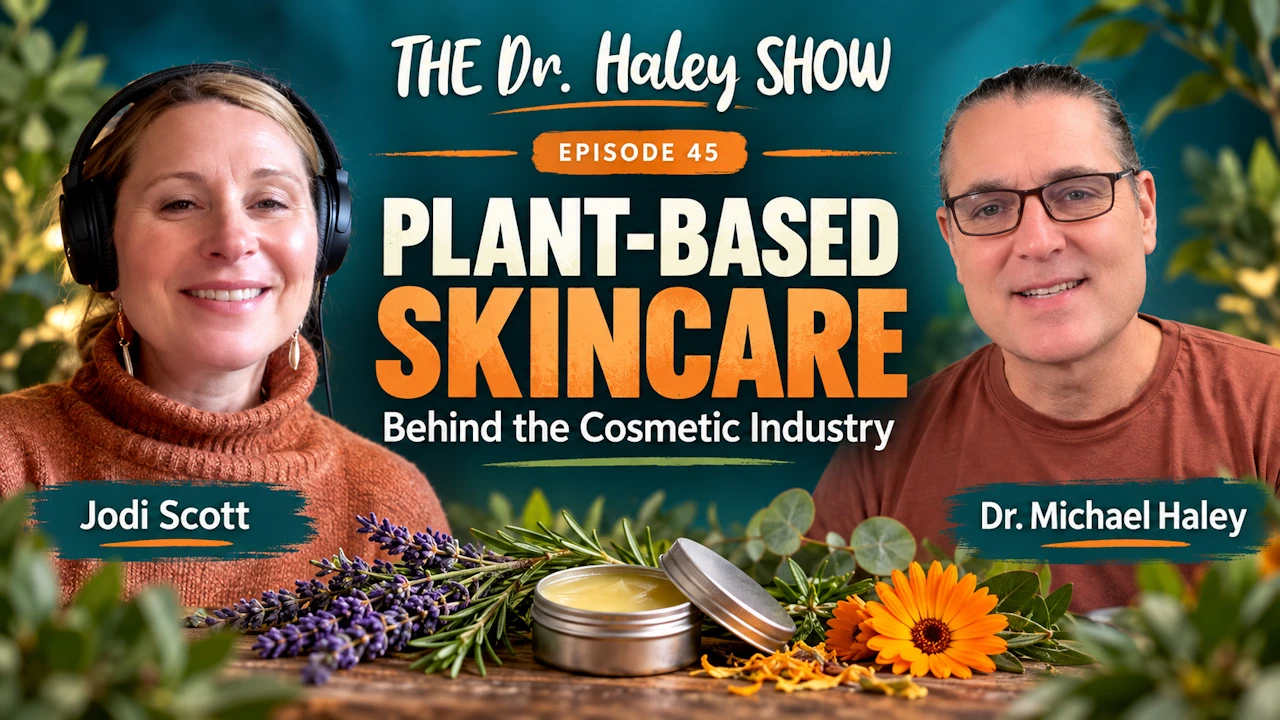
This show’s guest is Jodi Scott. Jodi has a Master’s degree in Health Psychology and she specializes in the field of Psychoneuroimmunology. She is CEO and Co-Founder of Sierra Sage Herbs and Green Goo and the visionary behind brands such as Green Goo First Aid, Southern Butter, and Good Goo CBD.
Her passion is in pioneering plant based products. Jodi’s journey expands further with the introduction of Melodiol Global Health where she explores emerging markets including cannabis and psychedelics, pushing the boundaries of health and wellness.
Watch the Interview
Listen to the Podcast
Resources
Quick Takeaway
Jodi Scott joins Dr. Michael Haley to explore what goes into plant-based skincare, from sourcing raw ingredients to making herbal salves. She explains Green Goo’s approach to extraction, ingredient combinations, sustainability, and product development, while the two compare manufacturing and labeling challenges.
The conversation also connects mind-body medicine with skin health and explores Scott’s perspective on neuroplasticity and psychedelic-assisted therapy. Product benefits, customer experiences, and treatment outcomes discussed in the interview reflect the speakers’ accounts and opinions.
ENJOYING THIS CONVERSATION?
Get the Next Episode in Your Inbox
Get notified when a new episode of The Dr. Haley Show is published, plus occasional highlights and resources worth exploring.
By subscribing, you agree to receive email from The Dr. Haley Show. Unsubscribe anytime.
Episode Timestamps
2:30 What is Psychoneuroimmunology?
7:03 What is Neuroplasticity?
9:55 How did GreenGoo come to be?
15:10 How do Parabens end up in a paraben free product?
16:35 How the industrial revolution contributed to the rise in chemicals in our cosmetics
19:15 The synergy of natural ingredients increasing efficacy and eliminating the need for chemicals
20:20 What is the entourage effect?
22:44 What is a Salve?
28:29 Caution about trying new products
28:50 Is there a natural product for diaper rash?
30:33 Are there truly “cruelty free sex lubricants”?
37:12 What is Melodial Global Health?
39:47 What is the difference between getting stoned and using psycodelics medicinally?
43:18 How do psychodelics help someone with PTSD?
Psychoneuroimmunology and the Mind-Body Connection
Scott describes psychoneuroimmunology as the study of relationships between the mind, nervous system, and immune system. Drawing on her health psychology background, she discusses the biopsychosocial model, mindful practices, and her interest in how emotional and physical health interact.
Plant Extraction, Ingredient Sourcing, and Skincare Labels
Dr. Haley and Scott compare their experiences developing topical products and working with manufacturers. Dr. Haley raises questions about preservatives already present in supplied ingredients. Scott explains why Green Goo brings plants into its manufacturing facility and performs its own extraction process.
Herbal Salves and the Entourage Effect
Scott uses the term “entourage effect” to describe her approach to combining plant components rather than focusing solely on isolated ingredients. She discusses lavender, rosemary, plantain, and other herbs, then explains the distinction between an oil-based salve and a lotion. She also describes the intended uses of several Green Goo formulas.
Product Sensitivities and Cruelty-Free Development
Dr. Haley discusses trying a new topical product on a small area before applying it more widely. The conversation then turns to baby-care products, intimate products, and the challenges the speakers encountered with labeling and animal testing. Scott recounts her company’s efforts, at the time of the interview, to develop a water-based lubricant while maintaining its cruelty-free commitments.
Psychedelics, Neuroplasticity, and Therapeutic Support
Scott discusses her involvement with Melodiol Global Health and her perspective on psychedelic research involving PTSD and mental health. She distinguishes recreational experiences from therapeutic settings and emphasizes the role of therapy alongside the substances discussed. The outcomes and remission figures she mentions are claims made during the interview.
Customer Experiences and Product Innovation
Scott shares customer stories that motivate her work and describes how feedback can suggest new directions for product development. These personal testimonials are presented as customer experiences rather than proof that a product will produce the same result for someone else.
Medical Disclaimer
This podcast and article are provided for educational and informational purposes only and do not constitute medical advice. The experiences and opinions discussed are those of the speakers and should not replace diagnosis or treatment from a qualified healthcare professional. Do not begin, discontinue, or change any medication, supplement, diet, or treatment based solely on this episode.
Full Transcript
The transcript has been lightly formatted for readability. Because it was created from the recorded conversation, it may contain minor transcription errors.
Read the Full Transcript
– I’m Dr. Michael Haley and this is the Dr. Haley show podcast. Today’s guest is Jodie Scott. Jodie has a master’s degree in Health Psychology, and she specializes in the field of Psycho Nero Immunology. She is CEO and co-founder of Cera Sage Herbs and Green Gooh. And the visionary behind brand such as Green Gooh First Aid, Southern Butter and Good Gooh CBD. Her passion is pioneering plant-based products. Jodie is Journey Expans further with the introduction of Melodio Global Health where she explores emerging markets, including cannabis and psychedelics, pushing the boundaries of health and wellness.
Jodie, welcome to this show. How are you?
I’m great. Good to be here. How are you doing?
I am doing awesome and, you know, before we got started, we were talking about where you are and where I am. And I haven’t been to Colorado in a few years. Had a wonderful time there. I did get to hit the slopes. It was in the winter time. And I didn’t break the law when I was in Colorado though. I can say that. That’s, but had an interesting time there. Love it in Colorado. I trade places with you. I think you should maybe come to Florida and get some sun and I’ll hit the slopes and then we’ll go back and have the best of both worlds.
I like that. We’ll do a little swap. I can get some vitamin D, some sunshine, some beach therapy.
I mean. I like to come back. I like to come back. Vitamin D therapy. Get it in Florida better than anywhere else in the US. I’m sure of that.
Psycho-nero immunology. That’s a big word. And I’m suspecting I know what it means. See, I went to school to car-practice school in the early 90s. We didn’t know that much about psycho-nero immunology. There’s a lot of stuff in this field that has just emerged. We’re just figuring out in the last 10 or 15 years. What can you tell me about that and how did you choose that field?
It’s been a journey to see tear point to evolution in this space and really emerging right now. So when I got my master’s in health psychology, I was in the first master’s program for health psychology in the country. And I was training resident physicians on the bio psychosocial model. And what that means is rather than the physician, you know, just administering a prescription, instead really looking at the patient as a whole. And saying, okay, you know, what are some other barriers that are inhibiting this patient from, you know, really getting the benefits of whatever this intervention may be. And of course, now we would call that a more integrative holistic approach to medicine. But then it was nothing that was being considered in the medical field.
And at that time, I had a passion for neurology. And there was this very small, disruptive emerging space called psychonero immunology. And at the time, it was pretty questionable if this really had credibility in the medical and psychology world. And what it really is is the relationship, I mean, really to simplify it. It is the relationship between your mind and your body and how your mindset can affect your immune system, can affect your nervous system and your perspective and how that all works together. And so today, you know, we would really call that mind body medicine.
And there’s so much more science coming out. It’s been really great, especially being in the skincare industry. Seeing more data, maybe it’s the behavioral, you know, journal of behavioral medicine, journal of dermatology. And they’re starting to look at, okay, if we look at specific mindful practices, can we have qualitative data that proves that it improves exima flare-ups, or it improves wound care healing. And we’re seeing real scientific data that supports that where, you know, I’d say the first, you know, five to seven years of psychonuro immunology was very much anecdotal research. You know, it was storytelling, people’s experiences. We’re enough of it became so compelling that there became, you know, investment towards looking at this further to see how we may be able to enhance medicine and our, you know, traditional medical practices.
Yeah, you know, when I went to school, they drilled in this, I think, I think it was on page three of Gray’s Anatomy, that the central nervous system, controls and coordinates all of the functions of the human anatomy and something like relates the individual to the surroundings or whatever, but it kind of put the brain in charge of everything and not to take away from the brain’s role, but, you know, one of the things the brain does in controlling the body is control organs that make chemicals that travel throughout the body and communicate other parts of the body. So there’s there is literally so much more going on and that’s kind of what I mean by having changed so much. Those are the areas that have been explored and understood.
Whereas, you know, if someone had a healthcare problem, we might, a mental problem. We might just, you know, simply medicate it in the past and try to change or reverse or balance or, you know, make the symptom go away as opposed to go ahead. You’re ready to do that. I know because it’s one of those, you know, you get the body working right and the chemistry changes and people get well in it. It affects more than, you know, just the mind. It affects the gut health. It affects the skin. It affects, you know, everything. Our energy levels are sweet sleep quality. Our addictions. It’s incredible.
It’s truly, truly is. And you mentioned a little bit about psychedelics. And I think that has been a very influential part of some of this data coming through where we’re now challenging. Some of the more, um, and I say traditional because modern medicine is still very modern. You know, I mean, we’re talking about the last hundred years. But it’s challenging what we know today in terms of feedback loops.
And the pain experience and, um, neuroplasticity, you know, when I was in, in grad school, there was this, this notion with neuroplasticity that you can’t teach a little dog new trick, you know, it, it just was what it was. When you’re over 27, it just can be harder to learn things. And it is what it is. And this is how it defines aging. And now we’re finding, no, you know, neuroplasticity can actually be modified, not just by psychedelics, but some really great mindful meditation. And they’re seeing the data to support that. So really opens up a whole new way of looking at our health and wellness, which is really exciting.
Yeah, you know, and I do want to talk a little bit about the psychedelics and some of the challenges people have with it and what are the benefits and all that. But let’s before we get to that. Let’s push that down towards the end. Because I did a little research on some of the products that you come up with. I went to greengoo.com and I do want to talk about those things first and some of the more basic concepts of, you know, what’s in it and why and things like that. Because I’m kind of in the industry and that really interests me, we have one topical product. I’ve had others and we’ve had challenges with ours that I think you’re going to be able to relate to and explain.
But what I saw was, well, two things. I’ll go with the top two things that I saw. One is, I saw products that aren’t being charged enough for. That was my first impression. I said, “How the heck do they do it?” I’m looking at the ingredients. They’re expensive ingredient. And the other thing I saw is that they’re natural. I’m not seeing chemistry in them. That would extend the shelf life, you know, a ridiculous number of years. So I’m saying, “How the heck do they do that?” And my surprise is that they’re mostly, mostly plant products in these sounds.
Oh yeah, and to your point there, it’s an expensive, they’re expensive ingredients, they’re an expensive process. And, you know, twofold, one, our mission and vision is to make natural and plant-based equitable and available. But I will say there’s a large sale on the website, too, because we’re getting ready to re-brand. So we’re, you know, letting some things go into the market and a little bit lesser than we normally would, but even our regular pricing is still a very equitable price. Because when we first started this natural was really for one percentors. And what we didn’t want was that to be a barrier for someone to have access to this.
Now to your point to give you a little history of how we got here. So my sister’s an herbalist in a midwife and I was remade. And, you know, here we were living these very clean lives. And incredibly diligent, mindful of sustainability. You know, our shampoos or household cleaning products. But one of the exceptions we made was that it was that you opened up our first aid cabinet. And it was full of one-time use, non-sustainable chemical-laden products. Because we just thought those were the only products that could get the job done.
And what we learned was that that was most of the natural consumers that they were willing to abandon their natural ethos. Because they were told things like NEOsborn, Hydro-Cordazone, Calamine, where the only products that could get the job done. And then we started looking into this space further. And the conventional consumer was like, you know, I don’t really care what the ingredients are. I just want something that performs better. I’m generally dissatisfied with what’s available.
And on the OTC first aid market, we’re talking about a population who has chronic skin conditions for the most part. And yet, they’re only these products are only serving for acute skin conditions. And saying, hey, use for three to five days, but if symptoms persists, go, you have to go see your physician. And, um, and or else that’s going to cause serious organ failure or some kind of damage, you know?
And so we thought, oh my gosh, and we make a plant-based alternative that is superior in efficacy. So we lead with efficacy first, that’s 100% plant-based, and also bring in some sustainability and some personality, because most of the brands, um, in the OTC space, they look clinical. So we wanted to have some fun and disrupt, and hence, you know, green goo was born.
Um, but to go to the ingredients to your point, when we first started bringing these products to market, we’re making these in our kitchen, you know? And, and there’s a very specific process in terms of extracting from these land, and eliminating to your earlier point as well, not all of these other, reserve it as phallate parabens. Other ingredients that are not only not healthy for you, but also, um, you know, disrupt the efficacy of the product.
And so, uh, we, and we also knew that we wanted to be credible with, um, the market, and that we needed an FDA facility, uh, we wanted to register with the FDA, really identifying lenient, lenient with these active ingredients. So, uh, we couldn’t find a manufacturer who would make the products for us, because the process is so important. What is unique about Gringo is we bring the plant to our manufacturing facility, and we take it through the extraction process ourselves. So we are not buying pre-made extracts that are already available on the market. We are yielding high amounts of the medicinal properties from these plants, and then putting unique combinations of these plants, these plant oils now into these products, which is unique to the products and it is unique to the market.
So Gringo almost didn’t happen, and it actually resulted in someone’s son who had Xima, and happened to use our product. And he said, “You came back a week later,” and he said, “You know what? I don’t know how we’re going to scale this,” but we have, too, because the world needs these products. He’s like, “This is the first product that my son has been able to use. That’s not prescription to help with his Xima.” And so that was a critical point in the turning process for green, you know, becoming available. So these are the real plan, like you said.
There is so much to unpack there. And so let me break down some of this stuff and make sense of it to people that are listening. A lot of people don’t realize that most of the products you see in the grocery stores and the drug stores on the shelf come from laboratories, not necessarily from the company that has that brand name on it. And, you know, someone like myself that once a certain topical product with my brand name on it and I want certain ingredients would go to a laboratory and say can you put these things together and then they’re scientists. They’re a chef so to speak. We’ll make some samples and give them to me for approval or disapproval and, you know, can you make it thicker? Can you make it smell better? Can you do this? And then they come up with more ingredients. And by the time you’re done, you have this chemical suit. And it’s not fit, but for people, but that ends up being the final product. And they can sit on store shelves forever and ever and ever at a low price point because there’s no spoilage.
I mean, I don’t know if we’re going to, you know, I’m not sure what I’m going to title this show. It might be uncovering some of the dirty secrets of the industry, of the cosmetic industry. There’s a lot of, there’s a lot of things that happen in that process that actually contaminate the products with chemicals even more so, for instance.
I might have very specific requirements for that scientists and say, I want aloe vera, for instance. I’m the aloe vera, for instance. I’m the aloe guide. I want you to use aloe vera, and I want you to put in coconut oil, and I want you to make it smell nice, maybe some lavender, and everything sounds wonderful, and then they go and source these products, and they have preservatives in them that aren’t going to go on the label, because I source that ingredient, and that’s what I list on the label, not the subcomponents or the things that they’re preserved with, and then you end up with a product that’s paraben-free, that actually has parabens in it.
Exactly.
What I’m getting from you is you’re providing the manufacturer, the actual laboratory, the people that are assembling it with the raw materials.
Exactly. So we have the plants that come to the manufacturing facility, that we take it through that process, so that we don’t to your point, get phallate and parabens, you know, sneaking into the product, because there are plenty of natural preservatives, rosemary, lavender, vitamin E oil, and to your point, and now I’ll bring this back to the industrial revolution that is kind of set the stage for what you just outlined, which is, you know, our transportation wasn’t what it is today, we didn’t have the technology that we have today, we didn’t have Amazon who could be your same day, your product, same day.
And everybody wanted like more volume, you know, and so there’s all these fillers, and there’s these preservatives, so it might take six months to a year to get to someone’s shelf, and then to your point, it’s sitting on the shelf for a long period of time, so you get all of these sneaking ingredients, and like, you start looking at Falle, and then that goes into the packaging as well, so you got to also think about what is being leaked, you know, leaching from your packaging.
Falle is an horrible endocrine disruptor. It is the number one produced chemical on this planet, and the U.S. produces about a billion pounds of that a year, and we’re ingesting all of this. So it, or we’re ingesting it, we’re putting it on our bodies, it’s going into our water system, and so to your point, it’s an opportunity to really eliminate some of these toxins that are, are fairly prevalent in our supply chain. And it’s really unfortunate, and it’s really unnecessary. You know, and we go back to like the Industrial Revolution wasn’t that long ago. So these chemicals have only recently been introduced.
Right, right. The other thing, and you’re kind of saying this already, as you’re sourcing and ingredients and you’re finding things that work, there’s things you might put in it that will actually inhibit it from working, but instead what you’ve done is found things that are synergistic, for instance, things do have to have some preservation. They do have to last and not be able to be consumed by microbiology. You know, there has to be some kind of a shelf life, and yes, you can keep these things in the refrigerator and make them last longer. But when you’re using things like essential oils that are natural, that have preservation benefits, some stronger against fungus, and others more anti-microbial against viruses or bacteria, and you have a combination of things that work together, lavender, it happens to be very healthy for the skin, and it’s somewhat anti-fungal.
When I look at your products, that’s what I see. I see a lot of synergistic ingredients that work together, and probably make a very nice product. I haven’t tried any yet. I’m going to. I just did research before jumping on the call with you, and I thought, wow, this is amazing, this is beautiful.
Can I add to that?
Yeah. Yeah.
At one of my sister and I’s favorite things to do is to see how these lants work so well together to your point. So, you know, I think most people think of Lavender is this very aromatic, you know, smells good, um, ingredient, but to your point, it’s a great antiseptic and it can help stabilize a formula when it’s real lavender. You know, maybe the extracts not going to be as powerful. But then you combine that with things like rosemary that also has antiseptic components. Collegila, anti-fungal, anti-use, anti-microbial. So it’s fun to put these plants together.
Another great, you know, yaro and plantain. You know, plantain is nature’s bandaid. Yaro helps slow down the bleeding. Will the two of them work really well together for wound care.
And so, you know, protecting the integrity of the plant, allows these plants to work their magic. And then you get the terpenes and the chlorophyll. And so we’re big fans of what you may have heard in the CBD market, the entourage effect, which we’ve been doing the entourage effect long before. You know, CBD with the thing, but it was a way for us to communicate to help people understand how important it is to protect the integrity of the plant, so that it can give you its full medicinal offering.
I don’t quite understand that. What do you mean? How are you protecting it? What was what was that word you used?
The entourage effect.
So, it’s just our extraction process. So, historically, and I say historically, loosely, but, you know, there’s a variety of different extraction process. And, and oftentimes, and especially when you saw this in like the cannabis industry, they wanted to isolate certain components of the plant. So, the rest just kind of gets thrown away or is exposed to very high heat. And so, it disrupts some of the cellular membrane.
And so, when you have a specific process that can protect the integrity of the plant, when you’re going out those medicinal properties, you then get to receive those without having them be damaged. So, it’s kind of like we call it like the fresh squeezed orange juice, versus like a, you know, a vitamin powder.
I think what you’re saying is the entourage referring to, like the things collectively working together as a whole plant, versus isolated elements of it. I’d get you. I understand.
If I had only one tool to improve most people’s health, if I could make only one recommendation for everyone, it would be to eat 10 servings of fruits and vegetables every day, representing all the colors. For those that just can’t do that, I recommend a scoop of Iagreens powdered fruits and vegetables. Sure, you can buy powdered fruits and vegetables in capsules, but you would need to swallow about 40 capsules of a high quality product to get the antioxidant power of 10 servings. Or you can add about a cup of water to a scoop of greens and drink it down as a tasty beverage.
To get started today, head over to haleynutrition.com and put some Iagreens in the cart, use the coupon code, anti-oxidants before February 29, 2024, to get 15% off your Iagreens vegetable and fruit powder. The coupon also works for the Haley Pro vegan protein powder. Use a scoop of each in your favorite beverage as a perfect meal replacement. Now, back to the show.
A lot of the products had sad. I don’t know, is the rebranding gonna carry sad instead of ointment or cream or…
Well, I mean, it was thick to do and I think more people know what it’s sad this today would. Green goo is a fun goofy name that we wanted to bring some personality, but in the first state space, everything is called ointment and it has a very, you know, it seems very petroleum-like, if you will. But a lot of people didn’t know what a saver a bomb was. And so we didn’t want, we also didn’t want to, you know, deter people if they, if they weren’t sure about that, where goo is just fun. And it’s green and the first product was actually green and it has the real plants in it. But in general, you know, the term for these kinds of products, where you don’t have the emotion and the water that you typically see in a lotion and it’s more of a medicinal oil-based product as a saver.
Well, I also think of a saver as something you might apply a little bit more heavy than rubbing in or am I wrong about that?
Yes, I mean, a little bit does go a long ways, but I’m a huge family called butter up or saver. And you, you know, get out of the shower and you had to tell yourself and food for your skin and you feel amazing. Put that bathroom on, let it soak in. And it becomes a ritual. And it’s interesting the next day after you saver. It, it, it, back to that mind body connection. And we can talk more about the skin and the mind body connection, but you just feel good. You just feel amazing. So, you gave your skin a healthy dose of nutrients.
Now, I noticed there’s a lot of different formulas, you know, a first aid formula. It was a deli butter and what are some of the others?
Yeah, so we started out in the first aid space and really looked at the needs of the consumers. So we’ve got our first aid, which is a natural antiseptic. And again, in the spirit of sustainability and avoiding one time news, when we formulate, we try to look at how else we can serve the customers. So we recognize if you look at a first aid set in a grocery store. There’s just a lot of the same thing. Or you hear something for a cut and hear something separate for an itch.
And so what we wanted to do is create a first aid kit in one little tin. So our first aid is not only a topical antiseptic, but it also takes the sting in the itch out, slows down the bleeding, speeds up the healing. So if you’re in a pickle, you can use it even for poison ivy or cold source. So with really fun and and it’s blisters and sunburns and chafing, you can take that with you everywhere you go in your pocket in your purse.
And once you have portable first aid with you, you’re like, “Where have you been my whole life?” So we have our first aid product that we have our dry skin formula. This product, John Hopkins, has been using in their sclerodermin skin condition department for over a decade. The nominal for xamun psoriasis, but it’s also fantastic for just chronic dry skin.
We have our repair formula and you’ll notice with the naming convention, we really call it for what it does to avoid any kind of confusion. So the repair is very much a skin repair. It was originally designed for sunburns and scarring. But what we found is it’s a fantastic anti aging. So it’s something that I put on my face every night before I go to bed. I live in Colorado. It’s incredibly dry. It has allow in it. It’s incredibly hydrating. And so, yeah, I highly recommend that one.
So, and then we have a free to breathe, which is like a vix vapor alternative. We have a cold sore. So you’ll see, there’s the core first aid. It’s the core first aid items that really address the OTC space.
But then we went into skin care as well. So we have a plants for your face and body, acne, eczema. Very much, everything is designed to be a topical therapeutic. It’s medicinal to serve you with wound care or a chronic skin condition. And what we found is there was kind of this separation between first aid and beauty. And yet, most people were shopping in beauty as well for those chronic skin conditions, and not getting it as well. So we kind of married the two with our product.
And we do have plant-based toothpaste now. We have bundy odor and deodorant. Deodorant’s fun because we were looking. We were always looking at the trans-dermal absorption on your body in the various places. And your armpits is like really unique skin. And you know when you look at it, right? It looks different than the rest of our body. And it’s a high absorption rate. You know, it’s like 70%.
And we talk a lot about what you shouldn’t have in your deodorant now. But now we’re talking at least here at Greengrew. So what you could be putting in your deodorant. Outside of what you shouldn’t be having. Let’s talk about what you put in there.
So we have like Holy Basil, Ashawanda, Rayshi, Mushroom, Ginko, Bole of Vitamin C. Because if you’re absorbing it there, why not, you know, continue to fuel it in nourish it. So it’s fun. We love product development. I’m sure you and I could talk products all day long.
Yeah, for sure, for sure. When we think of the skin, you know, a lot of people think of it as excreeting. But it liked the gut. It absorbs it eats and drinks too, which is why doctors will give you drugs. Hatches, and you’ll consume those medications through your skin, hormone, pain relievers. They give them in forms of patches that you stick on. You nicotine patches because your skin eats and drinks and consumes. So what you’re putting on your skin, definitely, definitely super important.
When we talk about different products, and where I’m going with this next question, I do recommend to people. If you have, you know, an XMA psoriasis, and you’re trying to new product, don’t just butter up on the first time test it. Because we all have different sensitivities. So test it in a small area, preferably someplace you can wash it off easily. If it doesn’t work out in chances, our will will work out. But if it doesn’t, you want to be able to wash it off.
A lot of people have infants and diaper rashes. Is there a product for that?
Yes, we have a baby bomb, which is lovely. It’s a head-to-to baby sap, designed for diaper rash, specifically, and it is also safe for cloth diapers. But we also, again, and that spirited rather than having a one-time use product. It’s great for egzima, Prado cap, massaging, it has some calming properties to it, so if you just have to get out of the bath, you want to butter up the baby.
And then we also have a nursing cream tab, that also is good for thrush for the little ones. So we added some marshmallow root, and some other anti-fungal properties there, so that it could also, you know, serve the little one, while also, you know, soothing the cracks and it bulls as well. My sister being a midwife, that was a very passionate, passionate, you know, the baby Caroline was fun for her.
Interesting. We recently, well, I don’t know if we just continued forever, but there’s definitely a temporary hold on it. A product that was actually selling very well, people loved it, but we probably didn’t push it out fast enough, and natural things expire quickly. And in this particular one, part of our issue was, we had to talk around its real, use and/or intention, and the reason for that, and the reason for that, we called it Allo Joy and I had five ingredients, and it was natural chemical free using Allo Vera, because Allo Vera is nice and slippery, or as a lubricant.
No, the reason I’m bringing this up is because one of the things I saw, kind of like a certification, I don’t know if it’s an actual certification, or just a statement, but it was no animal cruelty. And, or us, we didn’t have the animals tested, so we couldn’t promote that product, or the use we intended, or that we wanted to, because we didn’t want, essentially, in order to do that, they would have to, you know, essentially insert that lubrication and a bunch of animals, and make sure that everything went okay, and then they’d probably killed a rat when they were done with them. Do you have that same struggle with any of your products not being able to label them for a certain use that you wish you could, or how do you get around that?
So specifically to that topic, so we have a sexual wellness, brand called Southern Better, and one of the first products we made in Alabama based sexual lubricant that had our, you know, plant infusions in there as well. And to your point, the FDA took a position because at the time, so to your point, you have to have a medical device, this is a medical device certification in order to call it a lubricant. And at the time, there were some exceptions being made for food, great lubricants that they didn’t have to go through the medical device certification.
Well, then, and at the time, there wasn’t a whole lot of natural lubricants. They were all pretty traditional and doing their, you know, and had their medical device testing. And then the market started to, and I don’t want to say flood. But, you know, we started to see a lot more natural lubricants coming out. Arguably, I’d say that, you know, the bigger companies waved their wand to say that, you know, the food. Those companies needed to adhere.
And so that when the FDA started taking a stronger position. And really went to the retailers as well and said, you cannot carry a product that does not have this certification.
So we took that product down and we actually, for us being cruelty-free in the first aid space was so important, because so many of our competitors were testing on animals. Along with the fact, we didn’t want to test on animal. And so it was important for us to maintain that certification for a number of reasons.
So we go into this intimate. And we saw some of our, you know, peers or colleagues, if you will, competitors who were natural, they went ahead and tested on animals. And so they lost their cruelty free certification because they wanted to get to market fast.
We said no, we’re not going to do that. So we’ve actually spent the last five years working with the FDA to be the first cruelty free water based lubricant on the market. And it has been an expensive process and it has not been easy. And we’re on the closing. We’re close to having it across the finish line, which is really exciting so that we could stick to our ethos. And yes, it doesn’t mean we are first to market, but we got to stick to what was important to us. We’ve had some of the same challenges along the way.
Wow. What are the products you already kind of eluded to the fact that there are things that you can take with you? What are the products that you typically will carry with you or have to pack when you travel?
That’s a good one. So I don’t leave anywhere without my repair, that I put on my face every night before I go to bed and my oil face wash. If you haven’t used an oil face wash before it’s magical, gets all the dirt off but doesn’t dry out your skin.
Our breed of breathe, which is the VIX vapor alternative. When we developed this product, we found it very interesting that a lot of folks use it to put under their feet. As an irivated practice that affects, that it will boost our immune system or help them sleep better. And interestingly enough, you know, it’s a petroleum-based product. You’re not really getting any medicinal component. There is no sleep properties to it. Or anti-virus, so what we did with our vapor rub is we added Robinsara oil. So, you know, anti-viral components and sleep properties to it.
So I actually put that under my feet every night before I go to bed. And, Paul, it’s psychosomatic. I sleep better.
Yeah, your feet in drink too, right?
There you go, exactly. And they’re happy in their soft. And so, I absolutely love that.
I’m a lip balm junkie, so I’ve gotten in my pocket and just about every corner of my house. So I don’t leave home without it.
Our plant-based toothpaste that our daughter helped us develop that’s in sugar cane packaging with pure peppermint essential oil, which also has aloe vera in it. Huge vein of the toothpaste and fluoride-free.
And then of course, southern butter. But once you have southern butter in your life, you take it with you everywhere. It’s like an essential. So those are probably like the short list. Plus, my little first aid, my little first aid stick.
I love the name southern butter, too. Ars was, uh, aloe joy.
Oh, that’s fun, I like that.
Yeah.
Well, aloe was not to your point. It’s a phenomenal lubricant. And it’s beautiful and hydrating. And it’s really unfortunate because we saw the same pattern in the sexual wellness space that we saw in first aid, which was the natural consumer was willing to abandon their natural ethos. Because they were told this is the only thing that can get the job done. And the conventional consumer just wanted something that worked better.
And most of the lubricants on the market right now, they are very temporary. I mean, they pull the hydration out of your skin so you get a temporary glide. And then it’s almost like painful awful afterwards. Because it takes all that hydration out. And it takes out the nutrients.
And so something like aloe vera being a good gerier, as you pointed out earlier. And then you add medicinal properties to it. Hydrates your skin and improve sensitivity and the glide last a whole heck of a lot longer.
Yeah, healing. Is Southern butter, is it latex-friendly, or is it water or oil-based or what do we have?
The water-based aloe vera is latex-friendly, yes.
I want to know more about an alladial, global health, I say.
Melodial.
Yeah, so Melodial, global health is an international plant-based company out of Australia. And our goal and partnering with them was to expand plant-based alternative modalities across the globe. So we have cannabis and various countries. They have a psychedelic clinical trial, looking at treatment resistant PTSD in our vets and service men and women, which is just incredible. What I have learned in being a part of that team is extraordinary.
People are coming in with PTSD and suicidal thought. But it’s so many more other inhibiting symptoms in lifestyle challenges, whether it’s obesity, alcohol abuse, the inability to lead their home and have hobbies. And we get to witness the and being in health psychology. We know the years and years and years of therapy. But, you know, sometimes you feel you like you take two steps forward and intense that back.
And when you witness a micro and macro dose and you see an 80% remission rate. And they’re going to concerts and they’re reading books and they’re losing weight and they quit drinking. And you see all the wonderful other tentacles that how this improves their overall well-being is extraordinary.
You know, I told you that I went to Colorado before we started recording. I mentioned that I had been there and that I told you I didn’t break the law when I was there. Because in Colorado you have laws that other places in the country don’t have that forward. It doesn’t have when it comes to things like medical marijuana and even recreational.
Now, for me, marijuana was never something that I ever enjoyed or anything like that. And to me, you know, I can’t, I don’t want to admit it on air, but okay, I may have eaten part of a cookie from one of the dispensaries. To me, that does not feel good. What is the difference between being stoned and using some of these medicinal plants?
Medicinal plants, meaning cannabis or cannabis or psychedelics?
Psychedelics, mushrooms or whatever it is.
I mean, Colorado’s decriminalized psychedelic date wide as well, most recently. So, you know, I think the beauty of Wolfius cannabis just as an example being decriminalized allows the delivery system to be more… …more regulated and therefore, more transparency for the consumer so that when you go to a dispensary, you can say, “Okay, I’m someone who cares about a high number of THC or I want to look at the cannabinoid profile because I’m looking at my gut health and there’s CBG, CBN, you know, CBD, all of these things.” And so the science is gotten really solid in terms of being able to make those disclosures to the consumer, so you can say, “Hey, you know, maybe I want something that has less of this and more of that.” Um, I don’t want to smoke, I want to, I want to ingested and said, “And you’re seeing more and more technology come out all the time.” You know, I had a product come across my desk that was someone who was able to isolate when cannabis goes from, you know, it’s edible state to its moke state and that they were able to isolate that and then put it in an edible, so that people could get that same feeling. So I think we’re going to continue to see innovation in that space.
And perhaps that the path that psychedelics will follow, like psilocybin, you know, there’s lots of different strains and there’s different doses and they’ll probably want to find a way to regulate it so that the consumer can say, hey, I’m looking for therapeutic dose or I’m looking for a more lifestyle change, which we’re just seeing in the data that there’s quite a bit of variation there.
It is kind of funny when I was selling green goo in the early days before what we call now, the Plant Based Renaissance, and trying to explain to people the medicinal properties of these plants. And I was at a trade show, and the farm bill was just about to pass, and the farm bill was, you know, the big bill that was going to reschedule industrial hemp, which is where we get, you know, what we know is CBD today. And they had a keynote speaker at lunch talking about how these retailers could carry CBD products, you know, in the coming months.
So they came back to my, you know, booth, and I said, okay, remember that talk you heard and how they were talking about, you know, isolating cannabinoids from the plant and how it has medicinal properties, well, that’s what we’re doing at Gringue, but we’re just not using him. We’re using a bunch of other plants and oh, by the way, there is CBD naturally occurring cannabinoids in Echinacea and mango and black pepper, all of these other plants, but they don’t get credit for it because, you know, the hemp plant is way more fun to talk about because of what it looks like. It looks like, you know.
Yeah, and it’s easier to, you know, criminalize, right?
Yeah, yeah, exactly. So it’s a, it’s a very interesting space. I love seeing the, the results that are coming from it, alcohol cells are down, you know, and it’s very much a result of having alternative that can help you sleep and help you relax and improve your lifestyle without a hangover and without feeling crummy and perhaps, you know, causing more damage to your, to your body. So it’s nice to see these alternative modalities being welcomed because the results are extraordinary, they really are impressive.
Yeah, so I think what I’m hearing is maybe if someone had PTSD and now they can go to a concert where there’s flashing lights and big banging noises and all kinds of sensory input without having the overload because they use something from a more medicinal, well dose versus just getting stone.
I think the argument on the psychedelic side is that it’s not just the psychedelic, it’s also the therapy and they work hand in hand. So if someone is suffering from severe depression or PTSD, what that does is having a micro or macro dose combined with a therapeutic intervention, we’re seeing accelerated results in that intervention where you might have to take, you know, 10 years of therapy and you maybe make some progress.
And you know, we don’t, we don’t have all the answers as to why that works. I mean, we’re seeing some incredible meditation that produces the same neuroplasticity where you can combine this meditation, a very specific practice with the therapeutic setting and seeing some of those same results. You know, so something happens, you know, that unlocks the possibility for neuro pathways to embed themselves or become a part of you. And yet we can discard other things that may be like obstacles in terms of us moving forward and letting things go.
I mean, you get into like eye-begame, which is a fascinating psychedelic and how that works. And yeah, you think about it in the psychological setting and how these people are able to literally be a heroin addict, for example. And go through an eye-begame treatment and they have no withdrawal symptoms and they’re able to walk away with like a 60% remission rate. Like a 60% remission rate and not go back to using is incredible. So we have a lot to learn that we will be able to take into psychology, neurology, medicine from how these, these alternative modalities are able to improve, especially mental health.
All right, so some of that feels that they need to help in that area. Who should they contact what website should they go to?
You know, there’s a handful of leaders. I would say go to Matt. I’m a huge fan. Rick Doblin has done a beautiful job of really focusing on the therapy and having, he’ll be the first to have an FDA approval on MDMA, but they’re also working with Elizabeth Sivan in ketamine and other psychedelic alternatives, and they do have clinical trials and practices all over the country and all over the world. So it’s very reputable and you’ll find the right people. That’s on that.
Jo, what’s up? Some of your favorite stories testimonials with some of the product that you’ve manufactured or help manufacture at eukaryongreengoo.com.
That’s it. That’s it a lot because the testimonials are truly what gets me up every day and fighting this good fight.
Isn’t it awesome? It’s not, I mean, having an income from what we do is wonderful because it allows us to do what we do, but reading the reviews and the emails that come to us and answering the phone and people think, for what we do. And I’m so glad you’re here. I don’t know what I do without you. It’s not really rewarding. Part of what we do.
Yeah. It’s not too good.
It is such a gift to be a part of that. And it fuels me every day to find more innovation, more results and how I can better serve the community, the planet, the customers. You know, yeah, it’s pretty incredible.
I will share, you know, one and a lot of our customers end up becoming friends and this is one that this is one that we had a customer who was Jane Doe number one. She was the first person pulled from the World Trade Center and she had severe injuries, severe injuries and, you know, fast forward, a handful of years later, she’s working through her opioid withdrawal. And she reaches out because our pain relief lab is the only thing helping her reduce her number on a frequent basis because she would go through these awful and almost like seizure. And so she would use this lab head to liberally and it would calm her body and help her recover faster so that she could continue on this journey.
And she was asking for larger, and there’s so glad that, you know, someone from my customer service team escalated it to me. We of course made her bigger volumes and she stayed in touch and eventually became completely free of opioid. And she sends me pictures when she’s like a Disney land for the first time with her children and saying, like, look what I’m doing now. And, you know, that was really special. It gave a whole nother layer to what you’re doing.
One more fun one, and this is completely, completely WFEL. So we have a lot of military folks that take our first aid product with them out into deployment. Because, you know, you’re out into deployment, you have your gear is very thoughtful, and you can only take so many things with you. And they’re in awful weather conditions, long hours, they’re getting blisters, they’re getting sunburns, they’re getting chappellips. You know, all the things, and so oftentimes they’ll take their little tent of the first aid with them because it’s just makes you more comfortable. I mean, these aren’t the things that are going to, you know, put you in an ally for their situation.
But then, this guy calls me, he’s like, “Man, I just need to tell you, you saved my life,” and I’m like, “Oh.” And he goes, “I was out in the field,” and I was in a pickle. And I was in a pickle. And my gun, my weapon, was jammed. And he’s like, “I had second to get out of there.” And he goes, “What do I do? What do I do?” He goes, “Gring you!” He goes, “I put that in the O-rings,” and I got out of there. He goes, “I will never leave without my camera.” And I said, “Well, that I never thought I would hear.”
Wow. Wow. That is awesome. That’s so cool. I thought you were going to, you know, tell me, Southern better or something un-jambed as, you know, weapon or something. There you go. Is there anything other better ones for you? But we’ll save that for another.
Yeah. Yeah.
Well, yeah. And those are beautiful too, because, you know, people use it for one reason and find out they’re actually healing from an issue that they had. It’s a wonderful thing when you use healing products for a purpose.
You know, you said something earlier about one of the products and you said, and then we found out it did this. You know, we by accident have found out that some of our products have helped with these certain things. And it’s like, “Wow, we didn’t even know we made it for all of these benefits. We find out it does this too.” And that would be one of them, you know, the aloe vera in the intimate area can really help with some issues that people have.
It’s so true, our customers will drive, we’ll drive that a lot. Like I had an influx of people calling and saying that, you know, our first aid helped with their foot and mouth disease that their whole family had gotten. They had these like awful swords all over their body and I thought, “Huh, I would have never thought.” But it makes sense. You know, there’s blisters. They hurt. And yeah, so I love when my customers come to us and say, “Hey, this is what I used it for and it served me well.” And all of a sudden you have a whole new software.
Jody, is there anything that you wish I had asked in this conversation?
I don’t know. I could talk to you about ingredients and products and the manufacturing stuff all day long.
Yeah, we had another hour.
Only the other hour.
It’s fun having a conversation with someone that has been through the same challenges as me and, you know, it’s pretty cool. Thank you.
What’s the best source for someone to go and find out more about Jody Scott and your products?
Greengude.com. I’d say that’s the best spot. You can find Southern better in the other brands there. We have a new, a new tab that’s showing up the things that we love, so we’ll also be endorsing other brands, so that we can really invite you to this holistic skincare experience in mind-body medicine.
So you’ll start seeing some of that stuff on our website coming soon. And yes, you can find our family there and all about us, Mom’s Sister and I and our fun journey and the plant basement is on.
Okay, great. For anyone watching this on YouTube, below the video in the description, I’ll have links to all of Jody’s content, social media channels, websites, and everything else. If you’re on Dr. Hayley.com on the blog on the show page, everything will be all the resources that we’re mentioned in discuss here will be posted towards the bottom and the resources section.
Jody. Very enlightening, very enjoyable. What a great time. I have an educational for me this morning. Thank you so much for joining me.
Thank you so much. Really enjoyed being with you. Appreciate it.
Thank you.
Appreciate it.