
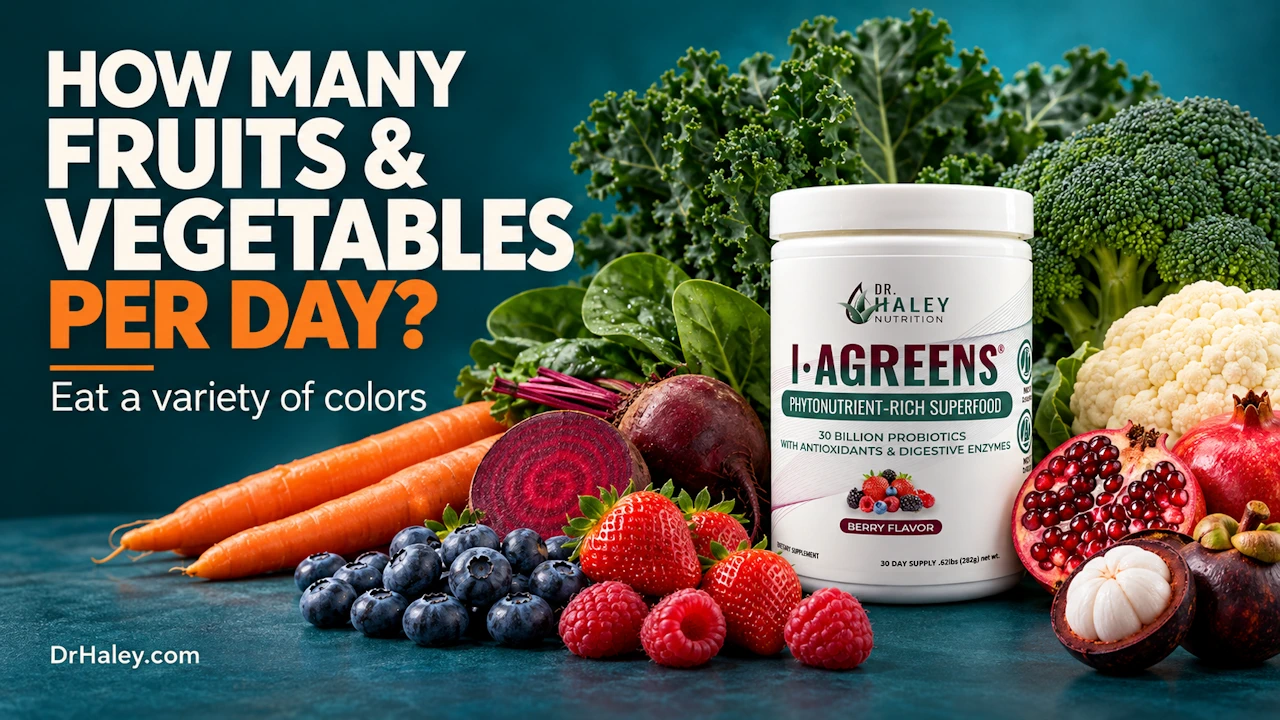
How many servings of fruits and vegetables should you eat daily? In this short video, Dr. Michael Haley compares the recommendations cited below, discusses the variety of nutrients in plant foods, and introduces IaGreens™ vegetable and fruit powder.
Watch the Video
Resources
These are the resources cited in the video and original article. They include the historical “5 a-day” campaign and the 2020–2025 Dietary Guidelines for Americans.
- CDC: 5 a-day fruits and vegetables campaign
- World Health Organization: Healthy diet
- Mayo Clinic Health System: The 1-2-3 approach
- Cancer.gov: Follow-up care and survivorship
- American Heart Association: Fruit and vegetable serving sizes
- USDA MyPlate: 2,000-calorie plan for ages 14 and older
- Dietary Guidelines for Americans 2020–2025
- Harvard: Vegetables and fruits
- IaGreens™ at HaleyNutrition.com
Quick Takeaway
The video compares fruit and vegetable recommendations expressed in servings, portions, grams, and cups. Dr. Haley encourages eating a variety of colors and presents 10 servings daily as his suggested goal. He also discusses IaGreens™ and its advertised antioxidant equivalence to 10 servings of vegetables and fruits.
ENJOYING THIS CONVERSATION?
Get the Next Episode in Your Inbox
Get notified when a new episode of The Dr. Haley Show is published, plus occasional highlights and resources worth exploring.
By subscribing, you agree to receive email from The Dr. Haley Show. Unsubscribe anytime.
Video Timestamps
- 00:00 — How many servings? CDC and World Health Organization recommendations
- 00:13 — Mayo Clinic Health System and Cancer.gov
- 00:32 — American Heart Association serving guidance
- 00:40 — USDA MyPlate and Dietary Guidelines
- 00:54 — Why eat more fruits and vegetables?
- 01:15 — Plant nutrients and eating a variety of colors
- 01:28 — IaGreens™ vegetable and fruit powder
Fruit and Vegetable Recommendations Compared
The video and original article cite the following recommendations. The CDC campaign and 2020–2025 Dietary Guidelines are identified by their original context.
The CDC recommended “5 a-day”
The World Health Organization recommendation cited in the video is “at least 400 g, or five portions, of fruit and vegetables per day” as part of a healthy diet.
The cited Mayo Clinic Health System article suggests a 1-2-3 approach to eat 6 servings each day.
The Cancer.gov guidance quoted in the original article includes general tips for cancer survivors, including “eating a plant-based diet and have at least 5-9 servings of fruit and vegetables daily”.
The American Heart Association guidance cited in the video encourages readers to “Try for 4-5 servings of each per day”. Dr. Haley describes this as 9 total.
The USDA “My Plate” 2,000-calorie plan cited for those 14 years old and up recommends 2 cups fruit and 2 1/2 cups vegetables.
Page 20 of the “Dietary Guidelines for Americans 2020-2025” (dietaryguidelines.gov), cited in the original article, recommends 2 1/2 cups of vegetables and 2 cups of fruits daily.
Why Dr. Haley Encourages a Variety of Plant Foods
Why are we seeing this pattern? Dr. Haley explains that studies show people aren’t eating enough fruits and vegetables. The original article quotes Harvard.edu: “A diet rich in vegetables and fruits can lower blood pressure, reduce the risk of heart disease and stroke, prevent some types of cancer, lower risk of eye and digestive problems, and have a positive effect upon blood sugar, which can help keep appetite in check.”
What is so special about plant foods? Dr. Haley describes a single plant food as containing hundreds or even thousands of unique nutrients. His suggested approach is to eat 10 servings of fruits and vegetables every day representing all of the colors.
IaGreens™ Vegetable and Fruit Powder
For those who find that goal difficult, Dr. Haley introduces IaGreens™ vegetable and fruit powder. He describes each scoop as having the antioxidant equivalence of 10 servings of vegetables and fruits and says that many people report feeling a difference in energy and clarity with a scoop a day.
Get yours today at HaleyNutrition.com
Medical Disclaimer
This video and article are provided for educational and informational purposes only and do not constitute medical advice. The experiences and opinions discussed are those of the speakers and should not replace diagnosis or treatment from a qualified healthcare professional. Do not begin, discontinue, or change any medication, supplement, diet, or treatment based solely on this content.
Full Transcript
The transcript has been lightly formatted for readability. Because it was created from the recorded conversation, it may contain minor transcription errors.
Read the Full Transcript
How many servings of fruits and vegetables should you eat daily? The CDC recommended 5 a day.
The World Health Organization recommends eating at least 400 grams or 5 portions of fruit and vegetables per day. As part of the healthy diet, myoclinic health systems suggests 1, 2, 3 approach to eating 6 servings a day. Cancer.gov has some general tips for all cancer survivors, including eating a plant-based diet and have at least 5 to 9 servings of fruit and vegetables daily.
The American Heart Association encourages you to try for 4 to 5 servings of each per day or 9 total.
The USDA might plate for those 14 years old and up, recommends 2 cups of fruit and 2 1/2 cups of vegetables. Page 20 of the dietary guidelines for Americans, recommends 2 1/2 cups of vegetables and 2 cups of fruits daily.
Why are we seeing this pattern? Studies are showing that people aren’t eating enough fruits and vegetables. A car in a Harvard.edu, a diet rich in vegetables and fruits can lower blood pressure, reduce the risk of heart disease and stroke, prevent some types of cancer. The lower risk of eye and digestive problems and have a positive effect upon blood sugar, which can help keep appetite and check.
So what’s so special about plant foods? A single plant food can have hundreds and even thousands of unique nutrients. A good way to make sure you’re getting all of them is to eat 10 servings of fruits and vegetables every day representing all the colors.
For those that just can’t do it, eat scoop of IaGreens®Vegetable and fruit powder has the antioxidant equivalent of 10 servings of vegetables and fruits. Just to scoop a day is all it takes for many to actually feel a difference with more energy and clarity. Get yours today at haleynutrition.com.