
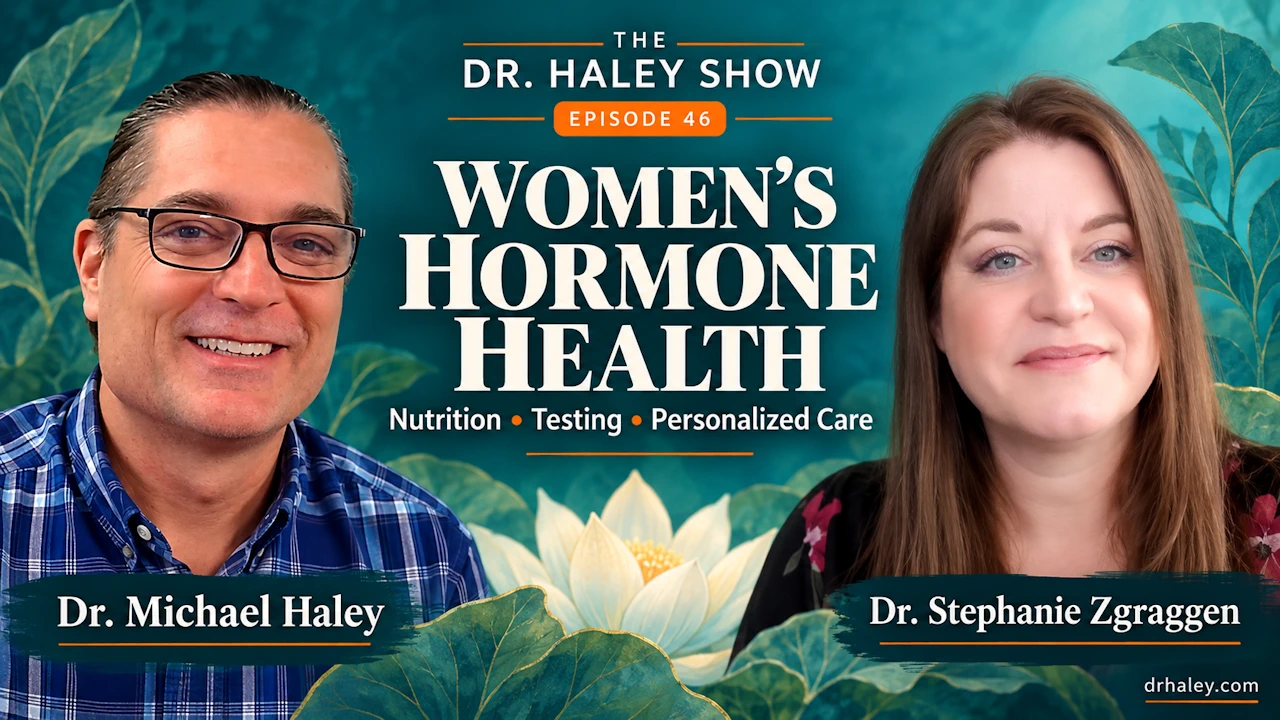
In this week’s podcast we interview Stephanie Zgraggen, founder of Lime and Lotus functional medicine centers that provides a variety of holistic therapies.
About This Episode
In this episode, Dr. Michael Haley extracts healing secrets from Dr. Stephanie Zgraggen, a chiropractor, functional medicine practitioner, clinical nutritionist, and author. “Dr. Z” has a focus in women’s hormones and health. As a chiropractor and functional medicine practitioner, Dr. Stephanie’s mission is to help women reclaim their hormonal health and feminine vitality naturally.
Watch the Interview
Listen to the Podcast
Resources
Quick Takeaway
Dr. Stephanie Zgraggen shares how her own menstrual symptoms led her to focus on women’s hormonal health. She describes her approach to functional testing, nutrition, lifestyle changes, and individualized care, including why she prefers professional guidance when considering supplements or a detox program.
ENJOYING THIS CONVERSATION?
Get the Next Episode in Your Inbox
Get notified when a new episode of The Dr. Haley Show is published, plus occasional highlights and resources worth exploring.
By subscribing, you agree to receive email from The Dr. Haley Show. Unsubscribe anytime.
Episode Timestamps
2:18 – Why did you choose Chiropractic?
5:04 – When did you decide to become a Certified Clinical Nutritionist?
6:36 – How did you come to balancing hormones and detoxifying?
9:11 – What is the difference between your diagnoses and other doctors’ diagnoses?
10:53 – Do you help men with their hormones as well?
11:49 – How reckless is it to try hormone changers without professional guidance?
15:22 – How do you think the contemporary chemical-filled diet plays into the chronic problems people have now?
16:44 – What is your advice of jumping into a cleanse or detox?
20:49 – What does a typical treatment plan look like for an in-person patient at your office?
22:32 – Why “Lime & Lotus?”
23:42 – Tell me about your transdermal supplement
25:06 – What’s a favorite testimonial related to what you do?
26:29 – Why should both in a relationship detox together?
27:17 – How often do you have clients with fatigue and/or other symptoms cured from your treatment plans?
28:46 – How long until a client sees a hormonal change?
29:27 – How much medicine and supplements are involved in a treatment?
A Personal Journey into Hormonal Health
Dr. Zgraggen recalls experiencing severe menstrual symptoms, headaches, hot flashes, and night sweats while in chiropractic school. She explains how that experience prompted her to explore hormone testing and nutrition and shaped her focus on women’s health.
How Dr. Zgraggen Approaches Hormone Testing
Dr. Zgraggen discusses the distinction between total and free hormones and describes using saliva samples across a menstrual cycle in her practice. She also discusses working with men and considering thyroid and adrenal hormones as part of her individualized assessment.
Nutrition, Supplements, and Detox Programs
The conversation covers Dr. Zgraggen’s preference for less processed foods, her concerns about environmental exposures and stress, and her views on choosing supplements. She describes favoring gentler detox programs that fit into everyday life. The program outcomes and patient stories she shares reflect her reported clinical experience.
Individualized Care and Health Advocacy
Dr. Zgraggen describes starting with a consultation, reviewing relevant lab work, and tailoring care to each patient. She discusses using supplements as temporary support and referring patients back to their prescribing doctors for medication decisions. The episode closes with her encouragement to advocate for yourself and seek another opinion when needed.
Medical Disclaimer
This podcast and article are provided for educational and informational purposes only and do not constitute medical advice. The experiences and opinions discussed are those of the speakers and should not replace diagnosis or treatment from a qualified healthcare professional. Do not begin, discontinue, or change any medication, supplement, diet, or treatment based solely on this episode.
Full Transcript
The transcript has been lightly formatted for readability. Because it was created from the recorded conversation, it may contain minor transcription errors.
Read the Full Transcript
This is the Dr. Haley Show Hotcast. Today’s guest is Dr. Stephanie’s a Gregon. Dr. Stephanie is my favorite kind of doctor. Dr. of Cairo Practice has practices. She has offices in both Georgia and South Carolina. Her practice line and notice I’m curious about the name. I want to find out more about that today. And she helps people among other things get well from hormone imbalances. And she helps people detox. Dr. Stephanie, thank you for joining me today.
Thank you, Dr. Haley. I’m so happy to be here with you today.
And I did look up your website. I looked up your YouTube channel. And I saw some very structured content. You’re a very organized person. I watched a few of your videos. Everything has a very methodical approach to it. I would probably guess you know that. And now just who you are, you do things very accurately.
Yes. Yes, it’s very methodical very accurately. I was that kid when I was little that always asked why? To the point that I annoyed my parent. So now I get to ask why the human body. So I’ve kind of transferred just that personality trait into just an entire career.
Yeah, I love what you’re doing. In fact, I actually downloaded and it’s right here. I took my, my, my text, my test. I did okay. I scored a 40 and hopefully we’ll, we’ll talk about that a little bit where you can take your toxicity quiz and decide if you need to detoxify off all who are listening.
Yep. I’m borderline there. I scored a 40 and I think that kind of, well, you should probably consider it. Maybe that’s what he’s kind of like cut off on that on that quiz.
Yeah. You just made the cut off. Peter and right there on the edge of disaster.
So how did you choose Kyro-Practic?
Oh, goodness. I chose Kyro-Practic. Initially, I thought I wanted to go into medicine. And then after a little bit of time, I realized I’m really not down with a lot of drugs and surgery. So it was like, what, what, what, what, what do I go from here? Went into physical therapy in the school that I was at Georgia State was very competitive. Hundreds of children or kids applied and only about 40 got into the program. So I was at Georgia State doing my bachelor’s degree in exercise physiology. I started volunteering and to even apply, you had to do a thousand hours of volunteer work before you could even apply. So I hit the ground running my freshman year, started volunteering at the Children’s Hospital, like a grady here in Atlanta, Georgia and just realized that everyone that was working really didn’t seem like they’re like their job.
And I asked if you had to do it again, would you, every single one of them said no, and so I was like, well, now what? And I had a friend of mine that was going through the same process. And then, he mentioned, well, let’s go be co-practors. So I really didn’t know what co-practice was at that point. I’m like, like co-practors, who are these people? And for my senior year, I had to do an internship and just decided, let me check out the co-practors. These co-practors were outside of Atlanta. They helped with some of the Falcons players. They had a family practice. I saw people call in and walk out.
And they were having such a fun time doing it. And I said, this, this is my home. And I graduated in May and started co-practice school in October. And the rest, as I say, is history.
Yeah. You know, I have a similar story only. I knew more about chiropractic because I went as a kid. And this doctor, it was almost like he did this Jesus thing to me. Raising the dead kind of thing. And I wanted to be like Jesus. So I went to a chiropractic school. You know what I like about it though? Not the fact that we help people without getting all bloodied and then guts and everything like that. And we don’t have to give drugs and medicine. But it’s the approach that is taken by chiropractors to diagnosing, figuring out what’s wrong and figuring out a treatment plan. It’s looking deeper than what is the symptom and how do I reverse that symptom?
Oh, it’s pain. We give it something that takes away pain. You know, it’s runny, we clogged it up. It’s clogged up, we make it runny. You know, if it’s saying, well, why is it clogged? Why is it runny? Why does it hurt? And try to get to that root cause. So that’s why chiropractors are my favorite kinds. So my favorite kind of doctor.
– And I think that’s probably why I was drawn to that one. So I really found out what chiropractic was and how in depth the training was that we received and really what kind of doctors we are. Really looking at the body as a whole, looking at function, and looking at the why of things. So that was right at my alley at that point.
– Now you’re also a certified clinical nutritionist.
– Yes.
– When did that come to be and why? When did you decide to add nutrition?
– Yeah, I started at life university for my chiropractic training. And you could do a concurrent the doctor chiropractic and do additional classes. So I was that crazy person that was doing my full load of chiropractic and doing additional nutrition classes. I didn’t get to finish because I ended up transferring out and finishing my chiropractic journey at Palmer West in San Jose, California. But I always love nutrition. I always wanted to have kind of a multi-faceted practice. Just like B.J. Palmer said, “Hey, nutrition is important. You know, all the things are important, clean water, positive mental attitude, what we put in our body.” So I just kind of wanted to go with that route of being able to offer multiple modalities and help to my patients.
So after I started my practice, about two years later, I finished up that master’s degree in clinical nutrition.
That’s great.
Yeah, for me, it was more of a delayed thing. I was doing chiropractic and I learned the importance of nutrition. When I was in chiropractic school, I thought I could just exercise whatever I ate into this superhuman being and stuff. But, you know, as I got older and things started hurting, I didn’t have the energy levels of when I was a teenager. It’s like, well, maybe I’m wrong about that, there, you know, this maybe it’s not, you know, maybe there is truth to the garbage in garbage out.
Absolutely.
How did you come to focus on balancing hormones and detoxifying?
I think that was more of my own personal journey. I think what let me down that past specifically, but when I was in car practice school, I had a really bad menstrual problems, very, you know, lots of cramps. Every month, I literally was vomiting and headaches and migraines and nothing was really helping. And finally at 20, what was I 24 years old started having hot hot flashes and night sweats. Like this is, this is a normal.
That’s 24 years old.
Yes, yes, so I wasn’t my senior year of chiropractic school or getting into that senior year. And of course, it’s crazy busy, we’re all stressful, we’re trying to do boards. I was working at the time. I was planning to wedding all the things. And just my body wasn’t happy with me. So I went to the kind of collegeist and he did lab work, exams and everything else, told me everything was, you know, normal. I’m like, absolutely, this is not normal. Like having these symptoms every single month, not normal. I was literally working my life around my menstrual cycle. So that’s not normal. So he said you’ve got two options. We can either give you birth control pills or we can start cutting things out.
And being in chiropractic school, not neither of those options really felt intuitively right for me. And I said there has to be a better way. And thank goodness I wasn’t chiropractic school. I guess I really didn’t pay too much attention to my chronology classes. You know, I got the A’s, but just didn’t really put it together in a worldly sense. And that’s why I said I really need to like learn about this more and why, why am I feeling this way when labs are normal and everything else. So then I learned that there are other lab work that we can do. More functional type labs to actually assess where your hormones are at, what levels they’re at.
And so I did my own test. I figured out that my cortisol levels were high. My estrogen was high. My testosterone was high. My progesterone was low. Basically, I was a hot mess. But I also had an answer which was nice because so many women don’t have answers when they go to the doctor. And now that I knew what was wrong, now it was like how do we fix this without the drugs or the surgeries or everything else? And so that was really diving deep into nutrition or biology. All those types of things, lifestyle changes. And was able to completely fix my cycle all naturally, which is what I want it.
Now I have to use an app to know what it’s coming. And I think that passion and just my own experience has led me to be able to help thousands of women in the last 20 years in clinical practice with those kind of issues.
Right, right. What is the difference between the diagnostics used when you went to the medical doctor, to what you are doing? How are you diagnosing? How are you testing patients?
Yeah, generally they run lab work with patients. And to me, they’re not complete labs. They might look at, let’s say, she’s, it’s a woman that’s having a menstrual cycle. They’ll look at your labs, you generally blood, and generally one day of the month. Well, it’s probably the day you’re feeling pretty good, so first of all. So we don’t have a full cycle. And also we’ve got total hormones, we have free hormones. And the free hormones are the functional hormones. Those are hormones that are attached to proteins. Sorry, unattached to proteins that, or other hormones are attached to proteins. And a lot of times they’re testing all the players in the game.
But really, what I want to know from a functional standpoint is, does it matter how many people are on the team, or doesn’t matter how many people are actually playing on the field. So a lot of times they’re testing all those together, and you might have enough people on the bench, but maybe not enough people playing on the field. So I want to make sure, one, we can convert hormones correctly. We have enough people playing in the field. And when we take players off the field and put them on the bench, we’re putting them in the right spot, so to speak. So that’s kind of a good analogy for functional testing.
The way that I typically do female hormones, it’s generally be a saliva, because with that, I can have a woman give multiple saliva samples throughout one whole month. And I can actually see the dance of her hormones. Did she ovulate? Our her levels appropriate at different times of the month. And if not, we can tackle it at certain times of the month, or I know more specifically what to do. So that’s kind of been my approach. Whether it’s female hormones, adrenal hormones, thyroid hormones. We really want to be testing more in-depth and more functionality for patients.
For men that might be listening, are you helping them as well?
Yes, yes. Even though men don’t have that cycle, like women do on the daily basis, men have hormones too. And there are functional hormones. You know, they’re kind of doing this a bit for men. They’ll test free testosterone, kind of hear that more nowadays. So they’ll test testosterone, free testosterone. But really, they should be testing our free or total in free hormones of everything. So free estrogen, free progesterone, free testosterone, free testosterone. But we can do that with both men and women.
Okay, and you know, I’m at that point in life where, well, late 50s. And, you know, I notice things are maybe slowing down. Right now, I haven’t done any testing. I’m just kind of throwing things at the wall and seeing what sticks. So, what happens when I have a go through a bottle of your himby? Okay, nothing. You know, my energy levels are the same. I’m still getting fat. Let me try tribulus. Uh, you know, I heard that was good for male hormones. How reckless is it to just go in blind and try picking?
Uh, you can do that. It just might not hit the mark. I mean, specifically for tribulus, um, for tribulus, for both man and women, for both sexes, libido, for women postmenopausal helping with their estrogen balances, for men they’re testosterone, um, erectile dysfunction issues. It’s a great herb, but you need a certain dosing. Um, they’ve even looked at where the plant is grown in the world. And there’s certain areas of the world that have better, um, just properties of the actual working bits of the herb itself. So, um, probably having someone that either knows the product or make sure you’re getting a therapeutic dose, because many times patients will bring a product in.
And I said, that’s a great herb. However, um, you would need a text. And I would, well, this was just last week. I told a man, I’m like, you need, and it was, um, a neuro similar to tribulus. But I said, you’ll need to take 61 of these to equal one of what’s in this bottle that I have. So, a lot of times, it’s just not therapeutic dosing to create a good effect for the body.
I completely understand what you’re saying on that. And so maybe going to Amazon and buying the cheapest one isn’t the best option.
Yeah, and unfortunately with Amazon, you don’t know where it’s been. There’s a lot of counterfeit stuff out there too that patients brought on them. I’m like, I don’t mean to think this is real. Um, so yeah, you just definitely got to be careful with those kind of things for sure.
I’m curious about your nutrition beliefs because a lot of my audience will have been fighting cancer at some point in their life for having, you know, irritable bowel conditions. Some of them, I don’t think are taking the best dietary approach. Some might be raw vegans, some might be vegetarians, you know, some will be paleo and some will be, you know, more Westinate price and stuff. I tend to be more Westinate price, paleo, a little bit of George Rubin and Fluence. Where do you stand?
I probably say personally, I’m more along the Westinate price model. I am the chapter leader for two chapters, so that’s, I tend to go that route, but I do think that people can be helped with different styles of diets. I think there’s not one size fits all approach either for patients, so for me it’s really about cleaning up their diet, you know, getting them to eat as-unprocessed as possible, full foods, foods that have the least amount of chemicals. Now we’re seeing such an increase in glyphosate in food in an environment and we can even do urine test to see how much glyphosate, which for those of you that don’t know glyphosate is round up and round up is very detrimental to your body.
It’s been shown to cause cancer issues. We know it is an endocrine disruptor, meaning it’ll mess up your hormones, so just if anything, we’re going to take any dietary steps. It’s probably clean up the diet, trying to eat as clean and organically, as you possibly can, just because those detrimental effects from those chemicals that they’re putting on our food supply of these things.
Yeah, that completely agreed, and I think you nailed it for anyone that might be offended by me saying the vegan diet isn’t the best healthiest diet, possibly for what you were going through, and maybe needing a detoxifying cleansing diet, maybe it is the best diet for you at this point in time, or was the best diet for you at some point in time, and the benefit is all the cleansing and detoxifying from the herbs, spices and vegetation. They have cleansing properties, and that’s very, very good. He, like you mentioned, obviously avoiding the chemicals, the toxic assault, the glyphics.
Yeah, I think that’s one of the biggest challenges we have right now, just in the United States with our food supply. This how chemically laid in it is these days.
How do you think that plays into all of the thyroid problems people are having all the hormone imbalances?
It’s it’s huge. It’s huge. I think the two biggest things that are creating the most havoc in patients overall, like chronically, is just chemicals in the environment and stress. Because we know there’s that whole process in the body that happens when we’re under stress. And the like I said, the glyphicate has been shown in glyphicate and even artificial sweeteners. Both of those have been shown to wreck and ruin your gut micro floor. So if you’re doing artificial sweeteners just try to be healthy to lose weight, you’re destroying your gut microbiome, which then therefore will tend to make you gain more weight and not lose weight. So it’s almost its counterproductive for what you’re doing.
And then the glyphicate itself, like I said, you can just turn on the TV now and see have you been around glyphicate? Have you done this? You know, there’s clash-out past action lawsuits now for those those products. So it’s not good, but it’s I think educating people on how to know what products have it and then how to avoid it and then how to clean up the bot. So even though your toxicity score was a 40, if you’re not eating organically most of the time, you know, doing some sort of detoxification program once a year is highly recommended because you just feel better, even though, like I said, you probably have a lot of chronic issues right now.
But it’s huge once you can kind of take that out of the system for it.
These might concerns when it comes to cleansing detoxing because I’ll always caution people. Don’t just jump into a cleanse or a detox especially something that might be harsh like a strong parasite cleanse for instance.
Yeah, those can be a bit rough on people at first. So definitely working with a product. If you’ve not done it before, definitely working with a practitioner that’s educated and knows what the heck they’re doing. I think is important. When it comes to products, we all work where all, you know, have kids, we’re stressed out. So choosing the company or product or program that is gentle I think is important. I’m not a fan of those, you know, three day sit on the toilet and don’t leave your house kind of cleanses. Mine are more geared to every day person that still has to work and work out and take care of a family.
So mine are more gentle on the body. You still get amazing results, but the whole point is we can do it within our lifestyle. That’s really important to me. And in looking at a product or a company or a practitioner that has been doing it and has results, like I’ve been tracking the results of my programs for the last 20 years. On average, if someone goes to my 21-day program, average weight loss 10 pounds, if you need to lose weight, average drop of blood pressure, 20 points, average drop in cholesterol, 20 to 100 points. That toxicity questionnaire score, average change in that is 55 percent, which is freaking huge because if you think in three weeks 55 percent of your symptoms are gone or at least decreased by that much, I mean, it’s giving people their lives back.
So it’s probably the easiest thing you can do in the short amount of time that can affect your health in a very positive way.
For those listening, if you’re seeing it on YouTube, that’s easy in the description. I’ll have a link where you can get the toxicity tests easy to download in print and fill out and calculate your score. Hopefully you’re seeing this on the doctorhaily.com blog and I’ll have links to the website, your YouTube channel where there’s great content to the toxicity test and more.
How many servings of fruits and vegetables should you eat daily? The CDC recommended five a day. The World Health Organization recommends eating at least 400 grams or five portions of fruit and vegetables per day, as part of a healthy diet. Myoclinic health systems suggests 1-2-3 approach to eating six servings a day. Cancer.gov has some general tips for all cancer survivors, including eating a plant-based diet and having at least five to nine servings of fruit and vegetables daily. The American Heart Association encourages you to try for four to five servings of each per day or nine total. The USDA might plate for those 14 years old and up, recommends two cups of fruit and two and a half cups of vegetables.
Page 20 of the dietary guidelines for Americans recommends two and a half cups of vegetables and two cups of fruits daily. Why are we seeing this pattern? Studies are showing that people aren’t eating enough fruits and vegetables. A car in a Harvard.edu, a diet rich in vegetables and fruits can lower blood pressure, reduce the risk of heart disease and stroke, prevent some types of cancer, lower risk of eye and digestive problems, and have a positive effect upon blood sugar, which can help keep appetite and shit. So what’s so special about plant foods? A single plant food can have hundreds and even thousands of unique nutrients. A good way to make sure you’re getting all of them is to eat 10 servings of fruits and vegetables every day, representing all the colors.
For those that just can’t do it, eat scoop of eye-o-greens. Vegetable Infraiter has the antioxidant equivalent of 10 servings of vegetables and fruits. Just a scoop of days, all it takes for many to actually feel a difference with more energy and clarity. Get your today at hailingutrition.com.
What’s a treatment program going to look like or your patients that would actually visit you in one of your offices? Are they going to get chiropractic? Are they going to be, you know, tested to see if they needed detox or what’s it look like?
I custom tailor everything to each person. So there’s no canned program, treatment plan, whatever you want to call for them. Currently, I have two chiropractors in both offices, so I at this point stepped away and given them the chiropractic care so I can focus on more the functional medicine and I see patients virtually. So that’s kind of nice too. Obviously I’m not adjusting people virtually, but I can work with people virtually all around the country for the functional medicine side of things. So normally I offer a complimentary consultation because I just don’t take everybody, I want to make sure one, I know what you have going on, and two that I think I can help.
That’s pretty important to me that we have a good relationship moving forward. So at that point in time, after a quick 20 minute consultation, that’s where I decide do we need to get some lab work, have you had labs done somewhere else that I want to pull and look at. So each person gets something custom tailored completely. And then if we do any diagnostics at that first new patient appointment that lasts about an hour, we go through everything. Most of my patients tell me that they learn more about their body and that one hour then they have going to any doctor their entire life. I take that as a very nice compliment.
So it’s really going in debt talking about the function, the physiology of their body, and then really what we need to do to kind of start putting things in the right direction. And each care plan will be different. I might see some patients for three months, and might be somewhere a year or two, if we got some complicated autoimmune cases. But in general, like I said, everything is just completely custom for each person.
Why I’m in lotus?
Yeah, I love a little rations first of all. And I knew I wanted to have that multifaceted just name that could encompass both the nutrition that I do, the holistic health and healing that I do. On each of my practices, I have other practitioners that have different modalities, so I wanted them to be able to be under one roof, so we have everything from carpractors to massage therapists, destititions to counselors and coaches and rakey practitioners, so I just tell them love with that name. Once I popped into my head.
When you have so many different kinds of practitioners in the office, it’s hard to maintain good reviews on Google. Yet you have a perfect five star. I’m proud of my 4.9. You have a perfect five. I’ve never seen that before.
Thank you. Someone has one review, but you have a lot of reviews.
I’ve taken a lot of time to carefully choose and curate the people that are in my practices. I churned away a number of people, but we finally have gotten people that are a perfect fit for us. So thank you for noticing that. We are proud of those ratings as well.
I’m also a fan of a lot of things that you’re doing. I having looked through some of your products. For instance, I noticed that you have your own digestive enzymes. And, you know, there’s obviously an important role, and especially as people are getting older and they’re not digesting their food. I also realized that you understand that, again, is kind of a digestive organ. One of your products is actually a trans-dermal supplement. Do you need some me about that?
Yeah, I have a trans-dermal progesterone. I might recommend that for patients where we know that there’s a progesterone issue with them. We’re using it short-term or maybe between cycles. So I’ve done lab work on them. I know exactly what they need. And it’s an easy way for them to get some lower dosing product into their systems so they can start feeling better. You know, my goal with my patients isn’t to always do everything from the outside in, but I also understand that it’s sometimes the bodies at the point where it needs some support. So we might be using different tools to kind of like a training wheel. You know, as we’re training the body to making more hormones to get better function to communicate more easily, we’re going to use some tools along the way.
My goal is not to have patients on supplements forever, but it’s to use those as tools as we heal the body. And then we start pulling those products away. And if we’ve done our job and the body’s healed, they were not going to need those products any. So that’s that’s my approach.
What’s one of your favorite testimonials related to what you do?
Oh gosh. There are so many. Some of my favorite ones are when we have families that are trying to get pregnant that have not been able to get pregnant. And when they go through, I have one, I’ll give you a one quick story. I want patients that she went through my detox program. Both her husband were trying to conceive. And I said, it’s part of my preconception care. I both want you to go through detox because whatever is in you, like we want to get rid of as much as we can in that process so that you have a better chance of conceiving, getting pregnant, staying pregnant, and having healthy babies.
So I remember the first chat we had. I told her there was no coffee for 21 days. She literally cried in my office. She was so sad. I said I would have cried. And then I promised to give me three weeks without coffee. You’re going to have more energy than you thought you would have. I promised. I said, it’s not going to feel like that now, but it will. And so she did. And then one of the things she said, and the program, she said, I’m so glad I did. She was right. I do have more energy. I feel better. I feel lighter. Both my husband and I are feeling great right now.
And then about two months later, she called me. And she was pregnant. So she was going around town, basically, told everyone that Dr. Stephanie got a pregnant. It’s no Dr. Stephanie think it’s your pregnant. Your husband did. But you know, it was just being able to be a part of that journey with them to start a family was just so special to me.
So she cried again only for the right reasons.
She did. She did. Yeah.
I also like the fact that you took the approach and said, let’s get you both detoxed. Why do you do that?
I think it’s important for, if we’re just for pre-conception care, both the main and the woman. Because a lot of times the woman’s blamed for issues, but sometimes it’s a guy. So just giving them both the tools to just really just refresh their systems and reset their systems. And also I think as a couple that brings them together too, whether you want to do this with a spouse or a family member or a girlfriend of yours. You know, when we do things like this and get healthy together, we tend to stay on it more readily. We tend to kind of make that more of a lifestyle choice. So that was also part of the process.
I would say there’s probably a whole bunch of people that are going to hear this, that their challenge is energy levels, sleep deprivation, night sweats, hormone changes, both men and women. Have you any stories from people that have recovered from those things?
Yes, I get those weekly because a lot of times, especially if you’re kind of in through your 30s, 40s, 50s, this is the time where your adrenal glands, a lot of times start taking over for the hormone productions as opposed to you are for the ladies, the ovaries for the men, the testicles, but if those systems aren’t strong enough, then you start getting symptoms typically. It’s not that those systems are or disease or you’ve got a major disease going on because if they test you they’re probably not going to find disease but it’s more of the functionality. Symptoms of that are generally fatigue, brain fog and salmnea, waking up at night, not being able sleep, being tired and wired, not being refreshed after sleeping eight, nine, ten, eleven, twelve hours and just an overall like kind of loss of zest for life or just not motivated to do stuff like you’ll push yourself to get through the day because you have to but then you’re just sitting in bed and out on the couch.
That’s those are the patients I love because that system is rebound so quickly. I mean those patients I’m working with maybe three to six months and they are literally a completely different people after I’m done with them. So with that I generally run some lab work kind of just see where your cortisol levels are at, some other adrenal hormones and a few other hormones. But once we can get that back on track, you really do feel like a new person. So I love I have so many of those. I wouldn’t even know where to start.
I suspect that of course. Now you said three to six months but how long until they actually see uh start seeing a change in it and have the hope that. Yes, I think I found these.
Yes. If we’ve we’ve done like some diagnostics, I know exactly what we need to do when we need to do it. I expect change within the first 30 days. We’re and I have questionnaires that they’re filling out and hand out. So we’re actually monitoring that on both the subjective and objective levels but they should be feeling some positive change within the first month. Usually I get about between 20 and 30% change each month so that’s kind of how my plans are geared anywhere between three and six months for those kind of patients.
And how much medicine is involved in how much supplement is involved?
Zero medicine. If you come to the table on medicine that’s okay you know a lot of my patients will say I’m on this and this I don’t want to be on it. It’s not my job or within my scope of practice to take you off that but what tends to happen is when the body functions better a lot of times you might not need those medications so at that point I refer you back to the doctors to let them handle that and manage that for you but a lot of patients will be able to go off medications they’re feeling better and then and then we take them off the supplements so that’s great too.
And start having them consume real food.
Exactly.
Nutrient dense foods.
Yep. It’s amazing what the body does when we give it what it wants all the right raw materials.
I love it and love it. Where do you think someone should start? Should they go to your website or YouTube channel? Take the toxicity quiz?
Yeah, if you’re having some of the symptoms we’ve discussed today start with the toxicity quiz would be awesome and then if you want more information by all means website is great if you want to connect with me like I said I was all for people a company or 20 minute phone chat before we get started just to make sure we’re good fit and I’d love to help anyway I can and if I can’t I will definitely find someone to send you to.
That’s awesome. Is there anything else that you wish I had asked or that you would want to share?
Ah, I think the biggest thing that I’ll say is just remember that you have to be your own health advocate. I think sometimes we forget that and if you go to the doctor just like I did when I was in college and the answers didn’t sit right with you, that’s okay. Listen to your intuition, listen to that inner voice and go for the second or even the third opinion or find out someone that’s doing something a little bit different that might have a better answer that’s going to fit with what feels right to you. So don’t be afraid to branch out and do that.
I like that. Yeah, something doesn’t seem right or feel right, it probably isn’t and you get that other opinion and that might you know confirm your thoughts there. So I love it. Dr. Stephanie Zgraggen, thank you so much for joining us today.
Thank you, Dr. Haley. I appreciate it.