
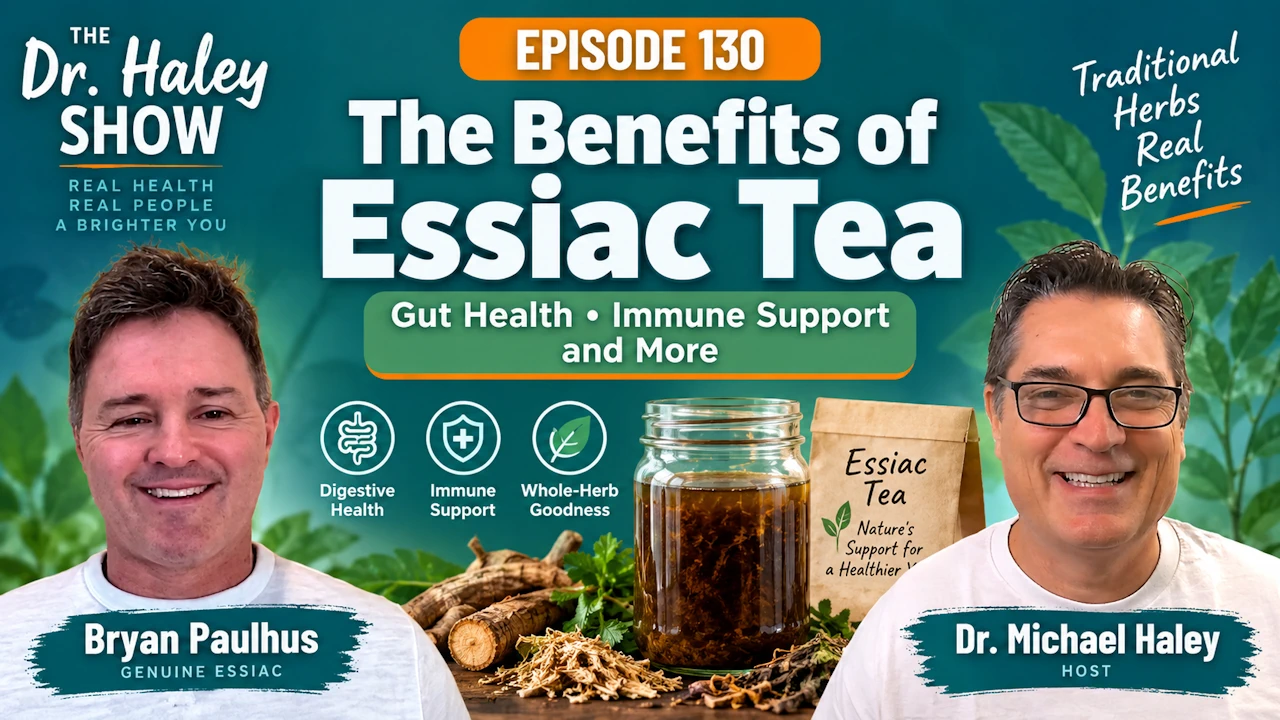
In this episode, Dr. Michael Haley talks with Bryan Paulhus of Genuine Essiac about what Essiac tea is, where it came from, how it is traditionally used, and why whole-herb preparation may matter. They also discuss gut health, detoxification, immune support, product quality, the difference between original and advanced formulas, and how Essiac tea fits into a broader health strategy rather than a quick-fix mindset.
About This Episode
Bryan Paulhus, co-owner of Genuine Essiac, joins Dr. Haley for a deep conversation about the history, philosophy, and practical use of Essiac tea. Bryan explains how his family connection to Dr. Charles Brusch led to decades of involvement with Essiac tea and why Genuine Essiac has focused on preserving the integrity of the formula while keeping it affordable and accessible.
This episode also explores the difference between highly processed wellness products and whole-food or whole-herb approaches. Dr. Haley and Bryan compare Essiac tea with minimally processed aloe vera, highlighting why “ugly” products that still contain their natural texture, particles, and plant matter may sometimes better reflect authenticity than polished, shelf-stable alternatives.
They also discuss how many people think about cancer, detox, gut health, nutrient absorption, and immune function. Throughout the conversation, Dr. Haley emphasizes that no single product should be viewed as a cure and that meaningful health improvement usually requires broader lifestyle changes. Bryan shares how Genuine Essiac approaches education, affordability, usage guidance, and ongoing research, including discussion of studies and customer experiences that have shaped his perspective over the years.
If you are curious about Essiac tea, whole-herb wellness, and how product integrity may influence outcomes, this episode offers a detailed and thought-provoking introduction.
Watch the Interview
Listen to the Podcast
Resources
Quick Takeaway
Bryan Paulhus describes Essiac as a whole-herb infusion with a history connected to Rene Caisse and Dr. Charles Brusch. The conversation focuses on preserving the full herbal material, practical preparation and use, digestive and immune-support claims, and Bryan’s view that meaningful health changes take time and should be considered alongside broader lifestyle choices. Claims about cancer, detoxification, DNA repair, safety, and treatment outcomes in this episode reflect the speakers’ experiences, interpretations, and discussion of research; they should not be treated as established medical advice.
ENJOYING THIS CONVERSATION?
Get the Next Episode in Your Inbox
Get notified when a new episode of The Dr. Haley Show is published, plus occasional highlights and resources worth exploring.
By subscribing, you agree to receive email from The Dr. Haley Show. Unsubscribe anytime.
Episode Timestamps
- 00:00 Opening claim about research and DNA damage reversal
- 00:18 Welcome to the Dr. Haley Show
- 00:48 Dr. Haley introduces the topic and frames the cancer discussion
- 01:46 Who Bryan Paulhus is and how he became involved with Essiac tea
- 03:22 First impressions of Genuine Essiac and how Dr. Haley prepared it
- 05:14 Why “ugly” whole-herb products may be more authentic
- 09:20 The origin story of Essiac tea and Rene Caisse
- 10:40 Dr. Charles Brusch, formula development, and the advanced formula
- 13:36 Cancer, causes, and why broader lifestyle changes still matter
- 18:59 Essiac tea as herbal food, not just a supplement
- 21:09 Comparing Essiac and aloe vera with processed competitors
- 24:09 Advanced formula vs. original formula and the Flor-Essence comparison
- 27:18 Dr. Haley’s digestive experience and why texture matters
- 31:17 The 8-herb formula and how the ingredients are viewed
- 32:14 Detox, the digestive tract, nutrient absorption, and immune support
- 36:16 Toxic buildup, tumor signaling, and Bryan’s explanatory model
- 40:56 How long customers stay with Genuine Essiac and why timing matters
- 43:34 Reversing momentum takes time
- 45:17 Learning curve: empty stomach timing, consistency, and daily use
- 47:10 Where the name Essiac comes from
- 48:18 Usage instructions, empty stomach guidance, and research discussion
- 49:47 How the research started and the Chile-related study discussion
- 51:19 Gray hair anecdote and the Facebook user community
- 52:29 Safety, dosage, and combining Essiac with other approaches
- 54:10 Detox reactions, bathroom changes, and what some users notice
- 56:10 Best places to follow Genuine Essiac online
- 57:13 Final thoughts and where to learn more
- 57:50 Outro
Quick Answers From This Episode: The table below summarizes the main questions and answers covered in this conversation about Essiac tea, whole-herb preparation, gut health, immune support, and practical use.
Key Takeaways About Essiac Tea
| Question | Short Answer |
|---|---|
| What is Essiac tea? | Essiac tea is a traditional herbal formula made from multiple herbs and used by many people to support detoxification, digestive health, and immune function. |
| What is discussed in this episode? | Dr. Michael Haley and Bryan Paulhus discuss the history of Essiac tea, how it is prepared, how it is commonly used, why whole-herb preparation matters, and how it may fit into a broader health strategy. |
| Who is Bryan Paulhus? | Bryan Paulhus is the co-owner of Genuine Essiac and has been involved with Essiac tea since 1986. |
| What makes Genuine Essiac different? | A major point in this episode is that Genuine Essiac emphasizes whole-herb integrity, affordability, and minimal compromise rather than highly processed convenience. |
| Why does Dr. Haley describe it as “ugly”? | He uses “ugly” as a positive term to describe a product that still contains visible plant material and has not been over-filtered or overly processed. |
| What are the main ingredients discussed? | The episode discusses an advanced 8-herb formula including burdock root, sheep sorrel, slippery elm bark, Turkish rhubarb root, blessed thistle, kelp, red clover, and watercress. |
| What health areas are emphasized in the conversation? | The discussion focuses on gut health, detoxification, nutrient absorption, immune support, and overall body function. |
| Does the episode say Essiac tea cures cancer? | No. Dr. Haley clearly states that no outside product should be presented as a cure for cancer and emphasizes broader lifestyle change and internal healing capacity. |
| How is Essiac tea commonly used in this episode? | The conversation discusses taking Essiac tea multiple times per day, often on an empty stomach, with consistency over time being important. |
| Why does preparation matter? | Bryan explains that keeping the full herbal material in the tea may preserve more of the original character and intended benefit than more processed versions. |
| What do they say about detox reactions? | The episode explains that some people may temporarily notice increased bowel activity early on, which Bryan describes as part of an initial cleansing response. |
| How long do they say it may take to notice results? | Bryan repeatedly emphasizes that some effects may take time and discusses a longer-term window of several months rather than expecting an immediate result. |
| What is the broader message of the episode? | The broader message is that real healing support usually involves consistency, better inputs, fewer harmful exposures, and respecting whole-food or whole-herb integrity. |
| Where can listeners learn more? | Listeners can learn more through GenuineEssiac.com and Genuine Essiac’s social media channels linked on the episode page. |
What Is Essiac Tea?
In the episode, Bryan describes Essiac as an herbal infusion rather than a conventional filtered tea. He traces its history to Canadian nurse Rene Caisse and discusses an original four-herb formula—burdock root, sheep sorrel, slippery elm bark, and Turkish rhubarb root—followed by an eight-herb version that also includes blessed thistle, kelp, red clover, and watercress.
Why Whole-Herb Preparation Matters to Bryan Paulhus
A recurring theme is Bryan’s preference for keeping visible plant material in the finished preparation instead of filtering or extracting it away. He and Dr. Haley compare this approach with minimally processed aloe vera and argue that appearance, texture, perishability, and convenience can change when natural products are heavily processed.
Gut Health, Detox, Immune Support, and Cancer Claims
Bryan describes Essiac as supporting digestion, detoxification, nutrient absorption, and immune function, and he shares his own explanatory model for how intestinal and bloodstream health could relate to cancer. These are Bryan’s claims and interpretations from the conversation, not established conclusions presented by this article. Dr. Haley repeatedly emphasizes that Essiac should not be presented as a cure for cancer and argues for considering broader diet, lifestyle, and environmental factors.
Research Discussed in the Episode
Bryan discusses animal research and a human study involving X-ray technicians with occupational radiation exposure. He reports that the human research found a 33% to 50% change he characterizes as DNA repair or reversal of DNA damage, and says findings were presented in Santiago, Chile, in October 2022. The episode does not provide the study paper or enough methodological detail to independently evaluate those claims, so they are presented here as Bryan’s account of the research.
Practical Use Discussed in the Conversation
Dr. Haley and Bryan discuss taking Essiac on an empty stomach, commonly three times per day, and Bryan describes higher amounts used by some customers. Bryan also says some users report temporary increases in bowel activity that he interprets as a cleansing response. These are usage practices and claims discussed by the speakers, not dosing or treatment recommendations from this article.
Frequently Asked Questions
What is Essiac tea?
Essiac tea is an herbal formula discussed in this episode as a whole-herb preparation traditionally associated with detox, digestive support, and immune support. Bryan Paulhus explains the history of the formula, its connection to Rene Caisse, and how it evolved from a 4-herb formula into an 8-herb advanced formula.
What herbs are in the advanced Essiac formula discussed in this episode?
The episode discusses an 8-herb formula that includes burdock root, sheep sorrel, slippery elm bark, Turkish rhubarb root, blessed thistle, kelp, red clover, and watercress.
How is Genuine Essiac different from more processed products?
A major theme in this episode is product integrity. Dr. Haley and Bryan discuss why a less processed, whole-herb product may appear “ugly” or contain visible particles, and why that may be preferable to a more filtered, shelf-stable, polished product.
How is Essiac tea commonly used according to this episode?
In this conversation, Dr. Haley and Bryan discuss using Essiac tea multiple times per day, typically on an empty stomach. They also discuss the practical learning curve of spacing it around meals and being consistent over time.
Does this episode claim that Essiac tea cures cancer?
No. Dr. Haley clearly states in the episode that no single outside product should be framed as a cure for cancer. The conversation instead focuses on support, body function, broader lifestyle change, and how Essiac may fit into a more complete health strategy.
What did Bryan Paulhus say about research on Essiac tea?
Bryan discusses ongoing interest in Essiac research, including conversation about DNA damage findings, animal research, and observational experiences over time. These points are presented in the episode as part of Bryan’s discussion and perspective.
Where can I learn more about Genuine Essiac?
You can visit Genuine Essiac and the company’s social channels linked above, including YouTube, Facebook, Instagram, X, Threads, and Bluesky.
Medical Disclaimer
This podcast and article are provided for educational and informational purposes only and do not constitute medical advice. The experiences and opinions discussed are those of the speakers and should not replace diagnosis or treatment from a qualified healthcare professional. Do not begin, discontinue, or change any medication, supplement, diet, or treatment based solely on this episode.
Full Transcript
The transcript has been lightly formatted for readability. Because it was created from the recorded conversation, it may contain minor transcription errors.
Read the Full Transcript
Dr. Michael Haley:
This is the Dr. Haley Show podcast. I’m Dr. Michael Haley, your host. Today’s podcast is really for everyone. We’re going to be talking about cancer in it, but you do not have to have cancer to benefit from this podcast. Before we get into this, I want to make sure everyone understands something important: there is no cure for cancer.
What we are talking about today does not cure cancer. My aloe vera does not cure cancer. Chemotherapy does not cure cancer. Radiation does not cure cancer. Surgery does not cure cancer. When we talk about cancer, the only cure comes from within. There is no outside-in cure. You cannot take something to cure cancer. You can take something to support the life that is in you, and that can do remarkable things.
Bryan Paulhus is the co-owner of Genuine Essiac, a company based in Massachusetts that specializes in providing authentic Essiac tea. He has been involved with Essiac tea since 1986, and along with his wife, Gina Paulhus, took the business online in 2005. Their mission is to offer Essiac tea at affordable prices, continuing the work of Rene Caisse and Dr. Charles Brusch.
Bryan’s connection to Essiac tea began through a family introduction to Dr. Charles Brusch in the early 1980s. Dr. Brusch, who collaborated with Rene Caisse in researching Essiac from 1959 to 1967, entrusted the Paulhus family with the formula to make it widely available. Bryan and Gina have since dedicated themselves to distributing high-quality Essiac tea globally.
In addition to managing Genuine Essiac, Bryan actively supports and funds ongoing research on Essiac tea, aiming to validate and expand its health benefits. Bryan, thanks for joining me today.
Bryan Paulhus:
Thank you. I appreciate it.
Dr. Michael Haley:
For those listening, you cannot see this, but I’m holding up a jug of Essiac tea to the camera right now. It’s a half gallon, and I started with a pack of Genuine Essiac. What I liked about it is that it was already measured in a four-ounce packet. I felt like I was making a pot of coffee for a coffee enema or something like that. I warmed up a pot full of water, dumped this in, and it bubbled up the way coffee grounds do when you pour them in. Then I split it into two half-gallon jars. I’ve got one here at the office and one at the house.
If you’re looking on camera, you can see the separation because there are a lot of particles in it. It’s not like a typical tea where you filter it. You’ve got all the plant material still in there. I call it the dregs. What I do is give it a little swirl or a good shake.
Bryan Paulhus:
Very good. You’ve mastered it.
Dr. Michael Haley:
My understanding is that we want to do this about three times a day on an empty stomach. I’m going to fill up my little glass here. It kind of looks like an espresso. This is a three-ounce glass, so I might have to have a little more than what’s in it. There you go. Very easy to do. If I leave it sitting, it settles again.
Bryan, what I find interesting about this is that you and I have similar products in one important sense. I would say that what I love most is that we may have the ugliest version of the product you can have, and that is actually what makes it beautiful.
Bryan Paulhus:
You stole my words. Ugly is where the beauty is.
Dr. Michael Haley:
It really is. When you see something highly processed, it should make you suspicious. What you’ve done is take the natural origin and process out the texture. Quite often you also combine it with other things to change the texture or preserve it on the shelf.
When I got what you sent, it was frozen. It was ugly. I thought, wow, finally. I’m not here promoting something because I was paid to. I don’t know you personally. I had your product, and after taking aloe experimentally in the past, nothing had ever done what this did. It was the first thing that made my digestive system function smoothly without me even thinking about it. From beginning to end, everything moved as smoothly as could be. I was in shock that this form made the difference, because I’ve tried other aloes before.
Bryan Paulhus:
The other neat thing is we’re both in the gut health world.
Dr. Michael Haley:
Yes. What I meant by ugly is that if you look at this jar on camera, you can see the particles floating around in it. The plant parts are still in there. This is not something that was filtered out. In that sense, I almost think the word “tea” is a little misleading. It is more like an ugly iced tea.
Bryan Paulhus:
It’s more like an herbal infusion. It’s not just made from leaves. There are specific plants in a formula for a very tested and time-proven purpose.
If you picture the origins of this, the Ojibwe Indians did not bring out strainers and filter everything away. Their culture used everything. They thought of medicinal herbs as a gift from God. They used grinding stones to grind and pulverize it so they could ingest the whole thing and use the entire product.
To this day, that has not been surpassed. It is the natural intake of the whole product, so you get everything in there. You get the fiber and everything that passes through you. Plants are meant to be ingested in their natural form. Any extraction lessens the benefit.
So ugly is good, because ugly means inclusion. We give people unapologetically the ugliest version of Essiac tea so they can get all of it. All you have to do is swish it around, stir it, or mix it with something like natural fruit juice. Lemon juice works great. You clearly understand what needs to be done to get the maximum benefit.
Dr. Michael Haley:
It may not be for everyone, but you’re probably going to help more people by giving them the whole product than by compromising and turning it into something that tastes like soda.
Bryan Paulhus:
Exactly.
Dr. Michael Haley:
And this is how I want it. It does not taste bad. It tastes earthy, which is what I would hope for. I do not want something that tastes like Skittles.
Let’s go back. How did Essiac tea begin?
Bryan Paulhus:
It started in 1922 when a nurse named Rene Caisse was doing her rounds at the hospital. She came upon a patient who had healed many decades earlier but still had a lesion on her breast as the result of a healed wound from topical breast cancer. Rene asked what it was and learned about these four herbs that had been used when conventional treatments were exhausted and the woman instead went to an Ojibwe medicine man.
Rene thought it sounded promising, but at first she had no one to use it on, so she put the notes away. In 1924, her aunt developed cancer. She used the formula, and it was successful. That set everything in motion. She started a clinic and did this for decades.
It became so successful that many thousands of people petitioned the Canadian government to allow it as a treatment in Canada. It failed by three votes. That was the tragic part. After that, she was left without an outlet. In 1959, she came to the United States and brought the original formula to a man who eventually taught me how to make it. That man was President Kennedy’s personal physician, Dr. Charles Brusch.
He had a major interest in herbal medicine, so it was a perfect pairing. They established what each herb did individually, looked at safety thresholds, side effects, and then studied the combination of herbs for its ability to address cancer. They used those results as a baseline to continue research, because as good as it was, there was room for improvement.
Eighteen physicians worked on this with them. They would test different herbs, and when one showed potential, they added it, adjusted it, and refined it. After years of work, they found a formula they believed was more effective.
We are the first company to ever say this openly: if you use this as directed for six months and you do not see anything improve by whatever measure you use for your case, we give your money back. We did not want to prey on desperate people. We wanted the opposite of that.
Dr. Michael Haley:
That is really nice of you.
Bryan Paulhus:
I always say it is not about me being nice. It is a reflection of what came before me. When I started working with Dr. Brusch in 1986, he strongly emphasized affordability and access. If someone had a desperate financial situation, he would say, “If they don’t have it, give it to them.”
As a businessperson, that can sound foolish, but as a humanitarian he believed it was right. He also believed it would work because word of mouth would drive growth if the product truly helped people. He was right. Don’t get greedy. Just get it to people. We have kept doing that ever since.
Dr. Michael Haley:
Now, with that said, some people might hear all of this and think it sounds like a cure for cancer. And it doesn’t. When I say there is no cure for cancer, I also acknowledge that people with cancer do get cured all the time. But I think the important distinction is that cancer usually has a cause.
There are things you can take to strengthen your body so it can fight cancer. When your body is fighting it faster than it is growing, you become cancer-free. But I never want to tell people to take this and think that is all they need to do. I want people to look at the whole-life approach.
Bryan Paulhus:
Just look at the benefit. That’s all we’re saying.
Dr. Michael Haley:
Exactly. If someone has cancer, they usually need to make more changes than just taking something. If I say, “I’m going to take this because I have cancer and that’s it,” but I do not change anything else, then even if my body starts functioning better, I haven’t changed the life that contributed to the cancer. So if I stop, the problem can come back.
Bryan Paulhus:
I have to address that because I’m not saying this is true for everyone, but I can tell you what I saw. My father was very good at drinking. He drank hard all day. As a result, what he ate was whatever was at the bar. Pickled eggs. He never ate vegetables. He developed cancer.
I remember July 21, 2003, because we were on our way to a Red Sox game when we got a call that he had fallen down the stairs drunk and broken his neck. When he was evaluated, they found lung cancer. At first, his reaction was to try chemotherapy. Even though Essiac had been in our family for years, he was so bitter about being divorced from my mother that he did not want to accept anything that came through her.
Thankfully, blood clots developed the next day, and he could not do chemotherapy. Eventually he spoke with me. I told him, “Dad, I’m not after your will. I love you, and this has the best potential.” He started taking Essiac. By May of 2004, he was cancer-free.
Was he an outlier? Maybe. Did he make all the healthy changes I would recommend? No. I agree with you that the chances go way up if people make broader healthy changes. But in spite of his foolish ways, he still stayed cancer-free for another eight years. He eventually died of COPD, not cancer. Still, only a fool would avoid healthy changes. They matter.
Dr. Michael Haley:
Not changing is the standard medical model. Medical doctors often treat symptoms and diseases rather than the person. They use drugs, radiation, surgery, chemotherapy. They are treating the symptom. If the symptom is cancer, the goal is to kill it.
But they may not be addressing the cause. The cause might involve nutrient deficiencies. It might involve emotional baggage. It might involve environmental toxins. It might be someone working in a chemical factory and breathing in toxins all day. It might be food full of chemicals. So yes, someone can take a medical approach, but they can also make lots of changes that radically improve their life.
Bryan Paulhus:
What we’ve found is that people fall on a spectrum. Some think this is the one solution. Others go overboard with excessive supplementation. Most people land somewhere in the middle and make reasonable healthy changes.
Dr. Michael Haley:
Oddly, I don’t even think of this as supplementation. I’m holding up this jar of Essiac tea again. It’s more like herbal food. We all practice herbology in some way. Plenty of people wake up to a cup of coffee every day, and that’s a form of herbology.
Bryan Paulhus:
Exactly. I grew up in a family that did not talk about religion at all. The first time I heard someone say that herbs were part of God’s design, I was in my early 20s and had never thought of it that way. But it makes sense. These plants were provided. We did not create them. We are just fortunate enough to have them cultivated and available.
What is amazing is that these herbs are doing things we are only now beginning to understand. Through the research we have done more recently, we are seeing that validated. The findings have surprised a lot of scientists. They have not surprised us, because we expected good things, but even the researchers come back saying, “Wow, this is really doing extraordinary things.”
Dr. Michael Haley:
Let’s talk about competitors for a minute, especially since much of my audience first found my work through aloe vera. They know there are other brands out there. I’ve jokingly said that aloe vera is a little like intimacy: even when it’s bad, it’s still pretty good.
Bryan Paulhus:
That line definitely works here too.
Dr. Michael Haley:
But there is still a real difference. Earlier today I put out a video showing the difference between what I would consider one of the most filtered aloe products and ours. With George’s Aloe, for example, they even said on their site that it does not have the polysaccharides in it. That does not mean people cannot benefit from it, but you could put a tablespoon of our aloe in a whole gallon of water and it might still feel thicker than George’s.
Bryan Paulhus:
There are also other Essiac teas out there. I’ll rank them honestly. The original formula was four herbs. The testing later increased the effectiveness of this significantly. The people who still sell the original four-herb version often send out warnings telling people to look for a certain trademark. But that trademark refers to the outdated formula.
That would be like bragging that you have the original version of a 1930s car. It may be original, but it is not necessarily more effective. Those warning campaigns work because people hear the word “original” and think they need to go back to the old formula.
There is a company that sells something like mine. They have the advanced formula. They sell two versions. One is a powdered version with the herbs in it. I’ll say this plainly: it is every bit as good as mine. It’s called Flor-Essence. It came from the same origin and was started before my company through Dr. Brusch.
The problem came later when they created another line that became dominant in their distribution. They began extracting out the herbs because whole herbs are perishable, and the outlets they were serving wanted more shelf life. Against the wishes of Dr. Brusch, they made those changes. That drove the price up and compromised both accessibility and integrity.
By around 1992, ties had broken, and we were seen as the next generation to keep this affordable, about a dollar a day, and to never compromise the ugly truth of how this should be administered. That is what we have done ever since.
If someone goes into a health food store and is traveling and they buy Flor-Essence in powdered form, that is fine. I’m not here to fight over every penny. I’m here to educate people. But the clinically proven formula is the advanced one, not the original one. It took eight years of development and a team of physicians to get there. I’m always open to improvement, but I also respect the work that went into refining it.
Dr. Michael Haley:
Just talking about what you have, I was surprised by my own experience. I live a healthy life overall, but I went to Nevada for a few weeks and did not bring my Essiac tea. I use it for digestive regulation. When I got back, a friend from California came by. He likes whiskey, cigars, and steak. I had one whiskey, which is enough to upset my stomach. I smoked three cigars in two days, which is a lot for me, because I usually smoke maybe two a year. Acid indigestion started coming on.
Your Essiac was in the refrigerator, and I got curious. It was only the beginning of indigestion, maybe a two or three on a scale of ten, but I drank it and thought, “What does this do?” Before I had even looked into it, I got my answer. I knew it had to have some digestive soothing effect.
I also loved the fact that I could feel the chunks in the aloe and that nothing had been added to it. When I saw that little drop at the end, the way it looked slimy before it came back down, I thought, this is what I want. I’ve never seen that with aloe vera before. Usually it pours like water.
That reminded me of slippery elm, which also has that slimy quality. People ask why it is so slimy, but that mucilage is part of what makes it soothing and useful.
Bryan Paulhus:
That’s interesting. I’ll have to look that up and see what the similar component is.
Dr. Michael Haley:
With slippery elm it is mucilage.
Bryan Paulhus:
Right. That makes sense. If you look around the market, you’ll find that slippery elm is processed into lozenges, cough drops, and other products for that exact reason. Aloe vera has also been processed and used in many other ways, especially for soothing. But when you process things heavily, you control them, increase shelf life, and usually increase profit.
Dr. Michael Haley:
That’s funny because, going back to aloe, we are actually the only two brands in that comparison with nothing added. No preservatives, nothing. But there are really only two ways to do that. You either freeze it, or you take out all the nutrition that would spoil.
Bryan Paulhus:
Exactly. And that’s what’s happening here as well. We are talking about the real thing, the whole thing.
Dr. Michael Haley:
So the ingredients now are eight instead of four. The original four were burdock root, sheep sorrel, slippery elm bark, and Turkish rhubarb root. Then blessed thistle, kelp, red clover, and watercress were added. I think it’s neat, and for anyone listening, those ingredients are worth looking up.
Bryan Paulhus:
Yes. When you look them up, you see a lot of digestive support and immune support associated with them. And that is really where the immune system begins to matter.
The immune system resides primarily in the bloodstream, and one of the best ways to clean the bloodstream is to reduce the toxin load coming in from the body. A major problem is that toxins adhere to the digestive tract. Products that can help remove those toxins can contribute to cleaner blood.
But there is an issue with many aggressive detox approaches: you cannot sustain them. They dehydrate people, cause headaches, and force them to run to the bathroom constantly. Essiac is different. During the first few days, some people do go more frequently, but it is usually short-lived. About 25% of people experience that. It is to be expected because this is a detoxifying process. Instead of plowing through you aggressively, it works in a more methodical way over time.
The easy part is removing the bulk of the waste. I use the analogy of scrambled eggs in a pan. You can get 95% of them out with a spatula, but if you want the pan truly clean, you have to work on that last 5%. You need time, soaking, and effort. Essiac is a moderate, achievable approach you can sustain for months. Around four and a half months in, you complete a process that addresses years of buildup, including that last thin layer.
When you have that kind of clean exchange at the intestinal level, there is less ongoing introduction of toxins into the bloodstream. Then, because the body is constantly making new blood, you can have a cleaner bloodstream in which the immune response functions the way it was designed to function.
Dr. Michael Haley:
And as the toxins continue to build up, they eventually have to go somewhere.
Bryan Paulhus:
Exactly. They flow somewhere and get stuck in an organ or gland. Once there is enough accumulation, a tumor can form. Dr. Brusch had a very interesting model for explaining this. He believed that when the body was cleaner, small tumors could form and then release chemical signals that called in white blood cells to deal with the problem and eliminate it naturally.
But what happens now, with the way people eat and live, is that a toxic issue starts, the body identifies it, and a small tumor forms. Before that tumor can complete its signaling process, more toxic sludge builds around it like an eggshell. That cuts off the signaling. It also contributes to continued growth.
The solution, in this model, is to clean out the intestines and clean out the blood. As you produce cleaner blood, you reduce the introduction of toxins. The outer layer around the tumor can dissipate over time in a cleaner internal environment. Once that resistance is reduced, nutrient absorption improves, the immune response gets the signals, and it can travel through a cleaner bloodstream with less interference.
Dr. Michael Haley:
We really have gotten away from herbology and nutrient-dense foods.
Bryan Paulhus:
Yes, and there are always people who maintain integrity and people who commercialize. I see people like you maintaining integrity. But commercial interests often override that. Some people stay the course. Some do unconventional things. Some ship aloe frozen so it reaches the customer in the right form. When you walk through a store and see these syrupy products, you often get very little from them.
People need to be selective about sourcing. One way to spot someone who is not just a slick marketer is to ask whether they are willing to do something that makes the product less appealing to the average consumer in order to preserve integrity. Who in their right mind would sell something ugly and goopy unless they believed that was the best way to deliver results?
That is the one rational explanation. They are maintaining integrity and going against the grain because they care more about results than polish. So when you see something transformed into a perfectly generic capsule or flavored drink, be suspicious. The natural form is how it was intended. Whether it is your stuff or my stuff, the natural form matters.
We keep getting better results than companies that encapsulate, extract, and overprocess. We keep growing while they diminish because they can only sustain first sales. They do not get referrals if they do not get results.
Dr. Michael Haley:
How long have some of your customers been with you?
Bryan Paulhus:
Forty years. That is one of the coolest things. I started in 1986, and I’m 60 now, so I have seen it. But I also want to paint this accurately. Time matters. Just like aspirin takes a little time to work on a headache, some people do not have four and a half to six months available. Some come to us too late. After a television show we did in 1992, we assessed the people we distributed to. Dr. Brusch predicted it accurately: some people would come too late and not make it. But as you move toward six months, the rate of failure drops dramatically.
That does not mean it works every time after six months. It means improvement becomes far more consistent when people allow enough time. I have had heartbreak. I have had people not make it. But I learned from Dr. Brusch that even when it is not a guaranteed answer, it may still be the best available option. That is how I frame it. I tell people the reality, the challenges, and the expectations. I do not want to sell fluff and rainbows.
Dr. Michael Haley:
Most people will find their cancer in time to make changes, but cancer has momentum. The first step is to slow that momentum, then stall it, and then reverse it.
Bryan Paulhus:
That’s a good way of putting it. It is similar to aspirin. Your headache may still have momentum for a while even after you take the aspirin. Ten minutes later it may feel worse, but if you know it takes 25 minutes, you wait. Essiac works more like that than like a painkiller that hits immediately. The initial phase includes momentum in the wrong direction before the cleansing threshold is reached and the tide begins to turn.
Some people say they feel worse one month later or two months later. That is why we suggest four and a half to six months, because that is where the greatest cluster of improvement tends to happen. It is their life, so I understand the impatience. We try to educate people so they can be as at ease as possible while they let it work.
Dr. Michael Haley:
There is also a learning curve when it comes to changing diet or learning how to take something consistently. We have to teach people how to eat again. It is not easy to turn on a dime.
I’ll admit, the first day I had this, I did not have three servings. I had one. By the second day I was locked in on three, but there is a learning curve. I had to leave a window between eating and taking it. I had to ask myself, “When is my stomach actually empty?” I had to figure that out.
Bryan Paulhus:
Exactly. You started by dipping your toe in the water. That is very human. People take little steps. They test something, then they increase. That is how most change happens. Some people are obsessive and change overnight, but the majority make achievable changes, face some challenges, and gradually improve.
Dr. Michael Haley:
Where did the name Essiac come from?
Bryan Paulhus:
The original nurse was Rene Caisse, spelled C-A-I-S-S-E. Essiac is simply her last name spelled backward: E-S-S-I-A-C.
Dr. Michael Haley:
We can find you at genuineessiac.com. I’ll make sure there is a link in the description. I know you also created a coupon code, and I’ll make sure that ends up in the notes.
Is there anything important I should have asked that would help people understand how to do this correctly?
Bryan Paulhus:
Yes. When you get the information that comes with it, read it. There are things that really matter, including understanding what counts as an empty stomach. For example, natural fruit juice and water are okay in that time window, so it is not total abstinence.
The other important thing is that we have had this researched, and in one clinical setting it showed a remarkable effect on DNA damage. When tested in humans, there was discussion of 33% to 50% reversal of DNA damage associated with Essiac tea. That was presented in Santiago, Chile, in October 2022.
We want to keep advancing the research. We knew the results would be good, but we did not know they would look that good. It appears to repair at a level very few things can.
Dr. Michael Haley:
That is interesting because a lot of people associate cancer with DNA breakdown.
Bryan Paulhus:
Right, and that is exactly what this seems to help repair. I had no interest in research for many years because there are legal limits on what can be claimed in this country. A 1994 law restricted a lot of those things, which is part of why we frame this conversation the way we do.
But in 2018, I was contacted by someone who wanted to do research. I sent samples out. The first studies were in mice. I did not think much of it at first. Then in 2019 he called me and said, “You’re not going to believe what we’re finding. We are radiating mice to try to grow tumors and make them sick, and the mice drinking Essiac are healthier than the mice drinking only water and getting no radiation.”
We then went to the Canadian Cancer Research Conference in November 2019. That generated a lot of interest from researchers in other regions. We now have a major research group in South America looking at this. They took X-ray technicians who have long-term low-dose radiation exposure, which is actually worse than one large burst in some ways because of the sustained DNA damage. They tested their blood over the course of a year and simply introduced Essiac.
If I remember correctly, they were only taking it twice a day rather than three times a day, so in my mind that was even a substandard dose. Still, the findings came back showing 33% to 50% DNA repair. That was extraordinary.
I have also seen unusual anecdotes. This sounds crazy, but I have seen gray hair grow back dark. We have posts about that in our Facebook group, Genuine Essiac Users. If you search for gray hair in the group, you can see it. So the DNA repair discussion goes beyond one narrow issue. It may relate to broader forms of damage repair.
Dr. Michael Haley:
I have a brother ten months older than me who is completely gray, and he does not touch Essiac tea. I have hints of gray, but what can I say, I’m getting older. Still, I’m excited. I plan to drink my Essiac for several months for sure, and I’ll be watching closely. I’m in my late 50s, and the gray is coming in. If it slowed down or reversed, that would be amazing.
Bryan Paulhus:
Exciting stuff.
Dr. Michael Haley:
Bryan, this has been eye-opening for me. I’m encouraged, and I’m not stopping. I’m going to keep going. It seems like one of those things you can consume daily forever without side effects and only potential benefit.
Bryan Paulhus:
No side effects. You can use it with anything. The internet is full of misinformation campaigns and confusion, so I want to clarify that everything in this formula was tested for thresholds that would cause problems, whether side effects or interactions. You can use this with other things without issue.
Dr. Michael Haley:
So what if I wanted to double up? What if instead of three ounces three times a day, I wanted to do six ounces three times a day?
Bryan Paulhus:
That is done quite often. It is part of a more aggressive approach, especially for people in very serious situations. After six ounces, you start getting diminishing returns, so there is usually no real benefit to going higher than that.
We do have a protocol that goes up to six ounces for critical cases. Usually we suggest starting at three ounces for about a week because of the detox aspect, and then progressing according to the person’s response. Some people go right to six ounces. Others move from four to five to six over several days. It depends on how they respond.
Dr. Michael Haley:
I don’t even measure. I just drink it down.
Along those lines, do people have detox reactions?
Bryan Paulhus:
The main thing is that it cleans the intestine. When people have diarrhea with something like this, it is usually because there is toxic buildup present. People tend to assume diarrhea is automatically a bad thing, like a sign they are sick, but in this case it can be part of a healthy flush. It usually subsides. Then they return to normal regularity.
That temporary flush is often part of the pathway to better regularity. About 25% of people have it. I do not consider it a side effect in the usual sense because side effects are just unnecessary suffering. This is more like a mild inconvenience that serves a purpose. Most people who experience it are only dealing with a few days of increased bathroom trips and some mild digestive stirring, then things calm down.
Most other people do not have that abrupt flush. They just notice regularity improving gradually over time.
Dr. Michael Haley:
For me, I haven’t noticed much change in that area, but that may be because I already live a life that is pretty focused on detox.
Bryan Paulhus:
That’s another thing. The people who need it most often have the strongest response. If someone is relatively healthy, the changes may be more gradual and moderate over time than someone eating a very poor diet.
Dr. Michael Haley:
Do you have a YouTube channel, Instagram, or other social channels? What is the best place for people to go?
Bryan Paulhus:
Yes. We have Instagram. We have Facebook, including the Genuine Essiac Users group. We have TikTok.
Dr. Michael Haley:
If someone wants video content, where should they go first?
Bryan Paulhus:
For video content, I would look at the YouTube channel. And this conversation will likely be something we use in the Genuine Essiac Users Facebook group too, because people respond strongly to educational content like this. We are getting new people every day, so we are constantly helping new students learn.
Dr. Michael Haley:
If I find all the content locations, I’ll make sure there are links in the description, not just to your website but also to your social media channels. I want to make sure people can access it all.
Bryan Paulhus:
My wife is the brains of the operation on that side. I’m just the guy who talks.
Dr. Michael Haley:
Bryan, thanks so much. This was great.
Bryan Paulhus:
Thank you very much. I appreciate it.
Dr. Michael Haley:
I’ll be in touch soon. I’ve got to place another order.
Bryan Paulhus:
Me too.
Announcer:
I hope you enjoyed that episode today on the Dr. Haley Show. Make sure to hit subscribe on whichever platform you are listening to this. If this episode made you think of someone, take a screenshot and share this exact episode with them. You can catch the show notes for this episode on drhaley.com. If you want to geek out with Dr. Michael Haley on other radical health topics, be sure to check out his YouTube channel where he posts exclusive video content. All the details are at drhaley.com, and we can’t wait to hang out with you on the next episode.