
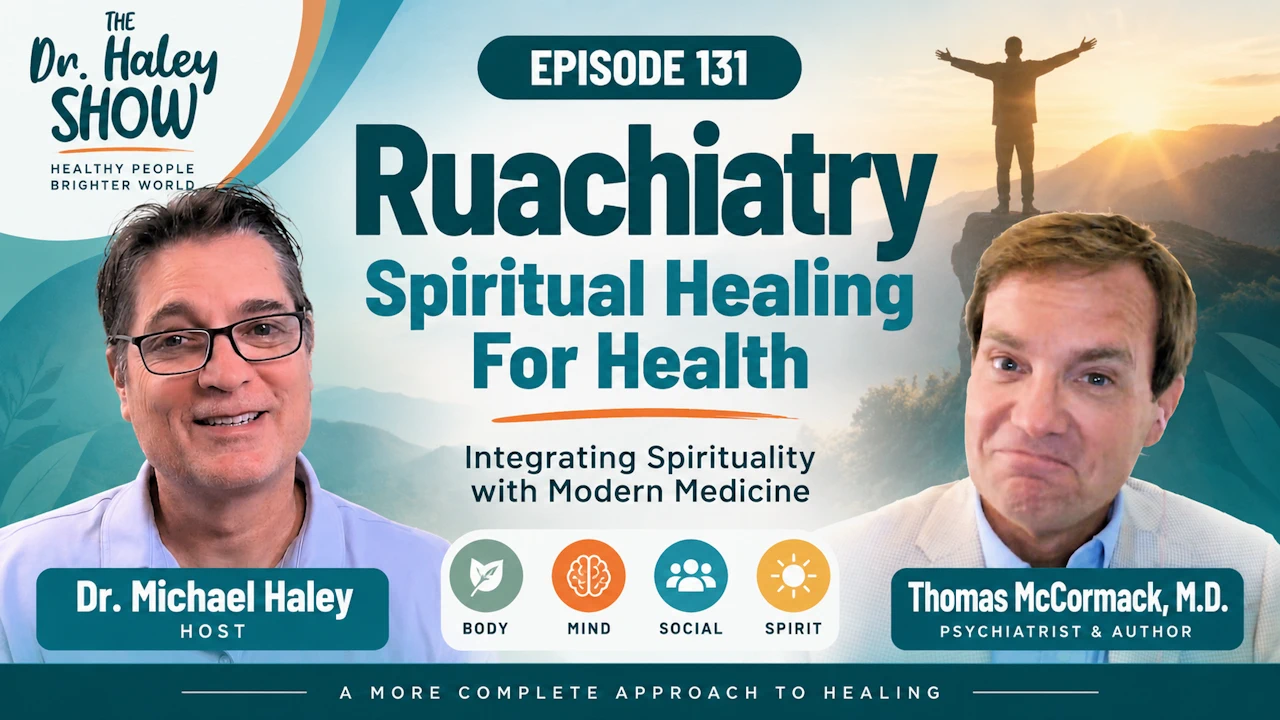
Can Spiritual Healing Improve Physical and Mental Health?
Spirituality is one of the most overlooked components in modern medicine—yet it may play a critical role in healing. In this episode, Dr. Thomas McCormack introduces Ruachiatry, a powerful 12-step framework designed to integrate the spiritual dimension into healthcare and personal recovery.
“This episode explains how spiritual health influences physical and mental illness, and how a structured 12-step approach can support healing when conventional treatments fall short.”
Watch the Interview
Listen to the Podcast
Resources
- Watch on YouTube: https://www.youtube.com/watch?v=qOg191DJXFY
- Listen (Audio): https://episodes.captivate.fm/episode/21593b2a-5f1f-41f6-b04e-19e8e6ef7587.mp3
- Apple Podcasts: https://podcasts.apple.com/us/podcast/131-how-ruachiatry-helps-the-spiritual-healing/id1573943789?i=1000737767956
- Spotify: https://open.spotify.com/episode/0TNRRDIsj9xtCJu8WDZHEs
- Athens Behavioral (Dr. McCormack): https://www.athensbehavioral.com/
- Buy “Hidden Medicine” on Amazon: https://amzn.to/43tkS9p
- Book Website: https://www.hidden-medicine.com/
- Dr. Pete Sulack: https://drpetesulack.com/
Follow Dr. McCormack:
Quick Takeaway
This episode challenges conventional thinking and opens the door to a more complete approach to healing—one that addresses body, mind, and spirit.
ENJOYING THIS CONVERSATION?
Get the Next Episode in Your Inbox
Get notified when a new episode of The Dr. Haley Show is published, plus occasional highlights and resources worth exploring.
By subscribing, you agree to receive email from The Dr. Haley Show. Unsubscribe anytime.
Episode Timestamps
00:00 – Why spirituality is missing in modern medicine
00:47 – Introduction to Ruachiatry
01:20 – Dr. McCormack’s background and mission
02:00 – The “spiritual battle” concept of health
04:15 – The biopsychosocial-spiritual model explained
06:24 – How emotions affect physical health
08:03 – Can this work without religious belief?
09:26 – Dr. McCormack’s powerful personal testimony
17:05 – The turning point: acceptance into medical school
23:20 – What is Ruachiatry?
24:02 – Why the 12-step model works
26:20 – Not replacing medicine—enhancing it
27:15 – Step 1: Acceptance and commitment
29:10 – Step 2: Searching for a higher power
29:35 – Step 3: True surrender
30:41 – Trauma and “radical renovation”
32:15 – Forgiveness and emotional healing
35:17 – Taking responsibility and making amends
39:03 – Moving from fear to faith
41:40 – Guarding your mind (vigilance)
42:24 – Final steps: drawing closer to God
45:00 – “Power words” that change lives
48:17 – Meeting patients where they are spiritually
50:03 – Study results: 48% reduction in depression
53:15 – Applying Ruachiatry in real life
55:33 – Final thoughts and outro
About This Episode
In this episode of The Dr. Haley Show, Dr. Michael Haley sits down with psychiatrist Dr. Thomas McCormack to explore the often-ignored connection between spirituality and health.
Dr. McCormack shares his groundbreaking concept of Ruachiatry—a system that combines medical science with spiritual principles to address illness at a deeper level. Rooted in the biopsychosocial model, Ruachiatry adds a fourth dimension: the spiritual component.
You’ll hear Dr. McCormack’s powerful personal story, including a life-changing moment that shaped his path into medicine and faith. The conversation also dives into:
- Why modern medicine often ignores spirituality
- How unresolved trauma and unforgiveness impact health
- The role of a “higher power” in healing
- A 12-step framework inspired by addiction recovery models
- Real clinical results from patients with treatment-resistant depression
Frequently Asked Questions
What is Ruachiatry?
Ruachiatry is a 12-step healing framework that integrates spirituality into modern medical care, addressing illness through biological, psychological, social, and spiritual dimensions.
Does Ruachiatry replace traditional medicine?
No. It is designed to complement—not replace—standard medical treatments by addressing the spiritual component of illness.
Do you have to be religious for Ruachiatry to work?
No. The system encourages individuals to explore their own beliefs and relationship with a higher power, regardless of religious background.
What conditions can Ruachiatry help with?
It may support mental health conditions like depression, as well as chronic or treatment-resistant illnesses by addressing underlying emotional and spiritual factors.
Is there evidence supporting this approach?
In a 12-week study, patients with treatment-resistant depression experienced a 48% reduction in symptoms using the Ruachiatry framework.
Here are the most important questions and answers about Ruachiatry and spiritual healing, explained simply.
Quick Answers: Ruachiatry & Spiritual Healing
| Question | Short Answer |
|---|---|
| What is Ruachiatry? | Ruachiatry is a 12-step healing framework that integrates spirituality into modern medicine to address physical, mental, and emotional illness. |
| What does “Ruach” mean? | “Ruach” is a Hebrew word meaning spirit, breath, or life force. |
| Does spirituality affect health? | Yes. Emotional trauma, stress, and unresolved spiritual conflict can contribute to physical and mental illness. |
| Does Ruachiatry replace medical treatment? | No. It complements conventional medicine by addressing the spiritual dimension of healing. |
| Do you have to be religious? | No. Ruachiatry encourages individuals to explore their own understanding of a higher power. |
| What conditions can it help with? | It may support depression, chronic illness, and conditions linked to stress and emotional trauma. |
| What is the core method? | A structured 12-step process focused on acceptance, surrender, forgiveness, accountability, and spiritual growth. |
| Is there evidence it works? | A 12-week study showed a 48% reduction in symptoms in patients with treatment-resistant depression. |
Medical Disclaimer
This podcast and article are provided for educational and informational purposes only and do not constitute medical advice. The experiences and opinions discussed are those of the speakers and should not replace diagnosis or treatment from a qualified healthcare professional. Do not begin, discontinue, or change any medication, supplement, diet, or treatment based solely on this episode.
Full Transcript
The transcript has been lightly formatted for readability. Because it was created from the recorded conversation, it may contain minor transcription errors.
Read the Full Transcript
Addictionology is the only branch of medicine that talks about the spirit at all. It’s not talked about in any other branch of medicine. And I thought, you know, I need to look into that. And looking at the 12 steps, there really some timeless truths in there. And I wanted to model the 12 steps of Ruachiatry after that. So they’re not exactly the same as AA or NA, but there’s a foundation there that is similar.
You are listening to the Dr. Haley Show, the podcast dedicated to helping you optimize your health. Each episode there will be an interview or a message to help you discover better health. We will be featuring health radicals on the show to bring new ideas to the table, as well as doubling down on key fundamentals to support you living your best life. Your host is no other than the founder of Haley Nutrition Dr. Michael Haley.
This is the Dr. Haley Show podcast. I’m Dr. Michael Haley, your show host, and today we’ll be discussing how the spiritual component to health care, with an emphasis on psychiatric care, can have a positive impact. We’re going to learn about a 12 step approach to better mental well-being. We’ll learn about integrating spirituality with medicine.
My guest, Dr. Thomas McCormack is a psychiatrist with a multidisciplinary practice in Athens, Georgia. He’s author of the book Hidden Medicine The Unseen War on Your Health and the Spiritual Prescription for Healing that could Transform Health Care. Dr. McCormack, thank you for taking time to be here on the Dr. Haley Show.
You know, I have a new favorite quote, and I took it from your website. I think it sets the pace for this discussion. It says the battle for your health is bigger than you think. Discover the cure that’s closer than you realize. Did you write that?
I did.
What does it mean?
Yeah. First of all, thanks for having me, Michael. I appreciate and look forward to talking to you today. But yeah, that quote comes from the fact that spirituality in modern medicine, as you all know, is largely neglected. And this puzzled me. And it was really the impetus for me starting to write back in 2022. But a lot of things in the book in medicine have been germinating in my mind for many years.
But yeah, that battle that goes on is really all around us and affects us in a lot of different ways, but it certainly affects our health. And first of all, in the book, I talk about how folks need to be firstly aware that they’re in a battle. We live on a battleground, not a playground, is another quote I have from the book. And when people walk around in the world and aren’t aware they’re on a battle ground. They’re easy cannon fodder for spiritual enemies.
And so, firstly, I really wanted to wake people up, to the fact that there is a spiritual war going on and secondly, how that potentially affects their health. And, you know, I say in the book that not every illness is caused by, you know, something evil or demonic or that sort of thing. But some of it is, you know, according to the Bible, at least in Christian faith, in a lot of different faiths as well. I found in my studies, you know, they believe that to be the case.
So if that is the case, especially in illnesses, whether it’s physical or mental illness, when things are unusual, meaning they’re treatment resistant to the usual standard of care treatments, and they’re severe and chronic in nature. We need to rule out physical causes. We need to rule out psychological contributions, look at their social supports and things of that nature, obviously. But if we’re looking at what we call the biopsychosocial spiritual paradigm, spiritual, it is last intentionally because there’s other things, in my opinion, as a physician, need to be ruled out. But once they are, we should really consider, hey, there might be a spiritual component to this patient suffering.
And, doctors are ill equipped. Both to talk about these things because this is not taught in our medical curriculum to a large degree. And patients really want that discussion.
Can I back up? What were the four components? Bio.
Yeah. So in 1977, a physician named George Engel, came up with what, he called the biopsychosocial approach, meaning in all aspects of medical care. We should, both in diagnosis and treatment. We should examine those factors. And that’s been standard part of medical curriculum that I was taught, for example, in the 90s, for, a long, long time in the 90s.
The biopsychosocial spiritual, adding that on to Engel’s, proposition was first really gained some traction, but it never was really widely implemented in, medical curricula, whether it’s a medical school or residency, for example, some medical colleges do talk about that to some degree. But really, that’s a gap, I think, in our treatment.
So, you know, bio psychosocial, spiritual is how I like to, to look at all things that come into my office and try to determine the degree to which each of those components might be playing a role in one’s illness.
Yeah. And, in your office as a psychiatrist, but you’re using the term illness as if it could apply to more than that. Is that accurate? And it could be illness in, you know, other reasons you’d go to a doctor? Not necessarily a psychiatrist, not necessarily related to mental health.
Absolutely. And, a physician, I certainly look at medical contributions to illness and I’m aware of, some of the basics of, medical, diseases. And so, trying to ascertain, you know, that the degree to which that might be affecting their psychiatric illness. But when I wrote the book in medicine, I really wanted this to potentially apply to, all branches of medicine, both physical and psychological, mental as well.
Yeah. I mean, from a just commonsense standpoint, we all know that things like laughter is good for your well-being and being angry makes kind of negative chemistry.
Yes.
And that could be detrimental to your overall health, your immune system, or even your immune function.
Yes. there’s something in Proverbs. I think it’s, 17, Proverbs 17, and it says something like, poor spirit dries the bones or something like that, but a joyful, spirit is like a good medicine or a good cure.
That’s right. So we know that things up here affect how our body works, you know, physically.
Absolutely. Yeah. I always tell patients that, this thing is the central nervous system. It controls the rest of this, right? It doesn’t mean every, physical illness necessarily. Is caused or has a psychological component, but many do. You know, a classic example is hypertension, right?
So if your stress is down. If you’re taking care of your body, you’re losing weight, you’re eating. Well, you know, you may have inherited, a propensity to having high blood pressure, but those factors if they’re dealt with can certainly enable it to be better controlled. And, you know, if you do need medicine, be on less medicine, for example. So, yeah, there’s a big literature about that. Of course.
Yeah. Okay. I do want to get into your 12 step program a little bit. But before we do, maybe go in a little bit of a different direction. And this podcast isn’t for you don’t have to be a Christian or of any particular faith. My understanding is, as your program would work regardless. Is that accurate?
That is accurate. You know, in the book, I tell my own story and my own spiritual journey and how I came to believe, what I believe. am a Christian. But I want this. First of all, I want everybody to realize that they have a responsibility to figure out on their own, what they believe spiritually.
And some people might if they go down that journey and they say, I don’t believe. I think that’s all hogwash and there’s no spiritual life, well, at least they have a search. But step two, we’ll talk about that maybe a little later. But it is that they earnestly sought, the higher power, because if there is a higher power, and I obviously believe there is. Who is it? What is it?
And, if it is benevolent and if it’s very powerful, certainly more powerful than you. Shouldn’t we at least consider tapping into that and trying to get that power to help us with, illness that our, physicians and other doctors and therapists, aren’t able to completely cure with, standard treatments.
Yeah. Yeah. And I did want to get into your testimonial. I’d like to hear about that little bit of a disclosure here. Your book is coming out in about a week from now. We’re recording this before it came out, but by the time I publish this, it will be out, so I haven’t had a chance to read it yet. I’m glad to know that you included your spiritual journey in there, but could you share that with us here?
Of course, I’d be happy to. Well, I grew up, in Atlanta, Georgia, as a when I’m referred to as a nominal Christian. You know, we live in the United States. There’s a lot of cultural Christianity and still is the largest religion in the United States, for example.
But I would say that I, was not born again. Meaning I don’t think I of a generous spirit. I went to church on occasion. I really never read the Bible. I prayed if, I was in trouble, but I, regrettably treated God sort of like a genie. If there’s any kind of a magic wish, and fire up some prayers, not sure if he listen to those. But, probably. Did But, so that’s how I grew up.
And what happened was, in medical school, sorry. In undergraduate, rather, I went to school in North Carolina, and my first semester I got really sick early on, so much so that I had to be hospitalized had enlarged liver and spleen and lost a ton of weight. Couldn’t eat. And I met with my premed advisor, and he said, Tom, I think you ought to, withdraw, you know, from the semester, or at least you probably should not take, chemistry and biology is a very rigorous kind of weed out medical courses.
This is my first semester in college, and in the school I went to is a small school. And at the time, you’re off for an entire year. So if I didn’t take, you know, biology one first semester, you know, you can’t take biology one. Second semester, they only had biology two, for example. Right? And so I thought that would put me off the pre-med track and put me a year behind. And I told them, I said, I’m not doing that.
In retrospect, that was very foolish of me. But what happened was, on account of that, I ended up getting two C’s I haven’t got a C in my entire life, I think on a test or on paper or anything, but let alone, you know, a final grade. And the C’s I got were in biology, in chemistry, so that for most people would be a death knell. Hey, you’re not going to go to medical school. You start off pretty bad. It’s over.
And, organic chemistry.
Well, organic was sophomore year, but now this was this was general chemistry, which for me, I found harder. For some reason, I liked organic, because I got a C in inorganic chemistry and that bothered me so much that I decided to become the organic chemistry tutor.
Oh, right.
When everyone else took their summer off, I went back and mastered it and came back as a tutor because I was bothered that I got a C. It was a tough class.
That’s great. It sounds very adaptive.
Yeah. So I met with my premed advisor and he looked across his desk at me, said, Tom you’re not going to medical school, so you need to think about another major.
And, I was very upset by that. And, was respectful but indignant and said, yes, sir, I am going to medical school and I’ll see you in three and a half years. You know, when I get my entrance. And he was like, okay, whatever. And, I changed advisors and, the rest of my time at school, I studied very hard and got good grades, almost, for the rest of the time.
So by the time senior year rolled around, I was in good shape. pulled up my grades. I had a reason to kind of explain the two C’s that were aberrant, on my record. Because I’ve been very sick.
So I went back to and he was the premed advisor, and, he said, well, the premed committee strongly recommends you for admission to medical school. And I didn’t remind him that you remember what you told me three years ago. But at any rate, I was excited about that.
I wanted to go to my state medical college, and he said, oh, you shouldn’t have any problem getting in there. And lo and behold, I got an interview, pretty early on in October, and it’s a rolling admission. And the interviews went fantastic. And I thought, all right, any day now, I’m going to get my acceptance letter.
And it didn’t happen, Michael. And what did happen was I went the rest of the year, my senior year and didn’t hear anything, which is really unusual in medical school if they think I was a good candidate. But maybe he’s not the cream of the crop. We’ll wait. List him in if something comes up and we’ll call them and maybe give it a position. They didn’t do that. I just didn’t hear. I wasn’t rejected or anything.
So by the time I graduated in May, I came home and having uncertainty about what I was going to do in the future. But one day I walked down there in June, 1992, and, I found a thin envelope in the mail from the medical college, and I knew that, bad news is the hold it did is a two line rejection. And, I was just crestfallen. I didn’t know what to do. I thought, my gosh, I’ve worked hard for this, and I really wanted to be a physician since a very, very young age.
And, I didn’t want go back up to the house and talk to my parents. They’d be upset. I just feel like I need to process this. So I had my dog with me. I started walking, in the neighborhood, and I didn’t get far. I get to the house next door, and I stopped and I had tears in my eyes and I was hurt, confused and angry.
And what I did was I ended up praying out of desperation. And it went something like, this is silent, but, is very disrespectful, but it went something like, what the hell? I’ve worked hard for this my entire life. I thought, this is what you wanted me to do. I’m not sure if I believe in you anyway. You would. You know, if I’m your child and you love me, why would you treat me like this?
And then I kind of made a bargain. I said, I tell you what, if you’re real, you need to show yourself to me right now. And I’m not saying you need to get me into medical school, but you need to show me my path because I’m lost. And if you do that, I’ll do whatever you ask me to do. It is not to be a physician. And you call me do something else. I’ll do that. But I need you to show me right now.
I prayed that prayer, tears my eyes, not expecting any response. And to my shock, immediately, the atmosphere changed. I don’t words don’t do it justice, but, it almost was as though time stood still and, I felt these invisible arms wrap around me. It was a very real sensation of touch. And the best I can describe is something pulled me toward an invisible bosom and held me.
And I was permeated with this peace despite the adverse circumstances. I just felt like everything’s going to be okay, and I didn’t understand. But this emotion was so intense and didn’t last long. But when it ended, I just felt great. And I felt this literally a burden lifted off of me. And things are going to be okay.
And, I went ahead and went, what? The two miles around my neighborhood came back, told my parents they were super upset and, long story short, my mom knew the dean of a medical college I hadn’t, applied to because it was near to in rural medicine. And I thought, I don’t wanna go there.
But she called him and he said, I’d be happy to interview Tom. Take him into Admission. But, you have him come talk to me. So, I kind of felt like that wasn’t the path. But since she’d open that door of opportunity, there seemed to be some hope. I said all right well I’ll go.
So, a few days later, I was lingering on the couch in my Sunday best, and she said, you got to go tell me you’re going to be late. And so I got up and I went to the back door and kissed my parents goodbye. And I literally had my hand on the, doorknob and the phone, back. when we had phones on the wall, rang, and my mom answered it, and I turned around and she looked puzzled and she said, yes, yes, he’s right here. And she kept the phone and said, it’s for you.
And I said, who is it?
It’s for you.
And so I grabbed the phone and, you know, you built up the story pretty good so far. I’m expecting God to be on the other end now.
Yeah, well, you know, he orchestrated this. In my opinion, it wasn’t God himself, but, it was the dean of a medical school that I had gotten waitlisted for, and, did not feel like I was qualified to go to that very rigorous, you know, top notch school.
At any rate, he said, you know, this Dean so-and-so, and, a spot came open. Would you be willing to accept, the position for our class of 1996? And I said, yes, sir. He said, well, get your affairs together. Classes start in a week. And I said, I’ll be there. And I hung up the phone and we just celebrated.
And, I was really humbled because I knew that, something had orchestrated this. I assumed he was God, but I didn’t know what God or whatnot. Yeah, but, and orchestrated this, not because it was my will, but because his will for me
Continuing exactly where the previous block stopped. I’m preserving the words from the original timestamped transcript and only arranging them into readable paragraphs. The commercial that occurred immediately before this point has already been omitted.
his will for me. And I finally come to a place where, I surrendered.
One thing that’s really fascinating there. You said you had your hand on the door. You’re on the way out the door, and you were going where?
I was going down to, medical college in Macon, Georgia. That was about 100 miles away, to talk with the dean there. But again, I hadn’t even applied there. But, among on millions of but possibly to secure a second plan.
And as you were going your own way, it’s like, okay, we got to stop him now, right?
Right.
And the phone rang.
Yeah. That’s right.
That’s great.
So that’s my testimony. But anyway, I just thought to myself, I made a bargain with whatever this was, and I need to decide who this God is.
And so what I did was find, you know, I was a scientific minded guy, so I thought, I’m going to get the sacred religious texts of all the major world religions, and I’m going to read them and, I’m going to decide for myself which one you know best, jives with, the realities in life and, which one I think is the truth.
And so I put Christianity last on purpose because, again, a group normally Christian in a Western culture. So, you know, I read the Bhagavad Gita and the Koran and, the, the Tipi, tipitaka thing, from Buddhism, obviously read the torah of Judaism and all and, to my surprise, when I read the Bible, really for the first time, completely certainly.
I was it blew my socks off because I just felt like it was the truth. I felt like, you know, something was pulling me towards that. It seemed to be in concert with the being that had, you know, not only personally granted me peace and, I think orchestrated events in my favor, but also described how I think the world really works and, decided to follow Jesus.
In early 1993. And, it’s been a wonderful, spiritual journey since then. And, it’s the right fit for me. But one thing I want in the book is I don’t want people to think, oh, gee, I’m not Christian, so I can’t read the book or follow these principles. I don’t believe that’s the case. I just encourage everybody.
It’s your own personal responsibility to decide what you believe or what you don’t believe. And, that should happen early on. And then, you know, we can go from there.
Yeah. I would also suggest that not everyone has such, obvious encounter where it’s, you know, I feel God’s presence here, and this is amazing. And, you know, the I can actually hear the angels singing. It doesn’t quite happen that way for everyone.
And I actually have a similar, story, where, you know, for me, I kind of chose, the Christian faith at a young age, but it was more of a choice. And I went to church because I knew it was the right thing to do.
And I continued to go, and I about the time I started really reading the scriptures, I was in chiropractic school. And there was a moment when in the cadaver laboratory where we’re looking at dead bodies, right? And all the organs are in the right place, and they still have all of their cells, but they’re not alive.
And you know, I realized that that body was alive. And then the next second it was dead right. And probably not much had changed in that body. But somehow the life left. Where the hell does the life come from. Right. You know and I and it just, it was so confusing to me like where did the life come from?
And you know that and reading the scriptures, it’s like, oh, God, that’s the only logical answer.
I agree, and, that’s fantastic. Thanks for sharing that. And you’re right, not everybody has a burning bush moment. Sometimes it’s a lot more subtle. And some people were born into a certain religious, background and might have, you know, had that from a young age.
But anyway, it’s everybody’s individual responsibility to, I think is adults to figure out, what they believe, and have a reason, you know, they can back up the reasons for that.
Yeah, yeah. What’s your 12 step program called?
So I call it Ruachiatry And I coined that term because ruach in Hebrew means spirit. And iatry in Greek means healing or the treatment. So really this is a, a spiritual treatment, something that I found was neglected in medicine. And, I thought that was a, term that might be memorable, because it’s unique rather than saying biopsychosocial spiritual. That doesn’t flow well off the lips.
But anyway, my goal is to add the spiritual component back into, medical care. As far as when we evaluate patients and when, when we’re treating them. So that’s how, I came up with that term.
The reason for the 12 steps is that’s already in our lexicon. Stanford, did a mountain analysis, in 2020 looking at 27 different studies. And it had 10,565 participants. And they were looking at Alcoholics Anonymous, which has been around since the 1930s.
And what they found was that those who had an alcohol use disorder and participated in AA, which of course is a free, you know, there’s no money involved there in it you don’t need a doctor to run it, for example, or a therapist, even in this patient run, they found that the, health outcomes were better than standard treatments such as cognitive behavioral therapy.
And they also found that health care costs were lower for those who had used AA. And prior to the 1930s, you may have awareness in you’re training you know alcoholism had a terrible prognosis. I mean, people, they didn’t know what to do with them. And a lot of times they’ll end up in institutions or even homeless.
And, it just had a very grim prognosis. And AA really changed that to a large extent. Still, those folks who are afflicted with addiction, it’s very difficult. But, nevertheless, my point in saying on that is when I saw those studies, I thought, you know, Addictionology is the only branch of medicine that talks about the spirit at all.
It’s not talked about in any other branch of medicine. And I thought, you know, I need to look into that. And looking at the 12 steps, there really some timeless truths in there. And I wanted to model the 12 steps of Ruachiatry after that. So they’re not exactly the same as AA or NA, but there’s a foundation there that is similar.
Again, because it is in our parlance, but also it’s incredibly effective. And I thought if this could be applied to general medicine and psychiatric care for example, what kind of impact would that have?
it’s free. It clearly helps people. And, we’re always concerned about health care costs and our insurance, you know, goes up every year exponentially. And people, you know, our politicians sure as heck don’t know what to do about that.
I just thought, wow, if we can add that in, in a systematized approach, it could maybe really have a big impact on the health care system, but certainly on individuals. Who aren’t getting complete healing from traditional treatments.
So Ruachiatry is not instead of medicine. I want to be very clear. I don’t say, oh, go off on your medicine and don’t see your doctor or chiropractor, therapist or whatever, no. do those things. Absolutely. We live in a fallen world. There’s sickness and you should battle it on all fronts.
But we should also battle on the front if we believe that we, you know, are part of our tripartite nature as humans is our biological nature. But then we have a a soul and we also have a spirit. And, we ought to fight on all those fronts in order to achieve wellness or at least work towards it.
Does someone need to see the psychiatrist, for instance? If they have their book is there, you know, how do you know at what point you need professional help? Or can you go through this program on your own with the book?
Yeah. The first step of the program is kind of similar to AA, and it’s, what I call acceptance. And commitment. So the first thing you have to do is accept that you, have a serious condition that you’re not powerful enough to deal with on your own.
So obviously, if you’re seeing a doctor or therapist, by definition. Hey, I need outside help. I can’t do this. I’ve tried this. And the other thing, it’s not got me to the promised land.
So while acceptance sounds like. Oh, that’s easy. Of course you can’t do that. It actually in practice is harder than you might expect. And I’m sure you as a doctor know this as well.
That, there’s a lot of denial if you look at the stages of grief, for example, that, you know, this as Doctor Elizabeth Kubler-Ross came up with in the 1960s, acceptance actually is the final stage of grief. And we think about grief if somebody dies or whatnot. But grief can be grieving over the loss of your health, right?
Oh, I don’t want to have whatever depression or whatever malady you have. And, by the time some folks seek the doctor, it can be further progressed because they’ve had that too now. So the quicker we can get from denial to acceptance, the better off they’re going to be.
And then that commitment is the commitment to fight it on all fronts. Okay, I’m going to see the doctor. I’m going to do What he or she says, I’m going to do the physical treatments. I’m going to do the medicine. If I need surgery, whatever. I’m going to consider those things.
I’m going to look at my social supports. Am I plugged in socially? Because a lot of times you will know when people are in pain or sick or mentally ill, they kind of recede in the background that I don’t feel like going to the party or going to church or whatever.
And they don’t mean to, but they get socially disconnected. And we’re social animals, a very important part of our being. So looking at that and then of course, psychologically, is there some component there that might be playing a role?
So that’s the first step there. As I mentioned earlier, the second step is that searching, once you’ve kind of accepted and all committed, then you get to say, okay, well, if there’s a higher power, what is it? Who is it?
And again, sometimes this is easy for people of faith. They’re born that way. And that sort of thing. They’ve already decided that that’s great. But a lot of us, even as adults, haven’t totally decided what that is. And going on that, earnest journey is important.
The third thing, that I think a lot of people of faith even, overlook it is called, submission.
And a lot of people think, yeah, doc, when I’ve treat people to 12 steps, they’re like, you know, I’m Christian or whatever, and I’ve got these first three, I got it. And I said, wait a second, we need to take some time with step three.
Have you turned your will and your life completely over to your higher power? have you surrendered all aspect because it’s obviously very common to say, God, I’ll give you 95% of this little part. I’m going to hold back.
And we are going to do better if we’re completely committed. And again, if our higher power, we’ve identified is benevolent, loves us, and, sees it as his children, for example, but also, is very powerful is the omnipotent king of the universe. Why wouldn’t I surrender to that? That’d be. I’d be crazy not to consider that.
So I think the first three are kind of foundational, steps and then four through nine have more to do with what I call radical renovation. And, I’ll not going into the detail right now. The basic thing is the things that have happened throughout your life, and built strongholds in your mind and have affected you.
We’ve all had trauma, sometimes with the big T sometimes with a lowercase t is a talked about in the book, and we believe lies on account those traumas and so going back and doing the hard work of tearing down some of these strongholds, replacing these lies that, we may not even be aware of, and replacing them with, the truth.
That’s hard work. And sometimes it takes a psychotherapist, you know, to meet with you and, go through that, process.
And, figure out what the traumas are. Even a lot of people don’t realize they have trauma.
That’s right. And so step four, in the book, I ask people to actually, there’s a, template, that I came up with where, there are different columns, and you say, What was the trauma? Who did it to you? Was it intentional or not?
The reason I feel like that’s important is that when we get hurt and it’s accidental, it’s just easier to forgive, right? And but when it’s intentional and especially when somebody hasn’t, you know, asked for forgiveness or sought to make amends, it’s a lot harder to forgive that.
So it’s important to kind of look specifically at what your traumas are, whether they’re intentional or not, and then examine the lies. What did I believe about myself, when this happened?
And, that takes a lot of soul searching. And again, sometimes needs a professional to help navigate that, but that’s kind of the, skeletal outline of step four, for example.
Okay. Does forgiveness follow trauma?
It does. Yeah. In fact, step five is choosing forgiveness.
Forgiveness is a choice. So in step five, I ask people to rank the degree of bitterness and resentment they have towards folks or institutions that have harmed them in some way.
And the reason why that’s important is, when I think of resentment, it’s it´s a progression. So resentment remains again, sentiment comes from sentire in Latin, which means to, feel.
And so you’re choosing voluntarily to feel again and again and again the hurt that you felt initially from the trauma. And it’s simply madness, because that resentment over time drains into, bitterness. And and the Bible calls it a root of bitterness.
So when I think of roots, roots go down and they spread out. You got to dig them up, right? You don’t just mow your lawn and say, oh you know it Looks good. If you don’t get the weeds out, you got to get in there and do the hard work. And it’s the same thing, with bitterness once it sets in with somebody.
So you’re basically, in a prison of your own choosing when you do not forgive other people, when you do, it sets two captives free sets you free. And the person, who hurts you.
And so forgiveness is so very important. That’s why the old saying to err is human, to forgive is divine. I think there’s a lot of truth. It’s hard to do.
And so you’re probably going to need your higher power to help you with that, especially when things people didn’t apologize or they were very unjust. And hurts deeply, depending on the degree of the hurt.
Yeah. And forgiveness is probably a tough one for, you know, big T in your life. You know, you killed a loved one of mine, right? You know, I, we seen an example very recently on TV of that.
Yes.
How do you know if you actually have forgiven that person is saying it. You know, just the first step.
I think so. I think it starts with a mental assent. You are choosing it, and, you might have appropriated, you know, you might not feel it. But you’ve made the right decision.
And, you know, again, I think it takes a higher power. The I think probably the example you’re talking about is Erika Kirk after the assassination of her husband, and she is in national TV. And says that she forgives the young man.
I think that takes, something divine to help with that. That would be incredibly hard for mourners to do. And it’s going to take a higher power. And, you know, she attributes that to her higher power, obviously, I think is a great testimony, but I think there’s a lot of truth that can be gleaned from that.
We can forgive even big T traumas like you mentioned. But man, it’s hard. And without the help of our higher power, it may not be possible. Honestly.
Yeah, yeah, well, that’s a good word, because, if it might not be possible without the higher power, it kind of implies that it is possible with. Right. So there is hope.
Yes.
I’m sure there is what comes after forgiveness.
So after forgiveness, comes traumas that we ourselves inflicted. Right. I like to think of it this way. Hurt people, hurt people, and we’re all hurt people, albeit to varying degrees. So we need to take a look in the mirror.
And I think in our, decadent, western society, you know, nobody wants to be in pain. And we, We’re 5% of the world’s population, but we consume 70 something percent of the world’s pharmaceuticals. And I think it’s to, you know, no more pain, largely.
I mean, certainly they’re appropriate, pharmaceuticals that should be given. And we’re blessed to have that option. But my point is, I think we rely too much on, some of these, these other things that mask it.
And looking in the mirror instead of just saying, well, my pain, my pain. And that’s what I think we can look and say, well, wait a second, I hurt people to and I’ve got to admit that.
And for me to really be healthy, you know, psychologically, but more importantly, spiritually, I’ve got to take ownership of that. I’ve gotta say, man, I fell short here. I hurt that person.
And I tell people to go from childhood honestly, right up into the present. And if it comes to your mind, it’s important people say, what should I talk about? You know, that, you know, punched in elementary school. If it came to your mind, yes.
Then it’s still there and you feel some kind of guilt about it. And, you know, if it weren’t important, you wouldn’t have remembered it. And, so just write down everything, and then we can meet and talk about, you know, how to digest all this, but, that naturally flows into step seven, which is making amends.
Now, it’s not always possible or advisable to make amends with somebody. Right. If you hurt somebody a certain way, you know, going back and contacting somebody, you know, hurt and whatever high school or something, they’re married and they’ve moved on.
And unless it was a huge deal,
Yes. Continuing from “And unless it was a huge deal,” and carrying it through the end of the interview. The commercial at approximately 37:57–38:34 is omitted, as requested.
And unless it was a huge deal, it’s probably better just to let it go, but you can still pray about it and try to ask God to bless them and forgive you for what you’ve done.
But if there are people that are in your life and readily accessible and it is safe to make amends, you should you should talk to them and say, hey, I did this thing and I’m sorry for it, and I’ve really been convicted. I need to reach out to you and try to make it right. Is there anything I can do to make it up to you?
The vast majority time people like, no, I really appreciate you, you know, telling me that, but I think it’s advisable, even if that’s the case, it’s a little hard with a, you know, a note with a gift card or something, just to show that you’re thankful that they were willing to talk to you about it.
And it’s making a small and, tangible. Amend. But, it’s just trying to, you know, correct the wrongs that we ourselves did in step seven.
Yeah. You know, had an interesting thought while you were saying that. And it’s kind of like Yeah. Is there any reason to dig up this person where I don’t even know where they are?
Right. From, you know, grade school or whatever the case is. You know, I can always pray that the Lord does bless their socks off and more than make up for any damage I have done. And they’re, you know.
Right. Well, the Lord looks at our heart. So.
Yeah, if your heart postures. Right. I think that’s, definitely a great start.
And the Lord will honor and answer that prayer. In my opinion.
How many more steps do we have?
So there aren’t 12, so eight. I’ll go through quickly, but eight is from fear, to faith and, fear in our world these days is almost ubiquitous. There’s such a rapid, changes that go on with, technology.
And then there’s, you know, increasing political divide and uncertainty about war and pandemics. So fear is really common. And moving to faith is what’s comprised in step eight?
Step nine go ahead.
And so would you say those go those go kind of hand in hand meaning, for instance, when you had your experience with God out in the street there, you know, I need you to show me who you are, and you sense his presence.
Well, the fear of, you know, what’s next? What do I do? Where do I go from here is kind of taken because now you all of a sudden have a faith. You know, that you’re connected with your higher power. So I almost see those kind of blended together.
Absolutely. I agree 100%. And, you know, the Bible says, for example, cast your cares upon him because, God cares for you and he promises to help carry the burden, right?
Whether it’s the burden of, hurt or, medical problems or psychological problems. It’s a burden. Right. And I know that is not in God’s will ultimately, because he promises one day he’s going to come back and he’s going to remake us and remake the world.
And it will be back to his former state, which he created, which he said everything was good and obviously my belief is that with the fall of mankind in sin, we’ve wrecked the world.
Now we have some help from the devil, in my opinion. But, we we’re good at wrecking things all on our own. And, someday that will be gone. Thank goodness.
So that faith. I talk about that in the book, is really, really important is foundational and the shield of faith at this point in these steps, I talk about how God, supplies you with, you know, that armor that Ephesians 6 for example, in the New Testament talks about, and you only get these when you’re a believer and you are working through these things.
I believe God grants them to you in order to equip you to fight these battles.
Briefly, step nine is the last part of this radical renovation, and what I call that one is sober and vigilant. And so sobriety, of course, means abstaining from alcohol and drugs and numbing yourself and that sort of thing.
But it also means not being under the influence, of anything outside of what’s godly. Right. So we can be under the influence of, media and, entertainment and sports and all sorts of things.
Not that those things are inherently bad, but it’s an opportunity to look at our lives and kind of say, you know, again, am I under the influence of God and His Holy Spirit fully?
And, then vigilance is once I’ve torn down, these strongholds that were built in my mind over many years because I believe these lies and have these traumas and that sort of thing. Now I’ve got a watch on the wall and be vigilant. I can’t let them back in because it’s easy to do. And the book talks about that.
And then 10 through 12, kind of is the culmination of the book. And it’s, offering that spiritual solution in a very tangible way. so, you know, that’s drawing closer to God and 10 and 11 and 12 talk about how to do that.
I like it, so I can still watch football right?
Absolutely, absolutely.
Yeah. Does don’t make it an idol. Although I think that.
Yeah, that as well. But.
Well, you know, I come from Cleveland, Ohio, so, I’m not that addicted because my team hasn’t played good football since the 80s.
Okay. So you got Ohio State, though.
Ohio State is amazing. Yeah, I was I was really I you know, we’re here in South Florida and I was hoping for University of Miami to maintain their undefeated record. I thought, you know, I don’t know what the rest of the schedule is, but I would love to see a bowl game, you know, between the number one and two.
Yeah.
Ohio State and my, near team here in Miami. But yeah.
Yeah. I don’t think that’s going to happen now.
Well we’ll see. They still, Carson Beck had a bad game last game, but, he was at Georgia for a number of years, and I know him well, and he’ll come around, you know, he’ll lead on certain of that.
You know, one thing I like to ask people on my podcast and I’m going to give an example, which I’ve given before because, well, it seems appropriate in this particular discussion. And I got it from this Dr. Bob Schiffman. He was a chiropractor that I went to see speak to a bunch of other chiropractors, and he was definitely a spiritual man.
And, you know, he felt that he had to literally get up at, you know, 3 or 4:00 in the morning before going to work and spend as much time as it took to get in the spirit before going to work, because he didn’t want to be he didn’t want him in front of his patients. He wanted God through him, in front of his patients.
And so he would take time in prayer and meditation and, I guess the more he did this, the less time he needed to prepare, because eventually, you know, you would almost be waking up in the spirit, and I’m ready to go and as he taught at the time, when I got out of chiropractic school, I knew I wanted to be a chiropractor, and I was really enjoying it.
But I also wanted to learn the scriptures more. So I decided to go to Bible college just for fun.
Okay.
But I started getting a little confused on, you know, am I a physician or am I a minister? What’s my role here?
And at the end of Doctor Bob’s discussion, I kind of went up there like everyone else did, wanting, you know, to ask a question. And I, you know, he’s rapid firing because he’s in the spirit and he’s got all the answers.
And it’s my turn. He looks at me, he goes, you know, just points at me. And I say, doctor Bob, I, I struggle with. And he just pointed and said, stop struggling. And he went on to the next person.
Easer said than done.
And well no actually for me, you know, it was an instant. That’s like the perfect answer.
Yeah.
Stop struggling and I’ve applied to so many areas of my life immediately. So those were what I call power words spoken into my life that had an impact from that day forward. Forever.
Have you ever had any power words spoken into your life that affect you, who you are today?
Oh, Lord. Yes. I have so many. I honestly can’t think of a seminal moment. Like. Like you had but Absolutely. Those are those are powerful.
And, like doctor Bob, that’s what I strive for is, to be in the spirit. I look at my calling, as a medical ministry, right? I’m not a, pastor, but, I have a ministry, and, I want to be faithful to that.
And the more I’m in the spirit and listening to him guide me, he comes up with the words. And I can’t tell you how many times. Just the other end, patients come to me and say, Doctor Mc, do you remember when you told me blah, blah, blah?
And my first thought is, no, I don’t remember. That didn’t sound like me.
And my second thought is, that doesn’t sound to, you know, revolutionary. But they’re like, it changed my life.
And you never know. You know, you’re meeting people at a certain point and they need a word. And it comes from the Holy Spirit if you’re surrendered. And I think I’ve seen that so many times just in me doing my own medical ministry.
But then also God puts people in your life. He’s sovereign. And, sometimes they tell us things we don’t want to hear, but, again, if they’re godly, like Doctor Bob was, you ponder it, you think, hey, he wasn’t trying to be mean. He’s trying to wake me up to a truth. And I need to think about that.
And, I think that’s really important. That’s a neat story.
Well, you know, with that said, all the things we talked about, we did talk a lot about this spiritual and about God. And, you know, we did start by essentially saying, you know, you work out your own faith kind of thing.
I feel pretty comfortable in, the faith that I have. And, it’s certainly work for me. And I would imagine there’s people out there that maybe haven’t found their way yet to a particular faith. How would you invite them to their Christian faith?
Yeah. So when just as background, when I started practicing, I decided early on that my calling from God was to treat everybody. I don’t advertise I am a Christian counselor or whatever.
so if somebody is normally Christian or is interested in the Christian faith, obviously, you know, we can talk about that because that’s the faith that I have.
If they’re not, I don’t beat them over the head with the Bible or with Jesus. Right. And people know where I stand. It’s not a, secret or anything, but by the same token, it’s about them and I want to meet them where they are.
And but if that comes up, then, I’m ready and willing and able to talk to them about, you know, the reasons for the truth. And I’ve decided on.
Yeah, yeah. Awesome. Awesome. I put you on the spot on that one.
Is there anything that I, should have asked you in this that you feel I left out?
I don’t I don’t think so. I thought that was thorough. And, Yeah. I appreciate you having me on and just want to, you know, shameless plug for the book.
It’s something that I’m, really, like I said, has been inside of me for a number of years and finally came to fruition because of a lot of different circumstances in my life.
But I really think it’s timely. I really think it is written for a time such as this. And, it’s not just for Christians. I want people who are just open and searching and curious about spiritual matters, to just look at it and examine it. And they may not agree with me and that’s perfectly okay.
But I’m hoping that it’ll add to the awakening that I think is going on right now, but then also open up an avenue.
Okay. Once you spiritually wake. Wow. It’s overwhelming. All this stuff is going on. Okay. Well, God is sovereign over all our spiritual enemies. He created them. He didn’t create them as enemies. They became enemies because they have a will. And they too, went astray.
But at any rate, God didn’t obviously create evil. He’s good and infinite and, he’s a, very present help in time of need and, decide who God is.
Reach out to him, work these 12 steps, and, I can back it up with some study that we’ve done in our own practice.
And we did a 12 week study of people with treatment resistant depression that, had not responded fully to the usual standard care treatments.
And what we found in our 12 week course, going through the 12 steps of Ruachiatry, is that people on the mean with 32 on the Beck depression inventory at the start, which is in the severe range.
At the end of the study of 12 weeks, the mean was about 14, which is in the mild area there was a 48% decrease. Just doing the steps of Ruachiatry for treatment resistant depression.
These people were severe and hadn’t respond to usual suspect. And during that trial we obviously said you cannot change your medicine during the course of this.
And you cannot change the frequency of your psychotherapy on every two weeks, you know, maintain that and whatnot.
So at any rate, I think there’s some initial evidence that this can be really helpful, specifically for depression. But I’m hoping that other studies this will pique curiosity of doctors as well.
And they’ll, want to do their own studies in their own practices and say hey can this apply to other things, because I think, again, these are universal. Truths.
Yeah. I want to ask you something about that, since you just brought up the study that you did, is that I’m familiar with as a chiropractor, outcome assessments when it comes to, people that have pain, for instance.
And there might be 20 questions or ten questions on this assessment. And there’s some assessments that are more highly revered than others. Right. And I would imagine this as some kind of standardized assessment used in psychiatry. Is that.
It is. Yeah. So it’s, Aaron Beck was a, renowned, doctor that came up with, that and it’s written extensively it’s quite famous, persons. He’s deceased.
But at any rate, you know, this is very standard, and it’s a thorough and well studied, tested to look at the degree of depression.
Okay. And then the numbers were went from, I think you said 48% to.
So the bottom lines, it went from severe the score. The total score is 32, which is in the severe range. And it went down to 14, which is in the mild range. You know, the 48%, decrease in their depressive symptomatology over the 12 weeks.
Okay. Very, very neat.
Yeah. I’m looking forward to the book coming out. I would imagine it takes these areas that we talked about and goes nice and deep into them.
As I was listening and learning today, I realize, hey, I got areas that I can work on in my life. I’m sure people listening thought of different situations in their life that they haven’t quite dealt with.
So, looking forward to it coming out. And if you’re listening to this, it’s already out. I’ll have a link in the description to get Dr. Thomas McCormack’s book that will help you understand those 12 steps and what you can do.
And I will tell you Michael that I apply these 12 steps to my own life.
And, we don’t have time to go into that in great detail. But right now, cancer, for example, and I’m obviously finding that with standard medical treatments, I’m going to have surgery soon.
But I have a piece of that, you know, I’ve gone back and work through the steps again. It’s been incredibly, helpful for me. And it was helpful in the past for some other medical maladies that I had.
And, so I want people to know that it is practical and we don’t just have this study. I do have my own experience, but I’ve used it in my practice, you know, and not quite as systematized way as this, for many years.
And, you know, adding the spiritual component, can do nothing but help potentially. So it’s a worthwhile consideration.
You know, I agree, and most of my listeners are going to agree too, because, you know, well, my audience is a unique audience, and a lot of the people that are in it, have had cancers that they’ve dealt with, and a lot of them have gone through healing programs that include the spiritual, but probably not nearly as in-depth, as your 12 step program.
They’ve been introduced to the concept of, you know, recognizing trauma and forgiving, those that have hurt you. But probably haven’t gone through a full 12 step program.
And in the same way, a lot of them have done things very naturally and some have done them in, combined approaches with medicine and natural integrative approaches.
And I’m sure a lot of them, heard you say that just now and said, okay, we’re praying for, doctor Tom that he would find that perfect balance in the perfect way.
So and yeah, I’m fighting it with medicine that I’m doing some, holistic things. I’ve a fellow I don’t know if you know Pete Sulack but he’s a, chiropractor who endorsed my book and he overcame, stage four. Lou Blastoma brain cancer.
And, so, you know, I’m using some of his protocols as well. But yeah, I’m confident that, things can work out well, and I appreciate any prayers for me and well wishes.
Awesome. Dr. Tom. Thank you so much.
You’re welcome. I’m great talking to you.
I hope you enjoyed that episode today on the Dr. Haley Show. Make sure to hit subscribe on whichever platform you are listening to this. If this episode made you think of someone, go ahead, take a screenshot and share this exact episode with them.
You can catch the show notes for this episode on drhaley.com. If you want to geek out with Dr. Michael Haley on other radical health topics.
Be sure to check out his YouTube channel where he posts exclusive video content. All the details are at drhaley.com and we can’t wait to hang out with you on the next episode.