
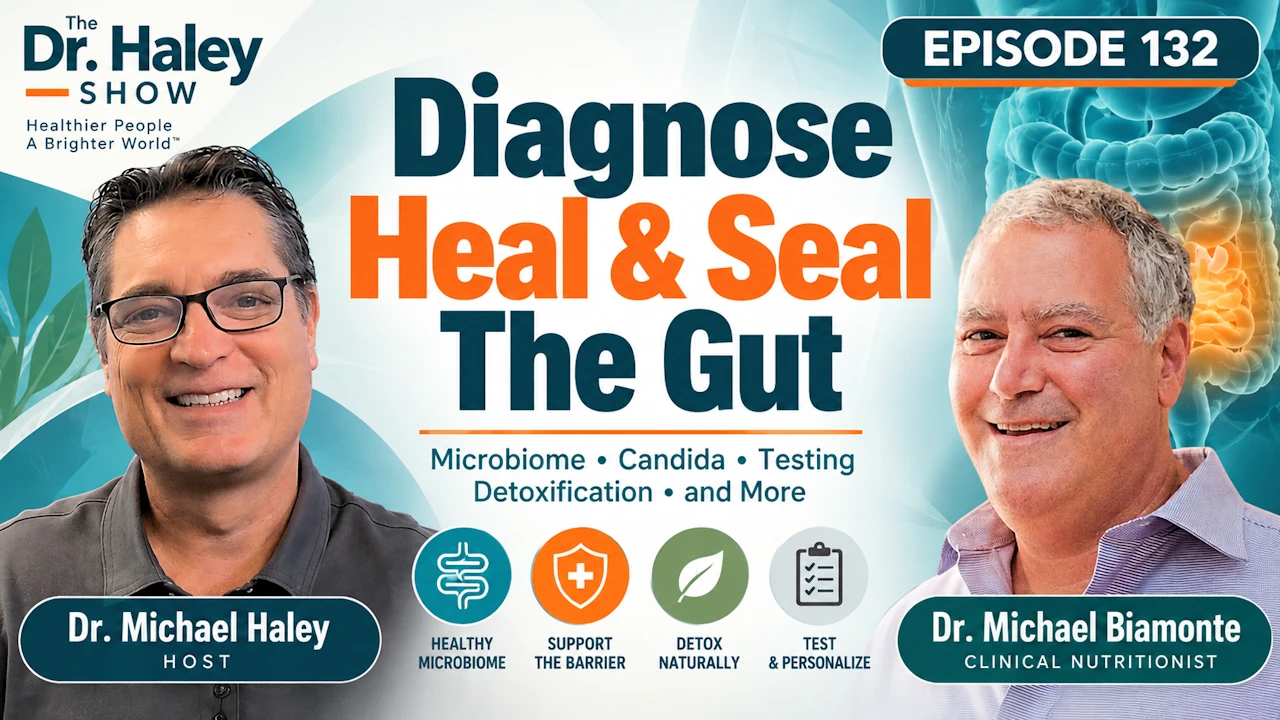
Leaky gut is one of the most talked-about concepts in natural health, but many people still do not understand what it is, how to test for it, or why so many gut-healing efforts fail. In this episode, Dr. Michael Haley sits down with Dr. Michael Biamonte to discuss intestinal healing, microbiome balance, Candida overgrowth, dysbiosis, detoxification, and the practical steps Dr. Biamonte uses in his clinical approach.
About This Episode
Dr. Michael Biamonte returns to the Dr. Haley Show for a wide-ranging discussion about the microbiome, intestinal permeability, Candida, dysbiosis, detoxification, and gut testing. He explains why he believes the order of operations matters—first identifying what is actually wrong, then addressing unwanted organisms, repairing the intestinal environment, and finally rebuilding beneficial flora.
The conversation also explores stool and organic-acid testing, zonulin and other approaches discussed for evaluating intestinal permeability, plus Dr. Biamonte’s clinical views on mucins, butyrate, glutamine, zinc, Akkermansia, prebiotics, and probiotics. Later in the episode, the conversation expands into COVID-19, spike protein, public-health controversies, and several claims and treatment approaches presented as the speakers’ views and clinical observations.
Watch the Interview
Listen to the Podcast
Resources
- Dr. Michael Biamonte – Health Truth: health-truth.com
- Dr. Michael Biamonte – New York City Candida Doctor: newyorkcitycandidadoctor.com
- Dr. Michael Biamonte – New York City Thyroid Doctor: newyorkcitythyroiddoctor.com
- Follow Dr. Michael Biamonte on Facebook
- Follow Dr. Michael Biamonte on Instagram
- Connect with Dr. Michael Biamonte on LinkedIn
- Subscribe to Dr. Michael Biamonte on YouTube
- Buy The Candida Chronicles by Dr. Michael Biamonte
- Get The Real Anthony Fauci by Robert F. Kennedy Jr.
- Buy Bamboozled, Duped, and Hoodwinked by Dr. Joseph Jacko
- Listen on Apple Podcasts
- Listen on Spotify
Quick Takeaway
Dr. Biamonte’s central message is that gut repair should be approached in the right sequence rather than by automatically adding probiotics. He emphasizes testing, identifying dysbiosis or intestinal permeability, addressing unwanted organisms when appropriate, supporting the intestinal barrier, and then rebuilding the microbiome.
The episode also includes broader discussions about detoxification and COVID-19. Some of the mechanisms, clinical observations, and treatment claims in those portions are the speakers’ views and should not be interpreted as established medical guidance or a substitute for individualized care.
Episode Timestamps
00:00 Why the microbiome matters for detoxification
01:18 Welcome back Dr. Michael Biamonte
02:52 From classical guitar to clinical precision
07:09 Nutrition politics, licensing battles, and the changing health landscape
10:40 Diet trends, GLP-1 drugs, and broader health concerns
14:25 Detoxification, sauna protocols, and toxin elimination
19:58 Why microbiome balance comes before advanced gut repair
21:51 The biggest probiotic mistakes people make
25:52 Why probiotics can backfire in leaky gut
26:25 How leaky gut is tested
28:24 Nutrients and compounds discussed for gut repair
32:12 Telemedicine and how to work with Dr. Biamonte
33:12 Stool tests vs. organic acid testing
38:47 How practitioners identify and target harmful organisms
42:18 Essential oils, food-grade products, and safety
45:08 COVID-related discussion, spike protein, and enzymes
52:22 RFK Jr., Fauci, studies, and public-health criticism
57:18 Where to find Dr. Biamonte and his work
58:38 Outro
Why Dr. Biamonte Says the Microbiome Comes First
A recurring theme in the episode is Dr. Biamonte’s view that the microbiome is foundational to other processes. He discusses relationships he sees among intestinal flora, detoxification, hormones, neurotransmitters, and the ability of beneficial bacteria to reestablish themselves after dysbiosis.
Testing Before Treating Leaky Gut
Dr. Biamonte cautions against assuming that persistent digestive symptoms automatically mean leaky gut. He discusses the historical lactulose-mannitol test, zonulin testing, breath testing, DNA-based stool testing, and urinary organic-acid testing, while explaining what he sees as the strengths and limitations of different approaches.
Remove, Repair, and Rebuild
Rather than beginning with probiotics alone, Dr. Biamonte describes a sequence that starts by identifying and addressing unwanted organisms, then supporting the intestinal barrier and eventually rebuilding beneficial flora. He discusses prebiotics and probiotics as well as mucins, butyrate, glutamine, zinc, Lactobacillus, bifidus bacteria, and Akkermansia in the context of his clinical approach.
Detoxification, Niacin, and Sauna
Dr. Biamonte also describes his experience with a niacin-and-dry-sauna detoxification program, including work involving 9/11 rescue workers. He recounts clinical observations involving sweating and niacin flushing, including his interpretation of temporarily visible prior sunburn patterns. These observations and proposed mechanisms are presented as Dr. Biamonte’s account and should not be treated as established medical conclusions.
COVID-19 and Spike-Protein Discussion
Later in the conversation, Dr. Haley and Dr. Biamonte discuss COVID-19, vaccination, viral origins, spike protein, enzymes, ivermectin, and other interventions. This portion contains personal experiences, clinical opinions, interpretations of research, and contested claims. It is preserved in the transcript as part of the recorded conversation rather than presented here as independent medical guidance.
Medical Disclaimer
This podcast and article are provided for educational and informational purposes only and do not constitute medical advice. The experiences and opinions discussed are those of the speakers and should not replace diagnosis or treatment from a qualified healthcare professional. Do not begin, discontinue, or change any medication, supplement, diet, or treatment based solely on this episode.
Full Transcript
The transcript has been lightly formatted for readability. Because it was created from the recorded conversation, it may contain minor transcription errors.
Read the Full Transcript
If you don’t have your microbiome in place and in balance, a lot of other more sophisticated things that you try to do don’t work. So and that even goes for detoxification, because in terms of hepatic detoxification, you have to have adequate amounts of bifidus bacteria in your colon. And if you don’t have adequate bifidus you don’t get correct hepatic detoxification. So you can’t detoxify via your liver if you’re bifidus or your colon microbiome is off. If you don’t have your microbiome in place and in balance, a lot of other more sophisticated things that you try to do don’t work. and that even goes for detoxification, because in terms of hepatic detoxification, you have to have adequate amounts of bifidus bacteria in your colon. So you can’t detoxify via your liver if your colon microbiome is off.
Speaker 1
You are listening to the Dr. Haley Show, the podcast dedicated to helping you optimize your health. Each episode there will be an interview or a message to help you discover better health. We will be featuring health radicals on the show to bring new ideas to the table, as well as doubling down on key fundamentals to support you living your best life. Your host is no other than the founder of Haley Nutrition Dr. Michael Haley.
This is the Dr Haley Show podcast. I’m Dr. Michael Haley, your show host, and today we are well, this is a repeat guest, Dr. Michael Biamonte. And you know, I actually took a sneak listen into our previous episode, podcast number 36. I think I’m up to about 130 something now, but way back 36, about 100 podcasts ago, Dr. Biamonte was my guest and it was a fantastic discussion. We well, we talked first we talked some fun things. We got some common heritage, some Italian, I have some Italian, I think Dr. Biamonte’s all Italian. He’s got to be pure Italian. Yes, he is. But he’s the founder of the Biamonte Center for Clinical Nutrition, the co-creator of Bio Cybernetics, a computer software program that analyzes blood work and lab tests. He’s a doctor of Nutripathy, New York State certified clinical nutritionist. And really check out episode 36. Dr. Biamonte welcome to the show. One of the things I enjoyed about that conversation was getting to know you a little bit. And your, you know, professional musical background as a classical guitarist.
And as we were talking about food and how it’s different in Sicily than it is here and, you know, it just made so much sense. It’s a great listen, people, check out episode 36. Also, you’re the author of The Candida Chronicles, and I think that’s kind of an area that you really went deep because it was lacking and people had been mistreating Candida. yes this is true we’ll be talking about that. But I want to get to know you a little bit more in a unique way. I think you’re classical guitar upbringing, your study of music. I think that really kind of showed us how you go about things, because it is a very detailed way of playing a guitar. It’s a very beautiful, you know, way of playing the guitar with lots of finger plucking and stuff and not necessarily strumming with a pick. It’s a lot of discipline to learn classical pieces on the guitar. Luckily, Andre Segovia really mapped it out for us.
These are of our great grandfather, and he, he mapped out the route that classical guitar players take not only to master the instrument, but also to execute very complicated classical pieces with relative ease. So we have to thank him. But the funny thing is, as I see that that’s kind of how you go about researching things with that same intensity, you know, getting really deep into what you do. This is true. And there’s a similarity between the jazz guitars with them I also really love and it’s math music and, health can be correlated as a parallel because certain things are very mathematical and there are certain patterns that take place over and over again in music that you also find in biological symptoms of systems like the body. So it makes it interesting. Yes. Transposable. You know, one thing I’m, wondering about you because, you know, as an Italian, we grow up very family oriented. And, you know, we get together and have big meals together. And there’s, you know, it’s funny when you talk about food to, to the Italian food is love.
So when our friends come over, we want to feed them. Right. Sometimes they say, no, I don’t want that. And you know, oh no thanks. No no no. Get out of here. that’s true I’m trying to give you love. Here, take some food. This is true, but is there you know, there’s something I like to call power. Words that have been spoken into our lives by people as we were growing up. And for me, there were a few real unique instances when one person answered a question. He cut me off, didn’t let me finish. He just said, stop struggling. That was a power word for me. Another guy, was probably seven years old, on a business call with my father, and he kind of pulled me aside and said, remember, kid, persistence will get you wherever you want. And I remembered that that stuck with me. Do you recall any time like that in your life where someone spoke power words into your life and you just lived by them? Yeah, there was, one in particular. My wife and I joke about it a lot when, our parents would say, don’t give that one too much confidence. And usually that one was a person who was shady.
And then what they were saying is, but don’t give them too much confidence. Just don’t let him in too close. And don’t let him think he can get away with too much discern. That’s in there is a there’s a parallel to that. And it’s really funny. The reason the Godfather movie was so popular is because so much of it was true from an ethnic standpoint. Keep your friends close, but your enemies closer. So keep your friends close to you. But also don’t let your enemies too far out of your knowledge. Know what your enemies are doing. Keep your enemies close so that you know what they’re doing. Yeah, interesting. Now, if we were to take that and apply it to our profession. Oh, this is a dangerous question. I already have the answer I would. I I’m not going to ask the question. Well, I’ll give you the answer. To play like this is jeopardy. So the answer is the back in the in the 80s when we had when New York City, we had what we called the dietician wars.
This is when the registered dietitians were trying to put all the nutritionists out of business, and they were trying to have the sole title of clinical nutritionist, because they had muddied the term dietician so much. The term dietician became associated with the hospital food, institutional food, jello, as we always joke, instant mashed potatoes. So they wanted to now have the title Clinical Nutritionist. And we had many battles in Albany regarding that. And then Mayor Cuomo, who was father the older Cuomo’s, I guess he listened to all this and he said, well, I’m no expert, but I see there’s two different disciplines here. Dietitians work in institutions, and they’re responsible for ordering, you know, large amounts of food to feed all these people. And you guys over here, you clinical nutritionists, you guys are more like doctors, and you’re more studying the patient individually, and you’re trying to figure out what vitamins to give them and whatnot. So he said, if you guys are both going to be licensed in New York, we have to have two different types, two registrations.
And he said, we’re going to give the dietitians next to their title, the number one, and the clinical nutritionist next to their title and number two, so we can differentiate them administratively. And back in those days, we became friendly with some of the dietitians who were instigating these things that we’re not going to say friendly, like we didn’t have them over our houses for coffee and cake, but we were cordial with them to the point where we stayed in touch with them, so we had no idea what they were doing. So here’s where you’re keeping your friends close, but your enemies closer. In a sense, that is a good example. I was thinking more in terms of, well, you know, FDA, CDC, NIH, and some of the three letter organizations that really are there supposedly to protect and help. We have to be careful what we say about them, you know, because they can come at us like dogs. This is true. But I can tell you it was hell back in those days. the government did more, interfering and trying to stop us from practicing. But that was under the influence of the AMA and the dietitians.
The ADA and the AMA bills were trying to get rid of us because they saw the future as being the way it is now. We have functional medical doctors. You have all these health coaches, you have all these clinical nutritionists who are serving the public in a manner that the public’s demanding. The public wants to know more about what the correct diets or the correct foods, or how vitamins work and things like that. So luckily, we were able to keep it together and pull it off to the point where we now exist, the way we do. Yeah. You mentioned the AMA and yes, they are, like a stronghold on things like coding for medical billing. And they really control who is recognized by insurance companies and so much more. This is true You know, the last time we talked, it was 2023, and we, you know, had already gotten off of the topic of Covid and immune system type stuff. And, there were different diet fads, back then. And now things are always changing.
Right now in 2025, the diet emphasis seems to be counting protein grams and trying to counter the effects of all the GLP-1 drugs and inflammation and diabetes. That seems to be the big focus when it comes to nutrition. And that’s right, RFK Jr has made people aware of. So probably yeah. Yeah. And have you seen some of the ill effects of the GLP-1s in your practice. Oh yeah. Very common. it gets really scary because the more you start investigating all these things, the more you’re led to Bill gates and some of his shenanigans. He’s got a product called appeal, which is this preservative that goes on food, and it’s a hormone disruptor. it’s on a lot of different foods and some sometimes you don’t even know it. I have heard it, heard the name before. I haven’t looked into it. I don’t know what it’s all about, but you can’t. You can’t really trust somebody with health advice. whose main goal is to depopulate the planet when he talks about through vaccines and through this and that, we can lower the population. This is somebody I’m going to take health advice from? I don’t think so.
Yeah. Yeah. Some of them like him are sometimes they say the quiet part out loud. Yes. And you start decoding what their plan really is. Well, 2025 GLP-1 is the focus. Do you foresee the next fad or the next? I’m not going to say pandemic world challenge affecting our health that we may or may not have to take action on. What are your thoughts on that? I know you’re well studied and the fact that you know, RFK is work. You never know. I think that, Covid set us up. It was a trial. They wanted to see how much they could get away with in a sense, how far they could push people. Yeah. It didn’t look like that worked too well because you have more and more people realizing. And as time goes by who were pretty pissed off at what happened with their kids being in lockdown, them losing their business, losing, you know, money because of the lockdowns, which Fauci admitted in front of Congress wasn’t necessary. So I am not so sure they’re going to try it again. But they might. You never know.
Speaker 1
you enjoying the show thus far? One of the many health secrets that we have covered on the show is all around aloe vera. Specifically drinking raw aloe vera. Our aloe vera has helped our customers effectively heal their gut, increase their intestine health, lower inflammation in the body, eliminate and or decrease acid reflux, have glowing skin and hair, and so much more. Now, as a frequent member of our audience, you will be exposed to exclusive specials and coupon codes for the awesome products manufactured by Haley Nutrition. That’s right, for simply being awesome and tuning in. You can get a mini discount to help you optimize and better your health. To see how we can help and support you on your health journey. Tune in to the episodes and listen for coupon codes that you can use at haleynutrition.com. Before you make your orders of raw aloe vera. Once again, it’s www.haleynutrition.com. Now back to the show.
the concerns that I have had lately have been things like, well, I know that Fukushima is still leaking radiation. And our planet is definitely toxic. Yeah. I wouldn’t be surprised if the next focus and I think it would be a good one would be on detoxifying, cleaning up our blood, avoiding toxins because we can’t avoid those in the atmosphere. Yes, that’s true. You know, if that was the next issue to really focus on, how do we do it? Right. Well, the first thing you do is you understand the body’s detoxification mechanisms. So pretty much all of us are familiar with phase one and phase two of the detoxification process, which utilizes your intestinal flora and glutathione, to detoxify. But there’s something that not many people fully know about. Some do is the use of niacin to draw toxins out of the body that was featured in the Hubbard method, which is the dry sauna with the niacin. That’s a very effective studies have been done.
As a matter of fact, after 9/11, we had a detox center on Fulton Street, and we had a lot of the, firemen, a lot of the 9/11 rescue workers come because they had developed all types of neurological and physical illnesses as a result of working in the rubble of the World Trade Center. And we were smart enough with the first group of them to, have them sit in tubs where we collected their sweat and we had their sweat analyzed by independent companies. And the amount of toxins these guys were sweating out was incredible. And there were several papers published using that material. So what would happen is the firemen would come in, they would do about 30 minutes of exercise, either jogging on a, treadmill, or they would get on a bicycle and then we’d take niacin and different other vitamins, and then they would start to get their circulation go, and then they would go in the dry sauna and they would sweat. And we had them sweating sitting in these tubs.
So we were collecting their sweat and when their sweat was analyzed with it, we found huge amounts of toxins of all kinds, from mercury to excessive levels of manganese to titanium to. It just went on and on and on the amount of toxins we found As these guys were sweating and releasing these toxins, they were improving physically. I saw people come limping in or using canes. And in a couple of weeks they didn’t have to use the cane anymore. And they were outside jogging on the streets. So I think that’s a pretty good example of what you can do to fix somebody who’s really been exposed to environmental toxins. You can reverse it if it is possible. And we did it back then. Okay. And the method you would suggest was, in that case, like sauna type then he. Yeah, sometimes it’s called the Hubbard method or it’s called the dry sauna method. And there are a bunch of scientific papers written on it. But the idea is that the person takes exercise to move their circulation. They take niacin, which acts to draw toxins out of the body, and they take different fatty acids.
they’ll help break down the fat cells that are storing the toxins. That’s essentially what the program is. And then when they take those things, they then go sit in the dry sauna and they sweat and then all these toxins are then released through your sweat. All right. Okay. Yeah. And niacin is that, that one where if you take too much, you almost get like, body flush kind of. Yeah. a flush okay. And this only works when you take the flushing type of niacin. And the thing that blew my mind about it is, because I’ve done this program myself and I would be sitting across from people and it’s especially interesting when you sit across from a young lady and you suddenly see bikini straps appear from when she had a sunburn on the beach, because the niacin also releases stored radiation. So when you get a sunburn, you’re storing radiation in your tissues, and you’ll all of a sudden see, like these straps show up for ten minutes and then fade away. And that’s where there was a sunburn. So flight crews, because flight crews are exposed to a lot of radiation.
They turn red as a beet for quite some time as that radiation is running out. Yeah. Just because they’re above the protective atmosphere. So often they’re getting bombarded and you’ll see all kinds of things, like, you’ll see sunglass marks appear in someone’s face or all these things, and you can almost think it’s an illusion, but it’s really not when you really look, it’s the sunburn turning on, the radiation running out, and then the sunburn fading away and going away. I want to try it. Is there any particular, dry sauna type that you recommend? Is that kind of like the ones where you where you get in the tent that type thing? Yeah, I think they’re all pretty dry sauna is dry sauna. It’s pretty similar. All right, all right, all right. One of the things that we had, talked about that didn’t get into too much depth was the dysbiosis microbiome and all of the imbalances that people have and how to correct it. We talked about, Candida quite a bit.
And if you could recap here, because it always comes up on the what you’ve learned about getting rid of it and why people fail well, as it turns out, your microbiome, we’re learning, is more and more important every day because there was so many other functions, higher functions that are dependent on the microbiome, as if you think of the microbiome as being a lower function, which a lot of other things are built on top of. If you don’t have your microbiome in place and in balance, a lot of other more sophisticated things that you try to do don’t work. So and that even goes for detoxification, because in terms of hepatic detoxification, you have to have adequate amounts of bifidus bacteria in your colon. And if you don’t have adequate bifidus you don’t get correct hepatic detoxification. So you can’t detoxify via your liver if you’re bifidus or your colon microbiome is off. There’s one point. There’s also a lot of work people try to do with hormones and neurotransmitters, which won’t work if your biome isn’t balanced.
And this is because your biome not only synthesizes a lot of neurotransmitters, but your body uses your intestinal tract as kind of like a storage place where it will shuffle neurotransmitters and hormones out of your bloodstream into the intestinal tract as storage, and then brings them back in when needed. And that transfer doesn’t happen that well if you have a disturbed microbiome either. So the more we find out about the biome, the more we find that it’s essential for other things to work which we might not have thought of. In terms of balancing up the big mistake that people make is they start out by trying to take probiotics because they want to replace what’s missing. But what happens is when you don’t have enough probiotics, you get what I would call dysbiotic organisms growing. Dysbiotic organisms would be bad actors, let’s say, which could be bacteria or parasites or Candida, yeasts, Funguses you get these bad guys grow and they kind of take over. And once they take over, they stop the good guys from being able to, re inoculate or re inhabit your intestines.
So if you have too many bad microbes, too many bad actors there, they stop the good stuff that you’re spending all this money on from being able to reestablish. Okay. So you kind of first get rid of the bad ones. And one of the real common things that mistakes that people make when they try to get rid of the bad ones is they have this one medication or drug or antibiotic or whatever, and they take it every day, and they take it every day until the microbe starts to mutate and become drug resistant to this, remedy. And then they wonder why they can’t get rid of it. Because now, not only have they caused that organism to become drug resistant to the tool that they’re using, but they’re now turning that organism into a super strain. It mutates into a more advanced strain, which is more resilient and more drug resistant to even other things. You’re not even using. That’s the first big mistake people make. Aside from taking probiotics while these organisms are still there because, it’s like a game of musical chairs.
You’ve got to get the good guys to sit in the chairs, and they can’t do that if the bad guys are sitting in the chairs. So you have to get rid of the bad guys first. This is where you get to the data of remove and then replace. And that’s where it’s got to go. It’s you have to first remove the bad guys. But if you don’t do it correctly, they’re not going to go away. You’re going to even have them more established. So you’re remove the bad guys then you replace. But it’s not as simple as just taking an acidophilus pill that you buy in the health food store, because once you’ve had bad dysbiosis, you have to not only take the correct probiotics like one, just to make it very simple. You’re there. The small intestine is where Lactobacillus is established. Lactobacillus acidophilus. The colon is where you have bifidus bacteria. So the two different strains then occupy that. And the companies will get into these arguments about how my product has 11 different strains, mine has 21 different strains. Mine has this and that. A lot of it is baloney.
Because to be honest with you, how these strains came about is they were mutated from the original strain. So if you have an original Lactobacillus acidophilus strain in your intestinal tract, and if it’s there long enough, other strains that you’re paying all kinds of money for, or eventually going to mutate from that, and you’ll find that because that’s how where did they come from in the first place? They were hidden under a rock, and somebody discovered them. That’s not what happens. So you’ve got to take, an acidophilus for your small intestine. A bifidus for your colon. And then you have to have what’s more important are the prebiotics. So prebiotics are substances that come before the probiotic. And they are there to help establish the probiotic. They’re there to help feed it to make the environments and the pH friendly for it to grow and various things.
So people will tend to just like take some expensive acidophilus without taking a prebiotic, and they’re not really paying attention to why are they taking the two different strains that you need one for your small intestine, one for your colon, and then in special situations, there are some other strains. Reuteri bacteria tend to be very important for people with chronic yeast. Akkermansia bacteria tend to be really important for people with a tendency towards leaky gut. But here’s the other problem. If you have leaky gut, the probiotics aren’t going to stick. And what will literally happen is when you take probiotics and you have leaky gut, you’re very often going to have bad reactions to the probiotics and allergy reactions to them, because the probiotics are just going to fall through the cracks in your intestines and into your bloodstream, and your body’s immune system is going to attack it like it’s an enemy, which at that point it is. So if you try taking probiotics while you have leaky gut syndrome, that’s not going to work out either.
So yeah, how do we treat the leaky gut then? First, that’s the point is you have to assess if you have leaky gut and not assume, because many people do. And, the story I always tell is I get people who come and they sit in front of me with this kind of look on their face, and they go, I have the worst leaky gut you’re ever going to see in any patient. I’ve been treating it for ten years. It’s no better. I still have the same problem. So I want to see what you’re going to do. So I said, well, let me see your leaky gut test. I don’t need a test for leaky gut, I knew I had leaky gut 15 years ago and it’s never gotten better. I said, why don’t we test you just to see. And in a lot of cases, we test them and they don’t have leaky gut. What they have is mast cell activation or other things that are acting like leaky gut. So the first thing you have to do is make sure you actually have it. Then what? What’s the test for that leaky gut? You know, the original one is the lactulose-mannitol recovery test.
And that was, based on drinking a little solution of lactulose and mannitol, and then collecting your urine to see how much of those sugars would then end up in your urine, because they weren’t really supposed to be absorbed. It would only be absorbed if you had leaky gut. And that test was reasonable. But there was a lot of people who had leaky gut and we had false negatives on that test. So things have advanced now to two tests that I use for leaky gut. One is zonulin protein, which I guess most people know about, you can do, a blood level of zonulin, or you can look for zonulin in the stool, which is really easy. And when you have leaky gut, your body produces this protein that’s called zonulin So if you find large amounts of zonulin you know you have leaky gut. Another test is a breath test, which I also like. There are certain gases that are produced in your intestinal tract. If you have leaky gut that you won’t produce if you don’t. So the breath test similar if people have done a breath test before for Sibo or for H.
Pylori it’s very similar to that is just that in the lab they’re looking for something different once they get your sample. So those would be the two tests one would use. And then once you find you have leaky gut, there are many products out there made by different companies, formulations, which will help heal the leaky gut. And typically they’ll have glutamine. They’ll have butyrate in them. They’ll have different nutrients there are certain nutrients that by now everyone knows that you put in a formula. You take it and after a while the gut will mend. So I’m going to suggest that to you. It seems like common knowledge because you know too much. But, a few the things that you said that, you know, everybody knows even I don’t know, you know, and it’s funny I used to teach organic chemistry and, people just thought, you know, Mike knows everything because you could teach organic chemistry. So easily, and it’s all right there. I got to be a sloppy teacher the longer I did it. Because I started assuming that people already knew stuff. All right.
certainly not taking away from you, but I am suggesting to you, you know, a lot more than most people, and it’s not common knowledge to even us other health care practitioners. Okay. So let’s start with the foundations. If you have leaky gut, you’re treating it. The first thing you need to do with the patient is give him a mucin supplement mucins are like, naturally produced in the intestinal tract of all mammals and mucins are a parallel to waxing your car or waxing your wood floors. There are protective barrier that your body makes. And that’s the first thing that goes when you develop leaky gut is that protective barrier erodes. So you want to have the person take a mucin supplement to replace that barrier. The next thing is you want to find a formula that contains butyrate. Because butyrate is an essential fatty acid, butyrate is found in really high amounts butter in real butter. Butyrate is a fatty acid. Your intestinal tract makes to constantly repair that intestinal cells. So it helps the cells to replicate. Also glutamine is very popular.
Glutamine is an amino acid that helps the intestinal cells repair themselves. And then depending on the formula you find, you’ll see other ingredients in there. Zinc is something that naturally helps the intestinal cells repair, and these formulas that you take will then help your intestinal tract renew the cells and repair the damage Supplements can be confusing. Consuming isolated vitamins and minerals can certainly create imbalances. That’s why our focus is on consuming nutrient dense foods and supplementing with concentrated, nutrient dense foods where the nutrients are present with each other in balance provided by nature. The fastest way I know of improving someone’s nutrition is to get them on a concentrated vegetable and fruit supplement. When it comes to dosing. Scoops are much more powerful than capsules. An average scoop contains the nutrition of about 40 capsules of a similar product. That’s where Iagreens Vegetable and fruit powder comes in. Head over to haleynutrition.com and try it now. Don’t be surprised if you feel the benefits. On the first day I did.
when it comes to probiotics, the only probiotic which really helps the intestinal cells repair is Akkermansia And you’ll see Akkermansia sometimes with GPL-1 And that stimulates the intestinal repair. And you can often find those in combination. The Akkermansia And these peptides okay. So when you do that you have a pretty well-rounded, program, I would say for repair of the intestinal tract. Yeah. And people that are hearing this are going to say, wow, this guy does know his stuff. How do I get help from him directly? Are you, seeing patients in the clinic? Are you doing telemedicine? What are you doing? We exclusively do telemedicine. what’s the best website for that? The best website would be the health-truth.com website. All right. Perfect Yeah. A lot of the things you’re saying, I mean, I’m a certified gaps practitioner. Gut and psychology syndrome. I have an aloe vera company that’s all about the gut. But when it comes to supplements and the different exact nutrients for healing and sealing, I don’t know them like you do. Okay. I’ve been around.
Well briefly about some of the, biome testing that’s available. So at one time, microbiome testing was pretty limited to stool tests that were done by various labs. And there’s a new generation now of stool tests which use DNA technology. So in the old days, they would take a culture of your stool and they would see what bacteria would grow, bad ones and good ones. Nowadays they use DNA technology to identify all the friendly bacteria that you might have and all the pathogen bacteria that you have, the bad ones. That’s now the next generation of testing. There is, additional testing that can be done looking again for good and bad. And this type of testing is done using urine samples. And it’s done looking for organic acids of these microbes. So organic acids are like chemical waste products that all living things create. All good bacteria will release certain organic acids which are part of their metabolism, and all bad bacteria release other organic acids that are part of their metabolism. So it’s a matter of getting the urine sample, having the lab test for all these things.
And then you get to see the balance. Now, stool is a strange thing, but stool is solid for the most part. So because it’s solid, it’s not so homogeneous. Now, what I mean by homogeneous is thoroughly mixed. So you don’t always get a complete, accurate representation of what’s in somebody’s intestinal tract by looking at their stool. Because if that piece of stool that you have that day to the lab is going to test hasn’t been in contact with certain areas of the intestinal tract, where certain organisms live, you may not pick them up, might not pick up the DNA. You’re saying. Yeah. Yep. And is also be true of the live organism that when you’re trying to culture it. So if you had a flashlight and you could walk through somebody’s intestinal tract with this flashlight, you would see for the most part there’d be a pretty, basic uniform coding of a lot of the friendly bacteria and a lot of the more dominant common bacteria. But then every once in a while, you would come up to this spot where there’d be this weird mucus, which is called biofilm.
And this biofilm is made by certain organisms as a protection to hide in. And a lot of the bad organisms like to be together. So if you had also is shovel with you now and you started to hit this biofilm that’s up there and you break this mucus up, you’d find yeast falling out, you’d find bad bacteria growing around the yeast, and you’d find different parasites. All these things would be huddled together in this biofilm, hiding. So fine, you haven’t. Now, you know, you walk past that, you go a few more feet. It all looks normal again. Keep walking. And then you find another one of those areas you see. So that’s how the intestinal track and the flora that is there. That’s how it resides. That’s how it exists. So if a stool sample doesn’t come in good contact with those areas where those bad guys are, you get a false negative. The test doesn’t show they’re there, but they are. When you do an organic acid test because you’re looking for chemicals that those bad guys release, you’re looking for their footprints or their signature in the urine, in the urine.
So you don’t necessarily have to have them come in contact with your sample per se, because those things are being released from those bad guys. They’re dripping into your intestinal track, you’re absorbing them, they’re going into your blood, and then you’re urinating them out. So in ways the organic acid tests are easier to determine these bad guys because you’re not looking for them. You’re looking for chemicals that they release that are easy to find in your urine because it’s a liquid. It sounds like an easier test to take to. It is that it’s true for a lot of people. Cleaner, Well, for people that are uncomfortable sending in feces. Yes. you know, who’s uncomfortable about peeing in a cup or a test tube? The drawback is that right now. Test for as many different organic acids from as many different individual flora that you can with the stool. So that’s a drawback. But in terms of looking for the bad guys, that’s a more accurate way.
You’re not going to miss the bad guys if you’re looking for their organic acids, you can miss the bad guys if you tried to find them in your stool for reasons I spoke of earlier. Right now in the urine test, are you getting, you know, bacteria, candida kind of the full spectrum of flora. Yes. Yep. Also good flora. Good flora to, Yes. Yes, yes. So I’m, guessing then it might start with a urine test for the organic acids. And then probably put them on a certain program of maybe kill off. Yes. You want to. So once you would identify who you want to remove you then target them using let’s say different herbs that are known to destroy them. So depending on what needs destroying what it is, you know. But here’s the, the other part although to, is very often you combine the urine test with the stool test. if you have a patient who comes to you and he says, which is this is I’m not going to say the name of this patient, but this is a real life example and a really good one.
This patient comes in, he says, you know, I’ve had this, strange rectal itching and bloating and gas and all these digestive problems ever since I went fishing with my cousin 15 years ago. So that’s interesting he says yeah we were in the water. You know, when guys do fly fishing or this type of fishing, they’re actually in the water up to their waist, let’s say. And they’re fishing and they can contract bacteria and parasites from that water. Now they didn’t eat anything and get sick. So it’s not like food poisoning issue. These guys are just fishing. But ever since then they have now have these problems. So in that water was bad bacteria and parasites of some kind. And those organisms got into their system either absorbed through their skin or something got into their body. And now they have chronic digestive problems ever since. So there you would do a stool test to try to identify what these organisms are that they have so that you know what they are so that you can properly target them.
Now, when you’re targeting organisms, Candida in a way is the easiest one because there are so many herbs and spices and things that we know of that are antifungal, that you can use. And as long as you rotate them, as long as you switch them around every couple of days, like let’s say you pick four and you switch them around every four days or so, you stop the, genetic mutations from occurring. You’re okay. You can handle the candida and reduce it It’s where they have it. These exotic parasites and bacterias where you have to do some study. And what you end up finding out is amazing, because you’ll find out that so many different herbs and spices, have anti-microbial effects against a lot of these, unusual organisms and bacteria. Very typically we use cinnamon oil, we use clove oil, rosemary oil. Anise oil or tinctures of these things. And I could go on and on. Thyme also is very common as an antimicrobial is very common. So oregano of course, everyone knows.
So there are so many of these different spices and herbs which there are studies on that have actually been used either by themselves or in conjunction with antibiotics against these, let’s call them exotic parasites. And bacteria, which have been found to be highly effective. As a matter of fact, there are certain strains of Candida now coming out of Japan which the standard pharmaceuticals are completely worthless against. And it’s not until they’ve combined these pharmaceuticals with cinnamon and clove oil that they had any real good effect on reducing them. Neem is another oil which is also very antifungal. And this is why you see neem oil in shampoos for dermatitis is because a lot of the scalp problems, flaking and drying are actually caused by different yeasts and molds and funguses that get on your scalp. And this is a non-pharmaceutical way of killing them by using Neem So just as in Dr. Biamonte, and for anyone listening, I’m going to first say, don’t just try this. You have your aromatherapy oils and you think, okay, I’m going to start taking this and taking that.
And I don’t know what I’m trying to kill or anything like that. And these oils can be very potent, but is that what we’re talking about? Just like the aromatherapy oils, if I have oregano oil as an example, would that be something? No, it’s not there’s a difference between aromatherapy oils and oils that are meant to be ingested, food grade that are meant to be taken in. Aromatherapy oils tend to be not of the grade. There would be food quality where you can ingest them. They’re more for smelling. Got it, got it. I have to make sure you have the difference in the product you get. Okay. And where do people get the oils that are intended for ingesting? They can get them from different companies, like Gaia, for instance. Gaia Herbs makes quite a few of them. There’s herbs, etc. there’s quite a few companies that make them. It’s just a matter of looking and they can go to the health food store easily and they can find them, and they just have to ask the person that was this for is a food grade, can I ingested or is this just for aromatherapy? Okay. And then are they being diluted?
Are they putting like a drop of that type of oil in water, or are they going full strength on the tongue or something. Not such a good idea to have a go full strength on the tongue with any of these things, because you may be into a quite a surprise. So you always want to put them in water or something else. Yeah, that that’s what I assumed. I know when my wife and I were sick with, Covid, we were throwing everything at it and hitting some pretty, you know, aggressive herbs and spices and. Wow, some of them are potent. And, yes, dilute, dilute, dilute. True. As a thank you for tuning in to the Dr. Haley Show podcast. I have a special coupon code that can be used throughout the month of November 2025. Get $10 off your purchase of $100 or more at Haley nutrition.com. The coupon code is XXXXX. That’s XXXXX. And as usual, you can even use this coupon with on sale and already discounted bundled items. Enjoy the rest of the podcast. as far as Covid goes, probably the easiest protocols that one can find for Covid one of them is from wei laboratories.
W E I WEI laboratory makes a product called, Golden Flower and one called Silver flower. Highly effective against Covid can knock it out in a few days. You can also use hydrosol silver. There’s a product called Argentyn 23, which originally was made for lime, and I found it to be extremely effective against Covid. When you combine the hydrosol silver which is the Argentyn 23 with monolaurin knocks Covid out pretty quickly. Then all you have to do is worry about the spike protein in either of these cases, because this is another confusion. When you get Covid, you’re dealing with a virus that has been, manipulated and it has a spike protein, and the spike protein is actually more dangerous than the virus itself, because the spike protein interferes with your telomeres. For those people who don’t know what telomeres are, if you can imagine in your cells you have DNA, you have RNA. So RNA is the helper for DNA. DNA is the guy who sits in your cells like a big Buddha, and he’s directing everybody in the cell to do all this work.
And he’s got this messenger who we call messenger RNA, and this guy, the Buddha DNA. He has this shopping list. He gives this shopping list to messenger RNA, and messenger RNA goes to the bloodstream and starts pulling in all these supplies like he’s at a supermarket. Now, in this cell, you have these things that we call telomeres. The telomeres are like alarm clocks, and they’re set to have gene expressions take place at different points on your time track. Let’s say. So if in your family people typically get arthritis, this is just an example. It could be any illness. But in your family of people typically get arthritis at the age of 60, between 60 and 70. That usually means your telomeres are set for that time in your life to go off. The alarm clock goes off in a wakes up. All these genes that cause arthritis. Now Covid and the spike protein jams those telomeres, jams and messes them up.
So that means that at any point they could go off essentially, they’re not going to listen to their programing anymore because the spike protein is interfered with them, short circuited them, and now you don’t know where they’re going to go off. And that’s the problem with the spike protein. So when you have Covid and you get over Covid, your next goal is to get rid of that spike protein, isn’t it the spike protein that’s almost like self-replicating or something like that or no. Yes, yes. No, that’s true. And, originally we heard stories from somebody I’m not going to mention who said the spike protein left your body in just a few hours and sometimes a few days? Well, based on his reputation, we know that wasn’t true. And since then, we’ve had blood tests for the spike protein. And I’ve seen the spike protein be in people’s bodies for years. So you have to have a way of dealing with it. Now, luckily for us, the spike protein can be disintegrated, physically disintegrated with enzymes.
Nattokinase and bromelain are the two enzymes which we definitely have seen will destroy the spike protein in a few days. Sometimes in a few weeks. A study in Japan showed that when they combined the element germanium with these enzymes, they had even a better result in destroying the spike protein. So it’s the element germanium, which you can get as a supplement with the bromelain and the chymotrypsin or Nattokinase whichever formulation of enzymes you get but, chymotrypsin is another enzyme from your pancreas was also will dissolve the spike protein. Most people buy this under the heading of Nattokinase. So combining those on an empty stomach will destroy the spike protein in a few weeks. Is that another thing that you help people with? If you they can call you through telemedicine and you would. Oh yeah. All the time. You all the time. But the thing what I find annoying about this and where I actually have a bit of resentment, is because of Covid. Now, every time somebody gets Covid and some people have gotten to 3, 4, 5 or 6 times, it’s almost like a seasonal flu.
In some cases, person has to go through this thing of handling the spike protein again. Because they’ve now ingested the spike protein again. So here’s where I say, you know, write a nasty letter to the Communist Chinese party and tell them, you know, because of you, now, I have to do this right. And I don’t know if, that’s going to be for people that were only vaccinated or the people that got it naturally. Either way, both of them are still getting multiple cases. They’re still getting the spike protein, whether you’re Vaxed or just get Covid, it’s still there. Yeah, but the people what I’m saying is the people that developed natural immunity to Covid are still getting it, probably because there’s other variations. When you develop a natural immunity to Covid, you’re developing an immunity to the virus, not the spike protein. Okay. That’s where it becomes complicated. And that’s where this then becomes an issue where even though you have natural immunity to the virus, you don’t have a natural immunity to the spike protein, the spike protein is like an added factor.
So you have to go through the enzymes to destroy the spike protein. But how do you get the spike protein again if you don’t get the Covid, if you have the immunity to the Covid, if you have immunity to the Covid, it would be because you were exposed to it and your body developed antibodies against Covid and being exposed to the Covid, you were also exposed to the spike protein because understand the spike protein was added to the virus. You have the coronavirus. That’s right. And the studies on the coronavirus go back to the 60s believing or not Some people don’t know this, but some of the first studies on the coronavirus were in 63 and 66. You can read any of RFK Junior’s books on this, and he explains the whole thing. But they go back that far, and it was weaponized. The spike protein was added to the coronavirus in order to weaponize it. Okay. So yeah, if you have immunity, it doesn’t mean you’re not exposed to Covid. You will still breathe in Covid, and it just So happens that your immune system responds to it before you have the symptoms, but it’s still how to deal with it.
And that still exposed you to the spike protein again which can self replicate. Yep. Got it. that’s a mess. That’s a disaster. Yes. And thank you. Yes I’m in you know full agreement with you that people did some really stupid things and yes, we’re probably correct about the origin and the lab leak and, you know, patient zero on the subway. So ugly stuff. Great book, a great book for everyone to read. And I think this is required reading for everybody. The name of the book is called The Real Anthony Fauci. And it’s written by RFK Jr who happened to get all of Fauci’s emails. And he wrote the book based on thousands of Fauci’s emails and he names, names, times, places, explains the whole deal. Bill gates even made his way into that book to. So you get the real scoop from that book. That’s awesome. And, you know, I love what he’s doing now, taking a very scientific approach. And we’re going to show what the science really does say. And how can we without looking at it. So let’s look at it. This is true. It’s not like anything he says isn’t backed up by thousands of references.
It’s just that when you oppose what he says, because you have financial interests that will oppose it, you can come up with your own references and then you have a war of, you know, whose references are right, per se. But the way I look at it is, there was an old saying, whoever pays the piper calls the tune. You’ve heard that, I haven’t heard the phrase before. it’s a great one whoever pays the piper calls the tune. So who’s ever paying the university or who’s ever paying the doctor to do the study? Can usually tell them how they want it to end up in the outcome, that they have the money behind them. Yeah. You know, I recently had, Dr. Joseph Jacko on and he wrote a book. I wish I remembered the title of it, but I grabbed a section out of it. And here it is. He writes in his book. You likely heard that the Covid 19 vaccines were 95% effective in preventing infection and 100% effective in preventing death. Those are relative risk reductions, and they sound impressive, but they are misleading. Let’s examine this further.
So when we kept on hearing the science, this is the science they were referring to just one Covid 19 death is prevented for every 22,000 people who are vaccinated, per Pfizer’s study. For every 22,000 unvaccinated, two died from Covid 19. For every 22,000 vaccinated, one died from the disease. That represents a 100% relative risk reduction in deaths. Going from 2 to 1 represents a 100% reduction, but 22,000 must be vaccinated to achieve one less death. That 100% relative risk reduction is very misleading. It is a half truth. Now, he goes on to explain. The research also shows out of the vaccinated that although one less died from Covid, four more died from other problems. Right? In my practice, we did a study, an in-house study, and we collected, statistics on everyone we had who has been vaccinated. We asked them how many times they were vaccinated and how many times they had Covid, and overwhelmingly the more someone was vaccinated to someone was vaccinated four more times, they usually had Covid 2 to 3 times. And the people who were not vaccinated at all had Covid once.
Yeah, and that’s what I experienced when I got Covid and it kicked my butt and I wouldn’t have thought it would have. I was really bothered by the fact that we didn’t have things available to us, like ivermectin. And it was about that when we had gotten it, it was about the time we were learning of it and scrambling and trying to figure out a way to get some right. It wasn’t available at the time. And we have since seen some tremendous responses to something so simple, like ivermectin. But it kicked my butt. I’m not going to lie. I was, you know, I remember my wife and I, we went for a walk. We’re like, let’s go for a walk around the block. We made it to the next door neighbors and said, let’s go back home and go rest You know, what an awful evil disease. Well, Dr. Biamonte I really enjoyed the conversation. And, you know, we could talk forever because you do know so much.
But I think the important thing at this point, if you could give yourself some plugs on your websites and again, how to get in contact with you for the telemedicine where they can get your book and learn more, go ahead and be selfish. what’s your contact? Very simple. I have three websites newyorkcitycandidadoctor.com the newyorkcitythyroiddoctor.com Reason for that is there’s a tremendous correlation between thyroid problems and Candida. And then my main website is health-truth.com You can find my book, The Candida Chronicles on Amazon, like everything else and very easy to find me just by those three websites. Fantastic. And are you currently in Florida or New York? Where are you? I’m in Florida. I plan on staying there. All right. Me too. On the other coast, though, I believe I’m on the East Coast. I think you’re on the West Coast. I’m on the west yeah. we want to stay away from New York for now. Okay, that’s another podcast. It’d be a good one. I’d listen. It’d be. It would be definitely entertaining, no doubt. We’ll see how it works out. Yes, yes.
And I have no idea what the best thing for them is right now, because the options are not good. Yeah. You’ve got dumb and dumber, but, And not the movie. This is real life. This is true. Well, my friend. Thank you very much for having me. I enjoyed being with you, as always. Thank you.
Speaker 1
I hope you enjoyed that episode today on the Dr. Haley Show. Make sure to hit subscribe on whichever platform you are listening to this. If this episode made you think of someone, go ahead, take a screenshot and share this exact episode with them. You can catch the show notes for this episode on drhaley.com. If you want to geek out with Dr. Michael Haley on other radical health topics. Be sure to check out his YouTube channel where he posts exclusive video content. All the details are at drhaley.com and we can’t wait to hang out with you on the next episode.