
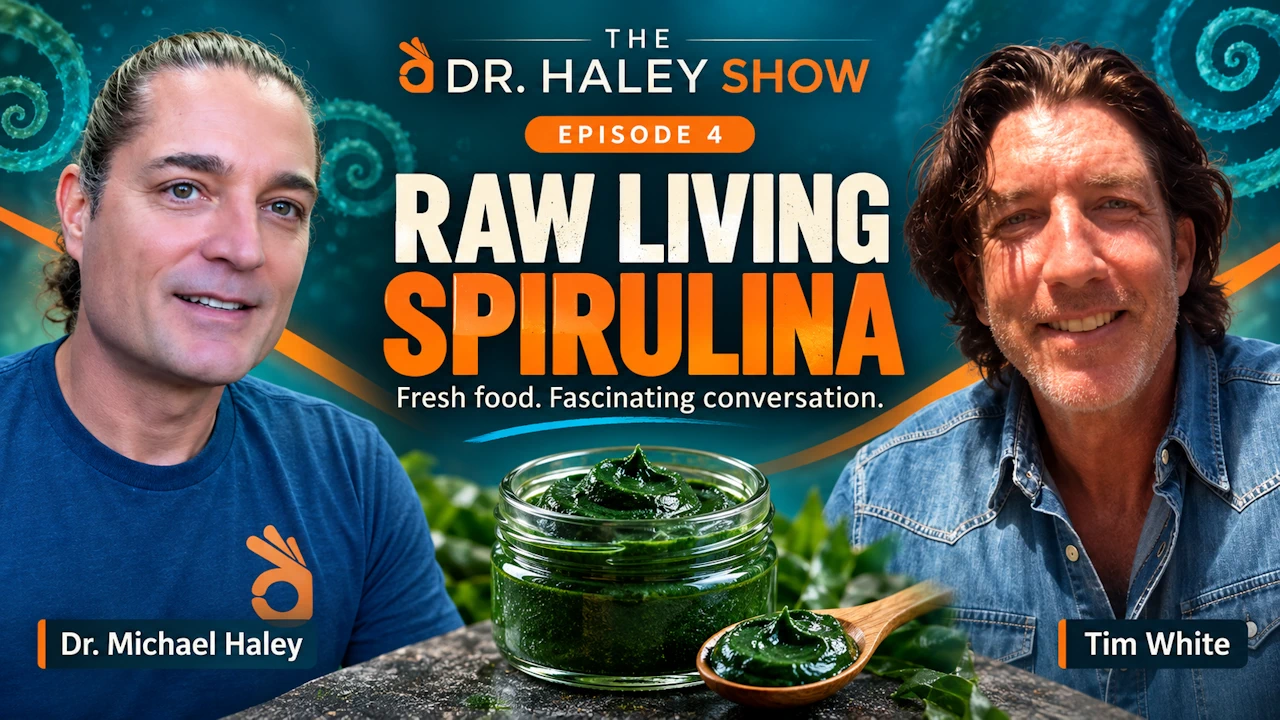
Did you know that consuming tropical algae can work wonders for your health? If not, listening to this show can help you get rid of some totally wrong misconceptions.
In today’s show, Dr. Haley interviews Timothy White, co-founder and co-owner, Raw Living Spirulina who espouses the amazing benefits of living spirulina while revealing some fascinating and little-known facts.
About This Episode

Tim explains where spirulina grows, how his farm harvests it, and why he prefers its raw, living form. He describes his personal fasting experience, discusses NASA’s interest in spirulina as a food source for space travel, and shares his perspective on plant-based eating. Enjoy!
Watch the Interview
Listen to the Podcast
Resources
Quick Takeaway
Tim White explains his preference for fresh, living spirulina over dried products, walks through cultivation and harvesting, and describes its taste and texture. He also shares personal experiences and customer stories. His accounts of fasting and disease-related outcomes reflect the speakers’ experiences and opinions; the episode does not establish that spirulina treats or cures cancer or other diseases.
ENJOYING THIS CONVERSATION?
Get the Next Episode in Your Inbox
Get notified when a new episode of The Dr. Haley Show is published, plus occasional highlights and resources worth exploring.
By subscribing, you agree to receive email from The Dr. Haley Show. Unsubscribe anytime.
Episode Timestamps
- 00:08 — Introducing Tim White and raw living spirulina
- 02:02 — What is spirulina?
- 04:39 — Fresh spirulina versus dried products
- 05:47 — Chlorophyll, phycocyanin, and food colors
- 10:02 — Taste, texture, and first impressions
- 14:51 — Growing, harvesting, chilling, and shipping
- 17:08 — Tim’s fasting experience and customer stories
- 20:14 — Research discussion and disease-related claims
- 23:15 — Cell size, freshness, and storage
- 26:10 — Growing conditions and sourcing
- 28:27 — Dr. Haley’s first tasting video
- 29:16 — Tim’s daily routine and plant-based eating
- 31:52 — Where to follow Raw Living Spirulina
- 32:30 — Tim’s take-home message and closing
What Is Raw Living Spirulina?
Tim introduces spirulina as a microorganism commonly called blue-green algae and describes its spiral shape under a microscope. He contrasts his company’s fresh product with powders, flakes, and chips, focusing on processing, texture, and his preference for living foods.
Growing, Harvesting, and Shipping
Tim describes shallow growing systems with paddle wheels that circulate the water and bring spirulina toward sunlight. He walks through skimming, filtering, rinsing, removing excess water, jarring, and chilling before shipment. The shipping schedule and storage periods he mentions describe his operation at the time of this interview.
Phycocyanin and the Health Claims Discussed
The conversation covers chlorophyll, the blue pigment phycocyanin, amino acids, and growing conditions. Tim discusses research and reports of use at the Gerson clinic. These are his descriptions and interpretations; the conversation does not provide the study details needed to establish clinical effectiveness or support using spirulina as a cancer treatment.
Fasting and Plant-Based Eating: Tim’s Experience
Tim recounts consuming spirulina and coconut water for 30 days and comparing his blood tests before and afterward. He also shares customer stories, his daily routine, and his preference for foods with high water content. These accounts are part of the interview rather than a fasting protocol or a recommendation to rely on one food for complete nutrition.
What You Will Learn In This Show
- What is raw, living spirulina?
- How Tim addresses the question: Can spirulina help fight cancer?
- Where does spirulina grow, and how is it harvested?
- How Tim incorporates spirulina into his daily routine.
Medical Disclaimer
This podcast and article are provided for educational and informational purposes only and do not constitute medical advice. The experiences and opinions discussed are those of the speakers and should not replace diagnosis or treatment from a qualified healthcare professional. Do not begin, discontinue, or change any medication, supplement, diet, or treatment based solely on this episode.
Full Transcript
The transcript has been lightly formatted for readability. Because it was created from the recorded conversation, it may contain minor transcription errors.
Read the Full Transcript
[Music] tim i want to thank you so much for joining me today this is a i think it’s a very interesting topic we’re going to talk about raw living spirulina which to me is the superfood of superfoods one of those things that people are probably barely familiar with and you probably the world’s leading expert thank you for joining me today
yeah thank you michael this is a a great thing you’re doing here and let’s uh let’s get rolling on answering these questions and uh telling people about the world’s most powerful super food and the foundation of life
what brought you to spirulina
well we we like to say here that spirulina doesn’t uh you know we’re in the right place at the right time but we find that spirulina chose us and and instead of us choosing spirulina it’s following the right path it’s following the right health and then you you find the products and the destination you’re supposed to find when you follow that path
i completely relate because with the aloe vera it found me i know i’m on the right path and it takes someone like you to really take charge in this space because there are other players in it but as you and i both know none compare
yes there are a few people that are now trying to do this uh trying to copy a little bit of what we’ve started and uh we’ll see what happens but it this spirulina is a tropical algae it needs to grow in florida and beautiful warm sunshine and these other players are i think are um are going to find out that it’s it’s they’re not going to have the quality that we have
yeah i completely understand well let’s talk about some of the products that have existed you know what backtrack what is spirulina
spirulina is known in the world as a blue-green algae uh technically it’s a ciana bacteria it’s lower on food chain than algae it is the foundation of life on this planet 4.7 billion years ago the earth was created and it it it spent a billion and a half years in no life until three and a half billion years ago life appeared as as a cyanobacteria so it is the oldest life on the planet and and every piece of life that we know today has originated from cyanobacterias spirulina is one of them and it is in responsible for producing most of the oxygen that we are all breathing right now and and still today is is responsible for that
now okay how is that different than analogy
then an algae is more of a plant and algae is the next level above the cyanobacteria it has different properties red algae is an example um uh chlorella is an example of a green algae it’s it’s a little bit closer to the plant world plant kingdom it’s more of a something that you can see without microscope whereas the blue-green algae and the cyanobacteria you have to look at a microscope it’s it’s it’s a micro organism very very tiny tiny tiny
okay and which i have had the pleasure of doing and it’s called spirulina for a reason and how it looks when you see it on a microscope
yes it has that spiral shaped coil like identical to a dna strand and that spiral is where the spirulina comes from it is actually the trade name uh as far as what we’re all selling it under under that under that brand spirulina brand
but as as most everybody knows it was originally a fresh beautiful delicious food source that even today the people in africa are still consuming out of lake chad the kamebu people scoop it out of lake chad they spread it onto the rocks they let it dry in the sun and they consume it whole and fresh
but today we see it in the stores and whole foods and powdered form and flake form and chips form those are mass produced and then they to dehydrate them they have to spray dry them they have to do something to extract the water uh from the cell structure in order to give it some kind of a shelf stability or shelf death what we call it because it isn’t alive anymore
yes and it’s probably not a terrible thing compared to what other people are eating when they’re eating these shelf preserved things but it is no longer a live living food
correct correct um
yeah so uh when we look at spirulina then in the pond is it these little tiny separated uh what makes the water green or does it grow as a colony how is it extracted from the water
they’re all individual individual cells and it’s just the the trillions and millions of them that make the color green and the water
there are two main phytonutrients in the spirulina one of them is the green the chlorophyll and the other one is the blue the phycocyanin phycocyanin and fico meaning plant cyanide mean in blue is the only blue phytonutrient on the planet today in food there is no other plant vegetable fruit that has a blue phytonutrient to it people might say well what about blueberries well blueberries are actually purple they’re the violet spectrum of the sun and this magic between the two colors gives that wat the water in the in the ponds that beautiful green because that the chlorophyll is where the most of the light is coming through the cell membrane that we are seeing visibly behind that green chlorophyll is the blue phycocyanin
and that’s really the magic phytonutrient in spirulina that anybody can go on to the national institute of health nih.gov type in the word phycocyanin type in the word spirulina and you name it utah in cancer you type in heart disease you type in diabetes you type in any health challenge that people are facing today and you will see study after study after study that that shows the the dynamic results that that people are getting used using spirulina and now take it to another level and think about what results people would be getting if they were utilizing fresh spirulina in those studies versus the powdered selena
right yeah i can relate because most aloe vera studies have been done with you know pasteurized preserved aloe vera which i happen to know is diluted in the sense that once it’s filtered you’re taking many of the nutrients out it’s not the same thing just like when you take the life out of the the spirulina
but you just said something that i’ve heard before but it just clicked in a whole new way talking about the phycocyanin because i know quite a bit about phytonutrition one of the things i like to communicate is that it’s very important to get phytonutrients representing all of the colors and you can get those from fruits you can get them from vegetables you can get them from spirulina if they’re in fruits and vegetables we call them phytonutrients we might call them zoe nutrients from the animal kingdom uh i don’t know what they would be called from bacteria but nonetheless they’re these micro tiny itty bitty nutrients that there are just thousands up and what just lit up was the fact that if you want to get the blues there’s only one source correct
very interesting that’s that’s neat
these phytonutrients yeah go ahead
oh i was going to say these phytonutrients we don’t know how major of a role they play in our health because their absence doesn’t show up instantly in our lives it shows up over time and we might be getting the blues already when we’re eating things like fish but why because the fish ate the spirulina right
what were you saying
i was just saying the uh the chlorophyll spectrum that’s in the spirulina is 575 percent higher than wheat grass and we know how powerful wheatgrass is from a chlorophyll perspective and you know to look at some of these numbers it’s just off the charts incredible that you need just a small tiny amount of something that is so nutrient dense to to to supply our you know our our life with more life that and that is about is bringing in more of this this uh this energy of the sun that promotes health
yeah and it’s funny because wheatgrass can be a little hard on you and here’s something that has more nutrients that is extremely gentle on your digestion on your gut
you know we love to say it it’s it’s like a dessert it’s like a creamy delicious uh you know we eat it off the spoon all day long here at the farm uh it’s just uh it’s something that is part of our everyday routine
i i could imagine i had my first taste of it at the farm with you and i remember my reaction because it was completely not what i expected it was so delicious and there’s just this magnetic pool you know stick that spoon in there again you just want to enjoy it i haven’t eaten it to the point where i said that’s too much but i want to get there i i think what i need to do is open up a pound jar and just eat until i’m done and see how much it takes before i you know my body says that’s enough you’re full you’re satisfied
right and you can do that it’s a whole food it you know most people look at spirulina as a supplement it’s something that you can add on to your daily routine and and when it’s a whole fresh living cell you can eat it as a whole there there are no missing parts to it where you know a powder you may want to use it as a supplement
yeah i get it you know it’s funny some people are afraid to have natural foods in fact i remember when i offered somebody an orange off my tree and they were uncomfortable consuming it because it was grown on my tree in a yard and not purchased at a supermarket you know people are so far removed from growing and raising their own food when it comes to something so natural and so different because we’ve never even purchased raw living algae in a you know grocery store so what are some of the crazy reactions and fears that you’ve seen people while consuming raw living spirulina for the first time
well we we’ve we’ve had the pleasure of doing a lot of shows especially at hippocrates and that’s something that is really powerful to watch when somebody comes up and you know you a lot of people don’t know what it is they know the term spirulina but they don’t actually know that it’s a fresh live algae you know and to see the reaction is priceless sometimes you know even telling them afterwards what they haven’t just eaten or consumed and then and then seeing that but you know it it really is uh you know like like your experience about pleasurable nothing like they would have thought um it’s it’s not like going down to the you know to the the pond and scooping out algae and you know you’d think about what that may or may taste like
but you know there’s so many uh nutrients that we used to get out of the rivers and lakes and streams to get our own water we you know hundreds and hundreds of years ago we weren’t drinking bottled water we weren’t drinking water that’s chlorinated out of the top so we we had to go get water from the natural sources and these natural sources have algae in them
so even the animals the wild animals today they get a lot of their b12 from the wild water sources they’re drinking out of and we humans think we’re smart we’re gonna put chlorine in our water sterilize it and then wonder why we have b12 deficiencies all over
you know it’s funny hearing that i kind of laugh because i i know you and i know that you have made trips to get your spring water and you get a lot of your hydration from well aloe vera from coconuts um so it’s funny when you speak of we er we’re referring to the general population but i know that you are so much different than that
yeah every three minutes uh we we drive up to um asheville and north carolina next to black mountain and we collect a hundred gallons of spring water from the top of black mountain and that’s all we drink and that in coconut water um but yeah i would never drink bottled water or tap water uh i i’m you know i wouldn’t even shower in it
and that does say volumes about you know who you are and the standards you have for your product so i absolutely love that
um question about the actual harvesting is it scooped off does it float on the top is it you know how how is it harvested
so we have four systems that are 10 000 gallons of water each uh they’re about 12 inches deep and the algae grows on the surface primarily it wants the sunshine so our paddle wheels are turning the water and moving it horizontally vertically lifting the lifting the algae lifting the water up to the surface so that they can get the sun
so once we harvest uh it takes about three to four days for that to new cells to regrow back to so that we can re-harvest again and that’s under perfect optimal conditions in the middle of summer sunny warm days so we want to skim off the top surface those new brand new baby cells that just grew okay and that’s what we’re doing is we’re skimming off the top the new brand new baby cells
and removing them through filter bags mostly by hand and then we rinse uh the water that it’s grown in off of them and then we have to uh de-water which is what it’s called removing that rinse water and concentrate it down into the the product that goes into the jars
and then we chill them overnight because they’re growing in 90 degree water and then we put them in the uh the special compostable cooler boxes we designed and shipped them fedex you know almost either overnight or the second day directly to the consumer’s door
okay so harvesting is primarily the day before shipping
yes all right that’s great
so we harvest on sunday monday tuesday and we’ll ship on monday tuesday wednesday
oh incredible awesome what are some of your favorite stories people that have maybe fasted on raw living spirulina or used it as a way of changing their life and their health
well i started uh 2017 i decided i was going to do a fast and i did 30 days one jarred at one pound a day for 30 days and some coconut water and that was it i did a full blood profile at the beginning the full blood profile at the at the end and i’ve been 100 plant-based for 18 19 years now 90 raw so my blood profile was very good when it started but what what i saw was a 33 increase in my iron in the 30 days which is pretty dramatic i was at the low end of the iron when i of the normal and i started and at the high end when i finished
and and that was just to show people that yes you can live on this and this is what nasa decided to use as their food sources for space travel because it is so nutrient dense
and then i think what happened is that stimulated other people to do the same thing or something close to that so we’ve had we’ve had 15 20 people that have done three day to a two week fasting
and many of them have recorded their the entire process and put shown videos and it really is a dramatic dramatic i think it’s the most dramatic experience someone can go through uh if you’re going to fast because you don’t have to experience the uh that you know some people call it the the suffering of getting over that day three once you start fasting on water it’s it’s a liquid nutrition so your body can go through with the fast without having that feeling of starvation happening
but i hear stories every single day and i wish i would have been somehow recording and documenting all these and this is what drives us this is our passion that makes us want to keep getting up every day and doing this because we’re really helping hundreds and hundreds of people every day and these stories are are you know i i pause every time i talk to somebody and you know say how grateful i am for my health but then how can i help more people and grow more which is what we’re trying to do every day
you’re probably one of the few people that i can really relate with on that because of what you have the product that you have and what i know is you know well i’ve experienced it myself and i’m one of those people that says wow what an amazing product and and i feel incredible when i consume it so i i understand that and i’m in a similar business with the raw aloe vera which is such a unique food that people consume and it has you know again super uh health benefits so i get to answer the phone and speak to customers all day long and they thank me for what i’m doing because no one else is doing it like us and i know it’s the same for you and it’s uh it just brings a total joy to to our lives so
it sure does
tell me you know we you mentioned briefly science and there’s a number of studies on spirulina and they may have been done on powdered dried inferior less nutritious brands but what is some of the favorite science behind spirulina
well spirulina is a whole complete food so all the nutrients that are required by the human body to thrive are in the spirulina it seems like every time i go to do some more research i find something else that’s there that i didn’t know about and and even though we haven’t found out everything that’s in the spirulina when we are consuming it we’re getting everything that we know about everything we don’t know about uh you know all the minerals all the phytonutrients that are primary for strengthen the immune system uh we we see the uh the the the sod the enzymes the oxygen the life force that the the sun these are capturing the little solar cells from you know capturing the sun as as the solar energy direct so that when we consume that this is what we’re getting inside of our body
it’s it’s endless i mean you could spend days and days and days just researching the nih uh of all of the uh amazing benefits that are there
have there been studies done on you know people with cancer or other specific diseases
there are many studies on cancer and that’s one of the the primary ones that we’re focusing on uh dr vickers at the at the gerson clinic is is utilizing our spirulina primarily as one of the top protocols for treating cancer at the gerson clinic and it’s been about two years now he’s been using it with all their patients and they do they do four ounces a day in the regular protocol of the 9 to 13 juices
and i i talked to him almost every week and we the stories that he’s telling me are so dramatically different than what he saw two three four years ago when he was doing that and he was using powdered spirulina so once he made that transition he’s seeing a dramatic difference in in the in the healing and the the the speeding up of the of the healing of the cancer
yeah dr vickers definitely cutting edge i love what he’s doing there and that’s really neat to hear and i didn’t know that he was using powdered spirulina and now he’s using raw living spirulina that’s absolutely great and amazing but who would have known that raw living spirulina actually existed and it didn’t until a few years ago so
right man we’re the first ones we figured out uh over many years uh how to do this uh it’s not something you you can’t take regular spirulina the uh arthrospira plantation cells that most of the spirulina powders are made from is a very tiny cell and the spirulina that we’re growing is uh is called arthrosphere maxima which is seven to ten times larger than those cells that gives us the ability to strengthen the cell membrane to increase the nutrition and to it gives us the ability to harvest it fresh whereas the smaller cells they they’re they they’re not able to harvest fresh it they they don’t hold up longer than a couple days out of the water they’ll they will collapse they’re like they’re like ourselves they’re like little tiny water balloons
and that cell membrane has to be strong enough to hold its stability as a fresh food in the jar out of the water out of its natural growing environment
we’ve we’re able to extend it 14 days on average we’ve seen it go 30 days put a jar in the refrigerator open it up 30 days later and it still looks the same as when it was first packed uh and that depends on the amount of sunshine that we get the sunshine determines the strength of the cell membrane
um for example in the summertime we have lower protein but higher lipids
and in the winter we have pretty much the opposite that’s why when you see a lot of research on the protein content in spirulina it will say 55 to 71 percent that’s why there’s a range there because it determines it depends on how it’s grown where it’s grown the conditions the quality the nutrients that we add into the systems and that determines the strength and viability of those cells out of the water
okay so it has lipids or fats
yes protein
are there carbohydrates
yes about 22 percent
oh okay
yeah it’s around we’re we range right around 65 to 71 percent as our range on the proteins and those are the amino acids that are the raw amino acids that our body is able to utilize and make the proteins that we need in our body just like you know all the rest of the natural wild animals that are mostly eating plants and the strongest animals in the world are eating plants the elephants the gorillas you know the the giraffes the rhinoceros those are all animals eating raw amino acid plants and converting those into the proteins for their to make their muscles
okay what what does spirulina eat
that’s a very good question spirulina is because it’s the foundation of life it’s taking this basically the sun it’s it’s using the sun’s energy to create its cell structure so that it’s not really eating anything as far as a food but it is uh utilizing the nutrients that we’re feeding so we have to add iron we have to add carbon we add the sodium bicarb to raise the ph because it grows in a 10.3 to 10 p 10.5 water which is the highest alkaline food in the world there’s nothing that’s anywhere near that spectrum of of that high ph levels
once all those nutrients are there in the perfect recipe then the spirulina will thrive in that environment it’s a monoculture it will not grow with anything else so that’s why spirulina is the only algae that is approved by the fda because it is a monoculture it doesn’t allow any other uh invaders it doesn’t have a defense mechanism to produce anything that would be harmful to to it or to another species that may it may be growing with and that’s why it’s so rare it’s why it only grows in in two locations primarily on the planet which is lake chad and africa lake texas cocoa and mexico those are those are those are lakes that are that only have spirulina in them
so there are other algaes in the world that people are harvesting and selling but they’re not approved by the fda and they’re not a monoculture so the other species that may or may not grow within them can produce defense mechanisms called cytotoxins or toxins that can affect the the water and affect those those other algaes and that’s why it’s it’s it’s very you want to be very careful what your source is where you’re getting the the other algaes if you’re buying other algae you want to be careful with your sources for sure
i can assure anyone that’s listening to this if you try raw living spirulina you will not be interested in any other sources you know it is the real deal i have to leave a link near this audio look below i’m going to link to the video that we made a couple years back and have the starting point queued up to where i’m eating that for the first time because you really see what’s in the jar and what my true authentic response was as i immediately had that for the first time i i think it was such a neat moment for me and just opened up a whole new world of understanding to what raw living spirulina really is it was it was a wonderful moment
tell me about tim white what’s a day in the life of tim like what do you when how early do you start your day and what do you do
i get up around eight nine o’clock it it varies i follow the sun whatever wherever the sun is shining i’m waking up when that sun so i i follow the sun in the winter time i’m going to bed a little earlier when in the summertime a little bit later it’s just i like i live on the beach um so if you can hear the ocean in the background but uh it’s i i love being outside i love playing tennis um i we you know we live here at a tennis facility so i play a lot of tennis um i i grew up scuba diving i i’m a dive master i lived in a lot of places around the world lived in australia for a while
so i i primarily like i said i eat almost all raw food all plants and my focus throughout the day is every couple hours i’m i’m hungry again and i think that’s kind of normal because the food that i’m consuming is going through me you know pretty fast and i’m utilizing and burning it up and uh
so i’m i’m always looking for some food every few hours and it’s uh lots of juicing i’ll i’ll do three or four juices a day i have a lot of avocados i do a lot of sprouts
my wife and i are hippocrates health educators so we followed that lifestyle a lot and my wife is now doing um matthew kenny’s culinary school so for the last six months she’s been making these amazing foods every day that it’s just been a total enjoyment to wow what’s what’s this what’s next what’s next today
and they’re all plant-based they’re all um unique uh recipes that i think are going to help change the world and the way we’re going with the the spike in veganism moving people away from the the bland i like to say meat products and animal foods over to the the the the array of natural plant-based foods that you can make so many amazing different things
and and this is this is where we’re going and this is what’s going to change the world and i want to be you know right there in the forefront to help change the world
that’s great i love it where can people go to find out more obviously raw livingspirulina.com is there social media channels to follow you on on instagram on facebook
yes we’re all there the links are on the on our website uh raw living we’re all living spirulina on the on the instagram and facebook we post uh some videos every once in a while
okay great i’m gonna subscribe
okay um i i probably am already on some of them but uh you’re spread out so i gotta check them all out
if there was one take-home point four people uh regarding spirulina what would it be
uh i would say in your life the best thing you can do is to eat wet foods
and what i mean by wet is foods that have water to them and that’s what i look for every day and spirulina is water-based as it as it how it grows but it’s also liquid primarily liquid based as this water balloon like i mentioned earlier and and those liquid nutrients are what feeds us we don’t have solid foods running through our blood every food that we consume has to our body has to extract the liquid portion of the nutrition and that’s what feeds us that’s what supports our immune system so go towards the wettest foods you can find and you will be as healthy
that’s you know it goes back to water you know drink a lot of water water is you know the secondary nutrient on planet earth air being oxygen being number one
and you get all of that when you consume the the fresh spirulina as the foundation of life you’re not going to have to worry about anything above that foundation that may have a negative impact in your in your life because it’s the bottom of the food chain it’s as low as you can possibly go it’s where everything begins
that’s great i’m gonna order some more right now
okay michael
tim thank you so much for joining me and answering so many questions and uh to our audience when you hear this if you have questions um send them to me and if we haven’t answered them here we’ll get him answered from the source from tim so thank you again tim
yeah thank you michael have a great day you