
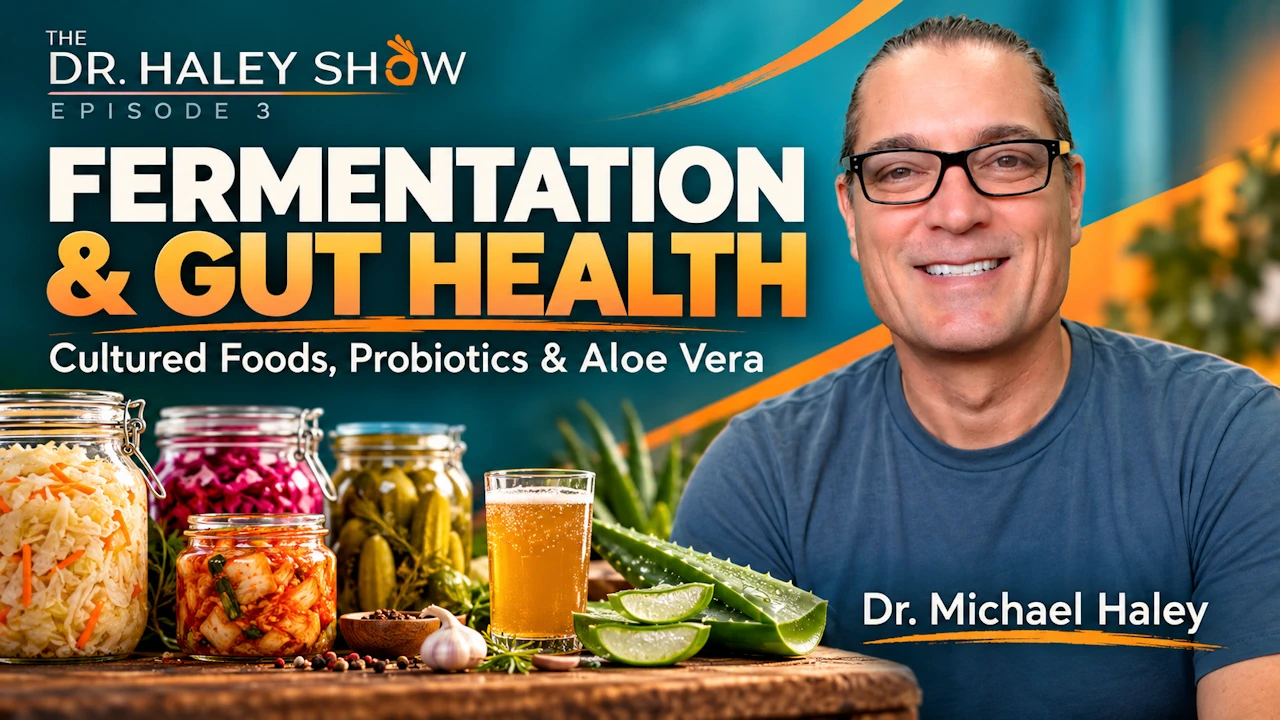
On today’s show, Aloe Vera Guru Dr. Michael Haley dispels some common misconceptions about fermentation, the difference between good bacteria and bad bacteria, and healthy food.
How often have you thrown away stale food fearing that it might have gone bad? I suspect that you do this all the time. But before you repeat this behavior again, you might want to tune in to today’s show.
About This Episode
In this solo episode, Dr. Michael Haley uses a penny-doubling example to introduce microbial growth, then discusses cultured dairy, bread, kombucha, wine, fermented vegetables, preservatives, and changes in stored aloe vera.
Watch the Interview
Listen to the Podcast
Quick Takeaway
Fermentation changes food as microorganisms multiply and consume nutrients. Dr. Haley explores this process through familiar foods and explains why he prefers fresh aloe vera over fermented aloe as a source of its original nutrients. His comments about probiotics, preservatives, and gut conditions reflect the views discussed in this episode.
ENJOYING THIS CONVERSATION?
Get the Next Episode in Your Inbox
Get notified when a new episode of The Dr. Haley Show is published, plus occasional highlights and resources worth exploring.
By subscribing, you agree to receive email from The Dr. Haley Show. Unsubscribe anytime.
Episode Timestamps
- 00:09 – Fermentation and the question of whether aloe has gone bad
- 00:49 – The penny-doubling example
- 03:32 – Bacterial growth and storage temperature
- 05:11 – Cultured dairy, cheese, yogurt, and kefir
- 07:21 – Bread starters and yeast
- 08:11 – Kombucha and its culture
- 08:59 – Grape juice, wine, and fermentation
- 11:30 – Dr. Haley’s explanation of preservation through fermentation
- 12:13 – Sauerkraut and fermented vegetables
- 15:36 – Preservatives and Dr. Haley’s views on gut health
- 18:10 – Returning to the question about stored aloe vera
- 19:17 – Aloe fermentation, nutrition, and texture changes
- 20:57 – Closing thoughts
Dr. Michael Haley “The Aloe Vera Guru”

What Are Preservatives?
Today, you will learn the real truth about adding preservatives to make your food “last longer”. You will also learn some interesting facts about wine, cheese, and vegetables among other things. You will learn how fermentation, in fact, can turn your food into a nutrient-rich “super food” that strengthens your gut. If you are interested in adopting a healthier, more scientific approach, today’s show will be particularly interesting for you.
Enjoy!
What You Will Learn In This Show
- What is fermentation? Understanding the basics
- Why consuming probiotics is good for your gut health
- How fermentation plays a role in the making of wine and cheese
- And so much more…
Cultured Foods and Microbial Growth
Dr. Haley connects his doubling-penny illustration to the growth of microorganisms in food. He describes the use of cultures in cheese, yogurt, kefir, bread, and kombucha, then discusses his experiences with fermented grape juice and vegetables.
Fermentation, Preservatives, and the Microbiome
Dr. Haley contrasts fermentation with other approaches to food preservation and shares his concerns about preservatives and the gut microbiome. His proposed connections between preservatives, microbial imbalance, and inflammatory conditions are presented as his interpretation of these topics.
Why Dr. Haley Prefers Fresh Aloe Vera
Returning to the question that opens the episode, Dr. Haley describes changes in aloe’s flavor and thickness during storage. He explains that his goal is to preserve the nutrients for which people purchase aloe, and he favors other foods as sources of fermented cultures.
Medical Disclaimer
This podcast and article are provided for educational and informational purposes only and do not constitute medical advice. The experiences and opinions discussed are those of the speakers and should not replace diagnosis or treatment from a qualified healthcare professional. Do not begin, discontinue, or change any medication, supplement, diet, or treatment based solely on this episode.
Full Transcript
The transcript has been lightly formatted for readability. Because it was created from the recorded conversation, it may contain minor transcription errors.
Read the Full Transcript
[Music] i’m dr michael haley and today we’re going to talk about fermentation one thing people frequently call and ask about they say you know dr haley i left my aloe in the refrigerator for two weeks did it go bad and i think what they’re really asking is is it still good for me but did it go bad maybe they’re asking did it go bad to understand fermentation and bacteria multiplication and things going bad or maybe even getting better in some cases
to understand fermentation let’s talk about money something that people can relate to and understand a little quicker people pay attention when it’s money it’s like what money how does that work bacteria oh stay away bacteria close my ears off i don’t want to hear about that i want to wash my hands and sanitize them but money oh okay let’s talk about money yeah how do i get more
imagine if you had a choice to make a penny that doubled every day for a month or a million dollars door number one million dollars door number two a penny that’s going to double every day for a month what would you rather have now on first glance million dollar sounds like a pretty sure win and it is a pretty good victory for you know and just have a million dollars that’s a nice thing but let’s look at the penny in a week that penny on the first doubling day becomes two pennies then four then eight then 16 32 64 and at the end of the week you got a dollar twenty eight
probably should have taken the million dollars right but week two comes and you have two dollars and fifty six cents and that goes to five twelve and ten twenty four twenty and forty eight cents by the end of week two you got a hundred and sixty three dollars and 84 cents now we’re talking right no i’d still rather have the million dollars
week three the first day it doubles on week three you have 327.68 and by the end of week three twenty thousand nine hundred and seventy one dollars and fifty two cents ah do i have your attention now not even a hundred thousand dollars yet i want millions
week four the first day of doubling forty one thousand nine hundred and forty three dollars and four cents and by the end of week four two million six hundred and eighty four dollars no i’m sorry two million six hundred and eighty four thousand three hundred and fifty four and fifty six cents
so even on a short month february 28 days better to take the penny that doubles every day for a month if it’s a leap year you have over 5 million dollars and a month like april 30 days over 10 million dollars a month like january over 20 million dollars doubling a penny that doubles every day for a whole month so should have taken the penny that doubles every day
now the reason we’re having this discussion is because it’s a lot like fermentation or bacteria growing in food now bacteria is going to double more frequently i’m pretty sure of that depending on the environment it doesn’t bacteria don’t double every day in a warm environment and good clean healthy food maybe every 20 minutes but let’s say it was every day at the end of the week you only have a small handful of bacteria right probiotics capsules we measure those in the billions of probiotics so when you’re you know taking probiotics to nourish your gut flora back to good health billions are consumed
so things that ferment and bacteria grow in them they’re doubling more frequently sure not as fast when it’s in the refrigerator maybe instead of doubling every 20 minutes maybe it’s every several hours that the bacteria double they multiply in food but much slower and even in freezing temperatures some bacteria will continue to double but even slower than the refrigerator of course but things still get old and expire even when in the freezer that’s why you know some uh recommendations for like steak might be up to a year and ground beef maybe six months so depending on what it is and how it’s packaged and stored things like frozen vegetables that have a lot of air they’re going to get a lot of freezer burn in there might not last as long so it just depends
well when it comes to fermentation bacteria can actually be a very good and healthful thing yeah we’ll get back to the question about the aloe vera and whether or not it went bad but think about milk that sours or gets old nowadays they pasteurize milk so ultra pasteurize it and you know you can buy it and consume it a month after it was taken out of the cow and processed and pasteurized but if that milk were to sour i don’t know if you’ve ever poured milk and clumps have come out those clumps are almost like clumps of accidental cheese
what do i mean by cheese well the way cheese is made milk dairy is infused with bacteria and yeast and things that will first sour and then maybe enzymes added to curdle it and then those curdles pressed together and shaped and separated from the whey the liquid way which is very much a live probiotic beverage could be healthful for your gut flora and then you know it as it’s shaped and and dried if it’s dried and aged beyond a certain point i guess eventually all the bacteria may die off especially if it’s dried to where all but you know when you take the hydration out you’re actually removing the life from the microorganisms
but cheese especially young cheese is a very much a live cultured food and in the same way we culture milk to make yogurt and kefir so these are things that were intentionally infused with bacteria to sour them to change them to turn them into live living foods it’s interesting because you know
many many years ago they would keep a lump of the dough aside because they found a good culture of yeast that came from the air if you start bread from scratch and you don’t start with a good culture of yeast you might get a good one from the air but more likely to get a funky kind of yeast and your bread might not taste so good so when you make it from scratch and truly get the yeast from the air and it comes out good you say oh this was a good culture let me keep a lump aside so the next time i can start with that same yeast and infuse that life into it to make my bread rise
microorganisms are very much used in our food sometimes they’re baked off and bred and killed and sometimes they’re kept alive in the food in things like yogurt and kefir and even in some cheeses
in fact a popular health beverage kombucha is sweet tea it’s like iced tea with sugar added and then they put this scoby s-c-o-b-y which is a symbiotic culture of bacteria and yeast scoby and those live living organisms culture and slightly ferment the tea consuming much of the sugars and turning them into live living bacteria and some alcohol output and that is consumed as a living probiotic beverage
when fresh raw grape juice gets a little old we call that wine in fact in the book of timothy chapter 5 verse 23 it says stop drinking only water and use a little wine for your stomach and your frequent infirmities
in this fermentation process we have live living bacteria and i do believe that the wine of that day 2000 years ago is very different than the wine of today i’m confident that we’ve really mastered the art of not only fermenting and we use you know instruments to measure fermentation and know when it’s mostly done and when the sugars have been consumed off and fermentation has stopped and you know sometimes even sugars are added back in for a second fermentation to further increase the alcohol content and we you know bottle these wines and some of them have preservatives and sulphites added to you know kill off the live living microorganisms that are probiotics actually good for you
i do believe when this was written stop drinking only water use a little wine it was more like the case of old grape juice
in fact i remember when i had a raw bottle of grape juice that i purchased from the amish and after a couple weeks of finding it in the back of my refrigerator i opened it up and it made this little sound when i took the cap off it had fermented into almost a champagne a little bit of an effervescent wine was no doubt live living probiotic bacteria and no i was not afraid of it and yes i did drink it and it was quite tasty it was actually a very delicious wine or champagne or whatever i should call it because it still had a lot of the sweetness the fermentation hadn’t completed so it had some of the sugars of the grape juice but a little bit of the sour so it’s that sweet and sour almost lemonade kind of thing sweet and sour goes so good together
it was it was delicious and no doubt it was live and living and probiotic which is good for the stomach and probiotics good for the immune system which good for your frequent infirmities according to the book of james as it said 2 000 years ago somehow they knew that
so fermentation kind of preserves how does it preserve well when you have these good cultures in there it’s kind of like the dominating population wins so now if it is contaminated with pathogenic bacteria they don’t stand a chance growing living multiply because they have been filled with healthy strong populations of probiotic bacteria that outnumber the pathogenic bacteria so the pathogenic bacteria can’t live in that place and that’s the concept of preserving through fermentation
vegetables can also be soured just like grapes and grape juice to make wine we take cabbage and maybe sprinkle some salt on it to after you chop it up to draw the water out and and squeeze it down with your hands just like little grapes can be squeezed down with hands or feet or wine presses to get the juice out but in the case of cabbage if you’re making it at home you chop up the cabbage and sprinkle some salt on it and and as the salt draws the water out and you’re scrunching out the liquid from the cabbage when it gets to the point where you can wring it out like a wet sponge you stuff it in a jar and put a lid on it and you push press down the cabbage below the water line put a lid on it and leave it on your counter room temperature which might be i don’t know 74 75 degrees fahrenheit for most people i would imagine and after about a week you have soured cabbage or sauerkraut
now i have opened my sauerkraut too early remember the concept of the penny doubling from you know you’re talking chump change in the first week but at the end of the month those doublings by the time by the 30 30th time or so millions are doubling and if we take that uh just a little further billions and then trillions are doubling
that is how it is when making cabbage if i open my cabbage on day six it’s gonna taste like salty wet cabbage but on day seven or eight all of a sudden it starts getting sour as the billions or who knows how many of bacteria are multiplying that’s when it’s becoming much more probiotic and much more preserved by the increase in the population of the good bacteria that taste good too
so that’s fermentation of vegetables and if i add to that other kinds of vegetables carrots radish whatever you want really we might give it other fancier names like kimchi you know and we put spices in it and make it all like a spicy vegetable cultured food it becomes a superfood it started out as a simple vegetable but now as you’re fermenting it and making not only bacteria but enzymes and certain acids and things that are going to help digest food and nourish your gut flora you’re turning a simple vegetable into a super food that still has much of those same nutrients as the vegetable but all of the probiotic gut healing health foods as well
not all the same nutrients because remember those bacteria had to consume stuff but guess what most of what they’re consuming is things like sugar that you’d rather not have sometimes they’re cleaning it up and actually making it into something better for you like in the case of wine sugars are being consumed as we’re making all of these new uh super nutrients that are so good for you
so that’s fermentation in a nutshell and it certainly beats the what we’ve seen in the past let’s say 100 years where we’re cooking all our foods super pasteurizing it adding chemical preservatives to it to kill it off and make sure nothing can grow in it and then we’re consuming those things and remember they put preservatives in the food to kill that’s what it is there for people say it’s to make the food last longer it is there to kill mold yeast fungus and bacteria so that those things don’t consume the food and change it giving it the appearance of a longer shelf life but really it’s a less healthy food that the microorganisms cannot live in it
and then it’s interesting because when you consume that food and you put it into your stomach those chemicals do they know to stop working all of a sudden or are they going to potentially damage your microbiome making it harder to recover
i believe this is the reason why we have so many more inflammatory bowel conditions like acid reflux crohn’s celiac disease you know there’s a gazillion names for all these inflammatory bowel conditions from esophagitis and gastritis and colitis there there’s a gazillion names they’re all pretty much the same theme inflammatory gut throwing off the microbiome changing its environment killing off the good bacteria bacteria and now bad bacteria are taking over and we’re having an imbalance of that gut flora the intestines are becoming raw they are leaking creating autoimmune responses that have a whole host of symptoms affecting everything from the way your mind thinks the way your body works the aches and pains and throwing off hormones and all kinds of things
gut health is essential and consuming good clean real foods pesticide free herbicide free fungicide free all those things the farmers are putting on the food going into your microbiome acting as a sort of anti against bio life a form of antibiotic killing off your gut flora damaging it versus the old way that they used to do it preserving real food with live healthy microorganisms that actually nourish your gut
so back to the original question that i get i forgot my aloe in the back of the refrigerator or i left it out overnight and it got warm is it bad what has happened to it is the bacteria have increased and they have consumed many of the nutrients the reason why you purchased it it does not make it bad and some things ferment and are actually not only better for you but even taste better you know for instance some people would much rather have wine than grape juice
i promise you that’s not going to be the case with aloe vera aloe vera doesn’t start out tasting good people don’t drink it for the taste and when it ferments it sure doesn’t taste better
not only that the bacteria are consuming the nutrients the reason why you did get it for the things like the ace man and the mucopolysaccharides that are actually helping heal your gut and strengthen your immune system there are better sources of probiotics than fermented aloe
now nutritionally aloe vera is not bacteriostatic it’s not going to you know stop bacteria from growing in it but it’s not a great source of sugar and food for fermentation so aloe vera ferments a lot slower than things like dairy and grape juice you know and even cabbage
so it could last much longer in your refrigerator then even seven to ten days is what we tell people because we want you to have the maximum nutrition there’s a point where that doubling starts having a big impact and all the sudden shaking your jug of aloe goes from having that real goopy sound to a splashy watery sound because all of a sudden the doubling is consuming all the nutrients so fast that the thickness has disappeared as those molecules have been broken down from the thick long chain mucopolysaccharides to essentially water
the bacteria consumed the nutrition at some point changing it we might not notice that thickness change in things like grape juice because it was never thick to begin with but in aloe it’s very noticeable and drinking it isn’t gonna harm you unless it was first contaminated with pathogenic bacteria and that’s what multiplied instead of the healthy probiotic bacteria
but chances are you weren’t sticking dirty fingers into the bottle when it was fresh and it’s going to be just the naturally occurring bacteria that happen in vegetation that multiply and become more of a probiotic
so kind of a long-winded answer but i hope that answers questions of are these things going bad you can make a more educated decision now with old food and decide for yourself whether or not it has been contaminated or is just merely probiotic you