
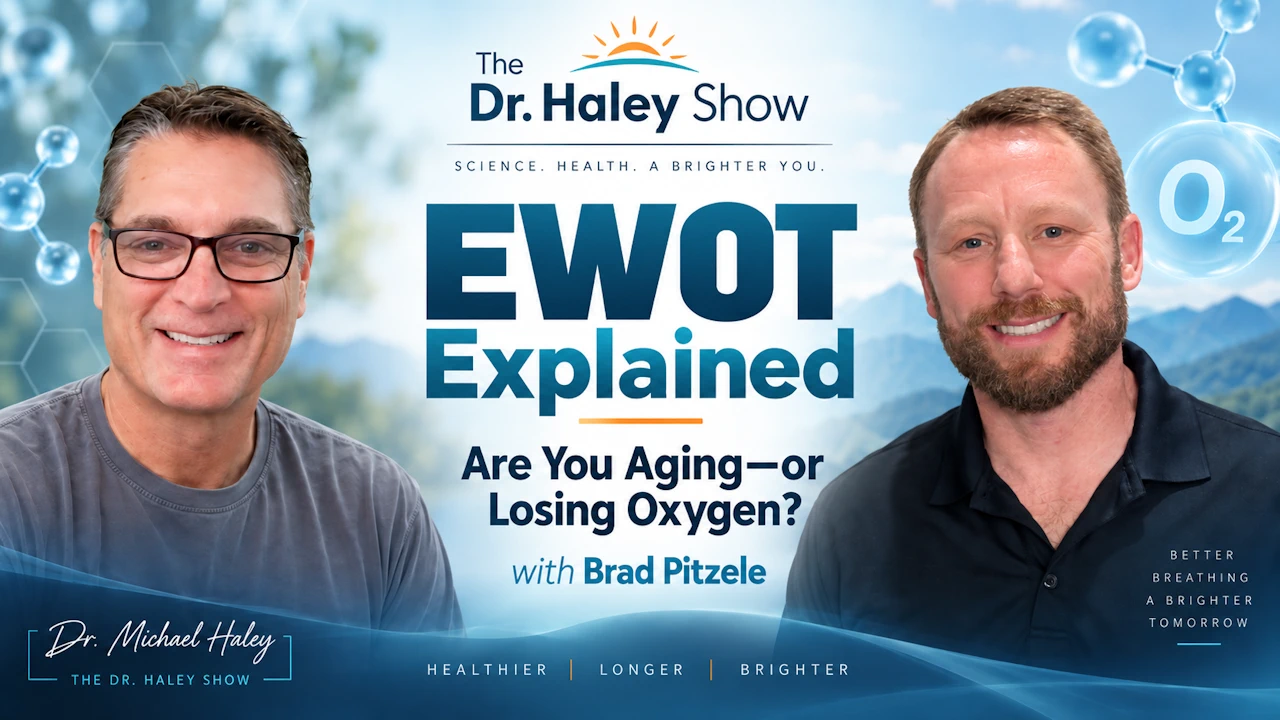
Could some changes commonly blamed on aging also involve declining oxygen delivery or utilization? In this episode of The Dr. Haley Show, Dr. Michael Haley speaks with Brad Pitzele, founder of One Thousand Roads, about Exercise With Oxygen Therapy—better known as EWOT.
Brad shares how serious health challenges, including cancer, autoimmune illness, Lyme disease, chronic fatigue, severe pain, and limited mobility, led him to investigate mitochondrial health and eventually build his own EWOT system. He explains how EWOT works, how it differs from supplemental oxygen and hyperbaric oxygen therapy, and why people use it for exercise performance, recovery, biohacking, longevity, and chronic health support.
The conversation also addresses responsible claims, system quality, mask hygiene, session length, red light therapy, and the important distinction between supporting health and claiming to cure disease.
Watch the Interview
Listen to the Podcast
Resources
Quick Takeaway
Brad Pitzele’s interest in EWOT began during his own prolonged health crisis. Using his engineering background, he built his first system after commercially available options felt financially out of reach. In the interview, he describes EWOT as using exercise to increase breathing, circulation, and oxygen demand while the user breathes concentrated oxygen.
The episode also compares EWOT with nasal-cannula oxygen and hyperbaric oxygen therapy, discusses typical 15-minute sessions and system features such as reservoir size and concentrator flow, and explores why Brad pairs EWOT with red light therapy. Personal experiences and proposed mechanisms discussed in the episode should not be confused with proof that EWOT diagnoses, treats, cures, or prevents disease.
ENJOYING THIS CONVERSATION?
Get the Next Episode in Your Inbox
Get notified when a new episode of The Dr. Haley Show is published, plus occasional highlights and resources worth exploring.
By subscribing, you agree to receive email from The Dr. Haley Show. Unsubscribe anytime.
Episode Timestamps
- 00:00 — Are You Aging—or Losing Oxygen?
- 00:55 — Meet Brad Pitzele
- 02:20 — Brad’s Health Crisis and Search for Answers
- 06:00 — Discovering EWOT and Mitochondrial Health
- 07:43 — Building His Own EWOT System
- 09:47 — Recognizing Predatory Wellness Marketing
- 11:29 — Lyme Disease and Bartonella Explained
- 15:57 — When Illness Becomes a Catalyst for Change
- 18:22 — Can EWOT Cure Cancer? Responsible Claims
- 19:05 — Oxygen, Inflammation, and Aging
- 22:05 — The Origins and Proposed Mechanism of EWOT
- 24:00 — Exercise Alone vs. Exercise With Oxygen
- 28:18 — EWOT vs. Supplemental Oxygen and HBOT
- 36:44 — EWOT Explained in 60 Seconds
- 37:38 — What an EWOT Session Feels Like
- 39:17 — The Best Exercises and Who Uses EWOT
- 42:20 — Session Length, Frequency, and Safety
- 45:11 — How to Compare EWOT Systems
- 48:18 — 5-Liter vs. 10-Liter Oxygen Concentrators
- 50:30 — Masks, Sharing, and Cleaning
- 51:48 — Combining EWOT With Red Light Therapy
- 54:02 — VO2 Max, Recovery, and Potential Benefits
- 57:15 — Where to Learn More
About Brad Pitzele
Brad Pitzele is the founder of One Thousand Roads, a wellness technology company specializing in Exercise With Oxygen Therapy and red light therapy. His work grew from his own experience navigating cancer, autoimmune illness, chronic Lyme disease, and severe limitations in mobility. Combining that personal experience with a background in mechanical engineering and business, Brad now works to make these technologies easier to understand and more accessible. He also hosts conversations with experts in chronic health recovery, biohacking, and longevity.
What Is EWOT?
Exercise With Oxygen Therapy combines physical activity with breathing a high concentration of oxygen through a mask. An oxygen concentrator gradually fills a reservoir, allowing the user to draw a much higher flow during exercise than a concentrator can produce moment by moment. The exercise increases breathing, heart rate, circulation, and oxygen demand while the reservoir supplies concentrated oxygen.
In this interview, Brad describes EWOT as distinct from medical supplemental oxygen, which may be prescribed for low blood oxygen, and from hyperbaric oxygen therapy, which uses increased atmospheric pressure. EWOT is not presented as a cure for cancer, Lyme disease, autoimmune illness, or any other condition.
Haley Nutrition Listener Special
Listen to the podcast for the current listener coupon code, which may be used at HaleyNutrition.com.
Medical Disclaimer
This podcast and article are provided for educational and informational purposes only and do not constitute medical advice. The experiences and opinions discussed are those of the speakers and should not replace diagnosis or treatment from a qualified healthcare professional. Do not begin, discontinue, or change any medication, supplement, diet, or treatment based solely on this episode.
Full Transcript
The transcript has been lightly formatted for readability. Because it was created from the recorded conversation, it may contain minor transcription errors.
Read the Full Transcript
[00:00] Brad Pitzele: What happens as we age is that we develop pockets in the body that are not getting oxygen because of inflammation. That can contribute to a buildup of waste in our cells, slower repair and healing, and some of the memory decline we often attribute to aging. That may actually involve a loss of oxygen utilization.
[00:27] Show Announcer: You are listening to the Dr. Haley Show, the podcast dedicated to helping you optimize your health. Each episode there will be an interview or a message to help you discover better health. We will be featuring health radicals on the show to bring new ideas to the table, as well as doubling down on key fundamentals to support you living your best life. Your host is no other than the founder of Haley Nutrition Dr. Michael Haley.
[00:55] Dr. Michael Haley: This is the Dr. Haley Show podcast. I’m Dr. Michael Haley, your show host, and today we have a special guest, Brad Pitzele, founder of One Thousand Roads. I think the web address is OneThousandRoads.com. It will be below his picture the whole time, in case I’m wrong with that. But it’s a wellness technology company specializing in Exercise With Oxygen Therapy, better known as EWOT and also red light therapy. Brad’s work grew out of his own struggle with serious health challenges, including cancer, autoimmune illness, chronic Lyme disease. At one point, he could barely walk and felt like he was running out of options. Who can relate? He credits EWOT and red light therapy with helping change his direction of his recovery. Combining that with personal experience with his background in mechanical engineering and business, Brad now helps make these technologies easier to understand and more accessible. He also hosts conversations with experts in chronic illness recovery, biohacking, and longevity. Brad, thank you for joining me today on the Dr. Haley Show podcast. You know, I was looking at your website and looking at some of the technology and I thought, this isn’t something someone does just to start a business to make money. It seems like a very niche, maybe even difficult from a business perspective. You are introducing something that I—and probably many listeners—know very little about. I think a lot of people probably don’t know much about EWOT and red light therapy in recent years has become more and more known. Maybe that’s a little less niche, but get us caught up to speed. What is your story and what led you to start such a company?
[02:53] Brad Pitzele: Yeah, I’m someone who runs on passion. It seems about every decade I come up with a passion project. When my oldest was born, she was born with Down syndrome, something I didn’t know about, and I got really involved in Down syndrome advocacy and helping pass laws. So we’d spent many weekends traveling out to Washington, D.C. and knocking on Congress people’s doors. But while all that was happening, my next passion project unfortunately was forming. And that was I had started to become really ill. It started with arthritis and I went to the rheumatologist and was put on medications, and they helped a little bit, and then they would wear off and I’d be in a worse place, and I’d just kind of kept stair stepping down. Each time they wore off, they got worse. And after several years of that, I developed melanoma. And that was kind of my ripcord moment when I had to pull the ripcord and just step away from standard medicine. I went back to my rheumatologist and said, what do we do if I take these drugs? I can die of cancer. If I don’t, I’m going to die crippled up in a ball in the corner. And he said, no, no, we’ll just give you a different drug in the same class and hope for the best. And I just like, heard alarm bells in my head and I didn’t know what to do. And I was sitting in my car after that appointment and I just thought to myself, I don’t like either one of these paths. I don’t feel good about them. I need to forge a third path. And I didn’t even know what that was. So I started doing a bunch of research and trying to get better. And for years I was in the alternate health space, trying diet supplements, different modalities. I would go on these chronic illness groups where folks were talking and they had similar symptoms as me and nothing, nothing was moving the needle. And I started seeing functional medicine doctor. At one point he decided he wanted to test it for Lyme disease. And I remember scoffing at it and saying, like, I didn’t have Lyme disease. I’ve never been bitten by a tick or had that bullseye rash thing. I’m like, this is, you know, this is silly, but I’m going to let him do it just so he can get it out of his head. And we can, like, focus on the real thing. And sure enough, it came back with, I had Lyme disease and a co-infection called Bartonella, and I still didn’t even believe it. I went back to the next appointment. I’m like, what’s the chances? This is like a false positive? And he kind of laughed at me. And he’s like, Brad, you have the DNA of the bacteria in your urine. What do you think? And I was like, oh, that’s what that means. So that’s not a really comforting diagnosis because when you research it, there’s a lot of folks not getting better. A lot of doctors don’t even believe it exists. And the ones who do, so many of them won’t treat it. And so it’s just one of these kind of do it yourself diseases sort of thing. You’re like, dropped in the forest, go find your way out. Luckily, he gave me some advice later on and he was like, you know, you should try looking at mitochondrial health. And one of the first things he recommended was Exercise With Oxygen Therapy. And, you know, that was over a decade ago. So, no one knows about it today, but they really didn’t know about it a decade ago. There was no information on the internet. No one was using it. The only places I found information were a couple of manufacturers who were making it, but it was, you know, somewhere between $5,000 and $25,000 for a system. And I tried so many things that I wrote a list recently. I wanted to count it and I could count at least 200 different modalities. I had tried on trying to get better. So, you know, when the doctor says, hey, here’s 201, you’re kind of like, yeah, you know, I don’t have a high degree of confidence. And so when I saw the price tag, I was like, yeah. Yikes. I can’t spend $10,000 on an experiment because how am I going to feel when I fail? That? And how many $10,000 experiments do I really have? And so I kind of walked away and said, I’m not doing it. And then I kind of thought about it more and I realized like, what else? What other options do I have? I’m getting worse and worse at this point. It wasn’t just arthritis, it was brain fog. It was no energy. It was, you know, chronic fatigue, I guess is the way that you describe it now. Nerve pain. I could barely walk the bottoms of my feet felt like someone had beaten them with a meat hammer. My muscles were stiff, And of course I had more and more arthritis. It wasn’t just my hands, it was my hands and my feet and just new symptoms were coming and going, which isn’t untypical of Lyme disease. so then I was like, what am I going to do? And then I kind of settled on the idea. I’m like, well, if it wasn’t $10,000, I’d give it a try. And I thought to myself, well, what if you just make your own, you know, do the research and figure it out? And as I joke, I’m a recovering engineer. I spent the first decade of my career doing mechanical engineering. Probably saw me smile when you said engineer at the beginning because I, you know, kind of tried to put distance between me and that, but sometimes it comes out. And so I built my own. I didn’t have a whole lot of faith in it. The first couple of months I did it, I didn’t notice anything. And I thought to myself, this is another one you can throw on the trash pile. But I didn’t have anything else to do. And kind of out of inertia. I just kept doing it in the mornings, and about the third month I started to notice symptoms going away. And then it progressively I got better, and a year later I went in for a checkup with a doctor and he just like, took one look at me when he walked in the room. Michael, he was just like, whoa! He’s like, you’re much better. He’s like, what’s going on? Are you doing the oxygen? And I said, I am. And he’s like, who’d you buy it from? So I can tell my patients. And I was like, oh, he’s going to be disappointed. I’m like, well, doc, I just kind of made my own. And then he looked at me like I was crazy for a second. And then he gathered his composure and he was like, well, would you consider making him for my patients? And at first I just kind of like, recoiled. I was like, you know, I’m still I’m a healing journey. And like, I don’t want to overextend myself. And, you know, I got I’ve got a family and I got a job and like, do I really you know. And so but I sat with it for a while. In about six months later we launched the company. So and you’re right, it wasn’t. I launched it more as a passion project than, than a business enterprise. My goal was to kind of pay it forward. I know how lonely it is when you’re really sick, and I always felt like there were a lot of folks coming at me with $10,000 tests I could do that might help me. And it kind of felt predatory at times. And I also felt like there wasn’t much information on this. No one knew about it. And there wasn’t the science. Wasn’t there anything out there was really hyperbole in marketing speak. And so that was kind of my goal to bring the price down, make it affordable for people and bring the science forward.
[09:47] Dr. Michael Haley: You know, in all your experience in trying the different things, when did you start to realize that some may be predatory and probably most weren’t? I’m sure a lot of people really have good intentions behind the things they do, but how are you able to weed out the ones that might be predatory?
[10:11] Brad Pitzele: I can’t tell you who was and wasn’t, but I remember a specific conversation I had with a doctor and he was importing some new technology. So it’s from Germany. It’s this new technology. I’m the only one in the United States who has it. And he says it’s about $60,000 for a treatment, but I think it’ll take care of you. and he saw the look on my face when he said $60,000. And then he said, he’s like, yeah, it’s like the cost of a Mercedes. He’s like, would you give a Mercedes to get your health back? And I was just shocked that he said that. I was like. And I thought to myself, I’m like, yeah, I suppose if I knew 100% the thing was going to do it, I probably would find the money. I’d probably remortgage the house and do it. But like, he was just so casual about it. It was like just his, his delivery on it was like he already had his sales pitch. And I’m like, I felt like I was being pitched versus listened to. And that was kind of just it was a icky feeling like, you know what I mean? So I’ve had I had several of those too. I like when people do pay attention to that.
[11:07] Dr. Michael Haley: You know, that inner feeling, that little quiet voice that might be saying, this is not for you. You know, don’t be duped. And I think the problem is, is some people aren’t bold enough to let that come out of their mouth. I’m not perceiving this as right for me. I’m going to try something else. Yeah, and they get put in all these different directions.
[11:29] Dr. Michael Haley: What’s Bartonella you mentioned having that diagnosis.
[11:32] Brad Pitzele: So Bartonella is known as a co-infection of Lyme disease. When you get Lyme disease, it likes to invite its friends over, is what I say, you know. So Bartonella, Babesia, there’s several others, Anaplasma or Ehrlichia that these other co-infections. And they basically team up to beat your body up while they’re knocking your immune system down. They’re kind of having a party in there. Bartonella in particular. There’s a it’s a Bartonella henselae is the subspecies is an infectious agent that actually causes what’s commonly known as cat scratch fever or cat scratch disease. It’s called cat scratch fever and cat scratch disease actually for a couple of reasons. One, feral animals like feral cats often carry and if they do, they can infect a person through a cat scratch. But also it causes these striations in your skin that look like cat scratches. you know, it’s also one of these reasons why pregnant women are recommended to stay away from, like, feral cats and so forth, has to do with cat scratch fever. You probably thinking of the Ted Nugent song right now either had it or it was a song about something completely different, parallel to it, I don’t know. Yeah, exactly. So we more of us know that song than know that it’s about that. It’s named after that bacteria. So yeah, it’s a and it was really interesting when I started to research it. Like I had all this foot pain and the best like I try to explain it to people. It was so bad that if I had to go to the bathroom in the middle of the night, I had to put a special set of shoes on just to get out of bed and walk, you know, like the ten feet to the toilet. I just couldn’t do it barefooted and I couldn’t, I, you know, I had shared that with my rheumatologist early on and he’s like, no, that’s not Arthritis I don’t know what you’re talking about. Your toes may have arthritis, but the thing on the bottom of your feet is and I was like, what are you talking about, doc? How can these both inflammatory, painful conditions not be related when they’re living in the same foot? And when I finally got diagnosed with Bartonella, it made sense. It’s very common to have this foot pain. Often it’s mistaken for plantar fasciitis as well. So and a lot of nerve pain. But it can cause a different kind of cluster of symptoms as Lyme, some of them over lap and some of them are distinct. I would say, you know, when we talk about these kinds of syndromes, conditions, sometimes we can take a measurement and say, you have this particular DNA evidence that you have this.
[14:04] Dr. Michael Haley: Other times it’s just a group of crazy, stupid symptoms that no one can make sense of, and there’s no real treatment for them. Right. I think that’s almost the best kind of problem to have because there is no cure for it. So now you have to start doing things right. I can’t just take something. I can’t just open up a pill bottle, swallow three capsules a day for a week and it’s gone. I actually have to take care of myself and do things for me that are healthy and beneficial. I might change my diet, I might work on my rest patterns, I might do red light therapy and expose myself to the light I’ve been shielding my body from. Like right now I’m in an office with these bright white lights. I’m not getting any real light, right?
[14:55] Show Announcer: Are you enjoying the show thus far? One of the many health secrets that we have covered on the show is all around aloe vera. Specifically drinking raw aloe vera. Our aloe vera has helped our customers effectively heal their gut, increase their intestine health, lower inflammation in the body, eliminate and or decrease acid reflux, have glowing skin and hair, and so much more. Now, as a frequent member of our audience, you will be exposed to exclusive specials and coupon codes for the awesome products manufactured by Haley Nutrition. That’s right, for simply being awesome and tuning in. You can get a mini discount to help you optimize and better your health. To see how we can help and support you on your health journey. Tune in to the episodes and listen for coupon codes that you can use at HaleyNutrition.com. Before you make your orders of raw aloe vera. Once again, it’s HaleyNutrition.com. Now back to the show.
[15:57] Brad Pitzele: And I have this conversation often with folks. What starts as a sickness actually becomes a gift in some ways, which sounds absolutely crazy, but it forces you to focus on your health and to refocus on what are the things that you’ve done, the controllable things that may have contributed to this situation? I know for me, I always tell folks like my first symptom started when I was in kindergarten, but I didn’t get really sick until I was in my 30s. And lo and behold, when I was in kindergarten, we took in a feral cat. So. You know, like, interesting. So I, you know, you can have things going on in your body, but it’s not just the infectious agent. Sometimes it’s other things you’re doing lifestyle choices, the way you treat your body, the way you handle stress, those sorts of things you allow into your life. And sometimes to your point, like the health crisis becomes a focusing point for like, okay, what needs to change? Because I can’t go back to that old way of living.
[16:58] Dr. Michael Haley: Yeah, I think about how programmed we are to believe that health comes in a bottle. And if I take this for that symptom, I’m going to get better. But I’m just covering the symptoms. And you were talking about how the doctors wanted to change your medications. We’ll just, you know, we’ll give you something else. And when you think about it, you’re giving drugs, chemicals to someone who is challenged. They have a health challenge. Yeah. If you give it to someone completely healthy, they don’t get healthier. They have one choice, and that’s to get less healthy. When you give drugs to someone that’s completely healthy. So how can medicine, how can medications make someone who is sick healthier? Now, I’m not saying medications don’t have any value, but we’re treating these symptoms with them. And that could be life saving to buy time. But ultimately you have to change your lifestyle. You have to address your nutrition, your exercise, your rest, maybe vitamin D levels. Maybe, you know, there’s all kinds of things that you can address in your to make it better fight cancer, autoimmune conditions, chronic fatigue, fibromyalgia. There’s things you can do.
[18:22] Dr. Michael Haley: EWOT does not cure cancer, right?
[18:25] Brad Pitzele: No. There is a strong linkage between oxygen and cancer, but I can’t tell you that it cures it.
[18:34] Dr. Michael Haley: The body addresses cancer, but sometimes the body needs help. There are things that can support it, just as nutrition can support the immune system so it works more like it is supposed to.
[18:52] Brad Pitzele: That is right. The physiology of why it works and what is going on in the body was one of the eye-opening things to me about oxygen. Now, we’ve given it this term, Inflammaging like we’re all just supposed to become more and more inflamed. And of course, to your point, a lot of that has to do with the environments we operate in. We’re growing our food in depleted soil. We’re drinking water with all sorts of contaminants in it. We’re, you know, we’re eating foods with their spraying with I mean, I just learned this year that they use Roundup glyphosate as a desiccant to dry crops, not even to keep the pest away after they’ve cut them down. Rather than wait for them to dry, they’ll just spray a bunch of roundup on them. And I think that speaks. I mean, even though we know it’s a carcinogen, that just speaks to how little care is being paid to the things that we put on and in our bodies. So as this inflammation builds up, one of the most sensitive places in the body is our capillaries. These are like the very end points of our circulatory system where the rubber meets the road. It’s where oxygen’s exchanged and it’s where nutrients are exchanged. And they’re so thin. They’re thinner than a human hair, and they’re so thin that even red blood cells that carry our oxygen need to fold up like a taco to fit in, because the red blood cell is bigger than the capillary. And then they march down in single file. But this inflammation can cause inflammation in our capillaries. And there’s over 50,000 miles of capillaries in your body. So there’s a you know, there’s a ton of them. It can go around the earth two or more times. And when they become inflamed, those red blood cells can’t pass through cleanly. And so your body starts losing the ability to utilize oxygen. And every year past the age of 25, it loses 1%, which doesn’t sound like a lot. But when you get to age 50, you’ve lost 25% of your body’s ability to utilize oxygen. And why that’s important is your cells. They run on aerobic respiration, which requires oxygen. And so if they run out of oxygen, they can still produce energy, but only about 5% as much. And it’s a dirty energy source that causes free radicals and damage to our mitochondria and our cells. So what happens is as age is we have these pockets in our body that aren’t getting oxygen because of this inflammation, and it causes buildup of toxins in our cells because the cells are in low energy and they won’t take the trash out. It causes slow repair and healing. It causes a lot of the age related memory decline, the slow healing of the body, all these sorts of things that we often think of as, oh, that just happens as we age. Naturally. That’s actually a loss of oxygen utilization, which I found kind of shocking. I was like, why doesn’t anyone talk about this? Why isn’t this more widely known? And the way EWOT was discovered was there was this German physicist and inventor, Manfred von Ardenne, who started playing around with oxygen and exercise. He had studied another German, Otto Warburg, in the 1920s, was doing work on oxygen cancer, and he showed that he could turn a regular cell into a cancer cell by starving it of oxygen. And so Manfred von Ardenne wanted to follow up with that. So he started experimenting with oxygen, with exercise. And what he found was this swelling in our capillaries is stopping oxygen from reaching cells and causing all sorts of problems. And when he did, he had folks breathing oxygen while doing exercise. He was able to cause this anti-inflammatory effect in their endothelial cells of their capillaries that reestablish more youthful blood flow. And that was kind of the birth of Exercise With Oxygen Therapy. Was this epiphany that oxygen is incredibly anti-inflammatory and it can reestablish normal oxygenation in the tissues over time. He had there was one piece of research. He did what he had, elderly folks who had a lot of inflammation, and he had them just do two sessions and he had them come back, I won’t say several weeks later. And like he measured their endothelial swelling and he saw that it had remained open at that youthful level even after two sessions. And so that was kind of like there was a lot of shock in that for me, and probably for you and listeners, is like realizing oxygen’s anti-inflammatory and the actual the truth of the matter is anywhere in your body. You have inflammation, you have low oxygen. And then when you have low oxygen, you have inflammation. Those two have to ride together. And so that was kind of like one of these AHA moments for me where I was like, wait a second. Like, so you’re telling me that if I have, I know I’m inflamed. Every part of my body hurts.
[23:55] Brad Pitzele: So you’re telling me all these parts are also low on oxygen? That was kind of shocking to me.
[24:00] Dr. Michael Haley: Now, by any chance, did he compare those results to someone that just did the exercise without the oxygen? Cause I have to consider the possibility that exercise is increasing circulation and circulation is moving the inflammatory. I won’t say markers, but yeah, kind of getting the inflammation out of the system.
[24:24] Brad Pitzele: Yeah, it’s a good question. I don’t think he directly did. But we now understand the mechanisms and why that works. So to your point, exercise is definitely beneficial. One of the physiological adaptations of exercise is The circulatory system releases nitric oxide, which causes a cascade of changes in vascular system, including vasodilation, causing the blood vessels to open up. So if you could imagine a clogged pipe, your capillaries opening it up will allow more red blood cells to go through. Because our red blood cells, they’re not all identically sizes you would imagine. They’re kind of on a spectrum. And so some of them, even if they’re clogged, maybe they’re getting a few through. And as you open it, maybe you’re allowing more of the spectrum of red blood cells to get through. But the reason why Exercise With Oxygen Therapy works, it works similar to hyperbaric oxygen in that it normally when we’re breathing oxygen, the main vehicle carrying it to our cells are those red blood cells. And when we do Exercise With Oxygen Therapy we create a second vehicle. We actually infuse the blood plasma with oxygen. Now our blood plasma is a clear, straw-colored liquid that the red and white blood cells ride on. It’s kind of like water-plus. And it normally only carries like 2% of our oxygen. But under these conditions of exercise, in breathing high concentrations, we can flood it. And the reason why that’s important is because blood plasma is about a thousand times thinner than a red blood cell. So as you can imagine, these choke points that aren’t getting oxygen through. The immediate thing that happens is that blood plasma is able to get through that choke point, not only deliver oxygen downstream, but all around that bulge in the capillary, and cause that anti-inflammatory reaction so that it’s permanent. If you were just to exercise without oxygen, you would create vasodilation and drive more oxygen through. It might be able to have a mild anti-inflammatory effect, but it’s not going to reestablish normal blood flow. and we know that because, look, a lot of us exercise and we can still see a drop in oxygen utilization with age. And you see it in everything from you think about grandma who’s got cold hands and feet. What do you think that that’s why she’s wearing a sweaters. Her circulation isn’t as good as it used to be. Blood isn’t perfused into the tissues as much you think about. Hey, as you get older, your memory, you know, you sometimes you forget where you put something or whatever. That’s. Our brain is incredibly oxygen intensive. It’s the most oxygen intensive organ in the body. Or you think about slow healing and healing slows as we get older. All of that is related to decreased energy production. And all of that goes back to decreased oxygen delivery as a primary cause.
[28:18] Dr. Michael Haley: Let’s understand the differences in technologies first so people can have a bit of a mental picture of what this is and the things that I’m familiar with. Well, now I’ve seen the EWOT system so I know what it looks like. I don’t really have a picture of how big it is and or how much space it takes, but I understand there’s two primary pieces of equipment. How is that different than someone that with COPD that has an oxygen tank with one of those things around their neck where the little things go up their nose and they’re getting some additional supplemental oxygen. And how does it differ from the hyperbaric equipment? What is that actually doing that’s different? Are there any that I’m leaving out and just what are their purposes. Who should get supplemental oxygen. Who should get hyperbaric. Who should get EWOT
[29:14] Brad Pitzele: Great question. So there’s a variety of different supplemental oxygen modalities out there. You know you can think of something like supplemental oxygen for someone with COPD. So they got that cannula in their nose. What. There are two ways you can get oxygen highly concentrated oxygen. One is bottled oxygen and one is a device called an oxygen concentrator. In it basically purifies the oxygen out of the air, which is at like 21% up to medical grade, which is 93%. So the person breathing the cannula, they can use either one of or maybe a combination of both. Obviously, the problem with an oxygen bottle is you’re always having to refill it. And to be quite honest, when you’re doing exercise, you can use a massive amount of oxygen. It’s not pragmatic. You’d be running out to get it refilled every day. So that doesn’t make a lot of sense. But the device is great. So the oxygen concentrator device is it’s basically you plug it in and flip a switch and you have an endless creation of oxygen for, you know, years on end, so to speak. The challenge with them is they only produce about 5 or 10-liters of oxygen in a minute. And when you exercise, you can easily use 50 or 60 liters of oxygen in a minute. So they don’t produce nearly enough. So if you were to put that cannula up to your nose and try to do Exercise With Oxygen Therapy, even if you were getting 10-liters per minute and you’re pulling in 50l of air, you’ve now gone from 93% oxygen diluted down into like 30 something percent oxygen. So it’s not quite the same. We want a high concentration of oxygen because that’s what drives it into the blood plasma. So COPD, the reason why they’re doing extra oxygen is their lungs are inefficient at pulling gas through them. And so they run hypoxic, which is the fancy medical term for low oxygen. And so they supplement so that each breath, each element of gas that’s passing through their lungs is got more oxygen in it so that their blood oxygen levels maintain closer to normal. EWOT and hyperbaric are very close cousins. So hyperbaric what happens is there’s two flavors of hyperbaric. There’s hard-shell hyperbaric which you have to do in a doctor’s office. And their soft-shell, what you might see a celebrity doing in their home. The difference between them is the pressure level. So if we talk about hard-shell hyperbaric, they go up to what’s called 2.3 ATA So when you’re standing at sea level, you’re experiencing 1.0 ATA So that means they have got 130% more pressure than you feel at sea level, the mild ones that people do in their homes, maybe they have 30% more, so they’re much less effective. So for these hard-shell ones, you get into a tube, they pressurize at 130% more than sea level, and you sit in them for maybe 60 or 90 minutes. And that pressure forces more gas through your lung membrane and into your circulatory system. And then it uses the same principles EWOT where it forces that oxygen into your blood plasma, because your red blood cells are tapped out, there’s not really much room on them for incremental oxygen. So without blood plasma, neither of these modalities would do a whole lot. And so now inside your circulatory system with hyperbaric, it kind of ends there. What I mean by that is you’re feeling 130% more pressure here on the outside, but you’re not feeling it in your circulatory system, your circulatory system, thank God. Right. It doesn’t. If you had 130% increase in blood pressure, that would be, you know, life threatening for certain. There’s a small difference in blood pressure when you’re in a hyperbaric chamber, and that’s mostly caused because you’re forcing more gas into your blood. So that incremental gas volume causes a 10% increase in blood pressure. But then the body, in all of its infinite wisdom senses, there’s a high amount of oxygen, in the blood. And it does what it can to maintain homeostasis. So it actually causes what’s known as vasoconstriction. It causes all your blood vessels to constrict. And so net net you do still get more oxygen through, but you’re kind of fighting against your physiology. Now. It’s great for a variety of things. if you’re scuba diving and you spend too much time down below and you come up too fast, you can get something called the bends. And so they’ll put you in a pressurized chamber. It’s really good for folks who are too sick to do any kind of exercise. It can be great for that. For folks who have like, non healing wounds, like diabetic foot ulcers, if you get in a particular hyperbaric chamber where they actually fill the entire chamber with oxygen versus just a mask, I think it’s really great for that and probably superior to EWOT for that.
[34:13] Dr. Michael Haley: What’s that? No, I’m just like, I didn’t know there was a difference where they would either fill the chamber versus having a mask. And I’m not familiar with hyperbaric chamber.
[34:24] Brad Pitzele: Yeah, yeah, a lot of them. They’ll just have you breathe a mask because obviously there’s less oxygen being utilized. And so there is less reason to fill the entire chamber with oxygen. And if they use a good mask that’s actually can be better than just filling the chamber for most things they’re doing it for. Because if you just keep pumping oxygen into the chamber and you’re stuck in this tube, well, every breath you breathe out, guess what? That’s diluting what’s in the chamber. So using a mask, if they have what’s called a breather valve, which is one valve in one valve out, then it doesn’t matter. They keep feeding you oxygen and your breath isn’t in that mask, so to speak. So like when you’re scuba diving. Yeah. Exactly. Right. So Exercise With Oxygen Therapy we’re using we’re taking advantage of all the physiological differences that happen in our body during exercise. So when you start exercising your body and all of its wisdom recognizes it can’t keep up energetically with all this movement. And so the gating factor to produce more energy is oxygen. And so immediately it has this cascade of physiological changes that we all know. You start breathing faster and deeper, your heart starts beating faster. And there’s some were less familiar with like your lung membrane actually thins out and some of the capillaries that normally don’t get blood flow in your lungs become engorged with blood to allow to have more blood gas exchange happening in your lungs. So and then inside your circulatory system you have vasodilation. Your blood vessels open up, as we talked about earlier. And you also have increased systolic blood pressure, which is a normal exercise response. It’s your systolic pressure goes up during exercise. And that’s really important because the difference in pressure between your blood and your tissues is actually forcing more oxygen out and deeper into the tissues. And so we hijack all these physiological adaptations and we have you breathing near pure oxygen. And so in a 15 minute exercise session, you can take in as much oxygen as you would in like a full day of just normal breathing or like 90 minutes in one of those hard-shell hyperbaric chambers. And we’re doing it in a situation where your body is tuned in and it’s seeking more oxygen versus fighting that physiology.
[36:44] Dr. Michael Haley: All right. I’m going to ask for a summary of that. Give me the YouTube short version, the 60 second version. When you are doing EWOT, why is it important to be exercising as opposed to just wearing the mask?
[36:58] Brad Pitzele: Well, when you exercise, your body has all these physiological changes that allow it to take in more oxygen so that it can produce more energy, because oxygen can be a gating factor in energy production. More oxygen equals more energy. And so you start breathing faster and deeper. your lung membrane thins out and your heart starts beating faster and deeper. And all of these changes are really about driving that oxygen through the circulatory system into the tissues that need it.
[37:31] Dr. Michael Haley: Boom. That is great. The first time you did EWOT, that was with your own equipment that you made?
[37:38] Brad Pitzele: That is right.
[37:40] Dr. Michael Haley: Did you notice anything during that session?
[37:43] Brad Pitzele: I did actually. And the very first thing most folks notice is the exercise is easier, noticeably easier. And I describe it like this I was on my elliptical machine and I was at a resistance of 12, which I had done for a long time, and I started doing it, and immediately I had to turn it to 13. And a couple minutes later I turned it to 14. And in my second session I had to turn it to 15 sort of thing like, which was kind of shocking to me, but it makes sense if your body’s getting more oxygen and producing more energy, you can just do more work, right?
[38:27] Dr. Michael Haley: That is really neat. Which brings up more questions, though, because now I am wondering: is the benefit the fact that you have EWOT, or is it that you are able to do more exercise in less time?
[38:37] Brad Pitzele: That’s a great question. It is definitely the oxygen delivery. Exercise is the vehicle. So exercise has a ton of its own benefits. And let’s be honest, there’s only one health practice we all could do exercises probably up there on the list. If it’s not number one, it’s definitely number 2 or 3. So it has a whole host of benefits. But exercise alone will not get you there. And a little bit more exercise is not the turning point for a lot of folks. Really. What it’s about is delivering oxygen to starved tissues and causing an anti-inflammatory effect that allows for more of what I call a virtuous cycle, which is more oxygen delivery, less inflammation, less inflammation, more oxygen delivery, and so forth.
[39:17] Dr. Michael Haley: Now, when you’re using an EWOT machine or system, I guess it’s a system because there’s a machine and the bag that holds the concentrated air. How long of a leash do you have for your face mask?
[39:31] Brad Pitzele: So our systems come with a ten foot hose. But we also sell hose extension kits. So we have folks who want to do it further away, or they want to place their equipment a little bit further away from their equipment. They can.
[39:43] Dr. Michael Haley: Okay. And the reason for it, I’m wondering also what is the best exercise to do. Could I do deadlifts and squats? Or should I be sticking to a rebounder or elliptical or stair steps? What’s the best exercise?
[40:00] Brad Pitzele: Well, that’s actually one of the best parts about EWOT is that it’ll meet you where you’re at as far as your physical abilities. We have folks who are very chronically ill, and all they can do is bounce on a rebounder or use like one of these $50 under the desk pedal bikes. We have some that are so sick they can’t do any exercise, and they’ll start by just going in an infrared sauna blanket and put the mask on, because an infrared sauna can increase your heart rate. But really, the benefits from it come from doing it consistently over time. So the best exercise for you is the one that you’re most comfortable with and you’re willing to keep doing, whether that’s an elliptical, whether that’s calisthenics, whether that’s even weightlifting. Anything that gets your heart rate up is great for doing EWOT. Okay.
[40:50] Dr. Michael Haley: Your typical customer—are they someone who is sick and trying to get well like you, or is it someone trying to optimize overall health?
[41:00] Brad Pitzele: We actually get folks who come at it from different angles. We have all sorts of folks dealing with a variety of chronic illnesses, everything from cancer to autoimmunity to Long COVID and chronic fatigue, even Alzheimer’s and Parkinson’s and CTE. And we also have folks who are doing it because they’re biohackers or they’re interested in longevity. then we even have folks who are doing it because of the sports benefits and the athletic benefits.
[41:15] Dr. Michael Haley: So is this maybe something that’s used in some of these biohacking clinics where you can do a one stop shop and get your ice plunge, your red light therapy, your EWOT
[41:29] Brad Pitzele: Absolutely. Yeah, there are definitely biohacker gyms out there. And there’s also like I said, there’s also folks using them in like fitness gyms. We’ve got them in chiropractor offices, doctor offices, etc..
[41:47] Dr. Michael Haley: As a thank-you for tuning in to The Dr. Haley Show, I have a special listener offer available now and throughout July 2026: $20 off a purchase of $200 or more at HaleyNutrition.com. [ACTIVE COUPON CODE REDACTED—LISTEN TO THE PODCAST FOR THE CODE.] As usual, the listener coupon may also be used with sale-priced and already discounted bundled items. Enjoy the rest of the podcast.
[42:20] Dr. Michael Haley: Tell me about the typical session. And why does it tend to be 15 minutes at a time? And how many times per week can you do it twice a day. What’s the right amount of EWOT
[42:34] Brad Pitzele: So I’ll start by saying the risks of EWOT, the only real major risks of EWOT are the risks of exercise injury. So it’s all the same sorts of things. There’s not really any sort of risk to doing too much EWOT, there can be with other oxygen therapies. There’s not really with EWOT. So as far as frequency you kind of have, you can do as much as you want. I generally recommend that folks do it about 3 to 5 times a week. We find that most of our customers see a peak benefit right around there. I know of anti-cancer clinics that have folks doing it three times a day, and I think that’s kind of ridiculous. I think it’s a little overkill. I don’t know that you necessarily need to do that much, because particularly for sick folks, there’s a balance between the benefits and also trying not to overdo it and wear out the body. So you’ve got to kind of have, you know, you’ve got to listen to your body. As you were saying earlier, I think that’s really important. So usually it’s 15 minutes, about 3 to 5 times a week. I recommend I recommend you at least take a day or two off just to recover from the exercise itself.
[43:49] Dr. Michael Haley: Why is it 15 minutes?
[43:51] Brad Pitzele: It goes back to Manfred von Ardenne and his work in figuring out at those concentrations what amount of exercise was required for that capillary switching that caused that anti-inflammatory effect, which is really what we’re going after with this. So you can do more, but you really don’t need to do more. And it’s a law of diminishing returns.
[44:12] Dr. Michael Haley: Yeah, I think that’s the thing I like to tell my customers to when they ask, how much aloe should I drink? I have the Aloe vera business. And, you know, well, there’s probably a point of diminishing returns. People got results with very small amounts, but I would probably do more than that. Yet at some point I’m going to say, all right, how much of this is, you know, how much more benefit am I having at some point? Probably none.
[44:40] Brad Pitzele: That is right.
[44:42] Dr. Michael Haley: At some point, if I am consuming so much of one thing, I may not be getting other things I should be getting.
[44:49] Brad Pitzele: That is right.
[44:51] Dr. Michael Haley: Everything in life is about balance. Now, tell me about your system and what sets it apart from competitors besides price. What should people compare, and what should they avoid?
[45:11] Brad Pitzele: Yeah. I always tell folks: we do not sell Coca-Cola; we sell the Coke can, right? the magic is the oxygen. It’s sitting in the room around you right now. All we do is purify it and give you a mechanism to deliver it to you during exercise. With that said, I think there are a few things out there that I would call. Watch out! There are some folks who’ve like, cut costs and created really cheap masks. They’re really paint inhalation masks. You know, where you get those paint with the two little, you know, for fumes, and they’ve turned those into masks. I wouldn’t do that. I’ve talked to folks all the time who’ve used that mask, and it’s just not a comfortable mask, I just tell folks I could save a lot of money if I were to switch to that. But I won’t do it. I just refuse to give people something that I think is a poor experience. Not a lot of competitors out there, but there are some doing it and they have two ports, so they put two hoses on. They try to tell you it’s twice as good, but the having multiple hoses actually doesn’t do anything for you. The other thing to watch out for is there’s actually several competitors out there that are misquoting their reservoir size. They’ll tell you it’s 900 liters. And I you know, you do the math on the geometry and it’s like 700. Why that’s important is I went back at the beginning and I told you, we can do 50 or 60 liters of oxygen a minute or more, depending on how in shape you are like. So our reservoir is 1,000 liters. And when I use it every week, I mean, I can drain the whole thing. So and I’m a five foot seven man, I’m in shape. But like you can imagine, a football linebacker probably can drain it faster than I can, right? So when you get down to 700 liters below 900 liters, as many of these are, you may not be able to do the full 15 minute protocol. And I’ve actually heard some affiliate selling some of these products saying, oh, you just need 7 or 8 minutes. I don’t know that we have science that says 7 or 8 minutes. You get the benefits. I’m sure you get some benefits from it. So I would be careful on that. Other than that, just make sure you know, they have good quality components, medical and food grade components. You’re going to be breathing from it. You want it to be high quality. And the biggest thing is customer service. Like, can you pick up the phone and talk to somebody? If you send an email to you get a response. Because for a lot of folks, you know, it’s a piece of health technology and you’re going to have questions as you come up to speed and figure out what works for you or have questions as you’re, like, coming up the learning curve. So it’s I think it’s important to have good customer service just to help folks get going and get the benefits from it.
[48:18] Dr. Michael Haley: I looked at the two systems you offer. My understanding is that the reservoir is the same with either system, but one oxygen concentrator fills it about twice as fast. With the less expensive system, you wait longer when starting with an empty reservoir, and that could also matter when more than one person in a household uses it. Is that the primary difference?
[48:54] Brad Pitzele: when I got into this space, we sell a 5-liter per minute and a 10-liter per minute model. So when I got into the space, everyone was selling the more expensive 10-liter models. But because I wanted to make this affordable for people with chronic health conditions, I wanted to make an economical unit. So we were one of the first to launch with the 5-liter model, something we still do today. The market is kind of bent towards us, so now others are doing that as well, which I think is great. It’s an economical thing. Neither one is EWOT like It’s both full benefits. The difference is filling. So if you’re a single user and you’re the only person using it, 5-liter could be enough because both of them are digital timer capable, meaning you can program it. Like for me, I program mine so it’s completely full. I walk out in my garage where I do my exercise every morning first thing and it’s ready. So the three hours versus an hour and a half won’t make a difference. But if you’re somebody who wants more flexibility, like you decide not to do it in the morning and then, you know, an hour and a half before lunch, like maybe I’ll do it on my lunch hour. But 10-liter gives you more flexibility. Also, if you have multiple people in the house, to your point, what folks will do is leave the machine producing oxygen while they use it. And if the first person does that with the 10-liter system, you might be able to get the next person on in 25 or 45 minutes. If it’s the 5-liter machine off and you’re waiting for an hour and a half or more, and that just for most folks, it becomes really difficult to like, actually do it in your day like you did it. Now I got to wait an hour and a half like, but then life’s happening an hour and a half later sort of thing. So for most folks who have multiple users in the household, they go and get the 10-liter. Just makes a lot of sense.
[50:30] Dr. Michael Haley: Should each person have their own mask?
[50:33] Brad Pitzele: Usually they do. You can share if you want, but obviously you’re sweating in it and it’s pretty intimate in that respect. So even husbands and wives who kiss a lot often want their own mask and sometimes their size. There’s multiple sizes, and so if you’re different size than your spouse or whoever else you’re going to use it with, you want your own mask?
[50:55] Dr. Michael Haley: Now, if I am going to a clinic and relying on the mask they give me, how do they clean it?
[51:05] Brad Pitzele: It’s a great question. I can’t speak for everyone, but how we instruct folks who use our systems and clinics we normally have them do is the first thing we need to do is wash them with warm soapy water. The second step usually is they’ll use like a UV sterilizer oven. So it’s kind of like something you might see at a barber shop. Well, it’ll, you know, bombard it with UV energy that can kill any bacteria, viruses, etc..
[51:32] Dr. Michael Haley: All right, great. Briefly tell us about red light therapy, the systems you have, and what makes them unique.
[51:48] Brad Pitzele: Yeah. So red light therapy I think the interesting thing is what you pointed out is we’re all underneath LED lights at nowadays indoors. And they filter out reds and near-infrared because they cause heat. And so in the name of energy efficiency, we’ve taken these reds in near-infrared out of the spectrum that we live in. Unlike the sun, which is full spectrum. And light isn’t just about increasing our visibility. It’s a signal into our body. And what red light do in near infrared lights do is they actually interact with our mitochondria, which are these little energy factories that use oxygen. And what they do is they force your mitochondria to use more oxygen. So that’s why we pair them with exercise. With oxygen therapy is we first have folks to EWOT exercise oxygen therapy to flood their body with oxygen. And then immediately afterwards, while there’s still a lot of excess oxygen floating around, we get them underneath the red light, which causes their body to utilize that oxygen. And so all of the benefits you hear about red light are all about oxygen utilization. So if you hear about the skin benefits, the skin cells use more oxygen. They produce more energy. And when they have more energy, they can produce more collagen, they can repair more quickly, etc.. So what we do with our lights that is a little bit different is ours have eight different wavelengths and four red wavelengths and four near-infrared wavelengths. And why that’s important is each wavelength has a different penetration depth into our body. So reds generally stay at the skin level. Infrared can get deeper. And because we’re focused on helping people with their wellness and get over chronic health conditions, we want to treat as many of the tissues as possible and cause as many of those mitochondria throughout the body to utilize that excess oxygen. And so we offer a broader spectrum than most on those wavelengths. So you’re getting kind of a full benefit if you’re going to go under it for your skin. Why not also treat your organs and your bones and everything else at the same time and get the full benefit sort of thing? And that helps us because, as I mentioned, a lot of the people we are helping. They have a variety of different health needs and health concerns, and so we’re able to help address all of those kind of simultaneously.
[54:02] Dr. Michael Haley: Is there anything I should have asked you that I left out?
[54:07] Brad Pitzele: I think you did a good job. Actually, I think we covered a lot of the basics. Maybe benefits. I guess we could talk about that.
[54:14] Dr. Michael Haley: Benefits of, generally speaking, measurable benefits.
[54:18] Brad Pitzele: Yeah. The benefits are actually really impressive. A large portion of the research is in athletic performance. Everything from improved VO2 max to improved power output. It was used by, you know, a lot of research done and by Olympic teams. And VO2 max is an incredibly important metric. it stands for the maximum volume of oxygen your body can use. And it’s directly tied to longevity and health. So and improving it by 8 to 12% is actually very large. So a lot of research there. But we also know there’s a lot of benefits around energy production. As we’ve mentioned detoxification which is not talked about often enough. So when your cells are in a low energy state, they stop taking the trash out. So your cells build up with all these lactic acid and metabolic waste products inside the cell walls. And when you give them oxygen, you allow them the energy to detox the cells. But also in order for your body to detox things, it needs to go through an oxidation reaction, which means it uses oxygen to break complex molecules into simpler molecules that your elimination organs can handle and eliminate from your body. So it works through a variety of modalities on detox, that lymphatic drainage. And of course, sweating is a great detox. So it’s great for that. It’s great for anti-inflammatory effects. And that’s why we have so many folks using it for chronic health conditions and for longevity. And then of course it also there’s a growing body of research that shows the links between low oxygen and cancer and cancer fatality rate. And so a lot of folks are using it in part of their cancer healing journey as well.
[56:02] Dr. Michael Haley: Yeah. Interesting. You know, I think about and something you said triggered this in my mind. I think about the you see the athletes on the side of the field. I don’t know if they still do this, but you see them sometimes putting a mask on their face, and now that’s just getting caught up with their immediate oxygen deprivation so they can get back in quicker. I wonder if they have any long term benefits.
[56:26] Brad Pitzele: It is. It’s also about recovery. So the when I mentioned all the athletic benefits, one of the big ones is when you start working out and you get sore, that means you ran out of oxygen. You went to anaerobic respiration, you started producing this lactic acid, which as it stays in the muscle, it continues to damage tissue. And the way we break it down is through an oxidation reaction. We combine it with oxygen and it breaks it down further. So it can be used as fuel. And so part of the reason why they’re doing that is certainly to catch back up, catch their breath literally, but also to help break down the lactic acid that’s already built up inside of their muscles so that it’s not causing further damage and it keeps them going.
[57:12] Dr. Michael Haley: That’s pretty interesting. Yeah. Wow.
[57:15] Dr. Michael Haley: You have a YouTube channel. What is your number-one channel—YouTube, Instagram? Where should people go to learn more?
[57:22] Brad Pitzele: Our YouTube channel is the best place to find out more. It is One Thousand Roads, all spelled out, HQ.
[57:30] Dr. Michael Haley: Okay. And the reason I think that’s going to be important is and I told you this before when we got started, I’ve got this list of questions here more than I can possibly ask. And I’m hoping that you continue to answer them on your own channels. So I’ll be sending this to you. I appreciate that, and I know you’ve created a lot of content, but now people know where they can go and subscribe and find out more. Brad Pitzele, I want to thank you for joining me and taking this time out of your schedule to teach us about EWOT. Thank you so much, Brad.
[58:00] Brad Pitzele: Thank you so much, Michael. I appreciate it.
[58:06] Show Announcer: I hope you enjoyed that episode today on the Dr. Haley Show. Make sure to hit subscribe on whichever platform you are listening to this. If this episode made you think of someone, go ahead, take a screenshot and share this exact episode with them. You can catch the show notes for this episode on drhaley.com. If you want to geek out with Dr. Michael Haley on other radical health topics. Be sure to check out his YouTube channel where he posts exclusive video content. All the details are at drhaley.com and we can’t wait to hang out with you on the next episode.