
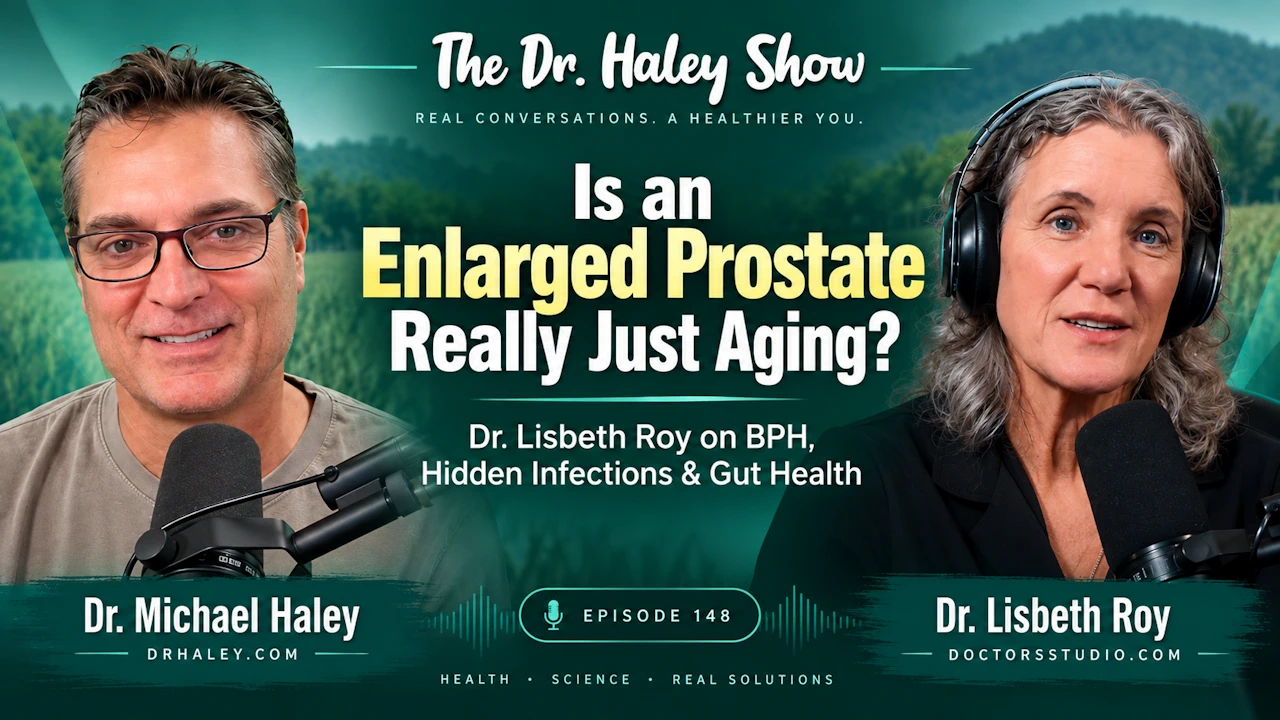
Most men do not think seriously about their prostate until something changes: getting up repeatedly at night to urinate, pelvic discomfort, changes in sexual function, or an elevated PSA. But should those symptoms automatically be accepted as an unavoidable part of getting older?
In Episode 148 of The Dr. Haley Show, Dr. Michael Haley talks with Dr. Lisbeth Roy, DO, founder and CEO of Doctors Studio and creator of the ProstaGen™ Method. Their conversation explores BPH, chronic prostatitis, urinary symptoms, PSA, prostate size versus function, next-generation sequencing, biofilms, gut and oral health, inflammation, immune function, food quality, and the difference between relieving symptoms and investigating possible underlying causes.
“Getting older doesn’t cause a large prostate. Chronic infection causes a large prostate. Metabolic dysfunction causes a large prostate.”
Dr. Lisbeth Roy
Important context: Dr. Roy expresses several clinical opinions in this episode that are stronger than, or differ from, conventional medical consensus. They are presented here as her perspective and experience, not as established facts. Men with urinary symptoms, an elevated PSA, suspected infection, or concerns about prostate cancer should seek appropriate medical evaluation.
Watch the Interview
Listen to the Podcast
Resources
- Doctors Studio: DoctorsStudio.com
- Ask Dr. Roy / prostate assessment information: AskDrRoy.com
- ProstaGen™ Method: Doctors Studio ProstaGen™ Method
- Doctors Studio on YouTube: @DoctorsStudioBocaRaton
- Dr. Lisbeth Roy on LinkedIn: linkedin.com/in/drlisbethroy
- Doctors Studio on LinkedIn: DoctorsStudio
- Dr. Roy’s book: Regenerating Sexual Potential
Quick Takeaway
This episode challenges the assumption that prostate enlargement and urinary symptoms should automatically be accepted as a normal consequence of aging. Dr. Roy describes looking beyond prostate size alone and considering patterns involving metabolic health, inflammation, immune function, gut and oral health, hormonal balance, toxic exposures, and possible infection.
A central theme is the difference between relieving symptoms and investigating why those symptoms developed. Dr. Roy’s views on hidden infection, biofilms, and next-generation sequencing are stronger than conventional urologic consensus, so they are best understood as her clinical perspective and an area for further investigation rather than settled medical fact.
ENJOYING THIS CONVERSATION?
Get the Next Episode in Your Inbox
Get notified when a new episode of The Dr. Haley Show is published, plus occasional highlights and resources worth exploring.
By subscribing, you agree to receive email from The Dr. Haley Show. Unsubscribe anytime.
Episode Timestamps
- 00:00 – Is an enlarged prostate really just aging?
- 00:38 – Meet Dr. Lisbeth Roy
- 03:28 – Root-cause medicine vs. symptom management
- 07:24 – The wellness trajectory and preventing disease
- 10:40 – Why BPH may be a warning sign
- 12:19 – Immune function, inflammation, and chronic disease
- 14:20 – Dr. Roy’s whole-food approach to nutrition
- 18:58 – Leaky gut, gluten, and food sensitivities
- 24:04 – The personal experience that changed Dr. Roy’s career
- 28:10 – Toxic load and individual susceptibility
- 32:42 – Conventional prostate treatments and symptom management
- 34:03 – Flomax, finasteride, and prostate procedures
- 35:31 – Prostate size vs. prostate function
- 37:06 – How prostate problems are commonly evaluated
- 38:48 – PSA, prostate exams, and multiple data points
- 39:43 – Next-generation sequencing for possible hidden infections
- 40:36 – Biofilms, oral bacteria, and the gut–prostate connection
- 43:07 – The ProstaGen™ Method explained
- 44:10 – Combining functional and conventional medicine
- 45:25 – When should men start checking their prostate?
- 46:42 – EPS testing and early prostate symptoms
- 47:55 – Why men avoid prostate care
- 49:10 – What happens at Doctors Studio
- 51:46 – Where to find Dr. Roy
- 52:23 – Regenerating Sexual Potential and upcoming books
- 53:30 – Final thoughts
Episode Summary
Dr. Roy approaches prostate complaints through a functional and regenerative medicine lens. Rather than viewing the prostate as an isolated organ, she describes looking for patterns involving metabolic health, chronic inflammation, immune function, gut integrity, oral health, hormonal balance, toxic exposures, and possible infection.
A major theme of the interview is the distinction between prostate size and prostate function. Dr. Roy explains that she sees men with very large prostates who function relatively well and men with prostates near the expected size who have severe urinary symptoms. She also discusses conventional symptom-management approaches such as Flomax, finasteride, TURP, laser procedures, and steam ablation, while emphasizing that symptom relief and determining why a problem developed are different clinical questions.
The conversation then turns to testing. Dr. Roy describes using next-generation sequencing on urine, semen, or expressed prostatic secretion samples to look for bacterial or fungal DNA that may not be detected by conventional culture. She discusses her clinical hypothesis involving chronic infection, biofilms, gut bacteria, and oral bacteria in prostate dysfunction. This interpretation is not universally accepted in urology, making this one of the more provocative parts of the episode.
Dr. Roy also shares the deeply personal story of her son’s illness and how that experience influenced the way she practices medicine. The discussion includes her interpretation of events surrounding vaccinations he received before the onset of seizures. A temporal association in an individual case does not by itself establish causation, but the experience became an important part of Dr. Roy’s motivation to investigate mechanisms and possible contributing factors more deeply.
Finally, Dr. Roy explains the ProstaGen™ Method, what men can expect during an assessment at Doctors Studio, how conventional and functional approaches may sometimes be used together, and why she believes men should investigate prostate symptoms rather than simply accepting them as normal aging.
Key Takeaways
- BPH may be common, but “common” and “normal” are not necessarily the same thing. Dr. Roy argues that prostate enlargement and urinary symptoms deserve investigation rather than automatic attribution to age.
- Prostate size does not always predict symptom severity. Dr. Roy describes patients with relatively small prostates and significant symptoms as well as men with very large prostates who function better than expected.
- Symptom management can still be useful. Dr. Roy speaks favorably about medications such as Flomax when immediate symptom relief is needed, while distinguishing that relief from addressing what she believes may be contributing to the underlying dysfunction.
- PSA and the digital rectal exam are data points, not the whole picture. She discusses combining them with imaging and other testing rather than making major decisions from a single result.
- Dr. Roy uses next-generation sequencing to investigate possible hidden infections. She explains how DNA-based testing can detect microbial material at levels that conventional cultures may miss.
- Biofilms are central to Dr. Roy’s infection hypothesis. She compares them to dental plaque and proposes that they may help microorganisms persist in the prostate.
- The gut and mouth may matter to prostate health. Dr. Roy describes finding gut-associated and sometimes oral-associated bacteria in prostate samples and discusses possible routes by which microorganisms could reach the prostate.
- Food quality matters in her wellness model. She favors whole, fresh foods and pays close attention to how animal foods are raised and how plant foods are grown and processed.
- Her ProstaGen™ Method starts with assessment. Testing, examination, lifestyle changes, coaching, and a personalized treatment plan are used to build what she calls a bespoke program.
- She is not “anti-conventional medicine.” Dr. Roy says patients may still need cardiologists, medications, procedures, or other specialists and describes herself as a thinking partner who wants to use all appropriate tools.
About Dr. Lisbeth Roy, DO
Dr. Lisbeth W. Roy, DO, is an osteopathic physician and the founder and CEO of Doctors Studio in South Florida. She created the ProstaGen™ Method, a multi-phase approach to men’s prostate health that emphasizes screening, comprehensive assessment, and individualized treatment. Her clinical work includes prostate health, chronic prostatitis, BPH, sexual health, functional medicine, regenerative medicine, hormonal health, gut health, and longevity.
Dr. Roy is also the author of Regenerating Sexual Potential: Revolutionary Treatment Solutions for Sexual Dysfunction Using Platelet-Rich Plasma (PRP). During this episode, she also mentions that she is working on future books related to prostate health and her broader “bucket” concept for understanding how multiple stressors may contribute to declining wellness.
Connect With Dr. Michael Haley
- The Dr. Haley Show: DrHaley.com
- Haley Nutrition: HaleyNutrition.com
- YouTube: Dr. Michael Haley / Haley Nutrition
- Instagram: @drhaleynutrition
- X: @aloe1
- Facebook: Haley Nutrition
- LinkedIn: Haley Nutrition
Listener special: Listeners of The Dr. Haley Show can hear the current Haley Nutrition coupon code inside the podcast and use it on qualifying purchases at HaleyNutrition.com.
If this conversation helped you think differently about prostate health, consider sharing it with someone who may benefit and subscribe to The Dr. Haley Show for future conversations about health, nutrition, and emerging ideas in medicine.
Medical Disclaimer
This podcast and article are provided for educational and informational purposes only and do not constitute medical advice. The experiences and opinions discussed are those of the speakers and should not replace diagnosis or treatment from a qualified healthcare professional. Do not begin, discontinue, or change any medication, supplement, diet, or treatment based solely on this episode.
Full Transcript
The transcript has been lightly formatted for readability. Because it was created from the recorded conversation, it may contain minor transcription errors.
The source transcript did not reliably identify every speaker turn, so names are not inserted where attribution could not be made confidently. The current Haley Nutrition listener coupon code has been intentionally removed from the written transcript so it remains a benefit for podcast listeners.
Read the Full Transcript
00:00 Dr. Lisbeth Roy: getting older doesn’t cause a large prostate. Chronic infection causes a large prostate. Metabolic dysfunction causes a large prostate.
00:11 Narrator: You are listening to the Dr. Haley Show, the podcast dedicated to helping you optimize your health. Each episode there will be an interview or a message to help you discover better health. We will be featuring health radicals on the show to bring new ideas to the table, as well as doubling down on key fundamentals to support you living your best life.
00:32 Narrator: Your host is no other than the founder of Haley Nutrition Dr. Michael Haley.
00:38 This is the Dr. Haley Show podcast I’m Dr. Michael Haley, your show host. Today we are going to be talking well, mostly about men problems, but I think it’s a good conversation for everybody. I think this podcast really is for everyone. You see, most men don’t think about their prostate until something goes wrong. Like frequently getting up to urinate or pelvic discomfort, declining sexual performance, maybe an elevated PSA.
01:09 But what if the prostate should not be treated as an isolated organ? Today’s guest is Dr. Lisbeth Roy and osteopathic physician, founder and CEO of Doctors Studio and creator of the ProstaGen Method. Dr. Roy is a board certified anti-aging and functional corrective medicine doctor with advanced training in functional, regenerative and sexual medicine. Her work examines how chronic inflammation, gut dysfunction, hidden infections,
01:46 toxic exposures, metabolic health, and hormonal imbalances may contribute to prostate problems and declining male vitality.
01:57 She works with men dealing with conditions ranging from BPH, benign prostatic hypertrophy and chronic prostatitis to erectile dysfunction and prostate cancer concerns. Combining conventional assessment with advanced diagnostics and emerging regenerative therapies. Dr. Roy is also author of Regenerating Sexual Potential, and recently served as principal investigator on a small pilot evaluation examining molecular and PSA changes following intra prostatic ozone therapy.
02:39 Today, we’re going to explore what men should know about prostate health which problems might be reversible. How to investigate possible root causes and where promising treatments end and unproven claims begin. Dr. Lisbeth Roy, welcome to the Dr. Haley show. I understand you are just up the road from me in South Florida, land of vitamin D, right? Yes, we’re in Boca Raton, Florida.
03:08 Thanks for having me here. I think it’s the land of vitamin D and maybe pickleball now. Yeah, absolutely. Pickleball for sure. You know, as an osteopathic physician, I am curious because I’m a chiropractor. And I know that when it comes to
03:28 health, we tend to step back and look at things differently, in our training a little bit of a less medical approach, not necessarily mainstream medicine, where we’re really focused on symptoms, but rather we’re focused on root causes.
03:45 We want to say, well, why does this person have symptoms? Is that how you were trained in osteopathic school, or was this something that really just kind of developed after the fact? A combination of both. I would say certainly one of the osteopathic tenants is that form and function are interrelated, right? That the body has an ability to heal itself.
04:09 And so
04:10 there’s a root cause mindset just right from the very beginning. I’m a mechanistic thinker and I always have been. Even growing up, I would take things apart to better understand how they work. And the human body is the same. So the entire list of imbalances and dysfunctions that you mentioned in the intro are applied to women just as easily.
04:30 I mean, they are the reason why we have any disease at all. I happen to apply it to prostate problems, because those are very difficult challenges that men face every day, and there are very few options. So an osteopathic education is in line with that root cause
04:47 mechanistic thinking, though not all osteopaths go on
04:50 to really embrace that fully.
04:52 It just seemed very obvious to me, I guess should say. Yeah. And it’s one of those things where I can’t understand how you can’t go down this road. When you think about treating people and, you know, I love that. If you look up the definition of mainstream medicine, it really talks about doctors and physicians and nurses treating symptoms using medicine, radiation.
05:22 You know, we don’t treat symptoms. We treat patients. We help patients. Right. Get well. And I think what most people don’t realize, Dr. Haley, is that a doctor’s license, whether it’s an MD or a DO’s license, is to diagnose and manage disease. That’s what we’re licensed to do. That’s what we’re taught to do. There’s nowhere in there that
05:51 it says preventing disease or even understanding how disease happens.
05:56 And I think that’s the real problem. If you don’t understand the problem, how can you possibly fix it? Right. And so I think taking a deep dive
06:05 at a cellular level, at a consequence level with toxins and gut imbalance and so on and so forth, is the only approach to understanding the problem,
06:17 the only real productive approach to understanding the problem.
06:20 But, you know, there’s very little in terms of diagnostics at that level on a conventional approach. It’s sort of like an MRI, right? Well, let’s look at a prostate MRI to see if there’s
06:34 potentially any lesions that a radiologist could call scary PI-RADS 4 plus for cancer. Well, by the time there’s a lesion large enough to be seen on an MRI, you have at least a billion circulating tumor cells, right?
06:50 So so it’s very end stage. Any of the diagnostics that we do
06:56 in a conventional approach or very end stage, you’re certainly not looking in early. You’re certainly not trying to understand how it happened. You’re identifying it. You’re naming it so that you can look up the recipe to treat the symptoms essentially. Yeah. You know, I’m thinking when I looked out my back door today, the house behind us had a tent on it for termites, and it would be nice if we could get that first termite and not have to tent the whole house, wouldn’t it?
07:24 And same thing, you know, when it comes to our health, wouldn’t it be nice if we could see things before they become a problem, you know, with that? And we can’t just said, yeah, yeah. And so I want to know who is this podcast for then? Is it for people that already have problems? Is it for men only, you know, how are women involved?
07:45 How can they benefit from listening to this podcast? Who is this for? I think it’s for everyone at every stage. You know, we are more alike than we are different. Our cellular mechanisms are supposed to work, and when they don’t, there’s a reason. And if you can find that reason and you can fix that reason, then
08:05 healing occurs or prevention occurs.
08:08 You know, wellness is not a destination. It’s a process. There’s a wellness trajectory that I think about. And if you’re not focused on how well your body is actually working, what you’re putting in, you know, your thoughts, your actions, all of these, these very important decisions that you make every single day, then you could very well be and likely are headed toward a disease.
08:32 So if your trajectory is toward a disease, then you’re just simply somewhere along the way. And
08:38 so, you know, when you’re diagnosed with the disease, often people will say, wow, how did how did that happen? Cancer, for instance. It’s a very common thing. How did that happen? I never get sick. I’ve been so healthy. Well, not so much.
08:51 And you didn’t realize that you were headed for it 10 or 15 years before you’re actually even diagnosed? Same thing with diabetes. Same thing with hypertension, a cardiovascular disease. You know, you’re on your way to those diseases today in our very toxic environment, or you’re being proactive and you’re making an investment of time and energy and resource in your wellness so that your trajectory is toward wellness.
09:21 Again, it’s not that you get there and then you just leave it in the rearview mirror.
09:24 it’s like compounding interest. I tell my patients quite frequently, a little bit on a regular basis gets you to exactly your goal. You can’t just decide that for one month you’re going to be perfect, and then all of a sudden you’re well, and then you can do whatever it is that you used to do.
09:41 So I think this is for everyone. Yeah. And I kind of like this backed up view that we have kind of, you know, everyone looking down and we’ll drill in and get more focused soon. But the problems, the things that people do that might cause prostate problems in men. What would those things cause in women? Cardiovascular disease, autoimmunity, diabetes, hypertension, all the common problems frequent urinary infection, frequent urination and urgency, all of these things.
10:18 So, you know, a male prostate tissue is similar to a breast tissue. So all of the reasons for chronic prostate issues would also be all of the reasons for developing breast cancer.
10:32 you know, it’s very interesting when you’re looking at
10:34 the center of
10:36 the wheel,
10:37 it affects everything, right.
10:39 when you’re looking at that cellular level.
10:40 All consequence is downstream. And so what are the consequences of chronic infection, systemic inflammation you know, immune dysregulation all of the common diseases and the things that we’re all trying to avoid. And mainstream medicine scratches their head and says, you know, well, you have an enlarged prostate. They call it BPH benign prostatic hypertrophy. There’s nothing benign about it. There’s no offer for any reason why this is happening.
11:08 In fact, they’re quite perplexed. And they chalk it up to, well, you’re getting older. You know, all the guys your age have this problem, so it must be getting older. That’s ridiculous. You know, getting older doesn’t cause a large prostate. Chronic infection causes a large prostate. Metabolic dysfunction causes a large prostate. I think what you just said is so significant.
11:29 People listening to this thinking, you know, well, I just have the benign, you know, BPH, it’s not significant. So what I get up once or twice in the middle of the night to pee. It’s not it’s probably not cancer. Everyone gets a big prostate. But what you’re saying that’s not the case. That is not normal. It might be average.
11:49 Common. Right? Common. Normal. Yeah. Very common. Not normal. We live in a very messed up world where we don’t do things the way they used to be done or, you know, man made foods as an example. Yeah. Perfect example. That’s right. You know, we have to think about our wellness through the lens of the immune system always, because we all know now it’s commonplace to realize that inflammation is the precursor to all disease.
12:19 Well, what caused the inflammation? Toxicity, chronic infection, metabolic dysfunction. Right. And
12:26 so if you
12:28 look at everything through the lens of the immune system, you realize that if you’re stuck in a chronic inflammation, that’s the immune system. If you’re stuck in an autoimmune process, that’s your immune system. If you’ve developed cancer, it means your immune system isn’t working.
12:43 If your immune system is working, you can’t possibly develop cancer. Right.
12:47 there are easy ways to identify a state of wellness. Very little has to do with symptoms. You know, one of the things that I’ve realized through this process of taking care of men, we take care of women as well. But
13:02 taking care of men
13:04 and helping them with their chronic prostate issues has been incredibly eye opening for me, because you get to see patterns.
13:13 You know, when you’re a generalist and anybody who walks through the door, you have to figure out how to fix them.
13:17 it’s the same approach, but you don’t get to see the patterns. When you take care of hundreds of men and you’re running the same testing and you’re seeing the same processes, you realize that look at immune system is the most important thing.
13:32 And if I could only do one test on any human being, regardless of how old they are, it would be an evaluation of their immune system to see. Are they suppressed? Is their immune system exhausted? Is it reacting to something? Is it overreactive and inflamed? So we don’t understand our bodies in this country. We don’t understand how it works.
13:55 Doctors aren’t taught how it works, and my hope is to raise awareness so that the consumer people
14:02 like you, and I can understand exactly how it works, so that we know, we realize it’s not a mystery. This is not a mystery.
14:10 it’s a very simple diagnostic process that leads you then to understanding how you know what’s happening before the wheels fall off the cart and you’re in real distress.
14:20 So with that said, I am curious about your personal diet and what are some of the nutritional choices that you make in your life and why?
14:31 And I know that one diet is not the same for everyone. So just for you, how do you eat and why? Great question. So I eat a
14:41 whole foods fresh diet that I control the quality of my food quite rigorously, actually. Green grass fed, grass, finished animals only. Free range chicken only farm fresh eggs, organic vegetables and fruits.
15:03 I mill my own grain, actually, and it’s not that difficult to be honest. You know, you buy the wheat berries and it looks like a little coffee grinder, you know. And if I’m going to bread anything, I have an organic grain. It’s very, very important that we spend our time controlling what we put in our mouth. It’s it’s the most important, I think.
15:28 And it’s not easy.
15:31 it’s simple, not easy. Right. And we are all familiar with what we really should be eating. But I think that people don’t realize that it’s not the chicken that you put in your mouth. It’s not.
15:43 how was the chicken raised?
15:45 where was it processed? Do those things are super, super important?
15:48 Maybe more so. What was put in the chickens mouth? Right. I say it’s not what you eat. It’s what you ate. Ate, right? And it’s. It’s true. If you have a commercially raised beef, it can be the highest quality. Meaning, you know,
16:04 it’s marbleized, it’s aged. It’s all of this. Well, if it grew up in a commercial way, then it was stressed.
16:10 It was fed grain that it was never meant to eat. It was, you know, jacked up with antibiotics and everything else. And you’re putting that in your mouth. Food is information. Food is chemical signals that go into the body
16:23 and create an action. And so you truly are what you eat and what you ate, ate You know, I love a lot of the things you just said, partly because for some of the listeners, it’s going to be shocking what animal foods, well, you know, understand the science is based on conventional meats, not traditionally raised, grass fed and even grass fed, you know.
16:55 Well, what if they did use grass fed? Okay. Grass fed by legal definition or truly pastured 100% grass fed for the entire life of the animal, not just the first six months and then fattened on grains. Yeah, well, that’s a tricky part, right? Because there’s no truth. Can’t the cows eat grains. Well, cows aren’t supposed to eat grains. Well, what about people?
17:16 Are they supposed to eat grains? Yeah, I love what you said about that, too. And less. You’ve ever taken your own wheat berries and put them through a grinder and made your own bread. You’re not going to really understand the difference between homemade real bread and something bought in the store that’s been filled with chemicals. You’re not going to understand it, but doesn’t.
17:42 It caused diverticulitis? Some people have sensitivities and should probably avoid wheat because they have sensitivities. They shouldn’t have the sensitivities, but now that they do, they should probably avoid it and get things under control.
17:56 Narrator: you enjoying the show thus far? One of the many health secrets that we have covered on the show is all around aloe vera. Specifically drinking raw aloe vera. Our aloe vera has helped our customers effectively heal their gut, increase their intestine health, lower inflammation in the body, eliminate and or decrease acid reflux, have glowing skin and hair, and so much more.
18:21 Narrator: Now, as a frequent member of our audience, you will be exposed to exclusive specials and coupon codes for the awesome products manufactured by Haley Nutrition. That’s right, for simply being awesome and tuning in. You can get a mini discount to help you optimize and better your health. To see how we can help and support you on your health journey.
18:42 Narrator: Tune in to the episodes and listen for coupon codes that you can use at haleynutrition.com. Before you make your orders of raw aloe vera. Once again, it’s www.haleynutrition.com. Now back to the show.
18:58 Well, and I test, I test the gut and we test the immune system. You know, you have to. If you can’t, you can in general, as you just said, paint everybody with the same brush.
19:11 In general, we are built as humans to eat whole fresh foods. We’re hunters and gatherers genetically still. But you’re right.
19:19 the minute you come into this world, you are affected by the toxicity in this world. And some people will develop a leaky gut, an autoimmune process. You didn’t come in with that. It was developed. And I think that that’s really important.
19:33 So you do have to meet the patient or yourself where you are. What is your current state of wellness? You ask me a very broad question. I don’t have gut issues.
19:43 I don’t have food sensitivity issues. I used to I have fixed them. You can literally fix your leaky gut
19:50 and down regulate your food immune reactivity.
19:53 So all the diet has to be within the context of where you are right now. But you can be fully recovered. You know, we’re generalizing here, but for the most part, humans and I fully, you know, often joked I could probably snort a box of gluten without sneezing. Now, they didn’t necessarily add gluten to the bread when they were making it traditionally hundreds of years ago.
20:16 That’s right. But now we isolate it because we love that stretchy dough. That’s right. And you know, honestly, the gluten is not always the problem. It’s the glyphosate that are in the wheat that are, you know, really problematic for people. So I think gluten gets a bad rap quite frequently, though it goes hand in hand with glyphosate unless you’re controlling your food to the nth degree.
20:43 So you do have to be very careful. Many people do. Now, I’ve had my own chickens. I do know what truly you know, pastured eggs are. And I know what it means to, you know, supplement the diet of the chickens or to rewild them and force them to eat what’s around them. And there is a difference in the eggs they produce based on what they are eating.
21:05 So what you’re buying in the grocery store? Probably not going to compare to a true free range egg from a hen. It’s completely different. Yeah. And I just want to clarify. We’re not talking about taste. We’re talking about the information that’s delivered to your body, the information that’s delivered to your body when you eat a commercially raised egg that, you know, grew up not even moving right, versus the information that
21:34 your body receives from an egg from a chicken that’s eating bugs and, and and lizards in Florida and and lizards in Florida.
21:44 It’s like steak to them, you know. And there will be a different taste. I’m going to little sidetrack here a story from the past. I remember when we ran out of eggs and we wanted to have eggs. So we went to the grocery store and I stayed forever in the egg section, studying all the labels, trying to find the best ones I could.
22:05 And I thought, I, you know, nailed it with these free range organic eggs. Brought them home. And I remember cracking them in the pan. And I remember my kids looking, going, daddy, what is this? This is yours ago. They’re all grown up now. But what is that? Because they had never seen pale yolks. And when we were eating them, they were like, oh, this is gross.
22:29 What’s wrong with them? Because they didn’t have any flavor. The color is nutrients. The flavor is nutrients. The aroma, the things you taste and see, you know, those are nutrients. And when you don’t see that color and you don’t have the flavor, you should be concerned there’s something wrong with the food. Well, yeah, absolutely. The other thing people say, well, wait a second, Dr. Haley, don’t you promote a vegan lifestyle for some people?
23:04 Not for everybody. I myself, and I’ll say it again, I am definitely not a vegan. I have my salads and my share of fruits and vegetables, and I think that these are given to us as medicine and could be helpful for cleansing and detoxifying our bodies. I’m going to agree 100% with Dr. Lisbeth Roy when she says whole foods, real foods.
23:32 And that’s something we can all agree on. Yeah, no lab substitution. Doesn’t matter how you know. They are infusing it with vitamins and minerals and so on and so forth. That’s all just marketing hype. There’s much more that goes into that information
23:53 than just, you know, these small elements. Honestly, the way the animal is raised, just like the way we are raised, has such influence on what happens next.
24:04 Yeah, for sure, for sure. Yeah. So in your career, was there a particular patient or clinical experience that convinced you the conventional approach to prostate problems was missing something? Yes, it’s kind of a big story. So when I was in medical school, my first year of medical school, my son, 13 years old, developed seizures, all of a sudden started having some seizures.
24:38 And I realized very early on through that process, through that experience, the limitations of a conventional medicine. He went on to develop dementia and movement issues. He passed away when he was 23 years old. And so through that,
24:59 you know, every every doctor visit, every year that went by and seeing the degeneration of
25:07 his function, his body, the odd answered questions, the lack of, of investigation into why really raised my awareness.
25:19 I was older when I started medical school, and I was a little wiser than a typical medical student. Having been a little older, I grew up with a mother who was way ahead of her time and, you know, was very much a health fanatic. If back then we she chases around with cod liver oil every morning or and, you know, followed by a life saver.
25:44 So it wasn’t perfect. But you know it was pretty interesting. So I so I had an awareness that there was a different way when I started medical school. And then when my son became very ill, it was very, very obvious that there are significant limitations and that we needed to dig in deeper and figure out what was actually happening and support his body in a way that medications don’t.
26:11 And so he ended up living several years longer than expected.
26:16 had a, you know, quality of life as good as it can get in that circumstance. But that was the beginning of the real education. And as you can imagine, a first year medical student, you know, you’re pretty overwhelmed by just what you have in front of you every day at a sick kid on there.
26:34 And then add the necessity to do your own research and really dig in and try to figure things out. And that was a while ago, so there wasn’t a lot written, but I’d find a paper on fish oil ratios, EPA to DHA, and you realize, wow, just that ratio makes a difference. And every it’s like a you know, he used to say, mom, you know, you treat me like a chemistry project.
26:59 I said, well, you know, you kind of are a chemistry project. And as a result, you know, he did pretty well
27:05 for a while. I’m not obviously in control of everything. But yeah, I think back, you know, I was raised on peanut butter and jelly, on Wonder Bread and baloney and all kinds of processed foods. And I remember when I was in chiropractic school, we started getting some nutrition courses.
27:26 Not as much as I would have liked to have had, but it was being exposed what was really in the food. And at the time, my mother had cancer. And, you know, I wanted to help her as much as I could, but I had very limited knowledge. And it was at that time for me that I was going through changes in my understanding of what it meant to eat a healthy diet.
27:53 At that time in your life, where were you? Were you already on the Whole Foods, or were you kind of in that same transition, just learning?
28:04 We were, as I mentioned, I grew up really that way. And so we ate healthy food.
28:10 we moved our bodies. We understood clean water. Right. You know, what happened with Liam is, is a little bit challenging to talk about. We were going to go do a medical mission. And so not knowing anything, I brought him to his pediatrician and said, hey, we’re going
28:30 to Indonesia.
28:33 Liam was born in 1986. There was no hepatitis B vaccination given to these kids back then. So the doctor said he needs a Hep B series and he should have an MMR booster. And so, you know, not knowing any better, I said, okay. And then it was within 90 days of that vaccination episode, if you will, that he developed these seizures.
28:58 And so, you know, was it the vaccinations? Probably. And not because vaccinations are all bad, but there is a toxic
29:08 element to vaccinations and there are some bodies that cannot manage that. Right. And so we talk about toxic exposure. Well we’re all exposed to toxins, there’s no doubt about that. But how it’s not even about the exposure. It’s how well does your body process these things.
29:25 You know, you can have a family of five living in a house that’s full of mold, and only two of them are taken
29:31 out and are affected. The other two seem fine. And that’s because
29:35 for very specific biochemical reasons,
29:38 I was going to say for whatever reason. But we know what the reasons are for very specific biochemical reasons.
29:44 Those people are able to process out those toxins. And I don’t believe that Liam was
29:50 and you know, that was really the challenge. All diseases there are less than 1% of diseases are actually genetic where
29:59 you’re born with these. We’re all born with a predisposition to have a disease. I talked to my patients about a weak link.
30:06 Whatever your weak link is, and it’s usually family associated. Some families get cancer, some families get cardiovascular disease, whatever that weak link is.
30:14 if it’s challenged, that’s where you’re going to have a problem. And
30:18 if Liam had a toxicity, a detoxification pathway dysfunction then and he was he took this big hit. You know, that’s what triggered this epigenetic likely genetic associated vulnerability.
30:36 And so our diet
30:39 wasn’t really the problem.
30:41 we lived in rural New Hampshire and we really weren’t exposed to lots of industrial type toxins. I that’s the only thing I can put
30:51 my finger on. And, you know, again, who knows. Had I known then what I know now, Liam may still very well be thriving.
31:01 Because it’s not just one thing, you know, perhaps he had mold toxicity on board. Perhaps he had some, you know, Epstein-Barr, cytomegalovirus. He had walking pneumonia several times when he was a kid. So, you know, it’s like a bucket, right? As the bucket overflows is when you have the symptoms, your bucket can be filling with these things and you can be without symptoms.
31:23 But as soon as that bucket overflows, you know, now you’re in a different place. Had I known then what I know now, as I mentioned, I would check him for toxicities. I would check him for these stealth infections. I would fix his gut. I would, you know, have taken a deep dive. But it’s all part of learning, you know.
31:43 And thank you for sharing that about Liam. And I was unaware of that going into this and in the discussion. I do think it’s, you know, definitely helpful for people to just step back and say, okay, let me find out about the decisions I’m making. Let me decide what treatments we need, what treatments we don’t. When it comes to vaccines, I like to tell people, you know, maybe look up the thing you’re getting vaccinated against and decide, do I need that?
32:18 Am I being exposed to this? What are the risks? And if it’s, you know, is this something that is going to cause the sniffles? If I don’t get it, is there or is there a serious risk on my life and decide individually when it comes to the vaccines, whether or not you need that particular vaccine? That’s my advice on that.
32:42 And I would say the same with all medical treatments, I’m guessing. See, we never got into this discussion yet about the prostate, but I’m guessing there’s probably some common medical procedures that people get to their prostate that have risks. Right? 100%. All of what conventional medicine has to offer men with an enlarged prostate, chronic prostatitis are symptom management approaches.
33:09 So the medications are symptom management. The procedures are symptom management. And though there’s nothing wrong with managing symptoms, if you also dig into root cause, the men that I see have been managing their symptoms for years and the management of their symptoms no longer works. And so they’re seeking some sort of alternative. So we don’t see easy cases, you know, simple early problems.
33:35 We see problems that these guys have been dealing with for decades typically. And some of them even since teenage their teen years. Dr. Roy, what’s an example of managing a prostate symptom. Yeah. Flomax is an example of managing a prostate symptom. Flomax is a common medication. In fact, if you were to survey your neighbors, probably 50% of men over 50 are on the flomax on your neighborhood.
34:03 Well it’s unbelievable. Yeah, it’s a very, very common medication. And again, it’s a great medication if you need symptom relief right away. It’s a great medication. It works quite frequently for a period of time. The reason it doesn’t work forever is because the disease process continues to march on
34:21 When you treat symptoms, you’re not actually treating the cause.
34:24 So the cause continues
34:25 to move forward and you end up in a different place. Five years later, the flomax relaxes the urethra so that it’s easier to urinate. And you, you know, empty your bladder better. So it does work. Finasteride is another symptom management for the prostate. Even the procedures like a terp or the green laser or steam ablation, all of these things are getting, you know, press these days.
34:53 It doesn’t matter how good conventional medicine gets at doing these procedures, how less invasive is better, because it is you’re still treating a symptom. And, you know, a lot of the guys that we see, they are tagged again, the diagnosis is really just a tag doesn’t tell you where it came from or why it’s happening. They’re tagged with a BPH diagnosis.
35:18 Nobody’s imaged their prostate. Nobody’s really identified how big their prostate is. But you know, it’s so normal. They say you’re just getting older. We’ll give you this tag. We’ll give you this medication.
35:31 we do 3T MRIs on all of our male patients. And often they have a tiny little prostate with horrible, serious symptoms. Why? Because it’s functional, not structural.
35:44 I have some guys. Your prostate supposed to be around 30g. I have some guys with prostate above 200g. That’s a lot that that’s you know, you’re talking seven almost seven times the size. And yet we’re able to recover their function without symptoms. And then I have men with 35 and 32 gram prostate who have horrible symptoms
36:08 and are really challenged.
36:09 So it’s not about size, it’s about function.
36:12 A Haley Nutrition listener special is announced here. [The current listener coupon code is intentionally omitted from the published transcript. Listen to the episode for the code.]
36:42 Enjoy the rest of the podcast.
36:44 Well, the things you’re saying right now are very educational because as you’re talking about grams and size differences. And the other thing that you said that was educational, you said something to the effect that they’re not doing the imaging. So if I heard you correctly, it’s a symptom based meaning, you know, I get up 2 or 3 times to pee at night.
37:06 Oh, here’s flomax. Is that what’s happening 100%, 100% There’s no there’s typically rarely is there any kind of testing to see if you have hidden infection? One of the reasons is because your urine culture is almost useless, to be honest. In this particular case, these bacteria are well established, deep in the prostate, covered with biofilms and urine.
37:32 Culture is not sensitive enough
37:33 to grow these things out. If you look at the urologic literature, they’re in complete denial that there’s infection, chronic hidden infection associated with BPH. They don’t give you any reason for BPH, but they’re in complete denial. In fact, the literature even says that less than 10% of men with chronic prostatitis have infection.
37:56 I can tell you 100% of them do. 100% of the BPH guys do as well. So yeah, it’s crazy, but I think part of the reason is the testing isn’t sensitive enough that’s offered in a conventional setting. And, you know, you get a negative test over and over again. You stop even testing because you say, well, this is probably not infectious.
38:16 And so you medicate. So there’s really no diagnostic that’s done. There’s assumptions that are made, this medication that helps to relieve symptoms. And so success from a conventional perspective until it gets bad enough where then you’re offered a procedure. I’m not the best example when it comes to taking care of myself and getting scanned or checked. I admittedly haven’t been to a doctor in years when it comes to prostate exam.
38:48 What am I familiar with? Rubber glove and some lubrication, and I’m guessing possibly when it comes to, you know, you were talking very specific sizes diagnosed by MRI, I would imagine possibly the prostate palpation is what most people are getting and. Oh, kind of feels big. Yeah. And I’m not saying that that exam doesn’t have a place you would know, does it?
39:16 It’s a data point. We want all the data points. Right. But it’s only one of many data points that should be collected. Okay. PSA only feel a very small piece. Okay. PSA is a data point I wouldn’t make any major clinical decisions based on just PSA. But it’s an important piece
39:35 of information okay. So it sounds like the urine test isn’t really that much of a data point at all.
39:43 What are the accurate data points? There are urine tests and semen tests that use next generation sequencing to identify bacteria that are in the prostate hidden.
39:55 that is what we use. Big word next generation sequencing. Next generation sequencing. What’s that? Yeah. Thank you. That is that we can find little pieces of bacteria, fungal DNA in the sample versus a culture where you have to have enough of them to grow it in a culture.
40:16 So it’s a instead of having to have 50,000 of an organism in a sample, you can have five. That’s how sensitive it is. So it’s very sensitive. So you’re finding things that
40:28 weren’t found before. Their in their and they don’t belong in there. And so that’s important. And it’s important to identify them because many of the
40:36 bacteria that we find in the prostate are biofilm forming, which means that the bacteria in your mouth, for instance, form biofilms.
40:45 That’s the plaque on your teeth. Plaque on your teeth is very thick. It’s very sticky. It’s very hard to get off. That’s exactly what happens in the prostate is these bacteria that find their way to the prostate are often oral bacteria, from tiny little infections that you don’t even know that you have, that are seeding into the bloodstream, or gut bacteria or both gut bacteria that have microscopically leaked through the lining of the gut into the bloodstream and found their way to the prostate.
41:16 those are the two big ones. And we find gut bacteria almost universally and sometimes oral bacteria. Every time we found oral bacteria and just real quick finishes, every time we found oral bacteria and we send our patient for a cone beam Cat scan that actually can find it, they find a small infection. The bacteria came from somewhere.
41:37 If it’s oral, it came from your mouth. Whether you realize you have an infection or not. Yeah, same thing with a leaky gut. Maybe you don’t have any gut symptoms, but if you have gut bacteria in your prostate, you’ve got a gut problem. So okay. And is the traveling from the oral, you know, infections swallowing through the gut and still through the same mechanism, a leaky gut eventually making it to the bloodstream?
42:00 Or is there a more direct from the. Yeah, oral infections from the oral infection itself going into the bloodstream right from the mouth. Okay. Well, this is why, you know, diabetics who have an infection that they’re unaware of will have a spike in blood sugar, right.
42:20 oral infections are a major, major problem. And most people don’t even realize that they have one.
42:27 Right. And what do you do along those lines? Obviously you have to treat the oral infections. Is that going to a biological dentist in combination with treating the prostate? Sometimes, yeah, sometimes. That’s what that means. Sometimes it’s a matter of, you know, it’s not large enough to have to be treated directly. You can treat it indirectly. You fix the gut, you recover the immune system.
42:54 You, you know, change the diet. There’s lots of things that can be done. Not everything needs a big procedure, but you need the information, okay? In order to be able to, you know, to make educated and appropriate decisions. What was the name of the protocol that you have developed? Trademarked Prostagen It’s called the Prostagen method. And it’s really a methodology.
43:18 it’s an assessment first so that we can really understand we call it there’s seven hidden clinical dysfunctions. And we need to identify which of the seven are you experiencing. And from that diagnostic from that assessment we then develop a bespoke treatment program that we will put down in writing for you that you can go off and do on your own, or you can do with us.
43:46 It’s highly dependent on what it is that we found on the assessment. Is it an assessment and a treatment process? Is it kind of all inclusive, or is it sometimes done alongside of medical treatments through the care of another physician, or is that something that you would supervise the full program? Yeah, it depends. It really depends what it is that we’re dealing with.
44:10 I’m not a cardiologist. I’m not going to replace your cardiologist. It’s, you know, we may do things that are going to effectively change your cardiovascular wellness, and that’s important. But, you know, I think that you need a team of providers and you need to be educated on what the options are. And then you need to make your own decisions.
44:31 So I will certainly be thinking partner with my patients for sure. I’m not anti anything. I’m really I like common sense, I like data and to drive decisions and you know, we suspend judgment. We basically say does it make sense. And if it makes sense we do it. If it doesn’t make sense we don’t do it. So there are very frequently times when a conventional approach is continued and necessary.
44:59 You know, it’s like somebody with depression taking antidepressant medication. All of a sudden they feel better, they stop their medication. You know, that’s not the right approach to realize. What did you do to fix the reason why you got there to begin with? You know, if that’s fixed, then, okay, maybe we can come off medication, but just because you’re seeing a wellness focused physician doesn’t mean you suddenly can stop taking your blood pressure medication or cholesterol medication.
45:25 You know, so we use we use common sense. And I like all the tools in the toolbox. Okay. So when we’re looking at men of all ages, men have prostate. At what point should they be thinking about getting checked? I think men should be checked in their 30s if they have any kind of symptoms. Meaning pain, pain with ejaculation where they’re aware of their prostate, they should be checked at any age.
46:00 As I said, I have a couple of patients that these problems started as teenagers, and several of them started in their 20s where
46:08 they had discomfort, you know, went to the urologist it was nothing, nothing to worry about. Or maybe there was a course of antibiotics which seemed to take care of the symptoms. And really what it did was drove the infection just deeper to hide behind these biofilms, got rid of the free floating bacteria that caused the symptoms but didn’t get rid of the real problem.
46:33 So yeah, I think that a we call it an EPs and express prostatic secretion test should be
46:42 part of a 30 year old’s evaluation. Yeah. Very interesting. Yeah. And you know personally don’t use me as an example people. I have not been to the doctor forever and I know I should, I know I should I haven’t had a prostate exam since I was a well drugged in college.
47:03 So someone must have slipped something in my drink and I did not know what was wrong with me. So I took myself to the hospital. I didn’t know what else to do. I just knew something was really weird. And it was after that when I realized there’s a difference between hospitals and teaching hospitals. So I guess the students have to learn somehow.
47:25 And a lot of students learn how to do a prostate exam that night. I’m sorry about that. You had your lifetime supply, I guess. Yeah. Yeah. No one should go through that. But years later, I actually do kind of chuckle. Oh, boy. And that’s not why I have not gone to the doctor. Yeah, but I think it’s important to just note that, you know, these are challenging problems for men.
47:55 They’re embarrassing. Men feel very vulnerable. You go to urology office and there’s dozens of men just sitting in the waiting room waiting to go in to see the urologist for a quick visit. You’re there two hours before you come in again. I’m generalizing, but that’s the common experience. I think that’s another big part that’s wrong with medicine is, you know,
48:20 this is a relationship.
48:22 It begins right from the beginning. And men need to feel comfortable and able to allow themselves to be vulnerable, allow themselves to be educated, allow themselves to be treated, and to disclose all of the information associated. So I think it’s really important to create a safe place, which is what we’ve done.
48:44 and as a result, you know, the healing relationship begins.
48:48 It doesn’t matter what tools you have on the other side of that door. If there’s no healing relationship, you’re going to be limited. Great, great. Tell us about what people would expect in your particular clinic on a well, let’s say they’re 30 years old, going for their first check or they’re 40 years old or they’re 50. How does it change over the years?
49:10 What can people expect if they made an appointment with you? And would they come in person? Or is it telemedicine where they’re given instructions to get certain tests? The assessment at this particular time is done in person. We are collecting samples, many different kinds of samples. We’re examining you, you know, we introduce you to the team, we give you a little tour, you’re quite comfortable.
49:36 You’re there for an hour and a half or two, and then we start you on a wellness program we call Studio Detox, which is really a modified elimination diet with some gut support, liver detoxification support, K2, D3, all the foundational stuff. And we connect you with a health coach that you virtually connect with once a week through a 30 day process.
50:01 While we’re getting your lab results and putting together a bespoke treatment plan for you. So it’s about a four week process where most men are doing better already by the time we deliver their results to them.
50:17 and, you know, give them
50:19 plan forward, because we’ve already started to fix their diet and prepare their body
50:23 for a better result.
50:25 So that’s how the whole thing starts and every person goes through the same process, meaning everything starts with an assessment. Everything starts with cleaning up the body foundationally. And you know, I have people who say, well, but I already eat well and I already this and I already that. Okay, great. Well then you it’ll be easy for you to go through this process.
50:44 And many times they’re the ones at the end of the four weeks are saying, wow, I feel so different already. It’s like, yeah,
50:50 it’s an interesting, great process actually. So they really get to know us even before we, we go any further. It’s a whole team approach. It has to be. Now let me just elaborate there.
51:03 We do much of the medical management, the lab interpretation. Again, that whole lab interpretation and the presentation
51:11 of the bespoke program is done remotely. So the only time we have you come to the office is if we’re, you know, poking and prodding or delivering some procedure or collecting some sample that can’t be done remotely. Otherwise, we see our patients once a month virtually.
51:28 that’s where all the heavy lifting really happens. And again, they’re connected with a coach that they see as frequently as possible. We’d like to have them see the coach every week that coaches are I mean, you know, the better you get the more coaches you need, right. That’s right. That’s right. You know, I have hundreds of questions I could ask you.
51:46 I feel like we scratched the surface. I’m hoping that you can give a some references of where people can go to find out more. And a good, solid call to action for those that need to take action. Absolutely. The practice website is doctorsstudio.com all spelled out two S’s, and we’ve created a special website for men who are interested in pursuing prostate assessment evaluation.
52:15 It’s called askdrroy.com ask A S K D R R O Y.com
52:22 And I think that’s
52:23 the next best step is to come in for an evaluation and assessment so we can see where you are on your wellness trajectory and what might be causing some of the symptoms. If you’re experiencing any. Great. And how about a quick plug on your book. Tell us about that. Oh, Regenerating Sexual Potential is a book that I wrote actually several years ago.
52:45 I was at the beginning of the wave of using platelet rich plasma in a practice to regenerate.
52:51 and now that is part of my discovery. I actually have a book coming out soon on prostate in particular, and another one on this whole bucket theory where I’m trying to help educate people so that they can understand what wellness is, how to be well,
53:09 how you actually became unwell.
53:11 And so two books in the future, great regenerative. I love what you’re doing is a good place to start. Thank you. Thank you so much for taking time to spend with me and my audience. This was great. I wish we had more time next time. Thank you very much, I appreciate it.
53:30 Narrator: I hope you enjoyed that episode today on the Dr. Haley Show. Make sure to hit subscribe on whichever platform you are listening to this. If this episode made you think of someone, go ahead, take a screenshot and share this exact episode with them. You can catch the show notes for this episode on drhaley.com. If you want to geek out with Dr. Michael Haley on other radical health topics.
53:55 Narrator: Be sure to check out his YouTube channel where he posts exclusive video content. All the details are at drhaley.com and we can’t wait to hang out with you on the next episode.