
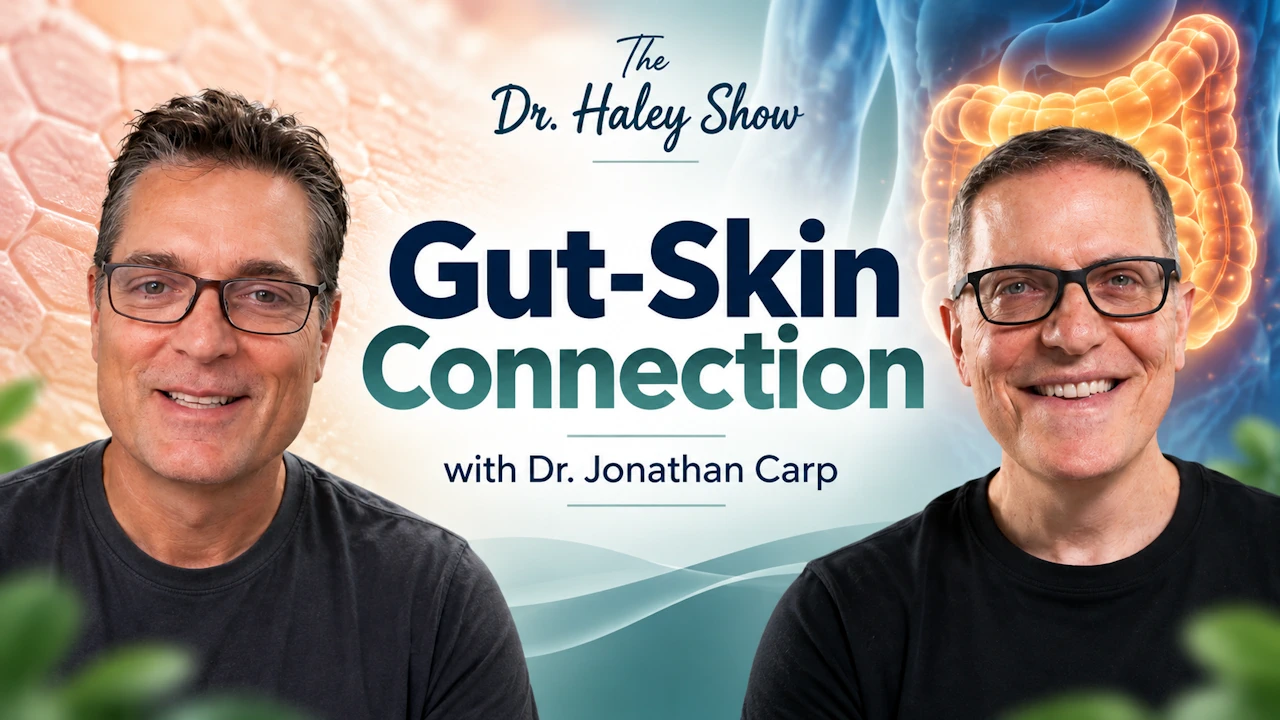
Could acne, eczema, psoriasis, or another inflammatory skin problem be telling you something about what is happening inside your body?
In Episode 149 of The Dr. Haley Show, Dr. Michael Haley sits down with board-certified dermatologist, lifestyle medicine expert, and Miracle Noodle founder Dr. Jonathan Carp for a wide-ranging conversation about the gut-skin connection, metabolic health, inflammation, nutrition, mental imagery, and what it means to become your own authority in health.
Dr. Carp explains why he has long viewed the skin as a window into internal health and shares the story of a patient with severe lupus whose dramatic improvement caused him to rethink the way he practiced medicine.
The conversation eventually turns to another major chapter in his life: a visit to a Buddhist vegetarian restaurant outside Kyoto, Japan, where a bowl of unusual noodles introduced him to konjac and glucomannan. That experience ultimately led to the creation of Miracle Noodle.
Watch the Interview
Direct YouTube link: https://youtu.be/RDLizF7_Qgw
Listen to the Podcast
Resources
- Miracle Noodle: miraclenoodle.com
- About Dr. Jonathan Carp: Miracle Noodle – About Dr. Carp
- Dr. Jonathan Carp on Instagram: @drjcarp
- Miracle Noodle on Instagram: @miraclenoodle
- Miracle Noodle on YouTube: Miracle Noodle YouTube Channel
- Healing Visualizations by Gerald Epstein, M.D.: Book Information
- Radical Remission by Kelly A. Turner: Book Information
- The Dr. Haley Show: drhaley.com
- Haley Nutrition: haleynutrition.com
Quick Takeaway
Dr. Jonathan Carp encourages listeners to think beyond the surface when considering inflammatory skin problems. In this conversation, he explains how metabolic health, gut health, diet, hormones, immune function, mental state, and lifestyle may overlap rather than acting as completely separate influences.
The episode also traces two major turning points in Dr. Carp’s career: a patient with severe lupus whose improvement pushed him to investigate nutrition and lifestyle more deeply, and a later trip to Japan that introduced him to konjac noodles and eventually led to the creation of Miracle Noodle.
ENJOYING THIS CONVERSATION?
Get the Next Episode in Your Inbox
Get notified when a new episode of The Dr. Haley Show is published, plus occasional highlights and resources worth exploring.
By subscribing, you agree to receive email from The Dr. Haley Show. Unsubscribe anytime.
Episode Timestamps
- 00:00 Your Gut Is an Extension of Your Skin
- 00:49 Meet Dermatologist Dr. Jonathan Carp
- 03:04 The Skin as a Window Into Internal Health
- 06:26 Acne, Insulin & Gut Health
- 08:50 The Lupus Patient Who Changed His Practice
- 12:16 Mental Imagery and Healing
- 15:08 How Dr. Carp Uses Healing Visualization
- 19:29 The Gut-Skin Connection Explained
- 23:10 Metabolism, Gut Health & Inflammation
- 27:09 The Four Pillars and the 80/20 Rule
- 30:23 Disease-Reversal Diet vs. Long-Term Diet
- 33:00 How Miracle Noodle Began in Japan
- 34:45 Glucomannan: The Fiber Behind Miracle Noodle
- 35:50 Keto, Satiety & Fasting-Mimicking Diets
- 38:10 Gut Benefits of Konjac and Glucomannan
- 40:46 How to Prepare Miracle Noodle
- 41:44 Egg-White Noodles: A High-Protein Alternative
- 43:11 Fiber, Regularity & the Microbiome
- 45:21 Where to Find Miracle Noodle
- 46:24 Becoming Your Own Authority in Health
- 48:22 The “Power Words” That Shaped Dr. Carp
- 51:41 Final Thoughts
What You’ll Learn in This Episode
- How the skin can provide clues about what is happening internally
- Why Dr. Carp considers acne partly a metabolic problem in many patients
- How insulin, diet, hormones, gut health, and inflammation may intersect with skin health
- The lupus patient whose experience changed the direction of Dr. Carp’s medical career
- Why Dr. Carp uses mental imagery with some patients
- What he means when he describes the gut and skin as parts of one connected system
- Why metabolic health and gut health are two major areas he considers when evaluating inflammatory disease
- The difference between a temporary disease-reversal diet and a sustainable long-term diet
- How a meal in Japan led to the founding of Miracle Noodle
- What konjac and glucomannan are
- How soluble fiber may interact with the gut microbiome
- Why Miracle Noodle became popular among people following low-carbohydrate, keto, and gluten-free diets
- The difference between Miracle Noodle’s konjac noodles and its egg-white noodles
- Why Dr. Carp believes people should become active participants in their own health decisions
The Skin as a Window Into the Body
Dr. Carp says one of the things that originally attracted him to dermatology was the realization that the skin can reveal signs of conditions occurring elsewhere in the body.
Even within conventional dermatology, certain metabolic disorders, infections, autoimmune diseases, and internal illnesses can have recognizable manifestations on the skin. For Dr. Carp, that made dermatology much more than simply treating what could be seen on the surface.
Over time, his interest expanded into nutrition, lifestyle, metabolic health, and the gut microbiome. Rather than viewing every inflammatory skin condition as an isolated problem, he began asking what might be happening within the patient’s broader physiology.
Acne, Insulin, and Metabolic Health
One example discussed in the episode is acne. Dr. Carp describes acne as frequently having a metabolic component and says he often evaluates fasting insulin in his acne patients.
He also looks at diet, gut health, and hormonal factors. According to Dr. Carp, lowering the glycemic load of the diet and increasing whole vegetables can be useful strategies for some patients.
The larger point is not that every case of acne has one simple cause. Instead, Dr. Carp sees skin disease as a “mixed bag” in which metabolism, hormones, gut health, immune function, lifestyle, and other factors may overlap.
The Patient Who Changed Dr. Carp’s Practice
One of the most memorable parts of the interview is Dr. Carp’s story about a patient named Karen.
Early in his career, Karen had severe skin manifestations associated with lupus. Dr. Carp says he had tried multiple powerful medications without getting the results he wanted and had become deeply concerned about the risks of the treatments she was receiving.
After disappearing from his practice for several months, Karen returned dramatically improved and carrying a stack of books and journal articles about nutrition and lifestyle approaches.
Dr. Carp initially put the materials on a shelf. Eventually, however, he read them, contacted physicians working in this area, attended conferences, and began cautiously incorporating what he was learning into his own practice.
He describes that experience as a major turning point in his professional life.
Mental Imagery and the Healing Process
Dr. Carp’s approach was also influenced by psychiatrist Dr. Gerald Epstein, with whom he studied for many years.
Epstein taught a form of mental imagery that differs from a typical guided visualization. Instead of telling a patient exactly what to picture, the practitioner may create a starting point and allow the patient to generate his or her own imagery.
Dr. Carp gives the example of a patient who compulsively picked at her skin. She described her condition as feeling like barbed wire being dragged across the skin. When asked to imagine the opposite, she pictured smooth glass tubes moving across and healing the skin. That image became part of an exercise she could repeatedly practice.
He emphasizes that these techniques are not a replacement for appropriate medical care. Rather, they are one component of the broader way he thinks about health, behavior, stress, perception, and patient participation.
Is the Gut Really Connected to the Skin?
Dr. Carp offers a simple way to visualize the gut-skin connection: the digestive tract and the skin are both interfaces between the body and the outside world.
From the mouth through the gastrointestinal tract, the body maintains a highly specialized barrier that interacts continuously with food, microorganisms, chemicals, immune signals, and the environment.
Dr. Carp encourages patients to stop thinking about the skin and gut as completely unrelated systems. If the body’s barriers, immune system, metabolism, or microbial environment are disrupted, effects may appear in more than one location.
Metabolism, Gut Health, and Inflammation
When Dr. Haley asks what is going wrong “from the inside out,” Dr. Carp describes several pillars of health, including mental state, environment, mechanical factors, and nutrition.
For many of the patients he sees, however, he says two broad areas repeatedly stand out: metabolic health and gut health.
Psoriasis is one example discussed during the interview. Dr. Carp points to the association between psoriasis, systemic inflammation, and metabolic syndrome as one reason dermatologists should not always think exclusively about the skin lesion itself.
He also stresses that no single lifestyle factor is necessarily the dominant factor for every person. For one individual, nutrition may be the biggest opportunity for improvement. For another, sleep, stress, movement, relationships, or mental outlook may have an outsized effect.
Disease-Reversal Diet vs. Long-Term Diet
One particularly useful distinction Dr. Carp makes is between a disease-reversal diet and a long-term diet.
A person trying to make a significant change in a chronic condition may temporarily follow a more restrictive nutritional program than someone who is simply trying to maintain good health.
That does not necessarily mean the restrictive phase must continue forever.
Dr. Carp personally describes his own diet as vegetable-heavy and Mediterranean-style, with fish included. Both he and Dr. Haley agree on one principle that transcends many competing dietary philosophies: prioritizing real, minimally processed whole foods.
How Miracle Noodle Began in Japan
Shortly after his experience with Karen began changing his medical thinking, Dr. Carp traveled to Japan.
A friend’s family took him to a Buddhist vegetarian restaurant outside Kyoto, where he was served a bowl of noodles unlike the conventional flour- or rice-based noodles he expected.
He learned that the noodles contained very few digestible carbohydrates or calories. Because he was already helping patients make dietary changes, Dr. Carp immediately saw the potential for a food that could provide the familiar experience of eating pasta while fitting into specialized diets.
He returned home, created a website, and began selling the noodles in 2006.
What began as a product aimed largely at people with diabetes, celiac disease, and specialized low-carbohydrate diets eventually grew into Miracle Noodle. During this interview, Dr. Carp says the company’s products are now carried in approximately 25,000 stores nationwide.
What Are Konjac and Glucomannan?
Traditional Miracle Noodles are made primarily from water and flour derived from the konjac plant.
Konjac contains a soluble fiber known as glucomannan. Dr. Carp describes glucomannan as a potent prebiotic fiber that can interact with the gut microbiome and contribute to satiety.
Because the noodles are mostly water and contain very little digestible carbohydrate, they became particularly popular among people eating keto or other low-carbohydrate diets.
During the interview, Dr. Haley also notices an interesting similarity to Aloe vera. Aloe contains complex polysaccharides—including acemannan—that have made Aloe vera another plant of interest in conversations about digestive health.
How Do You Prepare Miracle Noodle?
Dr. Carp says preparation is simple.
- Open the package and drain the liquid.
- Rinse the noodles.
- Add them directly to a pan with your preferred sauce.
- Heat for several minutes so the noodles absorb the flavors of the dish.
He also uses the noodles or Miracle Rice in soups, stir-fries, salads, and Instant Pot recipes.
Miracle Noodle additionally offers an egg-white noodle made primarily from egg whites and water. Dr. Carp explains that this option serves a different nutritional purpose by providing a higher-protein alternative while still avoiding conventional starch-based pasta.
Becoming Your Own Authority in Health
A phrase that appears repeatedly throughout this conversation is “becoming your own authority in health.”
For Dr. Carp, that does not mean refusing medical advice or believing that an individual automatically knows more than a trained clinician.
It means becoming informed, engaged, observant, and willing to take responsibility for the decisions and daily behaviors that influence health.
Dr. Carp currently teaches a live Wednesday evening class for people who want to explore topics ranging from metabolic health to laboratory testing, nutrition, and other practical health strategies.
Power Words That Shaped Dr. Jonathan Carp
Near the end of the interview, Dr. Haley asks Dr. Carp about memorable words or phrases that influenced the way he lives.
Three immediately come to mind.
- “It’s better to be smart than right.” — advice from his father reminding him that proving oneself correct is not always the wisest response.
- “Become your own authority.” — a concept central to the teaching of his mentor Dr. Gerald Epstein.
- “You can have everything in life you want if you will just help enough other people get what they want.” — a principle associated with Zig Ziglar that Dr. Carp says continues to influence his life.
About Dr. Jonathan Carp
Jonathan Carp, MD, is a board-certified dermatologist, lifestyle medicine expert, and founder and CEO of Miracle Noodle. His approach combines conventional dermatology with an interest in nutrition, metabolic health, gut health, lifestyle, and mental imagery.
After a patient experience early in his career caused him to explore nutrition and lifestyle medicine more deeply, Dr. Carp began incorporating those concepts into his clinical work. A later trip to Japan introduced him to konjac noodles and ultimately inspired the creation of Miracle Noodle in 2006.
Learn more at MiracleNoodle.com.
About Dr. Michael Haley
Dr. Michael Haley is the founder of Haley Nutrition and host of The Dr. Haley Show. Through the podcast, he speaks with physicians, researchers, entrepreneurs, practitioners, and other health innovators about nutrition, gut health, longevity, lifestyle, and unconventional ideas worth exploring.
Visit DrHaley.com for more podcast episodes and HaleyNutrition.com to learn more about Haley Nutrition.
Medical Disclaimer
This podcast and article are provided for educational and informational purposes only and do not constitute medical advice. The experiences and opinions discussed are those of the speakers and should not replace diagnosis or treatment from a qualified healthcare professional. Do not begin, discontinue, or change any medication, supplement, diet, or treatment based solely on this episode.
Full Transcript
The transcript has been lightly formatted for readability. Because it was created from the recorded conversation, it may contain minor transcription errors.
Read the Full Transcript
This transcript has been lightly edited for readability. Promotional segments are abbreviated, and the current Haley Nutrition listener coupon code has intentionally been omitted so it remains an exclusive benefit for podcast listeners.
00:00 — Preview
Dr. Jonathan Carp: Your gut is an extension of your skin. It is very similar to the skin. Your skin actually is much thicker than what’s happening in your gut, but it is directly connected. Obviously, everyone can imagine why it’s connected. It’s connected from your face to your mouth, to your throat, to your stomach, small intestine, etc.
00:21 — Show Introduction
Announcer: You are listening to The Dr. Haley Show, the podcast dedicated to helping you optimize your health. Each episode features an interview or message designed to help you discover better health. We feature health radicals bringing new ideas to the table while doubling down on key fundamentals to support you in living your best life. Your host is the founder of Haley Nutrition, Dr. Michael Haley.
Dr. Michael Haley: This is The Dr. Haley Show. I’m Dr. Michael Haley, your show host. Today’s guest brings together two areas of medicine that are often treated separately: the health of our skin and the health of everything beneath it.
Dr. Jonathan Carp is a board-certified dermatologist, lifestyle medicine expert, and founder and CEO of Miracle Noodle. After seeing patients transform their health through changes in nutrition and lifestyle, he began looking beyond prescriptions to better understand how food, inflammation, the microbiome, stress, sleep, and even the images we hold in our minds can influence healing.
That journey eventually took him to Japan, where he discovered noodles made from the konjac plant and saw an opportunity to give people a lower-carbohydrate alternative to traditional pasta. He founded Miracle Noodle in 2006, and the company’s products are now sold in thousands of stores nationwide.
Today we’re going to explore the gut-skin connection, what might be driving chronic inflammatory conditions, how to determine whether food is helping or hurting you, and whether changing what’s on your plate can truly change what happens to your skin.
Dr. Jonathan Carp, welcome to The Dr. Haley Show.
03:04 — Why Dermatology?
Dr. Michael Haley: When you studied medicine and decided you were going to be a dermatologist, did you foresee helping people from the inside out like this?
Dr. Jonathan Carp: I did, because one of the things that attracted me to dermatology was something a lot of people don’t realize: the skin is often the first sign of many internal conditions.
One of the things during my medical-school rotation that interested me was seeing cutaneous signs of diabetes and unique skin expressions associated with certain internal cancers. That was what made me interested in dermatology from the beginning. The skin was a window into the body.
Dr. Michael Haley: Maybe I have the wrong impression of dermatology. I think of going to a dermatologist and having things scraped, burned, or removed, and then putting creams on inflammatory conditions. It seems like an outside-in approach.
Dr. Jonathan Carp: The history of dermatology is interesting. It began as dermatology and venereology—the study of skin and skin infections. We still routinely see sexually transmitted diseases in dermatology practices.
Thirty to forty percent of the practice may involve things like skin cancers depending on where someone practices, while much of the rest involves inflammatory skin diseases.
In my case, I’m looking at what I can do to correct the internal terrain to improve what’s happening on the outside. Medicine has also developed many external or systemic treatments that can quiet inflammatory conditions such as psoriasis.
I’ve cultivated a practice where everyone who comes in is informed about what they may be able to do from a diet and lifestyle perspective to improve these conditions.
05:34 — When Should a Skin Problem Make You Think About the Gut?
Dr. Michael Haley: There are so many names for gastrointestinal problems—GERD, gastritis, Crohn’s, celiac disease, IBD—and there are also so many names for skin conditions: eczema, psoriasis, lichen planus, acne, and more.
When someone sees something in the mirror or notices something on the body, when should they start thinking about an internal or gut problem?
Dr. Jonathan Carp: We can start with acne. Acne is often a metabolic disease. My patients with acne frequently get a fasting insulin test, and often their insulin level is high.
People with poor gut health can also have issues with acne, so it’s often a combination of things. When someone has poor gut health, they may have metabolic issues as well.
Dr. Michael Haley: If acne is related to insulin levels, could simply cutting sugar make a difference?
Dr. Jonathan Carp: Definitely. A low-glycemic diet that is also good for the gut can help. I encourage a lot of vegetables. There are hormonal aspects too. Increasing cruciferous vegetables, for example, may influence estrogen metabolites and can sometimes help acne.
There’s often a lot going into what is happening in the skin.
Dr. Michael Haley: So if you have acne, you might not necessarily need antibiotics?
Dr. Jonathan Carp: That’s for sure. It’s difficult to get people to change their diet and lifestyle, and people are coming to see me in a conventional practice. But nobody leaves without knowing there are options on the table.
Adult men, as an example, often see their acne improve very predictably when they do a full dietary overhaul. Women can be different because there may be additional hormonal factors, and it can take longer and require more intervention. But even in those cases, if you account for hormonal aspects, you can often avoid antibiotics.
08:50 — What Changed Dr. Carp’s Medical Philosophy?
Dr. Michael Haley: What specifically happened in your life that led you to really look inside for the cause of disease?
Dr. Jonathan Carp: I grew up the son of an incredible family-practice doctor in a small farm town in New Jersey. I followed him on house calls. We would go to farmhouses and see grandma upstairs.
That instilled in me the importance of listening to what’s happening in a person’s life, understanding family and social connections, and making personal connections with patients and families.
That art has largely been lost, but I grew up in it. I carried my father’s black doctor’s bag into innumerable homes as a seven-, eight-, and nine-year-old boy. That became part of the foundation of who I became.
Around 2004, four years after I started practicing, I had a patient named Karen with horrific skin manifestations of lupus.
I had her on multiple organ-transplant medications trying to help her skin, and nothing was working. It was so bad, and I had her on so many medications, that I would think about her while sitting at red lights because I was worried the medications could kill her.
We tried everything. Nothing worked. We stopped the medications, and unfortunately she flared even more. Then she disappeared.
She returned two and a half to three months later about 95% clear, carrying a stack of journal articles and books.
She handed them to me. I put them on a shelf. Eventually I devoured them over a weekend, but it took me a month or two to pull them down.
That changed my view. I realized physicians were implementing these kinds of changes and that there was scientific literature behind some of what they were doing.
I contacted some of those physicians, started attending conferences, and gradually implemented what I was learning in my practice.
There is hesitancy among doctors when they start doing something that wasn’t part of their residency training, so it took time to become comfortable. But I rapidly realized how satisfying it was to work with these patients, and it became life-changing for me.
I never looked back—with the caveat that I still practice conventional dermatology and use all the tools at my disposal. It’s not my place to judge someone else’s health journey.
12:16 — Discovering Mental Imagery
Dr. Jonathan Carp: Around the same time, I met a mentor named Dr. Gerald Epstein. He was a psychiatrist in New York who moved away from conventional Freudian-style psychology after meeting a remarkable teacher in Jerusalem who taught him techniques involving mental imagery.
I had an experience with him and apprenticed with him from 2004 until his passing in 2017.
In addition to diet and lifestyle, I saw incredible benefits from harnessing the imagination for healing, goal-setting, spiritual growth, or whatever someone wanted to use it for.
[Promotional break: Dr. Haley discusses Haley Nutrition and reminds listeners that exclusive listener coupon codes are revealed inside the podcast.]
Dr. Michael Haley: Does Karen know what an influence she had on you?
Dr. Jonathan Carp: Oh, yes. I’m still in touch with her. She occasionally attends my Wednesday night classes, so she definitely knows.
15:08 — What Does Mental Imagery Look Like?
Dr. Michael Haley: I’ve always believed there is some connection between what happens in the mind and what happens in the body. What does the mental imagery you learned actually look like?
Dr. Jonathan Carp: From a technical perspective, it is very quick. One difference from guided visualization is that I may place someone in a setting, but then they use their own imagination to generate the images.
I recently had a patient with neurodermatitis who was picking her skin and creating sores wherever she could reach. I had her breathe out slowly three times and asked, “What does your condition look like?”
She said it looked like barbed wire being pulled across her skin.
One of the techniques I learned is called reversing, so I asked her, “What’s the opposite? Give me an image for that.”
She immediately said she saw smooth glass tubes moving across and healing her skin.
I had her do that exercise three times a day. It helped her prevent herself from picking at the skin.
The key difference is that the patient comes up with his or her own image. In a sense, they’re coming up with their own medicine because the imagination is accessing something deeper than an image I simply give them.
Another example involved an eight-year-old boy with chronic warts all over his hands. I led him through a similar process and asked him to imagine a special tool removing the warts.
He imagined a blue laser.
These are simple examples, but I’ve used related techniques with people facing very serious illnesses as well.
Dr. Michael Haley: Is there any danger in someone listening to this, coming up with an image, and deciding to visualize it several times a day?
Dr. Jonathan Carp: There is nothing wrong with doing that. I recommend my teacher’s book, Healing Visualizations. It breaks exercises down by condition and teaches the breathing and sitting process.
One distinguishing feature is that the exercises are quick. You want to get in and get out because you want the experience to remain spontaneous. You don’t want the rational mind taking over and analyzing every image.
19:29 — Explaining the Gut-Skin Connection
Dr. Michael Haley: People hear about the gut-skin axis. What’s actually happening? What’s the communication between the gut and skin, and what practical things can help keep that healthy?
Dr. Jonathan Carp: I like to explain it by saying your gut is an extension of your skin.
It’s connected to your skin and is very similar in many ways. Your skin is much thicker than what’s happening in the gut, but they’re directly connected.
It’s connected from your face to your mouth, throat, stomach, small intestine, and onward. There are chemical communications involved too, but I like people to think about it as one contiguous system.
If you have eczema, for example, you may see one patch of dry skin behind the knee, but there may be a broader problem involving the barrier of the skin.
There are studies suggesting that significant dry skin in older people can be associated with increased inflammatory cytokines. The point is that you need to think about the entire organ.
If you’re thinking about the whole system, you also need to recognize that you’re putting things inside your body that you might not even rub on your skin—artificial ingredients and other substances that may damage the gut barrier.
If you don’t look at it from a holistic perspective, the whole system may show problems.
Dr. Michael Haley: I’ve always thought about it similarly. The tissue on the inside is more mucosal, digestive, absorptive, and involved with excretion, while the outside skin has other specialized functions. But there’s a real continuity there.
Dr. Jonathan Carp: Exactly. We think about them as two completely different organs, and that doesn’t work very well.
23:10 — What Goes Wrong From the Inside Out?
Dr. Michael Haley: Let’s talk about what goes wrong from the inside out and then lead into the kinds of foods we should be consuming. Where does Miracle Noodle fit into all of that? What’s causing these problems to begin with?
Dr. Jonathan Carp: I look at health through several pillars. There’s the mental-state pillar, the environmental pillar, the mechanical pillar, and of course the nutritional pillar.
With most of my patients, the primary issues are both metabolic and gut-related, and they feed into each other.
From a metabolic perspective, there are an incredible number of problems that make skin disease worse. Psoriasis, for example, is an inflammatory condition that can be made significantly worse when people have metabolic syndrome.
Then there’s immune dysregulation, which is often directly related to gut health.
If you improve metabolic problems and improve the gut, you’re generally on your way toward making substantial improvements.
Dr. Michael Haley: When we’re talking about the mind and how it affects things, I sometimes wonder whether we should broaden the definition of nutrition. Maybe nutrition isn’t only what we eat. Maybe it’s the chemistry of the body—and food, thoughts, sleep, and exercise can all influence that chemistry.
Dr. Jonathan Carp: No question about it. Your ability to foster a positive mental outlook has enormous benefits throughout the body.
27:09 — The 80/20 Concept and the Four Pillars
Dr. Jonathan Carp: I often explain the 80/20 concept: 20% of your inputs may create 80% of your outputs.
Everyone is different. For one person, mental state might be the 20% creating 80% of the impact. For another person, it might be nutrition.
The point is that all of these areas have biochemical effects on the body.
Inflammation itself can negatively affect mood. Once someone begins to feel positive and optimistic and feels some authority over their own health, it can become a snowball effect.
One of my goals is for people to become their own authority in health. When they begin to feel empowered, it can be incredibly exciting to witness.
Dr. Michael Haley: I find that people who are willing to address one thing often address more than one thing. Instead of looking for a magic bullet, they step back and ask, “What else can I improve?”
Dr. Jonathan Carp: Definitely. There’s a great book called Radical Remission by Kelly Turner. She reviewed cases described as spontaneous remission and looked for factors those patients had in common.
It’s a remarkable book, especially for helping people see that there is hope and that many people who experience unexpected recoveries made major changes in areas such as diet, mental state, and other aspects of life.
30:23 — What Does Dr. Carp Eat?
Dr. Michael Haley: Let’s talk about diet and the foods we should be eating. What does your diet look like?
Dr. Jonathan Carp: I’m very vegetable-heavy and Mediterranean. You could call it a pescatarian, high-vegetable Mediterranean diet.
Dr. Michael Haley: One thing most people seem to agree on, regardless of the specific diet philosophy, is eating real whole foods and avoiding highly processed foods.
Dr. Jonathan Carp: I like to tell patients that there’s often a difference between a disease-reversal diet and a long-term diet.
Sometimes you need significant dietary changes if you’re looking for disease reversal. That doesn’t necessarily mean it’s going to be your diet forever.
Depending on the case, you may be on a particularly restrictive diet to get into remission. Making that distinction can be helpful for the patient.
Dr. Michael Haley: I think there is a time and place for different foods depending on your goals. The way I might eat for physical performance could be different from how I would approach nutrition if I were fighting a serious illness.
33:00 — The Birth of Miracle Noodle
Dr. Michael Haley: Karen changed the trajectory of your life. What happened in Japan that changed your course again?
Dr. Jonathan Carp: Shortly after Karen, I was visiting a friend in Japan. Her family took me to a Buddhist vegetarian restaurant outside Kyoto.
They served me a bowl of noodles. Normally I wouldn’t be eating a large bowl of flour- or rice-based noodles, but they told me these noodles basically had no carbs or calories.
I tried them and immediately thought they would be incredible as a transitional food—something people could enjoy while learning how to become healthier.
I’ve always been entrepreneurial, so when I came home I created a website and started selling them to people on special diets.
They were gluten-free and had virtually no digestible carbohydrates. I called them Miracle Noodles because when I tried them in the restaurant I thought, “My God, this is miraculous.”
I initially sold them to people with diabetes, people with celiac disease, and people following ketogenic diets. This was back in 2006, before keto had become as widespread as it is today.
Then I realized people were buying them simply because they wanted an alternative to pasta.
What makes the noodle special is not just that it’s low in carbohydrates. It’s made from glucomannan, which is a remarkable prebiotic fiber.
We slowly grew the business. We’re now in around 25,000 stores nationwide under the Miracle Noodle brand.
We also make an egg-white noodle, which is a high-protein noodle made from egg whites. So we cover both the soluble-fiber gut-health side and a protein-focused alternative.
35:50 — Can You Eat Miracle Noodle on Keto?
Dr. Michael Haley: If I’m in ketosis and I eat Miracle Noodle, am I going to stay in ketosis?
Dr. Jonathan Carp: Yes. It basically has no carbs. There is about one net carb per serving and five calories, so they’re very popular with people who want to stay in ketosis.
I’m also a fan of a fasting-mimicking diet—a five-day low-calorie diet designed to mimic certain aspects of fasting. These noodles can be useful because the plant-based fiber helps people feel full.
Konjac has also been eaten in Japan for more than a thousand years, and it appears in traditional Chinese medicinal literature going back much further than that.
Traditional cultures often discovered useful foods long before we had modern terminology to explain why they might be useful.
37:29 — Aloe Vera, Konjac, and Glucomannan
Dr. Michael Haley: It’s funny because I didn’t know much about Miracle Noodle or the konjac plant before this conversation.
If you’re watching on YouTube, you see a field of Aloe vera behind me. I didn’t realize how interesting the similarities are.
People drink Aloe vera partly because of polysaccharides such as acemannan. Glucomannan is obviously a different material, but we’re talking about interesting plant polysaccharides that people use in conversations about gut health.
38:10 — Gut Benefits of Glucomannan
Dr. Michael Haley: What are the gut benefits of Miracle Noodle from the konjac plant?
Dr. Jonathan Carp: Again, it’s the glucomannan. Studies have looked at its ability to influence cholesterol in the digestive tract. It’s also a prebiotic fiber, so it’s feeding bacteria in the gut.
It also produces a significant amount of satiety. Even a relatively small amount of glucomannan can make people feel full.
Dr. Michael Haley: Can you overdo it by having a huge bowl of Miracle Noodle every day?
Dr. Jonathan Carp: You could overdo it if you’re eating three or four bags and getting a lot of concentrated fiber.
I eat a bag a day myself, which is technically two servings. A serving size is half a bag, but I’ve eaten a whole bag for years.
I also like Miracle Rice, which is essentially the same type of product shaped like rice. It’s easy to add to salads, soups, and stir-fries.
Dr. Michael Haley: This is sounding too good to be true. I’m getting hungry.
[Promotional break: Dr. Haley reveals the current Haley Nutrition listener coupon code. The actual code is intentionally omitted from this public transcript.]
40:46 — How to Prepare Miracle Noodle
Dr. Michael Haley: How do you prepare these? Is it just like making pasta?
Dr. Jonathan Carp: They’re about 97% water. They’re packed in water, so you drain the bag, rinse the noodles, and then put them in a pan with your sauce.
You can heat them for about five minutes in a marinara sauce and eat them like spaghetti.
They also work very well in stir-fries and soups. I’m a big Instant Pot soup guy, so I’ll often throw the rice or noodles into the Instant Pot with beans, vegetables, or whatever else I’m cooking.
They’re very versatile.
41:44 — Egg-White Noodles
Dr. Jonathan Carp: The egg-white noodles are made from egg whites and water and provide ten grams of protein per serving.
Yesterday I mixed the egg-white spaghetti with Rao’s sauce and it was amazing. There’s no starch, and you get ten grams of protein.
It’s about giving people a way to enjoy foods they like while still moving toward their health goals.
With the konjac noodles you have a gut-friendly, fiber-focused option. With the egg-white noodles you have a high-protein option.
Dr. Michael Haley: What other ingredients are in them?
Dr. Jonathan Carp: For the konjac noodles, it’s water, konjac flour or glucomannan, and a little citric acid.
For the egg-white noodles, it’s water, egg white, and a small amount of algae extract used as a binder. So both are very simple ingredient lists.
43:11 — Fiber, Bowel Regularity, and the Microbiome
Dr. Michael Haley: I once ate a very high-fiber bread made with ingredients such as flaxseed and psyllium husk, and it had a dramatic effect on bowel regularity. Is Miracle Noodle going to do the same thing?
Dr. Jonathan Carp: Not unless you’re overeating it. You’re not getting a huge amount of fiber. You’re getting a relatively small amount of a very potent soluble fiber.
It can contribute to regular elimination as part of improving gut health, but you’re not getting the same sheer amount of bulk that you might get from a product loaded with flax and psyllium.
The main point is the prebiotic fiber and its interaction with the microbiome.
45:21 — How Big Is Miracle Noodle?
Dr. Michael Haley: How big is Miracle Noodle? I read that you were in more than 20,000 stores.
Dr. Jonathan Carp: At this point we’re in around 25,000 stores. We’re in Walmart, Whole Foods, Sprouts, and many of the major retailers.
At Walmart, look in the gluten-free section. We’re an entirely gluten-free company. At Whole Foods and Sprouts, we’re generally in the pasta aisle, although placement can vary by store.
46:24 — Becoming Your Own Authority
Dr. Michael Haley: What would be the call to action for someone who wants to find out more about you or Miracle Noodle?
Dr. Jonathan Carp: My goal is for everyone to become their own authority in health.
Our company is arranged around creating products that hopefully allow people to become more empowered in their diets.
The easiest thing is to go to miraclenoodle.com and try one of the products.
You’ll also get an invitation to my Wednesday night class. Every Wednesday night I have a live class where we go through different health topics with the goal of helping people become more empowered.
Recently we discussed eight laboratory tests people should understand for themselves and how to order their own labs. Another class focused on what I call the perfect metabolic day—what a day might look like when your metabolism and gut are balanced in terms of activity and diet.
There’s a lot of interaction in those classes, and it’s one of the most personally satisfying parts of what I do.
48:22 — The Words That Shaped Dr. Carp
Dr. Michael Haley: I like to ask people who have done interesting things where some of their inspiration came from.
I think of them as power words—something someone said to you that had such an impact that it helped shape who you became.
For me, I remember someone telling me when I was six or seven years old, “Persistence will get you anything you want.” Later, someone interrupted me while I was struggling with a question and simply said, “Stop struggling.”
Those phrases stuck with me. What are some of the power words spoken into your life?
Dr. Jonathan Carp: Three come to mind.
The first was something my father once told me: “It’s better to be smart than right.”
People often get caught up in trying to prove how right they are when the circumstances may simply require being quiet and not pushing the point.
I think about that whenever I’m in an argument: Am I trying to assert my rightness, or is there a better way to handle this situation?
The second phrase we’ve already talked about. After meeting my mentor Dr. Epstein, he invited me to a class called Becoming Your Own Authority.
The class was full of clinicians, and one of the goals was to make sure that when working with patients we were not robbing them of their own authority.
It’s your birthright to become your own authority. Otherwise, you become dependent on someone or something else. That phrase became a mantra in my teaching and in my life.
The third is the Zig Ziglar idea that you can have everything you want in life if you help enough other people get what they want.
To me, that’s what we ought to be focused on. Everything in your life tends to get better when you’re helping other people.
Dr. Michael Haley: That’s a whole podcast in itself.
51:41 — Closing Thoughts
Dr. Michael Haley: Is there anything you wish I had asked?
Dr. Jonathan Carp: No. It was a pleasure meeting you, and I certainly hope we can maintain contact.
Dr. Michael Haley: Dr. Jonathan Carp, thank you so much.
Dr. Jonathan Carp: Thank you.
Announcer: We hope you enjoyed today’s episode of The Dr. Haley Show. Subscribe on whichever platform you’re listening to. If the episode made you think of someone, share it with them. You can find show notes and additional health content at drhaley.com.