
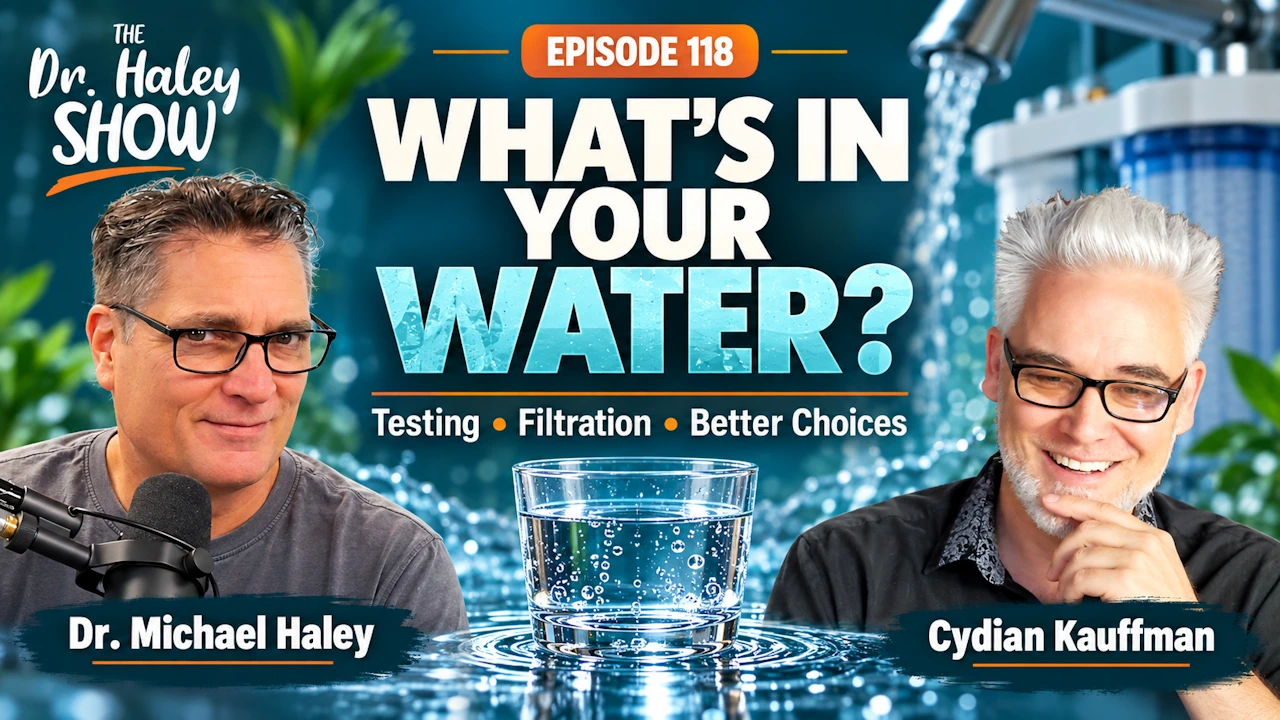
Water is the most important nutrient and yet people tend to choose the worst source of it. Cydian Kauffman from Pure Water Northwest attacks this topic with laboratory analysis and logic to customize a treatment plant specific his customers needs. In this episode we discuss the various water challenges that we all have and what what can be done about it. Join us for the fun and even controversial discussion that covers everything from scams to medical freedom and even the fluoridated water debate.
One interesting part of the discussion is Kauffman’s explanation of bottled water sourced from municipal supplies and the role of wastewater recycling in some water systems. The speakers raise concerns about water sources and treatment; their comments reflect the discussion in this episode rather than a description of every municipal supply or bottled-water brand. Enjoy the show!
Watch the Interview
Listen to the Podcast
Resources
- Visit Cydian Kauffman’s website purewaternorthwest.com
- Watch this episode on YouTube
- Listen to this episode on iTunes
Quick Takeaway
Cydian Kauffman’s central recommendation is to understand what is in your water before choosing a treatment system. He describes using laboratory testing and municipal water reports to match filtration methods to specific contaminants. Dr. Haley and Kauffman also question alkaline and structured-water marketing, discuss bottled water and microplastics, and share their perspectives on fluoride and personal choice.
Episode Timestamps
00:00 Intro Snip
01:25 Introduce Cydian Kauffman
03:06 How Cydian Kauffman got into the water business
04:31 What are the standards that the EPA sets for water? (MCL Maximum Contaminent Level and MCLG)
06:28 How detailed is the testing of our water?
08:27 What is the acceptable level of PFAS in the water?
11:43 How is well water different from municipal water and how do we filter them?
13:28 How old is the water we drink?
14:04 Where do municipalities get their water?
16:30 Why is carbon such a good medium for filtering water?
20:45 What are “Forever Chemicals”?
21:32 How do medications get in our water supply?
23:10 What does Dr. Haley think about alkaline water?
25:55 What is structured water?
29:50 What are some problems with bottled water?
31:24 Where are people getting microplastics in their body from?
34:25 How is bottled water made?
39:05 What are the options for filtering municipal water at home?
40:48 How do I find my municipalities water report?
43:32 What are the three types of water filters?
45:23 What kind of filtration system do you feel best about when the contamination is unknown?
53:57 What does Pure Water Northwest do?
55:17 What does Dr. Haley think about fluoride in the water supply
Water Testing: Legal Limits and Health Goals
Kauffman describes how a tenant’s discolored, foul-smelling water led him into the water-treatment business. He discusses maximum contaminant levels (MCLs), maximum contaminant level goals (MCLGs), and the distinction he draws between meeting a legal standard and evaluating water quality. He also explains why the concentration and identity of a contaminant matter when interpreting sensitive laboratory tests.
Well Water, Municipal Water, and Emerging Contaminants
The conversation compares private wells with municipal supplies and explores how water moves through the environment. Kauffman discusses PFAS, volatile organic compounds, pharmaceuticals, chlorine, and treatment byproducts. His recurring point is that the source alone does not tell you everything about the water: he favors testing and reviewing the available data.
Carbon, Ion Exchange, and Reverse Osmosis
Kauffman explains adsorption with carbon, physical filtration, ion exchange, and reverse osmosis. He emphasizes that different methods address different contaminants and describes his preference for customized treatment. For listeners who do not want to pursue detailed testing, he discusses under-sink reverse osmosis as a broad treatment option, while acknowledging that performance depends on the water and system.
Bottled Water, Alkaline Water, and Structured Water
Dr. Haley and Kauffman discuss municipal sources for bottled water, plastic packaging, and their concerns about microplastics. They also challenge claims made in alkaline-water and structured-water marketing. Their explanations include personal opinions and interpretations of research; the episode does not establish that every bottled-water product has the same source, treatment, or contaminant profile.
Finding Your Water Report and Choosing Treatment
Kauffman suggests searching for your municipality’s water report or Consumer Confidence Report (CCR). He also mentions the Environmental Working Group’s tap-water database at ewg.org/tapwater and advises looking at the reported contaminant concentrations rather than reacting only to comparison multipliers. He describes Pure Water Northwest’s approach of testing water, identifying contaminants, and selecting treatment to match.
Fluoride and Personal Choice
Dr. Haley frames his concerns about community water fluoridation around medical freedom and personal choice. Kauffman shares his own reservations and interpretation of studies, and both speakers acknowledge difficulties in comparing health outcomes across populations. These are the speakers’ perspectives on a debated topic, rather than individualized dental or medical advice.
Medical Disclaimer
This podcast and article are provided for educational and informational purposes only and do not constitute medical advice. The experiences and opinions discussed are those of the speakers and should not replace diagnosis or treatment from a qualified healthcare professional. Do not begin, discontinue, or change any medication, supplement, diet, or treatment based solely on this episode.
Full Transcript
The transcript has been lightly formatted for readability. Because it was created from the recorded conversation, it may contain minor transcription errors.
Read the Full Transcript
So it’s that 100% chance that, people who are buying bottled water, really pretty bottles and all that are drinking tap water, absolutely, without a doubt, 100% random tap water from California.
You are listening to the Dr. Haley Show, the podcast dedicated to helping you optimize your health. Each episode there will be an interview or a message to help you discover better health. We will be featuring health radicals on the show to bring new ideas to the table, as well as doubling down on key fundamentals to support you living your best life. Your host is no other than the founder of Haley Nutrition Dr. Michael Haley.
This is the Dr. Haley Show podcast. I’m Dr. Michael Haley, your show host. And today we’re going to be talking about the most important nutrient on the planet. Water. And this is one of those topics where there’s probably a lot of confusion. And there may be even people using fear mongering to sell things to clean up the water.
And I suspect that our discussion today might even sound a little bit like fear mongering, but that’s not our intention. We’re going to be talking about the truth, things that are in the water and what you can do about it. Our guest is Cydian Kauffman. He’s an owner at Pure Water Northwest Cydian thank you for joining me today.
And I’m looking forward to this, because I’ve heard you speak before, and you’re kind of one of those techie guys, almost like a scientific mind. And looking at this from a very real approach that I appreciate. So thank you for taking time to share with us. Yeah. I appreciate you having me on. Dr. Haley, it’s great to be here.
Yeah. You know. And where exactly are you right now? I would imagine we’re in different time zones, and you’re probably still in the morning. Yeah, I’m in Seattle. So Pacific time and. Yeah, it’s, 11 a.m. here. It we actually ship to Seattle. We have a business that ships frozen products, and you’re, like, in the most challenging area because we’re in Florida.
So you’re, like, the furthest point you could be away. And, you know, trying to get things that are still frozen is not Really possible in the summertime. Right now we’re in the heat of it. We’re in August and it’s just not even possible. Yeah. Somehow our yeah, our customers put up with it anyway is like, okay, we need your product.
It’s going to be melted when it gets here. We can still refreezing. How did you get into the water business? Well, I was actually in property management, and, what happened was, you know, we were, another business partner and I were looking at, company to get into. And it just so happened to coincide with a tenant who came to me with some water that was brown and smelled like rotten egg.
So it’s a hydrogen sulfide gas, right? And that water I took, I didn’t know anything about water at the time. I was just shocked by it. I took that water to a lab and I, had them test, say, tell me what’s wrong with this water. And I went back to the lab. In the lab, technician was hilarious. They were like, this water is healthy. I was like, no, it’s not. healthy for my garden or healthy for me? Exactly.
and then they corrected themselves and they said, I mean, it’s within the legal levels. And that little thing right there, was eye opening I didn’t fully understand is the time, though.
But yeah, labs do this all the time. They conflate the legal level with the health level, which are not the same thing. According to the EPA. But I didn’t understand that. So I actually, in part of my, you know, searching for a company to, invest in or purchase, we, we had already found pure water in northwest, which had been started by Chris Pelton like ten years prior.
Chris is one of those really impressive minds. he really understands a lot about water. More than I do, actually, for sure. And, he is the one who explained to me about the EPA guidelines. And I know now, because I’ve been doing this a long time now, I know now that the EPA sets two standards for drinking water the MCL, which is the maximum contaminant level.
That’s the legal, enforceable level. And that is the level all labs think of, just like kind of, as a go to thought process. Is this water healthy? Is it legal that they conflate that with being the same thing? And then the MCLG is the health guideline, and the EPA says right on the website that the MCLG is set as close to the MCL as possible, taking cost and other factors into consideration.
That’s what they say. No, no. Yeah. It’s just a reality that the water we drink is it’s now I don’t want to jump into the other end of the pool and say the water is bad just because it has some stuff that’s a little bit above the health guideline. Can I jump in? Yes. Here’s my question for the laboratory when you give me the results okay.
So it’s supposedly safe, right? Would you drink it right every day? Yeah, exactly. Yeah I know, and it’s changed to like I remember I, you know, I grew up a long time ago and in the 70s running around in the, you know, neighborhood and stuff. And we were thirsty. We’d get off our bikes and we’d grab the garden hose and drink from it.
Yeah. I think things have changed since then. It probably wasn’t the best option, but I do think even then the water was different or better than it is now. Well, there’s no doubt about that. The water was definitely better, But I don’t want to have this be a binary.
my preference. Would that have that that answer not be binary. So the water was better, but our testing is also better. I mean, we’re testing down to the, parts per quadrillion at this point. Now that’s very rare, but some labs can test down to that level. And that level of testing is revealing all kinds of stuff in the water that I’m sure if we had that level of testing in the 50s or 60 or 70s, we would have. Yeah. You know, been exposed to more data about the water back then, too. Certainly with lead there would it’s definitely more lead back then than there is now. And so I want to make sense of that for a minute though, because you talk about to the quad what you said to the quadrillion or something quadrillion. Yeah. Okay. So we think in terms of like parts per million and city water, municipal water might have two parts per million chlorine.
And even at that level you can still smell and taste it. Yeah. Two parts per million. Yeah. Because it’s enough in there. Yeah. That that’s getting close to pool water too. But yeah, that’s exactly right. Yeah. So I understand with only 1 or 2 parts per million, if you can tell that it’s there without a laboratory, you know, okay.
I like the, yeah. Drilling down to the reason parts. Yeah. The reason why parts per quadrillion matters is because it depends on the contaminant. So, we look at arsenic and technically the health guideline for arsenic. Zero, the legal level was 0.01 parts per million. If we have a few parts per quadrillion of arsenic, I mean, that doesn’t matter.
I can drink water from a parts per quadrillion for 50 years and be equal to one drink of apple juice. So parts per quadrillion doesn’t matter for arsenic. Really. Now effectively it doesn’t. Right. But if we look at PFAS for example, the health guidelines for PFAS are now in the four parts per trillion. So if we have parts per quadrillion of PFAS we drink enough of that. That could build up. Yeah. If so, yeah. No, it just makes sense.
Yeah. And this is funny because you and I, we could probably geek out on some of these things. I’m going to try to simplify things and talk, step back and look at the bigger picture and say, okay, there’s stuff in the water, everyone knows it, and no one wants to drink it. Meaning if I fill up a glass of water here from the sink I’m at, at my warehouse right now. Yeah. Haleynutrition.com. Or if I flush the toilet bowl, you know, it’s a white toilet bowl. I can see the water is stained. It’s colored. There’s stuff in it that I don’t want to drink. Right?
I don’t drink it. Of course, I you know, we actually have big glass jars, gallon size jars, and we tote it from our home to here. And that’s what we drink from because we know that at our home, we have a whole house water filter system and an under sink carbon filter that we change every 2 to 3 months as it’s needed. So we are getting super clear water. I’ve had the water tested after the whole home filter before the under sink filter. And you know they say this is great water. There’s nothing in it. It’s just H2O. Yeah. And that’s and we know that that’s what we want as a and I’ll say as a base because not everyone likes to drink pure water.
I don’t like to drink pure water. Right now I’m, you know, well all the ginger and lemons at the bottom so it looks kind of clear on top. I’ll swirl it around, but I like to have some flavor and some nutrition in my water. Yeah, but I don’t want to put that stuff on top of this municipal water.
I don’t want that crap in my body. Yeah, well not again. Absolutely. And not only that, the purer your water is, the more it’s going to be able to pull out and bind with whatever you’re adding to it for your body. So you know, if you’re adding ginger into water that has, free chlorine in it, the chlorine is going to start oxidizing the ginger. And the chemical reactions. Yeah. It could actually alter the effect it has on your body to some degree. All this is talking in minor terms, but it’s definitely real. So having the pure water to start with before you do, that’s a great idea. Yeah. So let’s step back and say, okay, people are on municipal water or they’re on, well, systems or what other options are there?
I guess some people might draw from a spring or something like that. Yeah. The rare cases people are drawing from rivers or springs or, or stuff like that, which it’s kind of scary because you can’t get a baseline that stays. But yeah, those are the choices. Rain collection is another option. You have rain collection.
Sure. So, what’s in the well water that’s different from this municipal water and, how do we filter them and turn it into good water? I love that you asked that question, because, well water can be anything. It is the most can be anything, that you’re going to get for a stable source of water. Everything on the periodic table of elements can be in a well as well as any factory chemical, emerging contaminant, VOC every single one of those things can be in a well, and that’s because of the hydrologic cycle, right?
If it’s on the ground, if it’s sitting on the ground and the rain hits it, and then it gets collected by the rain and pours across the ground, and then drops down underground into an aquifer, and then you pull that water up from the aquifer. Then it’s in there, all the filtration medium that it goes through that can decontaminate some stuff or it cannot.
It’s completely unknown what it’s going to be until you test. I’ve had people understand that, and I’ve had other people say, oh, I have well water. So I have good water. you don’t know that you could have literally anything in that water. Absolutely anything can be in that water. Radium, uranium, radon, arsenic, cadmium, chromium, it doesn’t matter.
It can all be in the water. You know, just making a little humor out of it when you think about it, that water has been everywhere. All the water has been everywhere. Yeah, water. There’s a cycle of water. And, you know, the water where it’s at. Well, some of the water that’s in this glass that I’m holding up right now, may have been in people or animals or plants or the sky or under the earth, or in the ocean or in lakes and rivers and, you know, this could have been, you know, in urine from any animal or being there is.
And it just keeps it’s as old as the earth. It keeps on going round and round and round. And we like to think it gets filtered by the earth, but anything can be in it. Yeah. That’s right. And some municipalities, I understand actually recycle water. Oh, yeah. Before cleaning it up. Oh, yeah. Definitely. So municipalities have to do that.
They cannot, support, dense population by rain water and water collection alone. Their have to be for many municipalities. It has to be recycling. So, I mean direct recycling of wastewater. So that does have to happen, which means sewage. Yeah. From people flushing their toilets with everything that is in it. Yep.
That has to happen in some places. Absolutely. Now that doesn’t mean it’s disgusting water. Honestly, they are simulating what the Earth does in a way, as best they can. So municipalities, you ask the question about, well, water, if the answer is anything can be in that city. Water, not anything can be in that they’re going to test their water.
And 99% of municipalities, the tendency for municipalities is for it to have more VOCs. More factory chemicals, more VOCs stands for? volatile organic compounds. Yeah. And, that’s like a giant selection of hydrocarbon based. You know, we’re talking a list that’s too long for me to even, like, approach of possible stuff. So, they’re going to have a lot more pharmaceuticals that type of stuff.
They will have almost no chance of having metals in high, high quantities. And almost everything is going to be oxidized, which means it’s going to be in a form that is less bioavailable for your body. It’s not gone, it’s not unavailable. It’s less bioavailable for your body. So, when you chlorinate something, you’re basically creating, an environment where, say iron will turn from, ferrous iron to ferric iron. Yeah, as a part of the process. And ferric iron is what you see, staining things. That’s where you get an orange stain on things. And that, oxidization happens from contact with air, obviously, because air is oxidizing. But chlorine is more oxidizing. That’s basically what that means. And so the act of oxidizing causes many, many, many things to kind of combine, which then allows simple carbon to capture it, which is cool.
Carbon is one of the most common methods of treating water. It is not the only way and it is not the most reliable for certain things, but it’s the most broad spectrum approach to water treatment. And so, a single a cool fact. Sorry to geek out about this and take a tangent, but a very cool fact about carbon is a single gram of carbon like this much carbon?
A single gram has enough surface area inside of it that if you were to spread out the surface area, it would cover three tennis courts. Oh, that’s pretty interesting. Yeah. The reason why that’s cool is this much carbon can capture that much stuff, because the way carbon works is by pulling it to the side. It’s called adsorption, the stuff. instead of going inside like a sponge, it’s sticking to the side and just holding there. That’s how carbon basically does its job. It’s got a very weak pull, but it’s got enough of a pull and enough surface area and enough areas where things can get trapped that it’s super good. And,
so chlorination, would come after what’s called Flocculation Flocculation is adding a chemical that makes stuff bind together and brings it to the surface so it can be scooped off. chlorination, does a similar thing, but on a much smaller level, which then allows carbon to remove it. And frequently. Then there are other treatment methodologies based on the actual specific testing done. But what this means is that any municipality won’t have anything in it.
It could have small, small levels of anything in it, but it’s going to have chlorine and it’s going to have, chlorine byproducts, trihalomethanes, haloacetic acids, dibromochloromethane, stuff like that, and maybe even fluoride and fluoride. And then they’re going to have some additives. Many will have fluoride. Which, has its own.
We can talk about fluoride if you want, but it is. And then it could have all low levels of all these other things. And about a recent study was done with like 19 different sources. And this is out of the tens of thousands of different sources in the US. But out of the 19 different sources they did for PFAs, 98% of the samples came back showing that there was forever chemicals in the water, 98%.
you enjoying the show thus far? One of the many health secrets that we have covered on the show is all around aloe vera. Specifically drinking raw aloe vera. Our aloe vera has helped our customers effectively heal their gut, increase their intestine health, lower inflammation in the body, eliminate and or decrease acid reflux, have glowing skin and hair, and so much more.
Now, as a frequent member of our audience, you will be exposed to exclusive specials and coupon codes for the awesome products manufactured by Haley Nutrition. That’s right, for simply being awesome and tuning in. You can get a mini discount to help you optimize and better your health. To see how we can help and support you on your health journey. Tune in to the episodes and listen for coupon codes that you can use at haleynutrition.com. Before you make your orders of raw aloe vera. Once again, it’s www.haleynutrition.com. Now back to the show.
And what is PFAs it so like, It’s a man-made chemical. And so it basically is simple terms like, Teflon frying pans back in the day, Gore-Tex, that was waterproof, fire foams, which are really essential. I mean, they’re doing a new version of it now, but without fire foams, many oil based or oil based fires could not have been put out.
But all that stuff leaks into the water supply and forever Chemicals are called forever chemicals because they’re incredibly difficult to break down. Yeah, they just won’t break down for tens of thousands of years. The nerd in me had to look up PFOS Yeah. perfluorooctanesulfonic acid, a man-made chemical compound, like you said, belonging to the PFAs, per- and polyfluoroalkyl substances family, widely used for its water, grease and stain resistant properties, and various products like firefighting foam, food packaging, textiles.
So, yeah, I see the problem. You know, the other thing you mentioned was the medications, and you mentioned that being in the municipal water supply, probably from getting flushed down the toilet, I would imagine. Right.
Yeah. For example, I don’t know. Take methadone for example. and you know what Methadone is, it’s like, how people, get off heroin. Right. Methadone goes into the water. Because 30% of what you take in methadone goes out as methadone out of your urine, that goes into the water supply. And then it combines with other things in the water to become new chemical compounds. Because it’s a very it does its job in you because it’s a very reactive chemical.
So that’s just one of the many, many, many examples of pharmaceutical grade compounds. And why those being in the water are I mean, it’s kind of like we’re a science experiment in a way. we really don’t know what’s going to happen with all that. All right. I want to come back to these water supplies and what to do about them.
But I also want to talk about a few of the and this is where, quite frankly, I don’t know you well enough. I don’t know who believes in these things and who doesn’t. I have my stance. And if we have disagreement here, so be it. I know that, there will be people listening to this that are going to get upset over some of the things I say, and it is what it is.
I believe it’s truthful and, you know, let’s look it up. But I want to talk about some of the things that are being touted in the natural industry. Natural, you know, anti-cancer, be healthy. One of them that I am really kind of bothered by is people will say, you know, cancer can’t live in an alkaline environment and they suggest drinking a, you know, water, a pH of ten, which is kind of alkaline and the reason why I have a problem with those systems and the people that are selling that is, well, you know, there’s blood borne cancers and the blood is alkaline.
So cancer can live in an alkaline environment. And, you know, vegetables are maybe alkalizing, but that’s not what makes them anti-cancer. It’s the phytochemicals that, you know, cause cell apoptosis and have immune system, you know, they support your immune system so that your body can do what it’s supposed to and you can better fight cancer. So I’ve always been opposed to the alkaline water systems.
oh me too. and I’m mostly opposed to it because I don’t think anything you do with your drinking water can in any way affect your blood pH. Like your blood. But there’s that. Yeah. Right. Now, what they can do is they can separate water. And in doing that, yes, one’s coming out. And if you’re using a lower alkaline setting, potentially you’re magnetically pulling stuff out of the water to get rid of it and sending it down the drain.
And the minerals that are more alkalizing are probably less, you know, harmful or maybe even beneficial compared to the ones that are acidic. Yeah. So, you know, if people are using it for that purpose on a mildly you know, 7.5 instead of, 8, 9 or 10 when you start diluting your stomach acids, you can create a whole bunch of digestive issues.
So I caution people on that. Some people are using them to, increase hydrogen, hydrogen, may quench free radicals. May be anti-oxidizing. So there might be some benefit because of the hydrogen, but it’s definitely not the pH. If you could kill cancer with a high pH, you know, you drinking bleach would be a healthy thing. But it’s not. Yeah. There’s another word that I’d like to maybe debunk a little bit.
and who knows? I don’t know your position on this one. Sure. what would you say about structured water? I’ve had people ask this before. I did a lot of research on it, and it’s kind of easy for me to do research on it, because one of the biggest proponents of structure water is an actual professor at the University of Washington.
But his approach to it’s a little different from that. What’s the guy’s I can’t remember the guy’s name in Japan who kind of started the structured water movement by playing music and water. Do you know the guy I’m talking about that I don’t, yeah, I know I’ve heard a lot of people talk about it over the years, and I’m not even sure what structured water is, but I’ve had it explained to me that, you know, the molecules of water, the H2O molecules are essentially arranged in such a way that makes them closer together and more hydrating.
So I always thought, well, then a gallon of structured water should have a lot more molecules when it’s structured than when it’s not structured. So it should, you know, weight more when it’s volume wise, the same, but it doesn’t. It weighs the same. Yeah, exactly. Yes. So this is like a new age kind of fad with some like many things though, there’s like this teeny kernel of truth that can be latched on to.
And so I’ll get into the truth I’ll start by making the listeners who like structure water very happy. if structured water was possible to drink, it would be more hydrating and healthier for you. That’s just start with that. If it was possible to actually drink and have it remain structured that, that is true, it would be healthier. Okay, starting there, you can’t do that. As soon as you drink the water, the structure is gone.
there has been a modicum like a teeny amount of evidence that if you eat fruit, which does have a structure to it, the water is structured in fruit. If you eat fruit, it does retain its structure slightly. And there’s some question then, is eating fruit more hydrating? Well, it’s got fructose in it too. So by volume, no, but potentially healthier in other ways. Who knows. We’re talking about levels that are so small that, like, that’s not really worth spending the money that would be required to do that research. The guy at the University of Washington, he basically, you know, he’s really interested in structured water because who knows what bleeding edge technology will happen later that will potentially allow water to retain that structure in movement.
But when he structures water that is in a still container that is not moving, and he is doing something to the water to make it so that along the surface area of the container, the water actually creates a structure. And that’s real. He’s doing it. It’s real. It does something, studying. It’s interesting. And that’s it.
That’s the end of that. Like, yeah, I would imagine that, you know, the fact that it’s not frozen means the molecules are moving right? And, you know, you can slow them down. And if you could somehow, stack them right before they hit frozen, but even when they’re frozen, they’re still moving people. Right? Really? Really. I think you’re right. Just slower. All right. So, you know, there are people paying a lot of money for these machines that supposedly structure their water, and I’m I, you know, we think more scientific. I’m kind of like you. And that’s one of the reasons I wanted to have you on the show. And I know you know a lot about water.
So. Yeah. What do you know about bottled water? Oh, well, it’s one of the most unregulated industries in the world. I mean, it can be anything like a company is going to be sued out of existence if they sell somebody water, that kills them. So it’s not like I’m not going to say that the likelihood of you getting a bottle of water that has so much arsenic that you’re going to get, organ failure within a year is likely.
That’s not likely. But we saw recently with what happened with that prime, well, you know, product that, bottling, the industry of bottling and all that and even more so with this current administration, it’s very, very unregulated. So, I mean, they have to follow EPA standards still, but that’s about it. And, even that is questionable whether or not they hit all the metrics, the amount of testing they have to do is very minimal.
So it’s that 100% chance that, people who are buying bottled water, really pretty bottles and all that are drinking tap water, absolutely, without a doubt, 100% random tap water from California. For yeah. And, they frequently will run it through carbon so that you’re not getting chlorine, but sometimes not. And then there are other companies that run it through reverse osmosis, which means they are, without a doubt, improving the water quality.
But then reverse osmosis water has like a langelier saturation index and a calcium to sulfide mass ratio. Basically the water super hungry. So now you’re doubling the problem of the, microplastics in the water. The microplastics of every bottled water. There are hundreds of thousands of particles, nanoparticles of microplastics in that water. And those nanoparticles are without a doubt getting in your body.
People have millions of nanoparticles of microplastics in this society, without a doubt in their body for sure. the effects of that are not fully known. the for sure effect of that is, inflammation. And other than that, we don’t know. We don’t know about cancer with microplastics yet. We don’t know about any of that for sure.
But for sure, bottled water is the primary source where people are getting microplastics, and the cleaner water in bottled water is then going to have more microplastics. Because of that, water is hungrier, and stripping the sidewall of the water. And then earlier you talked about transportation problems. If I’m transporting something from Florida to Seattle in a plastic bottle, there are more microplastics in that bottle than there are. If I ship it from, like, Oregon to Seattle for sure, and then it sits on a shelf or it sits in a warehouse. The size of our country is always a huge factor in how much product sit, because our country is one of the largest countries on the planet, and because we have an infrastructure and a society where things are shipped across country, it dramatically affects.
I mean, that’s why we wash the eggs in our country, whereas other countries don’t is because of that. So yeah, I, sorry, maybe I shouldn’t too much about that but yeah. My no I think plastics are, you know, the problem with them is the bottled water more than anything meaning, if you go to the grocery store and you’re there to purchase water, and I’m not 100% against bottled water, I’ll personally drink out of a bottled water that was purchased at a grocery store in an emergency situation.
Yeah. And, you know, sometimes it’s convenient and we have it there. I avoid it at all costs as much as possible the other day, though, and I usually keep bottled water in my car, mostly for, like, washing my hands. When I, you know, unload a trailer or something like that. It’s convenient. But the other day, after playing pickleball, I couldn’t wait till I got home and I maybe had a couple ounces of it.
And I thought, okay, I’ll just so I can get home and get real clean water. But if you think about the grocery store taking a whole aisle for bottled water, imagine how big the water factory would have to be to store all of the empty bottles that they were going to fill. Oh, they can’t do it. So the machines.
If you’ve ever looked on YouTube or something like that, how is bottled water made? They have these machines with little fingers with like thimbles on them of plastic, and the bottle gets blown from that thimble of plastic. And then the machine kind of flips it upside down. They shoot water up into it, and then it flips back over, and then they fill it with water and the cap goes on. It. Yeah. So from a chemistry standpoint, those bottles don’t have enough time to completely cure and fully gas off. When you buy something new. New cars have a new car smell because they haven’t completely gassed off . exactly. Yep. thinks have to cure. And I think that’s where plastics gets its real bad rap from. I don’t think you’re going to, you know, if you refill a plastic bottle.
Yeah. I don’t think it’s going to have near the chemicals, the plastics in it that the bottle came with when you purchased it from the grocery store. If you refill it with good water from a fill, a good filtered system. Yep. And with, like a billion a I mean, with a billion worldwide, I think it’s like a billion bottles are used every day.
Something like that. It’s like when you compare it to that, that’s just like, wow, that is a I, I would love to know, you know, if you could measure the water and what’s in it compared to a, you know, how many plastics are in this bottled water. And here’s a bottle that we purchased in the grocery store.
We emptied this out and filled it with clean water. Yeah, I would like to know the difference. That way we would know how much is because the bottles are actually not completely cured. I honestly agree with that. That would be really good data to have. Yeah, we’re maybe some day. Yeah. What are some of the other well are there any scams in the water industry?
I you know, that we should be aware of that. Things that we haven’t talked about. Oh, boy. Well, here’s the thing. We’re in a world where businesses, you know, I own a company, and I have to struggle to make sure my company’s profitable. Right. And, an easier job for me would be if I was a product based company.
And that means that I promote my product, and people get excited about a product, and then they buy the product. That model is kind of in opposition to water treatment, and it very easily leads to scam products and scam products. And I, I, I differentiate those two because some companies are scam products and they don’t even know they are because they really don’t know the science.
So they think they’re doing good stuff and they actually believe it. Like from the top level, the CEO is like, I’m saving the world here. Like, I think a lot of people in the drug industry think that, yeah, exactly. Yeah, yeah, yeah, you’re totally right about that. So, and then there are people who are just bad people and they know they’re selling snake oil and they just keep doing it.
So I don’t think we have enough time to talk about all the products out there, nor do I necessarily want to expose myself to possible lawsuits. But yeah, there are a lot, a lot of lot of scam products out there and scam products. And, then there’s some good products. Yeah. All right. Let’s let’s, Figure out the solution. Then. For instance, most people are probably on municipal water. Yeah. What’s probably the best case scenario for filtering your municipal water supply, cleaning it up. What should you do? Well, you got two choices. The first one. Well, let me say this. You have three choices. You do nothing, you don’t filter, and then your body is the filter.
It’s. I mean, that’s fine if you want to do that, just know that’s what you’re doing. I know it’s hard to confront because everyone needs water, but that’s the reality. And maybe it’s good. Maybe it’s not that bad. Maybe your body is fine with filtering it. You’ll live your entire life. You’ll only notice it in the last few years of your life because of the buildup and whatever.
That’s option one. Option two is you test. But. But wait a second, wait a second. Those last few years of your life might come a lot sooner. Yeah, that’s true, that’s true.
it does affect the later. Like that’s the whole thing is the body’s really good at pushing back your problems. Like, yeah, your body’s super good at that.
Right. Because it’s a homeostasis engine. Right. Yeah. And you know, there’s a legitimate argument that you can support your body and it can do those things efficiently and effectively. Yeah. If you’re not overloading it with toxins from everywhere else. So yeah, I guess theoretically you probably could get away with it. Yeah. Depending on the source of water. Absolutely.
Yeah. But I you know, I happen to be in a position where I can afford to filter my water. So I’m going to choose that. Of course. Yeah. Option two, my preferred option is, because I’m saving the easiest option for last option too, is, to do a, a lot of testing or find your own testing for your municipality.
So every municipality is going to put out a CCR a water report. If you look up your municipality on Google and type in water report, after it, you will find a water report. And then also if you go to website called the Environmental Working Group, ewg.org/tapwater, you put in your zip code and find your, water.
You will find a bunch of contaminants listed for your water. A little caveat to that is there’s some scary looking stuff on the EWG website. They put in some multipliers that are an algorithm. They use that compare to the health guideline. It if it says it’s 5000 times the health guideline, I’m not even that worried about that because of the way their algorithm works.
I’m more interested in the actual number they post for the parts per million or parts per trillion. If you get that data and you talk to somebody like me, or you’re really good at ChatGPT and making sure it doesn’t give you false information, then you can get a lot of good data on how healthy that water is, and then that can give you a really good way to go to fix that water. That is customized. That’s my preferred medium. I test, I identify the contaminants, and then I customize the treatments to match it. Exactly. That makes it the most efficient. It makes it the best at removing the most stuff that you want removed. And it makes your water the healthiest and cleanest.
As a thank you for tuning in to the Dr. Haley Show podcast, I have a special coupon code that can be used throughout the month of September 2025. Get $20 off your purchase of $200 or more at Haleynutrition.com. The coupon code is XXXXXX. That’s XXXXXX. And as usual, you can even use this coupon with on sale and already discounted bundled items. Enjoy the rest of this podcast.
Okay. And I think I’m hearing you, but I want to try to understand it because I’m understanding maybe that filtering fluoride is different than filtering chlorine.
That’s right. And certain filters might capture one, but not the other. Yeah. That’s right. Yeah. I think of it in terms of, three different types of filtration. And then each of those types of filtration have subtypes.
There’s physical filtration which does not work for most, bonded contaminants, most atomically bonded, molecularly bonded contaminants. Physical filtration won’t help with part of the reason you chlorinated is to make it so physical filtration can’t actually work because it causes, contaminants to bind together when they oxidize.
So physical filtration, then there is ion exchange, and that is positively charged or negatively charged media and passing water through that will cause for example, calcium, magnesium, manganese iron strong and negative charge. So a positively charged, no strong positive charge. So a negatively charged, will pull it off of the water, like it’ll rip it off the water molecule, which is great.
And then, that’s cation resin. Anion resin does the opposite. It’ll pull stuff like arsenic or chromium or things like that. And then carbon, is, is adsorption, which is a type of physical filtration as well. And then there’s reverse osmosis and reverse osmosis has it is incredibly effective against many, many, many things. Which leads me to the third option that I hadn’t gotten to yet, which is if you don’t want to test.
And by the way, one of the options you have is to pay for testing that aside from all those other ways of figuring it out, you just pay a few hundred dollars to get a full spectrum 50 panel test done on your water that worked for well water or city water. But if you don’t want to test, you don’t want to worry about it. Get an under counter reverse osmosis. I mean that at least that I mean, you’re going to see a little bit of fluoride could get through a little bit of arsenic, a little bit of barium might get through depending on your amount, but mostly you’re going to get everything out if you do that. And that is like just that’s the most like don’t want to think about it.
Don’t want to do anything. I’m going to spend $1,000 on this and be done with it. Yeah. What is your personal water supply and what are you doing about it? My water supply is municipal water. It has, many different contaminants in it. And, the, lots of pharmaceutical has lots of VOCs and PFAs. Sometimes the PFAs season is bad here.
I go through I own a water treatment company, so I go through, like 12 different filtration for mine. Like I go through anion exchange cation carbon and reverse osmosis. So my water’s really good. In the end. Yeah. It’s nice when you’re, you know, you have access to all of these things. I own an aloe vera company, okay?
And people, you know, ask me, how much should I drink and how much do you drink? Well, I drink a lot because I have an unlimited supply. Okay. exactly you probably have some pretty cool gut health, actually. Yeah, yeah, that’s. Well, that’s one of the things we like to teach people is gut health. And. Yeah, drinking that much aloe vera, that would help a lot.
Right. Well yeah, it helps. Yeah I always look I always look at both sides of the equation. Meaning there’s things that you can consume that will help you. But if you do that, even aloe vera, if you’re taking aloe vera to help heal your gut, you’re almost still in a medical approach. You’re kind of saying, okay, what can I take to fix this?
Instead of how am I going to stop causing this problem? And prevention is a lot easier than fixing things. Yeah. So if you’re consuming chemicals and you’re killing your gut flora and you’re making your intestines raw and even bloody, yeah, you know, inflamed and they’re leaking, and now you have all kinds of autoimmune problems. Yes. Aloe vera might help you get well, but it’s probably not going to be an instant fix.
And you’re probably going to get a lot faster results if you stop doing the damage. Yeah, yeah, that makes sense. So we like to focus on what can you do to, stop harming yourself. What are you consuming? That’s damaging you? And it could be consuming water, consuming food. It could be consuming television, not exercising. Can you? Up.
Staring at computer screens like we both are right now. Yeah, exactly. Just. And not exercising enough. Like. Yeah, to me not exercising enough is one of the biggest ones. Yeah. Yeah. So you have all kinds of filters and there’s probably pretty much H2O in your glass. And it’d probably be pretty hard to detect. Yeah, yeah. anything else it’s super pure water.
But if I did a water report, even on my water there would be stuff in it. So, very low levels, but we can detect very low levels. it’s a matter of getting it low enough that it doesn’t matter. Basically. Yeah. When are you filtering the whole house or just, like, whole house and then point of views as a backup.
Yeah, yeah, yeah. And that’s what I’m doing. Only I have two major filter systems. not ten. Yeah. That’s self. Yeah. And that honestly it’s overkill what I’m doing. it’s genuinely unnecessary. at least seven of my filters I consider to be extraneous. But I mean it’s fun. I’m just. Yeah. Why not. It’s fun.
But you don’t want water. That’s too pure. Actually, It’s not that you’re really getting nutrients from water. Some people are worried about reverse osmosis because I think it strips it of the good nutrients, the nutrients somebody gets from water, unless you add it to your own water, is like virtually irrelevant.
The minerals that are in water are less than it is then in a single slice of bread, it’s basically irrelevant. But yeah, but if you get it too clean, then it starts stripping stuff. But that’s really hard to get anyhow. Like that’s like 18 million water lab quality water where they spend millions of dollars to get the water like that.
So all this space in between where the water is really good to really, really, really good, that’s like all fine. And that’s where I like to live. So yeah, I know some people that don’t drink any water. And because they believe their hydration should come from salads and fruits and things like that, which can be very hydrating.
Yeah. For me, I like the habit of drinking. You know, I have this and I enjoy a swig every now and then, and I like the flavor. I do drink pure water here and there, but I would rather have something with some flavor in it. So. And something that’s nutritious. So I like to practice herbology in my drinking water.
And now I’m not worried about drinking something that’s so stripped because it actually has nutrients that are beneficial. It’s great and cleaner water. Make sure all that stuff tastes better. Your tea is dramatically improved from cleaner water. Coffee is dramatically improved from cleaner water, although some coffee processes require some minerals. But basically yeah, this is like all great, like cleaner water helps with all of that.
I like what you said. And this is a health show and I drink coffee every day. Nice organic coffee with a little coconut milk. And I happen to flavor the coconut milk with a little stevia, which is a healthful, plant sourced sweetener. And I put a little of our protein in it, which gives it a little bit of a nutty flavor.
But, yeah, it can be. It’s there’s nutrients in coffee and can be beneficial and support brain health and all kinds of neat things. Yeah, it’s all about amount right There can be too much of something. But yeah, absolutely. That stuff is really good for you. And in the right amount. Yeah yeah. So if I’m understanding test the water and then you decide how to filter it.
It’s not like because you have, well water or because you have municipal water, you need this kind of system. Test the water and find out what’s in it. And then the system is built around that. It is like a doctor. A doctor would not look at somebody and say, you’re this type of person, you should have this drug to help you or you should have this treatment.
They would do blood testing and they would do panels and they would investigate. And then they’d say based on these symptoms, we’re going to prescribe this. That’s the way water treatment needs to be. Good I like it, I like it. Tell me about your company. What do you do. And how do you support your family? I mean, that’s how I support my family.
like I said before, it would be easier to be a product company where we just sell products. We have a few products because we found some water that it’s like most of this water tends to be like this and this product will help. But more than 50% of our customers have fully customized product. So we take water.
And honestly, I, I feel like there’s a whole industry that’s missing the game here, some of this stuff can be expensive, but there’s a lot of people with a lot of money and give me a call. I will go test your water, and I will customize perfect water for you and where you live, because that is what our specialty is, is fully customized water.
Well, I know that you have a whole bunch of things that you can speak about and, you know, I had like a one page on you, which I didn’t really look at because I had my own questions for you. I like the subject of water, and I wanted to work some on my own things out my head.
Is there anything that you think I should have asked you that would be important for people to hear? I think for most people what we covered was really good. I mean, I can wax philosophical about things people are concerned about with a lot of the political discussions. If you want to go into fluoride or, or any of that. but other than that, I think we covered a lot of stuff,
we might have a conflict. If we do that, that could happen. That’s okay. Let’s do it. Let’s talk about it. Well, you know, because on the fluoride subject, my, my personal take on it is medical freedom. Meaning I don’t want anything forced on me.
And I want to decide if I want to have fluoride and I can go to the dentist and decide if I want to have a fluoride treatment. I reject them for me. For me, that’s my personal decision. For the people that can’t afford the fluoride treatments, if they really want it, and they’re concerned about the fluoride being taken out of the water, my position is, well, can’t. We wouldn’t even be cheaper to offer them fluoride treatments instead of doctoring the whole water supply. And then everyone has a personal choice. That’s my take on it from a health freedom perspective. And I’m more concerned about the potential of, you know, neurological damage than I am, whether or not it’s going to make my teeth stronger. That’s my take on it.
All right, now it’s your turn. My take on it. My take on it is, and I don’t mind conflict. I think your audience likes, likes conflict. So for sure, I wish there was more conflict here, though, because, I am really bothered by the topic of fluoride. And let me tell you why. I think that the amounts we’re talking about don’t matter much.
But I also think that fluoride treatment doesn’t help much. So, I mean, I’d be all for either direction, frankly. I think I would lean a little bit more towards your side of things. I think I would lean more towards taking it out of the water supply. The Harvard study that was done 20 years ago was not done with the I mean, the, it wasn’t a Harvard study.
It was a recent Harvard study. The other study, I can’t remember who did that. Now it’s in another country. The amounts they use that showed that there was an IQ drop were way too high. A recent Harvard study, however, was done with the amounts that we use and use in our supplies, and it did show that it had a more subtle but still present IQ drop.
So that’s not good. That study has not been fully vetted yet, though, and we all know what happens when that happens. So we’ll see what happened to it that yeah. You know, there’s so many things that we’ll never know too because you can look at something like IQ. Okay. What about other neurological conditions. Where is Parkinson’s and multiple sclerosis and all of these things in dementia, where are they coming from?
That’s right, that’s right. And in fact, manganese itself, has been being debated by the EPA to be a class one contaminant for like a long time now. And we’re learning with recent stuff that, manganese has the ability to cause Parkinson’s like symptoms in people. This is a known thing. Now, but, I do want to say something fun about fluoride.
Scandinavian countries don’t fluoridated at all. And they have way better dental health outcomes than we do. Wow. But they also use way less sugar than we do. So it becomes complicated again. . Yeah. I’ve always looked at those studies to this country has this that has that. And then we attribute it to the water or the food or the, you know, non GMOs or the we don’t know, there’s too many, many factors.
I mean, there’s a higher genetic density of a specific type of population there that could be a factor. There’s so many factors that, yeah, I but we could use our brains and we could say these things probably aren’t normal or natural, right? this doesn’t look like real food. And they didn’t have this available 2000 years ago. You know, it was something that man invented. So maybe we should avoid it. I agree, and honestly,
That’s why I would lean more trigger on your side of things to me. Use fluoride toothpaste. You know, it’s if you want, if you want. And that’s what. That’s the medical freedom, right? Exactly. If you want to use it, it’s going to have, at least for teeth. Obviously bones are a different matter, but at least for teeth, it’s going to have, higher effectiveness than drinking the fluoride. The actual. Yeah. or use, fluoride toothpaste or use baking soda or use water when you brush your teeth. Right. It’s up to you. they are your teeth. Yeah.
As long as you can educate yourself, you should be able to make your own decisions. Yeah, yeah. Well, where do people go to find out more? Oh, well, we have a website, purewaternorthwest.com. Also, my name is very unique. So you can probably just look me up. It is definitely unique. I’m not even sure I said it right.
Cydian Kauffman That’s right. Good Cydian Kauffman Yes. And I also noticed that you’re famous on YouTube, but you can put your name in YouTube and there’s quite a bit of content out there. Oh, wow. I, I don’t know if I’ve done that to myself yet. Well, you know, you’re only going to find you because there’s probably not many Cydian Kauffman’s out there. And if they are, they haven’t created much content yet. That is true. That is true. there’s very few Cydians of any kind. And then. Yeah, you’re right. I’ve got a I’m on a few episodes there aren’t I. That’s funny because I hear the keyboards. I’m being fact check it. I like that that’s we think the same like that.
As you know, when you were talking, I’m looking up PFAs and figuring things out. I like that, yeah. Neat. I didn’t know I was on YouTube. Cool. Okay, this is going to be on YouTube. Great. I look forward to it. And Rumble and iTunes and Spotify and Twitter, Instagram and a whole bunch of other places. Awesome Cydian thank you so much. I enjoyed the conversation. It was educational. Thank you so much for having me on Dr. Haley
I hope you enjoyed that episode today on the Dr. Haley Show. Make sure to hit subscribe on whichever platform you are listening to this. If this episode made you think of someone, go ahead, take a screenshot and share this exact episode with them. You can catch the show notes for this episode on drhaley.com. If you want to geek out with Dr. Michael Haley on other radical health topics. Be sure to check out his YouTube channel where he posts exclusive video content. All the details are at drhaley.com and we can’t wait to hang out with you on the next episode.