
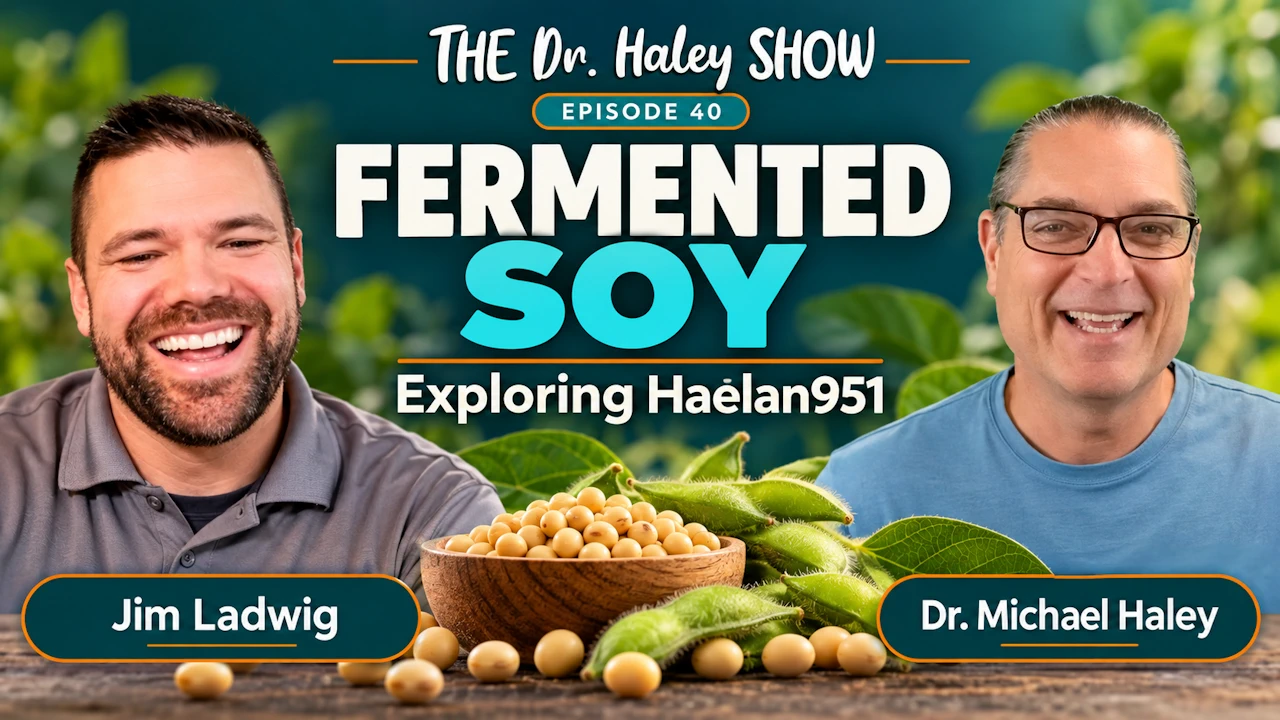
Dr. Michael Haley discusses Haelan951 Fermented Organic Soy with Jim Ladwig from Haelan Products.
About This Episode
After purchasing Haelan951, Dr. Haley invites Jim Ladwig to explain the product while he tries it on camera. Their conversation covers the company’s history, its nitrogen fermentation process, soy sourcing, serving amounts, and the beverage’s taste and texture.
Watch the Interview
Listen to the Podcast
Resources
Quick Takeaway
This episode offers a firsthand taste test of Haelan951 and a discussion of how the company makes its fermented soy beverage. Jim Ladwig describes the intended role of fermentation in changing soy proteins and making its compounds more available to the body, while Dr. Haley explores the flavor, texture, and mixing options.
Ladwig also shares the company’s perspective and customer reports about nutritional support, appetite, and other health concerns. These comments reflect the speakers’ claims and experiences; the interview does not establish that Haelan951 treats cancer or other medical conditions.
ENJOYING THIS CONVERSATION?
Get the Next Episode in Your Inbox
Get notified when a new episode of The Dr. Haley Show is published, plus occasional highlights and resources worth exploring.
By subscribing, you agree to receive email from The Dr. Haley Show. Unsubscribe anytime.
Episode Timestamps
- 00:48 Introducing Jim Ladwig from Haelan Products
- 03:20 History of Haellan951 formerly Haelan851 in the 80’s to fight the side effects of traditional cancer treatments
- 05:05 What’s in the bottle? Addressing the soy fears caused by the GMO version and its’ relationship with pesiticides compared to soy used by Haelan951 Products, Inc.
- 06:36 The patented Nitrogen Fermentation Process compared to fermentation of natto
- 07:30 The benefits of nitrogen fermentation as related to the proteins in it
- 08:00 The bioavailability of nutrients from the nitrogen fermentation
- 09:05 How nutrients are changed by the fermentation process
- 11:30 How Haelan951 fermented soy beverage tastes; Dr. Haley opens a new bottle and begins to consume the whole bottle
- 14:30 How much do people drink?
- 15:09 Dr. Haley describes the taste of Haelan951 as a bean juice
- 16:53 Discussion of the pH of this beverage
- 19:00 The benefits seen when those with cancer cachexia consume Haelan951 with respect to their appetite
- 19:50 The healthy powder flavor that helps with the taste of Haelan951 made from lacuma, monk fruit, and peppermint
- 22:25 Dr. Haley describe the taste after adding the flavor improver
- 23:40 Jim Ladwig explains the growing conditions for their soy and how it takes 25 lbs. raw soy to make a single bottle
What Jim Ladwig Says About Nitrogen Fermentation
Ladwig describes Haelan951’s production as a patented, multistage nitrogen fermentation process. He explains the company’s view that fermentation breaks down soy proteins and changes compounds such as isoflavones and saponins. Dr. Haley asks how this compares with familiar fermented foods and how nitrogen fits into Ladwig’s explanation of nutrient delivery.
A Firsthand Taste Test and Mixing Demonstration
Dr. Haley opens the bottle during the interview and describes a bean-like flavor with a creamy texture somewhere between juice and hummus. He then tries the accompanying flavor powder. Ladwig identifies its ingredients as lucuma, monk fruit, and peppermint and describes mixing the powder with water before adding the beverage.
Soy Sourcing and Production
According to Ladwig, the company grows its soy in Mongolia at elevation, uses volcanic ash fertilizer, and hand-picks the beans. He says approximately 25 pounds of raw soy are used to produce one bottle and discusses how the growing and fermentation processes contribute to the product’s cost.
Serving Amounts and the Guest’s Health Claims
The speakers discuss amounts ranging from roughly an ounce a day to a bottle divided between morning and evening. These are descriptions from the interview rather than personalized serving recommendations. Ladwig also recounts customer reports about appetite during cancer cachexia and discusses menopausal symptoms and nutritional support. Those reports and explanations are attributed to Ladwig and should be discussed with a qualified healthcare professional when considering a change to care.
Medical Disclaimer
This podcast and article are provided for educational and informational purposes only and do not constitute medical advice. The experiences and opinions discussed are those of the speakers and should not replace diagnosis or treatment from a qualified healthcare professional. Do not begin, discontinue, or change any medication, supplement, diet, or treatment based solely on this episode.
Full Transcript
The transcript has been lightly formatted for readability. Because it was created from the recorded conversation, it may contain minor transcription errors.
Read the Full Transcript
Hi, I’m Dr. Michael Haley with Haley Nutrition. And today I had a package delivered to me, a product that I’m a little interested in, wanna find out more about it. So I called up the company as soon as it came in, I purchased it, I’m not sponsored by them or anything like that. I want to experience it and ask questions about it. And they said that Jim Ladwick, the senior vice president, might be able to meet with me and answer some questions, while I convinced him to go behind the camera, jump on a zoom call and he’s gonna tell us about this very unique. I’m told it doesn’t taste so good product, but it’s really good for you. And I’m probably gonna catch him off guard a little bit when I consume a lot more of it on air than he’s anticipating. The serving size is like an ounce a day or something like that, it’s not a lot, but I think I’m gonna drink a whole bottle in one short recording session and see how it goes. Let’s check it out.
Jim, thank you so much for joining me on a zoom meeting. And I’m gonna be transparent with everyone. I am meeting you for the first time talking to you for the first time, just a few minutes ago, you were so gracious and said, yeah, I can jump on a zoom meeting right now. Sure, why not?
And we got those shirt on.
Yeah, but I think it’s so cool because we’re actually kind of in similar spaces, we’re both in nutrition and helping people with some of their more serious health challenges. And in this particular case, I came across your product that I have in my hand right here, it just got delivered by UPS. I know a little bit about it, but not that much. And, but I know good things when I see them. And at the table that you had there in Jacksonville, Florida, the Vel Jansky Conference, there was a document there. And one of the pictures on it was Brian Clements, so I’m guessing they probably carry your product down at the Apocritee’s Help Institute. I’m guessing.
Yeah. So that says a lot.
I mean, probably 10, 15 years now, he’s been working with us. And it carried in the story. Probably refers me to people in a couple times a week or getting phone calls from his patients.
And he wouldn’t do that if he didn’t love the product. But this was Nate too because this is the Box at Cayman. And it says organic plant-based nutrition for over 30 years. Has your company been there for 30 years?
Yeah, yeah. So a little history. So healing 951 used to be back in the ’80s. It started as healing 851. That was kind of a precursor formula. And that started in the ’80s. It was a hospital nutritionist in China. She was working on combating the side effects of traditional cancer treatments. And fighting Keksia, but she wanted to do it naturally. So they stumbled on a unique species of soy. Then they started to develop out the fermentation process. That all happened in the late ’80s.
And then I think it was like ’89, ’90, was really finalizing that formula of the ’85 one. And then in ’91 was the finalization of the ’95 one. I thought I got those dates correct. But that was where Joe Tidesco from the states here, he put together a team and started working with them. And they took it to the next level. And it sat at that 1951 formula now for long time, three decades, and we’re okay.
Awesome, that’s what I thought. Now we have more in common than, you know, I knew. Because my brand has been a long, around a long, long time. Roddy Stockton started in the ’50s. I only took it over about 15 years ago, 14 years ago. And from that’s how long I’ve known Brian Clement as well, as far as that he’s been carrying our products down in their store there in West Palm Beach, and they ship them all over the place too. So that says a lot about you, your product, your companies. Now what’s in the bottle?
Yeah, oh yeah, that’s the kicker right there. So it’s funny when you mentioned Brian, because when we first started talking with Brian, you know, he’s as he probably should be in our opinion. So our product is 100% so. And so when it comes to a lot of the conventional soy on the market, it’s kind of problematic. Um, rushed growing. The species is not that the monotonous species is not a great, uh, nutritional value. It at least not compared to ours. And then you have the rush growing the pesticides, the glyphosase, it’s all the problems that come with it. And then on top of that, it’s highly processed in most forms that you’re getting it. So when people hear soy, they’re kind of like, oh, we’re doing it. Okay.
Um, but a lot of people don’t know that soy, you know, for thousands of years was just considered this massive superfood and a lot of times it was fermented. And it has really five major compounds in it that back in the early 90s, the NIH just study and they found, man, these are some of the most anti-cancerous compounds that you can find in fruits and vegetables. And soy has the top five. And so it’s really just a matter of getting it into a really bio-available, deliverable package. And so that was really the onset of what we were doing in the beginning.
And so what we developed was a patented nitrogen fermentation process. And it happens in multiple stages where the only one’s doing it. And when you think nitrogen fermentation, a lot of people, if you know anything about fermentation, that’s not the traditional like lacto-affirmentation that you would see in various foods. About the type of fermentation you’d get with like a nato, which is a fermented soy or something like that, or even like a col– sorry, a sour crowd or something like that.
Yeah, typically you just put it in an environment and it’s in a nice warm environment. That’s good for, you know, the growing that particular species.
Yeah, exactly. But what is the nitrogen?
So nitrogen is typically found in fertilizer and so it’s an adaptation of that type of fermentation and so what’s really fantastic about it is two things. The breakdown, so you’re breaking down those proteins that protein that a lot of people can have an adverse reaction to or an allergenic relaxation or sometimes even like a food sensitive reaction. That protein’s broken down and the nice thing about soy and hernities, it’s completely protein. So you have all these amino acids, it’s just beautiful amino acid profile.
But then you also get those, those things like the, you know, some people are afraid of those spider-wester genes. You shouldn’t be. But those things like genists and diets in those isophilavins that are super powerful at helping to regulate and modulate hormones. But they’re really, really viable. When they’re not fermented, they’re not super viable. But when you take them through our fermentation process, the body can use it right away.
The second beautiful part is the nitrogen itself. Your cells need nitrogen. So the nitrogen kind of becomes like a Trojan horse. And the binding that happens with those compounds to the nitrogen and the cells bring in the nitrogen. And it’s like, oh, you get all these other beneficial things with it. So it’s just kind of sneaks it into the cells in a really, really unique way. So you’re getting a lot of different benefits from this fermentation process. One that break down. And then two also that edition of the nitrogen.
So that was a very jam-packed description of, I want to reset a couple things that I got out of it because I almost heard it’s like a cultureing other things. You’re taking a plain food, turning it into a superfood.
And when people cultured dairy as an example, most of my audience probably doesn’t drink dairy. But when you make yogurt, you’re breaking down the sugars and you’re breaking down some of the proteins and people that might be lactose intolerant can have very fermented lactose or milk. I should say dairy products because the fermentation changed it. And I heard that that’s kind of what’s happening to those harder proteins in the soy. Was that correct?
Yeah, absolutely. The proteins, the isophilavins, the saponins, there’s so many, you know, fighter nutrients in soy that when, if you think of, think of a fermentation like digestion, it just makes it, it’s that it’s one step closer for your body being able to use it. And those, those compounds actually, they change a little bit. And in that change, they become just so beneficial and your body can actually take it in.
It’s kind of what happens inside us when we eat food. The microbes kind of go to work on the food that we eat and it changes it into something that our body can then absorb.
The roots of our intestines sinking into the soil from the microbiome to extract the nutrients.
Yeah. The other thing that I heard in that little jam pack session was almost like a nano, you know, molecular thing happening to where I forget which molecule the nitrogen, being the carrier for helping a transport that makes your the nutrients more absorbable. Yeah. So that was very enlightening. And that was neat.
Yeah. It’s a really unique delivery method, you know, you know, a lot of things need a delivery method. A really common example is that people are probably familiar with this is turmeric, that curcumin is often paired with pepper, right? That, that, that, like, usually a bioprint and, and that is used. It’s just kind of that, that transport and the nitrogen just as a fantastic job of pairing up with all those constituents in the soy. It just kind of brings it right in where it needs to be.
Very neat. Well, I’m going to do something a little bit different probably and, you know, when, when it comes to taste, I don’t know what to expect. I kind of have an idea because I was told a little bit about it. Not great. But people listening in, it’s not about taste. You learn to like the things that make you feel good. So I’m not so worried about first taste. We’re going to find out what that is. I’m going to let everyone know in just a minute.
But I kind of think of our aloe vera where some people will have it for the first time. And half the people will say why it doesn’t taste like anything. And then the other half will say oh it’s so bitter. And usually the people that say oh it’s so bitter are usually the people that need it more. And I don’t know if that’s because the people that enjoy the real natural food tastes have enjoyed that for a longer period of time. And maybe that has to do with why they are healthier.
Yeah, where if we were driven purely by our taste buds, we’d be in trouble.
We find a lot of people who have a history of enjoying a more plant-based food, or a custom to eating a little bit cleaner don’t have us hard of time with the taste. Sometimes when people are coming from that standard American diet, it can be challenging. It’s very different.
It’s very different. That’s for sure. Well, I thought it was cool too. You had an animation that showed how to open this thing. And I kind of forget how it went, but it was multi-layered. So I’m going to actually see what–
Yeah, grab that, kind of pull it down and over. Yep, just– And you’re going to tear it down the side there.
Oh, tear it down the side this way. I got it. All right. Now, after doing that, this is just going to come off.
Yep, that little collar comes off.
Now, there’s another–
And then basically, you’re just left for the rubber stopper there. And then you can reuse that. Once it’s open, you want to put it in the fridge.
Oh, yeah, a little cellophane there.
Yep. And then rubber stop just–
And I probably should have given a good shake.
Absolutely. Yup.
And because I would imagine it’s almost going to be like drugs on the bottom.
It is. You’ll see those layers of amino acids. You’ll see them separate. It’s pretty neat, actually.
OK. And it made that little sound that something fermented would make, a little kind of sound. So this is also, I’m guessing, a very live, probiotic beverage, then.
And if you’re getting so many great enzymes, I mean, the thing is a live. And that’s, you know, a lot of people really feel that when they drink it, it’s pretty neat stuff.
You know, it’s funny because I got the green screen filter on, yeah. Just kind of cut and cut green on the label. So now you can see right through the bottle sort of. Yeah. All right. Let’s see what happens here.
Now I would imagine most people don’t drink from the bottle.
But I do.
I mean, okay. It kind of depends. Some people like some, if you’re, if you’re taking it for, you know, just general health, a lot of people would just kind of pour it into a green drink or maybe have a little shot glass or something like that with it.
So when you’re, when you’re dealing with maybe a more serious health concern, a lot of times people are drinking half a bottle in the morning, half a bottle at night. Yeah. And so that is usually just just drink it, get it over with.
Yeah. And the, the flavor is interesting. I’m trying to process what it is. It’s not, um, it, well, it kind of tastes a little bit like, maybe you would imagine a, being juice or hummus or, you know, it’s thicker than a juice. It’s thinner than hummus. Kind of in the middle. It has a creamy texture to it.
Yeah. Kind of the texture of like key for, but definitely not that flavor.
Um, I noticed on the bottle too, and I’m just going to kind of put it up here to the camera, where it’s said serving size one bottle, but obviously that’s for the new, nutritional facts just to show you that one bottle contains this much nutrition.
And then, you know, when people are consuming sour crowd, you can have a full serving, but you can benefit from a forkful and get all those probiotic benefits. And this, it seems that a bottle could last probably a few days, maybe more, depending on how much you’re having per day.
Yeah, a lot of people who are just dealing with, you know, just kind of want a general health, you know, maybe a little energy pick up, you know, immune support and ounce a day. So a bottle is going to last you, you know, about eight days, most people use a bottle a week, so it’s a little bit more than an ounce.
You know, a lot of times that can help with, you know, because there is that hormonal regulation element from the soy. A lot of women with like menopausal symptoms, perimenopausal hotplashes, you know, ounce, maybe, you know, ounce in the morning, ounce at night is super helpful to kind of regulate that out and balance that out. It’s, you know, so those are kind of like general health. And then you can go all the way up to, you know, a bottle of day, but we suggest doing that four ounces in the morning or half in the morning, half and night.
Do you know what the PHS is?
It’s really neutral. I, I, I, I, I’m trying to think we test it, we tested very regularly. Okay. Uh, the thing, but it’s, it’s, it’s fairly neutral. It’s not, it’s not particularly alkaline or acidic.
Yeah, because just in describing it, you know, when you have something, uh, fermented, sometimes in the back of your throat is almost like a, a acidic, um, you know, sometimes if I have salad with a lot of balsamic on it, and you have the vinegar in the back, you want to drink water or something like that. I almost have that sensation going on a little bit. And I’m probably because I may be drinking more than typical, but there we go.
Yeah. I’m breaking the rules here, I think.
No, there’s no rules. You just go for it.
Well, yeah. And the funny thing is, is it’s like, I know that it would be time to stop. You had enough to save some for later, but I like going all in just to see what’s going to happen.
And when, with our aloe vera, when I’m supervising the harvest, I have eight checkpoints. And I like to drink a full eight ounces at a time. So in a day, I’ll have eight, eight ounce glasses, and I’ll do that five days in a row. So I’ll have a half gallon of day, essentially, for five days in a row. It’s way more than you need. But there’s something unique about things that are good for you when it comes to food. You know, it’s only too much if you’re packing on the pounds because you’re eating so much. And you’re not going to, too many calories from that.
Yeah, it’s at 80 in the bottle, which I thought was pretty low. It tastes heavier than that. It tastes like there would be more calories because it’s almost satisfying.
Yeah, well, it’s such an interesting product. And we get a lot of feedback because we work with, I’d say, one of our major, you know, groups that we work with is cancer cuckaxia.
And that’s that late-stage wasting syndrome for those of you watching. You know, a lot of times you see in late-stage cancer people get really, really thin. Yeah, and that’s due to a number of different factors. And a lot of it is that gut lining. Just not absorbing nutrients and there’s no appetite. So a lot of people just lose all appetite.
What’s crazy is the 951 may not taste gray, but a lot of people just report like, Hey, I might appetite back. You know, so it really helps to put on that healthy weight, not because it’s so loaded with calories, but it’s like, it’s just calming things down so that you can ingest and bring on some other nutrition, which is great. I mean, you need that. You need that to help the body fight and stay in the fight, especially in those later stages as things can move pretty rapid.
I’m opening something else that I got with it. And when he tells us just a little bit about this gym.
Yeah, so we formulated that to just kind of help with the taste, especially initially in those first couple of weeks. It’s a powder and it’s very simple. It’s Lakuma, monk fruit, and a little bit of peppermint. The major player in that is the Lakuma, which is just such a great sweetener. It’s very mild.
But, what we’ll do is usually if you’re, so if whatever you’re taking, so if you’re taking one ounce, what we suggest is taking out to water, mix in a little bit of that powder, and then mix in the healin so that it emulsifies really well.
I was wondering about that. So in other words, because this bottle is almost gone, so I’m going to put it in a clear glass. You can actually see what it looks like. Yeah.
And I was thinking this stuff probably isn’t going to stir very well into this because it’s so thick.
Yeah, exactly. So we just kind of cut it and have, and on the side of the bottle are the jar of the sweetmen. It’s kind of got like a little graphic there that kind of shows like a little water, a little bit of the healing. And that helps to kind of mix it. But it’s just enough to kind of cut that flavor, give a little bit of mint kind of a light sweet mint flavor.
And how much would you use in a couple ounces?
Uh, you might, I don’t like things super sweet. We usually say one scoop to two ounces of water, two ounces of healing. Um, personally, I often wouldn’t do that much.
I see there is a scoop in there.
Yeah. Okay. All right. And I’m breaking the rules. Sorry about this. Jim, I shouldn’t do this. People don’t do it like this. Don’t put it right into the, uh, fermented soy beverage here, but instead put it in water. First, because it could mix up.
Okay. It’s just my, you might have a little clumps, but yeah.
Yeah. And it’s kind of staying on the top and stuff. But I’m still going to get the flavor from it. And I’m going to have to make sure that I don’t, you know, and cough on powder because I didn’t do it properly. But this will give me a good idea of how it tastes with the healthy flavoring.
Yeah, we definitely don’t suggest mixing in any, you know, artificial sweeteners or sugars. And we do a lot of cancer patients. So it’s like the sugars are not ideal. And so that’s why we formulated that.
Yeah, it does, it definitely changes it. And it’s not overwhelming. You know, you still taste the, the 951. How do I pronounce it?
Well, I pronounce it, hayland, healing, healing, healing.
He, okay, healing.
Yeah. Old, old, English.
All right. So definitely an interesting, very cool nutrition product added to my arsenal of stay in healthy.
Yeah. All right. Anything else you want to add? I know we talked briefly. And I put you on this spot and said, the, “El, let me jump on a zoom with you and get this recorited.” And I know you had a short period of time.
But no problem. Yeah, that, I think it’s great. I think, anybody wants to learn more. You’ll have a link that you can share. Probably, probably the description of this video. Check out the website. Take a look at it. It’s a really cool process.
One of the things that I, that’s really unique about our product is is, you know, obviously we have this very, very, you know, one of a kind of fermentation process. But the length that we go to in growing the soy. That’s a whole, another fascinating thing.
We grow in Mongolia at elevation. So we don’t cross-pollinate with other lesser species. We do a volcanic ash fertilizer. A lot of soy is kind of like machine harvested at one time. We are a hand-picked at the right time for each one. It’s pretty intense, you know, how we get to, you know, just the raw soybean.
And then it takes about 25 pounds of that raw soy, just to make one bottle. So you can imagine, you know, when you see the price of a bottle, don’t get sticker shot. Remember, that’s 25 pounds of raw bean, just to ferment down into what we take from it.
It’s an unfortunate thing that, you know, things that are really good for you. They, they’re costly. It just is what it is. And the things that are really inexpensive are inexpensive for a reason.
Yeah. So, yeah, it’s the same thing as the cello. It is what it is.
Well, a lot of work goes into, to make it happen, but that’s really where the, where the magic is, is that, you know, it’s a lot of back end work to, to make it right. And we, you know, it’s, it’s funny over the years, we’ve got a lot of companies come along and try and duplicate it. You know, it’s, it’s a pretty amazing product.
Well, I am impressed. The taste was, you know, definitely not what I expected because, you know, you can, you do what I do. You, um, under promise over deliver. Yeah. But for some people, I can understand where they wouldn’t like it because they’re used to the standard American diet and it is what it is.
But people that are searching out health and want, uh, want to try new products to improve their health, give it a, give it a shot.
I’m going to put links to your website below the video on the blog post or be links on the bottom on the podcast. There will be links that’s going to be everywhere there. And if anyone has any questions, you can put them below the video. And if I can’t answer it, I’ll tag Jim and make sure that you know about it.
Okay. Yeah. Awesome.
Great. Jim. Thank you so much for joining me on such a short notice.
Yeah. Thanks for having me. Let’s go.