
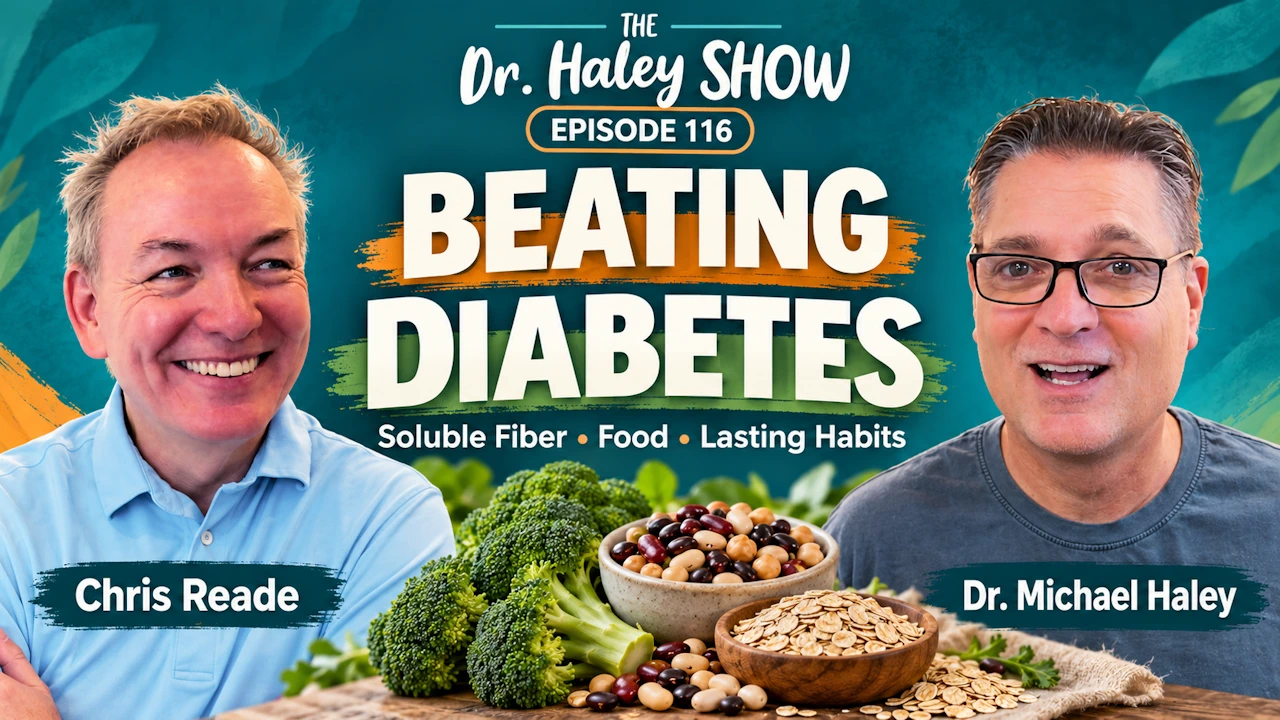
In this episode, we are here to empower people to prevent and even reverse type 2 diabetes with science-backed, sustainable strategies that are also available in book “Beating Diabetes”. Today we’ll find out why no extreme diets or medications are required.
Our guest is an entrepreneur, technologist, and author on a mission to change how we think about diabetes and food. After having a serious scare with diabetes, Chris Reade refused to accept it as a life sentence—he took control, reversed it, and now shares his science-backed, practical approach in his new book, Beating Diabetes. Get ready for an eye-opening conversation on breaking free from medications, mastering blood sugar control, and living healthier—without extreme dieting. Let me introduce to you, Chris Reade!
Watch the Interview
Listen to the Podcast
Resources
New: Get a DISCOUNTED copy of Chris’ book HERE: https://shop.ingramspark.com/b/084?params=eRnS5i8AAEafOVROlcPSHLtwBJko2U3fEFDOwRwAnA3
- Buy the book “Beating Diabetes – How a botched insurance renewal saved my life and how what I learned can possibly save yours.”” on Amazon
- Visit Chris Reade’s website beatingdiabetes.us
- Follow Chris Reade on Instagram
- Follow Chris Reade on LinkedIn
- Watch this episode on YouTube
- Listen to this episode on iTunes
Quick Takeaway
Chris Reade describes how he changed his eating habits after a diabetes scare and reports lowering his A1C from 9.1 to 5.4 in under five months. His approach centers on foods containing soluble fiber, less added sugar, and routines he believes he can sustain for decades.
The conversation explores his personal experience, restaurant choices, blood sugar monitoring, and habit building. His account reflects his own experience; decisions about diabetes treatment belong with a qualified healthcare professional.
ENJOYING THIS CONVERSATION?
Get the Next Episode in Your Inbox
Get notified when a new episode of The Dr. Haley Show is published, plus occasional highlights and resources worth exploring.
By subscribing, you agree to receive email from The Dr. Haley Show. Unsubscribe anytime.
Episode Timestamps
00:00 Intro Snip
00:53 Introduction to Chris Reade
02:45 What inspired an entrepreneur to write a book about diabetes?
05:40 What are your credentials for writing a book about diabetes?
06:21 What is the doctor's approach to treating diabetes?
09:28 What did Chris Reade find to be the key to reversing his diabetes?
10:45 What were "Power Words" spoken into your life?
12:50 What is the most powerful two letter 10 word phrase?
15:16 What is it about soluble fiber that helps maintain blood sugar levels?
18:09 What is the difference between Type 1 and Type 2 diabetes?
19:41 What are the common medications being used to control Type 2 diabetes?
21:33 How do you measure blood sugar levels at home?
21:50 What is a Dexcom and how does it work?
23:57 What sugar lowers blood sugar levels?
24:55 How is it that someone significantly overweight does not become diabetic yet a skinny person does?
26:46 What is another possible mechanism that fiber can help heal your bowels?
27:16 What else changed in your health when you added more soluble fiber to your diet?
29:30 What are some of the techniques you use to enable you to do this for years?
32:22 Dr. Haley's confession
37:20 Listen to your body when you eat
42:33 What is Chris Reade's favorite chapter in his book?
44:33 Where should people go to find out more?
46:15 How do you reinforce good habits to make real lasting changes?
Why Chris Reade Wrote Beating Diabetes
Reade explains that helping a friend understand the changes he had made led first to a text, then an email, and eventually a book. He connects his approach to his background in technology and his preference for simple, repeatable systems.
Soluble Fiber and Everyday Food Choices
Reade describes soluble fiber as central to his personal approach to blood sugar control. He discusses beans, broccoli, oatmeal, hummus, and other foods, along with looking for suitable sides and substitutions on restaurant menus. Dr. Haley and Reade also discuss whole foods, added sugar, and digestive changes Reade noticed after changing his diet.
Blood Sugar Monitoring and the Diabetes Discussion
The interview covers Reade’s experience with finger-prick testing, his views on continuous glucose monitoring, and his reported A1C changes. The speakers discuss type 1 and type 2 diabetes, metformin, insulin, berberine, and theories about pancreatic fat. These explanations and treatment opinions are presented as the speakers’ discussion rather than individualized medical guidance.
Making Habits Last
Reade discusses habit stacking, temptation bundling, reading added sugar information, and searching a menu for soluble fiber before choosing a meal. He emphasizes building a normal routine that he can maintain over many years rather than relying on a short-term diet.
Medical Disclaimer
This podcast and article are provided for educational and informational purposes only and do not constitute medical advice. The experiences and opinions discussed are those of the speakers and should not replace diagnosis or treatment from a qualified healthcare professional. Do not begin, discontinue, or change any medication, supplement, diet, or treatment based solely on this episode.
Full Transcript
The transcript has been lightly formatted for readability. Because it was created from the recorded conversation, it may contain minor transcription errors.
Read the Full Transcript
So I went from an A1C of 9.1 to an A1C of 5.4 in under five months, which without insulin, most people would say is simply impossible. all I changed was food. I didn’t change anything else.
You are listening to the Dr. Haley Show, the podcast dedicated to helping you optimize your health. Each episode there will be an interview or a message to help you discover better health. We will be featuring health radicals on the show to bring new ideas to the table, as well as doubling down on key fundamentals to support you living your best life. Your host is no other than the founder of Haley Nutrition Dr. Michael Haley.
This is the Dr Haley Show podcast. I’m Dr Michael Haley show host And today we’re here to empower you, empower people to prevent and even reverse type two diabetes with science backed, sustainable strategies that are also available in the book Beating Diabetes Today, we’ll find out why no extreme diets or medications are required. Today’s guest is an entrepreneur, technologist and author on a mission to change how we think about diabetes and food.
After having a serious scare with diabetes, Chris Reade refused to accept it as a life sentence. He took control, reversed it, and now shares his science backed practical approach in his new book, Beating Diabetes. You ready for an eye opening conversation on breaking free from medication, mastering blood sugar control and living healthier without extreme dieting. Welcome to the show, Chris.
You know, I want to start out a little bit different than I ever have before. I’ve asked this question at the end of podcasts. Okay, but something just put it in me and said, you know, let’s put it on the front end and get to know Chris first before talking our scientist and guru stuff. And partly because I know that you’ve helped people.
I think there was, 200 people that you helped in business as an entrepreneur, and all of a sudden you kind of switch gears. I’m sure you’re still doing those other things, but you, for some reason, took time to write a book about diabetes. in the middle of nowhere and who has what busy entrepreneur has time to sit down and write a book outside of their topic?
And I’m guessing that maybe there was some divine intervention or something that maybe you were called to do this. What happened?
So, I had my scare with diabetes and changed my life in, 2017, but, what actually precipitated writing the book was a good friend of mine had a very similar experience, and he asked me what I had done to kind of fix stuff up and changed my life around.
And when he asked me that, I started by saying, okay, well, let me just brain dump it to you. So I started a text and I was like, here’s all the things that you need to know, Tim, blah, blah, blah, blah, blah, right? And I was like, that’s just a fire hose is too much. So I said, let me write it down in an email.
And so I wrote him in long email and then I said, wait, I really need to organize this better. And in the process of organizing it better for a friend of mine, realized that there was material in here that was maybe better as a long form, book, basically a long form essay first. And then, after I realized that I said, you know, there’s a lot of other people who would probably benefit from this information.
And so I turned it into a book. Yeah, but no, I was not intending to be an author.
Frankly, it’s kind of funny because what you’re describing, you have a background in coding. Is that correct? Yeah.
So I started, you know, when I was young, we called it programing, but I started programing computers at 13, started my first company at 18, my second at 23. And always in technology. So, I’m 54 now. And so I guess I’ve been working in technology for 35 years or something like that. And
the way you went about in writing this book, the whole process you just described, it’s almost like a coders mentality. It has to be logical and, oh, there can’t be cluttered and there’s extra stuff in here I don’t need. I can clean it up and it has to be organized. I dabbled in coding a little bit, and it was one of those things where it always had to be right, and I might wake up in the middle of the night with an idea, and I better write it down or open up the computer and get it in the code before I lose it, because it was so, you know, this is unique.
This is the coolest. Yeah. That’s, my wife has had just about enough of me doing that in the middle of the night. Yes, that’s true. Wake up and got it. but also, you’re absolutely correct. So I’m a systems person at the end of the day, and I don’t believe and this is why I wrote the book the way I do it and the way that I structured the way that I have kept diabetes in remission for all these years.
It’s a system. And if the system is simple and you can follow it, then you’ll do it. And that’s the way coding is. That’s the way I approach it. Pretty much everything in my life, running my business, writing code, which I, frankly, I haven’t written code a long time, but, but yeah. So I’m always a systems thinker, and I believe that a system that is too complex is one that will be used.
Yeah. At the end of the it makes sense. And it also kind of answers the question, well, who are you to write a book about health? You’re not a medical doctor, right? No. Nope. But the kind of person that can research and logically think and organize well and also, I had to help a lot of medical professionals. Right.
so what happened was I had an insurance exam like for life insurance, like, you know, as you do and I by kind of random happenstance, I’d had one a year before and the year before I had sugar normal, totally normal A1C of like, you know, 50 51 something like that. Blood sugar at 95, you know, it was fine and it wasn’t even on my list. And then a year later, I happened to have to do another one and my A1C was over nine. And my blood sugar that day was about 160, 170 at the test. And I was like, wait, what in the heck has just happened to me?
And the first thing the doctor said, I mean, your doctor, you know, What primary care physician say to patients in that situation is, okay, here’s some drugs. And, unfortunately, this is only going to get worse. And that’s the normal progress, frankly. And for most people, that is what happens. I was just I was young, I was only 46.
And, I really, really, really didn’t want to take drugs the rest of my life. I really was very focused on living a normal life. And so I don’t consider myself a pretty healthy person. And so for me, that finding a way to do that was of paramount importance not to write a book. I mean, I wrote the book eight years later, but more just to find a way, that I could live, get rid of diabetes, live a normal life, and not be that weird guy who has to eat all different foods and can’t go to a regular restaurant.
Like, I don’t want to be that guy either. Which is not to say that that’s terrible thing, but I just didn’t want to be that guy. Yeah, you don’t want to be like me, but. Well, that’s the thing, so I, like I said, I wanted to, too. I wanted my normal life back. Right. And then really, at the end of the day, that’s all I was trying to do.
And so what I ended up doing was doing a ton of research, as you said. I mean, I’m a science focused human being. And so I believe, go where the scientific method tells you to go. And so I followed that and that’s what led to writing this book actually.
Yeah. And what you kind of described and not all medical doctors practice this way, but one of my recent guests use the term symptom satisfaction.
They’re in the business of symptom satisfaction. And in your case, the symptom is numbers on a blood test. Yeah. We want to satisfy those. We want to fix them. We want to make them normal. And we do that with chemistry. So take this. And we just satisfied the symptom. But we didn’t do anything about fixing you about your health.
Right. And well and also what we did. So for me and you can basically replicate what I did a lot of different ways you could do as you said, with chemistry with medicine. You can do it with very extreme, like keto style diets, like people who do paleo and stuff like that. You can absolutely do the same thing I did.
My problem with that was I didn’t feel like I could keep up an extreme diet like that for decades, and I was only 46. So I’m like, I could be doing this for 40, 50 years. I can’t do that. For what the next. I can eat nothing but meat and fish for the next 40 years. I just couldn’t I couldn’t imagine a world where I could do that.
And so what I discovered when you do the research is that, the real key to a lot of this stuff is soluble fiber. And that’s, like, been the magic thing that has changed my life.
Yeah. And I want to back up a little bit because you were talking about the, you know, meat, fish, high fat, high protein diet, which is also a form of symptom satisfaction because what you’re really doing is just kind of tricking the body.
You’re never giving it glucose, you’re never giving a sugar or an opportunity for the sugar levels to go up. And you’re not creating the insulin response, but it also means that you never get to have any birthday cake ever. And you haven’t really addressed the problem, which we haven’t gotten to yet. You talked about fiber, but the problem might be, gut issues.
It might be too much fat. It could be a lot of issues. And I want to get to that. Let me back up, though, because I never really asked that first question. And that has to do, again with kind of who you are and what made you into who you are. And I think of one of my guests that answered the question.
The question is, when you were young, growing up, or some time in your life, what were some power words that were spoken into your life that just kind of stuck with you, that that’s a good thing, shaped you into who you are? Sure. I think, Dr Lynn, you already have the answer. I can see this. I remember Dr Lynn Anderson, she said someone said, keep on swinging.
There was a baseball player. And that had to do with, you know, even the best baseball players are going to eventually, you know, hit home runs, but they’re never going to hit all home runs. And in fact, they miss more than they actually hit. But oh, think about it. I mean, if you bet 300 in the MLB, that means you strike out 60% of the time, right?
Right. And that’s like superstar status. You hit 300 in MLB. You’re going in the Hall of Fame, regularly. But yeah, you’re still striking out 60% of the time. No, I would say that’s really true.
and I don’t know if it’s a good mantra, but, you know, when I was, all my life, my parents told me, of a story when from obviously, I don’t remember it because I was an infant, but as a little kid, probably a year and a half, two years old. Maybe three. And I’m playing with blocks and the blocks. I’m trying to stack them up, and they keep falling over, and my father comes over to help me put them back up, and it grabbed the block out of his hand. And I say, I do it myself. And that was a mantra like that.
I do it myself. Like it’s been a sometimes bad but mostly good, thing in my life that, I mean, when I was 18 and I wanted to start a company, I must do it myself, right? Always. And sometimes, like I said, to my detriment, when I thought about beating diabetes and getting my life back on track, I was very focused on doing it myself.
It had to be something I could do that I could control. And so yes, that obsession around doing it myself is definitely been my empowerment all my life. It’s kind of like the most powerful two letter, ten word phrase. If it is to be, it is up to me. Yep. Absolutely. Absolutely.
and that’s you know, it’s been like I said, why did I not just listen to the first primary care doctor I talked to who said, well, this is just progressive and you’re just going to live with the rest of your life. I mean, I’ve known there’s lots of reasons, like, I could have just said, okay, it’s one pill a day, whatever, right? I could have done that. And so what drove me to not do that was, I think, a version of I do it myself. Like, I was just unwilling to, just accept an external, push like that, and it had to come from within, which is, like I said, for good or for ill.
That has been certainly, as you say, that has been, a power word or a power phrase, whatever you want to call it. All of my life, for sure. Yeah, that’s a great question. Not so good when it comes to, you know, pulling weeds around the house or, you know. Yeah, that’s got its moments.
You know, like I said, sometimes to my detriment, where I do things myself that maybe I need, to delegate or to get out of the way of, But. Yeah. No, it’s, that is definitely what is behind writing this book and the experience behind that book that led me to do it. I get it, I get it.
you enjoying the show thus far? One of the many health secrets that we have covered on the show is all around aloe vera. Specifically drinking raw aloe vera. Our aloe vera has helped our customers effectively heal their gut, increase their intestine health, lower inflammation in the body, eliminate and or decrease acid reflux, have glowing skin and hair, and so much more.
Now, as a frequent member of our audience, you will be exposed to exclusive specials and coupon codes for the awesome products manufactured by Haley Nutrition. That’s right, for simply being awesome and tuning in. You can get a mini discount to help you optimize and better your health. To see how we can help and support you on your health journey.
Tune in to the episodes and listen for coupon codes that you can use at haleynutrition.com. Before you make your orders of raw aloe vera. Once again, it’s www.haleynutrition.com. Now back to the show.
Let’s talk about the soluble fiber. What is it about fiber that helps maintain blood sugar levels? So there’s two basic types of fiber, and insoluble fiber, which is primarily like whole wheat. Or what you see in corn. It’s like this, the strong fiber that you can’t really digest. Then there’s a second type of fiber called soluble fiber.
Soluble fiber is the things that you see in broccoli or oatmeal or beans or, edamame or hummus or any of these sorts of things and that type of fiber you can digest. But it turns into kind of a mush in your stomach, and it slows down digestion because take longer for your body to clear it and to absorb the nutrients from it.
And it is that aspect of that kind of food that plays a role in sugar absorption. Because what basically you’re doing is if you have some sugary food, but in front of that sugary food or along with it is a whole bunch of soluble fiber, then what’s really going to happen is you’re still going to absorb that sugar. That’s still going to happen, but it’s going to happen over a much longer period of time. And because it happens over a much longer period of time, you never spike out your blood sugar. And it’s the spiciness of the blood sugar that is harmful. That’s what causes diabetes is when you have so much sugar in your system that it overwhelms the amount of insulin your pancreas can create.
And so basically what you’re doing is you’re kind of slow in the roll of sugar through your system. And which is why and it’s unfortunate I talk a lot about this in my book. whole fiber is great for you. It’s great for you. There are 100 reasons people Should Have whole fiber. But it really doesn’t do anything for sugar absorption. It’s just not going to help you. Whereas soluble fiber is going to help a lot and is going to change the digestive pattern and slow it down. And that’s going to give you know, because in type two you pancreas still working. It’s just not working great. And so what you’re basically doing is giving your pancreas the opportunity to work at the level it can work at.
And the good news about that is, what I’ve discovered over time is if you give your pancreas a break by doing this, your Islet cells do actually slowly sort of recover, you can kind of push back what’s called insulin resistance a little bit. And, you know, will my pancreas ever be 100% normal? Maybe. Maybe not. But with soluble fiber and I can eat pretty much anything anywhere.
Within reason, you know, obviously. Yeah. And, you know, I don’t I don’t mean like the, the, you know, simple sirup and, that sort of stuff or anything, but you can still, like, you can live like a normal person if you up the soluble fiber a lot. Yeah.
And if you could give a description of who this book, this podcast is for and who it’s not for, type one, type two.
So type one diabetes is, you know, it is an immune disease. It is where your immune system has decided that your pancreas is the enemy and it kills off all your Islet cells, which is what creates insulin, which allows your body to absorb sugar. Well, type one diabetics, this would help, but it’s not going to solve that problem for them.
that’s a much more serious issue. It’s also much less common. I mean, it’s probably 100 or 1000 to 1 number of type two people to type one. Type two means. And this is actually fascinating. It’s one of the research pieces in there. Type two is actually and this is weird because everybody knows these people. Type two appears as near as we can tell to be fat on your pancreas.
Very small amount of visceral fat in pancreas. In a British study they said about a gram, which is tiny if it’s so small, but it’s enough to get your pancreas to stop working particularly well. So this book and the podcast is really for type two diabetics who are trying to control type two diabetes without insulin or without metformin or without berberine, whatever they want to take.
And the idea is to help folks regain control by lowering the amount of those drugs they take or, in a perfect world, eliminating them. So that’s a which for at the end of the day, yeah.
What are the common medications again? So what do they do. Obviously the big the number one is insulin right. Insulin is the big drug.
But that’s usually you got to be pretty far down the road before you’re taking insulin. Probably targeting folks who are taking metformin, which is the most common diabetes blood sugar control drug. And what’s it. And so what metformin does, it’s like this actually also fascinates me. And you obviously know your doctor. So but, your liver is where most of the sugar comes into your body on its own.
So when you absorb food, your liver is the thing that’s actually secreting glucose, because you need glucose to run your brain and your body. And so, for a lot of different reasons, we get into we could geek out about ATP if you want, but at the end of the day, your liver needs to be told to manufacture little less glucose.
And what metformin does, apparently, for whatever reason, is tell your liver to chill out and produce a little less glucose. I’m vastly simplifying that, but that’s basically what it does. There’s a supplement you can buy called berberine that does basically exactly the same thing. And actually for me, if I feel like because I’ll still measure my sugar sometimes if I feel like I’m, getting somewhere, I’ll start using a little berberine for a while.
But it’s really metformin is like the first line, you know, every primary care physician in America, the very first time somebody comes in with prediabetes, diabetes, they’re like, here’s some metformin. Have a nice day. Right? That’s the very first thing they’re going to do. In in most cases. And it’s because it’s an old drug, it’s all patented it’s cheap.
And it’s effective. Almost no side effects for anybody. So it’s, it’s a really good drug, which is why physicians love it. In my case, I just want to get rid of everything. Yeah, yeah.
And how are you measuring your blood sugar levels?
So when I first started, I barely do it now because it’s been stable so long, it doesn’t really tell me that much.
But I used to just use a standard, you know, prick your finger test every single day When I was first battling this, Dexcom and stuff didn’t exist. If I had this happen now, I probably would use Dexcom. But again, it’s an expensive thing that you have to maintain all the time, and I just was like, I wanted that was the whole point was to be able to live without medical interventions.
But a Dexcom can be amazing. I mean, nowadays, like I said, if I had access to it, I’m a science guy, man. I have used it. I’m not sure how this work. So what it does, is it attaches on the outside of your arm typically. And it is basically kind of like, an oura ring or a smartwatch. But inside your blood stream. So it’s picking up and measuring your blood sugar continuously every second or so. My issue with that also is your blood sugar is constantly moving up and down to the response of a thousand things that are going on, whether you just ran up the stairs, whether you’re excited about something or you’re a little tired.
I mean, there’s a million things that are going on that are moving your blood sugar. And so actually, in some ways, too much data can lead you to because human beings, you know, we’re terrible about focusing on individual data points instead of seeing the picture, which is why doctors like A1C as the actual measure. Because Daily Blood, you know, once in the morning, blood sugar tests. That’s great. But the real measure is the 30 day average, which is what’s called your A1C
Yeah, I’m kind of a science guy and do like to see the numbers just to see what moves them. So even the daily fluctuations with the blood sugar levels, I like to know what happens. Like if I’m in ketosis and I consume this, what happens?
Do I stay in ketosis or am I still in slight ketosis? Right? Right. Absolutely. I mean, the data points are great.
Yeah. One that I haven’t nailed down yet because I haven’t taken the time to be in ketosis enough times and interrupt it with this particular food. I’m actually in the aloe vera business. Oh, okay. I don’t fully understand it because aloe vera is made up of something called Mucopolysaccharides and a polysaccharine means many sugars.
Yeah. Can you break down that slimy stuff? It’s the simple sugar. Mannose is the dominant sugar molecule, and interestingly, mannose that particular sugar somehow lowers blood sugar levels instead of raises them. Yeah. Interesting. It is. I didn’t know. And it’s one for you. learn something new It’s one of the reasons why, they’re using mannose when people have cancers.
Because cancer will actually not only will lower blood sugar levels, but cancer molecules apparently attached to it because they want to consume sugar, but they can’t use it for energy. And apparently it causes those particular cells to starve out instead of, thrive because they. Yeah, that’s interesting.
And, well, it’s interesting, since you mentioned that one of the things about the, visceral fat in the pancreas thing in diabetes was a big eye opener for me because everybody knows somebody who’s, you know, significantly overweight, never becomes type two diabetic. And everybody has met a runner who’s like 4% body fat, sort of people and yet is diabetic. and it’s an interesting like the science behind what we’ve learned around what makes this tick just in the last 20 years is really kind of amazing. The knowledge that we actually have about what you’re talking about, like, hey, this sugar actually lowers sugar instead of raising.
It’s like, wow.
And that was what you just said there in the last 20 years. Yes. And we still only know this much. I’m showing a pinch with my fingers. For those that are just listening, we have so much more to learn. I’m sure the yeah, the study that interested me on the aloe vera was they gave rats that were in ketosis aloe. And this was done back in I think like 1935. But apparently the rats stayed in ketosis when they were given aloe vera which is the sugar. So it’s like, okay, that’s interesting. I need to given it like oral and like not aloe like I use for sunburn but like actually eating it. Yes.
our customers, we have topicals, but they ingest it mostly for their immune system, some to lower their blood sugar levels and others for, you know, irritable bowel conditions and all that stuff, which ties in with things like diabetes.
If your bowels aren’t working right and you know, you’re not absorbing accurately as you should, some things are leaking right into your bloodstream because you’re bowels are irritated. And when you consume foods like fiber, I think this is interesting. A possibility. You’re feeding your microbiome. Oh yeah. As you strengthen your microbiome and kind of remake or reseed or seal the walls of your intestines, possibly they’re working more like they’re supposed to, and that might have an impact on your blood sugar levels.
Now you’re spot on. I will tell you so in in 2017 when I had this whole experience, I started eating as I’ve mentioned in this book, you know, tons of soluble fiber. I mean, I ate beans and broccoli and brussel sprouts and all sorts of junk, but I mean, just all that stuff, like it’s going out of style.
Before that experience, if I would go out for sushi and I love tuna, I would have like tuna sushi and I would just know I was going to have gas pains, like, like horrible stabbing pains, you know, for like an hour. And I loved tuna anyway. And I’d have it after this experience. I can eat tuna and it doesn’t bother me.
And I think, as you say, it’s I kind of like putting so much soluble fiber in so much these things and so little sugar into my life that I’ve changed my microbiome, for the better. You know that. Now I can digest something that before used to cause me a lot of intestinal pain, and now it doesn’t do anything.
So, yeah, I think absolutely spot on. You know, not only changing my diet changed not only my sugar levels, but also changed my microbiome so that a lot of other things in my life got a lot better. I mean, so when I look at like 2017, if I look at photos of myself, obviously I can tell is 23 or 24 pounds heavier than I am now.
But more importantly, when I look at the like yearly blood test stuff, you know, you go to the doctor once a year and they run a blood test. It’s not just that my sugar was up. There was a whole bunch of other things they’re changing. My diet seems to have things knocked all the other things down now, too.
And so I’m actually on a blood level basis, significantly healthier now than almost ten years ago. Almost the only thing I really changed was food. I exercise the same amount now that I did. Then. It’s just, you know, it’s not only did changing food change my diabetes, and my blood sugar absorption, it changed all of the other chemistry that drives my life.
And that I think is, is a big part of the story. There is, you know, and I think this is the legit question. What do I do? You asked me in the beginning of this, like, what is I’m a systems person. What is it that lets me do this for years and years on end? And a lot of it is habit stacking and what is referred to as temptation bundling or virtual bundling, depending on which version of it you want to talk about.
But those systems that help you figure out, okay, I go when I get coffee. I’ve just learned to live with the fact that there’s no sugar in my coffee. Now, if you give me like coffee with Sugar in it, I’m like, oh God, what is up with that? I can’t believe I used to drink this like it was going out of style.
I literally don’t even like it anymore. So part of it is also when you change things like that, you can change your own desires to the point where if somebody like if I had a cocktail, I would always have, bourbon and ginger ale. If if I drink a bourbon and ginger, I can’t even down the thing. I mean, with what? Because it’s so much sugar, like you, you don’t realize, like, you have a Coca-Cola. Now I’m like, oh, my God, I used to drink this stuff all the time.
and it’s amazing how different you can become just if you give it some time and, and work at it to where you don’t even realize because it’s incremental gains. Right? You don’t. It’s not like you go from one day your and everybody wants that. Right. And you said, what did you call it, a symptom satisfaction. Yes. Everybody wants that. Right. We want to take a pill. We want the problem to go away. But if you give it a little more time and you’re a little systemic and a little, you know, focused about how you’re doing things, it’s amazing how much change you can make incrementally over small periods of time.
So I went from an A1C of 9.1 the day of the test. That kind of started me on the path to an A1C of 5.4 in under five months, which without insulin, most people would say is simply impossible. But that’s my life. And I don’t think I’m unique. I don’t think I was particularly amazing. I certainly wasn’t, any all I changed was food. I didn’t change anything else.
And that’s, I think a big message for people Food is medicine. You can change a lot with what you put in your body. Yeah,
As a thank you for tuning in to the Dr. Haley Show podcast, I have a special coupon code that can be used throughout the month of September 2025. Get $20 off your purchase of $200 or more at Haleynutrition.com. The coupon code is XXXXXX. That’s XXXXXX. And as usual, you can even use this coupon with on sale and already discounted bundled items. Enjoy the rest of this podcast.
a lot of my audience doesn’t have room for error, and they have to stay very, very strict on their diets. And I would encourage them to continue to do so. For myself, I’m going to be transparent. Maybe shock a few of them. I drink coffee, I don’t like anything. It can actually be healthy, but I just could not possibly drink coffee with sugar because I would feel miserable. Everything about me would know it was bad. By the way.
I feel I’d be. If you’re into process, you can smell sugar too. Like it’s amazing. Like if somebody hands me something, the smell alone will tell me if there’s sugar in it. I don’t even have to eat it. I just look at, I mean, oh, wow, that’s got a lot of sugar in, like, instantly. It’s kind of weird, like, you start being able to notice that stuff and, it’s kind of funny that way.
Yeah. For about ten years, I’ve been a little bit addicted to my morning coffee and organic coffee with I put a vegan protein in it that has, you know, organic vanilla and organic stevia in it. And I drink it cold. And to me, it’s almost like a Frappuccino because it’s sweetened with the stevia. And it has a nutty flavor with the protein absolutely delicious with no sugar.
And it’s healthy. Yeah. It’s a it’s not top. So what is the difference between organic stevia and stevia I don’t know. Stevia you know is essentially like a tea leaf. Yeah okay and they juice it to get the sweetness out of it. Or you can actually buy the dehydrated leaves that are just crumpled up into a powder.
They’re not going to be nearly as sweet as the processed stevia, but so organic just referring to grown without pesticides, herbicides, fungus, I think. And the chemicals. Because, you know, why do we want, everything organic? The chemicals are there to kill pesticide. Yeah, they’re in the food to kill herbicides, kill weeds, fungicides kill fungus. You know, preservatives kill microbiology.
Chemist. Yeah. They’re all it makes sense to kill. And my fun question is, is when we eat it, does it know to stop killing? You know, we’re slowly killing, and we’re killing our microbiome and our guts, which are essential for good.
Well, and to your point, I mean, the way that I eat a lot of it is simpler foods, you know, like what is black beans? You know, it’s literally like just black beans real food. you soaking in water. And then you cook them. That’s. it You know, what is hummus ground up Chickpeas. Yeah. I don’t go for the hummus with lots of additives to it. You know, I don’t eat a whole lot of junk in it. Straight up regular hummus, but the same sort of thing.
I mean, the closer I find that the most likely thing that I’m going to find in a menu that’s going to have the soluble fiber I’m looking for is going to be a whole food. Yeah, it’ll be broccoli, it’ll be a bean. It’ll be, you know, it’ll be Brussels sprouts. It’ll be something like that. And that usually is present and this is What I like about the way that I do this diet, and why I can sustain it for so long, is it’s on every restaurant menu kind of like proteins. Proteins, if you’re doing full protein, it’s on every restaurant menu too. and so you can usually find that stuff.
And so for me, I find that any restaurant will have these whole foods. It’s just usually hidden in the apps or side somewhere. It’s not necessary. And most places will let you. It’s not a big deal. Like if somebody throws down, I was just in Memphis for a company thing, and, the side for one of the dinners was fingerling potatoes. Right? Which are lovely. They’re just terrible for you on a sugar basis.
It’s a Whole Foods, just fingerling potatoes. But they just happen to be not so hot for you on sugar. And there was asparagus on the menu on another thing. So I just asked him, hey, can you serve the asparagus in for the fingerling potatoes? No problem. Nobody better than I. And that, you know, there’s an instant hit of a whole food that has lots of soluble fiber in it without, you know, having to worry about, as you said, processed foods and all this kind of stuff.
Things that are whole foods typically pretty good for you.
Yeah. A couple neat things. You also said you mentioned soaking your beans, which is essentially getting rid of the phytochemicals on the outside that are there to protect the bean. Kind of like a natural pesticide, herbicide, fungicide only natural, but not good for our guts. And when you soak it, you get rid of that and even cause that bean to maybe sprout if you soak them long enough, which just.
Yeah, you can, you can screw it up and end up with sprouting beans, which is that’s for sure which is fantastic. Another thing you said is, you know, when you were talking about drinking, bourbon with ginger ale, yeah. You would feel miserable. And I. think a lot of people don’t take the time to recognize how they feel when they eat something, because the information is there.
Oh, yes. Your body knows. Good. Your body knows when you just put them in and it’s not good. Yeah for sure. And for me, I haven’t had a Coca-Cola in probably, I don’t know, 25, 30 years. I you know I’m tempted to buy one now because they’re actually going to put real sugar in them and not high fructose corn sirup. But I’m not going to because I still wouldn’t feel good. I think it’s going to be healthier. I think sugar is healthier than high fructose corn sirup, but it’s still going to have that spike. And who wants it, right. Exactly.
So when you travel, you’re going to restaurants and making best use of what you can find on the menus.
Yeah. And I like I said, if you’re not in a McDonald’s, you pretty much can find what I’m looking for in soluble fiber in any menu in fact, what I do, on our, Insta and, and TikTok stuff is I actually go to restaurants and we just, go through the menu. It’s like super fast. You just go through the menu and see what’s there.
And almost always, I don’t think I’ve eaten in a restaurant and not had what I was looking for on the menu. Almost never. I’m not including international travel.
I’m gonna have to put a link to your TikTok in the show notes in the description below the video, and also on the blog page and below the, podcast if you’re listening on iTunes or wherever you’re listening to it.
I think that’s fantastic.
So yeah, it’s a thing for me. Like, when I tried to put my life together to live without sugar and to live, you know, lowering without having drugs and keep my sugar low. One of the key things was finding ways to be able to go out, with friends, with family, and eat at restaurants and not have to worry.
and like I said, what I’ve discovered is that pretty much not anywhere, but almost anywhere you go, you’re going to find soluble fiber on the menu somewhere. And if you aren’t, then I will go the way you’re talking about and just stick with the protein.
You know, a lot of what you’re saying, though, is remind me of a podcast that I did with, someone named Cyrus Khambatta I don’t know if you’re familiar with him. His book was reversing diabetes. Okay.
I have seen that book I did not recognize the name. Well, what he teaches is sugars are not evil. Processed sugars are. But, yeah, I’m with that. And actually, that’s true. That’s. I actually talk about that exact thing. I wonder if he’s getting on with fruits.
Yeah. Because you would say, like, why is it okay to eat an apple? There’s a lot of sugar in an apple fiber. Well, it’s not okay to eat drink apple juice, but an apple has a lot of fiber and soluble fiber in it that protects you from the sugar that’s naturally occurring in it. Yeah. Is that how his book gets on to.
He’s to teaching people to eat real food. And yeah, that sugar is, you know, naturally enclosed in the food and you’re eating your carrot or your, you know, whatever it might your apple, these things have natural sugars, but it is different. There was another thought on diabetes because some people talk about insulin resistance. I heard another one, his theory was that we only have so many fat cells, and they can only hold so much, and that it’s not insulin resistance, but you’re out of place to put the fat, or the to store the sugar as fat. I should say. That’s his theory about it, man. And it might be a little confusing on why some people are skinny and still have diabetic. It is. It is a legit question, so we don’t know. Speaking of, you said like we only know this much is like a one centimeter of about our bodies. And we need to know like ten times that.
But it’s unknown and obviously forget what we’re talking about. The beauty industry would love to be able to give us a way to store fat in the places we would prefer to store fat instead of where your body decides to. Right.
and certainly the liposuction world would be very different if you could do that. But since we don’t know why we decide to put fat in certain places, not in other places, that’s where you get as I mentioned in earlier, you know, you get people who are marathon runners who are type two diabetics and you’re like, how can that be? They barely have any fat in their whole body. It’s just for whatever reason. And that’s the thing we would all love to know. Their body decides to store it in their pancreas, which is unfortunate, but it does happen. So yeah, I it’s interesting. There’s a lot of studies.
one of my favorite chapters in my book, maybe my favorite chapter in my book, I called studies. I bet my life on, because I read and read and read and read endless. And I used Google Scholar a lot, instead of just regular Google to try and actually read. And I’m not a scientist, so it was tough reading, a lot of times. But trying to understand what it is that is driving my body to not process sugar the way I needed to.
And at the end of the day, the guy with the fat cells is probably not too far off. I was terrible, man. I’d sit down and throw down a whole sleeve Oreos. I mean, I was bad and because I exercise a lot and play a lot of sports. I didn’t look out of shape. I didn’t look like a person who was sick, but I was and I was sick because what I was putting in my body was terrible for me.
And so studying all of these things when it came to the conclusion of is what you said eating real food makes a difference. Real food, not processed food. Real food.
You know, as you’re saying these things, I’m thinking about all the treats that we have hidden around the house that I have access to, and I refuse them because I know how they make me feel. I want them, I want to eat the sleeve of Oreos. We don’t have the Oreos in our house. But, you know, we have that kind of, you know, sweet treat that would, be very, very tempting. Yeah.
I live in New Orleans, and, one of New Orleans is many nicknames is, Sugar Town. And it’s well earned because there is a lot of sugary stuff, at every meal in this town. And it’s tough. It can be hard, I could imagine. Yeah. They even put sugar in meats. I can’t stand that there is sugar in meat who wants sweet meat.
Well, what’s your best call to action? Where should people go to find out more besides?
Tick tock beatingdiabetes.us which is my website. It’s got links to buy the book on Amazon, Barnes and Noble, on your Kindle, on your fire, all that stuff. that’s the best source. And, obviously. Yeah. Following the Instagram and checking that out, the TikTok and all that where you’ll see, you know, we go through and, one of my compatriots and I, we sit down at lunch, every week and, go through the menu and say, okay, if I’m eating here, what am I going to eat?
How am I going to do that? Because I think the other thing I like to do is go down the grocery aisle. You know, if you go in the grocery store and you’re looking for sugar control, there’s really only three lines in the box you got to read. And if you read those three lines, they’re all in the carbohydrate section, which is where the sugar section is.
You’ll know, and I’m sure you tell your listeners on other episodes, just look at that added sugar number. If you look at that added sugar number, you start seeing things that are seven, eight, nine, 20g per serving. Yeah. Added sugar. You know you’re in trouble. So yeah, that’s what I would say is check out the website beatingdiabetes.us and check out the book.
It’s short, it’s easy. You can read it in half a day.
Oh, great. Chris, is there anything that I should have asked you that I’ve left out? No.
you did cover a lot of that. I would say we didn’t talk a lot about how you make changes stick and that’s a big part of, my story, I think, is I try really, really hard.
Like you mentioned, you don’t keep Oreos in your house, so there’s no temptation to eat them. But what I do is I do a lot of things that enable me to live the way I want to live without really trying. So the whole starting with where is soluble fiber on this menu, before I even look at the other things I want to eat, I’m going to go find the items that have soluble fiber that habit reinforces me.
And so when I do that, I’m automatically looking at a menu in a very different way. Or if I’m walking down the aisle of grocery store, I’m looking at it in a very different way by training myself to do that is how that habit is really when you make something, a habit and you make something just part of your normal routine, you’ll do it as opposed to.
And that’s why I opposed like what people generally called diets is, I feel like a diet is a temporary thing. I was looking at something I was going to have to do for 40 or 50 years, and as a result, I came up with a way to do it that I could do for 40 or 50 years. Sure.
So I think that’s the only thing we didn’t really cover is how do you make stuff stick? Because everybody can do something for two months, right?
I like it, yeah. Find out more in the book. Everybody get the book. Sounds great. There you go. That’d be great. Well, thank you, Chris, for joining me. This was great and thanks for having me. I really appreciate the time. And it was really, a very informative and fun discussion.
I hope you enjoyed that episode today on the Dr. Haley Show. Make sure to hit subscribe on whichever platform you are listening to this. If this episode made you think of someone, go ahead, take a screenshot and share this exact episode with them. You can catch the show notes for this episode on drhaley.com. If you want to geek out with Dr. Michael Haley on other radical health topics. Be sure to check out his YouTube channel where he posts exclusive video content. All the details are at drhaley.com and we can’t wait to hang out with you on the next episode.