
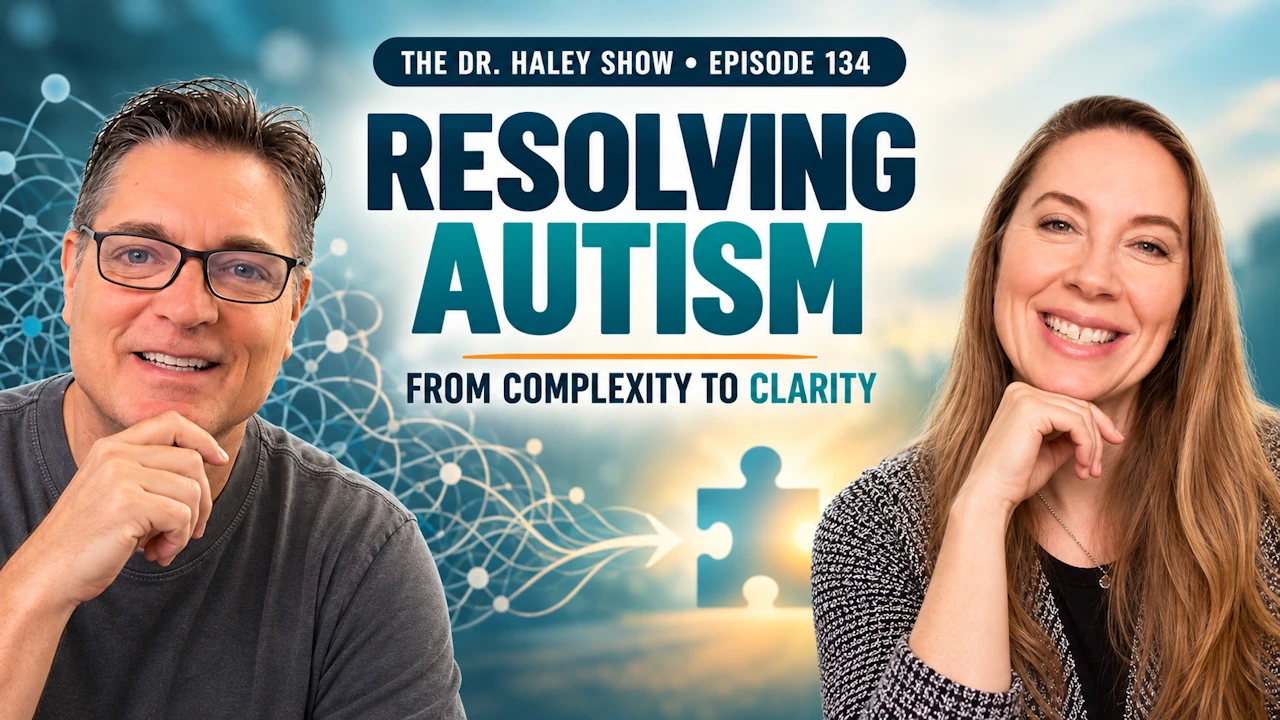
In this episode of The Dr. Haley Show, Dr. Michael Haley sits down with Dr. Theresa Lyons to explore autism through the perspective of a scientist, autism parent, and founder of Navigating Awetism. They discuss autism diagnosis, genetics and environmental factors, gut health, folate, communication and motor challenges, and a structured approach parents can use to better understand their child’s individual needs.
Watch the Interview
Listen to the Podcast
Resources
- Navigating Awetism – Dr. Theresa Lyons’ platform for parents navigating autism
- Awetism
- Navigating Awetism on YouTube
- Navigating Awetism on Instagram
- Watch this episode on YouTube
- Listen on Apple Podcasts
- Listen on Spotify
Quick Takeaway
Dr. Theresa Lyons approaches autism as both a scientist and a parent. Her central message is that parents can use research, observation, appropriate testing, healthcare professionals and ongoing reassessment to better understand the particular challenges affecting their child rather than assuming that one intervention applies to everyone.
The conversation also highlights an important distinction between a child’s ability to understand and their ability to express that understanding. Dr. Lyons discusses how communication and motor-planning challenges can sometimes obscure what a child knows, and she explains how the Navigating Autism Matrix is intended to help families organize a complicated body of information into actionable steps.
ENJOYING THIS CONVERSATION?
Get the Next Episode in Your Inbox
Get notified when a new episode of The Dr. Haley Show is published, plus occasional highlights and resources worth exploring.
By subscribing, you agree to receive email from The Dr. Haley Show. Unsubscribe anytime.
Episode Timestamps
00:00 – Can autism improve or resolve?
00:50 – Introducing Dr. Theresa Lyons and Navigating Awetism
02:23 – How Dr. Lyons built her autism research YouTube channel
04:03 – Food, sleep, gut health and behavior
04:56 – Why chemistry matters to understanding health
06:30 – What is computational chemistry?
09:24 – Dr. Lyons’ daughter’s autism diagnosis
09:53 – Genetics, environment and parental guilt
11:36 – Finding hope through science
12:40 – Medical, natural and integrative approaches
14:45 – Medication, short-term support and long-term goals
17:32 – How autism is diagnosed
18:49 – Are there biochemical markers for autism?
19:25 – Research on children who later lose an autism diagnosis
20:33 – What do we know about children who lose the diagnosis?
22:48 – What causes autism and what increases risk?
23:22 – Air pollution and environmental risk factors
24:54 – Environmental exposures in cities and rural areas
26:06 – Vaccines, environmental chemistry and genetics
27:34 – Detoxification, exposure and individual differences
28:48 – Is detoxification the answer?
29:26 – Leucovorin, folate and autism
31:28 – Gut health, inflammation, mold and FRAT testing
32:31 – Why children may understand more than they can express
34:46 – Expression, intelligence, apraxia and dyspraxia
36:18 – How the Navigating Autism Matrix works
38:03 – Pacing changes without overwhelming the family
39:22 – Measuring progress with the ATEC
41:10 – Dr. Lyons’ message to parents
42:16 – Where parents can begin
About This Episode
Dr. Theresa Lyons is a scientist with a PhD in computational chemistry from Yale University and firsthand experience as the parent of a daughter diagnosed with autism. After her daughter’s diagnosis, she began studying autism research in PubMed and translating individual scientific papers into information parents could understand and use.
In this conversation, Dr. Lyons and Dr. Haley discuss how autism is diagnosed, why autism cannot be reduced to a single biochemical marker or universal cause, and how genetics and environmental factors may interact. They also explore diet, gut health, environmental exposures, folate-related biology, laboratory testing and the role of conventional and integrative healthcare.
A major theme of the episode is the difference between comprehension and expression. Dr. Lyons explains that some autistic children may have motor-planning or communication challenges that make it difficult to demonstrate what they understand. She encourages parents and professionals not to underestimate a child’s ability to learn simply because the child cannot consistently express that knowledge.
How Is Autism Diagnosed?
Dr. Lyons explains that autism is not currently diagnosed through a blood test, urine test, stool test or MRI. Diagnosis is based primarily on developmental and behavioral observation, often incorporating evaluations from professionals such as speech therapists, occupational therapists, psychologists and physicians with specialized training in autism.
Genetics, Environment and Individual Differences
The episode explores the difficulty of identifying a single cause of autism. Dr. Lyons distinguishes between establishing causation and identifying factors associated with increased risk. She discusses genetics alongside environmental exposures and emphasizes that what is relevant for one child may not be relevant for another.
Expression, Comprehension and Motor Planning
One of Dr. Lyons’ strongest messages is that outward behavior does not necessarily reveal everything a child understands. She discusses apraxia and dyspraxia as examples of motor-planning challenges that can affect a child’s ability to respond physically or verbally, potentially leading others to underestimate comprehension.
The Navigating Autism Matrix
Dr. Lyons describes the Navigating Autism Matrix as a framework developed through years of working with parents. The platform is designed to help families learn about current research, consider appropriate laboratory testing with healthcare professionals, build a healthcare team, work on mindset and implementation, and track changes over time.
She also discusses the Autism Treatment Evaluation Checklist (ATEC), which parents can use to record observations and compare changes over longer periods such as six months.
Frequently Asked Questions
How is autism diagnosed?
Autism is diagnosed through developmental and behavioral evaluation rather than a single laboratory test. Dr. Lyons describes a process that may include observations and reports from speech, occupational, developmental and psychological professionals followed by evaluation from a clinician trained in autism diagnosis.
Is there one known cause of autism?
No single cause explains every case of autism. In the episode, Dr. Lyons discusses genetic and environmental factors and distinguishes between research showing an association with increased risk and research establishing direct causation.
Can some children later no longer meet the criteria for an autism diagnosis?
Dr. Lyons discusses research in which some children diagnosed with autism later no longer met diagnostic criteria. She emphasizes that outcomes vary and that autism is highly individual rather than presenting the same way in every child.
Can an autistic child understand more than they are able to express?
According to Dr. Lyons, yes. Communication and motor-planning difficulties can interfere with a child’s ability to demonstrate comprehension. She discusses apraxia and dyspraxia as examples of challenges that can affect outward responses.
What is the Navigating Autism Matrix?
The Navigating Autism Matrix is Dr. Lyons’ framework for organizing areas that families may need to consider when navigating autism. Her platform combines education, laboratory data, healthcare-team building, coaching, community and reassessment to help parents develop an individualized strategy.
Medical Disclaimer
This podcast and article are provided for educational and informational purposes only and do not constitute medical advice. The experiences and opinions discussed are those of the speakers and should not replace diagnosis or treatment from a qualified healthcare professional. Do not begin, discontinue, or change any medication, supplement, diet, or treatment based solely on this episode.
Full Transcript
The transcript has been lightly formatted for readability. Because it was created from the recorded conversation, it may contain minor transcription errors.
Read the Full Transcript
for any parent that has a child with autism, the first thing to know is that change can happen.
It’s also important to know that 37% can lose the autism diagnosis and do. That’s based upon science. So autism isn’t necessarily lifelong for everyone.
You are listening to the Dr. Haley Show, the podcast dedicated to helping you optimize your health. Each episode there will be an interview or a message to help you discover better health. We will be featuring health radicals on the show to bring new ideas to the table, as well as doubling down on key fundamentals to support you living your best life.
Your host is no other than the founder of Haley Nutrition Dr. Michael Haley.
This is the Dr. Haley Show podcast. I’m Dr. Michael Haley, your show host. On today’s podcast, we’re going to learn from an expert in autism and find out what can be done to better navigate the autism matrix with a roadmap that organizes the autism science into clear, actionable steps that can lead to transformation. From this podcast, you’ll get a new understanding of autism.
And if you have a child that has autism, you’ll have a clear next steps you can use today with a confidence to advocate for your child while filtering out the misinformation. Dr. Theresa Lyons is founder and CEO of Navigating Autism, found at www.navigatingawetism.com But autism is spelled a w e t i s m navigatingawetism.com, a platform dedicated to turning autism complexity into clarity.
Theresa has a PhD in computational chemistry from Yale University. She also has firsthand experience as a parent to a daughter with autism. Welcome to the show, Dr. Lyons. I watched some of your YouTube videos. You got a great following and a lot of, great content there. How long you’ve been building that channel? I’ve had a YouTube channel for over ten years now, and that’s great. And you actually continue to put fresh content on. Oh, yeah. Yeah. It’s been a continuous ten years. Definitely. It started out as, so I have a background in computational chemistry, and I was drug design, so I worked for pharma. And when I needed to understand what is autism. I went to PubMed and got myself up to speed on the different research.
And so what I did for the channel was I would take out one research publication that I thought it would be really important for parents to know about, and I would teach one research article based upon the current research. And then it has just grown and grown. I love that method of creating content, because in it, not only are you providing great content, but you become the expert because you’re literally absorbing all of the content.
Correct? Yes, and this was all for my daughter as well. So I was very personally invested in knowing that information. So I was a good teacher because I needed to know it myself. And there’s no one that can learn better than someone that’s right in the thick of it, where it is almost like life and death to them.
So I completely understand, you know, just like no one knows my children better than me. And sure, they’re sort of guinea pigs to when you know, they are not acting right. I might try different food choices and see how that affects them. and wow, wouldn’t you, you know, be amazed that, when they eat the stuff that’s giving to them at church, they’re different than their food that they get at our house and actually affects their personality.
And It does isn’t it amazing how our personalities and just the way we float through a day can change based upon basics like food and sleep? Yeah, it’s absolutely amazing and gut health, I would even say because yes, and we’re learning this more and more now than ever before, how the life that’s in our bowels actually influences how we think.
And it’s part responsible for communication that’s happening throughout our whole body. Yep. And as that gets more in balance, things seem to work better. Let’s go down the chemistry route first, because oddly enough, I’m known as organic Mike and not organic as in organic food, but organic chemistry. And awesome how they know me as organic, Mike.
Because, oddly, chemistry was the most difficult course I ever took. Organic chemistry was kind of the class that filters everyone out. If you don’t get to organic chemistry and physics, you don’t get into chiropractic school in my case, or medical school in other people’s cases. That’s kind of the class that weeds people out. And I remember when I took organic chemistry, I was really bothered because I got a C in the class.
Oh, and so bothered that, you know, we went from finishing that class to summer break. While everyone enjoyed summer break, I mastered organic chemistry because I was bothered that it was so difficult for me and I literally outlined the book and did all kinds of problems and worked on it as best as I could. And then I went, stood before the class.
And, you know, the next semester. And I said, this is a hard class. I’m having a tutoring session, you know, tonight. because you have a test tomorrow kind of thing. And I remember people saying, what are your credentials? I don’t have any, how do you do in chemistry? I got a C you know, just last quarter, but, you know, and I had a few people show up and they all aced their tests.
And then the next time I had 20 people show up and after a few classes, I was having 80 people show up. And I’m teaching them all organic chemistry so they can cram for the test. Wow. It was a very difficult thing. But you are next level chemistry with computational chemistry. What is that? Yeah. Well, so I actually have a master’s in organic chemistry. So love chemistry and I love the different areas of chemistry. So organic chemistry, I found it really taught me how to think about things and that biology was more straightforward. Right. You have different cycles to memorize and things like that. But with chemistry was really about how do you think about a problem? And organic chemistry was something that I really enjoyed.
But then I went on and got a master’s in general chemistry, but then I specialized in computational chemistry, and the reason why I liked computational chemistry was it’s that the intersection of chemistry, biology, physics, math, computer science, like it just rolls everything up into one. And I really enjoyed that challenge. So that is why I chose computational chemistry.
So basically what we were doing and this was this is way before Ai right So I have my PhD I think like 20 years now. Yeah, just about. so we were studying how a small molecule, hopefully eventually a drug would interact with the protein. So how is it going to fit in the pocket spatially? How are the interactions between, let’s say, a negative charge and positive charge.
So all of that. So you had to understand the concepts of organic chemistry. But then there was so much involved and I loved it. So it’s kind of turned into not only understanding what happens, you know, and how the molecules interact, but more from a biochemistry standpoint on what’s going to happen in the body with these. Yeah. So computational chemistry, it involves all of that. Okay.
And you know, even now as we’re talking, you know, I’ve got, you know, tetrahedrons floating around in all kinds of interesting shapes and electrical charges. Awesome. Yeah. All that stuff is important. It’s important in the body, for sure. It’s important to understand chemistry because so much related to our health, like you’re talking about gut health and everything.
Chemistry. You know, what is gut health? Chemistry. Yes, biology is involved, but chemistry is really important as well. Yeah. And why I like spending so much time on this just to open up this podcast is I’m wondering, well, first, when did you find out that your daughter had autism? we got the diagnosis when she was three and a half, although the first time a doctor told us, there might be a concern was when she was eight months.
A diagnosis nowadays can reliably be made at 18 months. So her diagnosis at three and a half is considered, on the late side. Okay. And would you say it’s, you know, something that she was born with or something acquired along the way?
I think it would be hard to separate out the two, because environment impacts so much. Right. Even while I was pregnant with her.
So I would say in her case, it’s a little combination of two genetics and environment, and this is a for anyone listening and even for you, I’m sure a sensitive topic because, if it was something that was acquired, you know, people might think that, well, then now it’s my fault.
Well, no, know, I will own that. I went through, probably six months of guilt thinking, oh my gosh, what did I do wrong? Working as a chemist. Right. So I did work in the lab for my master’s of organic chemistry. I used a lot of different chemicals.
I even thought, oh my goodness, What did I expose myself to? Even though I wasn’t pregnant at the time, that was at least five years or more. But I think any loving parent has that time of reflection to say, did I cause this was this my fault somehow? So I definitely went through that as an experience.
Yeah. And a lot of people, I would imagine, would but the reality is, we’re in a world where there’s problems. It’s an imperfect place and imperfect things happen, and it’s not, you know, how did we get there? But what can we do about it now? And with that, is there hope? Oh, definitely. Most definitely. there’s hope and there’s science.
And for me as a scientist, I really needed the science to give me the hope. it’s an even a flow back and forth. The more I know the science, the more hopeful I get, the more action I can take. That is logical. And then better things get, the more hope I have, right? So we get into, a positive cycle in life.
Whereas in the beginning, when you don’t really know what’s going on, you do feel guilty. You feel angry and frustrated, probably tired. It can just really snowball in a very opposite direction. Yeah, yeah. Well, when it comes to almost any health challenge, I recognize that there’s different approaches, meaning there’s a pure medical approach, there’s a pure natural approach, and there’s something in between which I would say is an integrative approach.
For the most part with autism, which of those three are we going to be using? All of them integrated. Well and it’s all of them. So there’s so many instances like let’s just take vitamin D for an example. Right. Because that would span just about all the categories. So vitamin D you can do conventional blood test right.
And get a value. Now some doctors would say a value of 25 is okay. Right. So that would be your classical medical approach. And your integrative approach would say, you know what. For optimal health you really want like 60, right? But the whole idea is to use both of them rather than have to feel like one is wrong.
It’s just using all of the pieces on the chessboard so you can get the best for your child. Yeah. when it comes to, medications, I’m always careful to suggest, you know, especially when. personality is involved or, how a person, participates. Meaning, when it comes to medication that we’re giving our kids, are we giving it to help them or are we giving it to them to help us?
Because if I take this child, you know, now my life is easier because my child is medicated. And I would say, okay, don’t do that. But if there’s a medication that really helps get things in balance and, and normalizes and now my, child actually is, able to participate and happy that they can participate, you know, well, then we should consider that and start saying, okay. are there side effects. If so, what are they? And, you know, we consider everything about it. And that would be kind of a scientific approach. So integrating things. Yeah. So I’ve had some very brutal days as an autism parent and that’s why I have a, a view of let’s use everything. So in that instance, like, okay, medicating the child, it makes my life better.
Okay. Sometimes that’s what you need in the short term. Right. so if a parent is getting exhausted and wound down and they’re stressed and they’re overreacting and you know, they’re having very difficult times, sometimes you do need that short term medication to say, all right, let’s just get to a much better place and then have the commitment of let’s also be integrative and understand what is the cause for this.
How can we resolve this for the long term? Because medication typically is a short term focus, right. It’s only going to help. It’s not really going to resolve. But sometimes I would say as an autism parent, sometimes you need both of those options.
And that I would say that certainly. And I do understand that, Dr. Lyons, because I’ve always had the perspective that the purpose of medication is to buy time.
Yes. While you fix the problem or exactly. Yeah. And, and some parents say, you know what?
I’m in a good place. Let’s just really resolve the root issue and have that integrative approach for the long term. And that’s fine too. So it’s just knowing yourself and knowing what really would work for your family and your situation. you enjoying the show thus far? One of the many health secrets that we have covered on the show is all around aloe vera. Specifically drinking raw aloe vera. Our aloe vera has helped our customers effectively heal their gut, increase their intestine health, lower inflammation in the body, eliminate and or decrease acid reflux, have glowing skin and hair, and so much more.
Now, as a frequent member of our audience, you will be exposed to exclusive specials and coupon codes for the awesome products manufactured by Haley Nutrition. That’s right, for simply being awesome and tuning in. You can get a mini discount to help you optimize and better your health. To see how we can help and support you on your health journey.
Tune in to the episodes and listen for coupon codes that you can use at haleynutrition.com. Before you make your orders of raw aloe vera. Once again, it’s www.haleynutrition.com. Now back to the show.
How is autism diagnosed. There is no blood test or urine test or stool test or MRI. There’s no lab way to quantify a diagnosis unfortunately. So the way autism is diagnosed is through observation. So it’s typically a long process in the sense of you have your child observed by a speech therapist and then occupational therapist and a physical therapist and some type of educational or psychologist approach.
And so they can understand how is this child learning. And then you take all of those reports and you go in front of, developmental pediatrician or, pediatric neurologist, someone who has specialized and has additional training in autism diagnosis. And that’s how the diagnosis is made. It’s usually that doctor reads all of the reports and then has maybe ten, 15 minute of observation of your child.
And that’s how the diagnosis is made. Are there any biochemical markers, such as people with autism, tend to have higher or lower levels of this. So from a pure diagnosis standpoint, no. However, when you start to look into, okay, what are the health issues of people with an autism diagnosis, that’s when you can get a little bit more of an understanding.
But it’s not something that has a direct relationship with, an autism diagnosis. Okay. So purely symptom based. And then I guess some people autism is resolved because we realize they don’t have those symptoms anymore. So yeah, over the years. And this is one of the first things that I learned when I was researching the scientific literature and trying to understand what is autism.
Over the decades, there always is, you know, these occasional studies showing that autism wasn’t a lifelong diagnosis for everybody with autism. So back when my daughter was diagnosed, it was about 10% of kids who were diagnosed with autism eventually lost their diagnosis, meaning they had an optimal outcome. That’s what they called it. And then in 2023, the latest study of that showed 37% of kids that are diagnosed with autism eventually lose that diagnosis.
And so they’re actually starting to refer to autism as there being a subset of non persistent autism. In that group that lost their diagnosis, are we finding any commonalities in the approach that they took to get there. So I know hate it. It’s like what did they do? But so the research publication didn’t really quantify a lot of what was done from a health standpoint.
I wish they even did something so simple as like vitamin D status, because vitamin D can impact so much.
But they didn’t get too granular from that. The only interesting tidbit about, you know, therapeutic approach was that as the children got better, got healthier, and started to not need support as much, those parents actually scaled back on therapies like ABA.
And now that’s contrary to what most people would think, because ABA is the gold standard in conventional medicine. As to what do you do for autism? So you give 40 hours a week, you have to be really intense and you focus on repetition and teaching in small steps. And the interesting thing was for those kids who lost their diagnosis, the parents were actually scaling back.
And exactly what conventional medicine says is what works. So that was definitely interesting insight. Wow. Do you think that’s because they were doing more things natural alongside or. Yeah, definitely diet changes, optimizing health, understanding root causes. A lot of parents now understand, okay, there’s an autism diagnosis, but then what is it that we’re doing. So, you know, do any need to detox There’s so many environmental factors. Right. That’s what we spoke about in the beginning. There’s so many environmental factors. And the tricky part is understanding what is most relevant for your child because it’s not universal. And that’s where autism can get very complex. I see. And for anyone listening, don’t let me lose you here. I got a lot of questions, but we’re gonna eventually get to your platform, how it works and how it helps people navigate, autism and find that clear path.
Here’s the zingers. What causes autism? What does not cause autism, and what might cause autism that we don’t really know about yet? Oh, sure it does or doesn’t. That last question is definitely a zinger. All right. We can start with what causes autism. So from an official standpoint, there is no scientific research that says this causes autism. But there’s a lot of research that show certain things increase the risk of autism.
And so understanding those is what can really help a parent understand what’s most appropriate for my child. What should the focus be? So something like air pollution. So air pollution, and there’s a whole variety of different air pollutions, but we can just look at one. So very small particle matter. And so it’s PM 2.5, when, a woman is pregnant in the third trimester, if she’s exposed to a certain level of air pollution, which is still under the allowable levels of air pollution for this particular matter, the autism risk increases by 30%.
And so, yeah, and the study went even further. And this is a meta analysis. And it involved, you know, thousands of, children. So they were really able to have some certainty in making these statements for increased risk. It showed that for young children, so under the age of two, if they were exposed to similar levels that the pregnant woman was exposed to, their risk for autism increased to 60%.
You know what I’m wondering? Is it done by saying, you know, these people came from this area of the country where pollution levels are this high and this group is, you know, where they’re in more fresh air, because if so, there would be lots of other variables. How do they do a study like that?
So, many times parents think, okay, let me move out of the city and I’m going to move into the country I’ve worked with thousands of parents now. And so there’s then different environmental factors in the country versus the city. So in the city, yes. You’re thinking air pollution and smog and, you know, cars and things like that.
Whereas the air, yeah, if the air is bad, chances are the water is not that good either. It definitely. Yes. But in the country then you have different environmental exposures, right. Maybe you’re living by a golf course and that’s a lot of different pesticides. Or maybe you’re living by a farm and same thing. It might be pesticides as well.
So there’s different environmental factors that you need to think about regardless of where you live. And that’s what makes, you know, trying to say, there’s one particular cause for autism. Very difficult because environment is a factor. It certainly is. Yeah. And, you know, I’m going to get to the zinger issue that we both know, you know, what we’re thinking about because everyone wants to know, do vaccines cause autism?
And I think what you’re suggesting is chemistry causes autism or can have that influence. And you’re more likely if you’re exposed to bad chemistry, whether it’s pesticides, herbicides, fungicides coming from the golf course or pollution in the air, or potentially something that was chemistry that was injected into you potentially. pollution or chemistry is probably the foundation of autism.
The cause of autism. But that’s where genetics comes into play as well, right? Because then the next step in that logic is, okay, you have, you know, siblings, why does one have autism and the other doesn’t. Right. And so that’s where you can start to look at genetics and changes in genetics. Right. So bad chemistry definitely does not help the body.
Right. So the environment is important but also genetics. So if somebody has a genetic issue relating to detoxification then that’s what can really impact the body in a negative way. But you would never be able to tease that out in just like a geographical study of environment, because genetics do they certainly do play an impact in health.
Yeah. I mean I’ve seen in well, two people in the same household, one has heavy metal toxicity. So they get chelating therapy to get rid of the heavy metals. And maybe the levels come down a little bit and they stop the chelating therapy and it goes right back up. But the other person in the same house doesn’t have that issue.
And I would think that that’s probably genetics. And some people just detoxify better than others. Right.
I’ve worked with many families and sometimes even living in the same house, you’re exposed to different things. So that person who was doing the chelation and it was decreasing and then it went back up again. When they stopped, I would start to ask, okay, what are you doing that’s different from that other person?
Right? So if it went back up, you’re probably continuing to be exposed. Right? So if you weren’t continuing to be exposed, if they stopped the chelation, you would anticipate it to stay around the same level or maybe start to decrease a little bit. So then it becomes like, what are you eating? What are you drinking? You know, like if they’re going to school, what’s the school environment? So it can get complicated very quickly. But that’s where chemistry, an organic chemistry has certainly trained me. How do you think about a problem and, you know, logically and then create a strategy. So if chemistry is potentially the cause of autism, is detoxification the cure? Not always, not always. We could take something like, so leucovorin is something that has been talked about a lot in the press lately.
RFK, just, made an announcement probably a month or so ago, about leucovorin being approved to treat autism. And so that doesn’t have a detox component to it, right? So when there’s a lack of folate that can be used in the brain, a lot of times speech becomes an issue. And 70% of kids with autism, it has been shown, has these antibodies in their brain that really impact the ability for folate to be used.
Right. So you can’t really say that detox necessarily is going to help in a linear fashion that way. But the question becomes, why is there an antibody in the brain of a young child? So what is causing that immune system to really turn on and be overactive? A lot of times there is some type of toxicity component, but not always so that’s where just thinking about whatever the health issue is for a particular child, just thinking about it in large terms and having that flexibility of really saying, what is the issue for this child?
Because that’s the only way to take their approach. With autism, it’s nearly impossible. I can’t think of a single thing that is universally true for every child with autism.
As a thank you for tuning in to the Dr. Haley Show podcast. I have a special coupon code that can be used throughout the month of December 2025. Get $10 off your purchase of $100 or more at Haleynutrition.com The coupon code is Charlie. That’s c h a r l I e. And as usual, you can even use this coupon with on sale and already discounted bundled items.
Enjoy the rest of the show.
If there’s excessive antibodies, is it possible that it’s related to inflammatory bowels or a leaky gut? It certainly could be it. Most certainly it could be something as simple as that.
It could be something as more complex as mold exposure But it’s so hard. And that’s why you want to do, you know, testing, lab testing and really quantity even for something like leucovorin, you can do the FRAT test which will tell you if the antibodies are present for your child or not. And so it’s really using lab and using data and chemistry.
Right. that’s what you get on lab reports. You get a lot of chemistry using that to really guide decisions okay. We’re going to get into your platform. But before we do, do you have a favorite story to tell of someone that used it and got amazing results? Oh my goodness. So many. Let’s see. Well, speech is such an issue.
One of my favorite stories is, So many of the kids, when they’re diagnosed, they’re just so underestimated. And I think the really important I could tell many different stories the universal theme would be even when your child is in the throes of autism and there are more bad days than good days, they are still learning.
They are still comprehending. The difficulty for most really comes from that expressing so, so many times when kids get healthier and the parents make these changes and do what’s needed and, you know, put in that work, they say things like, how did he know that? I can’t believe he learned that. Where did that come from? And it’s because the children are learning all along.
So, so many times, kids who are, let’s say, non-speaking and they might be flapping and jumping and, even if they can speak and it looks like they’re not paying attention to school and things like that, they are they’re paying attention to school. They’re learning all along. And that’s one of the most absolute blessed things to see is the parents just being so aw of wow, they were learning all along.
And that’s the important part to take with you. I mean, I have specific examples of there was a child who wasn’t really speaking at all. And after working with us for six months, you know, then he’s speaking four languages, right? But he was learning those four languages all along. It’s not as if in that six months he learned it.
In that six months, all of the different health obstacles that presented, so many issues were resolved. And then that allowed him to really express who he was. And that’s really the approach that I take with autism is just understanding that the kids are learning, and it’s really our job to understand what are those barriers in health so that they can really grow into who they want to be.
That’s interesting. And, you know, you’re changing my perspective right now in that I’m seeing autism more of a challenge in its expression. Definitely. There’s definitely lots of challenges with the expression, and it’s much more on the expression side rather than understanding and that receptive language. And there also becomes like body issues, motor control issues. So sometimes we judge comprehension based upon, you know, some type of display.
Right. So a lot of times kids with autism, they’re told, you know, pick up the blue block, right. And if you have problems with motor control, maybe you understand that, but you actually can’t get your body to motor and to move to pick up that block. Or maybe you go to pick up the blue block and your hand moves and it goes and it picks up the red block.
So then that looks like, oh, they don’t know. They’re not intelligent. That’s not the case at all. It’s a lot of times apraxia and dyspraxia which is a motor planning issue are comorbidities with autism. So motor planning is becoming an issue. But then that impacts what people think our intelligence is. So that’s really important to understand as well.
Wow. How does the platform work. So we have put together something called the Navigating Autism Matrix. That’s what we have developed over the years. And years of working with parents. And those are the seven categories that are really important for parents to focus on and take action. They really also want to learn what is the cutting edge information, because it takes anywhere from 20 to 30 years to go from scientific publication to actual mainstream practice.
And for me, the reason why I went to PubMed and was like, let me learn the science, was because I didn’t want to wait that 20, 30 years. You know, my daughter, it would be like 35 before any positive changes would be happening. So I didn’t want to wait that. So the platform teaches parents that the cutting edge, reliable science in small steps and it helps them build a health care team.
Right. So you do different lab testing, which can be ordered through the platform. You get to understand, oh, what is my focus based on my child? Not some just universal advice. And then how do I recruit doctors who can help me with that? How do I understand education? How do I work on my mindset? Right. This is a long journey of changing someone’s health and really changing that direction.
Mindset is really important. So we have health coaches on the platform as well. That group parents into small pods so they can feel a sense of community, other parents going through the same thing, wanting to know the science and to take everything from a logic, standpoint. And, it’s also we accept flexible spending. So it is, meant to be as easy for parents to learn, but do it’s that whole executing.
How do I implement? How do I actually take action and make the changes that are needed? Yeah. How much time would be required to use the platform? It really depends on, the parents pacing. So we have some parents who come in and they move really fast, and other parents who come in, maybe they start fast. They need to take a little break.
There’s a lot of things that come up in life. I like to see a decent change in six months, and we’re working on quantifying that, so we can tell parents what to expect in six months. But again, it really depends on the pace of the parent. And what I always say to every parent is you want to go as fast as you can while everyone is still smiling, because they shouldn’t be misery.
This is your child’s childhood. This is your parenting experience, right? So you want to have that emphasis of, yeah, we need to make changes. We cannot let this just go on because this situation is not going to get better. But at the same time, you can’t put so much pressure and stress on yourself that you become miserable.
So the pacing is really parent choice. But you want to be moving so that you’re seeing changes. But you don’t want it to be too stressful. You know, Teresa, I’m thinking when you talk about quantifying because as a chiropractor as well measure pain using questionnaires and they kind of give us a score and we can do the same questionnaire a week later and compare the score and know if we’re moving in the right direction or not.
Does that type of thing a standardized questionnaire, is there one for autism? There is.
So it’s based on observation. Again. This is from the parents. So when parents sign up for our platform they take something called the ATEC which is the Autism Treatment Evaluation checklist. And so that gives you a snapshot based upon the parents observation as to where the child is, the different issues.
And then the whole idea is to order different lab tests, start working with a health care team, really focus in on the chemistry that is important for their child. And then six months later when you have traction, take the test again, the ATEC see how the number has changed and you continue on that way. So you really want to see changes in six month time blocks, anything shorter than that.
It’s a lot of pressure and it takes it takes time to, you know, implement things and you never want to do something to aggressively with your child. So if you’re, you know, for the example of leucovorin you don’t start with the maximum dose, right? You start small and you titrate. So you’ve got to leave time to take a well thought out approach to everything.
But six months is an adequate time to see significant change.
Oh that’s great. How many people see significant change in six months?
Every single one that puts in the work. Okay.
If you could give a good, solid, summary and a call to action for anyone that’s listening. Sure. So for any parent that has a child with autism, the first thing to know is that change can happen. So you might be going in the wrong direction, and you might be seeing different videos on TikTok and parents doing things, and it’s important to know that your child can have improvements.
It’s also important to know that 37% can lose the autism diagnosis and do. That’s based upon science. So autism isn’t necessarily lifelong for everyone. So it’s important to really understand your child’s health issues and how to take action on that. And that’s exactly what the platform teaches. And that’s exactly the strategy that I teach parents. How do we use science to get a good insight into what actions should be taken?
Take action and reassess.
Okay. And you have a great YouTube channel where there’s some a continuous flow of free information. Definitely. That’s the place to get started.
All right. That’s fantastic. Dr. Theresa Lyons, I want to thank you so much for joining me today. And I’m confident that we have a very helpful, beneficial podcast for people with children that have autism. So thank you so much.
Thank you very much for having me.
I hope you enjoyed that episode today on the Dr. Haley Show. Make sure to hit subscribe on whichever platform you are listening to this. If this episode made you think of someone, go ahead, take a screenshot and share this exact episode with them. You can catch the show notes for this episode on drhaley.com. If you want to geek out with Dr. Michael Haley on other radical health topics.
Be sure to check out his YouTube channel where he posts exclusive video content. All the details are at drhaley.com and we can’t wait to hang out with you on the next episode.